
Judge, 1913-04-05 · page 9 of 24
Judge — April 5, 1913 — page 9: what you’re looking at
What you’re looking at
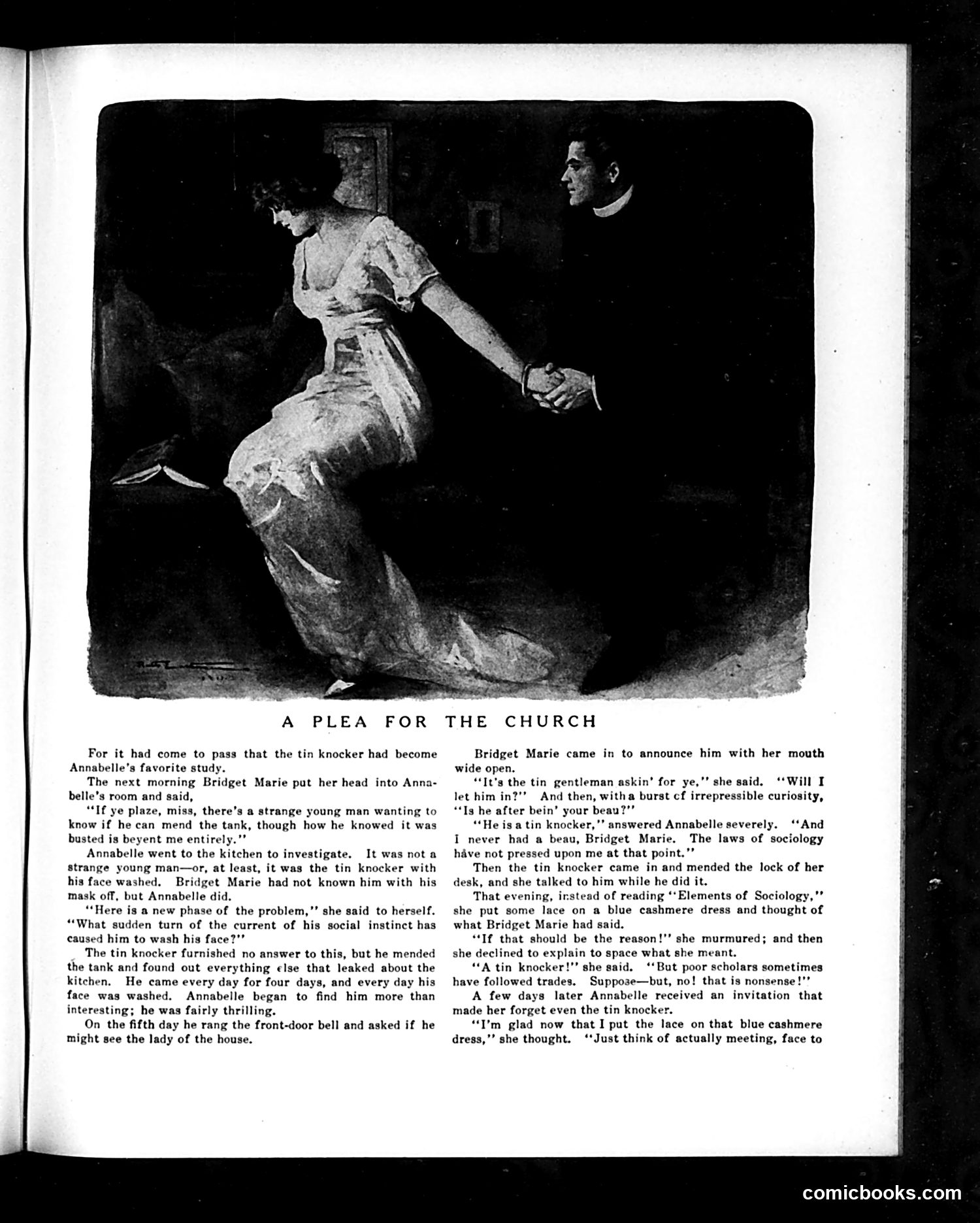
This satirical story mocks the pretensions of educated, intellectual women of the era. Annabelle, an upper-class woman absorbed in sociology texts, becomes infatuated with a working-class "tin knocker" (repairman). The humor lies in her rationalization: she tries to dignify the romance through sociology and scholarship, insisting she's never "had a beau" because "the laws of sociology have not pressed upon me." The satire's target is clear in the title—the story argues that intellectual women need "the Church" (traditional values and institutions) to guide them. Without religious moral authority, Annabelle falls for an unsuitable match, her learning providing no defense against romantic impulse. The Irish maid Bridget Marie represents common sense, while Annabelle's academic pretensions are exposed as mere cover for ordinary human desire. The joke: no amount of scholarly study can override nature and social class.
📄 Transcribed text from this page (OCR, searchable)
Machine-transcribed from the original scan — historical spelling and the odd misread are preserved.
A PLEA FOR THE CHURCH For it had come to pass that the tin knocker had become Annabelle’s favorite study The next morning Bridget Marie put her head into Anna- belle’s room and said, “If ye plaze, miss, there’s a strange young man wanting to know if he can mend the tank, though how he knowed it was busted is beyent me entirely.” Annabelle went to the kitchen to investigate. It was not a strange young man—or, at least, it was the tin knoc with his f: washed. Bridget Marie had not known him with hi mask off, but Annabelle did. ‘Here is a new phase of the problem,”’ she said to herself. What sudden turn of the current of his social instinct has caused him to wash his face?"’ The tin knocker furnished no answer to this, but he mended the tank and found out everything else that leaked about the kitchen. He came every day for four days, and every day his face was washed. Annabelle began to find him more than interesting; he was fairly thrilling. On the fifth day he rang the front-door bell and asked if he might see the lady of the house. Bridget Marie came in to announce him with her mouth wide open. “It's the tin gentleman askin’ for ye,’ she said. ‘Will I let him in?’’ And then, witha burst cf irrepressible curiosity, “Is he after bein’ your beau?”’ “‘He isa tin knocker,’’ answered Annabelle severely. ‘*And I never had a beau, Bridget Marie. The laws of sociology have not pressed upon me at that point.’” Then the tin knoe! came in and mended the lock of her desk, and she talked to him while he did it. That evening, instead of reading ‘‘Elements of Sociology she put some lace on a blue cashmere dress and thought of what Bridget Marie had said. “If that should be the reason!'’ she murmured; and then she declined to explain to space what she meant. “A tin knocker!’’ she said. But poor scholars sometimes have followed trades. Suppose—but, no nonsense !* A few days later Annabelle received an invitation that made her forget even the tin knocker. I’m glad now that I put the lace on that blue cashmere ’she thought. ‘‘Just think of actually meeting, face to comicbooks.com