
Judge, 1913-04-05 · page 22 of 24
Judge — April 5, 1913 — page 22: what you’re looking at
What you’re looking at
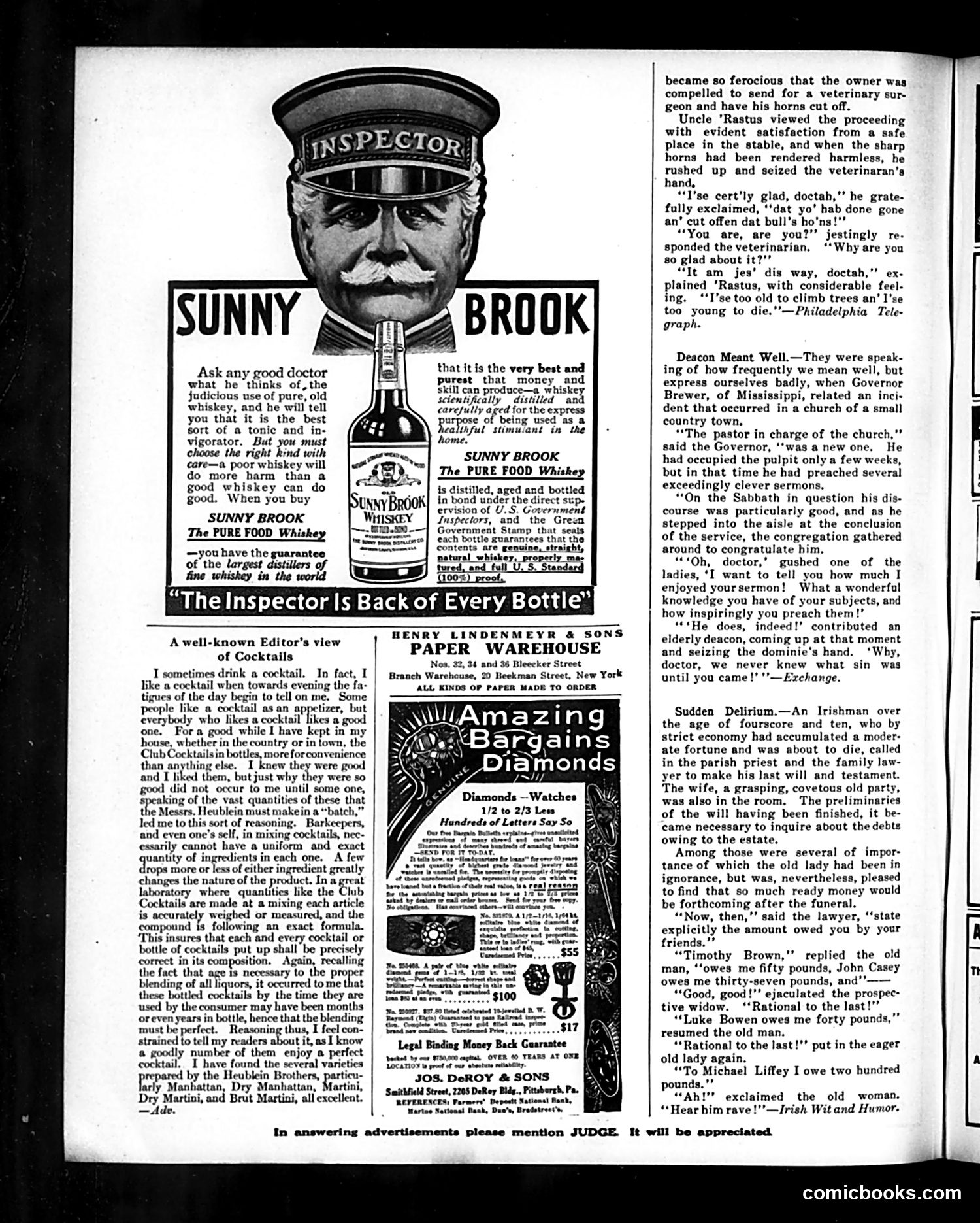
This page is primarily **advertising** rather than editorial content or political satire. The dominant feature is a large advertisement for Sunny Brook whiskey, fronted by an "Inspector" character assuring purity and government oversight under Pure Food standards. The page includes endorsements: an editor praising Heublein Brothers cocktails (pre-made, consistently blended), and testimonials for diamonds and watches sold "at less" cost. The only narrative humor appears in a brief story about "Uncle 'Rastus," a Black character using dialect, expressing gratitude to a veterinarian for removing a bull's horns. This reflects period stereotypes common in early-20th-century American publications. The whiskey advertisement emphasizes scientific distillation and government inspection—marketing appeals to consumers concerned about product safety following the Pure Food and Drug Act (1906). The page demonstrates how such regulations became selling points in advertising.
📄 Transcribed text from this page (OCR, searchable)
Machine-transcribed from the original scan — historical spelling and the odd misread are preserved.
Ask any good doctor what he thinks of, the judicious use of pure, old whiskey, and he will tell you that it is the best sort of a tonic and in- vigorator. But you must choose the right kind with care—a poor whiskey will do more harm than a good whiskey can do good. When you buy SUNNY BROOK The PURE FOOD Whiskey —you have the guarantee of the largest distillers of fine whiskey in the world that it is the very best and purest that money and skill can produce—a whiskey scientifically distilled and carefully aged {or the express urpose of being used as a Kealinyul stimucant in the home. SUNNY BROOK The PURE FOOD Whiskey is distilled, aged and bottled in bond under the direct sup- ervision of U. ernment Inspectors, and the Gresn amp that seals antes that the envine, straii natural whiskey, properly ma full U.S. Standard A well-known Editor’s view of Cocktails I sometimes drink a cocktail. In fact, I like a cocktail when towards evening the fa- tigues of the day begin to tell on me. Some | people like a cocktail as an appetizer, but everybody who likes a cocktail likes a good one. Fora good while I have kept in my house, whether in the country or in town, the Club Cocktails in bottles, more forconvenience than anything else. I knew they were good and I liked them, but just why they were so good did not occur to me until some one, speaking of the vast quantities of these that the Messrs. Heublein must makein a “batch,” led me to this sort of reasoning. Barkeepers, and even one’s self, in mixing cocktails, nec- essarily cannot have a uniform and exact antity of ingredients in each one. A few drops more or less of either ingredient greatly changes the nature of the product. In a great laboratory where quantities like the Club Cocktails are made at a mixing each article is accurately weighed or measured, and the compound {s following an exact formula. ‘This insures that each and every cocktail or bottle of cocktails put up shall be precisely correct in its composition. Again, recalling the fact that age is necessary to the proper blending of all liquors, it occurred to me that these bottled cocktails by the time they are used by the consumer may have been months oreven years in bottle, hence that the blending must be perfect. Reasoning thus, I feel con- strained to tell my readers about it, as I know ‘a goodly number of them enjoy a perfect cocktail. I have found the several varieties by the Heublein Brothers, particu- fanly Manhattan, Dry Manhattan, Martini, Dry Martini, and Brut Martini, all excellent. —Ade. HENRY LINDENMEYR & SONS PAPER WAREHOUSE Nos, 32, 34 and 36 Bleecker Street Branch Warehouse, 20 Beekman Street, New York PAPER MADE TO ORDER WAmMazing Bargains tamonds Diamonds —-Watches 1/2 to 2/3 Less Handreds of Letters Say So achat by our #75000 capital OVER 40 TEARS AT ONE LOCATION la proof of our shestate reat. JOS. DeROY & SONS ‘Smithfield Street, 2205 DeRoy Bidg., Pittsbereh, Pa. REFERENCES: Farmers’ Depestt Nations! Banh, Maries Netlonal Rank, Dan's, Bredatreet’s, became so ferocious that the owner was compelled to send for a veterinary sur- geon and have his horns cut off. Uncle ’Rastus viewed the proceeding with evident satisfaction from a safe place in the stable, and when the sharp horns had been rendered harmless, he rushed up and seized the veterinaran’s hand, “I'se cert’ly glad, doctah,’’ he grate- fully exclaimed, ‘‘dat yo’ hab done gone an’ cut offen dat bull's ho’ “You are, are you?’ jestingly re- sponded the veterinarian. ‘*Why are you 8o glad about it?’’ “It am jes’ dis way, doctah,”’ ex- plained ‘Rastus, with considerable feel- ing. ‘‘I’se too old to climb trees an’ I'se too young to die."’—Philadelphia Tele- graph. Deacon Meant Well.—They were speak- ing of how frequently we mean well, but express ourselves badly, when Governor Brewer, of Mississippi, related an inci- dent that occurred in a church of a small country town. “The pastor in charge of the church,"” said the Governor, ‘‘was a new one. He had occupied the pulpit only a few weeks, but in that time he had preached several exceedingly clever sermons, “On the Sabbath in question his dis- course was particularly good, and as he stepped into the aisle at the conclusion of the service, the congregation gathered around to congratulate him. ““*Oh, doctor,’ gushed one of the ladies, ‘I want to tell you how much I enjoyed yoursermon! What a wonderful knowledge you have of your subjects, and how inspiringly you preach them!’ ““*He does, indeed!’ contributed an elderly deacon, coming up at that moment and seizing the dominie's hand. ‘Wh: doctor, we never knew what sin was until you came!’ '’—Exzchange. Sudden Delirium.—An Irishman over the age of fourscore and ten, who by strict economy had accumulated a moder- ate fortune and was about to die, called in the parish priest and the family law- yer to make his last will and testament. The wife, a grasping, covetous old part; was also in the room. The preliminaries of the will having been finished, it be- came necessary to inquire about the debts owing to the estate. Among those were several of impor- tance of which the old lady had been in ignorance, but was, nevertheless, pleased to find that so much ready money would be forthcoming after the funeral. “Now, then,”’ said the lawyer, ‘‘state explicitly the amount owed you by your friends.”’ “Timothy Brown,’’ replied the old man, ‘‘owes me fifty pounds, John Casey owes me thirty-seven pounds, and’’—— “Good, good!’’ ejaculated the prospec- tive widow. ‘Rational to the last!’’ “Luke Bowen owes me forty pounds,"” resumed the old man. ‘*Rational to the last!” put in the eager old lady again. “To Michael Liffey I owe two hundred pounds.’” “Ah!’? exclaimed the old woman. “Hear him rave !""—Irish Wit and Humor. In answering advertisements please mention JUDGE. It will be appreciated. comicbooks.com