
Judge, 1913-04-05 · page 8 of 24
Judge — April 5, 1913 — page 8: what you’re looking at
What you’re looking at
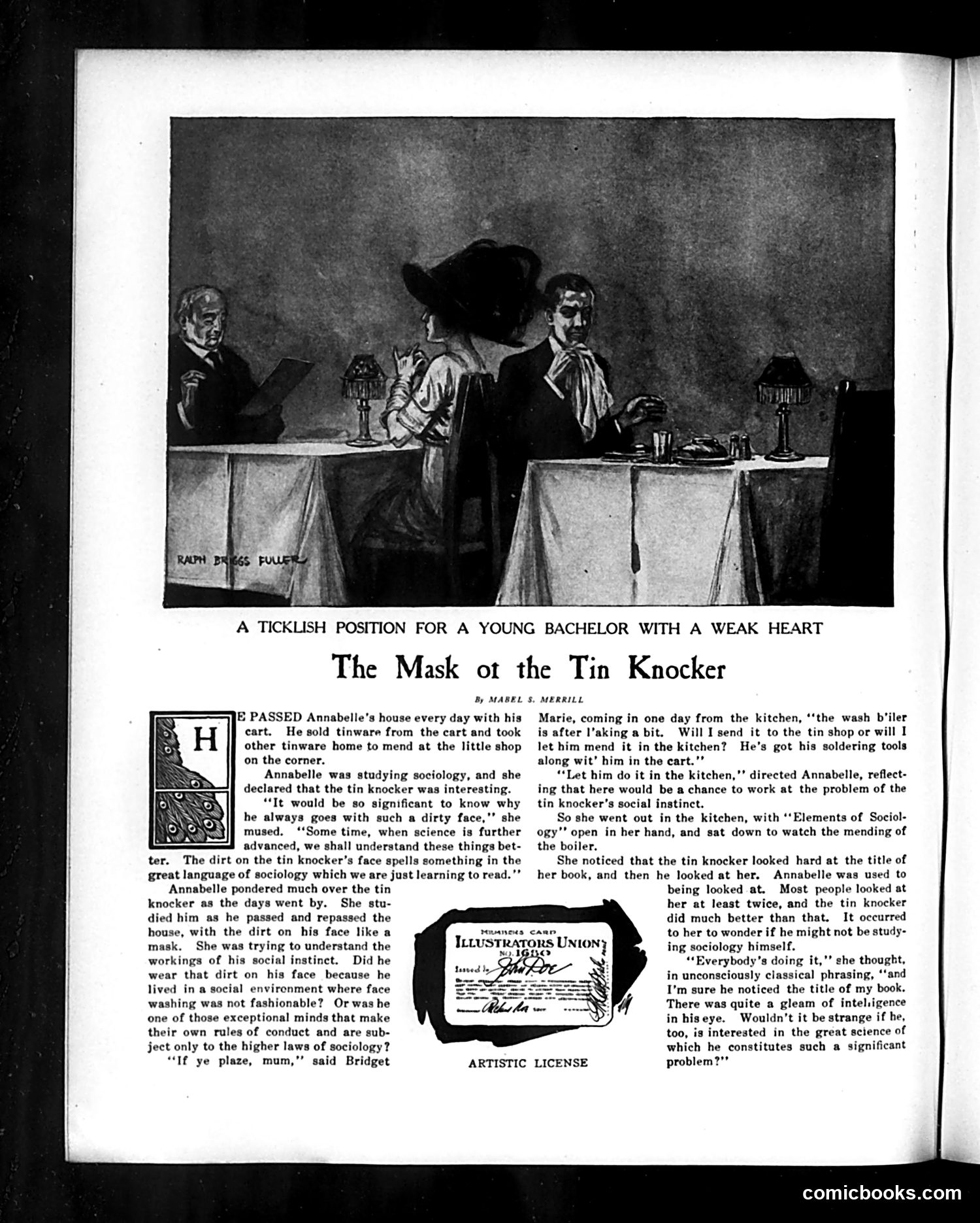
This satirical story mocks the early-20th-century intellectual fad of sociology. Annabelle, a fashionable young woman, becomes fascinated by the *idea* of understanding a working-class tin knocker's social behavior through sociological analysis. She theorizes his dirt-covered face reflects his "social environment" rather than simple lack of hygiene—applying pseudo-scientific jargon to avoid common sense. When she invites him to repair her boiler in the kitchen (to "study" him), she misinterprets his glance at her sociology textbook as intellectual interest, imagining he shares her academic pursuits. The satire ridicules how the newly-fashionable discipline of sociology was used by upper-class people to romanticize or intellectualize away the obvious realities of working-class life—turning a laborer's dirty face into a sociological "problem" worthy of scholarly consideration.
📄 Transcribed text from this page (OCR, searchable)
Machine-transcribed from the original scan — historical spelling and the odd misread are preserved.
A TICKLISH POSITION FOR A YOUNG BACHELOR WITH A WEAK HEART The Mask ot the Tin Knocker By MABEL S$. MERRILL IE PASSED Annabelle’s house every day with his cart. He sold tinware from the cart and took other tinware home to mend at the little shop on the corner. Annabelle was studying sociology, and she declared that the tin knocker was interesting. “It would be so significant to know why he always goes with such a dirty face,'’ she mused. ‘‘Some time, when science is further advanced, we shall understand these things bet- ter. The dirt on the tin knocker’s face spells something in the great language of sociology which we are just learning to read.”” Annabelle pondered much over the tin knocker as the days went by. She stu- died him as he passed and repassed the house, with the dirt on his face like a mask. She was trying to understand the workings of his social instinct. Did he wear that dirt on his face because he lived in a social environment where face washing was not fashionable? Or was he one of those exceptional minds that make their own rules of conduct and are sub- ject only to the higher laws of sociology? “If ye plaze, mum," said Bridget Pouanets CARD ARTISTIC LICENSE Marie, coming in one day from the kitchen, ‘‘the wash b’iler is after Il’aking a bit. Will I send it to the tin shop or will I let him mend it in the kitchen? He's got his soldering tools along wit’ him in the cart.’’ ‘Let him do it in the kitchen,’’ directed Annabelle, reflect- ing that here would be a chance to work at the problem of the tin knocker’s social instinct. So she went out in the kitchen, with ‘‘Elements of Sociol- ogy’’ open in her hand, and sat down to watch the mending of the boiler. She noticed that the tin knocker looked hard at the title of her book, and then he looked at her. Annabelle was used to being looked at. Most people looked at her at least twice, and the tin knocker did much better than that. It occurred to her to wonder if he might not be study- ing sociology himself. “‘Everybody’s doing it,’’ she thought, in unconsciously classical phrasing, ‘and I'm sure he noticed the title of my book. There was quite a gleam of intelsigence in hiseye. Wouldn’t it be strange if he, too, is interested in the great science of which he constitutes such a significant problem?” comicbooks.com