
Judge, 1913-04-05 · page 14 of 24
Judge — April 5, 1913 — page 14: what you’re looking at
What you’re looking at
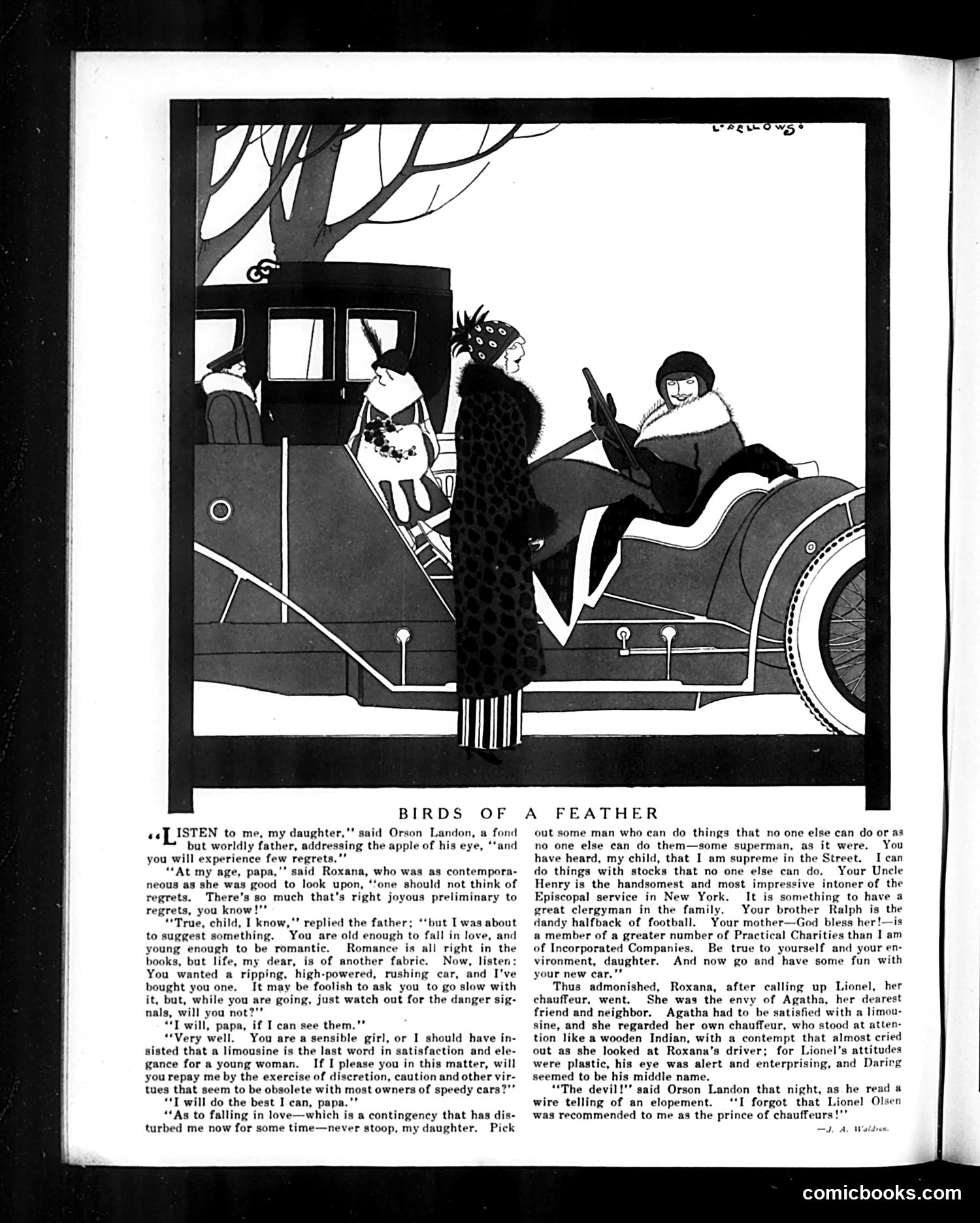
This is a satirical story-illustration about class and courtship in the Jazz Age. Orson Landon, a wealthy financier ("supreme in the Street"), lectures his daughter Roxana on choosing a suitable romantic partner—advising her to marry a man of exceptional accomplishment, like himself or her uncle the prominent clergyman. The irony: Roxana takes his advice literally but misapplies it. She falls for Lionel, the chauffeur, who possesses the one exceptional quality her father overlooked—the ability to drive dangerously well. The "danger signals" her father warned about prove prophetic: Lionel elopes with her. The satire mocks both parental hypocrisy (Landon's self-satisfied materialism) and the unpredictability of romance among the wealthy. The title suggests Roxana and Lionel are "birds of a feather"—equally reckless and suited to each other.
📄 Transcribed text from this page (OCR, searchable)
Machine-transcribed from the original scan — historical spelling and the odd misread are preserved.
BIRDS OF A FEATHER ISTEN to me, my daughter,”’ said Orson Landon, a fond but worldly father, addressing the apple of his eye, ‘and you will experience few regrets."’ “‘At my age, papa,'’ said Roxana, who was as contempora- neous as she was good to look upon, ‘tone should not think of regrets. There’s so much that's right joyous preliminary to regrets, you know!"" “True, child, I know,"’ replied the father; ‘‘but I was about to suggest something. You are old enough to fall in love, and young enough to be romantic. Romance is all right in the books, but life, my dear, is of another fabric. Now, listen: You wanted a ripping, high-powered, rushing car, and I've bought you one. It may be foolish to ask you to go slow with it, but, while you are going, just watch out for the danger sig- , will you not?”? ‘I will, papa, if I can see them.’” “Very well. You are a sensible girl, or I should have in- sisted that a limousine is the last word in satisfaction and ele- gance for a young woman. If I please you in this matter, will you repay me by the exercise of discretion, caution and other vir. tues that seem to be obsolete with most owners of speedy cars?’ “T will do the best I can, papa.’’ “As to falling in love—which is a contingency that has dis- turbed me now for some time—never stoop, my daughter. Pick out some man who can do things that no one else can do or as no one else can do them—some superman, as it were. You have heard, my child, that I am supreme in the Street. I can do things with stocks that no one else can do. Your Uncle Henry is the handsomest and most impressive intoner of the Episcopal service in New York. It is something to have a great clergyman in the family. Your brother Ralph is the dandy halfback of football. Your mother—God bless her!—is a member of a greater number of Practical Charities than I am of Incorporated Companies. Be true to yourself and your en- vironment, daughter. And now go and have some fun with your new car.’" Thus admonished, Roxana, after calling up Lionel, her chauffeur, went. She was the envy of Agatha, her dearest friend and neighbor. Agatha had to be satisfied with a limou- sine, and she regarded her own chauffeur, who stood at atten- tion like a wooden Indian, with a contempt that almost cried out as she looked at Roxana’s driver; for Lionel’s attitudes were plastic, his eye was alert and enterprising, and Daring seemed to be his middle name. “The devil!’’ said Orson Landon that night, as he read a wire telling of an elopement. ‘‘I forgot that Lionel Olsen was recommended to me as the prince of chauffeurs !"" J. AL Waldron comicbooks.com