
A complete issue · 28 pages · 1913
Judge — March 1, 1913
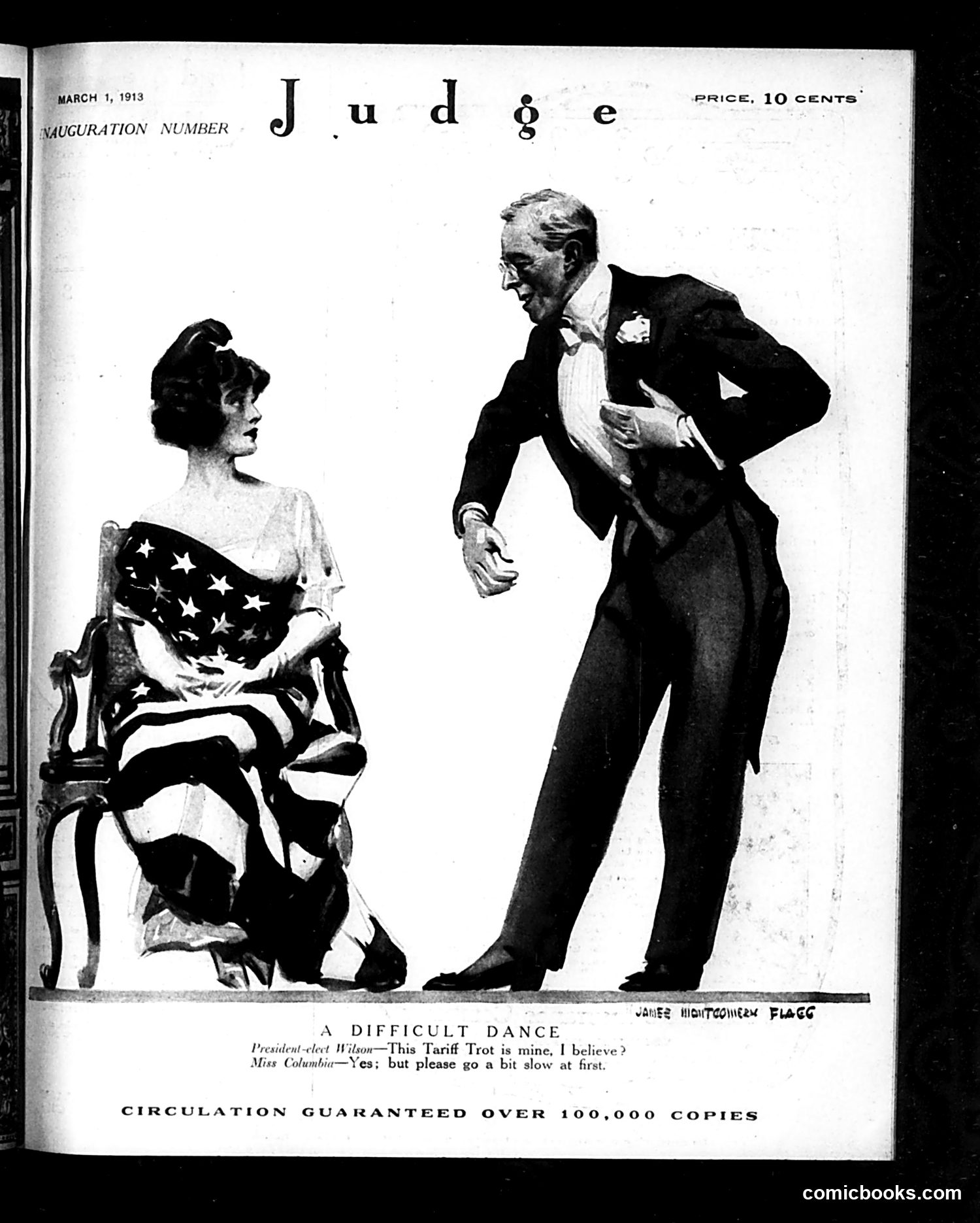
This is the inaugural issue of *Judge* magazine (March 1, 1913), featuring a political cartoon about President-elect Woodrow Wilson and "Miss Columbia" (the female personification of the United States). **The Satire:** Wilson, having just won the presidency, asks to lead the tariff dance—a reference to the central economic policy debate of the era. Columbia (representing America) agrees but cautions him to "go a bit slow at first." **The Context:** The cartoon satirizes Wilson's ambitious tariff reform agenda, which he would soon pursue through the Underwood Tariff. Columbia's hesitation reflects public anxiety about radical economic change. The "difficult dance" metaphor suggests Wilson must carefully navigate this contentious political issue without destabilizing the economy.
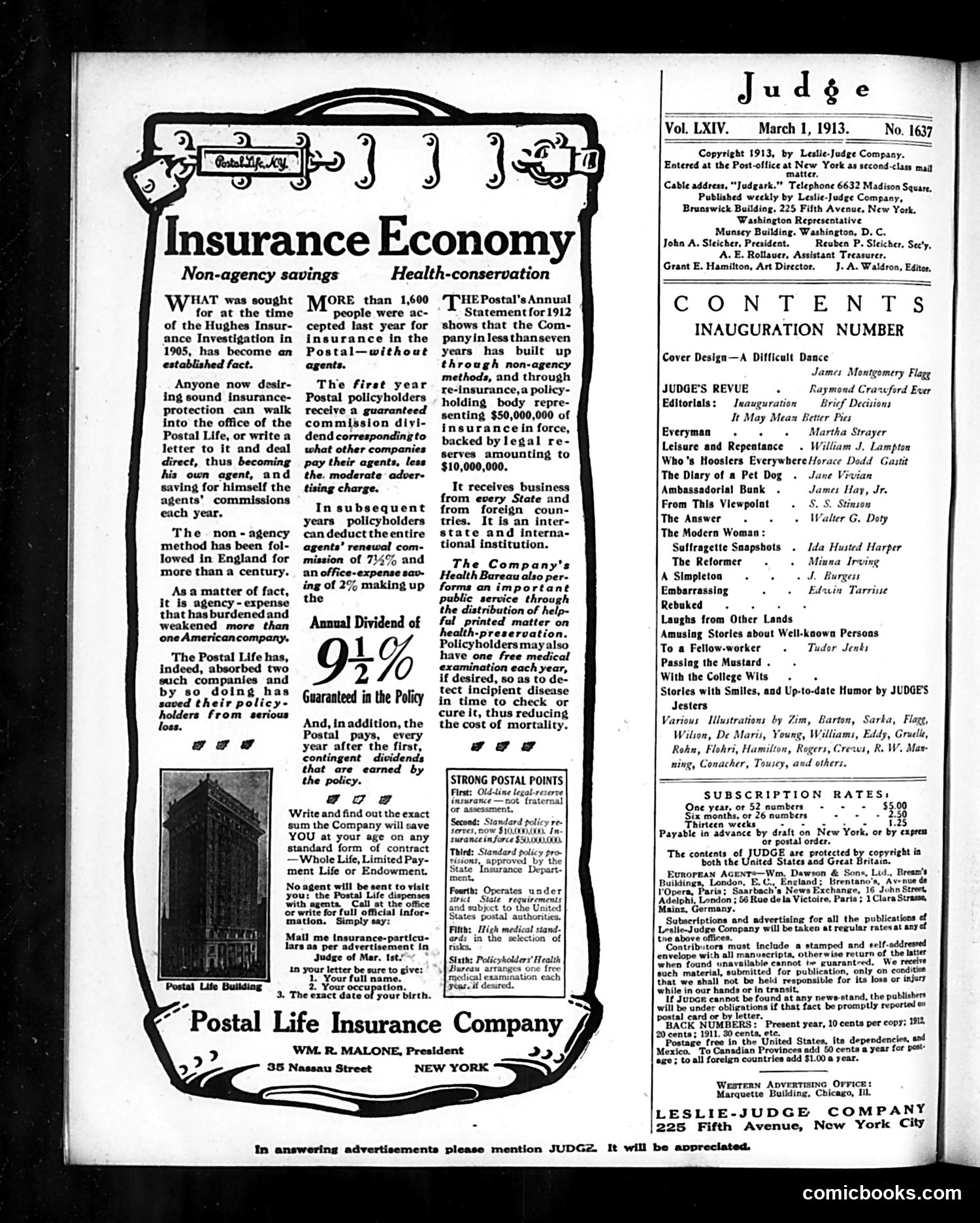
This page is **primarily advertising**, not political satire. The dominant content features two insurance company advertisements: 1. **"Insurance Economy"** (top left) - promoting Postal Life Insurance's non-agency savings model, highlighting an annual dividend of 9½%. 2. **"Postal Life Insurance Company"** (bottom) - a larger ad with the Postal Life Building image, emphasizing the company's stability and offering. The right side contains Judge magazine's table of contents for this March 1, 1913 inauguration issue, listing various humorous articles and satirical pieces. **No political cartoons or caricatures appear on this page.** While Judge was known for political satire, this particular page serves mainly to showcase insurance industry advertisements targeting readers with information about policy benefits and financial security—typical commercial content for the era's magazines.
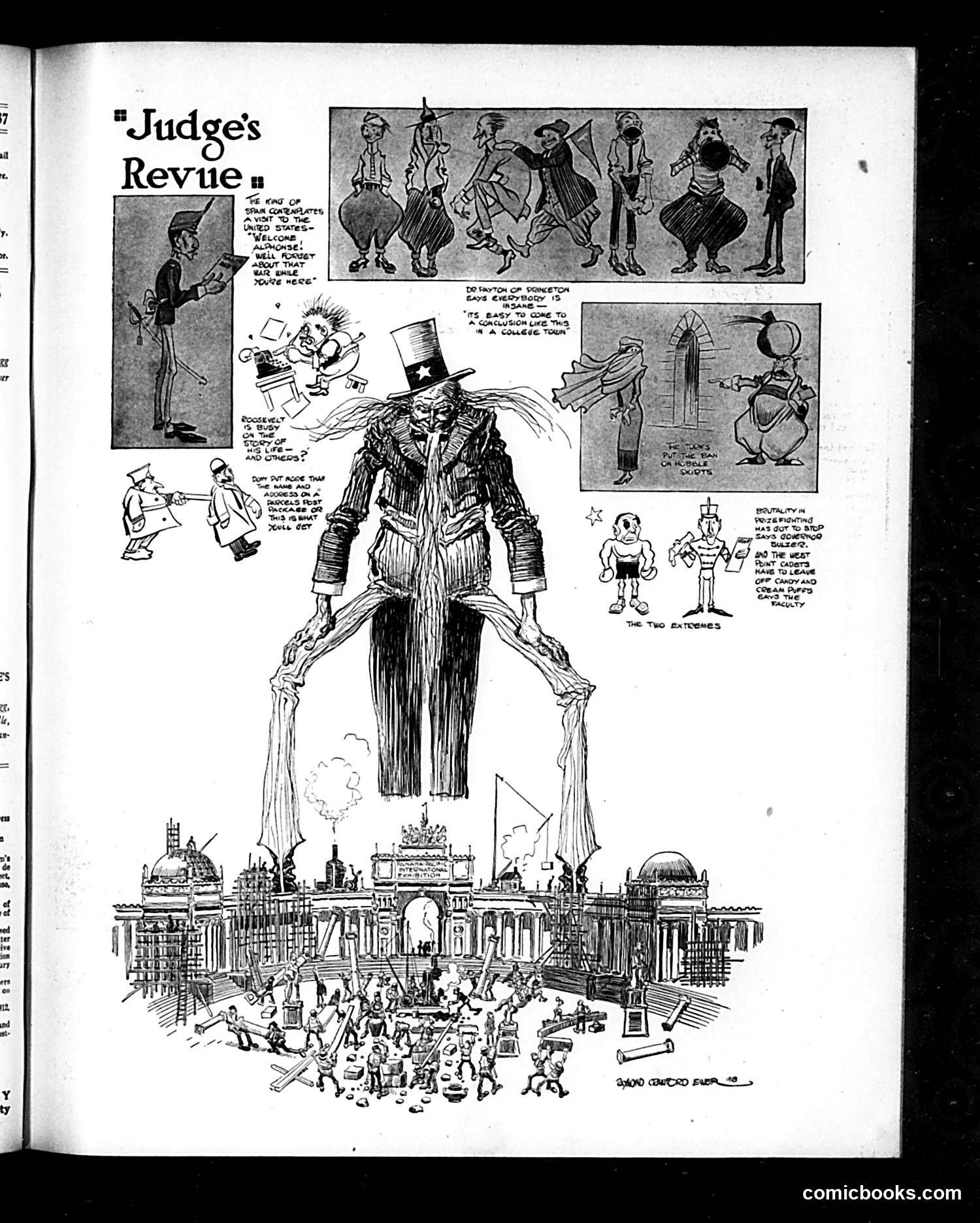
This satirical page depicts a towering skeletal figure in top hat and coat looming over what appears to be a government building (likely the Capitol), representing a political menace or threat to American democracy. The skeletal imagery suggests death or destruction. The surrounding vignettes mock various political figures and situations—including caricatured politicians in the upper panel and what appear to be commentary on political corruption or misconduct. Without clearer text or date information, I cannot definitively identify the specific figure or event referenced. However, the overall composition suggests criticism of a powerful political force threatening democratic institutions. The style indicates this is early-to-mid 20th century American political satire, but the exact target remains unclear from the image alone.
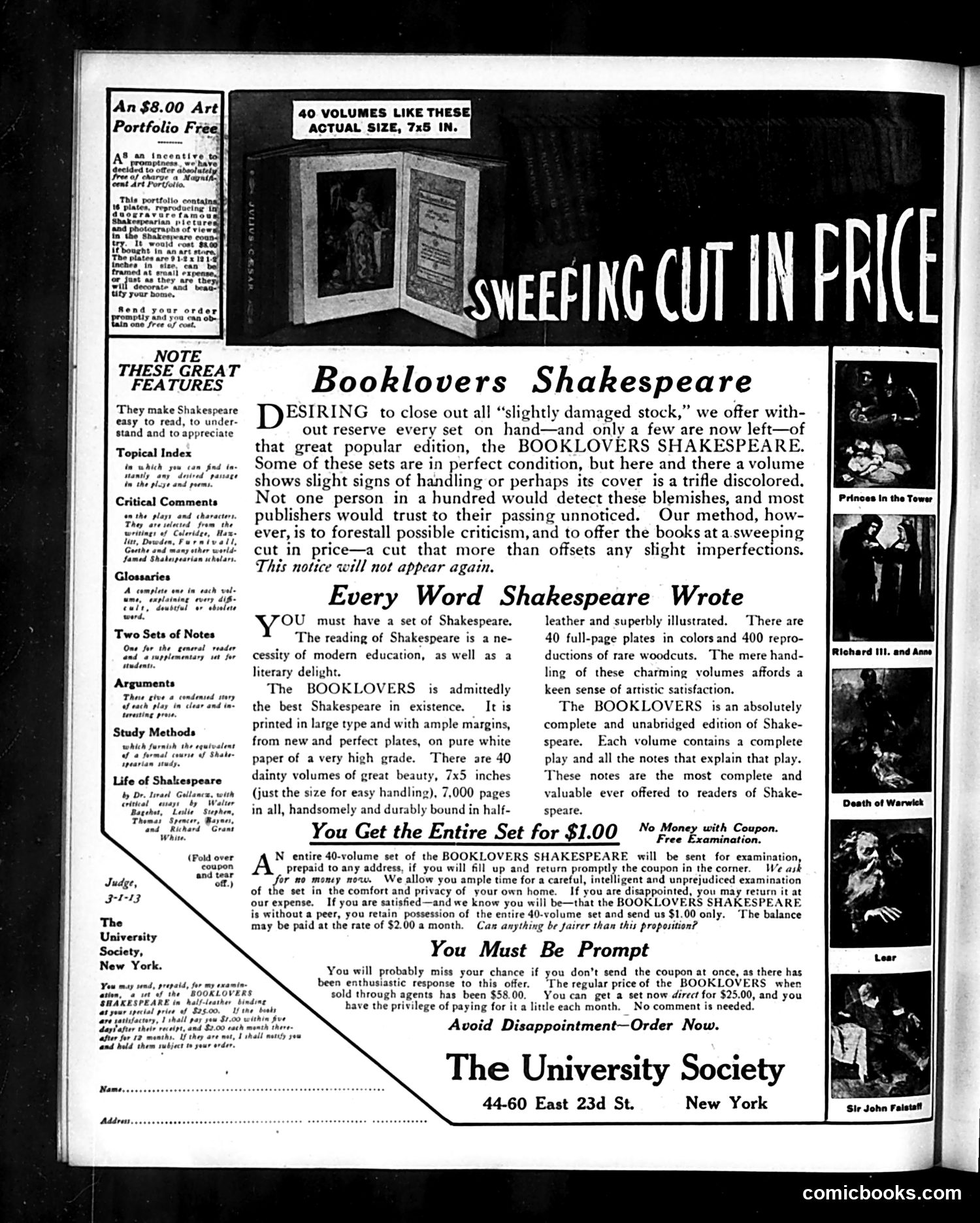
This page is primarily **advertising, not satire or political commentary**. The bulk consists of a full-page advertisement for the "Booklovers Shakespeare" edition—a 40-volume set of Shakespeare's complete works selling for $1.00 with a coupon (regular price $58). The right side includes **theatrical scene illustrations** labeled with Shakespeare play titles: "Princess in the Tower," "Richard III and Anne," "Death of Warwick," "Lear," and "Sir John Falstaff." These are promotional images showing dramatic moments from the plays, designed to entice buyers. The left sidebar contains study aids (topical index, character glossary, notes) to highlight the edition's educational value. There is **no political cartoon or satire** on this page—it's a straightforward (if aggressive) sales pitch from The University Society publisher in New York.
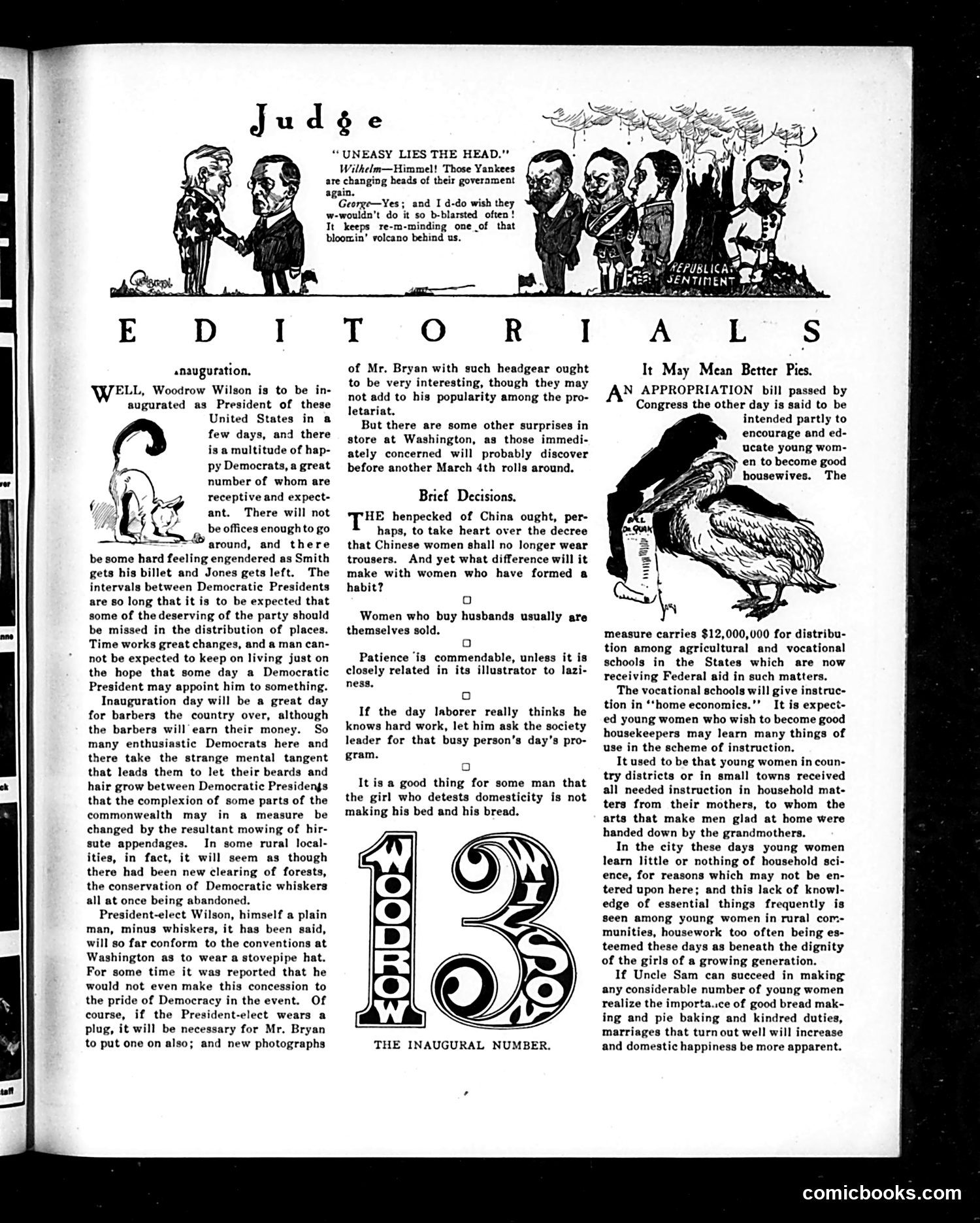
This is the inaugural issue (number 139) of Judge magazine, featuring political satire about Woodrow Wilson's presidential inauguration. The top cartoon shows Wilson (left) conversing with another figure, with the caption "UNEASY LIES THE HEAD," referencing Shakespeare—suggesting Wilson's anxiety about governing amid political turbulence. The accompanying editorial celebrates Wilson's inauguration while satirizing Democratic optimism. It humorously notes that Democratic barbers will profit from shaving beards between Democratic presidents, and jokes about Wilson possibly needing to wear a stovepipe hat at conventions, mocking political pretension. The "It May Mean Better Pies" section ironically endorses a Congressional bill promoting domestic education for young women, sarcastically suggesting homemaking instruction will increase marriages and domestic happiness—reflecting contemporary gender attitudes about women's proper roles.
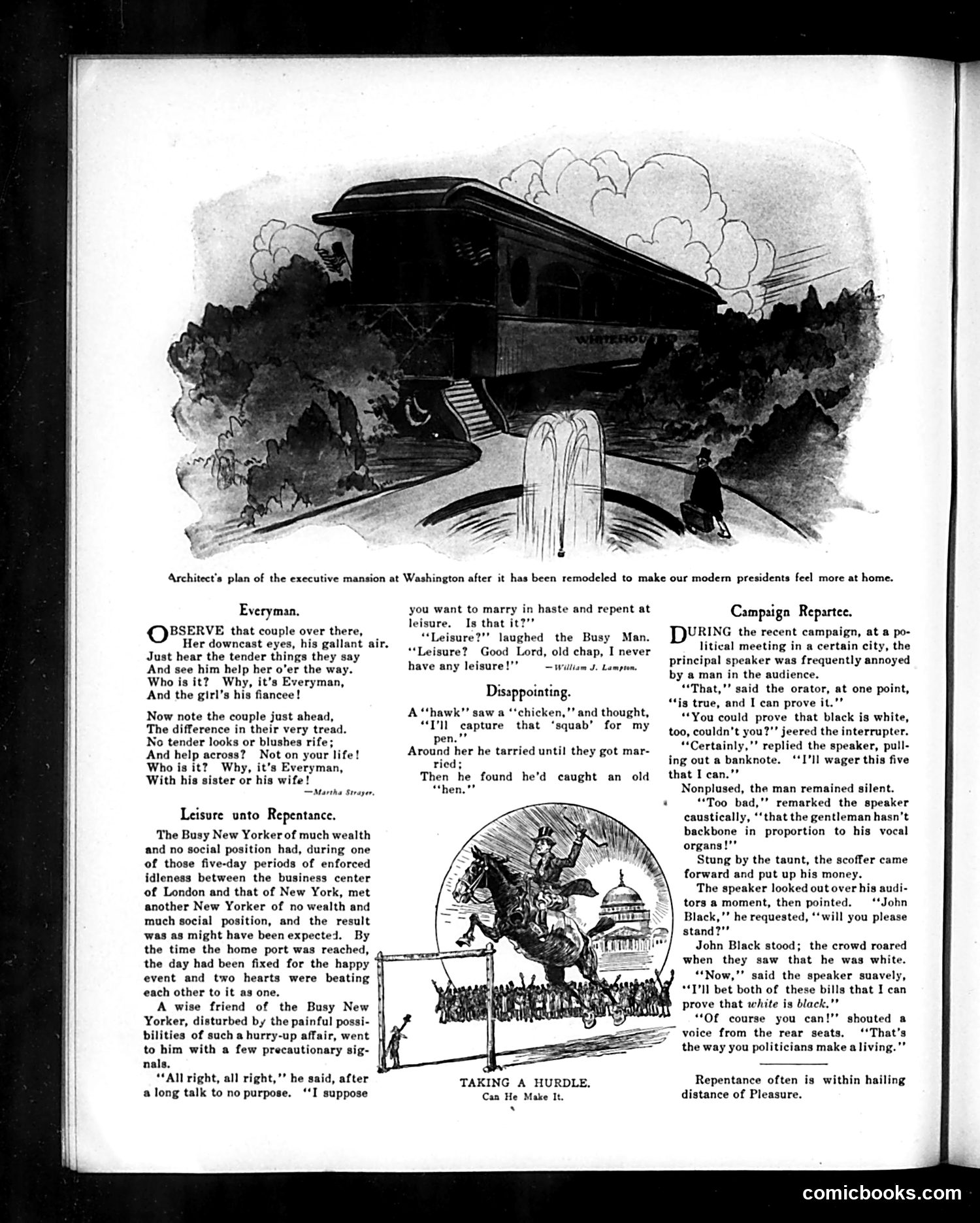
This page contains three satirical pieces typical of early 20th-century American humor: **Top cartoon:** Mocks the White House as needing remodeling to make modern presidents "feel more at home"—likely satirizing either presidential extravagance or discomfort with official duties. **"Everyman":** Contrasts courtship behavior with married life. An engaged couple displays public affection and gallantry; the married couple (or siblings) show indifference and lack of tenderness. The joke targets the gap between romantic idealization and domestic reality. **"Campaign Repartee":** A political speaker outwits a heckler during a campaign event. When challenged to "prove black is white," the speaker calls forward a man named John Black who is white-skinned, creating wordplay. The final heckler's rejoinder—"That's the way you politicians make a living"—satirizes politicians as manipulative tricksters using semantic games rather than honest argument. All three pieces reflect Judge's satirical stance on American social conventions, marriage, and political dishonesty.
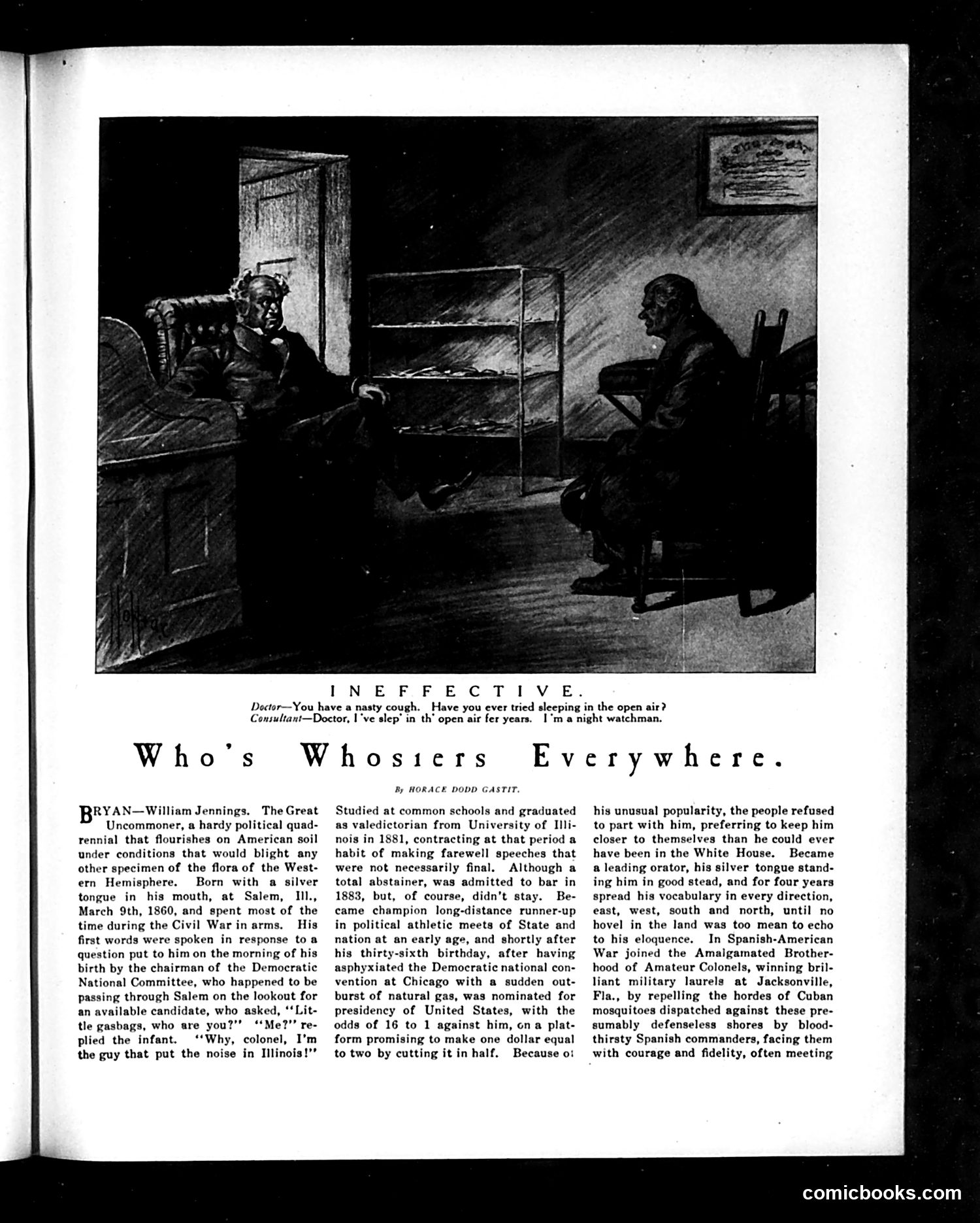
**The Main Cartoon:** A doctor consults with a patient about a persistent cough. The patient claims he's slept in the open air for years as a cure—implying fresh air is ineffective for his condition. **"Who's Whosiers Everywhere":** This is a satirical biographical entry mocking **William Jennings Bryan**, the Democratic politician and three-time presidential candidate. Judge ridicules him as: - A perpetual political candidate ("hardy political quadrennial") - An empty orator ("silver tongue," "natural gas") - A failed politician who repeatedly lost elections ("runner-up in political athletic meets") - A fool (his platform promised to make one dollar equal two by "cutting it in half") - Ineffectual in the Spanish-American War, claiming victory against mosquitoes rather than actual Spanish forces The satire suggests Bryan, like the patient's worthless open-air cure, is persistently ineffective despite his popularity and rhetoric. Judge presents him as all talk and no substance—a recurring nuisance in American politics.
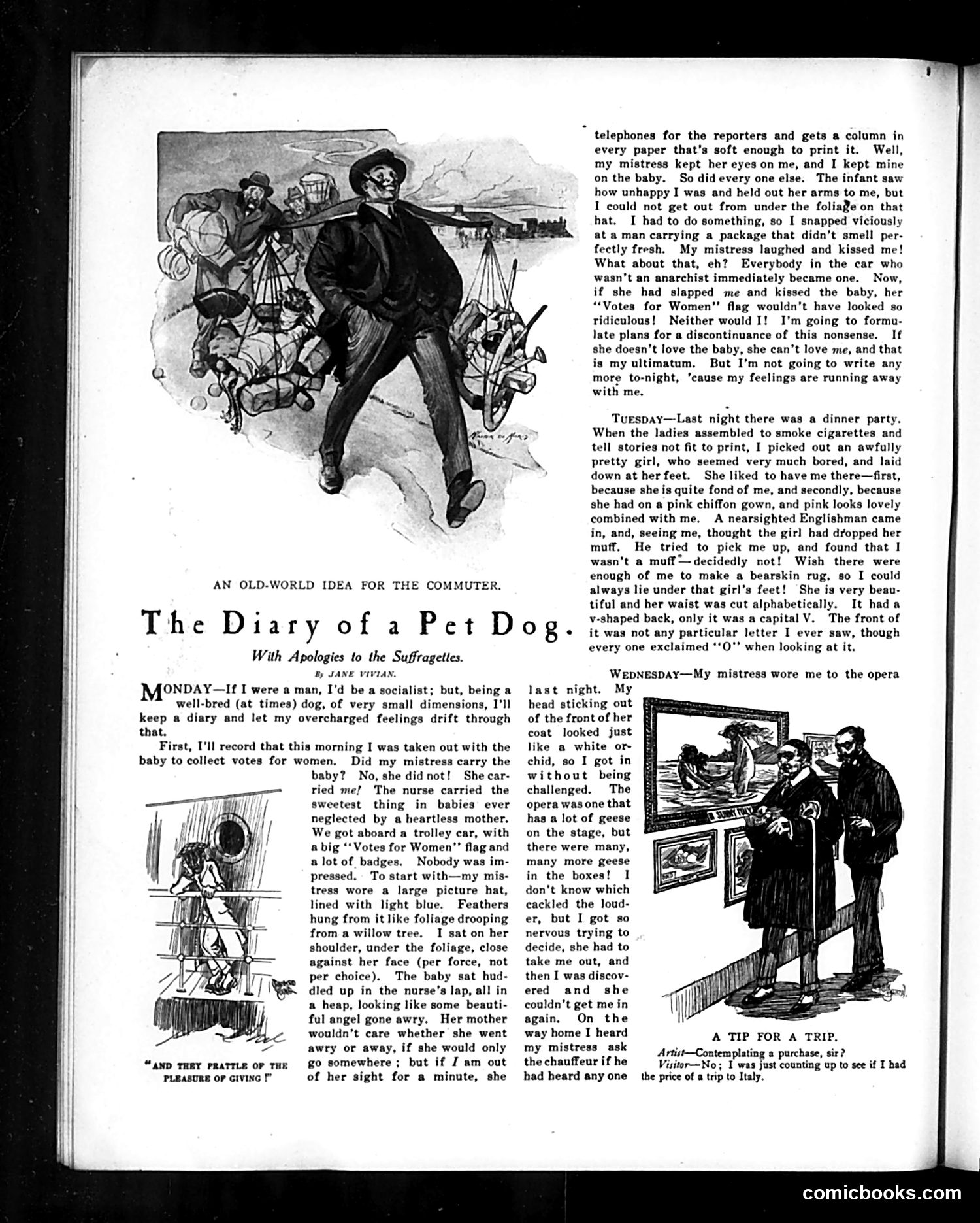
This is a satirical piece mocking the women's suffrage movement. A small dog narrates his diary entries about his mistress's activism for voting rights ("Votes for Women"). The satire works by inverting priorities: the dog observes that his mistress prioritizes her suffrage campaign over her own baby and pet. She carries the dog while neglecting the infant, and wears an elaborate "Votes for Women" hat so large it obscures her vision. The dog sardonically notes that when she shows him affection in public, onlookers become anarchists—suggesting the suffragettes are viewed as dangerous radicals. The title's phrase "With Apologies to the Suffragettes" is sarcastic mockery. The cartoon ridicules female activists as frivolous, self-absorbed, and neglectful of proper domestic duties, a common anti-suffrage argument of the era. The dog becomes the unlikely voice of reason, implying women neglect natural feminine roles when pursuing political power.
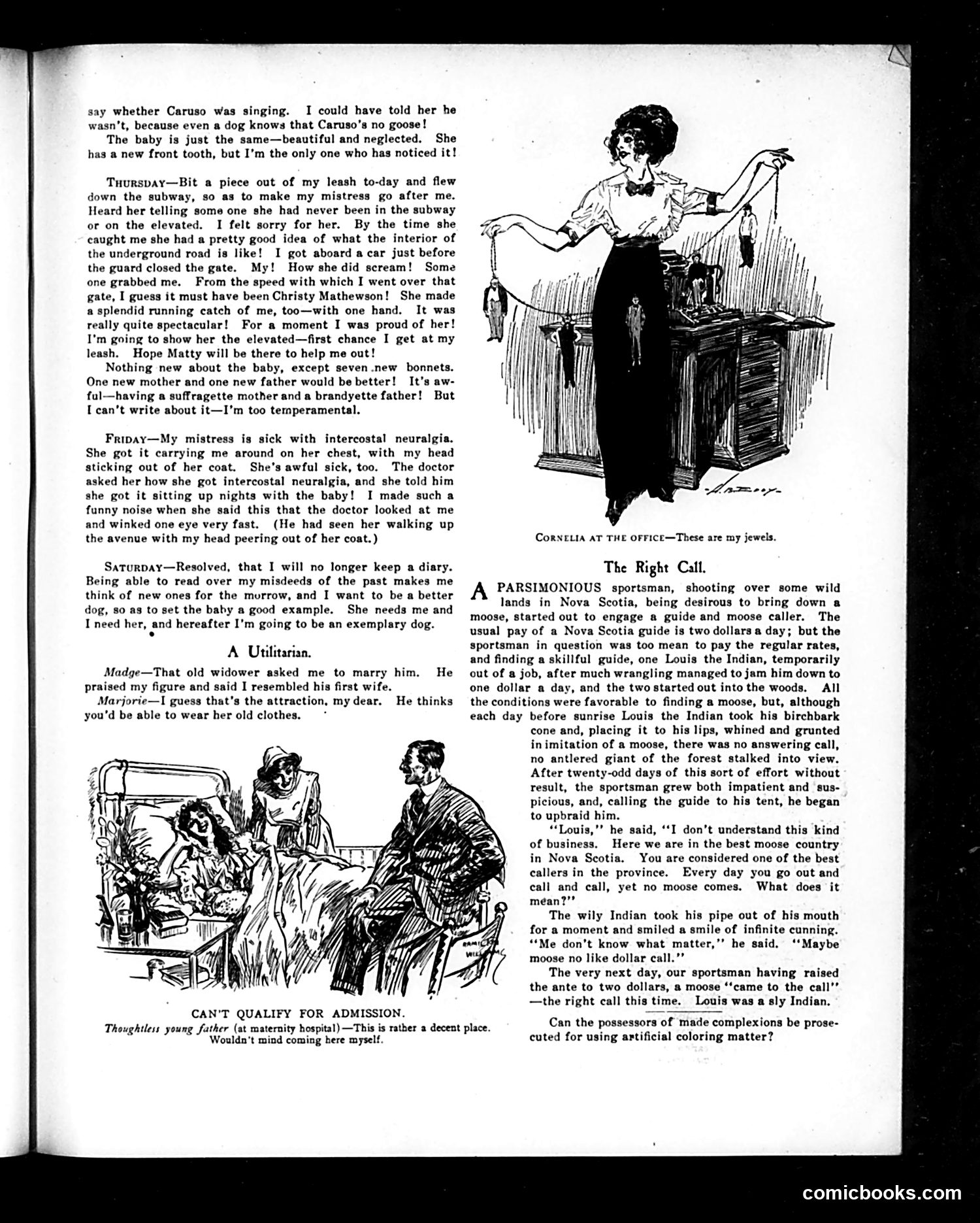
This page contains two distinct pieces of satire: **"Cornelia at the Office"** (illustrated): A woman at a desk displays her jewelry collection, captioned "These are my jewels." The satire mocks the "New Woman"—the emerging independent, working woman of the early 1900s. The joke plays on traditional gender roles: rather than a woman's "jewels" being her children (a common Victorian sentiment), this modern office worker proudly displays actual gems, suggesting she prioritizes wealth and career over motherhood. **"The Right Call"** (text story): A miserly sportsman hires "Louis the Indian," a Nova Scotia moose caller, for only one dollar a day (half the standard two-dollar rate). Despite Louis's skilled calls, no moose appear. The setup suggests the punchline will reveal the guide's justified revenge for being underpaid—likely by intentionally failing to bring the moose within range, or similar sabotage. The humor satirizes both cheap employers and working-class cunning. Both pieces reflect early-20th-century anxieties about gender roles and class relations.
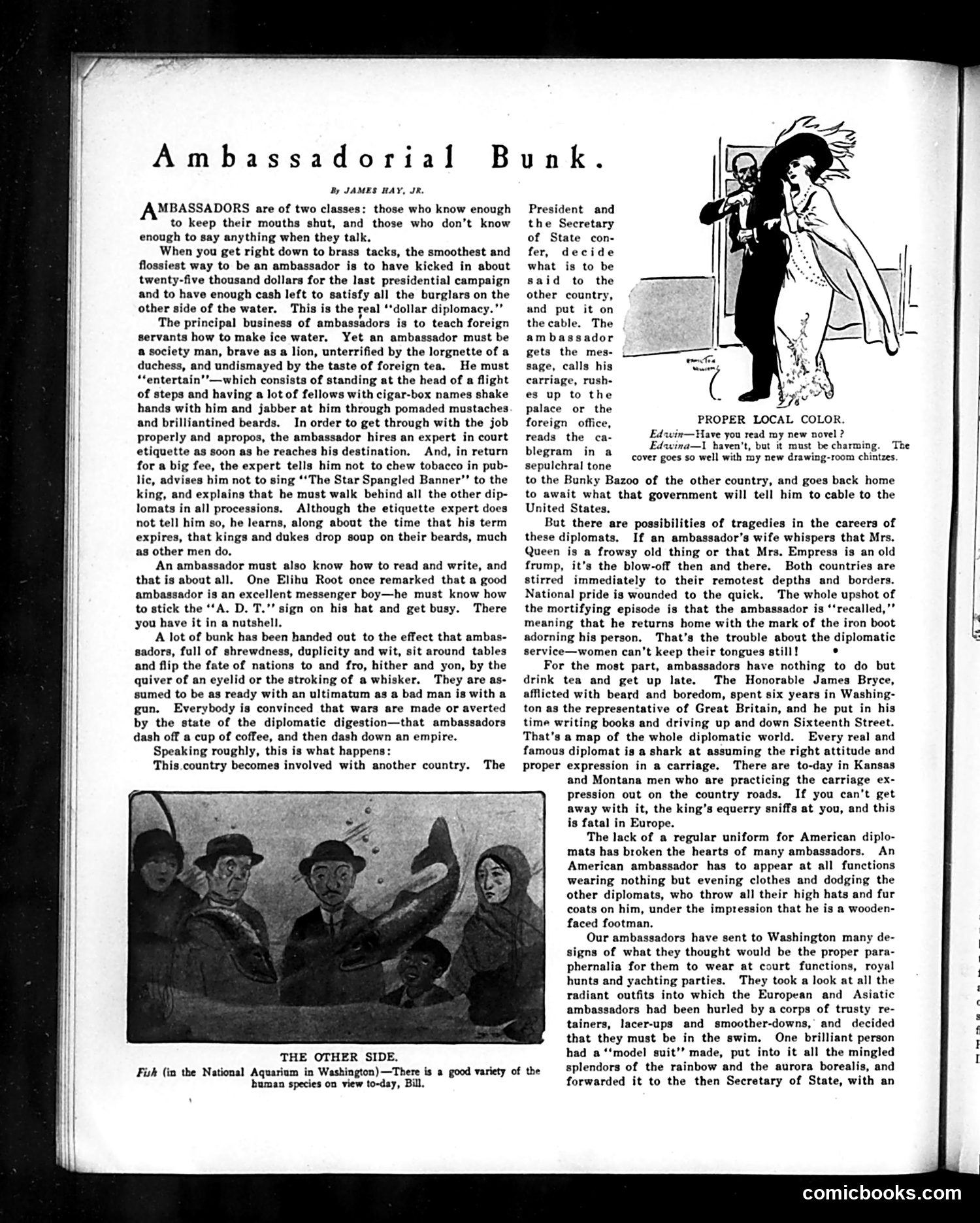
This satirical article by James Hay Jr. mocks American ambassadors as essentially useless political appointees. The author argues that ambassadorships are sinecures—positions given to wealthy donors who funded presidential campaigns ("dollar diplomacy"), not to qualified diplomats. The satire targets the pretense surrounding diplomatic work: ambassadors are portrayed as performing empty ceremonial duties while possessing no actual influence. Hay claims wars aren't decided by brilliant diplomatic maneuvering but rather by cable instructions from Washington that ambassadors robotically deliver. The accompanying cartoon ("The Other Side") shows fish in the National Aquarium labeled as representatives of "the human species," comparing diplomats to aquarium specimens—mocking them as curiosities rather than serious statesmen. The piece concludes by suggesting the real diplomatic danger comes from ambassadors' wives gossiping about foreign royalty, not from any substantive policy work, further ridiculing the entire apparatus as theatrical rather than meaningful.
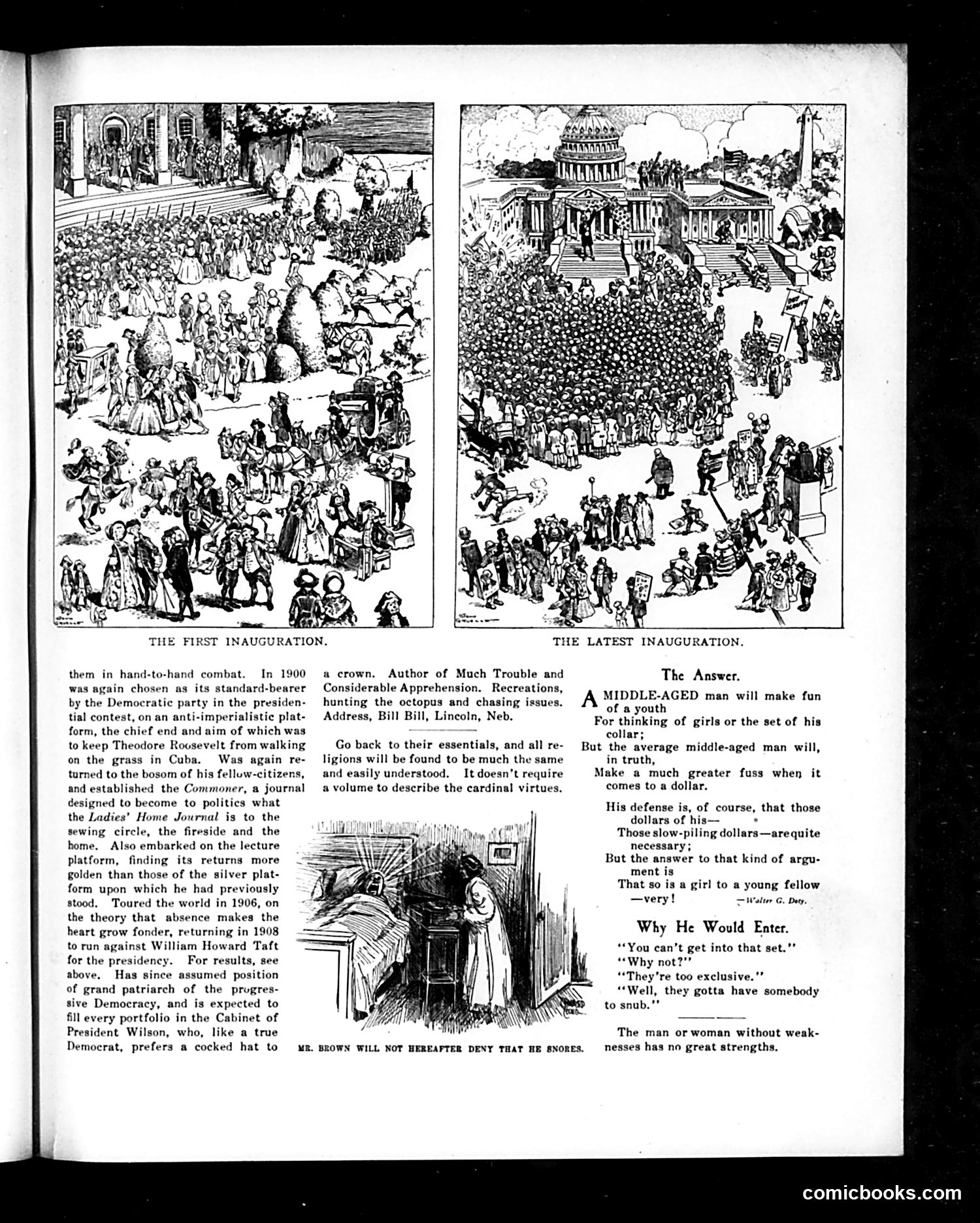
This page compares two presidential inaugurations through paired illustrations labeled "The First" and "The Latest." The text mocks **William Jennings Bryan**, the three-time Democratic presidential candidate (1896, 1900, 1908) who lost to William McKinley and William Howard Taft. Judge ridicules Bryan's career trajectory: his failed presidential runs, his lecture tours (more profitable than political work), his anti-imperialist platform, and his founding of *The Commoner* newspaper. The satire suggests Bryan has become a perpetual political figure expecting cabinet positions under President Wilson, despite his repeated electoral failures. The contrasting crowd scenes emphasize the difference between Bryan's actual political influence versus his outsized self-importance. The accompanying short humor pieces about vanity and weakness appear unrelated to the main political commentary.
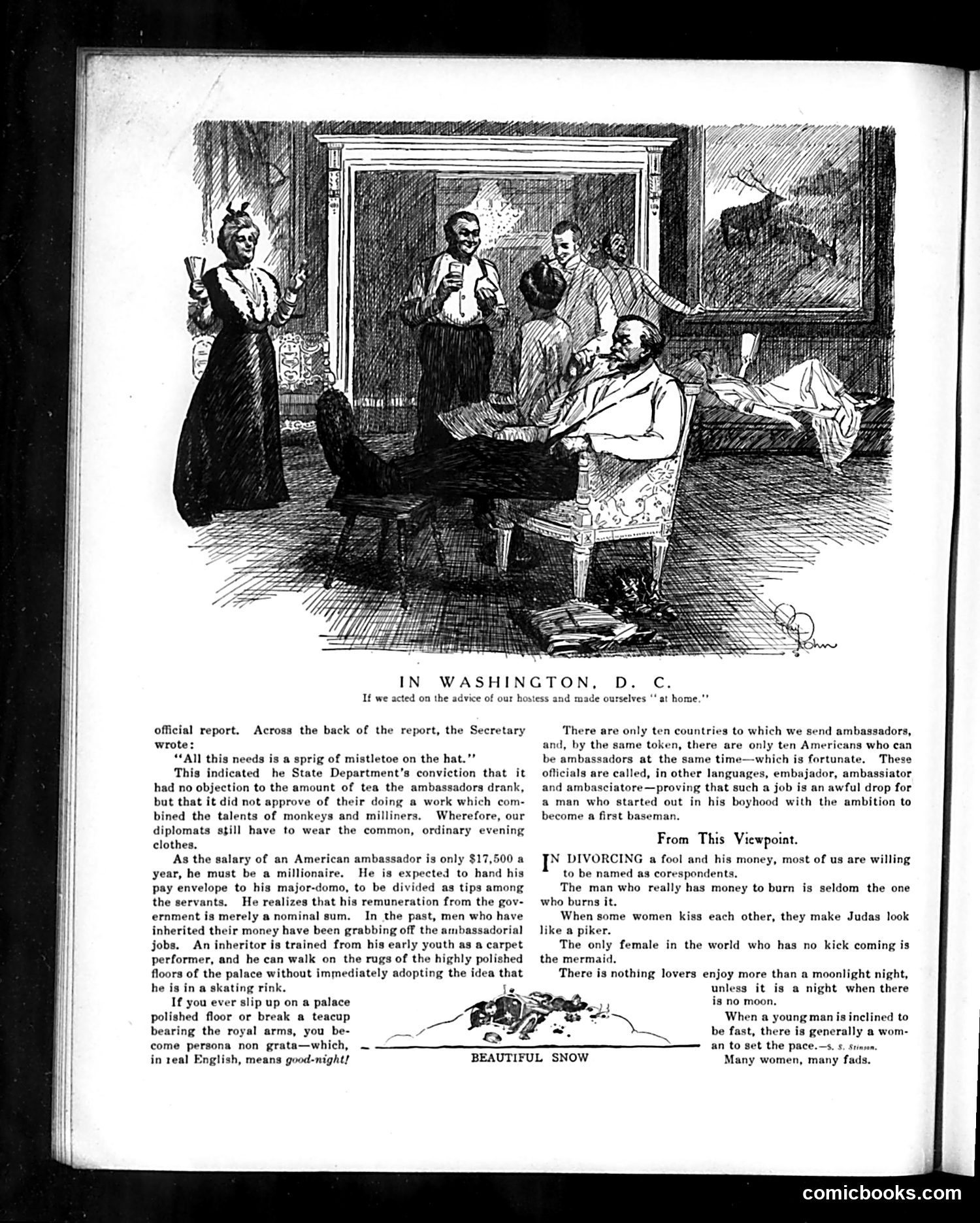
This **Judge** magazine piece satirizes the expense and pretension of American diplomatic life. The cartoon depicts a social gathering where diplomats entertain, illustrating the article's central complaint: ambassadors earn only $17,500 annually yet must maintain millionaire lifestyles to represent the nation abroad. The satire targets several absurdities: 1. **The mistletoe comment** — The State Department Secretary's sardonic remark about ambassadors behaving like "monkeys and milliners" (frivolous dressmakers) critiques their undignified conduct at official events. 2. **The salary paradox** — Ambassadors must be wealthy enough to finance their own diplomatic expenses, reducing their government salary to mere "tips for servants." 3. **Diplomatic vulnerability** — The piece mocks how fragile an ambassador's status is: breaking palace teacups makes one *persona non grata* (unwelcome), a humiliating fall from such an elevated position. The accompanying witticisms provide cynical social commentary on divorce, romance, and human nature, typical of Judge's satirical style.
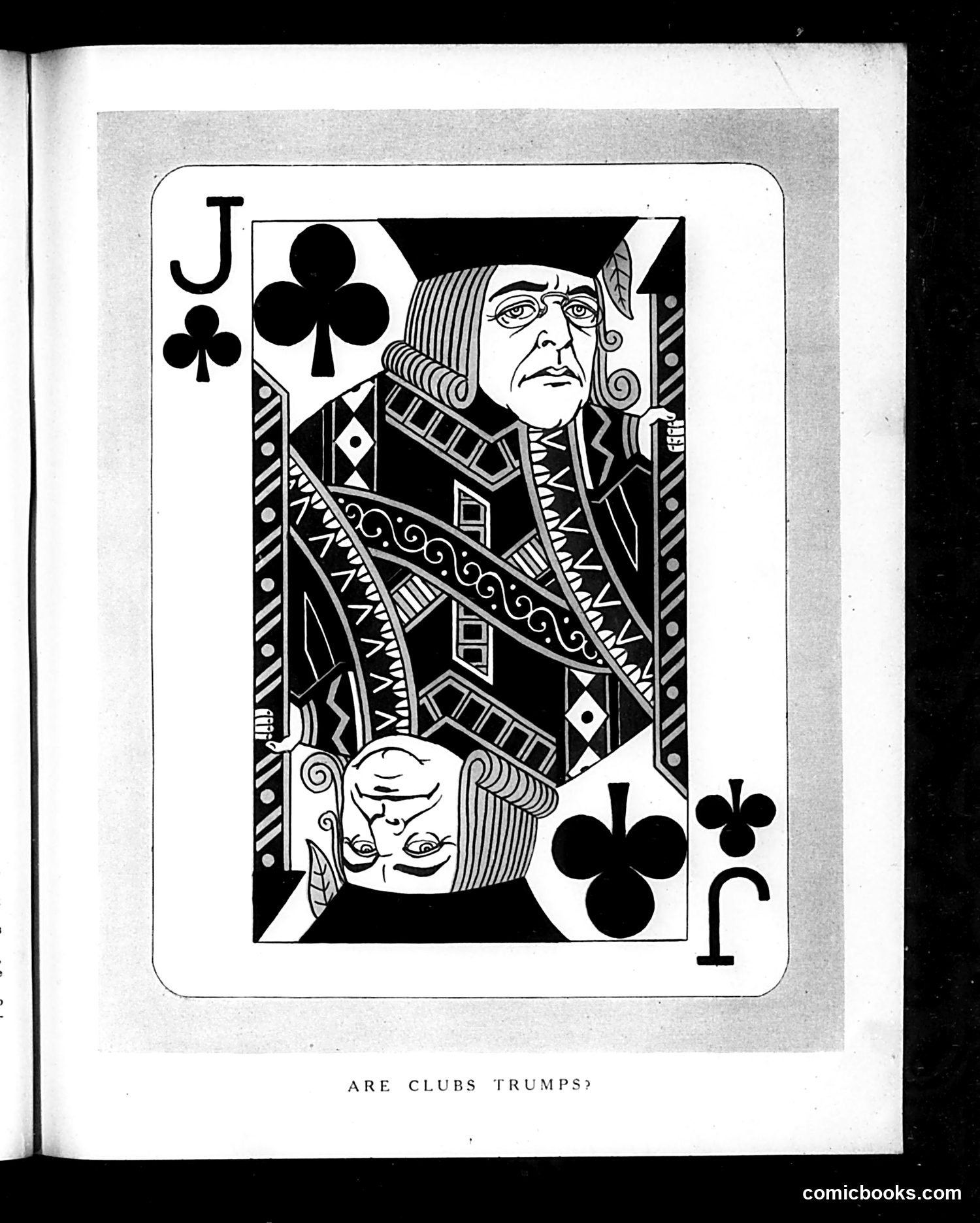
This page shows the Jack of Clubs playing card with an ornately dressed court figure. The caption "ARE CLUBS TRUMPS?" is a pun—a question about card games where "trumps" are the dominant suit. However, without clearer OCR text or additional context, the specific political/social reference remains unclear. The elaborate costume and somewhat grotesque facial features suggest this may be caricaturing a particular public figure or political faction from Judge's era (likely late 1800s-early 1900s), but I cannot confidently identify whom. The satire likely comments on power dynamics or political dominance—suggesting that a particular group or individual inappropriately claims authority (like declaring clubs the "trump" suit). More context would be needed for precise interpretation.
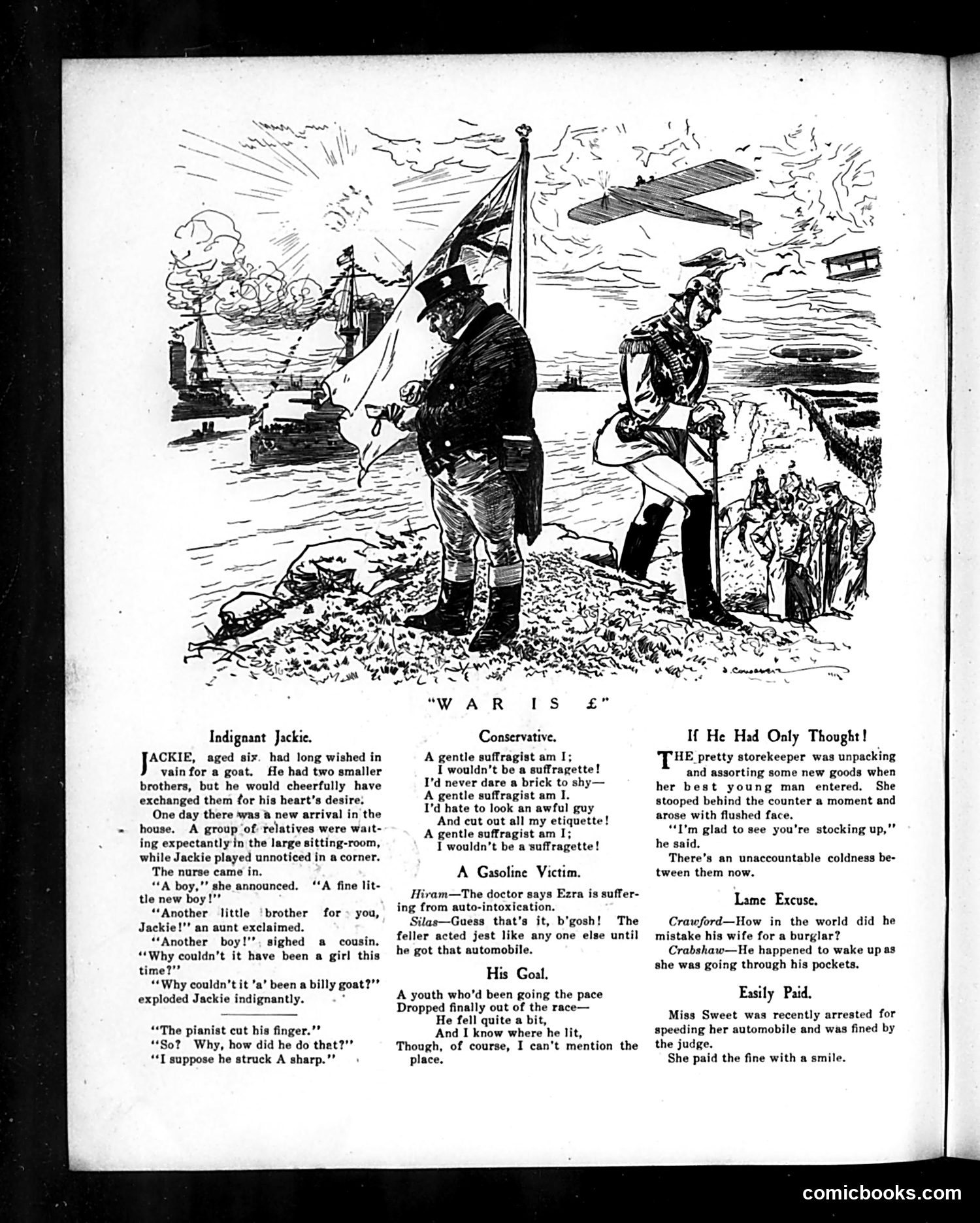
This Judge magazine page contains multiple unrelated comic vignettes satirizing early 20th-century social issues: **"Indignant Jackie"** depicts a six-year-old boy so disappointed at his third brother's birth that he wishes aloud for a billy goat instead—humor derived from children's brutal honesty about unwanted siblings. **"Conservative"** mocks mild-mannered suffragists who support women's voting rights but disavow the militant "suffragettes" (like British activists) who committed property damage and civil disobedience. The verse jokes that genteel supporters want equality without sacrificing etiquette. **Other items** include puns ("The pianist cut his finger"—music joke), automobile humor (newfangled cars causing intoxication-like behavior), and domestic comedy (a husband mistaking his wife for a burglar, implying she's violent with money). The overall tone reflects pre-WWI American attitudes: gentle mockery of social reform, emerging automobile culture, and traditional gender/family dynamics. The top illustration with military figures and flag likely ties thematically to "war" themes, though context is unclear.
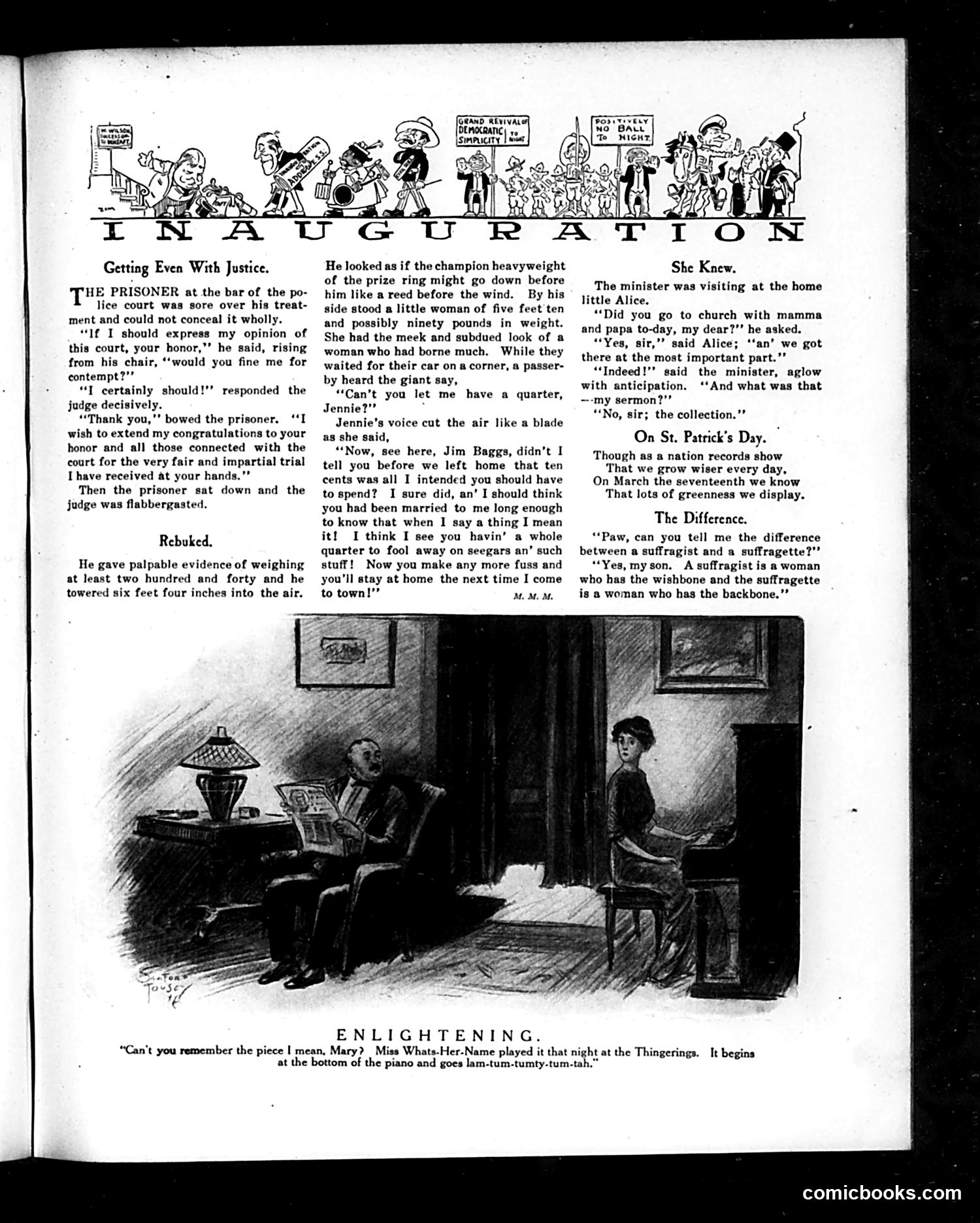
This page contains several satirical sketches typical of early 20th-century American humor: **"Getting Even With Justice"**: A prisoner outsmarts a judge by praising the court after being told he'd be fined for contempt—a clever loophole joke about legal absurdity. **"Rebuked"**: A huge man (Jim Baggs) is completely dominated by his tiny wife Jennie, who controls his spending money and behavior. The satire mocks henpecked husbands and suggests wives hold real domestic power despite physical disadvantages. **"She Knew"**: A child reveals that the "important part" of church is the collection, not the sermon—satirizing both childhood innocence and possibly clergy priorities. **"St. Patrick's Day"**: Brief verse mocking Irish-Americans' stereotype of excessive drinking on March 17th. **"The Difference"**: Political satire distinguishing suffragists (wishbone = desire without backbone) from suffragettes (backbone = militant action). This reflects the contemporary women's suffrage debate and the more aggressive tactics of British suffragettes. The page reflects period attitudes toward marriage dynamics, religion, Irish immigrants, and women's political activism.
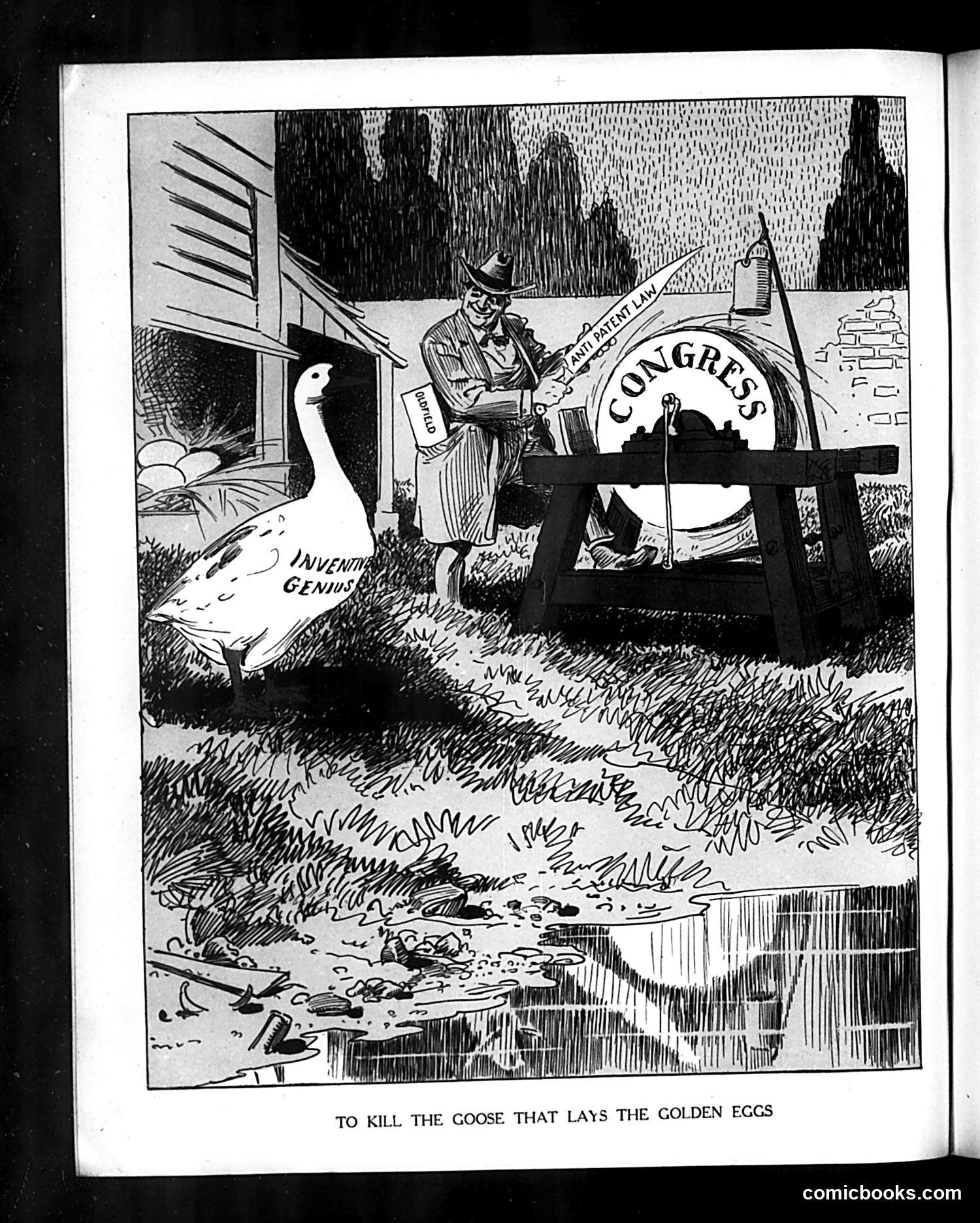
This cartoon illustrates the classic fable "The Goose That Lays the Golden Eggs." A man labeled "Congress" operates a drum labeled "Congress" while playing an instrument labeled "Anti-Patriot Law." A goose labeled "Inventive Genius" stands nearby, with scattered golden eggs visible below. The satire warns that Congress's anti-patriot legislation threatens American innovation and prosperity. By "killing the goose" (suppressing inventive genius through restrictive laws), Congress destroys the source of national wealth and progress (the golden eggs). The specific "Anti-Patriot Law" referenced is unclear without additional context, but the cartoon's message is straightforward: overly restrictive government policies harm the inventors and entrepreneurs who drive economic success. This reflects early-20th-century American debates about regulation versus free enterprise.
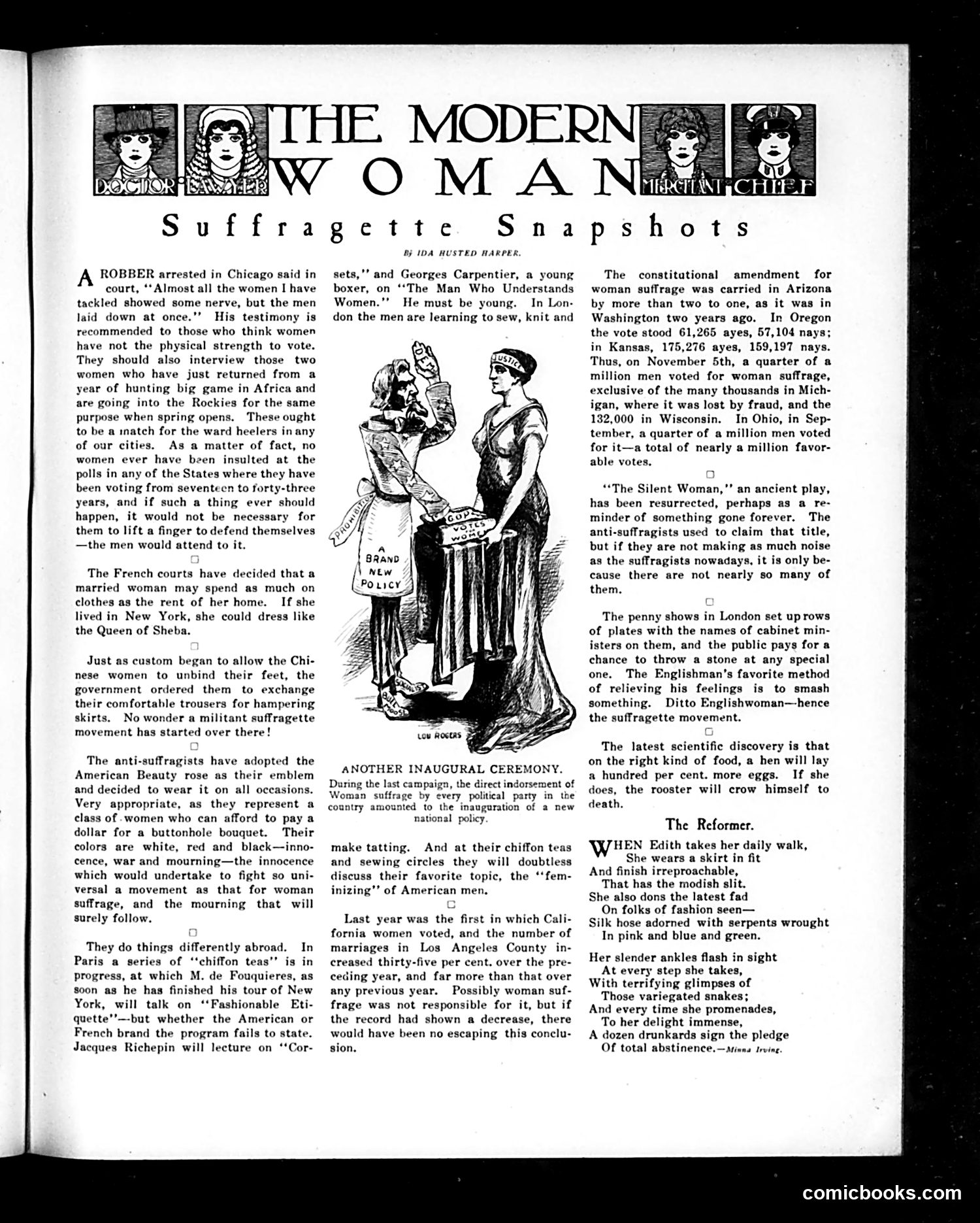
This page from *Judge* magazine presents pro-suffrage arguments through satire and commentary by Ida Husted Harper, circa 1912. The central cartoon depicts a woman in fashionable dress presenting a "Brand New Policy" to a man, likely satirizing anti-suffragists' claims about women's unsuitability for voting. The surrounding text uses irony to counter common objections: a criminal's testimony proves women possess physical strength; Chinese foot-binding reforms highlight women's agency; French courts grant married women spending autonomy. Harper emphasizes suffrage victories in Arizona, Kansas, Oregon, and Ohio, noting nearly a million men voted in favor. The piece mocks anti-suffragists adopting the American Beauty rose as their emblem while opposing democratic participation. It also sarcastically notes the resurrection of "The Silent Woman" play as anti-suffragist propaganda—the title meant to invoke women's traditional subordination, which Harper dismisses as obsolete.
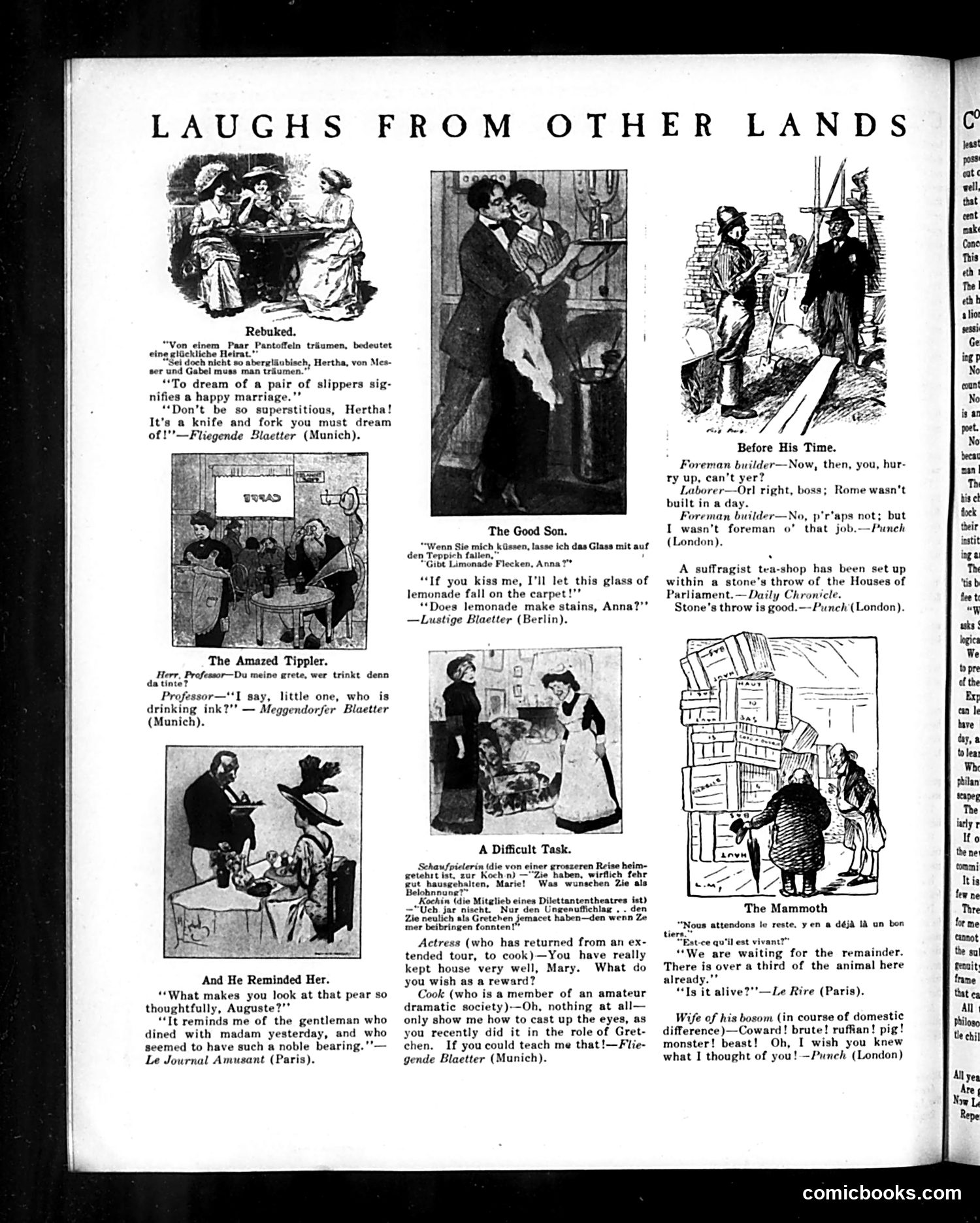
This page collects humorous cartoons and jokes from European satirical magazines (German, French, British), presented as international humor for American *Judge* readers. The jokes are lightweight domestic and social comedy: a couple debating superstitions about dream omens for marriage; a professor horrified to find someone drinking ink; a woman reminded of an elegant dinner guest by a pear's shape; a housemaid threatening to drop lemonade if kissed; an actress asked by her cook to teach her dramatic eye-rolling; a construction laborer invoking Rome's slow building; a suffragist tea-shop near Parliament; and a wife discovering her husband's "mammoth" purchase is only partially delivered. The satire is gentle—poking fun at marital dynamics, class differences, amateur theatricals, and contemporary women's activism (suffragism). Nothing is sharply political. The page simply demonstrates that humor was internationally traded among middle-class magazines of the era, creating a cosmopolitan "laughs from abroad" section for educated readers.
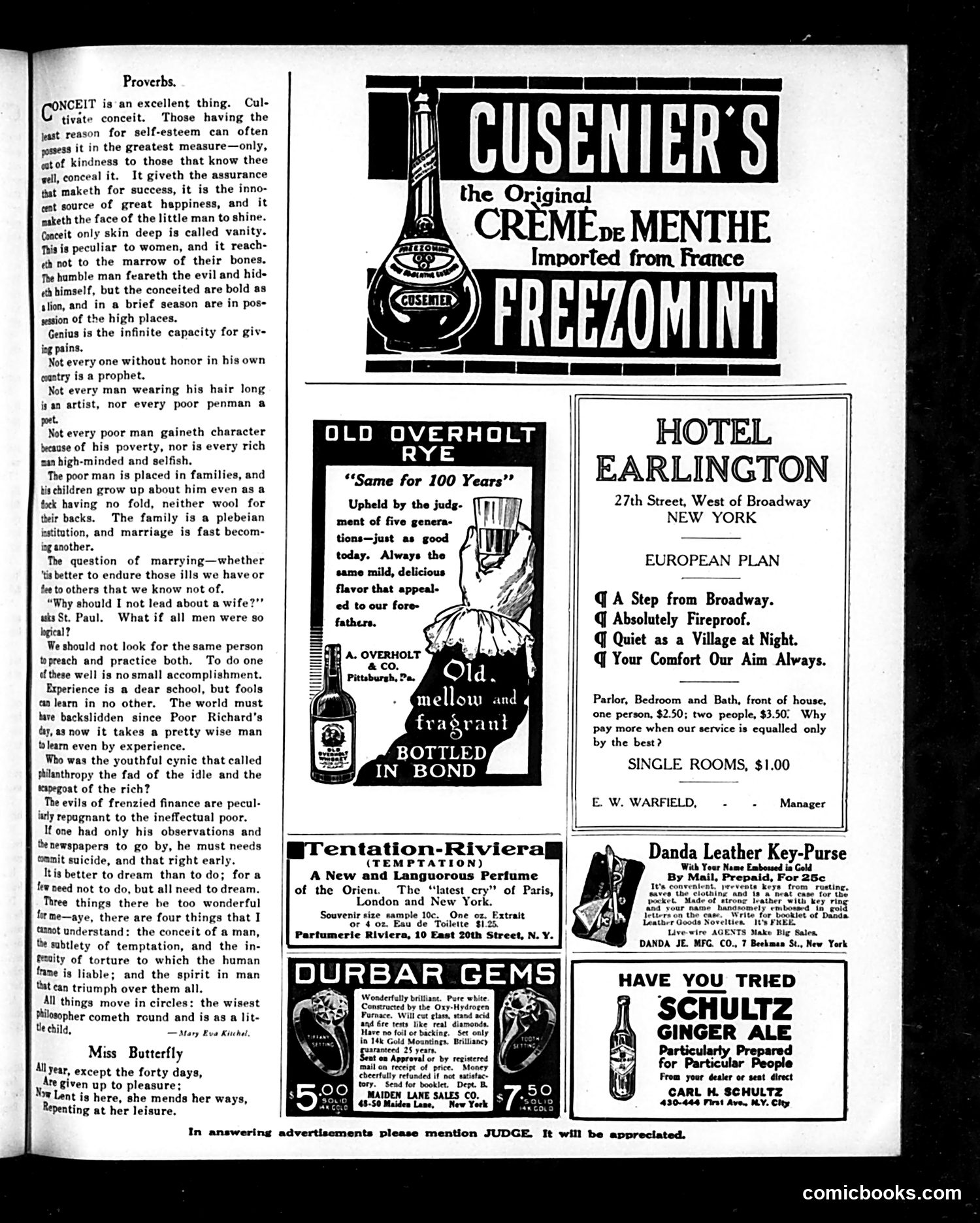
This page is **primarily advertising** with minimal editorial cartoon content. The left column contains **"Proverbs,"** a satirical essay attributed to Mary va Richel that mocks pretension and self-deception in early 20th-century society. It attacks conceited people, critiques poverty as character-building myth, questions marriage, and satirizes both the wealthy and the ineffectual poor who rely on newspapers for worldview. The brief poem **"Miss Butterfly"** mocks society women who abandon pleasure only during Lent, then resume frivolous behavior. The remainder is **period advertising**: Cusenier's Creme de Menthe liqueur, Old Overholt Rye whiskey, Hotel Earlington (budget lodging at $1), Tentations perfume, Durbar Gems (costume jewelry), Schultz Ginger Ale, and a leather key-purse. The satirical commentary is light—social criticism through aphorism rather than visual caricature. No identifiable political figures appear.
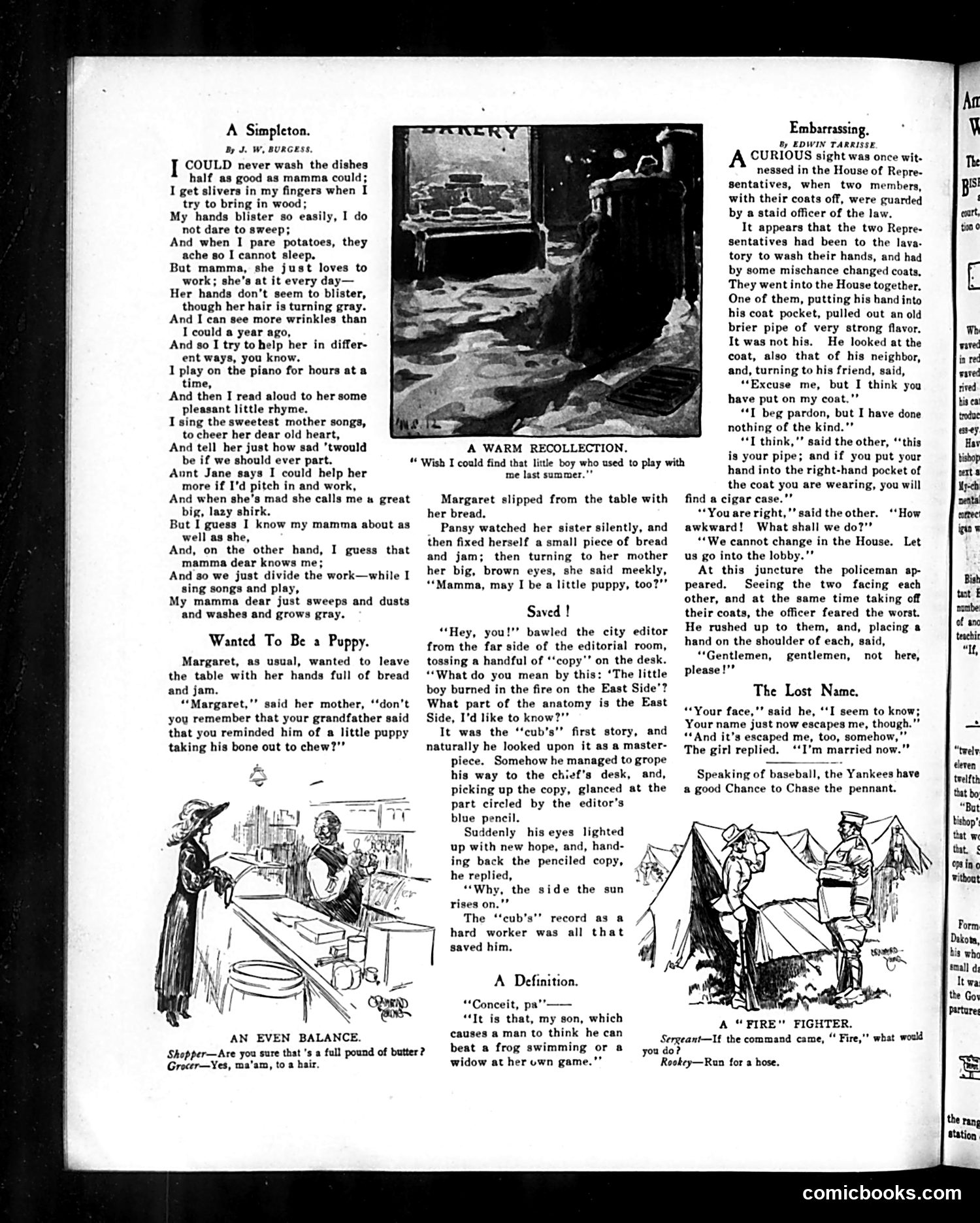
This Judge magazine page contains several satirical pieces reflecting early 20th-century domestic and social attitudes: **"A Simpleton"** mocks a lazy daughter who shirks housework by claiming delicate hands, instead entertaining her aging mother with piano playing and songs while the mother deteriorates from actual labor. The satire targets privileged indolence masked as refinement. **"Wanted To Be a Puppy"** humorously contrasts two sisters: one uses her mother's puppy-comparison as excuse to leave with food, while the clever younger sister sees the loophole and asks permission to do the same. **"Embarrassing"** depicts two congressmen who accidentally swap coats in a House of Representatives bathroom. One discovers the other's pipe in his pocket—apparently carrying strong tobacco was considered compromising or undignified for a legislator. The humor plays on the awkwardness of public figures caught in minor, embarrassing mix-ups. All pieces reflect period concerns about gender roles, propriety, and the contradictions between public respectability and private behavior.
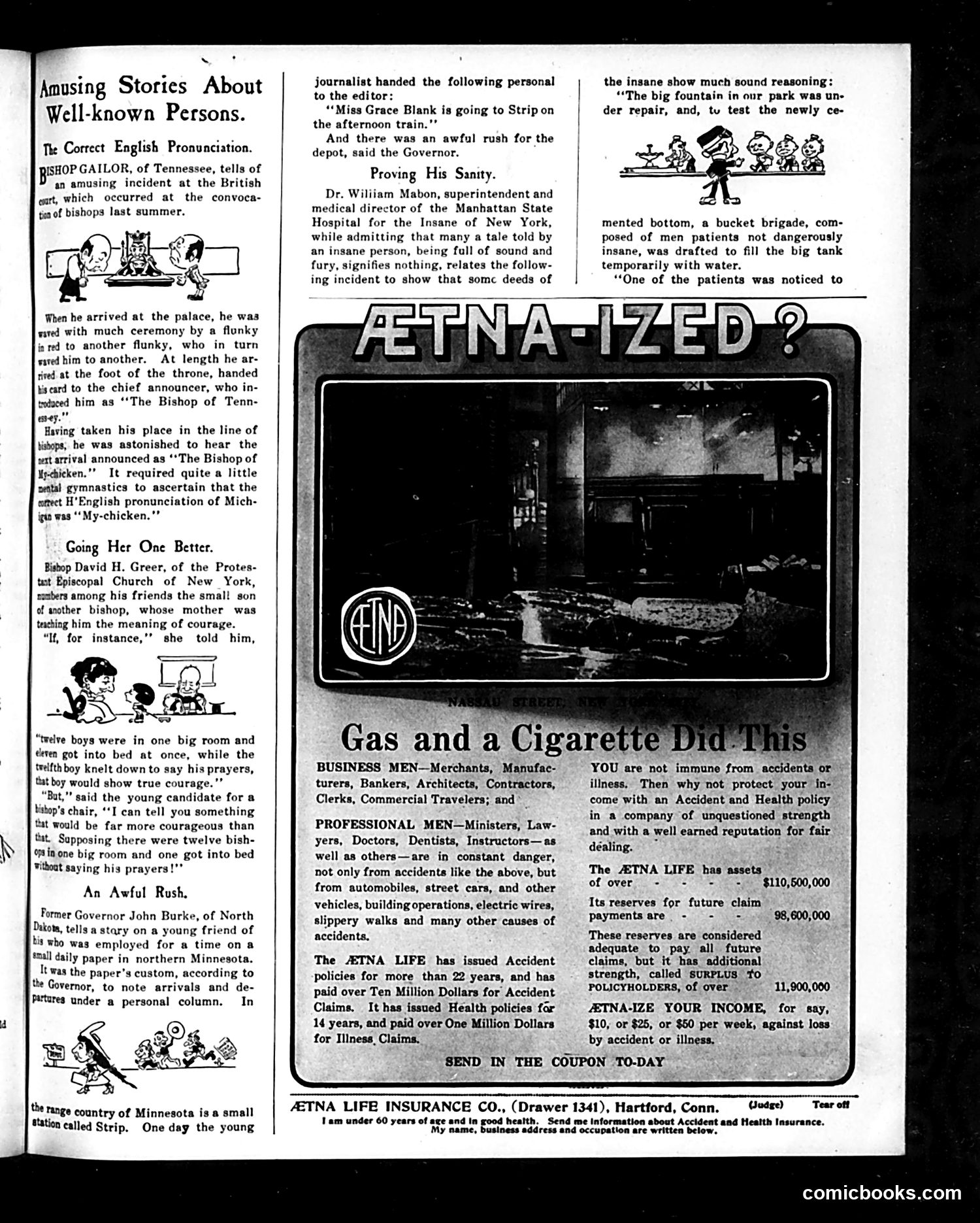
This page contains three humorous anecdotes about bishops and clergy, followed by an Ætna Life Insurance advertisement. **The Anecdotes:** The first story mocks Bishop Gaylor of Tennessee for mispronouncing "Michigan" as "My-chicken" at a British bishops' convocation—satire on American provincial speech. The second, attributed to Bishop David H. Greer, presents a joke where a young candidate for priesthood outdoes his instructor by claiming it would be more courageous for twelve bishops to share a bed without saying prayers than for boys to do so—satire on clerical hypocrisy and irreverence. The third, from Governor John Burke, jokes about a newspaper's personal column announcing "Miss Grace Blank is going to Strip"—the absurdity being that readers rushed to the depot assuming "Strip" was a location, when the phrase reads ambiguously suggestive. **The Advertisement:** The large Ætna Life Insurance ad emphasizes accident and health coverage for businessmen and professionals facing modern dangers (automobiles, electric wires, etc.). The page offers gentle satirical commentary on American religious figures and manners, typical of Judge magazine's humor.
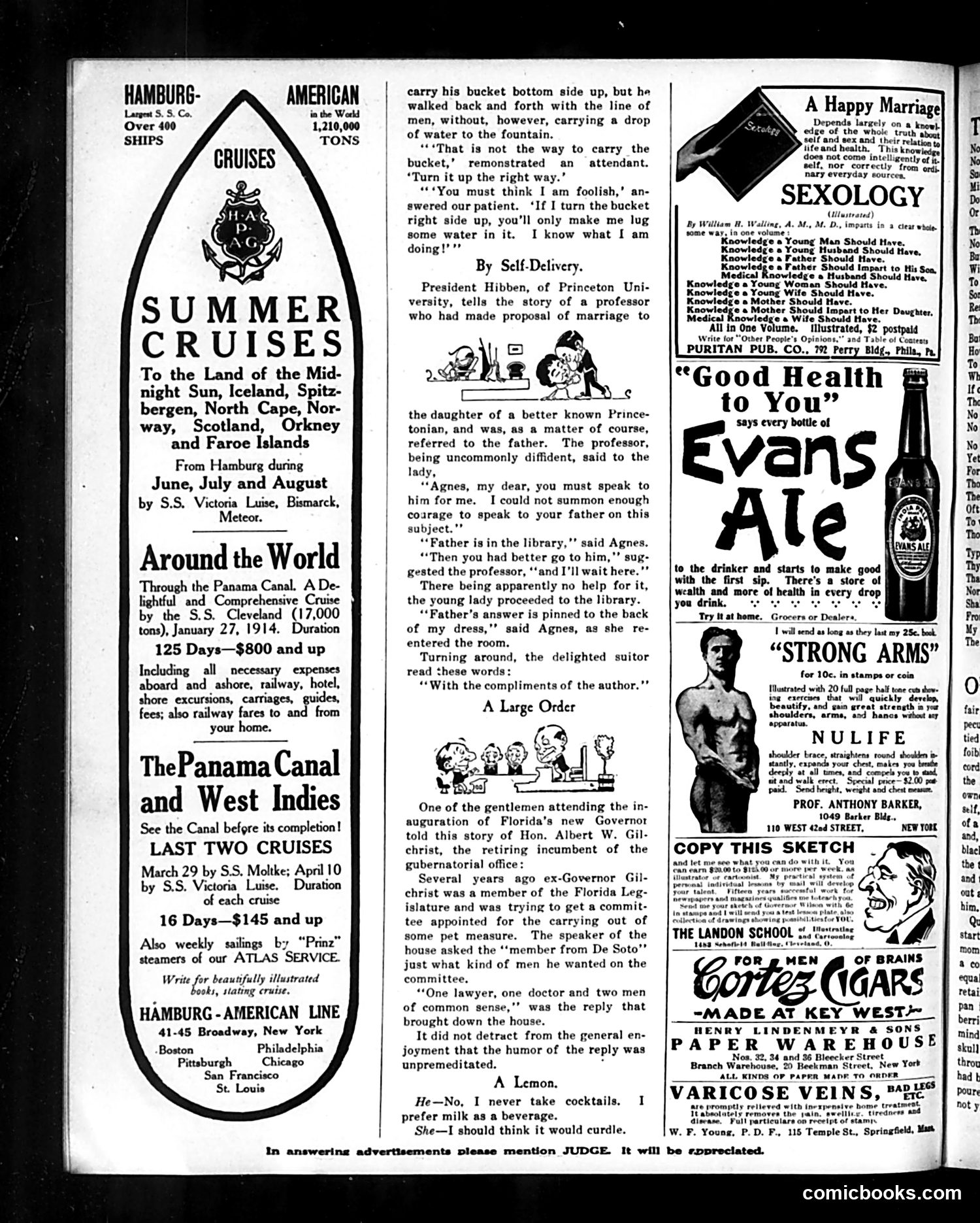
This page is primarily **advertising**, featuring cruise promotions from the Hamburg-American Line prominently, along with various other product advertisements (ales, health books, cigars). The editorial content consists of three brief **humorous anecdotes**: 1. **"By Self-Delivery"**: A Princeton professor proposing marriage is too timid to speak to the father himself, so sends his fiancée instead. The father's reply—"With the compliments of the author"—is a witty rejection, implying the proposal lacks originality. 2. **"A Large Order"**: Former Florida Governor Albert Gilchrist humorously requests committee members: "one lawyer, one doctor and two men of common sense"—satirizing political appointments by suggesting most politicians lack common sense. 3. **"A Lemon"**: A brief exchange where a man claiming to prefer milk to cocktails is told it would "curdle"—likely implying something unpleasant about his character or constitution. The jokes are genteel social satire typical of Judge's era, mocking timidity, political incompetence, and pretension through anecdotes rather than visual caricature.
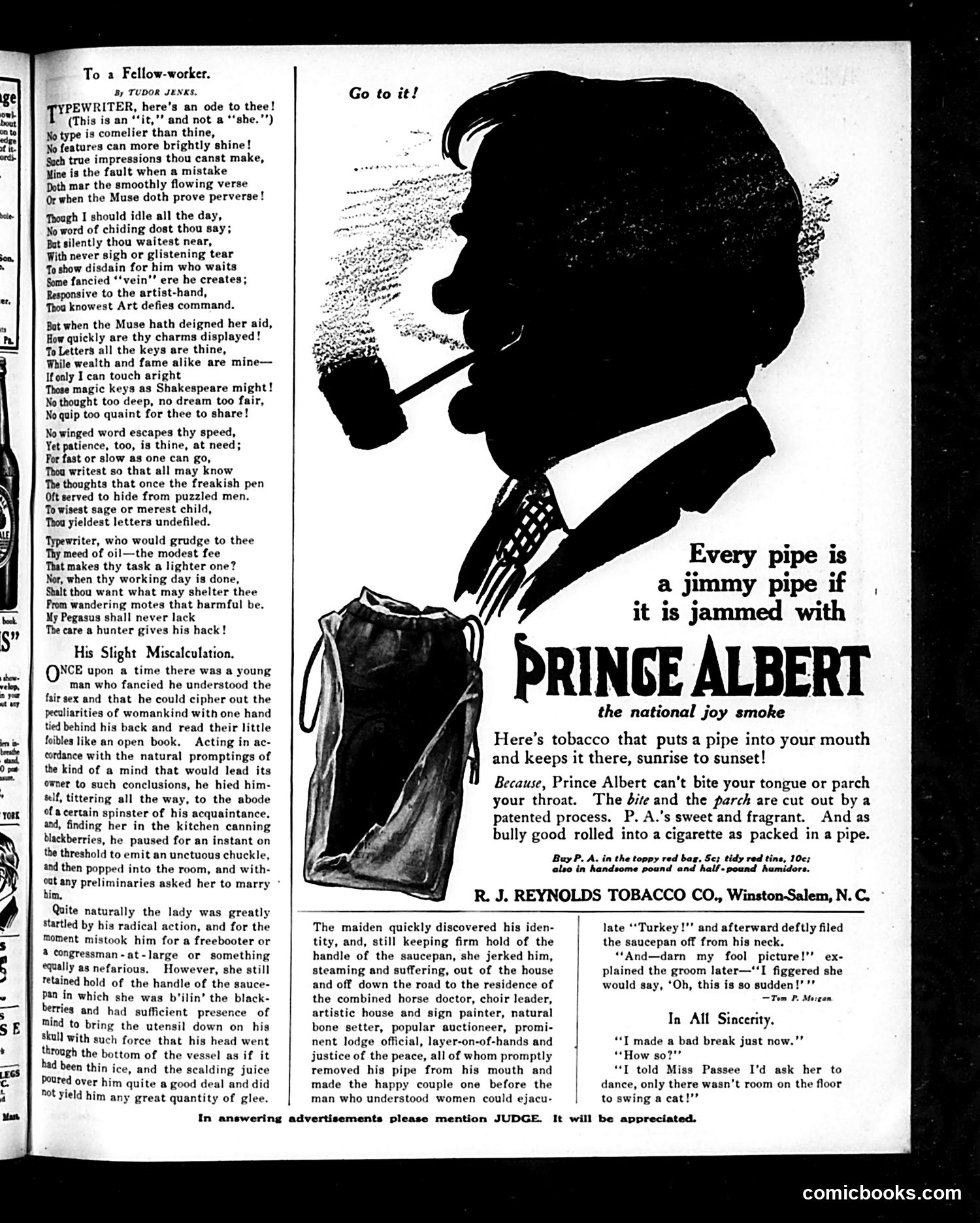
This page contains two distinct elements: **Left side:** A poem "To a Fellow-worker" by Tudor Jenks, personifying a typewriter as a loyal, patient companion to a writer. It's sentimental workplace verse celebrating the machine's reliability and responsiveness to the creative process. **Right side:** A humorous short story titled "His Slight Miscalculation" about an arrogant young man who assumes he understands women, then abruptly proposes to a woman canning blackberries. She responds by hitting him with the hot saucepan, trapping his head through the bottom and scalding him—a slapstick comeuppance for his presumption and lack of courtesy. **Bottom:** A full-page Prince Albert tobacco advertisement featuring a silhouette of a man smoking a pipe, promoting the brand's smoothness and packability. The satire targets masculine overconfidence and entitlement regarding women's affections, a recurring theme in early 20th-century humor.
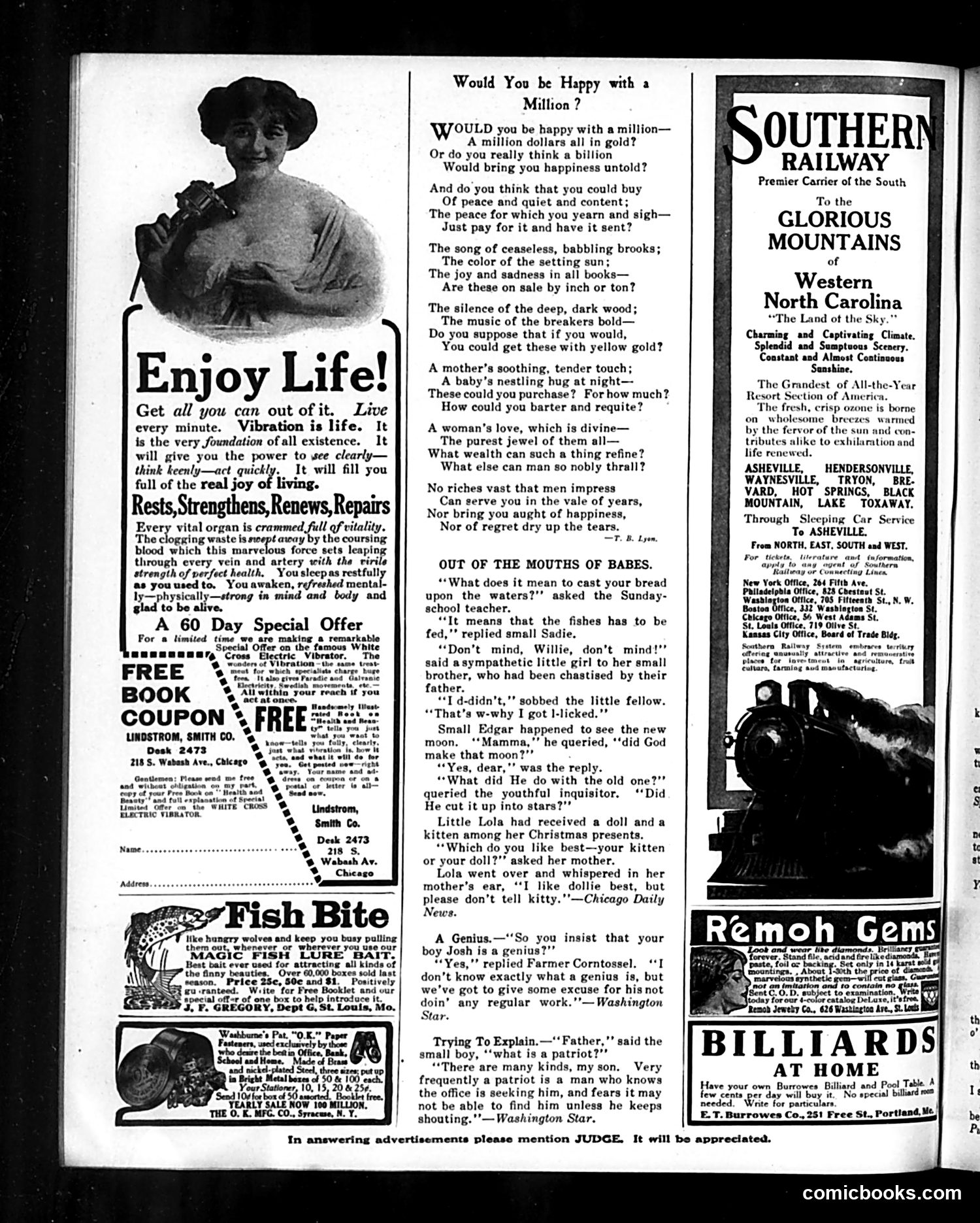
This page is primarily **advertising and humor content** rather than political satire. The main features include: **"Would You Be Happy with a Million?"** — A philosophical poem arguing that money cannot buy happiness (love, nature's beauty, peace). This reflects early 20th-century anxieties about materialism. **"Out of the Mouths of Babes"** — A humor section with children's jokes and witty misunderstandings, a popular magazine format of the era. **Other jokes** poke gentle fun at rural life ("Farmer Corntossel") and office-seeking politicians who loudly demand positions they claim not to want. The **advertisements** promote a vibration machine claiming health benefits (pseudoscientific wellness was common then) and Southern Railway travel to North Carolina mountains. This appears to be a **general-interest satirical magazine** page mixing light social commentary with commercial content—typical Judge magazine fare from the early 1900s.
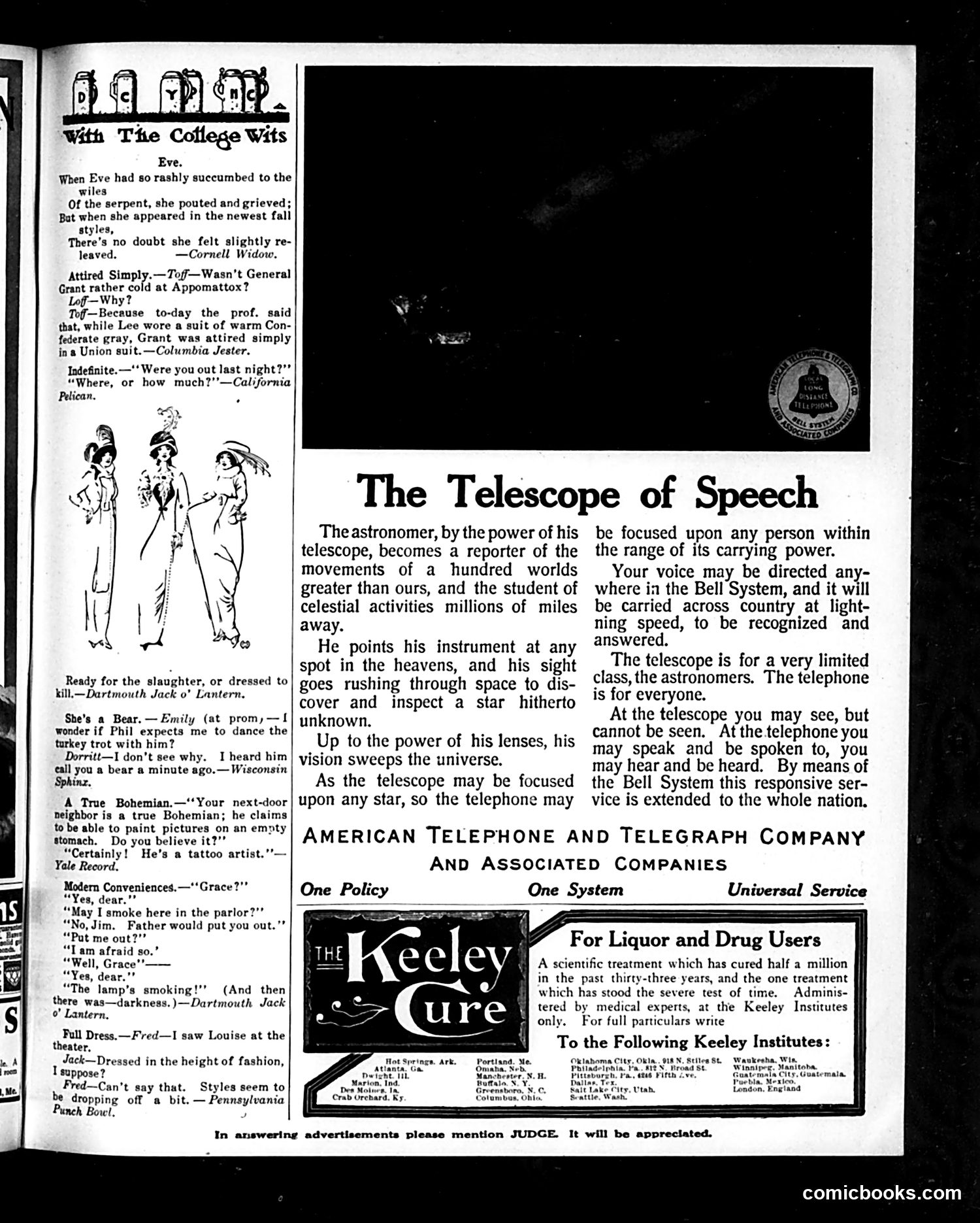
This page is primarily a **humor section** featuring short jokes submitted by college newspapers, plus two full-page advertisements. ## The College Jokes The left column collects brief comedic quips from universities (Cornell, Columbia, Dartmouth, Yale, Wisconsin, Pennsylvania). These are lighthearted campus humor—puns about dating, fashion, and student life. For example, one joke plays on "Union suit" (a type of underwear) when comparing Civil War generals Grant and Lee's attire at Appomattox. ## The Advertisements **"The Telescope of Speech"** (AT&T): Uses an extended metaphor comparing the telescope's power over distance to the telephone's ability to connect people across the Bell System. It's promotional copy emphasizing that telephones—unlike telescopes—are available to everyone, not just specialists. **"Keeley Cure"**: Advertises a purported medical treatment for alcoholism and drug addiction, claiming it has "cured half a million" patients. This reflects early-20th-century patent medicine marketing (the Keeley Institutes were real but of dubious efficacy by modern standards). The page is essentially **filler content and advertising**—typical of Judge magazine's mixed editorial/commercial format.
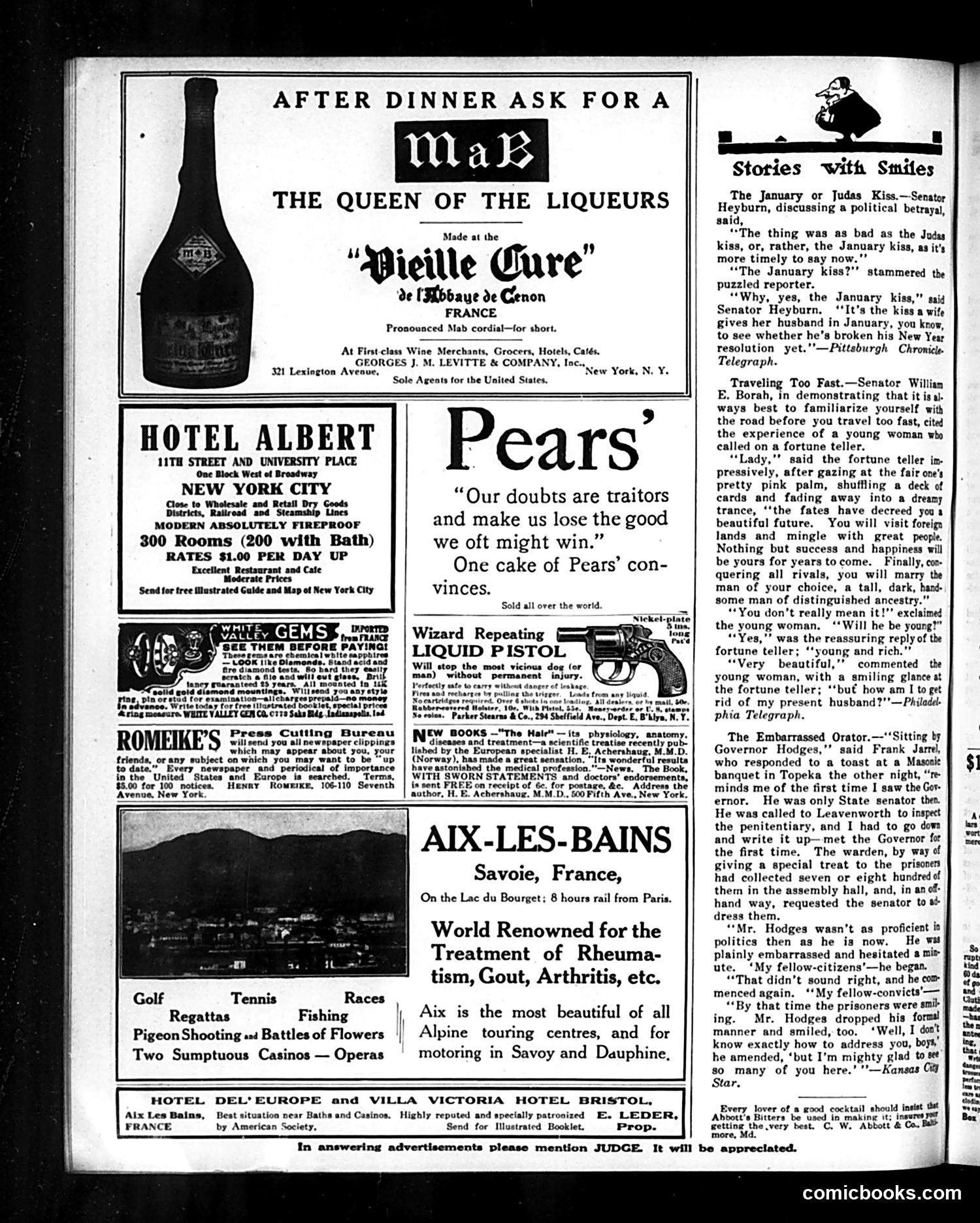
This is primarily an **advertising page** from Judge magazine, with a small "Stories with Smiles" humor column on the right side. The humor section consists of brief anecdotes featuring **Senator Heyburn and Senator William E. Borah** (identifiable Idahoans prominent in the early 1900s). The jokes mock political figures through wordplay and ironic situations: - The "January kiss" joke plays on a wife checking if her husband kept New Year resolutions—satirizing politicians' broken promises - The fortune teller story about a woman wanting to abandon her husband mocks the gap between politicians' flowery rhetoric and messy reality - The Governor Hodges anecdote implies embarrassment about past humble positions The humor relies on gentle political satire typical of Judge's style: poking fun at politicians' hypocrisy and pomposity without harsh attacks. The jokes suggest these were recognizable public figures whose contradictions between stated values and actual behavior were worth lampooning to readers. The page's bulk consists of liqueur, hotel, and patent medicine advertisements—standard for the era.
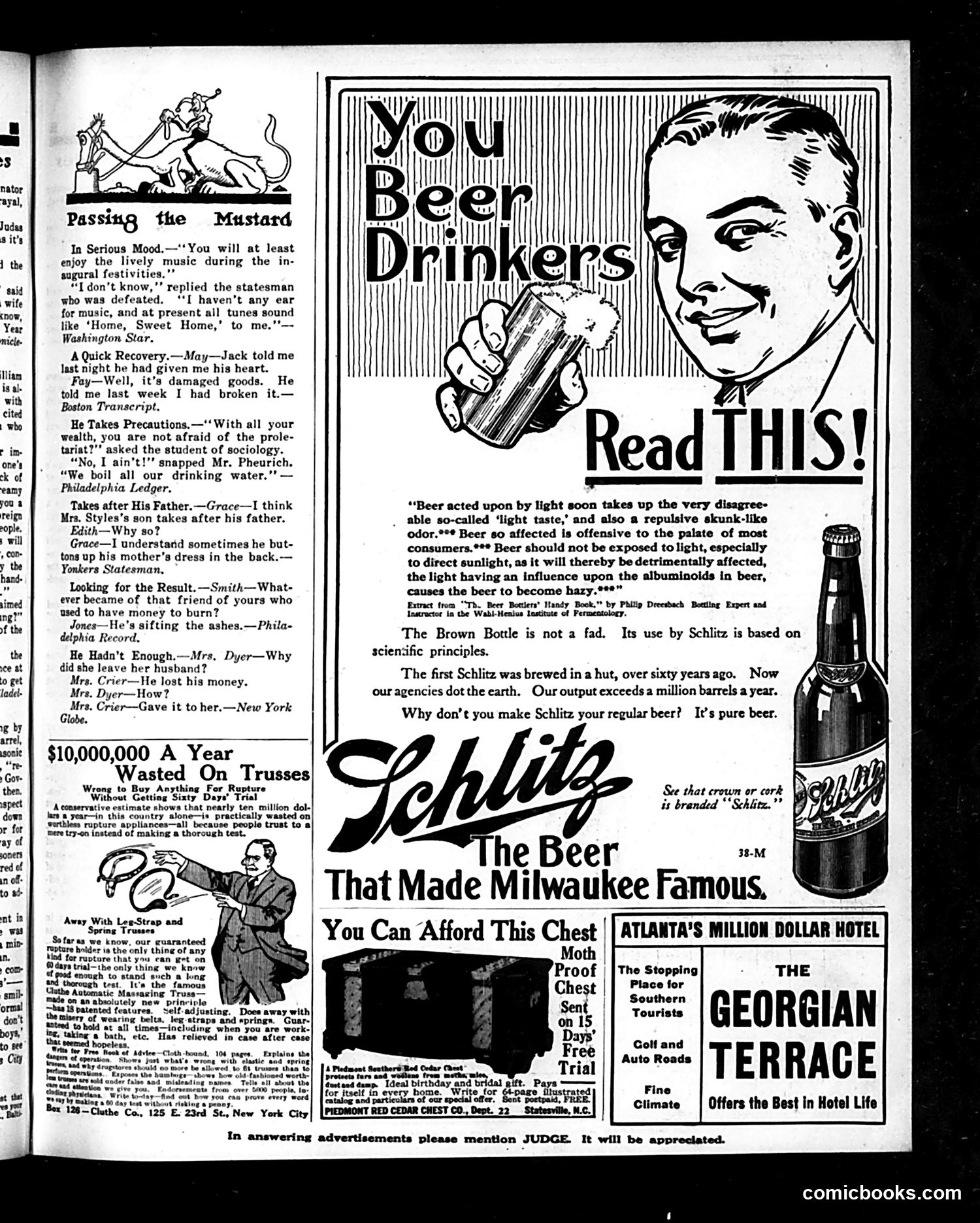
This page contains mostly **short humorous anecdotes** and **advertisements** rather than political cartoons. The jokes, titled "Passing the Mustard," satirize American social life through brief quips. One mocks a defeated politician who only hears "Home, Sweet Home"—likely referencing nostalgia for past political administrations. Another jokes about a wealthy man boiling his drinking water as protection against "the proletariat" (working class)—satirizing wealthy Americans' fears of socialism/labor unrest, a real concern in early 20th-century America. The page is dominated by **advertisements**: a Schlitz beer ad (emphasizing the brown bottle protects beer from light damage), a medical truss device, and a hotel advertisement. The humor is gentle, domestic satire reflecting middle-class anxieties: political defeat, romantic deception, class anxiety, and consumer product claims—typical of Judge magazine's satirical approach to American life rather than hard political commentary.
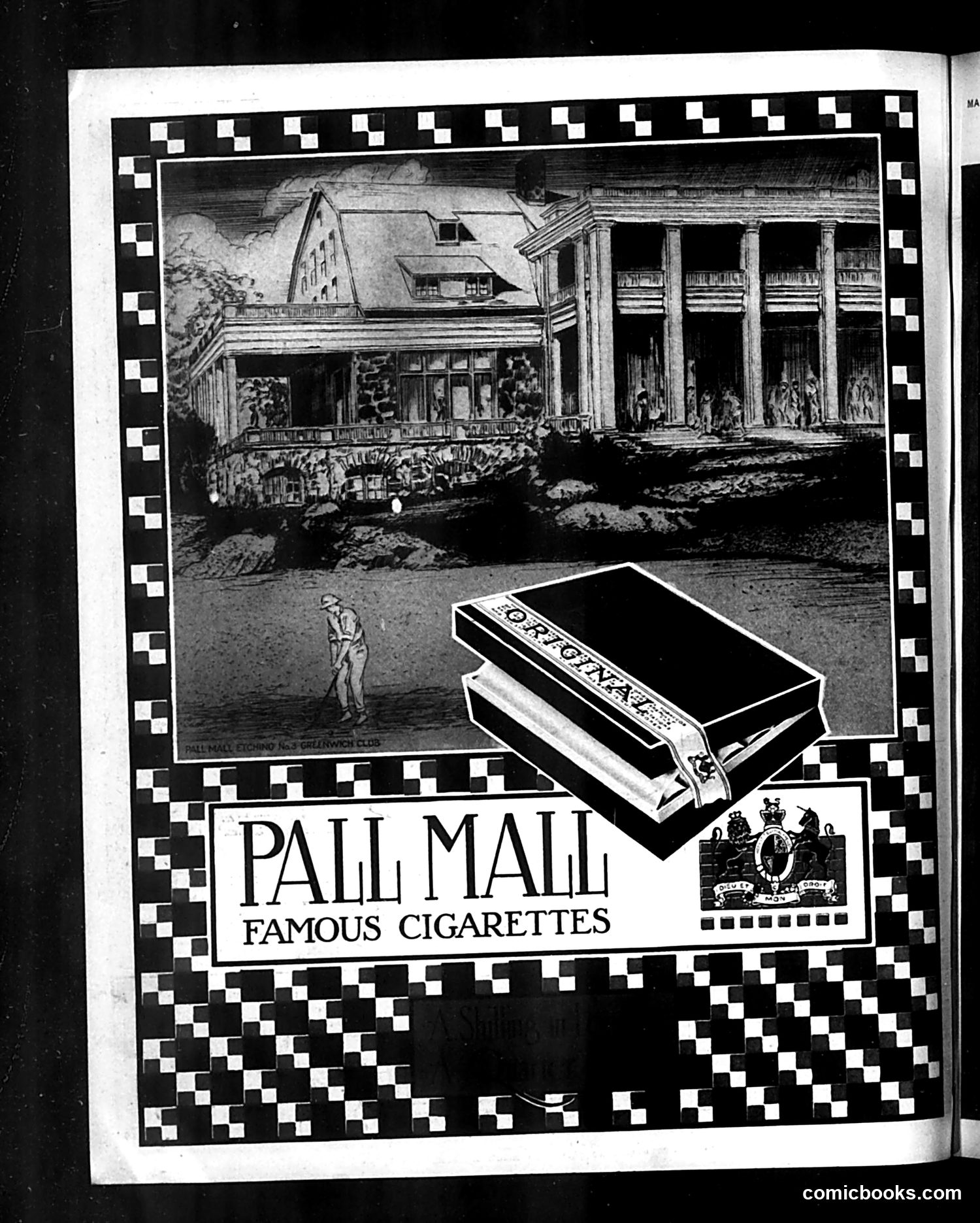
This is a full-page advertisement for Pall Mall cigarettes, not political satire. The image depicts an elegant colonial-era mansion with columns and a manicured grounds, with a solitary figure standing in the foreground. A large cigarette pack is prominently displayed on the right side. The advertisement uses the "famous cigarettes" tagline and includes what appears to be a royal or aristocratic coat of arms, suggesting the product's quality and prestige. The checkered border design frames the composition. This represents vintage tobacco advertising from an era when such promotions appeared regularly in magazines like *Judge*, before cigarette advertising restrictions became common. The elegant setting associates the product with wealth and refinement.