
Judge, 1913-03-01 · page 17 of 28
Judge — March 1, 1913 — page 17: what you’re looking at
What you’re looking at
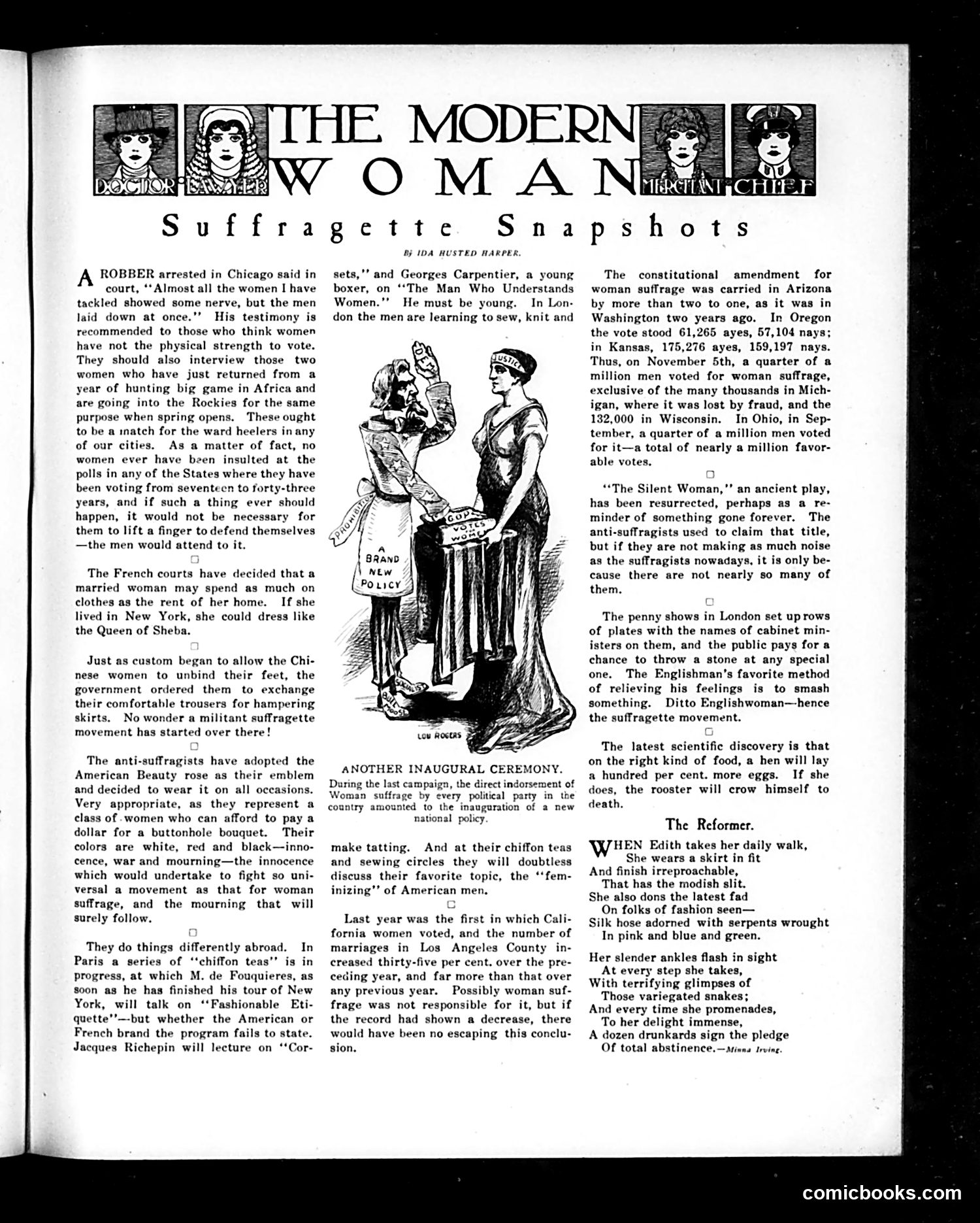
This page from *Judge* magazine presents pro-suffrage arguments through satire and commentary by Ida Husted Harper, circa 1912. The central cartoon depicts a woman in fashionable dress presenting a "Brand New Policy" to a man, likely satirizing anti-suffragists' claims about women's unsuitability for voting. The surrounding text uses irony to counter common objections: a criminal's testimony proves women possess physical strength; Chinese foot-binding reforms highlight women's agency; French courts grant married women spending autonomy. Harper emphasizes suffrage victories in Arizona, Kansas, Oregon, and Ohio, noting nearly a million men voted in favor. The piece mocks anti-suffragists adopting the American Beauty rose as their emblem while opposing democratic participation. It also sarcastically notes the resurrection of "The Silent Woman" play as anti-suffragist propaganda—the title meant to invoke women's traditional subordination, which Harper dismisses as obsolete.
📄 Transcribed text from this page (OCR, searchable)
Machine-transcribed from the original scan — historical spelling and the odd misread are preserved.
Suffra A ROBBER arrested in Chicago said in court, ‘*Almost all the women I have tackled showed some nerve, but the men laid down at once.’’ His testimony is recommended to those who think women have not the physical strength to vote. They should also interview those two women who have just returned from a year of hunting big game in Africa and are going into the Rockies for the same purpose when spring opens. These ought to be a match for the ward heelers in any of our cities. As a matter of fact, no women ever have been insulted at the polls in any of the States where they have been voting from seventeen to forty-three years, and if such a thing ever should happen, it would not be necessary for them to lift a finger to defend themselves —the men would attend to it. The French courts have decided that a married woman may spend as much on clothes as the rent of her home. If she lived in New York, she could dress like the Queen of Sheba. Just as custom began to allow the Chi- nese women to unbind their feet, the government ordered them to exchange their comfortable trousers for hampering skirts. No wonder a militant suffragette movement has started over there! The anti-suffragists have adopted the American Beauty rose as their emblem and decided to wear it on all occasions. Very appropriate, as they represent a class of .women who can afford to pay a dollar for a buttonhole bouquet. Their colors are white, red and black—inno- cence, war and mourning—the innocence which would undertake to fight so uni- versal a movement as that for woman suffrage, and the mourning that will surely follow. They do things differently abroad. In Paris a series of ‘‘chiffon teas’? is in progress, at which M. de Fouquieres, as soon as he has finished his tour of New York, will talk on ‘Fashionable Eti- quette’’—-but whether the American or French brand the program fails to state. Jacques Richepin will lecture on ‘Cor- gette Sna By IDA HUSTED HARPER. sets,’’ and Georges Carpentier, a young boxer, on ‘‘The Man Who Understands Women."’ He must be young. In Lon- don the men are learning to sew, knit and ANOTHER INAUGURAL CEREMONY. Daring the last campaign, the direct indorsement of Woman suffrage by every political party in the country amounted to the inauguration of a new national policy make tatting. And at their chiffon teas and sewing circles they will doubtless discuss their favorite topic, the ‘‘fem- inizing’’ of American men. Last year was the first in which Cali- fornia women voted, and the number of marriages in Los Angeles County in- creased thirty-five per cent. over the pre- ceding year, and far more than that over any previous year. Possibly woman suf- frage was not responsible for it, but if the record had shown a decrease, there would have been no escaping this conclu- sion. pshots The constitational amendment for woman suffrage was carried in Arizona by more than two to one, as it was in Washington two years ago. In Oregon the vote stood 61,265 ayes, 57,104 nays; in Kansas, 175,276 ayes, 159,197 nays. Thus, on November 5th, a quarter of a million men voted for woman suffrage, exclusive of the many thousands in Mich- igan, where it was lost by fraud, and the 132,000 in Wisconsin. In Ohio, in Sep- tember, a quarter of a million men voted for it—a total of nearly a million favor- able votes. “The Silent Woman,"’ an ancient play, has been resurrected, perhaps as a re- minder of something gone forever. The anti-suffragists used to claim that title, but if they are not making as much noise as the suffragists nowadays, it is only be- cause there are not nearly so many of them. ‘The penny shows in London set up rows of plates with the names of cabinet min- isters on them, and the public pays for a chance to throw a stone at any special one. The Englishman’s favorite method of relieving his feelings is to smash something. Ditto Englishwoman—hence the suffragette movement. The latest scientific discovery is that on the right kind of food, a hen will lay a hundred per cent. more eggs. If she does, the rooster will crow himself to death. The Reformer. WHEN Edith takes her daily walk, She wears a skirt in fit And finish irreproachable, That has the modish slit. She also dons the latest fad On folks of fashion seen— Silk hose adorned with serpents wrought In pink and blue and green. Her slender ankles flash in sight At every step she takes, With terrifying glimpses of Those variegated snakes; And every time she promenades, To her delight immense, A dozen drunkards sign the pledge Of total abstinence.—stinns Irvine. comicbooks.com