
Judge, 1913-03-01 · page 20 of 28
Judge — March 1, 1913 — page 20: what you’re looking at
What you’re looking at
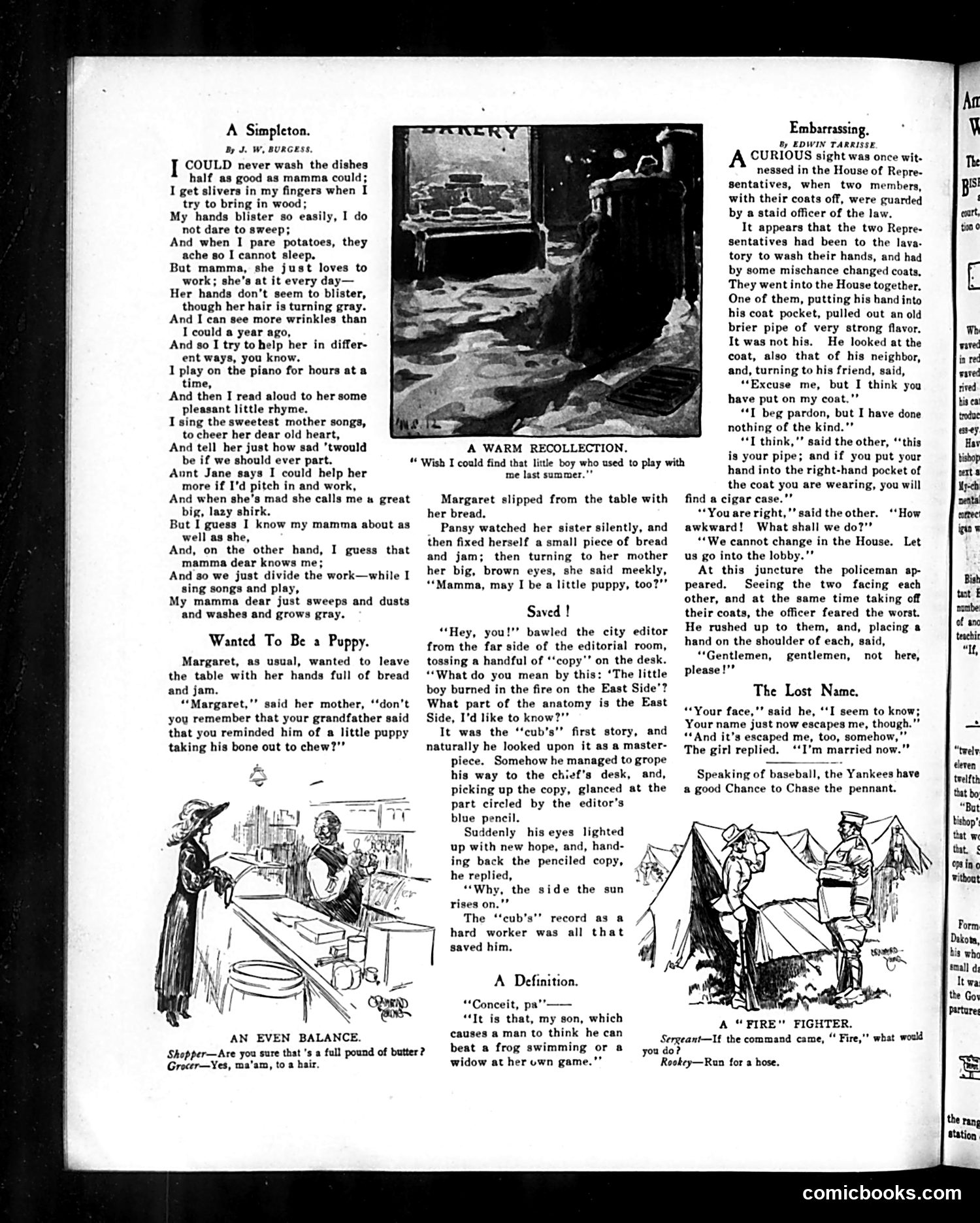
This Judge magazine page contains several satirical pieces reflecting early 20th-century domestic and social attitudes: **"A Simpleton"** mocks a lazy daughter who shirks housework by claiming delicate hands, instead entertaining her aging mother with piano playing and songs while the mother deteriorates from actual labor. The satire targets privileged indolence masked as refinement. **"Wanted To Be a Puppy"** humorously contrasts two sisters: one uses her mother's puppy-comparison as excuse to leave with food, while the clever younger sister sees the loophole and asks permission to do the same. **"Embarrassing"** depicts two congressmen who accidentally swap coats in a House of Representatives bathroom. One discovers the other's pipe in his pocket—apparently carrying strong tobacco was considered compromising or undignified for a legislator. The humor plays on the awkwardness of public figures caught in minor, embarrassing mix-ups. All pieces reflect period concerns about gender roles, propriety, and the contradictions between public respectability and private behavior.
📄 Transcribed text from this page (OCR, searchable)
Machine-transcribed from the original scan — historical spelling and the odd misread are preserved.
A Simpleton. By J. W, BURGESS. COULD never wash the dishes half as good as mamma could; I get slivers in my fingers when I try to bring in wood; My hands blister so easily, I do not dare to sweep; And when I pare potatoes, they ache so I cannot sleep, But mamma, she just loves to work; she's at it every day— Her hands don’t seem to blister, though her hair is turning gray. And I can see more wrinkles than I could a year ago, And so I try to help her in differ- ent ways, you know. 1 play on the piano for hours at a time, And then I read aloud to her some pleasant little rhyme. I sing the sweetest mother songs, to cheer her dear old heart, And tell her just how sad 'twould be if we should ever part. Aunt Jane says I could help her more if I'd pitch in and work, And when she’s mad she calls me « great big, lazy shirk. But I guess I know my mamma about as well as she, And, on the other hand, I guess that mamma dear knows me; And 80 we just divide the work—while I sing songs and play, My mamma dear just sweeps and dusts and washes and grows gray. Wanted To Be a Puppy. Margaret, as usual, wanted to leave the table with her hands full of bread and jam. ‘*Margaret,’’ said her mother, ‘‘don’t you remember that your grandfather said that you reminded him of a little puppy taking his bone out to chew?"’ AN EVEN BALANCE. Shopper—Are you sure that 's a full pound of butter? Grocer—Yes, ma'am, toa A WARM RECOLLECTION. “* Wish I could find that little boy who used to play with me last summer."" Margaret slipped from the table with her bread. Pansy watched her sister silently, and then fixed herself a small piece of bread and jam; then turning to her mother her big, brown eyes, she said meekly, ‘‘Mamma, may I be a little puppy, too?’’ Saved ! “Hey, you!’ bawled the city editor from the far side of the editorial room, tossing a handful of ‘‘copy’’ on the desk. “‘What do you mean by this: ‘The little boy burned in the fire on the East Side’? What part of the anatomy is the East Side, I'd like to know?” It was the ‘‘cub’s’’ first story, and naturally he looked upon it as a master- piece. Somehow he managed to grope his way to the chief’s desk, and, picking up the copy, glanced at the part circled by the editor's blue pencil. Suddenly his eyes lighted up with new hope, and, hand- ing back the penciled copy, he replied, “Why, rises on."” The ‘‘cub’s'’ record as a hard worker was all that saved him. the side the sun A. Definition. “Conceit, pa’’—— “It is that, my son, which causes a man to think he can beat a frog swimming or a you do? widow at her uwn game."’ Embarrassing. By EDWIN TARRISSE A CURIOUS sight was once wit- nessed in the House of Repre- sentatives, when two members, with their coats off, were guarded by a staid officer of the law. It appears that the two Repre- sentatives had been to the |; tory to wash their hands, and h: by some mischance changed coats, They went into the House together. One of them, putting his hand into his coat pocket, pulled out an old brier pipe of very strong flavor. It was not his. He looked at the coat, also that of his neighbor, and, turning to his friend, said, “Excuse me, but I think you have put on my coat.’"" “I beg pardon, but I have done nothing of the kind."* “TI think,’’ said the other, ‘‘this is your pipe; and if you put your hand into the right-hand pocket of the coat you are wearing, you will find a cigar case.’” **You are right,’’ said the othe awkward! What shall we do?”’ “We cannot change in the House. Let us go into the lobby.”’ At this juncture the policeman ap- peared. Seeing the two facing each other, and at the same time taking off their coats, the officer feared the worst. He rushed up to them, and, placing a hand on the shoulder of each, said, “Gentlemen, gentlemen, not here, please !”” “How The Lost Name. “Your face,"? said he, “I seem to know; Your name just now escapes me, though.” “And it’s escaped me, too, somehow, The girl replied. m married now.” Speaking of baseball, the Yankees have ‘a good Chance to Chase the pennant. A “ FIRE" FIGHTER. Sergeant—If the command came, “ Fire," what would Rookey—Run for a hose. comicbooks.com