
A complete issue · 26 pages · 1913
Judge — January 25, 1913
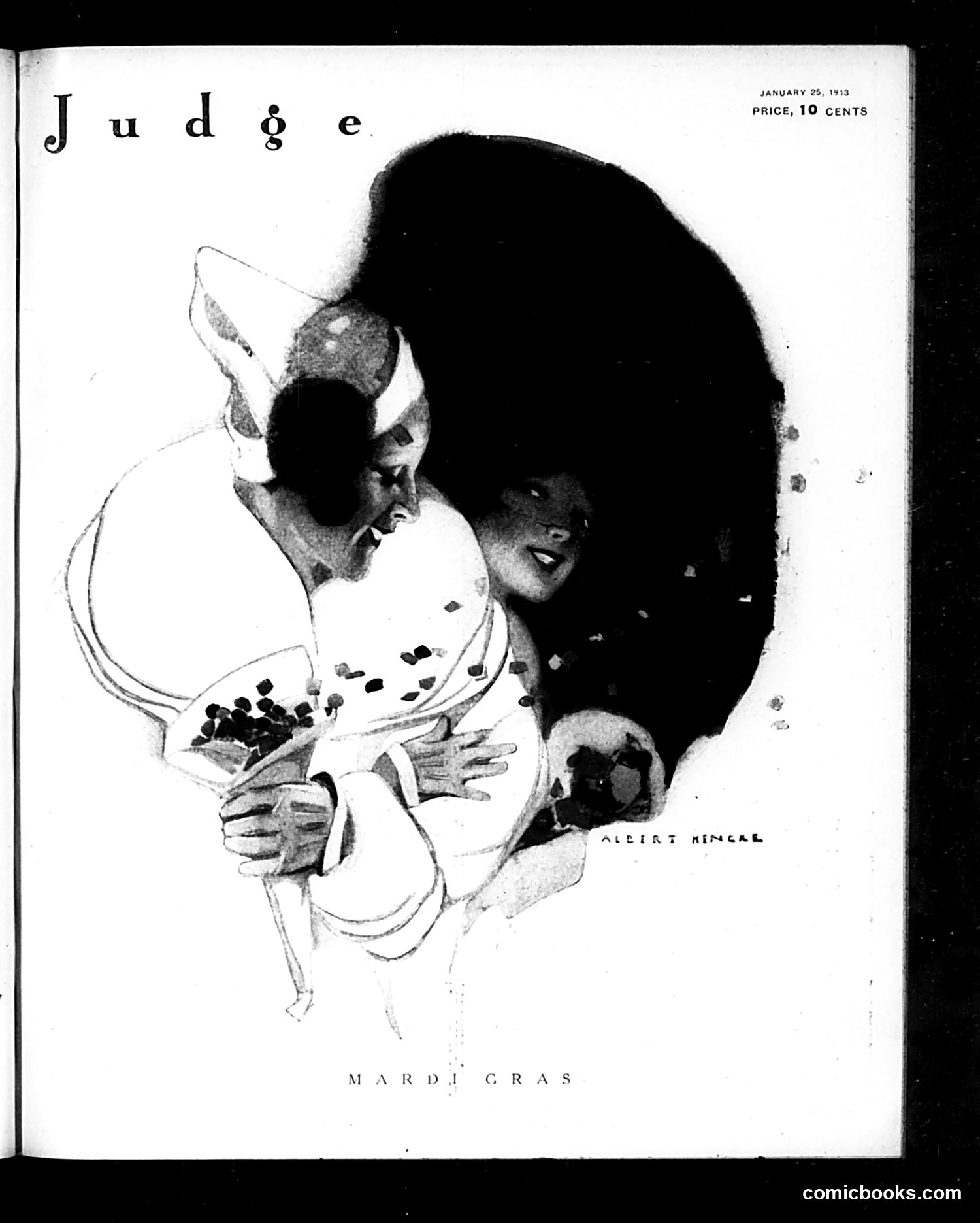
This cover by Albert Rimmel depicts a Mardi Gras reveler in elaborate costume—a figure wearing a large plumed headdress and ornate white outfit decorated with jewels, holding what appears to be a decorative fan or noisemaker. The silhouetted shadow behind creates a dramatic visual contrast. The cartoon likely satirizes the extravagance and excess of Mardi Gras celebrations, a recurring theme in American satire. The exaggerated costume and theatrical pose mock either the ostentation of the wealthy participants or, more broadly, the frivolity of such festivities during the era. Without additional context, the specific political or social target remains unclear, though the artist's emphasis on gaudy display suggests criticism of conspicuous consumption or aristocratic pretension.
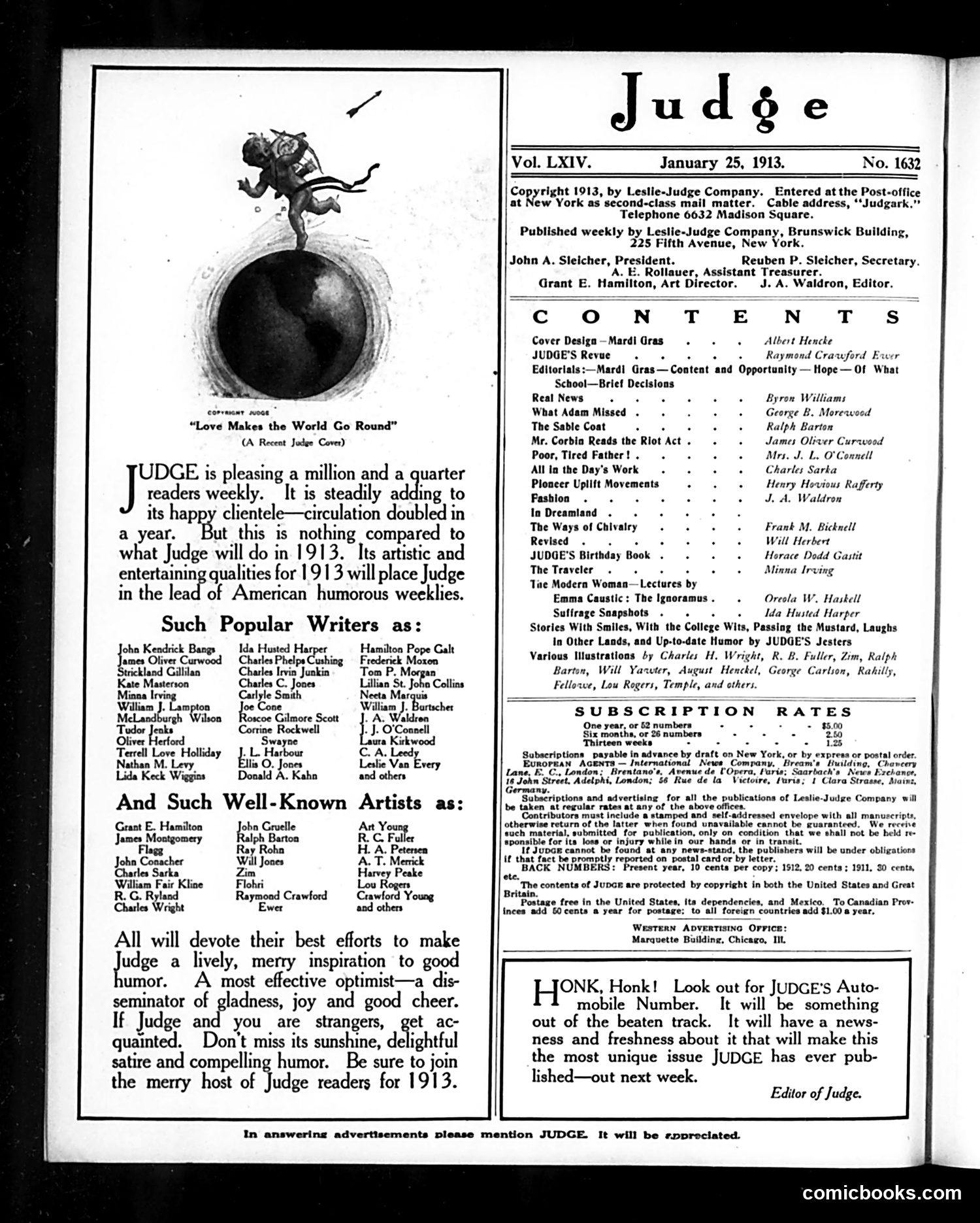
The cover cartoon, titled "Love Makes the World Go Round" (attributed to Albert Herdie), depicts a cherub or cupid figure perched atop a large globe. The image appears to be promotional material for Judge magazine itself rather than political satire—the accompanying text emphasizes Judge's growing circulation and promises "popular writers" and "well-known artists" will contribute humorous content in 1913. The satire is self-directed: Judge humorously credits "love" (its entertaining content) with making the world function, inviting readers to subscribe. This is essentially a lighthearted advertisement celebrating the magazine's success and upcoming contributions, not commentary on external political or social events.
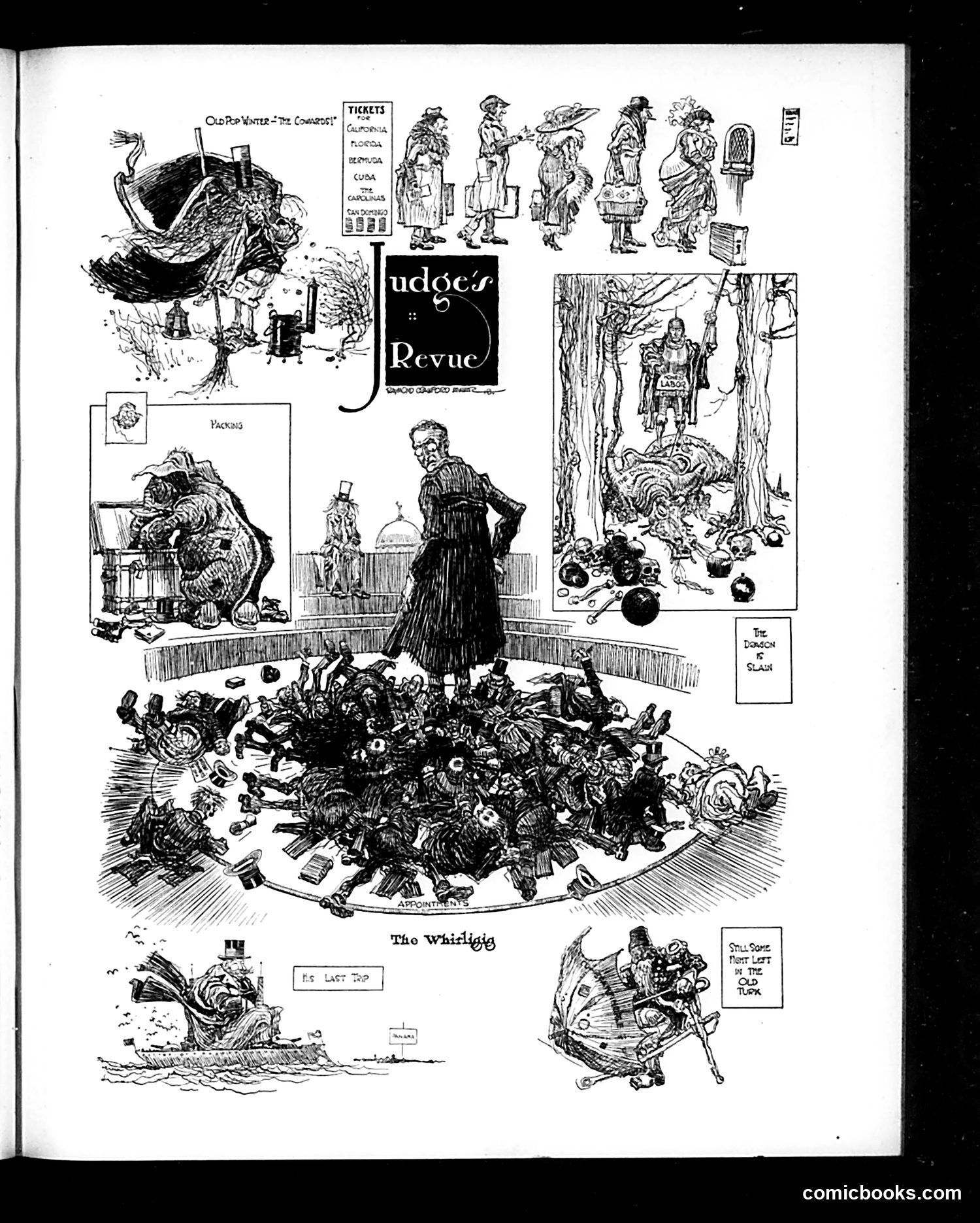
This appears to be a satirical collage from Judge magazine featuring multiple cartoon vignettes. The central image shows a tall figure presiding over a chaotic mass of people, labeled "APPOINTMENTS," suggesting critique of political patronage or cronyism in government hiring. The surrounding smaller cartoons include references to international destinations (tickets showing "FLORIDA," "CUBA," "PANAMA"), street vendors, and shipping scenes labeled "The Whitfield," "His Last Trip," and "Still Some Flotsam Left in the Old Hulk." The overall theme appears to satirize government inefficiency, corruption, or mismanagement during what seems to be an early 20th-century political administration. The collage style mocks various aspects of contemporary governance and bureaucratic chaos, though specific figures and events remain unclear without additional historical context.
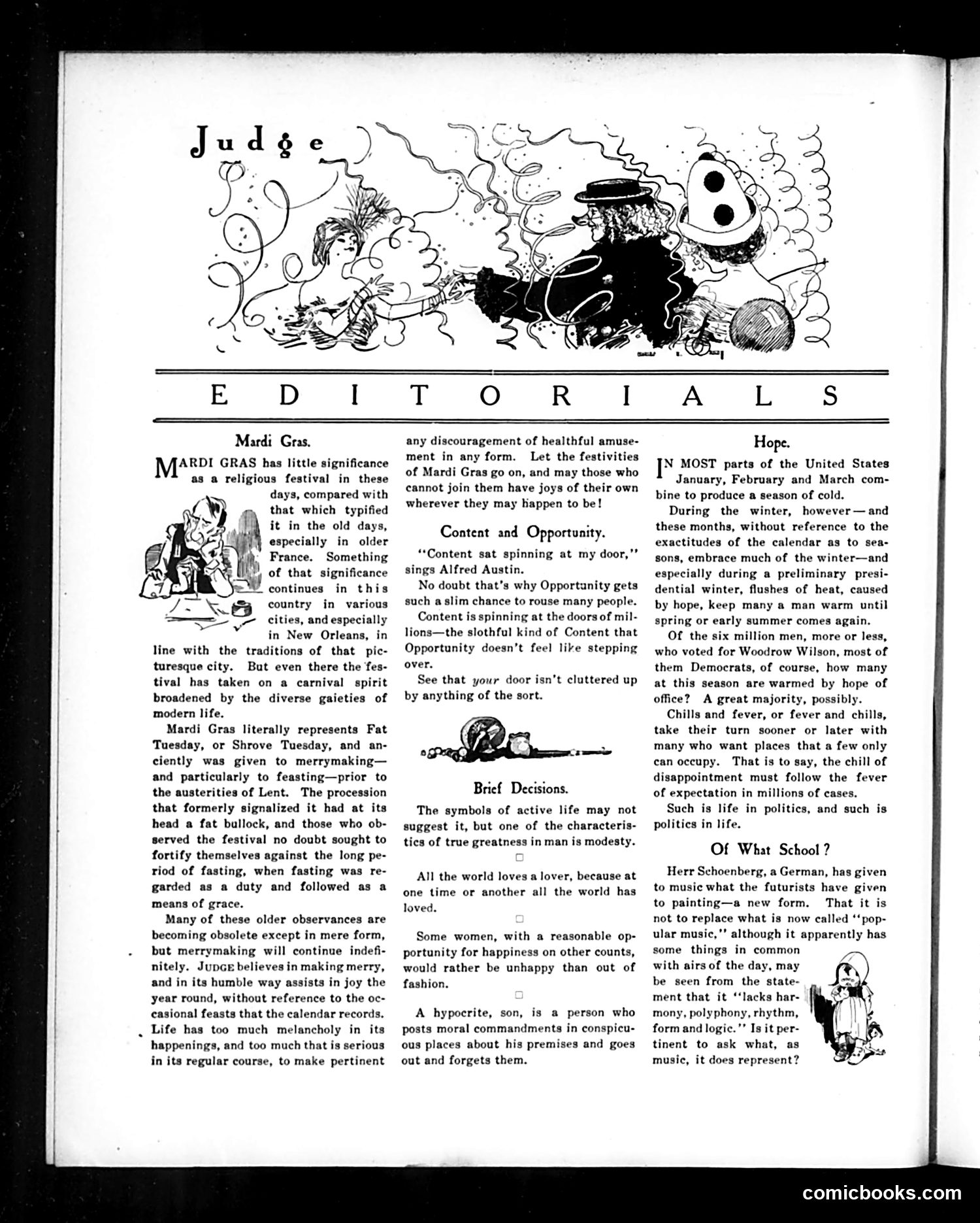
This page contains editorials and brief opinion pieces rather than political cartoons. The main sections discuss: **"Mardi Gras"** — defends the carnival tradition against those seeking to eliminate it, arguing the festivity serves a purpose in maintaining joy during the austere Lenten season. **"Content and Opportunity"** — satirizes people who complain constantly rather than seizing available opportunities, using the character "Content" as a foil to "Opportunity." **"Hope"** — addresses winter melancholy in America, noting that many (including "Democrats" who voted for Woodrow Wilson) find seasonal hope in anticipating spring's return. **"Of What School?"** — briefly discusses a new German musical form called "popular music" that allegedly lacks traditional harmonic elements. The page functions as editorial commentary on contemporary social attitudes and seasonal American life rather than containing visual political satire.
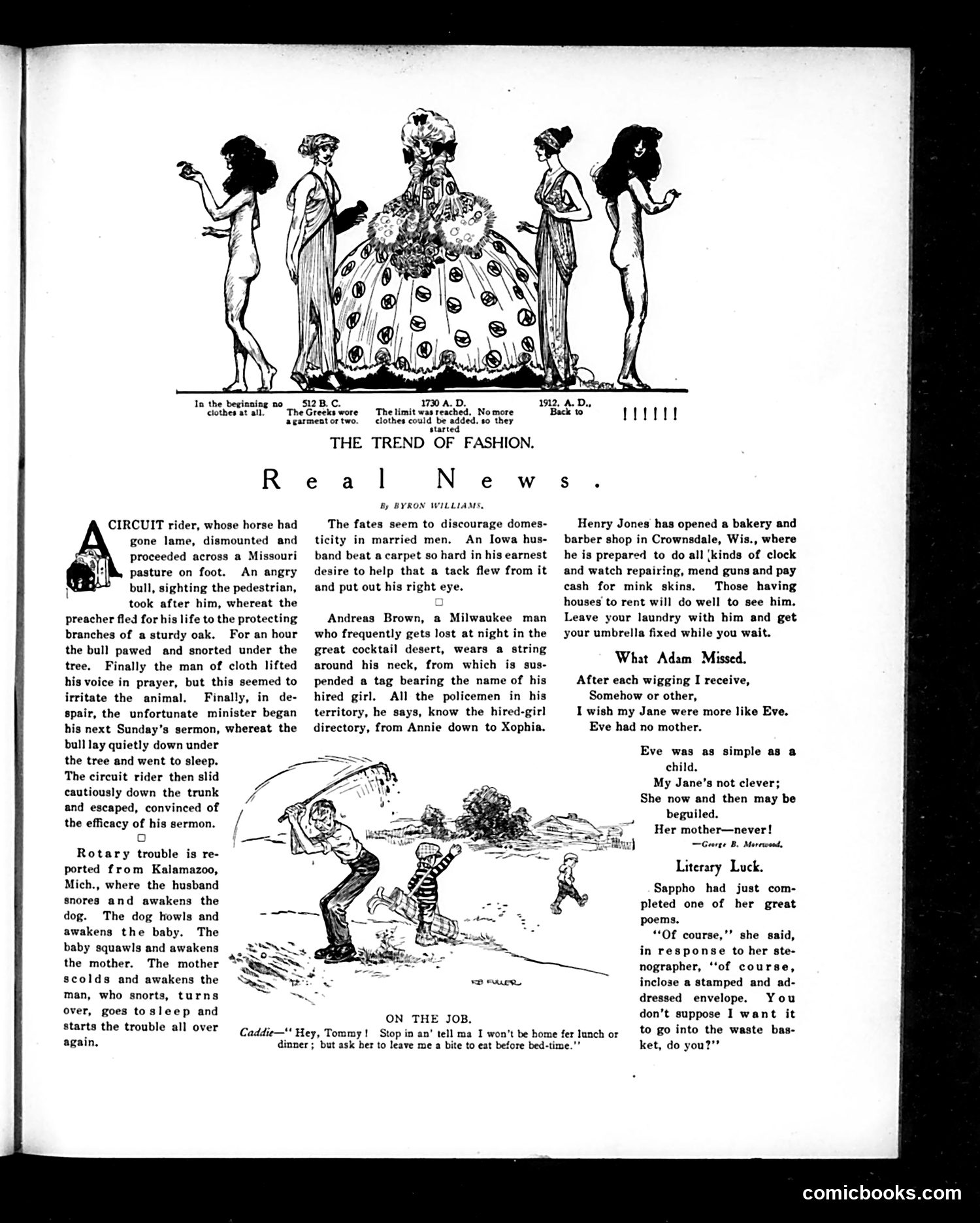
**Top Section - "The Trend of Fashion":** This historical illustration traces women's clothing from 512 B.C. through 1913 A.D., showing progressive exposure and less restrictive garments. The satire critiques contemporary fashion trends—specifically the increasing skimpiness and abandonment of Victorian modesty standards by 1913. The central figure in the elaborate dress represents how far fashion had "evolved" (or devolved, from the satirist's perspective), flanked by increasingly underdressed women representing earlier historical periods moving toward modern times. **"Real News" Section:** Brief humorous anecdotes and puns about everyday mishaps and ironies. Includes a cartoon showing children playing, with social commentary on domestic life. The writing style is characteristic of Judge's lighthearted satirical approach to contemporary American life and manners. The page blends fashion critique with general social humor typical of early 1910s satirical journalism.
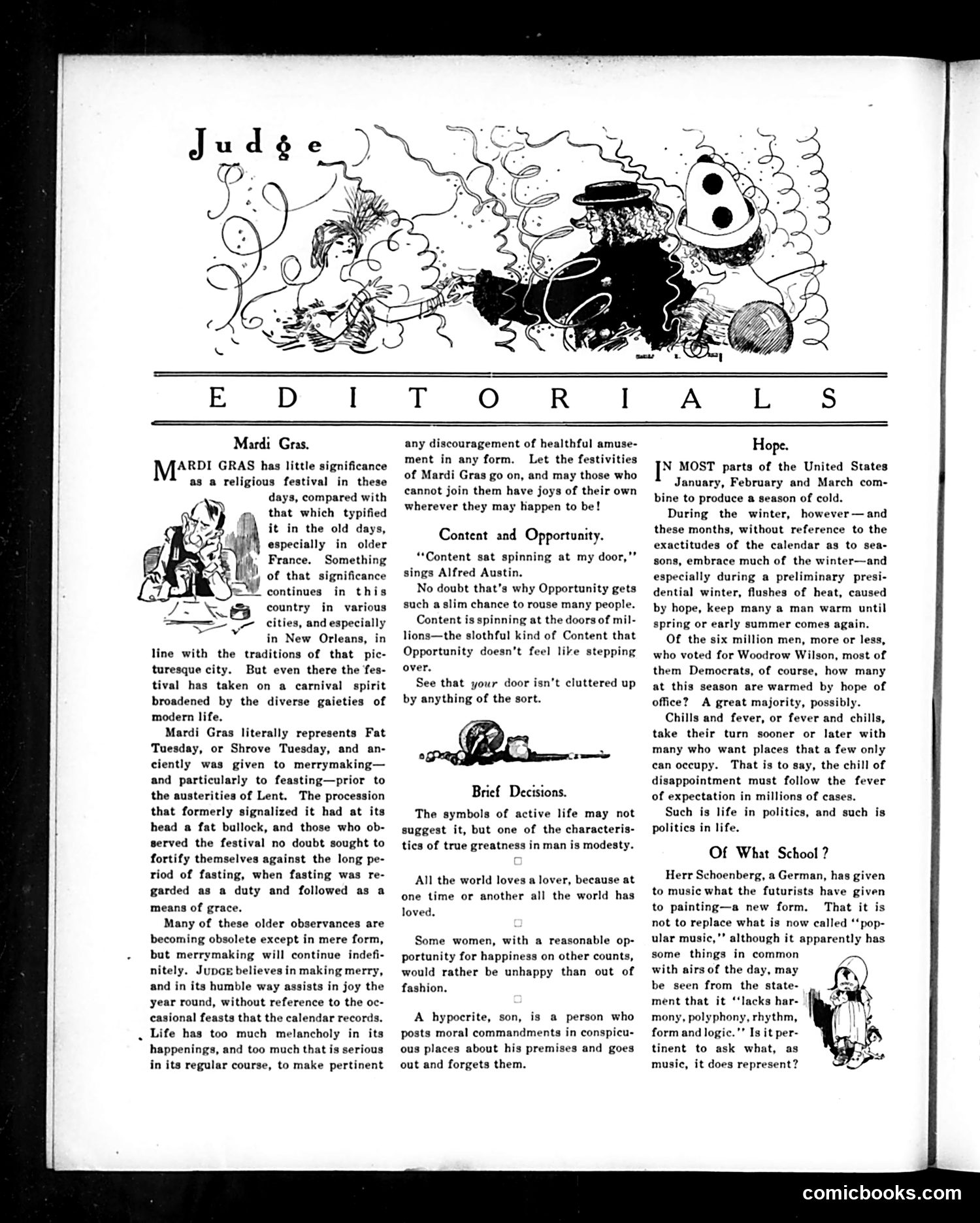
This editorial page from *Judge* magazine (date unclear from image) contains several satirical commentaries on American life: **Mardi Gras**: The opening essay defends the continuation of Mardi Gras festivities in New Orleans, arguing that despite the holiday's fading religious significance, celebrating is valuable because "life has too much melancholy" and merrymaking serves a social purpose. **"Content and Opportunity"**: A brief satire suggesting that complacency ("Content") prevents people from seizing opportunities—the slothful are too comfortable to act. **Political Commentary**: The "Hope" section appears to mock Democratic office-seekers following Woodrow Wilson's election, suggesting the fever of hope for government positions will inevitably give way to chills of disappointment when positions run out. **Schoenberg's Music**: The final piece satirizes German composer Arnold Schoenberg's experimental music (apparently lacking harmony, rhythm, and logic), positioning it as another example of avant-garde excess alongside futurist painting. The cartoons and snippets function as typical *Judge* fare: gentle social and political satire targeting pretension, complacency, and extremism.
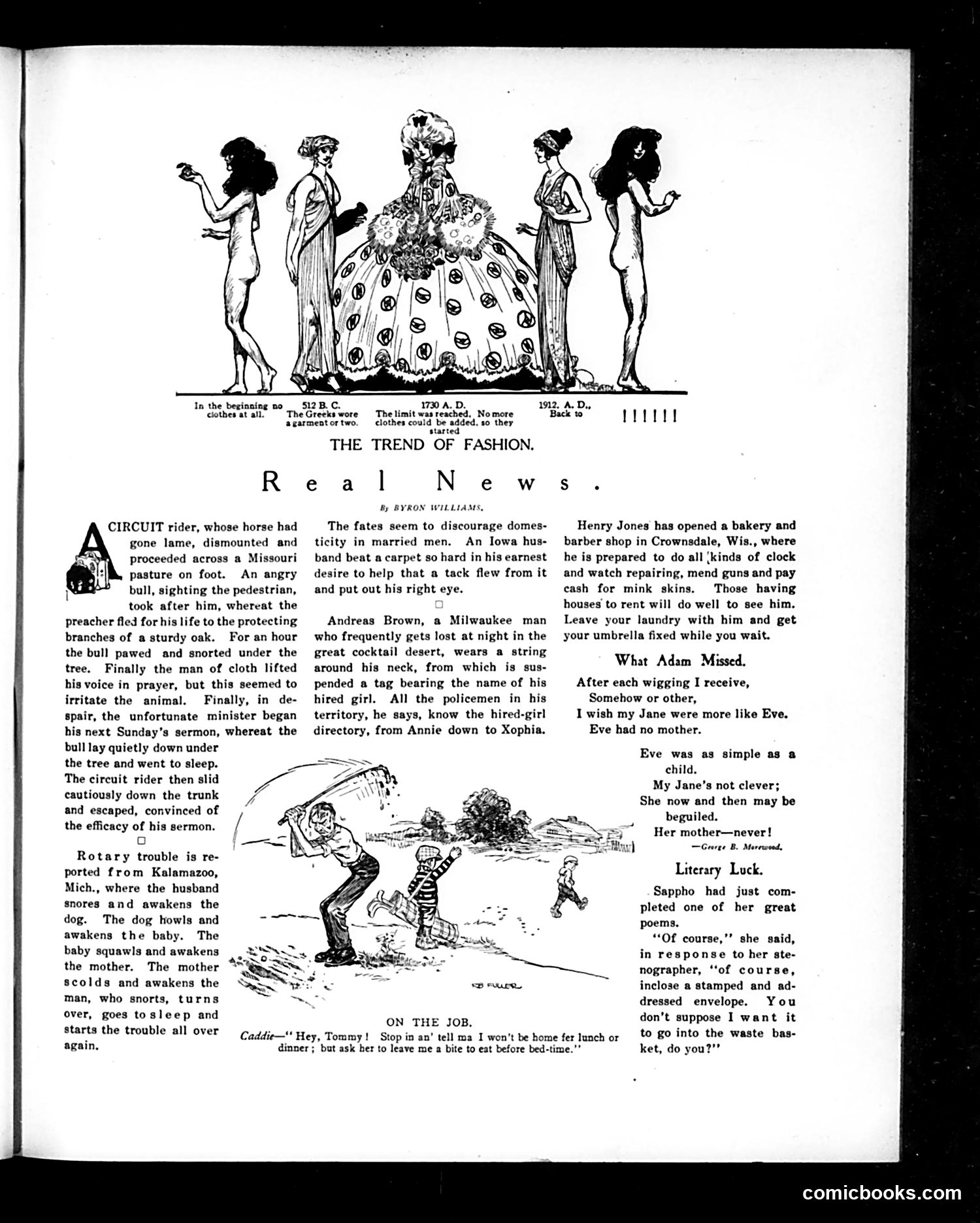
This page satirizes early 20th-century American life through humorous anecdotes and a fashion history illustration. **Top illustration**: Shows women's clothing evolution from 512 B.C. (nude) through 1730 A.D. (increasingly elaborate) to 1912 A.D. (modest dress). The satire suggests fashion reached maximum decoration by 1730, then retreated toward simplicity—mocking both historical excess and contemporary debates about women's clothing. **"Real News" stories** mock domestic mishaps and social absurdities: a circuit preacher escapes a bull by boring it with a sermon; a husband's snoring creates a domino effect of household chaos; an Iowa man injures himself helping with chores; a Milwaukee man wears an ID tag identifying his hired girl (suggesting he frequently gets lost or disoriented, likely from drinking). **Right column** includes sentimental verse about Adam wishing his wife Eve had "no mother" (implying mothers-in-law cause marital discord), and a joke about poet Sappho wanting her rejected manuscript returned in a self-addressed envelope. The overall tone: affectionate mockery of contemporary American married life and modern conveniences gone wrong.
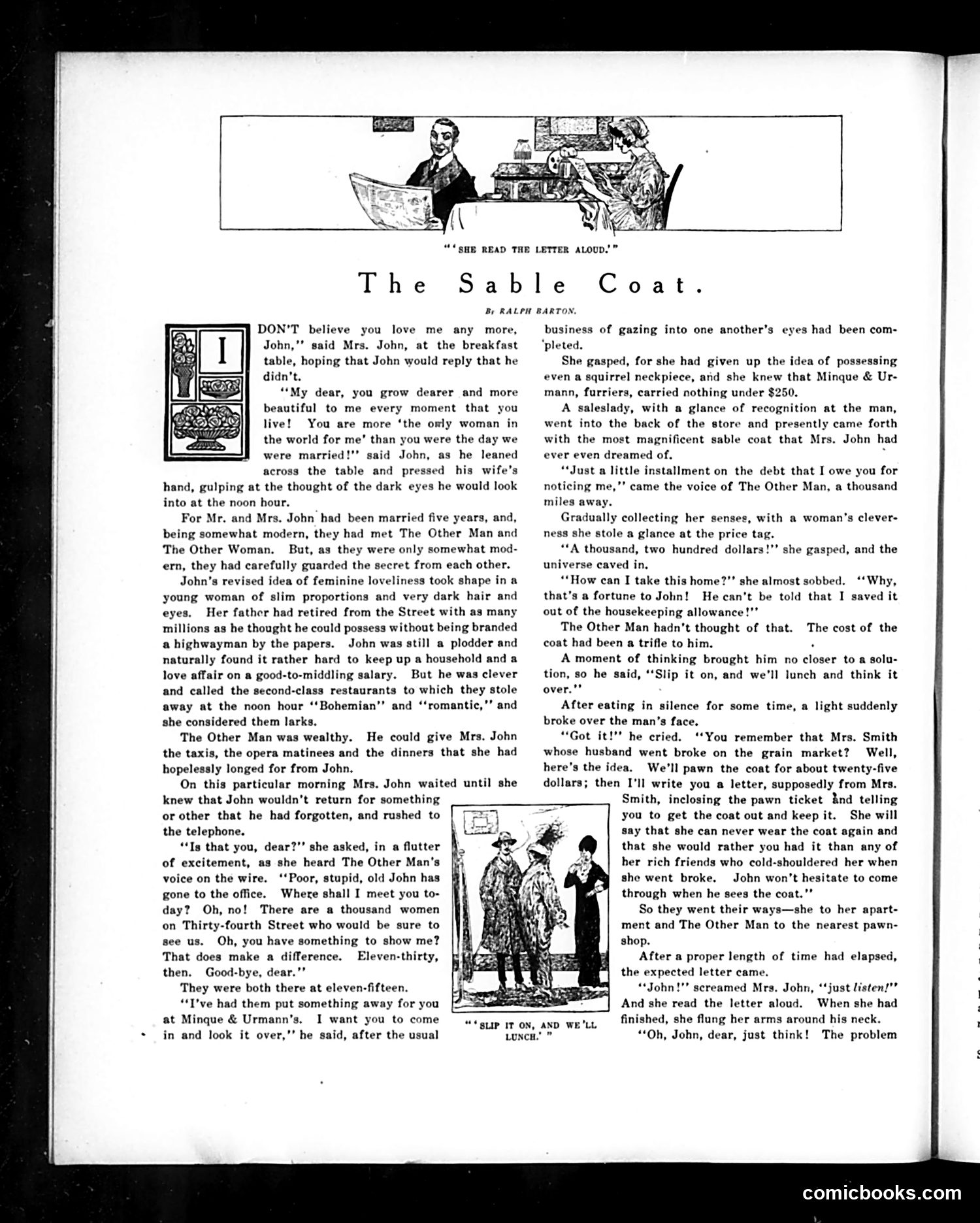
This satirical story mocks the moral compromises of the modern wealthy class circa 1920s. The plot depicts a married couple—John and Mrs. John—who each secretly maintain affairs with wealthier lovers ("The Other Man" and "The Other Woman"). John, a struggling office worker, cannot afford his wife's desires; her wealthy paramour lavishes her with a $1,200 sable fur coat. The satire targets several contemporary anxieties: marital infidelity among the "somewhat modern" set; the gap between working-class and wealthy lifestyles; women's material desires; and the elaborate deceptions required to maintain dual lives. When Mrs. John panics about explaining the coat to her husband, her lover's solution involves pawning it and fabricating a story about a broke acquaintance—adding fraud to infidelity. Barton presents this as absurd rather than scandalous, suggesting such behavior was becoming normalized among sophisticated urban Americans during the Jazz Age.
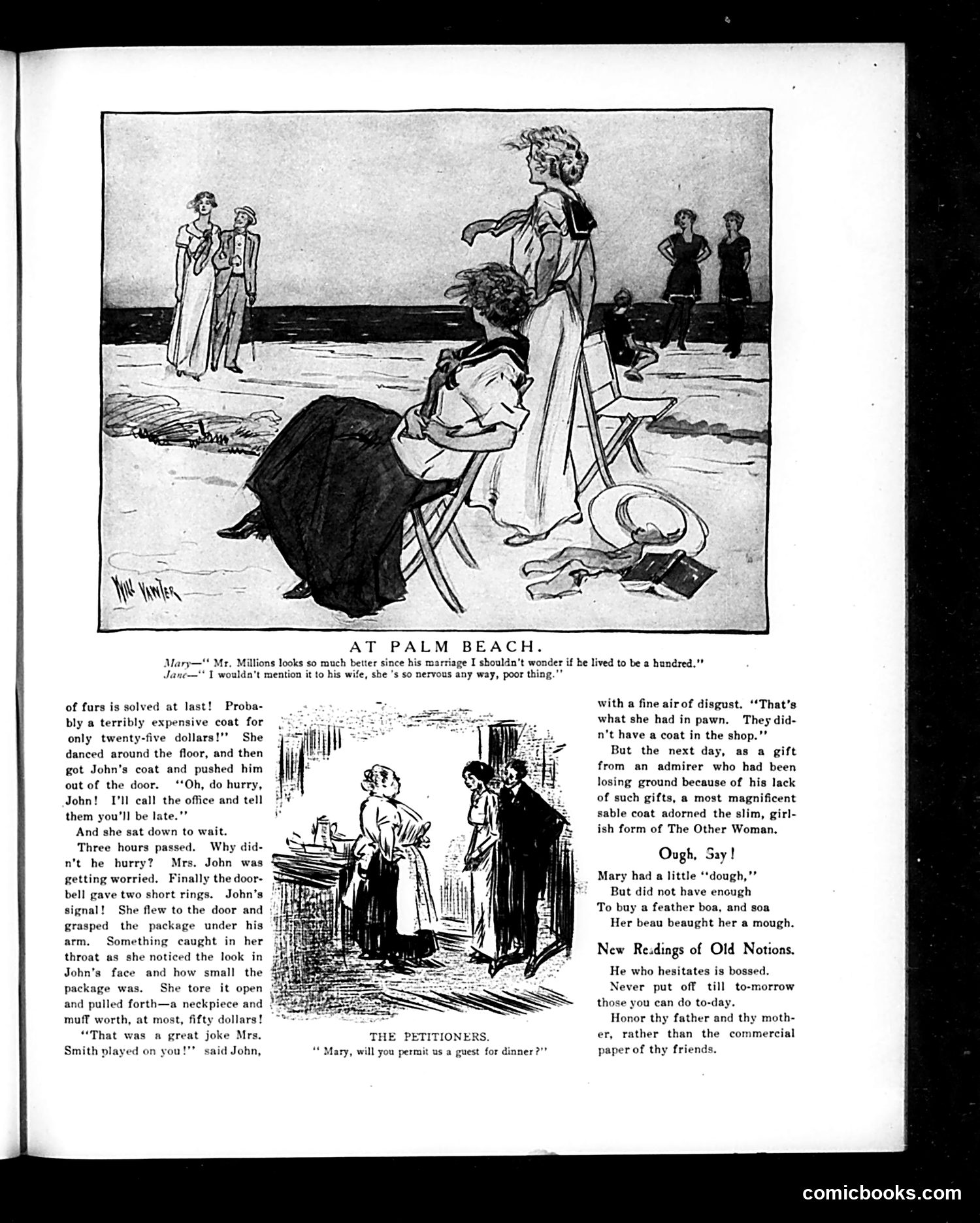
This page contains two satirical pieces about wealth and marriage in early 20th-century high society. **"At Palm Beach"** (top cartoon) mocks wealthy marriages. Two society women discuss "Mr. Millions," suggesting his new wife's nervousness might shorten his life—implying she married him for money and anxiously awaits his death. The joke targets both gold-diggers and the notion that wealth alone improves marriages. **"The Petitioners"** (middle illustration) depicts a domestic conflict: John's wife demands an expensive fur coat. When he returns with only a cheap neckpiece (claiming it's a joke), we learn his mistress ("The Other Woman") receives a luxurious sable coat from an admirer the next day. The satire exposes marital infidelity and the economic disparity between wives and mistresses in wealthy circles. **"New Readings of Old Notions"** (right column) offers sardonic moral inversions, mocking conventional wisdom—particularly the final jab about honoring parents over creditors, suggesting financial obligation supersedes family duty in modern society.
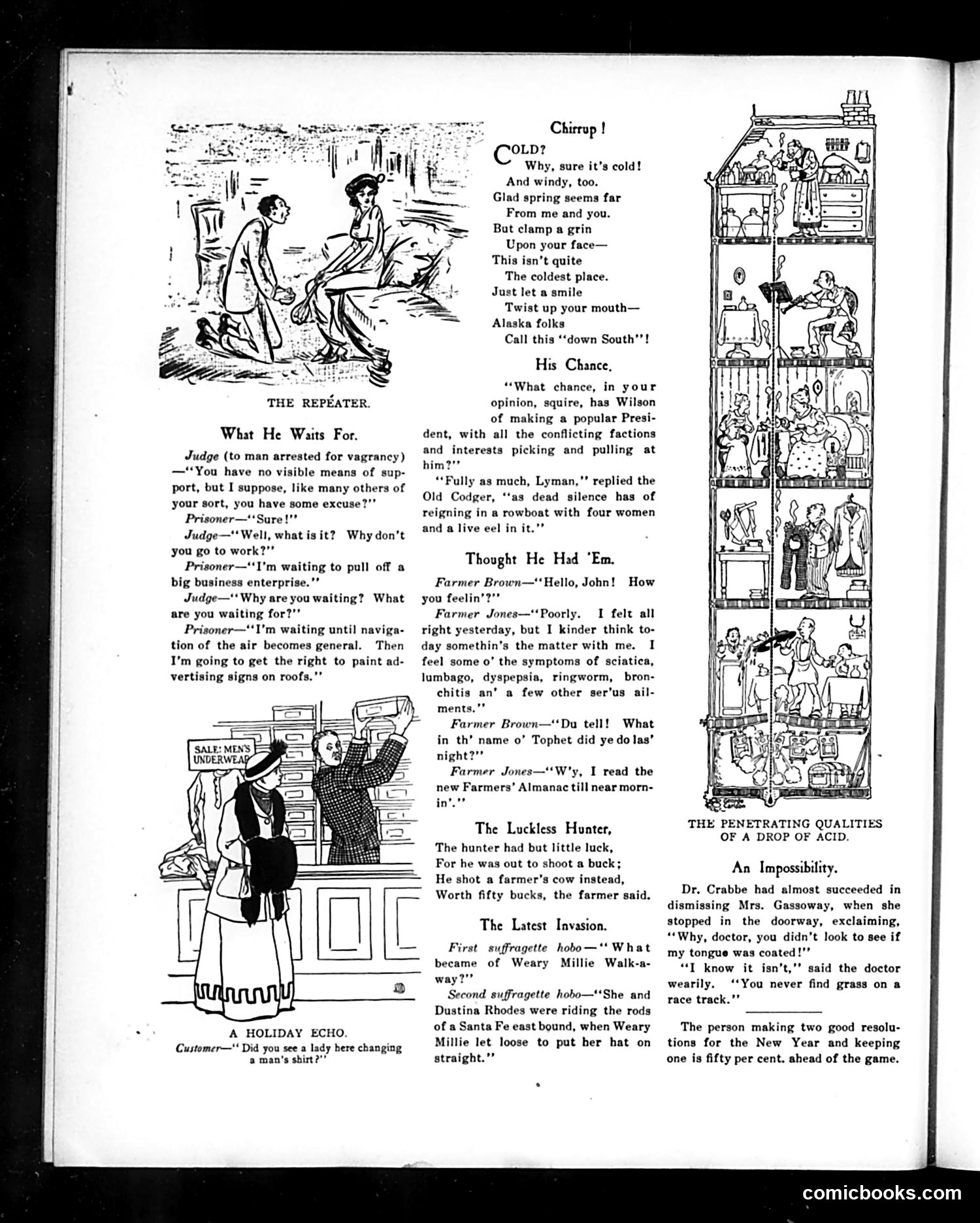
This page contains several satirical pieces reflecting early 20th-century American concerns: **"What He Waits For"**: A vagrant claims he's waiting for widespread air navigation to become legal so he can paint advertisements on roofs—mocking both unemployed dreamers and the era's growing fascination with aviation as a business opportunity. **"His Chance"**: References President Wilson's political difficulties, with an old codger comparing his chances of uniting fractious factions to maintaining silence in a rowboat with four women and a live eel—absurdist humor about political impossibility. **"Thought He Had 'Em"**: A farmer attributes his ailments to reading the new Farmers' Almanac, playing on rural stereotypes and the period's obsession with medical symptom-checking. **Minor pieces** mock suffragettes, overeager doctors, and New Year's resolutions. The "Penetrating Qualities of Acid" section uses medical humor to demean a talkative woman patient—typical period misogyny. The overall tone reflects Judge's satirical take on contemporary American life, politics, and social pretensions.
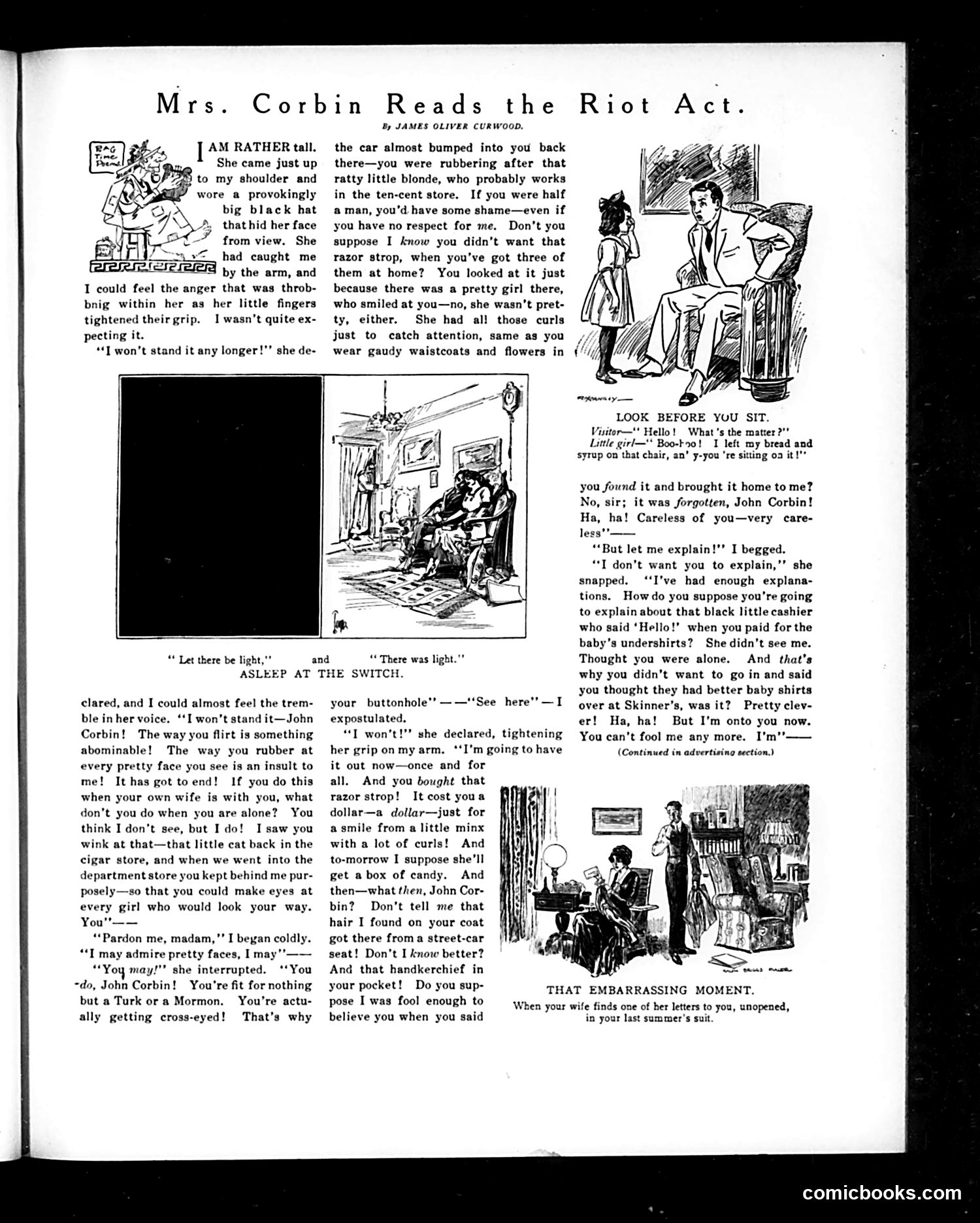
This page presents a domestic comedy story titled "Mrs. Corbin Reads the Riot Act" by James Oliver Curwood. The main narrative depicts a wife confronting her husband, John Corbin, about his flirtatious behavior—ogling women in stores, winking at shopgirls, and making suspicious purchases (a razor strop he didn't need, apparently bought to impress a pretty cashier). She catalogs his infractions: noticing a blonde on the street, lingering in department stores, finding mysterious hair on his coat and an unexplained handkerchief. The satire targets early 20th-century male infidelity and the marital tensions it creates. The wife's fury—expressed through her physical grip and escalating accusations—represents female exasperation with casual male philandering. Two smaller cartoons appear: "Asleep at the Switch" and "That Embarrassing Moment" (about a wife finding an unopened letter in old clothing), both playing on domestic mishaps and marital awkwardness. The humor relies on recognizable middle-class domestic conflict, presented as entertainment for Judge's readers.
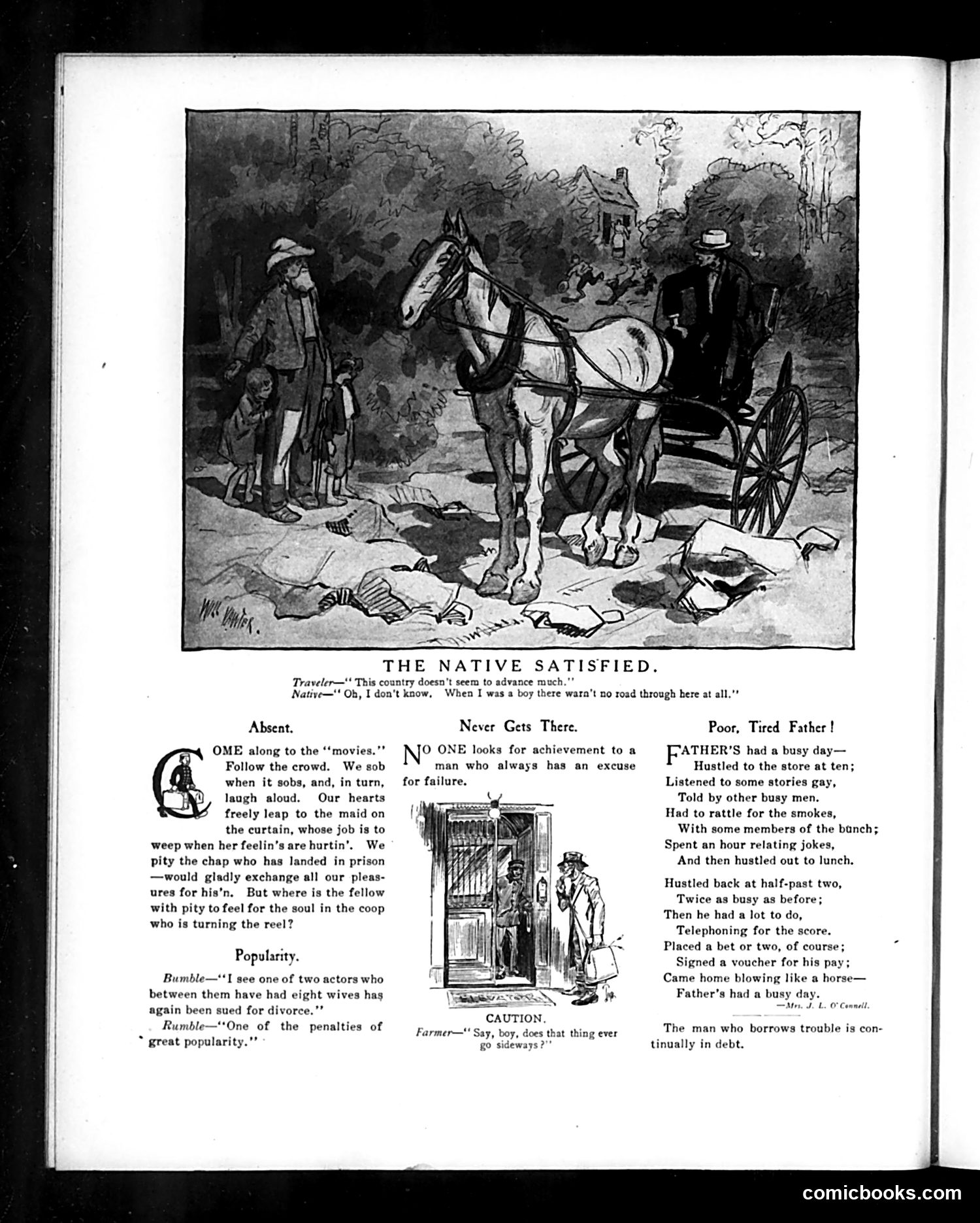
The main cartoon satirizes complacency about progress. A traveler remarks that the country "doesn't seem to advance much," while a native counters that merely having a road where none existed constitutes improvement. The joke critiques low expectations—the native measures progress by minimal standards rather than genuine development. The surrounding pieces mock various social behaviors: moviegoers' emotional manipulation by films; actors' marital scandals treated as inevitable to fame; and the "busy father" who fills his day with trivial errands (placing bets, arranging smokes) rather than meaningful work, then exhausts himself rushing between tasks. These sketches satirize early 20th-century American culture—superficial entertainment consumption, celebrity gossip, and the performative busyness of middle-class masculinity masking actual idleness or moral emptiness.
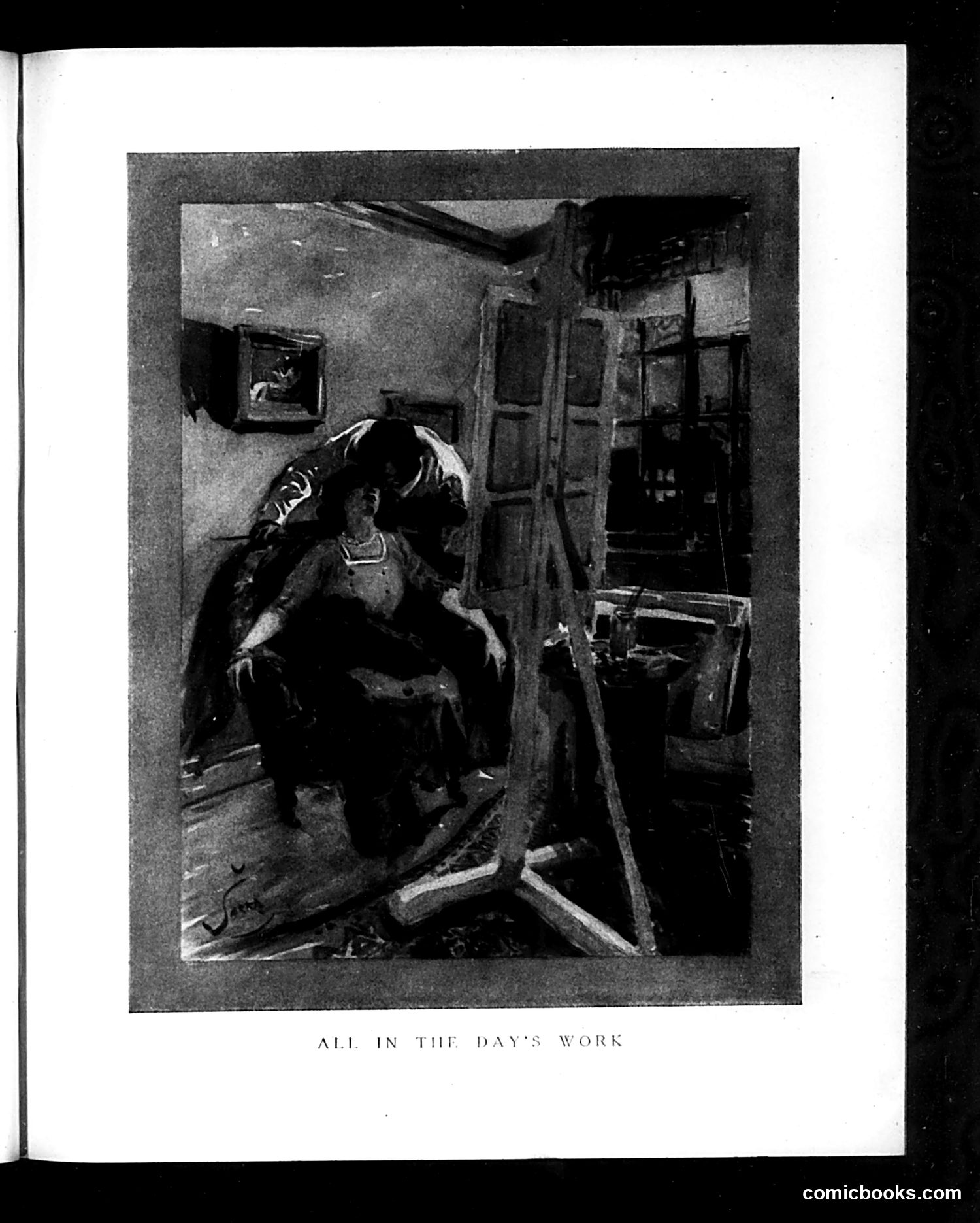
This appears to be a dramatic illustration rather than a political cartoon. It depicts a woman in dark clothing seated indoors, seemingly exhausted or distressed. The domestic interior setting—with visible doors, furniture, and household items—suggests the subject is a housewife or domestic worker. The title "All in the Day's Work" likely comments satirically on women's domestic labor, a common Judge magazine theme. The woman's posture and expression convey weariness, suggesting the satire critiques the endless, thankless nature of housework. Without additional context or publication date, it's unclear whether this addresses specific labor reforms, gender roles, or servants' working conditions that were contemporary concerns.
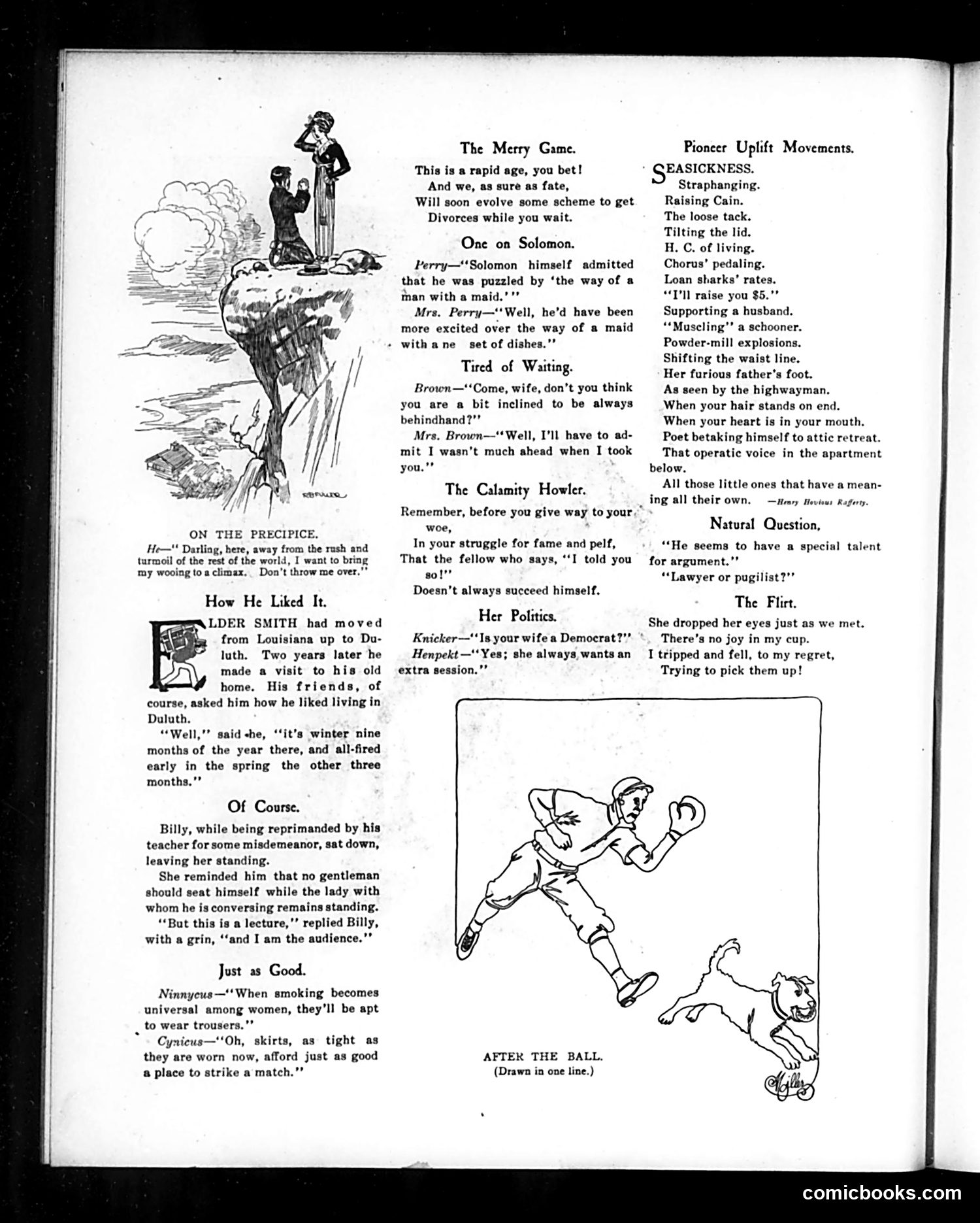
This page contains multiple short satirical pieces typical of early 20th-century American humor magazines: **"On the Precipice"** mocks romantic clichés—a man's dramatic proposal near a cliff edge. **"How He Liked It"** satirizes regional differences: a man relocates from Louisiana to Duluth and complains about the brutal winters, implying the North's climate is inhospitable. **"Of Course"** jokes about gender norms: a boy sits while his teacher scolds him, then quips that since she's lecturing, he's merely the audience—subverting expectations of gentlemanly conduct. **"The Merry Game"** and other brief pieces mock contemporary issues: easy divorce, marital dynamics, women's emerging social roles (smoking, political participation), and workplace hazards. **"Her Politics"** uses a pun: a wife who's a "Democrat" wanting "extra sessions" humorously conflates political affiliation with domestic nagging. The overall tone reflects Progressive Era anxieties about changing gender roles, modernization, and social conventions—presented through lighthearted, cynical humor typical of Judge's satirical approach.
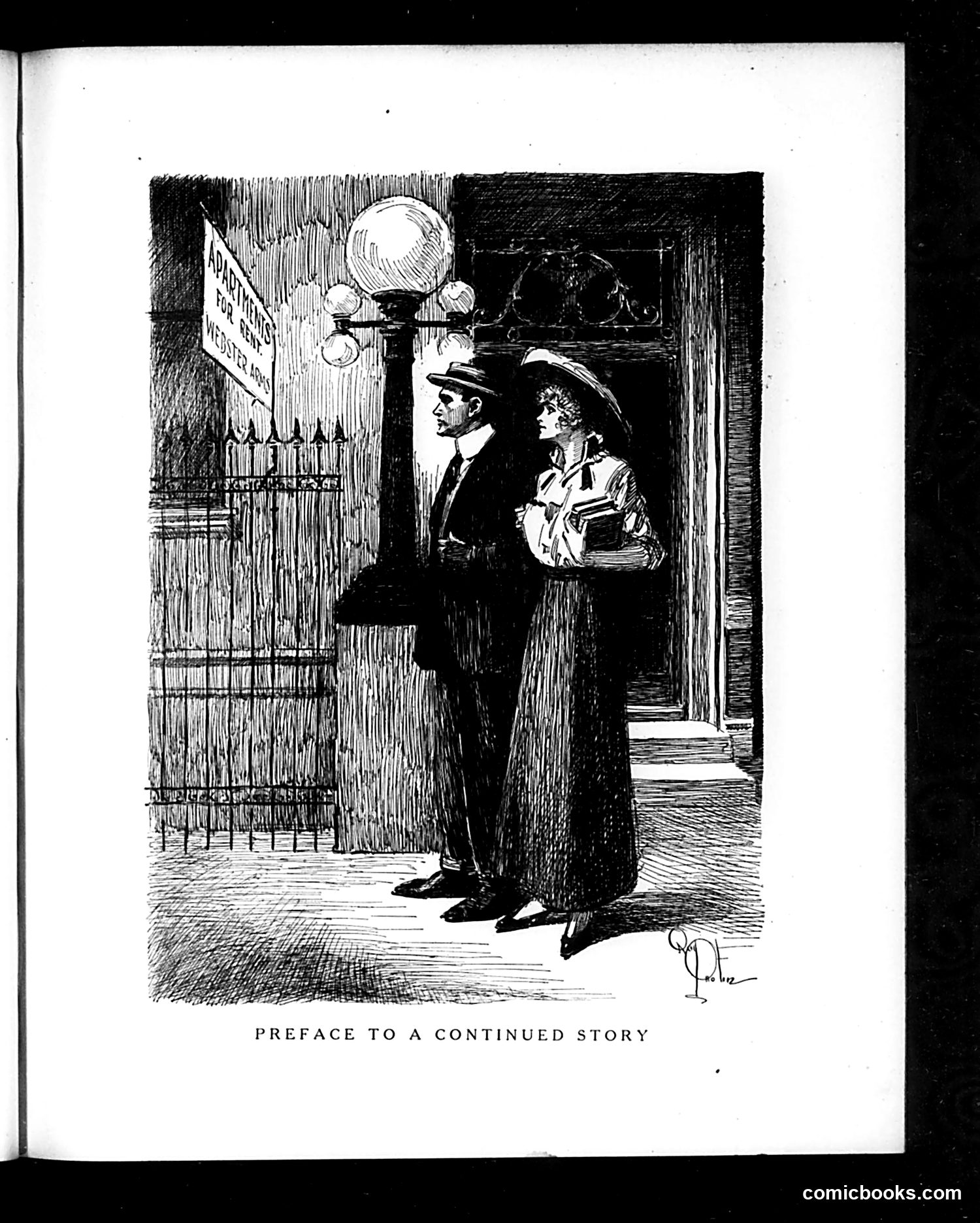
This illustration depicts a well-dressed man in a hat and suit standing with a fashionably dressed woman at what appears to be an elegant doorway or entrance. A sign reading "PRIVATE" is visible on the wall behind them. The title suggests this image introduces an ongoing narrative or serialized story. Without additional context from Judge magazine's publication date or surrounding articles, the specific satirical point remains unclear. However, the scene's emphasis on privacy, coupled with the couple's formal attire and the "continued story" framing, likely satirizes social scandal, romantic intrigue, or moral hypocrisy among the wealthy elite—common Judge magazine subjects. The artwork's style and composition suggest early-to-mid 20th century publication.
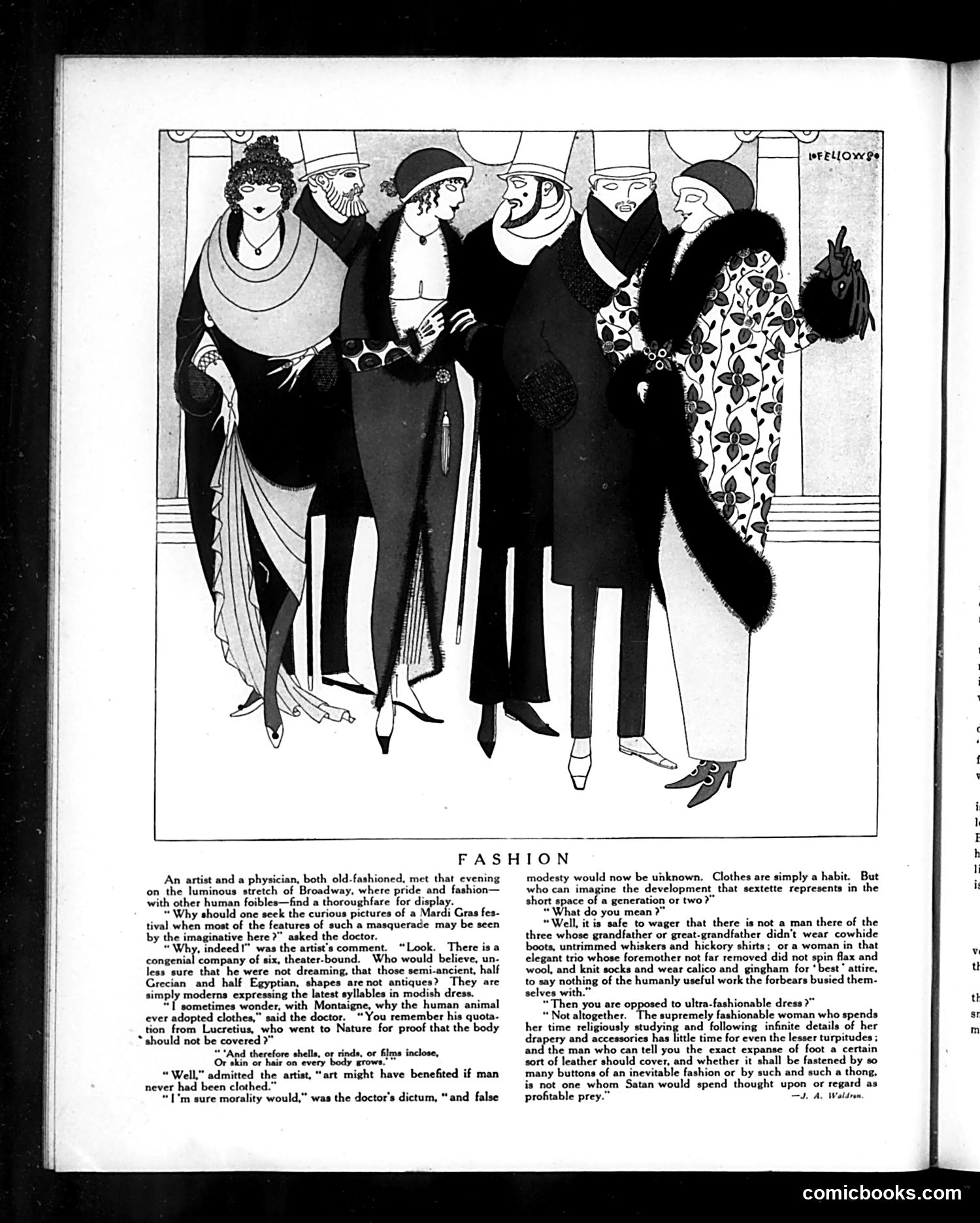
This satirical dialogue depicts two old-fashioned gentlemen (an artist and physician) observing well-dressed theatergoers on Broadway. The cartoon mocks the absurd extremes of 1920s fashion through their conversation. The satire works on two levels: First, it jokes that Broadway's fashionable crowds rival a Mardi Gras masquerade in their theatrical excess. Second, the dialogue contrasts modern fashion with natural simplicity—quoting classical philosophers (Montaigne, Lucretius) who questioned whether humans should wear clothes at all. The humor peaks when they observe the elegant six and marvel at how drastically fashion has evolved in merely one or two generations: their grandparents wore practical cowhide boots and homespun clothes, while current fashionable people obsess over minute details like button placement and leather expanse. The final twist—that excessive fashion-obsession actually *prevents* moral corruption—offers ironic social commentary on vanity as an inadvertent moral guardian.
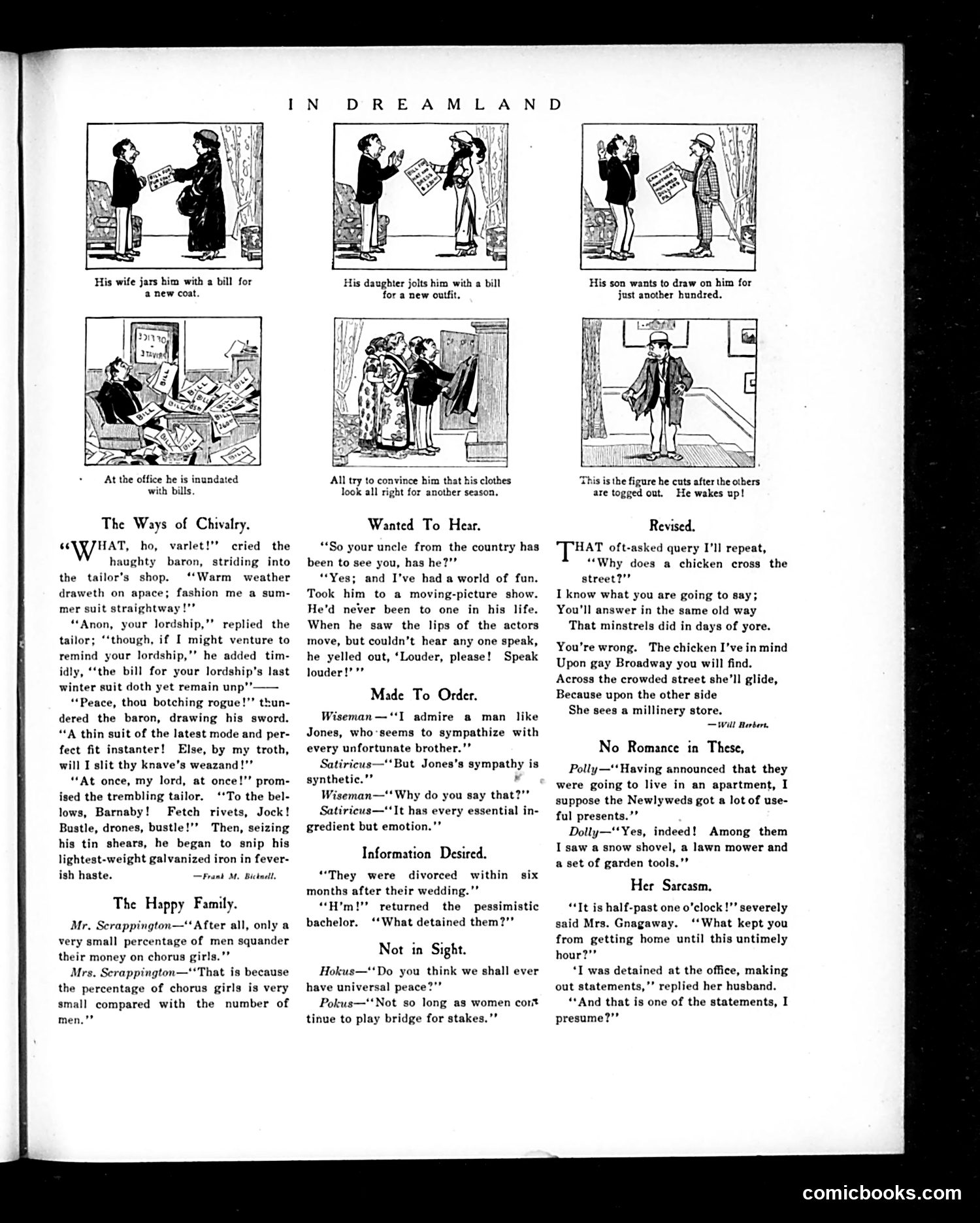
This page from *Judge* magazine presents a series of satirical sketches mocking domestic financial conflicts and social pretensions of the early 20th century. **Top Comic Strip ("The Ways of Chivalry"):** A husband repeatedly dodges payment obligations—his wife presents bills for a coat, his daughter for an outfit, his son for money—while he's "inundated with bills" at the office. The punchline: after others are dressed fashionably, he cuts a ridiculous figure. The satire targets husbands who prioritize appearing authoritative and chivalrous while avoiding financial responsibility to their families. **Other Sketches:** "The Happy Family" jokes that few men waste money on chorus girls only because there aren't enough chorus girls. "Wanted to Hear" mocks rural unsophistication at silent movies. "No Romance in These" sarcastically notes newlyweds received practical tools instead of romantic gifts—reflecting post-WWI economic constraints. Throughout, the humor targets masculine vanity, domestic financial strain, and changing social expectations around marriage and consumption during the early 20th century.
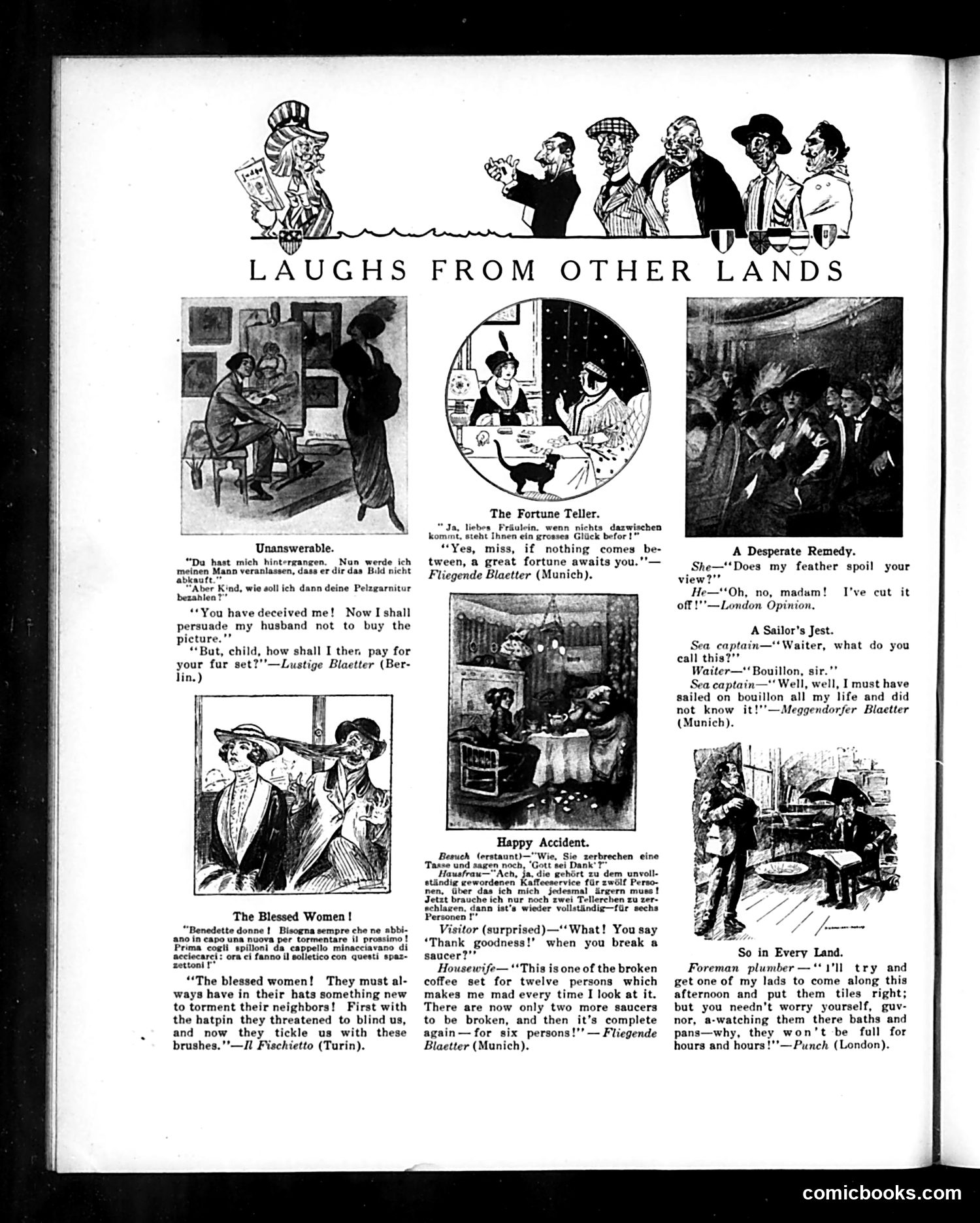
This page collects humorous anecdotes from European satirical magazines, translated for American readers. Each cartoon or joke targets domestic frustrations and social absurdities: **Key themes:** - **Women's fashion hazards**: Hatpins and feather boas that inconvenience others - **Marital economics**: A wife threatening to prevent a husband's art purchase over unpaid debts - **Domestic inconvenience**: A housewife perversely grateful when breaking dishes from an incomplete set, viewing breakage as progress toward a "complete" smaller set - **Class and service**: A plumber's cavalier promise of eventual work completion; a waiter's confusion about "bouillon" The satire mocks everyday frustrations—spousal manipulation, materialist anxiety, servant inefficiency, and women's fashion as social nuisance. The page's appeal lies in recognizing universal domestic comedy across national boundaries, reinforcing early 20th-century stereotypes about European life while suggesting shared middle-class complaints transcend borders.
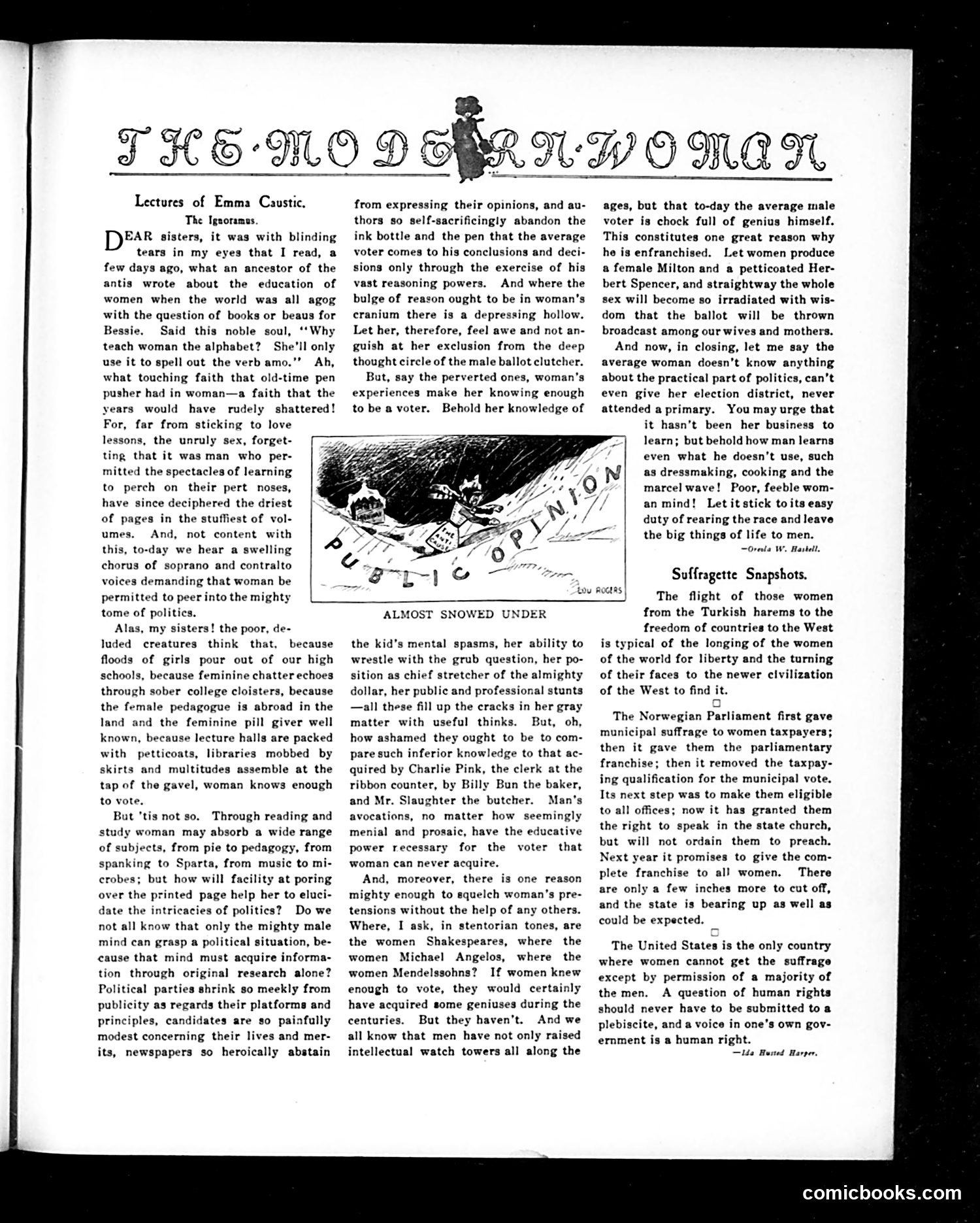
This satirical lecture mocks anti-suffrage arguments through heavy irony. "Emma Caustic" (a pseudonymous pen name) pretends to agree with opponents of women's suffrage, then systematically demolishes their reasoning. The cartoon "Almost Snowed Under" (artist appears to be Lou Rogers, based on signature) depicts a woman buried under household/domestic responsibilities—a visual metaphor for how women's actual lived experiences are dismissed as inferior to men's. The satire targets three key anti-suffrage claims: 1. **Women lack reasoning capacity**: The piece mocks the assertion that women's "cranium" has a "depressing hollow" where reason should be. 2. **Women's education doesn't count**: Despite women's demonstrated educational achievements, opponents claim book-learning cannot teach politics—only men somehow acquire this knowledge naturally. 3. **Women lack genius**: The rhetorical flourish about Shakespeare, Michelangelo, and Mendelssohn sarcastically suggests women's historical exclusion from opportunity proves inherent incapacity. The author exposes how anti-suffragists contradict themselves: women are simultaneously too educated *and* too ignorant to vote.
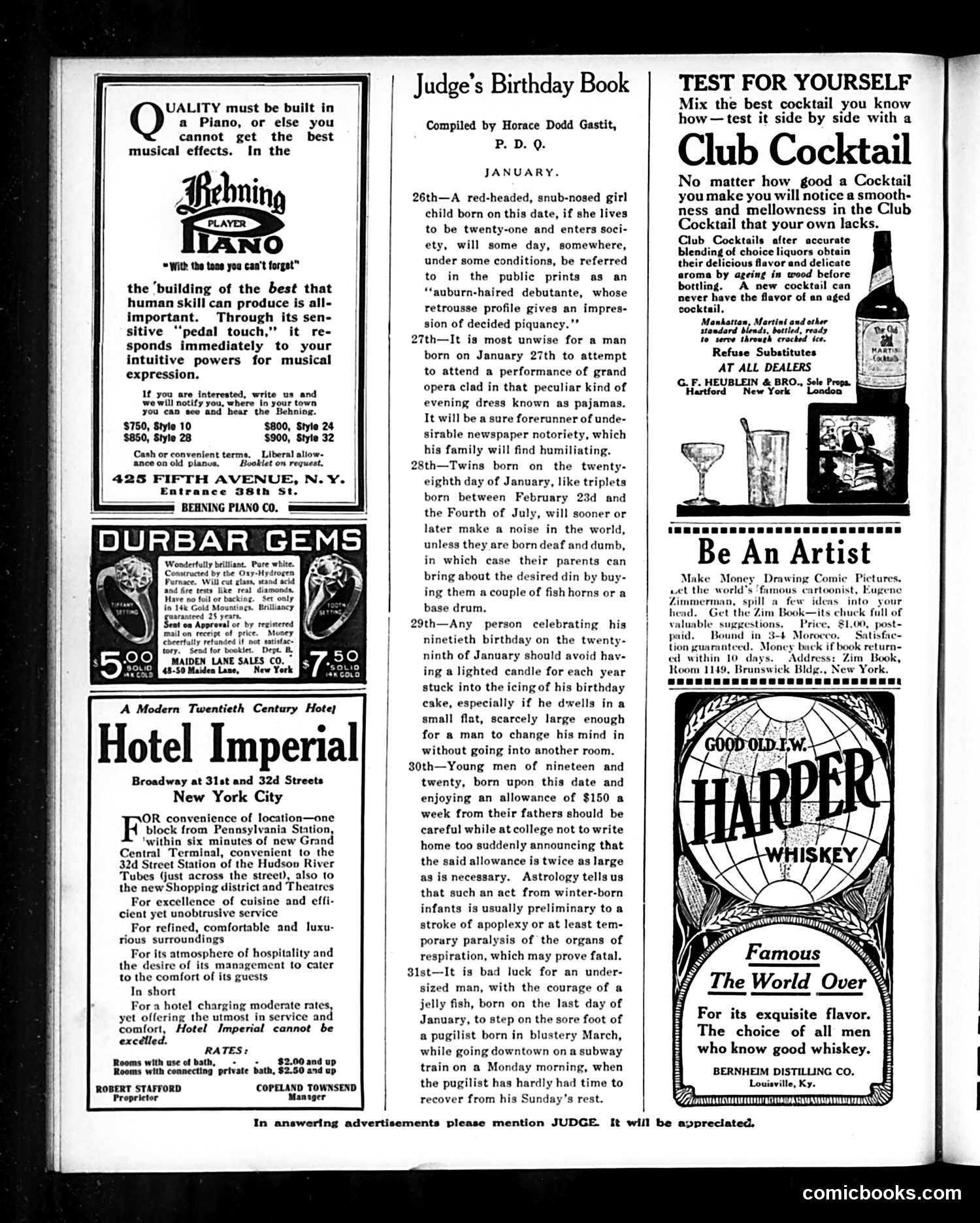
This page is primarily **advertising with satirical editorial content**. The left and lower sections contain conventional period ads for pianos, synthetic diamonds, and hotels. The **main satirical content** is the "Judge's Birthday Book" compiled by "Horace Dodd Gastit, P.D.Q." (likely a pseudonym). This features humorous, tongue-in-cheek "astrological" predictions for January birthdays. The jokes mock social pretension and human nature: a red-headed girl will be rebranded as "auburn-haired" by society; men born January 27th shouldn't wear pajamas to the opera; wealthy young men shouldn't boast about inflated allowances to their fathers. The satire targets **vanity, social climbing, and generational comedy**—typical Judge magazine fare. The "astrology" framing is the joke itself; these aren't real predictions but absurdist observations about human behavior and social conventions of the era (likely 1910s-1920s based on typography and advertising).
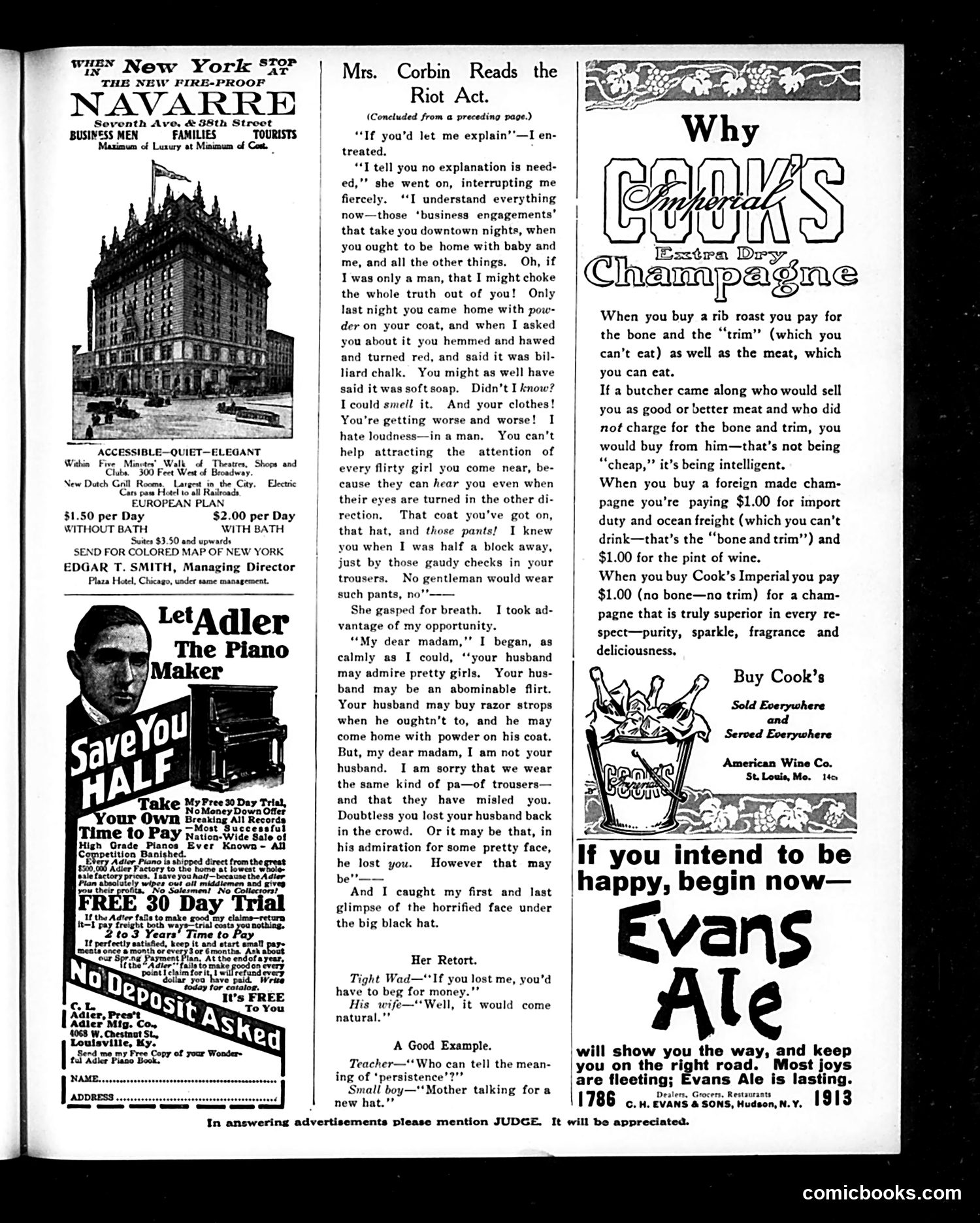
This page contains a serialized humorous narrative ("Mrs. Corbin Reads the Riot Act") depicting a marital confrontation. A wife confronts a man she believes is her unfaithful husband, accusing him of coming home with powder on his coat, wearing gaudy clothes, and attracting women's attention. The twist: he's a stranger she's mistaken for her spouse. The humor relies on the misidentification and her embarrassed retreat. The page is primarily **advertising**, featuring hotel, piano, and champagne ads typical of the era. The champagne ad uses an extended metaphor comparing buying imported champagne to buying a butcher's trim—you're paying for unwanted extras. This reflects early-20th-century marketing emphasizing domestic American products as economical alternatives to imports. The other brief jokes ("Tight Wad," "A Good Example") are light domestic humor about money and persistence, standard for Judge magazine's family-oriented satirical content.
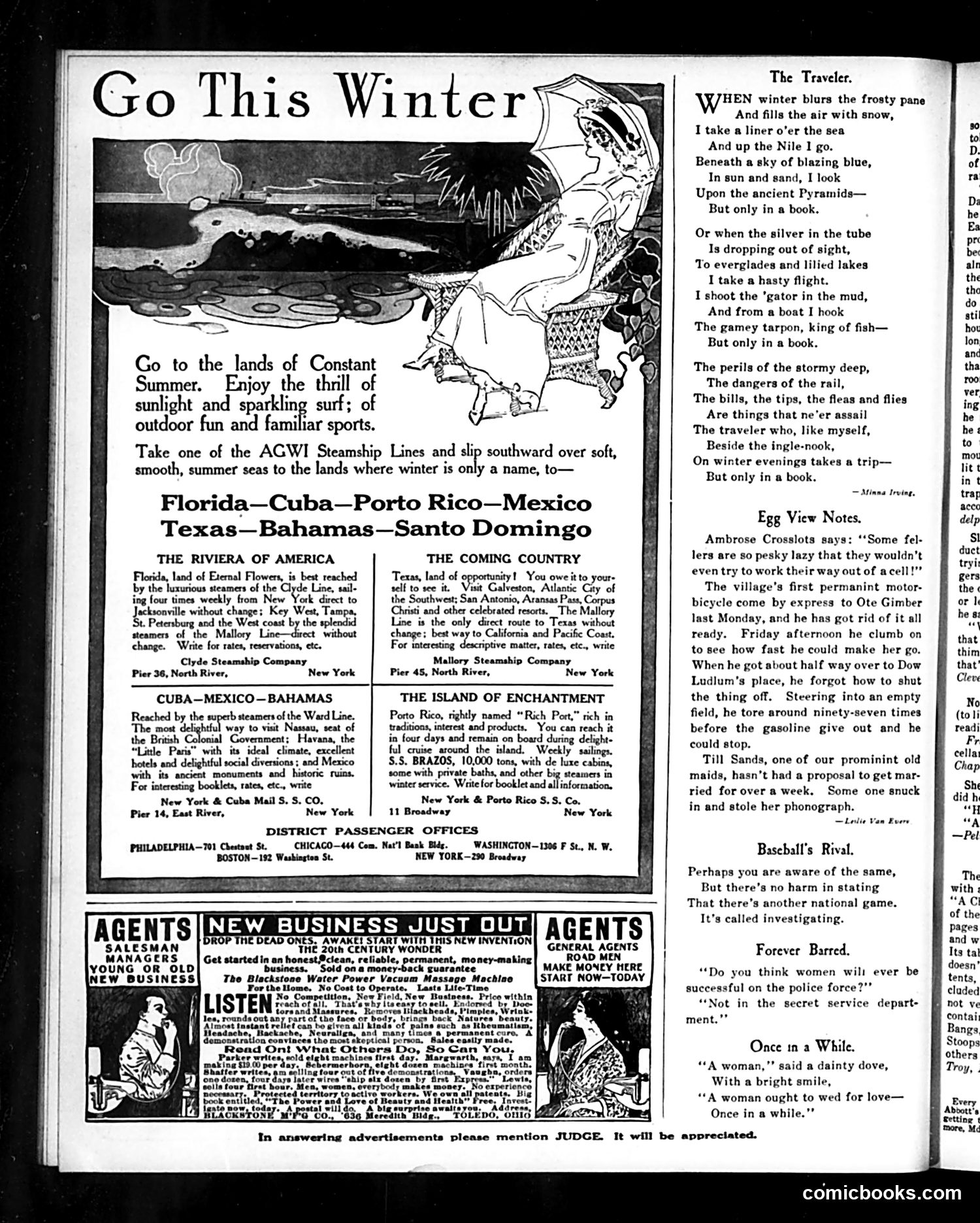
This page combines travel advertising with light satirical poetry. The main cartoon/illustration shows a woman in an armchair by a fireplace, imaginatively "traveling" through books while winter rages outside—visiting the Nile, Everglades, and hunting tarpon, all without leaving home. The satire gently mocks armchair travelers who experience adventure only through reading. The poem's repeated refrain "But only in a book" emphasizes this safe, vicarious experience. The page then pivots to aggressive advertising for AGWI Steamship Lines and competing steamship companies (Clyde Line, Ward Line, Mallory Line), promoting actual travel to Florida, Cuba, Puerto Rico, and Mexico—essentially mocking the poem's sedentary protagonist by offering real adventure. The lower advertisements recruit sales agents and promote a "20th Century Wonder" invention, typical of early 1900s magazine filler. The "Egg View Notes" gossip column includes unrelated anecdotes about village life. The overall effect: satire followed immediately by its contradiction—urging readers to actually travel rather than imagine it.
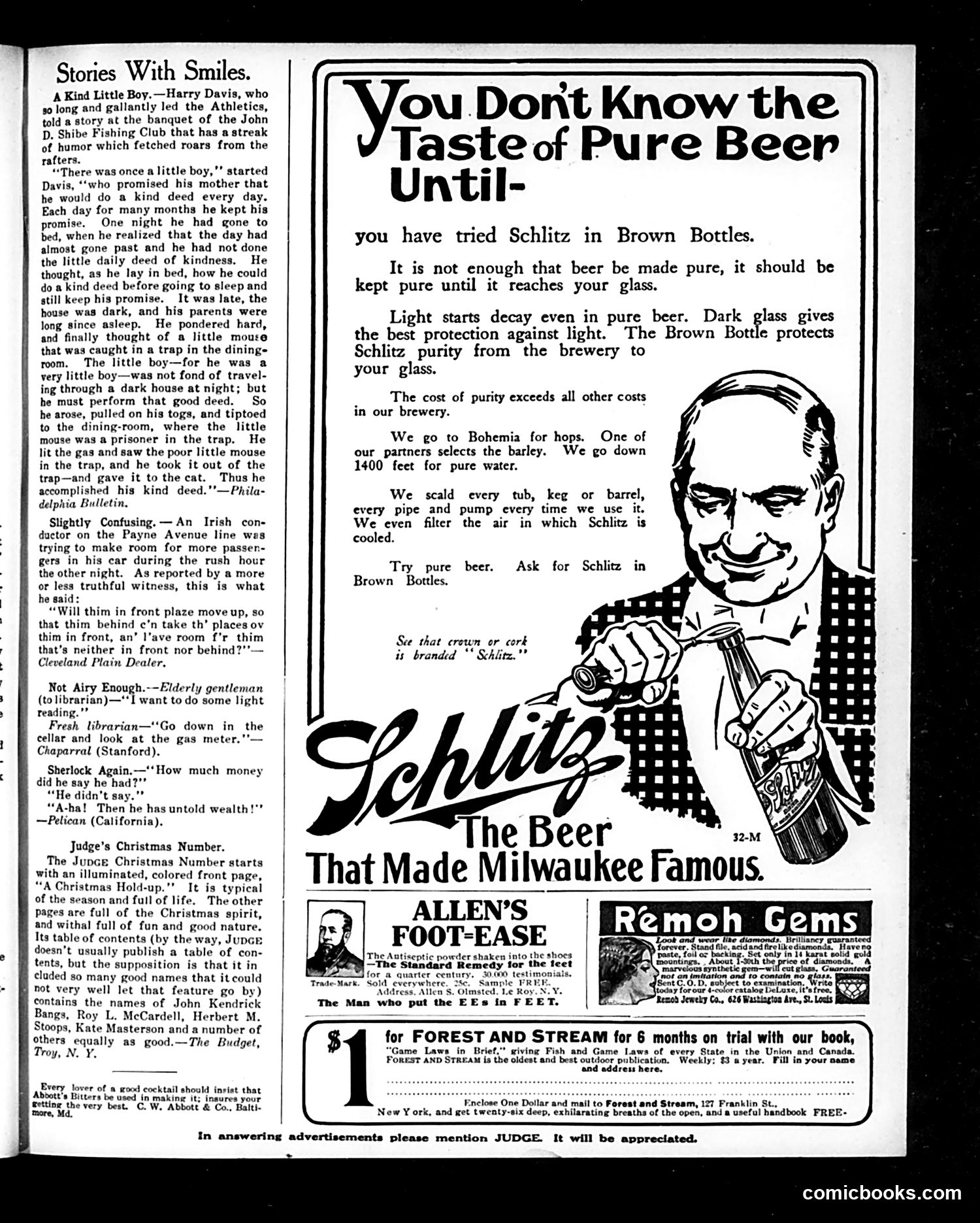
This Judge magazine page (circa early 1900s) contains humorous short stories and advertisements rather than political cartoons. The main content includes three brief jokes: a baseball player's anecdote about a boy who "kindly" releases a trapped mouse to a cat; an Irish conductor's confusing transit instructions; and a librarian's quip about "light reading" directing someone to a basement gas meter. The dominant advertisement is for **Schlitz beer**, emphasizing purity and brown bottles as protection against light decay. This reflects pre-Prohibition era beer marketing and the early 20th-century commercial emphasis on product "purity"—a common advertising trope of the period. A secondary ad promotes **Allen's Foot-Ease** powder and **Forest and Stream** magazine. The page represents typical Judge content: mild, genteel humor aimed at middle-class readers, interspersed with contemporary consumer advertisements. There is no overt political satire or caricature present.
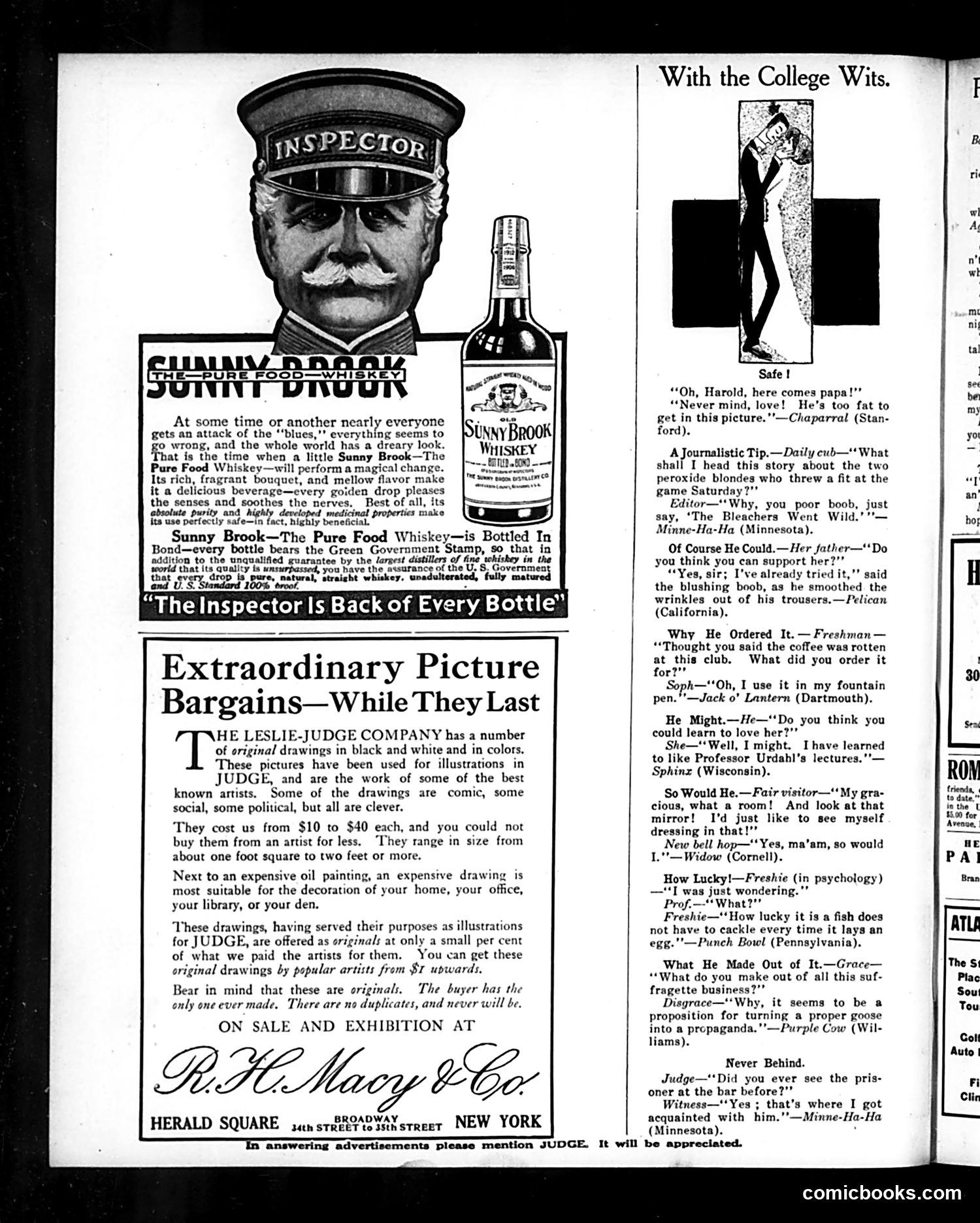
This page contains primarily **advertisements and humorous college jokes**, not political cartoons. The main advertisement features **Sunny Brook Whiskey**, depicted with an "Inspector" character endorsing the product as a "Pure Food Whiskey" bottled in bond under U.S. Government supervision—referencing the Pure Food and Drug Act's regulatory oversight. The bulk of the page consists of **"With the College Wits"**—a humor column collecting jokes from college publications. These are light, social satire aimed at college students: jokes about romance, student life, dating mishaps, and campus absurdities. Examples include humor about "peroxide blondes," fountain pen coffee, and fish laying eggs. A secondary advertisement touts original artwork from Judge magazine available for purchase ($1 upward) at R.H. Macy & Co. **For modern readers**: This reflects early 20th-century college culture, regulatory advertising standards, and genteel campus humor. The references to suffragettes and "proper goose into propaganda" show period social debates, but the page is primarily commercial and lighthearted rather than biting satire.
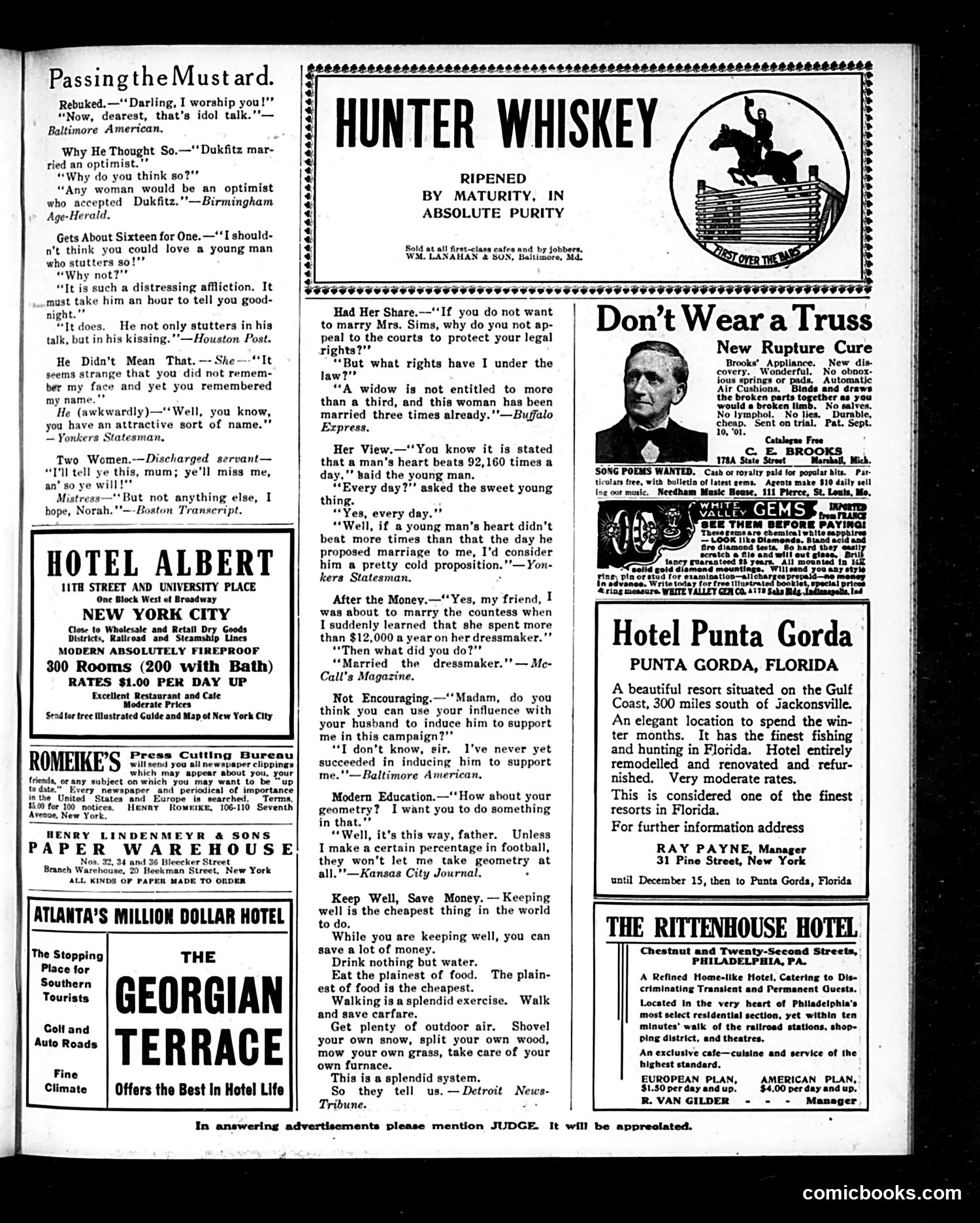
This page is primarily **advertisements and humor columns** rather than political cartoons. The content consists of: **Humor Sections:** Short jokes and quips about relationships, marriage, and domestic life—typical of Judge's satirical humor. These poke fun at courtship dynamics (women rejecting worship as "idol talk"), stammering suitors, servants departing, and financial disputes in marriage. One joke mocks a man marrying a dressmaker after abandoning a countess—satirizing mercenary motivations. **Advertisements:** The page features hotel ads (Hotel Albert in NYC, Hotel Punta Gorda in Florida, The Georgian Terrace in Atlanta), Hunter Whiskey, a rupture cure, and various business services. These reflect early 20th-century consumer culture. **No Political Content:** Unlike some Judge issues, this page contains no identifiable political cartoons or caricatures of public figures. The humor reflects period attitudes toward gender and marriage—treating women's financial independence and domestic arrangements as sources of comedy for a male readership.
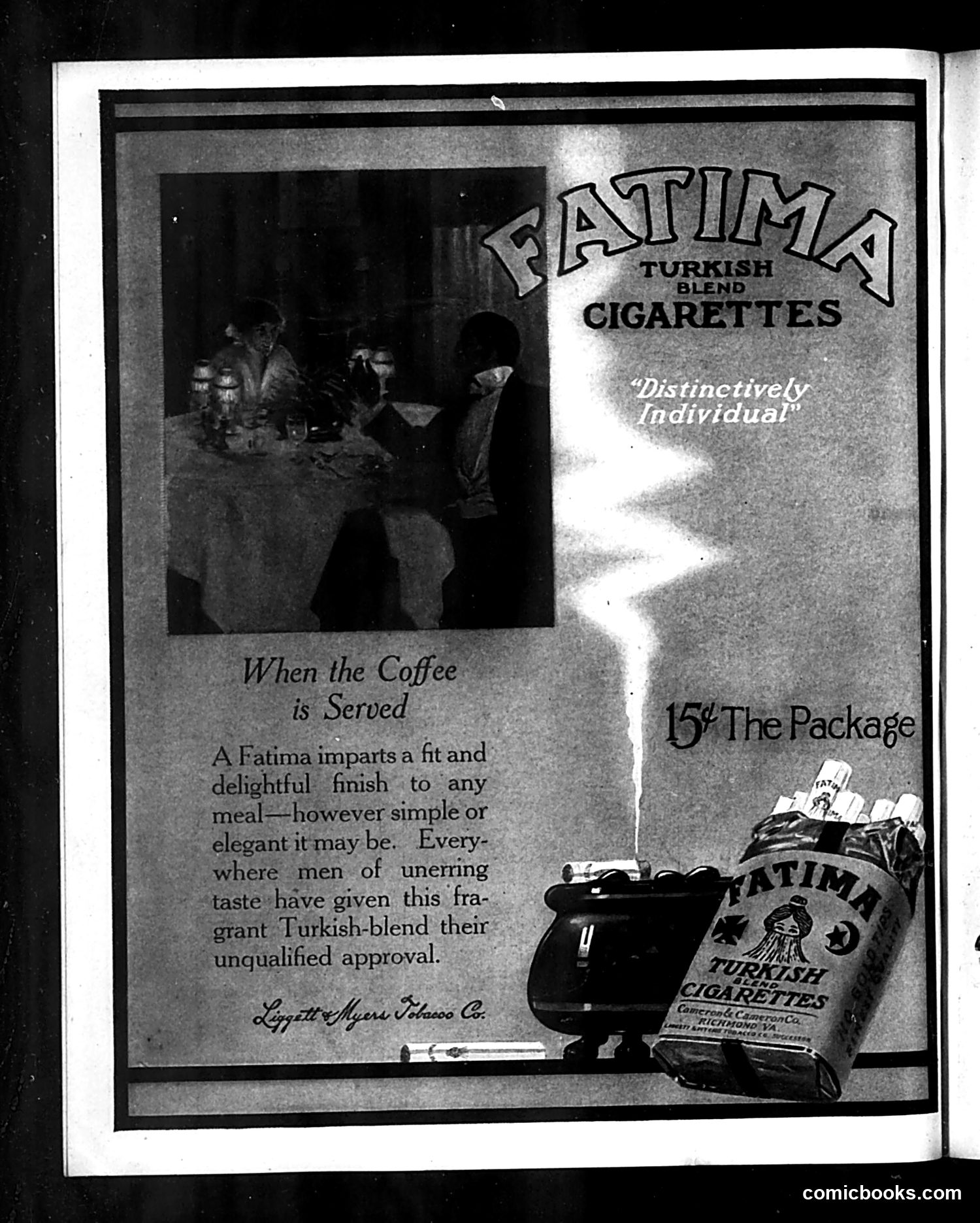
This is a **cigarette advertisement**, not political satire. The page promotes Fatima brand Turkish-blend cigarettes (15¢ per package) by Liggett & Myers Tobacco Co. The ad features a photograph labeled "When the Coffee is Served" showing what appears to be a domestic or social scene. The accompanying text claims that smoking Fatima cigarettes provides "a fit and delightful finish to any meal" and appeals to "men of unerring taste" who have given it "unqualified approval." This represents **early 20th-century marketing**, when cigarette advertising freely appeared in mainstream publications without health warnings. The "Turkish blend" designation and orientalist imagery were common marketing strategies of the era, suggesting exotic sophistication.