
Judge, 1913-01-25 · page 8 of 26
Judge — January 25, 1913 — page 8: what you’re looking at
What you’re looking at
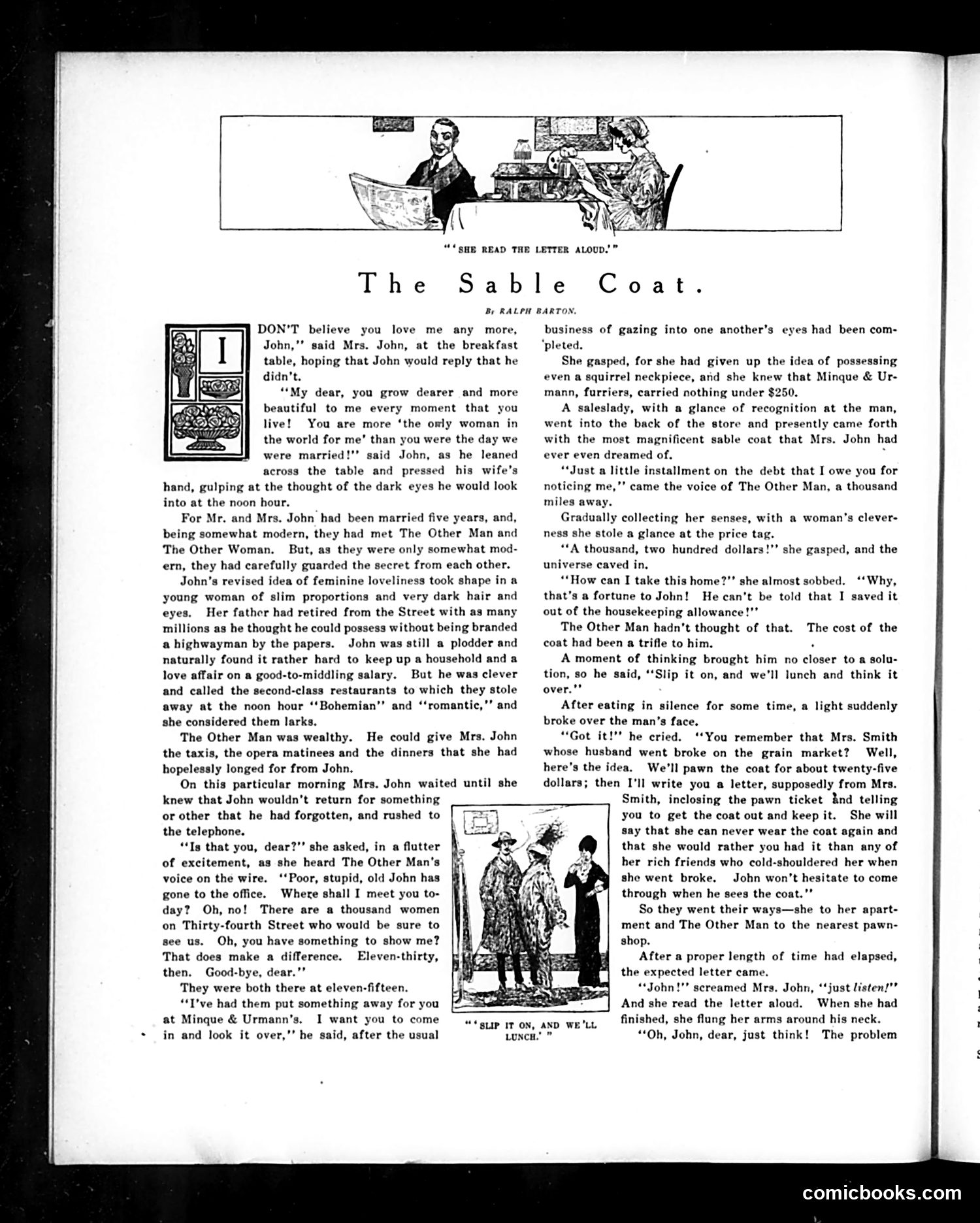
This satirical story mocks the moral compromises of the modern wealthy class circa 1920s. The plot depicts a married couple—John and Mrs. John—who each secretly maintain affairs with wealthier lovers ("The Other Man" and "The Other Woman"). John, a struggling office worker, cannot afford his wife's desires; her wealthy paramour lavishes her with a $1,200 sable fur coat. The satire targets several contemporary anxieties: marital infidelity among the "somewhat modern" set; the gap between working-class and wealthy lifestyles; women's material desires; and the elaborate deceptions required to maintain dual lives. When Mrs. John panics about explaining the coat to her husband, her lover's solution involves pawning it and fabricating a story about a broke acquaintance—adding fraud to infidelity. Barton presents this as absurd rather than scandalous, suggesting such behavior was becoming normalized among sophisticated urban Americans during the Jazz Age.
📄 Transcribed text from this page (OCR, searchable)
Machine-transcribed from the original scan — historical spelling and the odd misread are preserved.
The Sable SHE READ THE LETTER ALOUD.’” Coat. By RALPH BARTON. DON’T believe you love me any more, John,”’ said Mrs. John, at the breakfast table, hoping that John would reply that he didn’t. “My dear, you grow dearer and more beautiful to me every moment that you live! You are more ‘the omly woman in the world for me’ than you were the day we were married!"’ said John, as he leaned across the table and pressed his wife's hand, gulping at the thought of the dark eyes he would look into at the noon hour. For Mr. and Mrs. John had been married five years, and, being somewhat modern, they had met The Other Man and The Other Woman. But, as they were only somewhat mod- ern, they had carefully guarded the secret from each other. John’s revised idea of feminine loveliness took shape in a young woman of slim proportions and very dark hair and eyes. Her father had retired from the Street with as many millions as he thought he could possess without being branded a highwayman by the papers. John was still a plodder and naturally found it rather hard to keep up a household and a love affair on a good-to-middling salary. But he was clever and called the second-class restaurants to which they stole away at the noon hour ‘‘Bohemian’’ and ‘‘romant! she considered them larks. The Other Man was wealthy. He could give Mrs. John the taxis, the opera matinees and the dinners that she had hopelessly longed for from John. On this particular morning Mrs. John waited until she knew that John wouldn’t return for something or other that he had forgotten, and rushed to the telephone. “Is that you, dear?”’ she asked, in a flutter of excitement, as she heard The Other Man's voice on the wire. ‘‘Poor, stupid, old John has gone to the office. Where shall I meet you to- day? Oh, no! There are a thousand women on Thirty-fourth Street who would be sure to see us. Oh, you have something to show me? That does make a difference. Eleven-thirty, then. Good-bye, dear.”” ‘They were both there at eleven-fifteen. “I've had them put something away for you at Minque & Urmann's. I want you to come in and look it over,’’ he said, after the usual “* SLIP IT ON, AND WE'LL LUNCH.’ ” business of gazing into one another's eyes had been com- ‘pleted. She gasped, for she had given up the idea of possessing even a squirrel neckpiece, and she knew that Minque & Ur- mann, furriers, carried nothing under $250, A saleslady, with a glance of recognition at the man, went into the back of the store and presently came forth with the most magnificent sable coat that Mrs. John had ever even dreamed of. . “‘Just a little installment on the debt that I owe you for noticing me,’’ came the voice of The Other Man, a thousand miles away. Gradually collecting her senses, with a woman's clever- ness she stole a glance at the price tag. “A thousand, two hundred dollars!’’ she gasped, and the universe caved in, “How can I take this home?" she almost sobbed. that’s a fortune to John! He can’t be told that I saved it out of the housekeeping allowance !"" The Other Man hadn't thought of that. The cost of the coat had been a trifle to him. . A moment of thinking brought him no closer to a solu- tion, so he said, ‘‘Slip it on, and we'll lunch and think it over." After eating in silence for some time, a light suddenly broke over the man’s face. “Got it!’ he cried. ‘You remember that Mrs. Smith whose husband went broke on the grain market? Well, here’s the idea. We'll pawn the coat for about twenty-five dollars; then I'll write you a letter, supposedly from Mrs. Smith, inclosing the pawn ticket &nd telling you to get the coat out and keep it. She will say that she can never wear the coat again and that she would rather you had it than any of her rich friends who cold-shouldered her when she went broke. John won't hesitate to come through when he sees the coat.’" So they went their ways—she to her apart- ment and The Other Man to the nearest pawn- shop. After a proper length of time had elapsed, the expected letter came. “John!’’ screamed Mrs. John, ‘‘just listen!’’ And she read the letter aloud. When she had finished, she flung her arms around his neck. “Oh, John, dear, just think! The problem “Why, comicbooks.com