
Judge, 1913-01-25 · page 4 of 26
Judge — January 25, 1913 — page 4: what you’re looking at
What you’re looking at
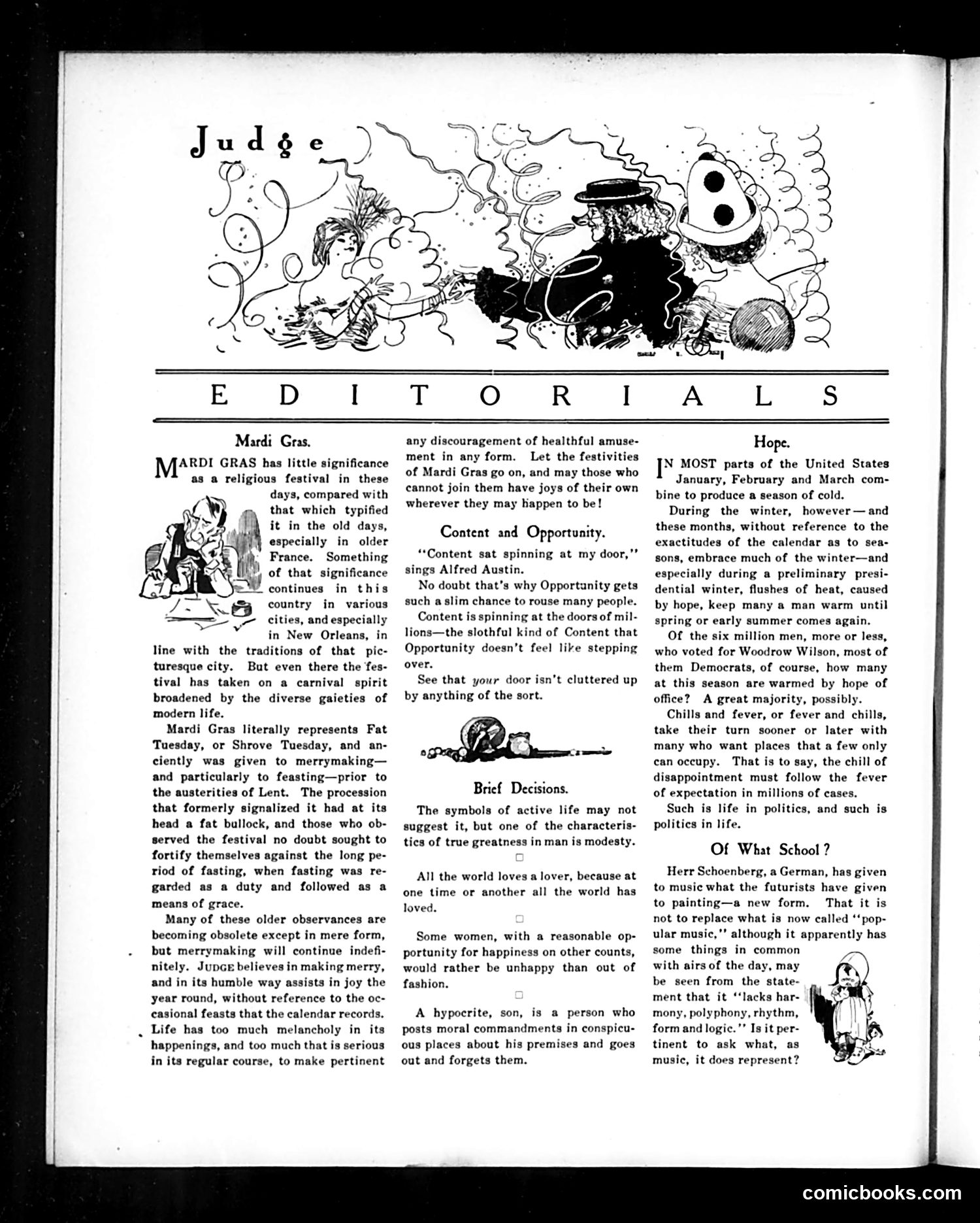
This page contains editorials and brief opinion pieces rather than political cartoons. The main sections discuss: **"Mardi Gras"** — defends the carnival tradition against those seeking to eliminate it, arguing the festivity serves a purpose in maintaining joy during the austere Lenten season. **"Content and Opportunity"** — satirizes people who complain constantly rather than seizing available opportunities, using the character "Content" as a foil to "Opportunity." **"Hope"** — addresses winter melancholy in America, noting that many (including "Democrats" who voted for Woodrow Wilson) find seasonal hope in anticipating spring's return. **"Of What School?"** — briefly discusses a new German musical form called "popular music" that allegedly lacks traditional harmonic elements. The page functions as editorial commentary on contemporary social attitudes and seasonal American life rather than containing visual political satire.
📄 Transcribed text from this page (OCR, searchable)
Machine-transcribed from the original scan — historical spelling and the odd misread are preserved.
Mardi Gras. MA®! GRAS has little significance as a religious festival in these days, compared with that which typified it in the old days, i VOY) especially in older fy France. Something ws 6H) 9 Kit KA of that significance Sew continues in this eB country in various =—— = cities, and especially in New Orleans, in line with the traditions of that pic- turesque city. But even there the fes- tival has taken on a carnival spirit broadened by the diverse gaieties of modern life. Mardi Gras literally represents Fat Tuesday, or Shrove Tuesday, and an- ciently was given to merrymaking— and particularly to feasting—prior to the austerities of Lent. The procession that formerly signalized it had at its head a fat bullock, and those who ob- served the festival no doubt sought to fortify themselves against the long pe- riod of fasting, when fasting was re- garded as a duty and followed as a means of grace. Many of these older observances are becoming obsolete except in mere form, but merrymaking will continue indefi- nitely. JupGe believes in making merry, and in its humble way assists in joy the year round, without reference to the oc- casional feasts that the calendar records. . Life has too much melancholy in its happenings, and too much that is serious in its regular course, to make pertinent any discouragement of healthful amuse- ment in any form. Let the festivities of Mardi Gras go on, and may those who cannot join them have joys of their own wherever they may happen to be! Content and Opportunity. “Content sat spinning at my door,’’ sings Alfred Austin. No doubt that’s why Opportunity gets such a slim chance to rouse many people. Content is spinning at the doors of mil- lions—the slothful kind of Content that Opportunity doesn’t feel like stepping over. See that your door isn’t cluttered up by anything of the sort. Brief Decisions. The symbols of active life may not suggest it, but one of the characteris- tics of true greatness in man is modesty. All the world loves a lover, because at one time or another all the world has loved. Some women, with a reasonable op- portunity for happiness on other counts, would rather be unhappy than out of fashion. A hypocrite, son, is a person who posts moral commandments in conspicu- ous places about his premises and goes out and forgets them. IX MOST parts of the United States January, February and March com- bine to produce a season of cold. During the winter, however—and these months, without reference to the exactitudes of the calendar as to sea- sons, embrace much of the winter—and especially during a preliminary presi- dential winter, flushes of heat, caused by hope, keep many a man warm until spring or early summer comes again. Of the six million men, more or less, who voted for Woodrow Wilson, most of them Democrats, of course, how many at this season are warmed by hope of office? A great majority, possibly. Chills and fever, or fever and chills, take their turn sooner or later with many who want places that a few only can occupy. That is to say, the chill of disappointment must follow the fever of expectation in millions of cases. Such is life in politics, and such is politics in life. Of What School ? Herr Schoenberg, a German, has given to music what the futurists have given to painting—a new form. That it is not to replace what is now called ‘‘pop- ular music,’’ although it apparently has some things in common with airs of the day, may be seen from the state- ment that it ‘‘lacks har- mony, polyphony, rhythm, form and logic.’ Is it per- tinent to ask what, as music, it does represent? comicbooks.com