
Judge, 1913-01-25 · page 5 of 26
Judge — January 25, 1913 — page 5: what you’re looking at
What you’re looking at
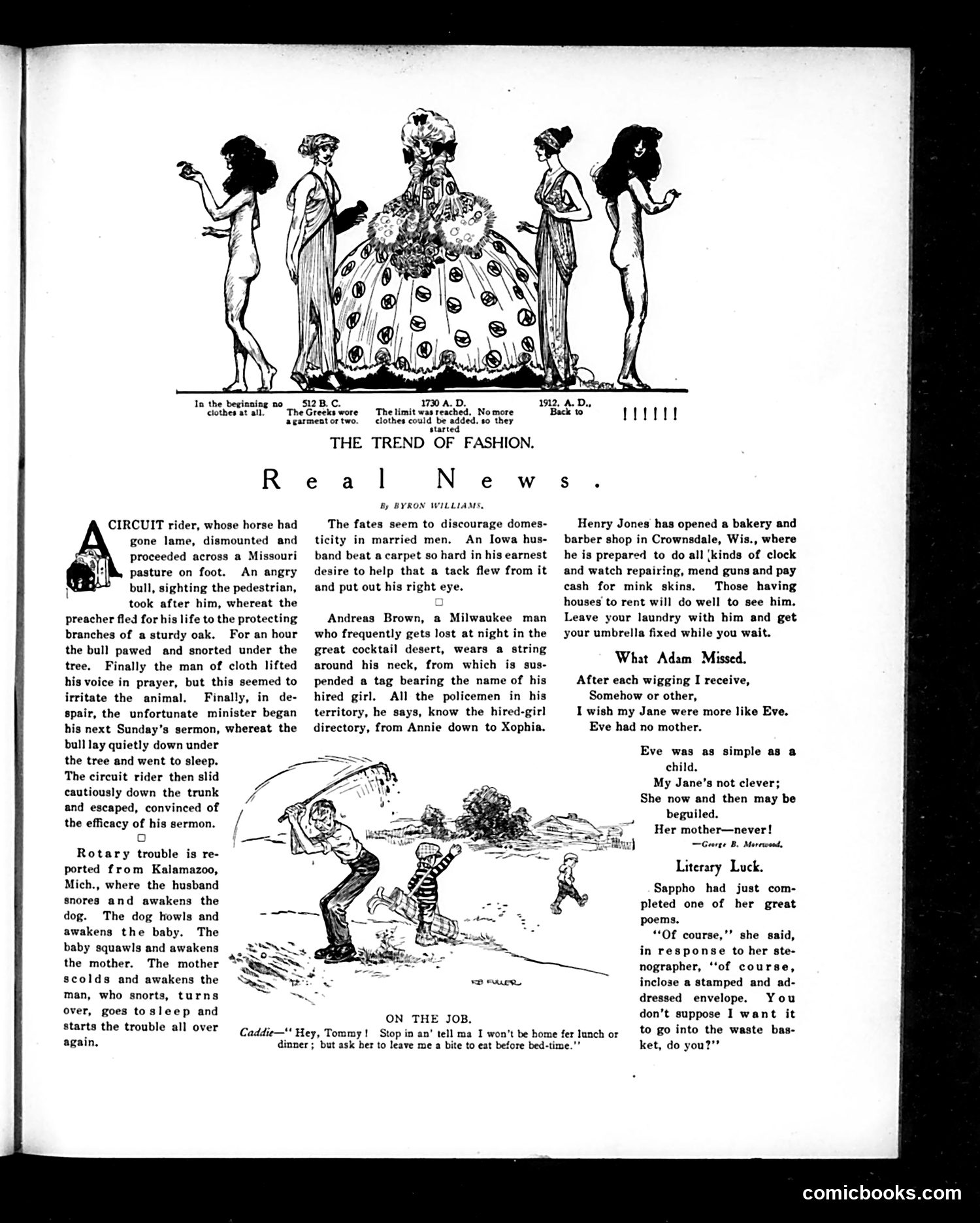
**Top Section - "The Trend of Fashion":** This historical illustration traces women's clothing from 512 B.C. through 1913 A.D., showing progressive exposure and less restrictive garments. The satire critiques contemporary fashion trends—specifically the increasing skimpiness and abandonment of Victorian modesty standards by 1913. The central figure in the elaborate dress represents how far fashion had "evolved" (or devolved, from the satirist's perspective), flanked by increasingly underdressed women representing earlier historical periods moving toward modern times. **"Real News" Section:** Brief humorous anecdotes and puns about everyday mishaps and ironies. Includes a cartoon showing children playing, with social commentary on domestic life. The writing style is characteristic of Judge's lighthearted satirical approach to contemporary American life and manners. The page blends fashion critique with general social humor typical of early 1910s satirical journalism.
📄 Transcribed text from this page (OCR, searchable)
Machine-transcribed from the original scan — historical spelling and the odd misread are preserved.
In the beginning no clothes at all. R CIRCUIT rider, whose horse had gone lame, dismounted and proceeded across a Missouri pasture on foot. An angry bull, sighting the pedestrian, took after him, whereat the preacher fled for his life to the protecting branches of a sturdy oak. For an hour the bull pawed and snorted under the tree. Finally the man of cloth lifted his voice in prayer, but this seemed to irritate the animal. Finally, in de- spair, the unfortunate minister began his next Sunday’s sermon, whereat the bull lay quietly down under the tree and went to sleep. The circuit rider then slid cautiously down the trunk and escaped, convinced of the efficacy of his sermon. ia} Rotary trouble is re- ported from Kalamazoo, Mich., where the husband snores and awakens the dog. The dog howls and awakens the baby. The baby squawls and awakens the mother. The mother scolds and awakens the man, who snorts, turns over, goes tosleep and starts the trouble all over again, The Greeks wore agarment or two. Caddie—"' Hey, Tommy ! 512 B.C. 1730 A. D. ‘The limit was reached, No more clothes could be added. so they started THE TREND OF FASHION. eal New By BYRON WILLIAMS, The fates seem to discourage domes- ticity in married men. An Iowa hus- band beat a carpet so hard in his earnest desire to help that a tack flew from it and put out his right eye. Andreas Brown, a Milwaukee man who frequently gets lost at night in the great cocktail desert, wears a string around his neck, from which is sus- pended a tag bearing the name of his hired girl. All the policemen in his territory, he says, know the hired-girl directory, from Annie down to Xophia. ON THE JOB. Stop in an’ tell ma I won't be home fer lunch or dinner ; but ask her to leave me a bite to eat before bed-time.'” littl Ss Henry Jones has opened a bakery and barber shop in Crownsdale, Wis., where he is prepared to do all (kinds of clock and watch repairing, mend guns and pay cash for mink skins. Those having houses to rent will do well to see him. Leave your laundry with him and get your umbrella fixed while you wait. What Adam Missed. After each wigging I receive, Somehow or other, I wish my Jane were more like Eve. Eve had no mother. Eve was as simple as a child. My Jane’s not clever; She now and then may be beguiled. Her mother—never! George B. Merewoed. Literary Luck. Sappho had just com- pleted one of her great poems. “Of course,’’ she said, in response to her ste- nographer, ‘‘of course, inclose a stamped and ad- dressed envelope. You don’t suppose I want it to go into the waste bas- ket, do you?” comicbooks.com