
Judge, 1913-01-25 · page 11 of 26
Judge — January 25, 1913 — page 11: what you’re looking at
What you’re looking at
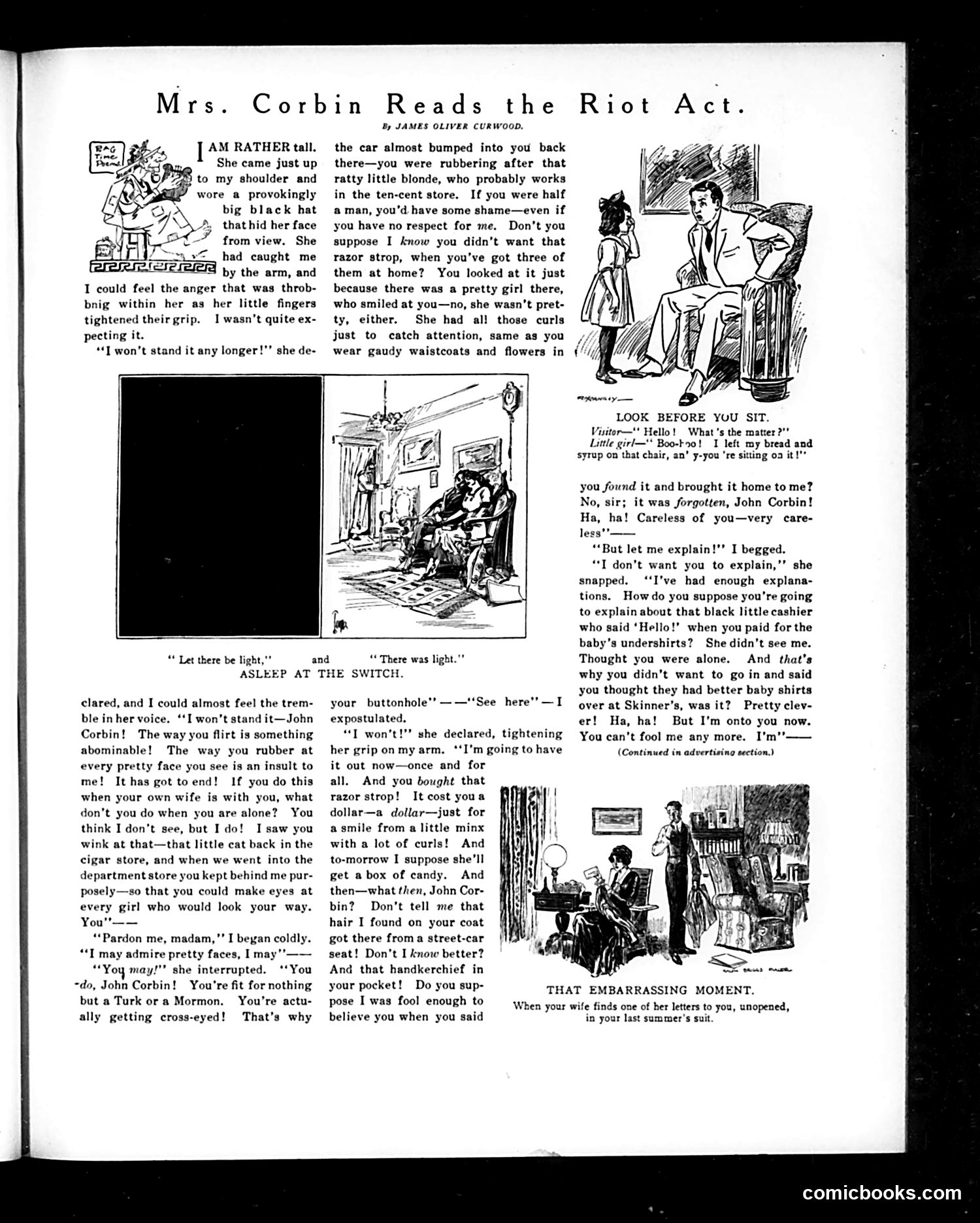
This page presents a domestic comedy story titled "Mrs. Corbin Reads the Riot Act" by James Oliver Curwood. The main narrative depicts a wife confronting her husband, John Corbin, about his flirtatious behavior—ogling women in stores, winking at shopgirls, and making suspicious purchases (a razor strop he didn't need, apparently bought to impress a pretty cashier). She catalogs his infractions: noticing a blonde on the street, lingering in department stores, finding mysterious hair on his coat and an unexplained handkerchief. The satire targets early 20th-century male infidelity and the marital tensions it creates. The wife's fury—expressed through her physical grip and escalating accusations—represents female exasperation with casual male philandering. Two smaller cartoons appear: "Asleep at the Switch" and "That Embarrassing Moment" (about a wife finding an unopened letter in old clothing), both playing on domestic mishaps and marital awkwardness. The humor relies on recognizable middle-class domestic conflict, presented as entertainment for Judge's readers.
📄 Transcribed text from this page (OCR, searchable)
Machine-transcribed from the original scan — historical spelling and the odd misread are preserved.
Mrs. Corbin Reads. the Riot Ate AM RATHER tall. She came just up to my shoulder and wore a provokingly big black hat that hid her face from view. She <_ had caught me HASSE LEICA by the arm, and I could feel the anger that was throb- bnig within her as her little fingers tightened theirgrip. I wasn’t quite ex- pecting it. “«[ won't stand it any longer!"* she de- By JAMES OLIVER CURWOOD. the car almost bumped into you back there—you were rubbering after that ratty little blonde, who probably works in the ten-cent store. If you were half a man, you'd have some shame—even if you have no respect for me. Don’t you suppose I know you didn’t want that razor strop, when you've got three of them at home? You looked at it just because there was a pretty girl there, who smiled at you—no, she wasn’t pret- ty, either. She had al! those curls just to catch attention, same as you wear gaudy waistcoats and flowers in “* Let there be light,’” and “* There was light." ASLEEP AT THE SWITCH. clared, and I could almost feel the trem- ble inher voice. ‘I won’t stand it—John Corbin! The way you flirt is something abominable! The way you rubber at every pretty face you see is an insult to It has got toend! If you do this when your own wife is with you, what don’t you do when you are alone? You think I don’t see, but Ido! I saw you wink at that—that little cat back in the cigar store, and when we went into the department store you kept behind me pur- posely—so that you could make eyes at every girl who would look your way. You"’"—— “Pardon me, madam,”’ I began coldly. “‘T may admire pretty faces, I may’’—— “Yoy may!"" she interrupted. ‘You -do, John Corbin! You're fit for nothing but a Turk or a Mormon. You're actu- ally getting cross-eyed! That’s why me! your buttonhole’’ ——‘‘See here’’ —I expostulated, “I won't!” she declared, tightening her grip on my arm. ‘‘I'm going to have it out now—once and for all. And you bought that razor strop! It cost youa dollar—a dollar—just for asmile from a little minx with a lot of curls! And to-morrow I suppose she’ll get a box of candy. And then—what then, John Cor- bin? Don’t tell me that hair I found on your coat got there froma street-car seat! Don't I know better? And that handkerchief in your pocket! Do you sup- pose I was fool enough to believe you when you said LOOK BEFORE YUU Visitor—* Hello! What's the matter?" Little girl—"* Boo-t>0! I left my bread and syrup on that chair, an’ y-you ‘re sitting oa it !"* you found it and brought it home to me? No, sir; it was forgotten, John Corbin! Ha, ha! Careless of you—very care- less"’—— “But let me explain!’’ I begged. “I don’t want you to explain,’’ she snapped. ‘‘I've had enough explana- tions. How do you suppose you're going to explain about that black little cashier who said ‘Hello!’ when you paid for the baby’s undershirts? She didn’t see me. Thought you were alone. And that’s why you didn’t want to go in and said you thought they had better baby shirts over at Skinner’s, was it? Pretty clev- er! Ha, ha! But I’m onto you now. You can't fool me any more. I’m''—— (Continued in advertising section.) THAT EMBARRASSING MOMENT. When your wife finds one of her letters to you, unopened, in your last summer's suit. comicbooks.com