
Judge, 1913-01-25 · page 16 of 26
Judge — January 25, 1913 — page 16: what you’re looking at
What you’re looking at
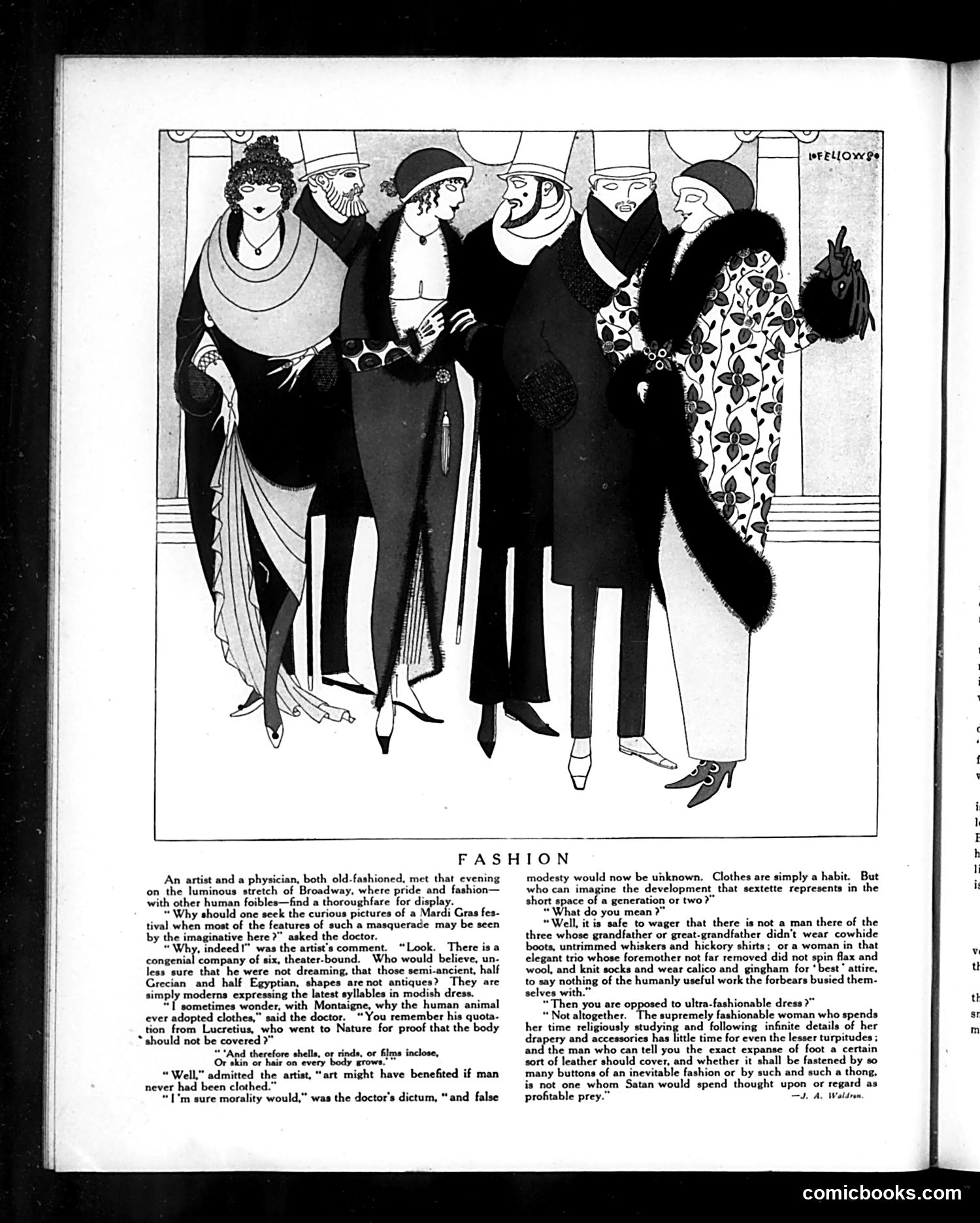
This satirical dialogue depicts two old-fashioned gentlemen (an artist and physician) observing well-dressed theatergoers on Broadway. The cartoon mocks the absurd extremes of 1920s fashion through their conversation. The satire works on two levels: First, it jokes that Broadway's fashionable crowds rival a Mardi Gras masquerade in their theatrical excess. Second, the dialogue contrasts modern fashion with natural simplicity—quoting classical philosophers (Montaigne, Lucretius) who questioned whether humans should wear clothes at all. The humor peaks when they observe the elegant six and marvel at how drastically fashion has evolved in merely one or two generations: their grandparents wore practical cowhide boots and homespun clothes, while current fashionable people obsess over minute details like button placement and leather expanse. The final twist—that excessive fashion-obsession actually *prevents* moral corruption—offers ironic social commentary on vanity as an inadvertent moral guardian.
📄 Transcribed text from this page (OCR, searchable)
Machine-transcribed from the original scan — historical spelling and the odd misread are preserved.
FASHION An artist and a physician, both old-fashioned, met that evening on the luminou: etch of Broadway, where pride and fashion— with other human foibles—find a thoroughfare for display. “ Why should one scek the curious pictures of @ Mardi Gras fes- tival when most of the features of such a masquerade may be seen by the imaginative here ?” asked the doctor. “ Why, indeed!” was the artist's comment. “Look. There is a congenial company of six, theater-bound. Who would believe, un- less sure that he were not dreaming, that those semi-ancient, half Grecian and half Egyptian, shapes are not antiques? They are simply moderns expressing the latest syllables in modish dress. “1 sometimes wonder, with Montaigne, why the human animal ever adopted clothes,” said the doctor. “You remember his quota- tion from Lucretius, who went to Nature for proof that the body * should not be covered 2” "And therefore shells, of rinds, or films inclose, ‘Or skin or hair on every body grows.’ ” “Well,” admitted the artist, “art might have benefited if man never had been clothed.” “['m sure morality would,” was the doctor's dictum, “and false modesty would now be unknown. Clothes are simply a habit. But who can imagine the development that sextette represents in the short space of a generation or two?” “What do you mean >” “Well, it is safe to wager that there is not a man there of the three whose grandfather or great-grandfather didn’t wear cowhide boots, untrimmed whiskers and hickory shirts; or a woman in that elegant trio whose foremother not far removed did not spin fl wool, and knit socks and wear calico and gingham for to say nothing of the humanly useful work the forbears busied them- selves with.” Then you are opposed to ultra-fashionable dress >” “ Not altogether. ¢ supremely fashionable woman who spends her time religiously studying and following infinite details of her drapery and accessories has fietle time for even the lesser turpitudes ; and the man who can tell you the exact expanse of foot a certain sort of leather should cover, and whether it shall be fastened by so many buttons of an inevitable fashion or by such and such a thong, is not one whom Satan would spend thought upon or regard as profitable prey.” J. A, Waldron. comicbooks.com