
A complete issue · 24 pages · 1913
Judge — January 18, 1913
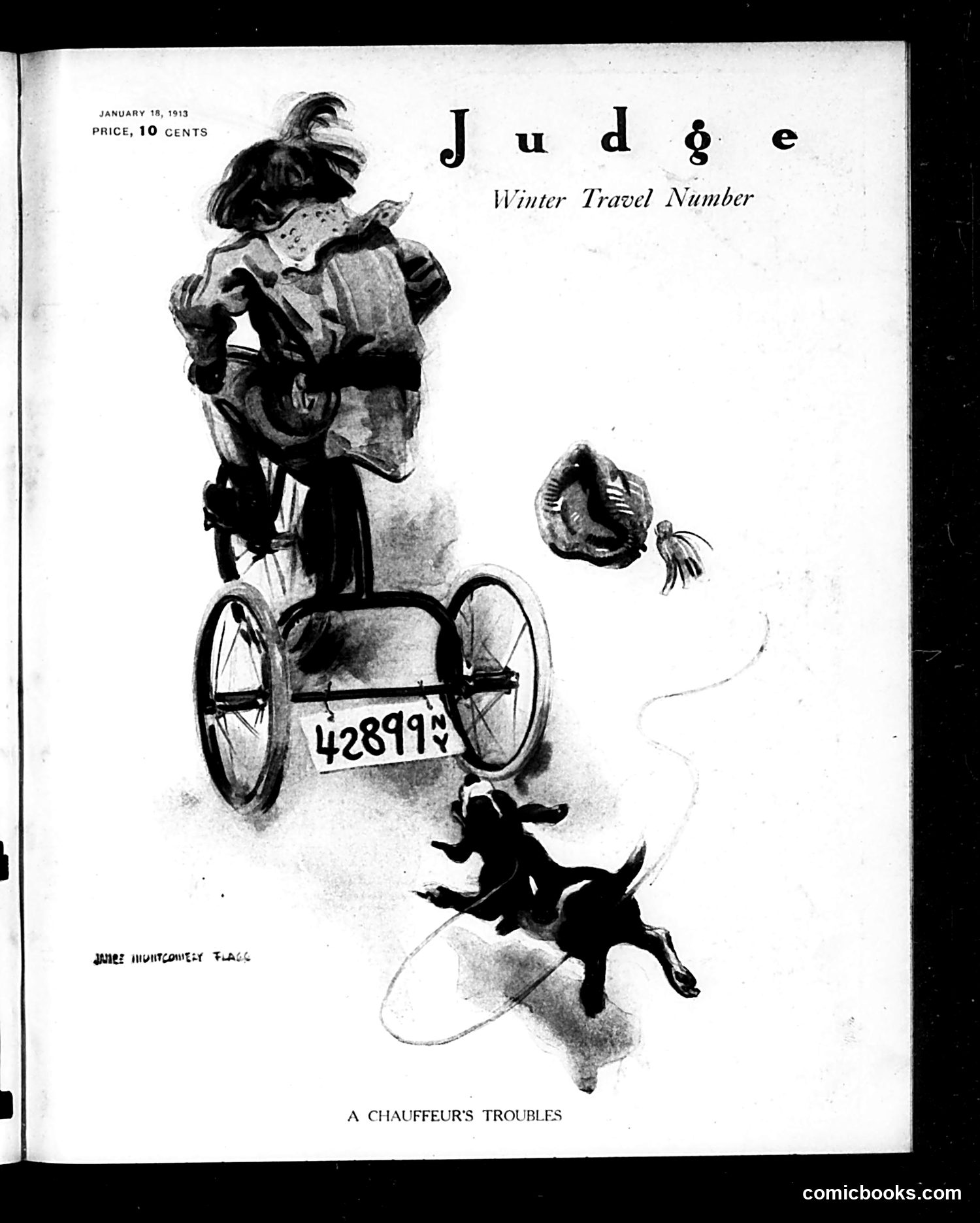
This 1913 *Judge* cartoon satirizes the emerging automotive age's hazards for car drivers. The illustration depicts a woman operating an early motorcar (marked with license plate 428993) while various disasters unfold around her: a runaway horse bolts beneath the vehicle, a pedestrian flies through the air, and a turkey or large bird escapes overhead. The satire targets early female drivers—a novelty in 1913—suggesting they create chaos on roads. The "chauffeur's troubles" refers to the driver's mounting problems managing both the unpredictable automobile and the panicked animals and people it disturbs. The cartoon reflects contemporary anxiety about automobiles disrupting traditional traffic patterns and the social concern about women operating vehicles, portraying female drivers as sources of public danger rather than competent operators.
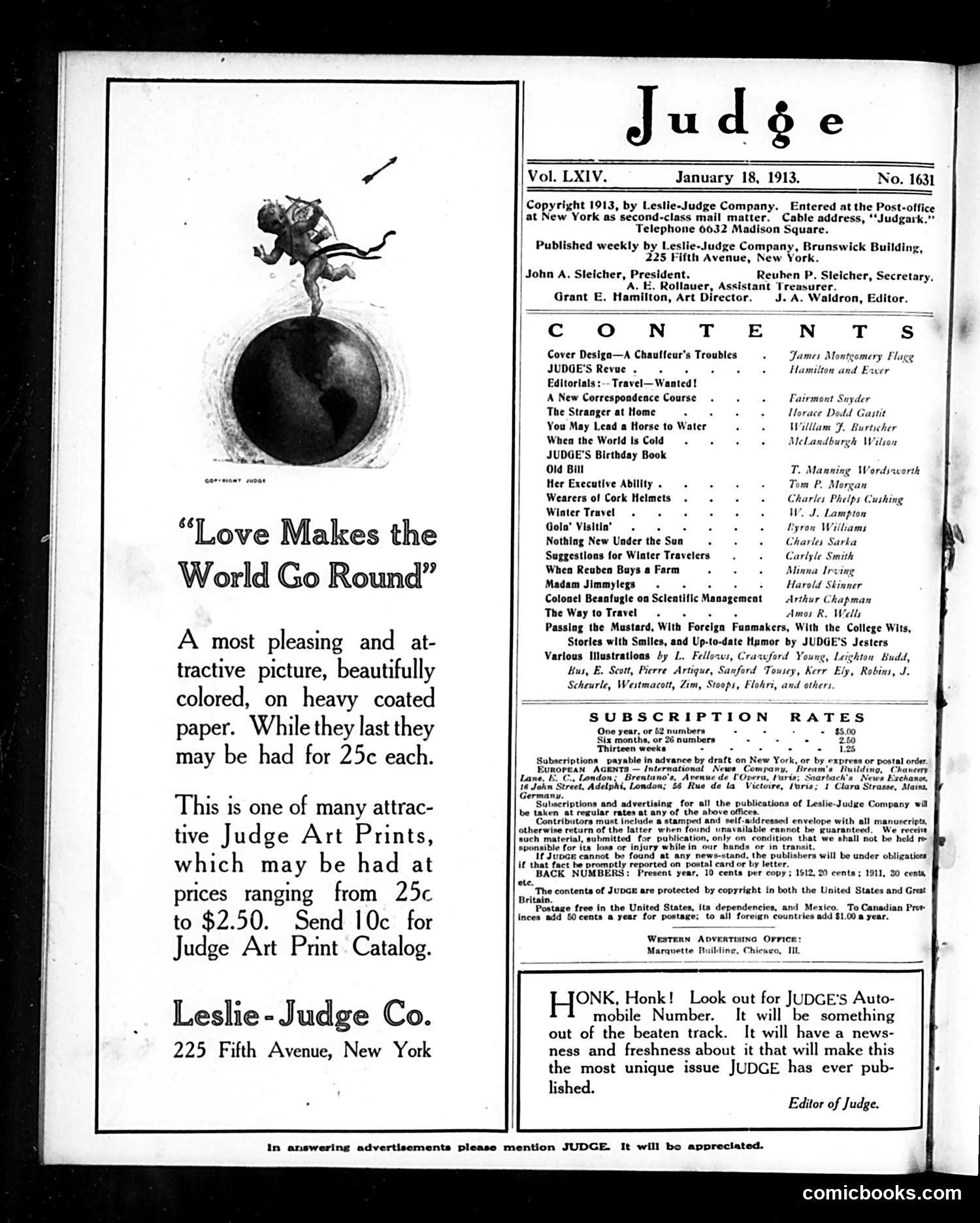
This page is primarily **advertising and editorial content** rather than political satire. The left side features a Leslie-Judge Company advertisement for "Judge Art Prints"—decorative prints priced 25¢ to $2.50, featuring the image "Love Makes the World Go Round." The illustration shows a cherub or cupid figure balanced atop a globe, a whimsical romantic reference with no political content. The right side contains the magazine's masthead, table of contents, subscription rates, and a teasing editorial note promising an upcoming "Judge's Automobile Number" with novel newsprint qualities. **No significant political satire or caricature appears on this page.** It represents the magazine's business operations during the early 20th century.
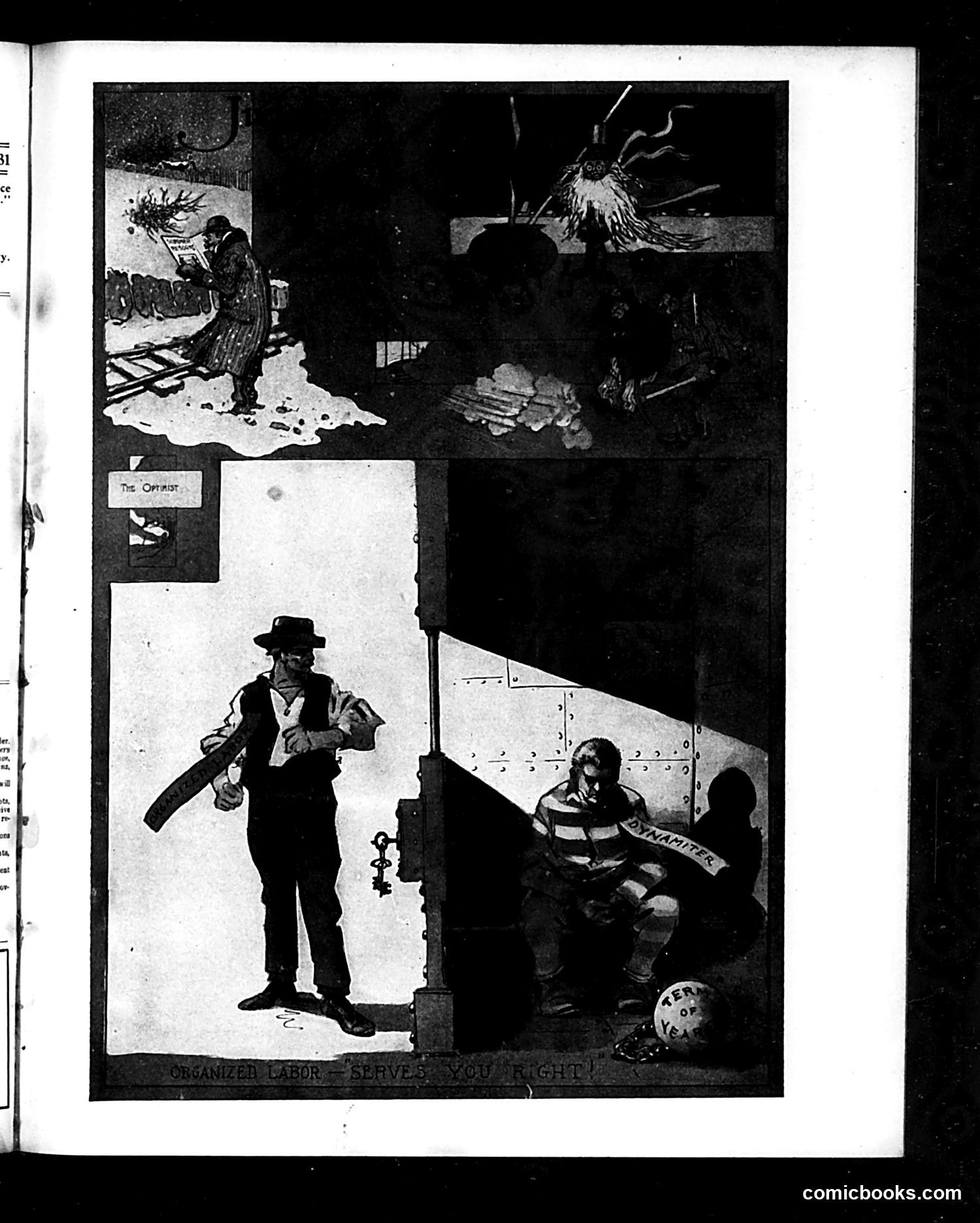
This appears to be a labor-themed satirical cartoon titled "Organized Labor Serves You Right!" The central figure is a man in working-class attire (hat, vest) confronting what appears to be a sleeping or reclining figure marked with labor union imagery. The caption suggests satire about organized labor's impact or behavior. The upper panels show additional scenes involving conflict or confrontation, with dramatic illustration typical of early-to-mid 20th century political cartooning. The overall message appears critical of organized labor, suggesting workers or unions are not serving the public interest—a common critique in Judge magazine during periods of labor unrest. Without specific dates or clearer text on figures, the exact historical labor dispute referenced remains unclear, though the anti-union sentiment is unmistakable.
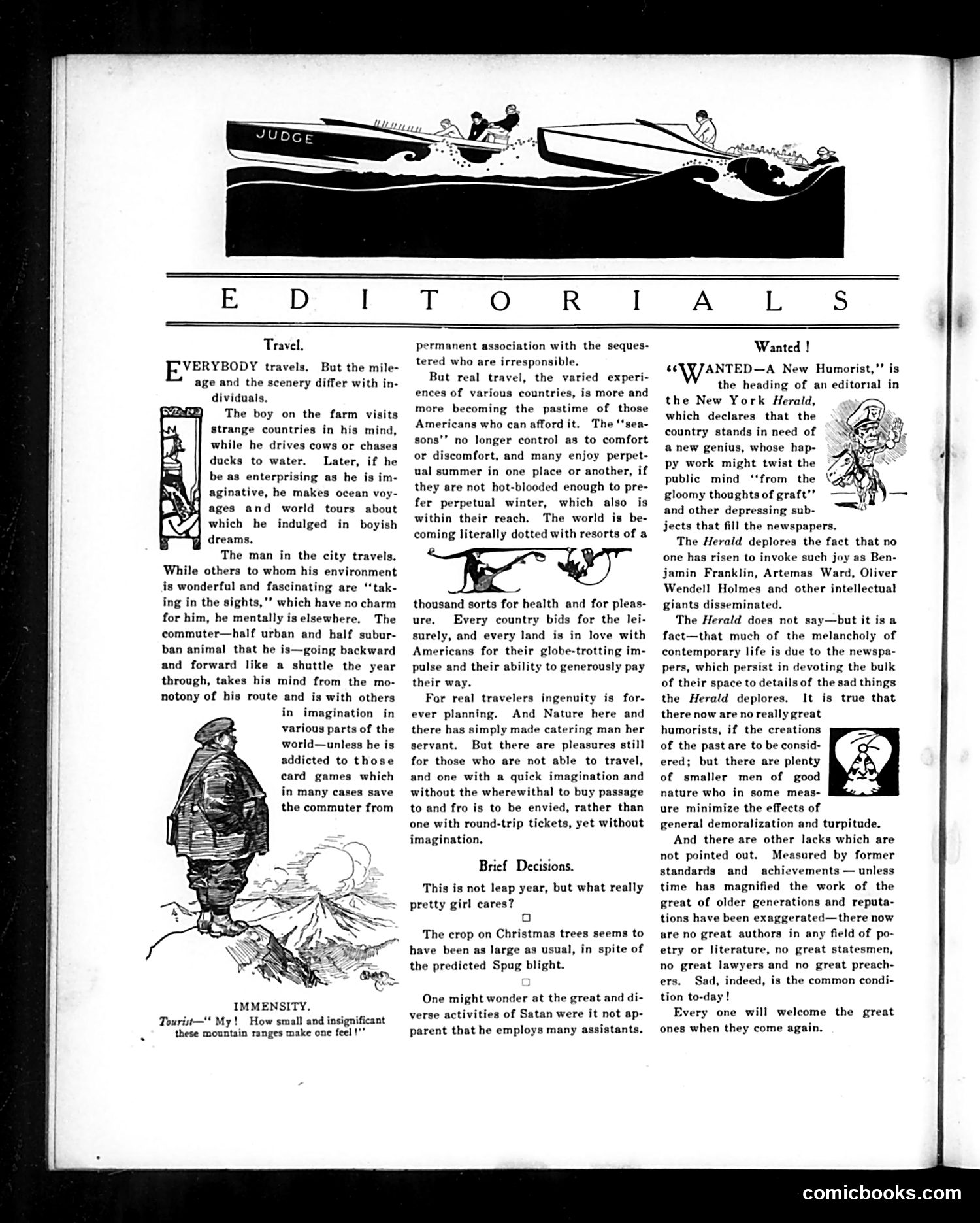
This page contains editorial commentary rather than political cartoons. The main article, "Travel," discusses Americans' leisure tourism habits, noting that while travel broadens some minds, it often fails to inspire imagination in others. The piece criticizes those who travel with "round-trip tickets" but lack genuine curiosity about the world. The "Wanted!" section on the right humorously announces that the New York *Herald* seeks "a new humorist," deploring the loss of great American writers like Benjamin Franklin and Oliver Wendell Holmes. The editorial sarcastically suggests current humorists lack the intellectual caliber of earlier generations. Small decorative illustrations accompany the text, typical of the era's magazine design.
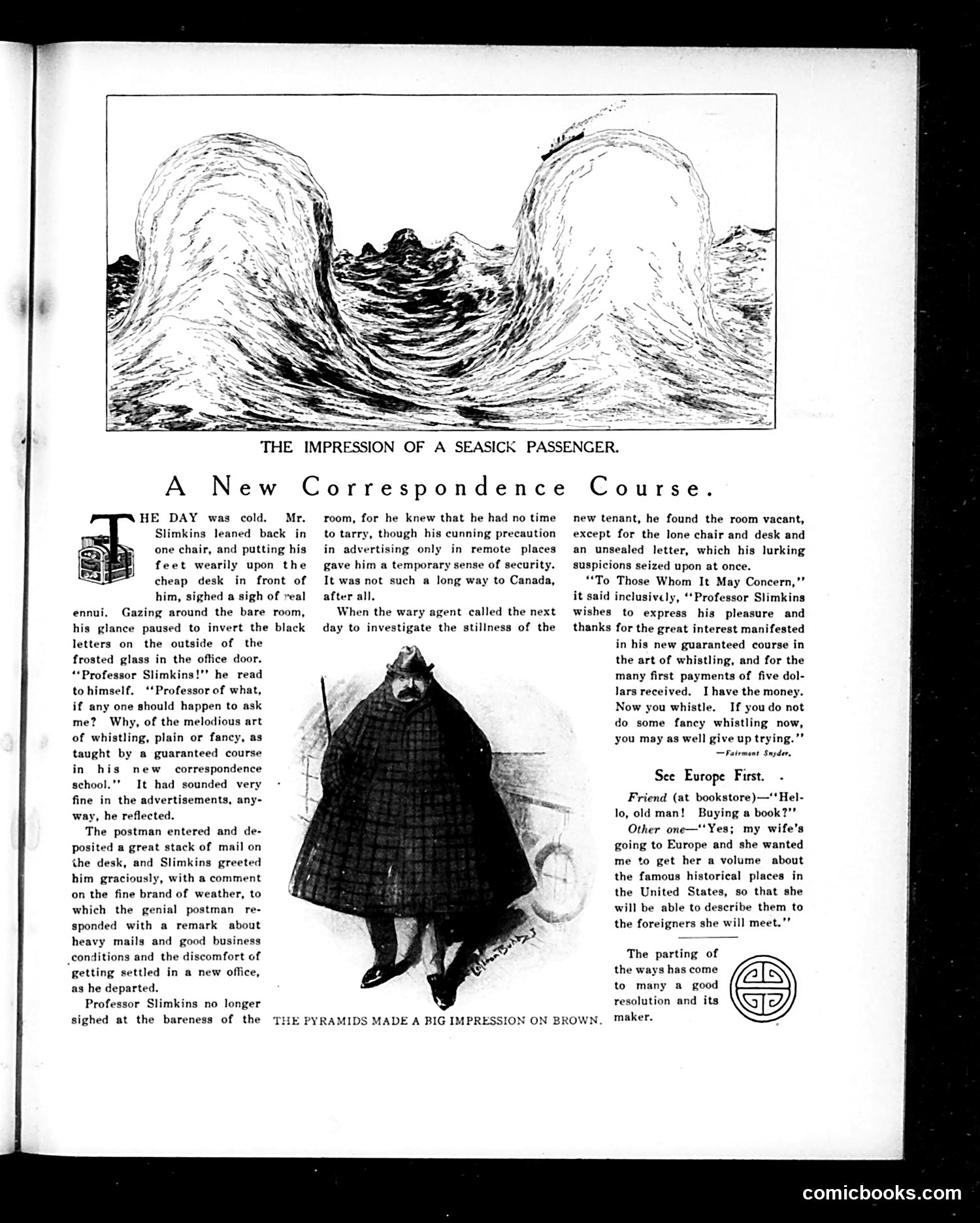
This page contains two separate satirical pieces from *Judge* magazine: **Top illustration** ("The Impression of a Seasick Passenger"): A humorous woodcut showing exaggerated wave formations that humorously depict a passenger's distorted perception during seasickness—the waves appear to form grotesque facial features. This is visual comedy about maritime discomfort. **Main story** ("A New Correspondence Course"): Satire of Professor Slimkins, who advertises a mail-order course in whistling. A gullible client (Brown) receives promotional materials after inquiring about this dubious "guaranteed course." The satire targets both mail-order correspondence schools—then proliferating with questionable claims—and the absurdity of attempting to teach whistling by mail. The joke mocks both fraudulent educational schemes and those foolish enough to pursue them.
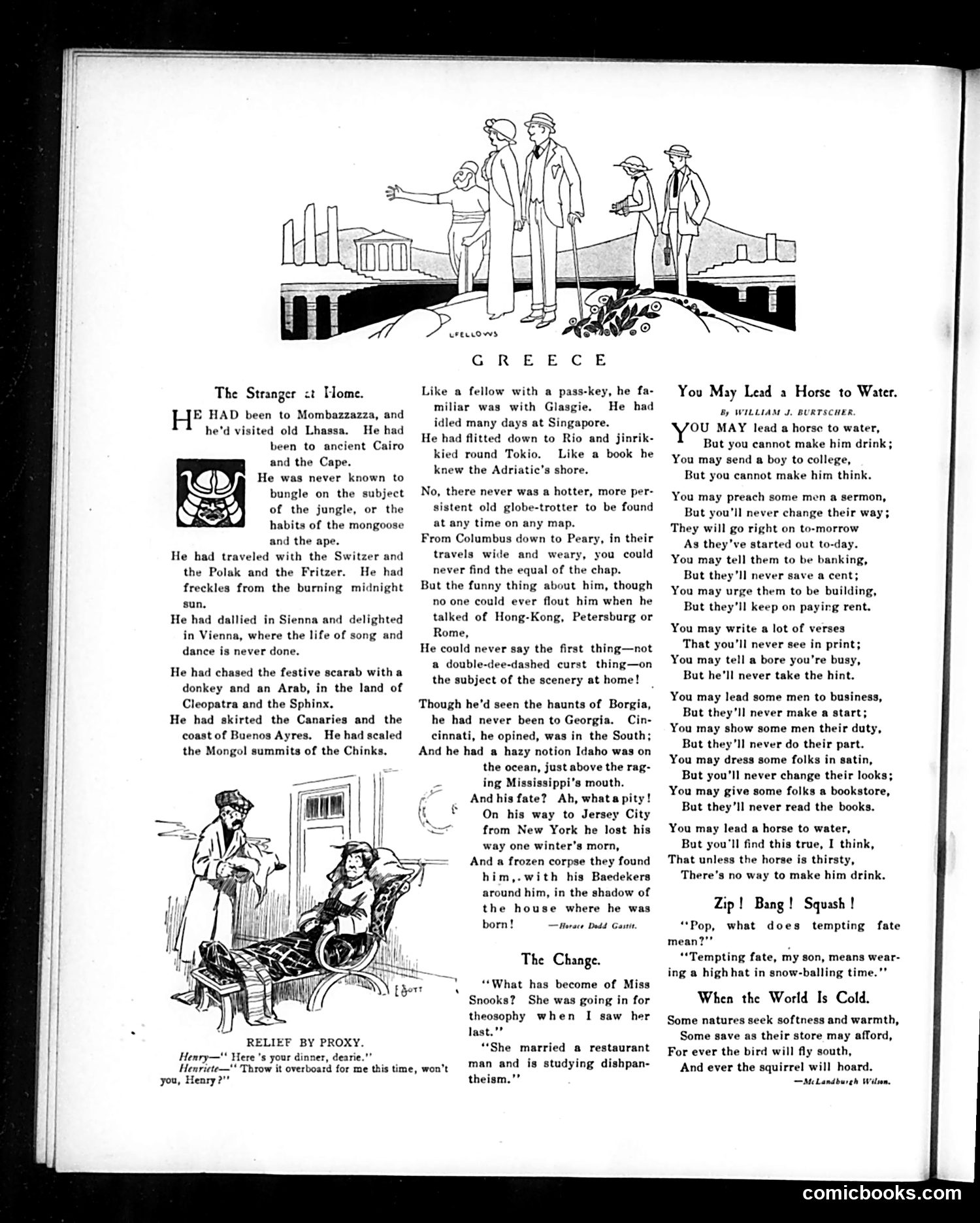
This page mocks a well-traveled man who has visited exotic locations worldwide—Cairo, Vienna, Singapore, Rio, Tokyo—yet remains ignorant about his own hometown. The joke: despite his extensive globetrotting credentials and knowledge of famous landmarks, he cannot describe local scenery, believes Cincinnati is in the South, and fatally loses his way traveling between New York and Jersey City in winter. The satire targets a specific type of early 20th-century traveler: those who collected exotic experiences and could name-drop foreign cities but lacked practical knowledge or genuine cultural understanding. It's a gentle mockery of superficial worldliness and the irony that familiarity with distant places doesn't equal actual competence or wisdom about one's surroundings. The accompanying poem "You May Lead a Horse to Water" reinforces the theme: you cannot force understanding or change on anyone, regardless of effort or opportunity.
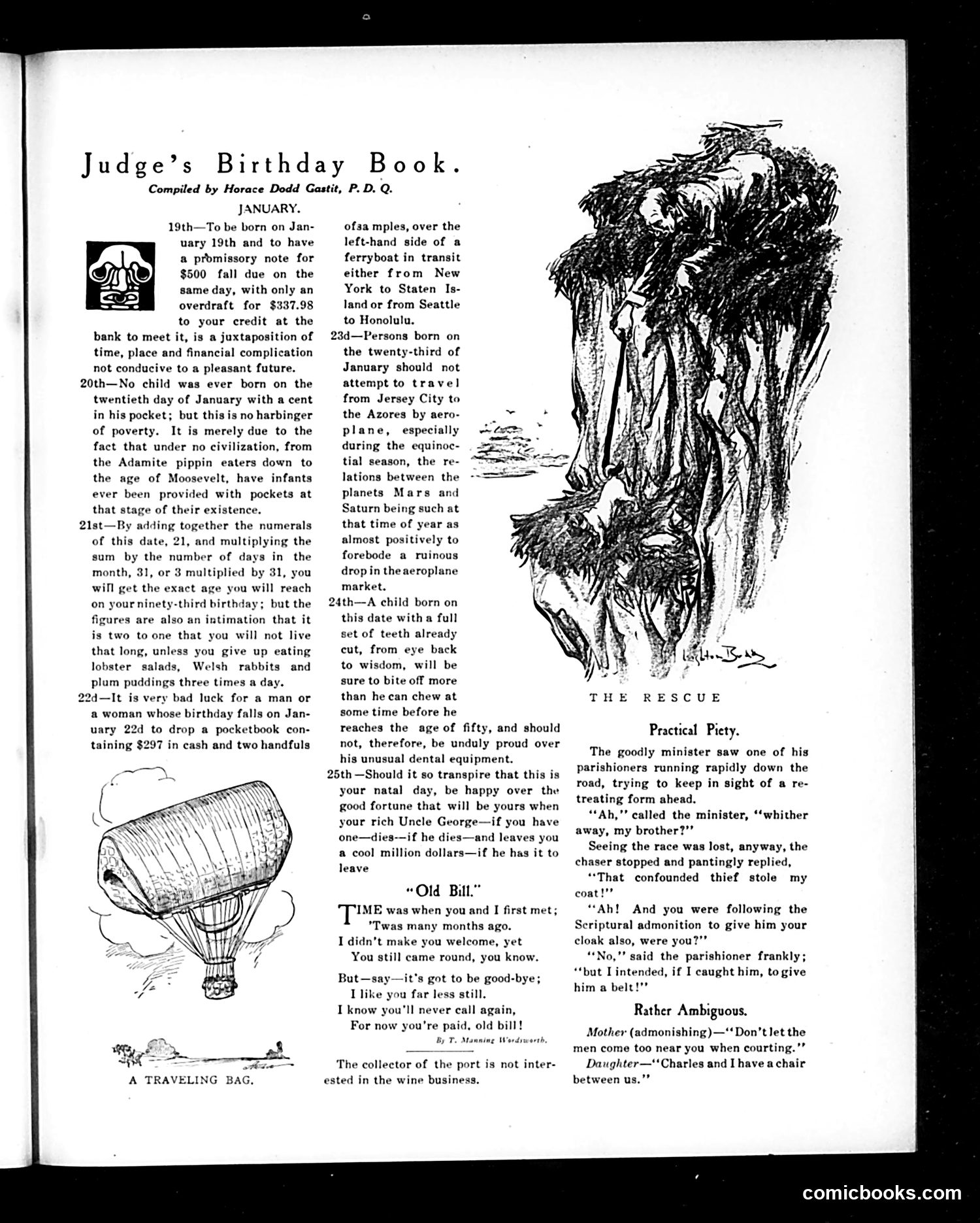
This page from Judge's "Birthday Book" is satirical commentary on superstition and bad luck, presented as absurdist humor typical of the era. The main text mocks the notion that birth dates determine fortune. Each January entry offers increasingly ridiculous "predictions"—a man born January 19th facing a $500 promissory note with insufficient bank credit; children born in January supposedly never having pocket money; calculations proving January 21st births lead to early death unless one stops eating rich foods. The satire peaks with entries warning against specific foolish acts (dropping money from ferries, flying aeroplane to the Azores during equinox season) as though astrological timing makes them particularly dangerous. Three separate humor pieces follow: "Old Bill" (a poem about a creditor finally paid off), "Practical Piety" (a minister misinterpreting a parishioner's violent pursuit of a thief as Christian charity), and "Rather Ambiguous" (a daughter's chaperonage joke). The illustrations—a hot-air balloon and a cliff rescue—are decorative rather than commentary.
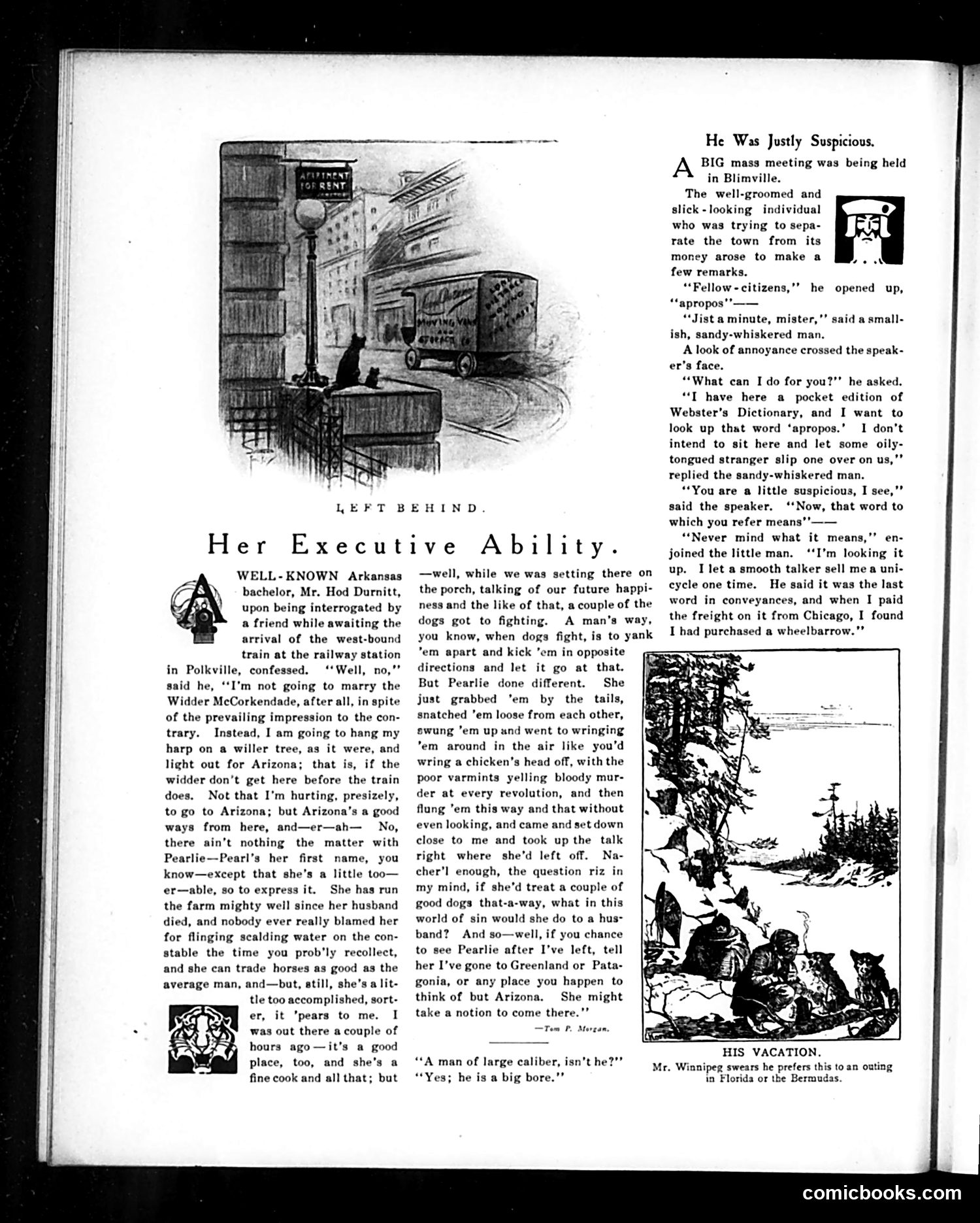
This page contains two satirical stories mocking rural American attitudes and social dynamics circa early 1900s. **"Her Executive Ability"** ridicules a bachelor's fear of an capable woman. Mr. Hod Durnitt plans to flee Arkansas rather than marry "Pearlie," the Widow McCorkendade—not because she's unsuitable, but because she's *too* competent. When her dogs fight, instead of the "manly way" (kicking them apart), she violently swings them by their tails. This demonstration of her aggressive problem-solving terrifies him into believing she'd treat a husband similarly. The satire targets male anxiety about women who display independence and strength. **"He Was Justly Suspicious"** mocks a con-man speaker at a town meeting. When he begins with the word "apropos," a suspicious audience member demands he look it up in a pocket dictionary first—because a "smooth talker" once sold him a unicycle fraudulently. The satire ridicules both the traveling huckster's manipulation and rural skepticism of city slickers, while poking fun at small-town paranoia about being swindled.
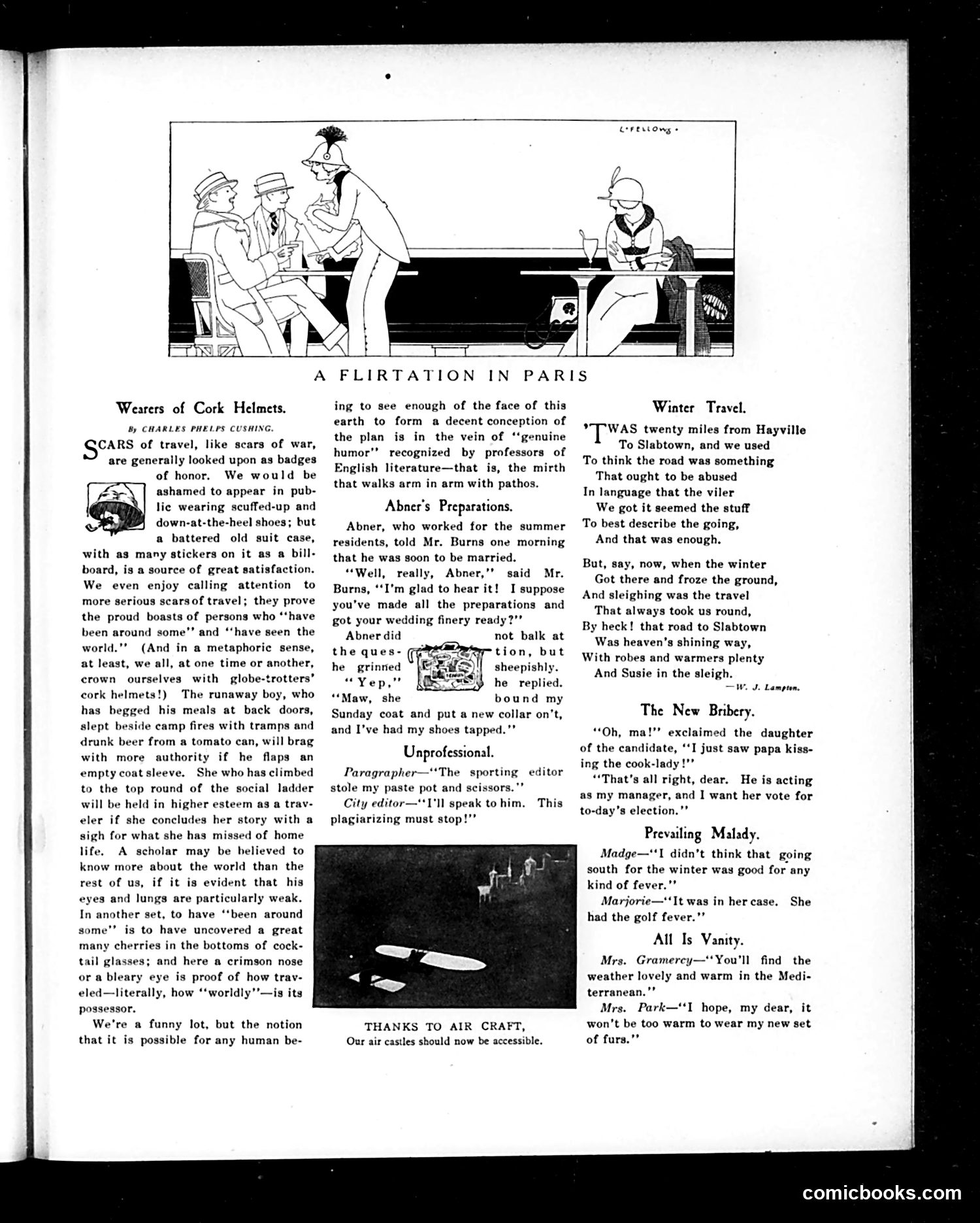
This page contains multiple satirical pieces typical of early 20th-century American humor. **"A Flirtation in Paris"** (top cartoon) depicts a flirtation scene at what appears to a café, with the humor relying on visual social dynamics rather than specific identifiable figures. **"Wearers of Cork Helmets"** satirizes travelers' pretension—people who boast about worn luggage and travel scars as badges of worldliness, whether from genuine adventure or merely excessive drinking. The "cork helmet" references the colonial traveler stereotype. **Abner's Preparations** humorously contrasts rural simplicity with expectation: a working-class man's wedding preparations consist only of his mother binding his coat and having shoes repaired—no elaborate finery. The remaining pieces mock contemporary vanities: editors stealing supplies, a politician's daughter using the family cook for votes, and a wealthy woman more concerned with wearing new furs than actual climate comfort. The overall tone criticizes American pretension, materialism, and class-based absurdities through gentle, domestic humor rather than sharp political commentary.
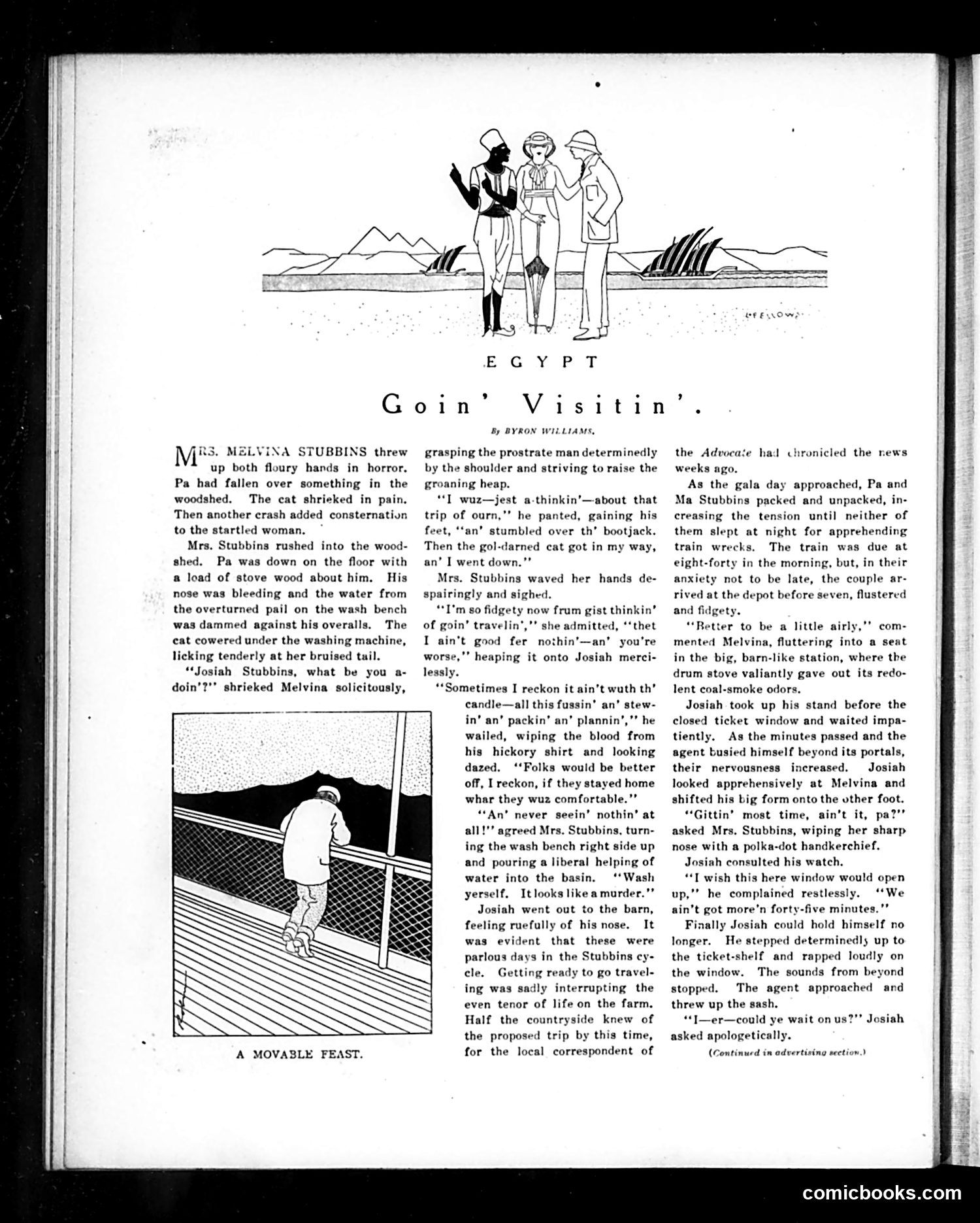
This humorous story satirizes rural American anxieties about travel in the early 20th century. The Stubbins family—Pa and Ma—are depicted as unsophisticated country folk preparing for a trip to Egypt (likely a tourist destination or resort). The satire centers on their nervous incompetence: Pa injures himself in the woodshed simply *thinking* about the journey; both become so anxious they cannot sleep; they arrive at the train station an hour early, then worry they won't make it; Pa must apologetically ask the ticket agent for service. The story mocks rural Americans' unfamiliarity with travel, their superstitious fears of train wrecks, and their general cultural discomfort with modern transportation. The detailed dialect and descriptions of their humble farm life emphasize the gap between provincial small-town existence and the sophistication supposedly required for tourism. The humor relies on readers viewing the Stubbins as quaint, anxiety-prone rustics.
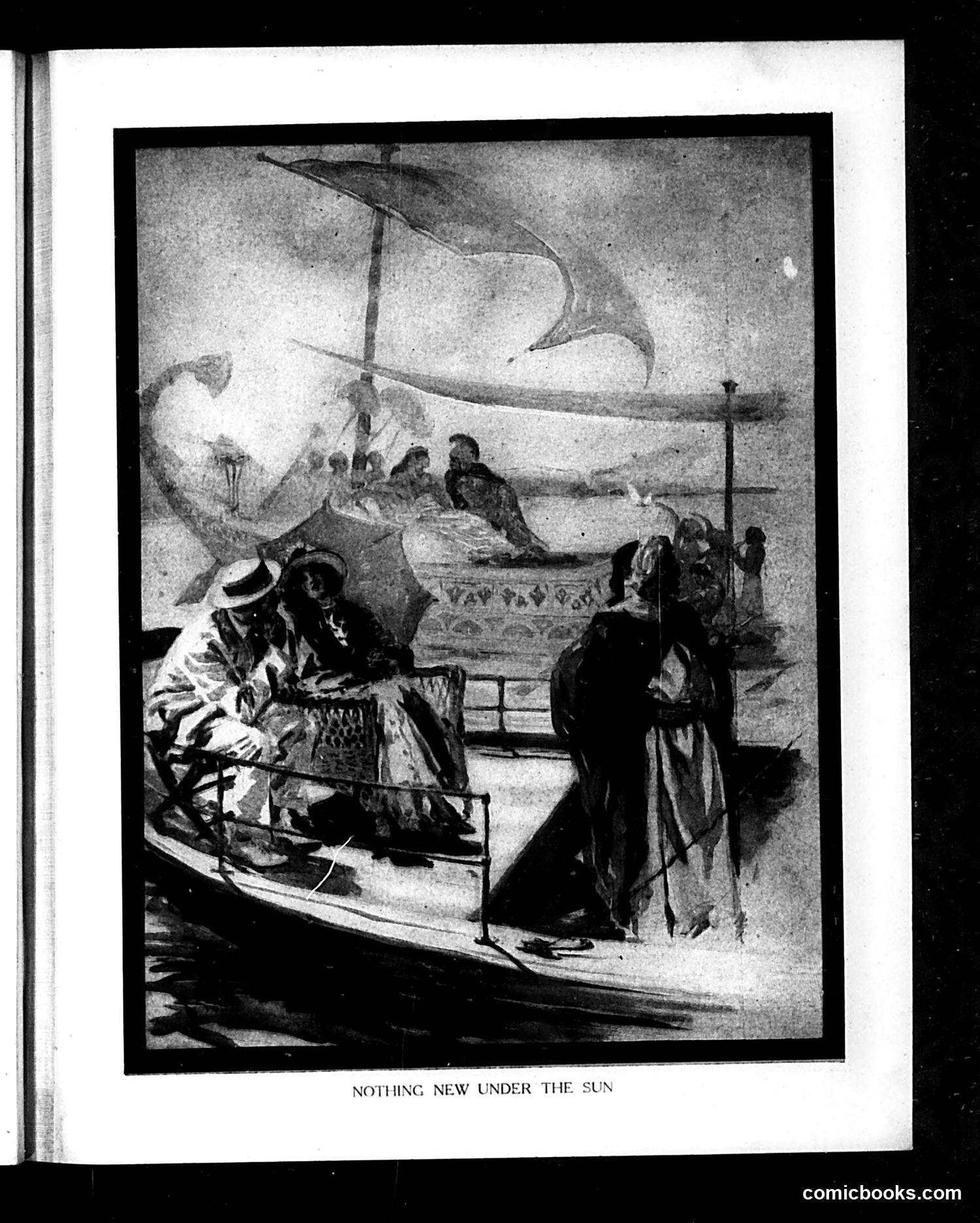
This page contains a single satirical illustration titled "Nothing New Under the Sun." The black-and-white image depicts what appears to be a historical or biblical scene: figures in period costume on boats or near water, with dramatic gestures and classical or religious staging. The title's phrase—a reference to Ecclesiastes ("there is nothing new under the sun")—suggests the cartoon makes a commentary about repetition in human affairs or history. However, without additional context about the specific historical moment Judge published this, or clearer identification of the figures depicted, I cannot confidently identify which particular political or social event or figures are being satirized here. The artistic style and composition suggest social or political commentary typical of Judge magazine's content.
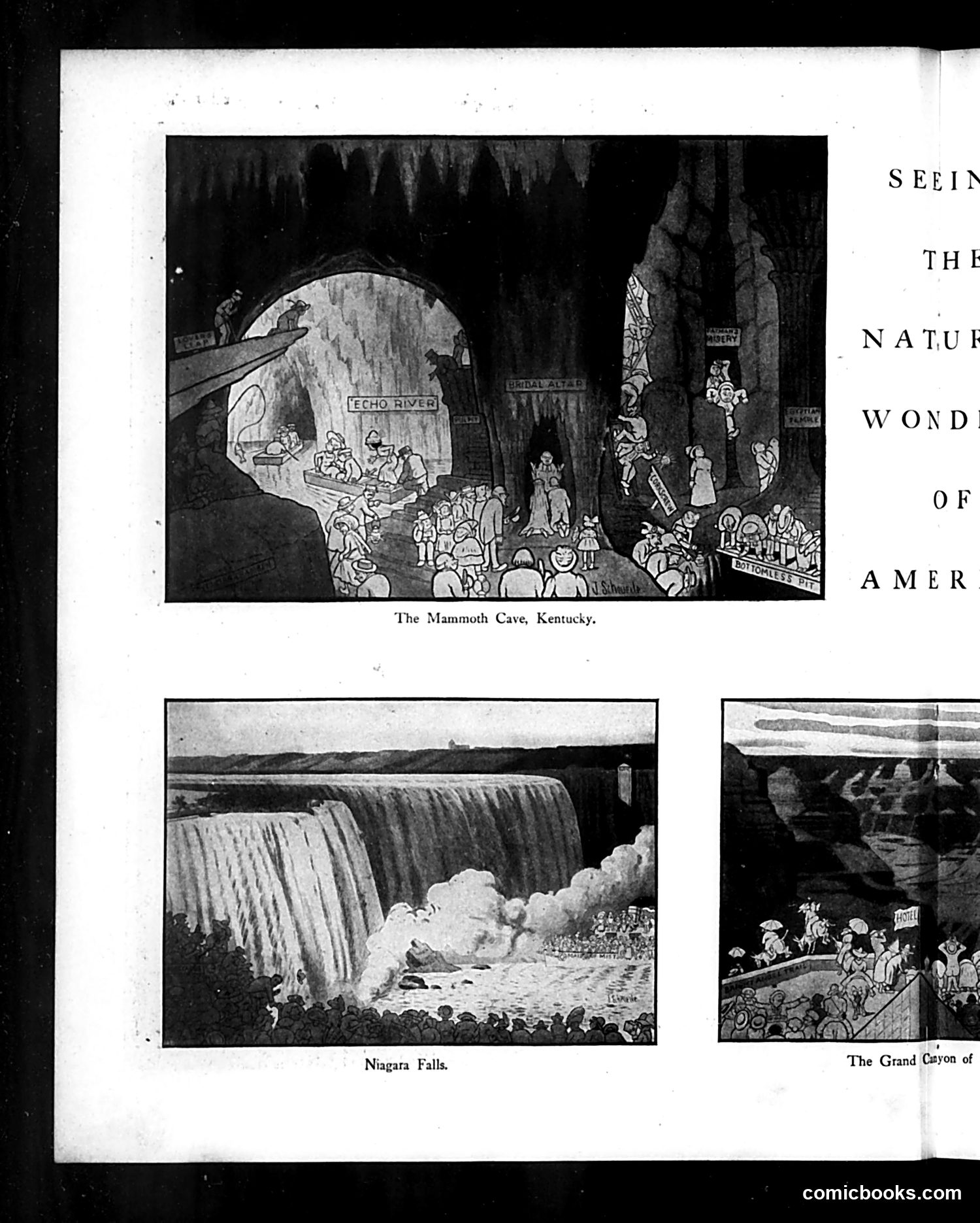
This page shows three illustrated tourist attractions of America: Mammoth Cave (Kentucky), Niagara Falls, and the Grand Canyon. The partial text on the right reads "SEEING THE NATURAL WONDERS OF AMERICA." The cartoons depict these natural sites as crowded tourist destinations, with crowds of visitors depicted in each scene. The satire appears to mock American tourism and the commercialization of natural wonders—presenting these supposedly sublime natural features as overcrowded attractions mobbed by tourists. This reflects turn-of-the-century anxieties about mass tourism and the tension between preserving natural beauty and the public's desire to experience it. The cartoons suggest that these "wonders" have become more about tourist spectacle than genuine natural appreciation.
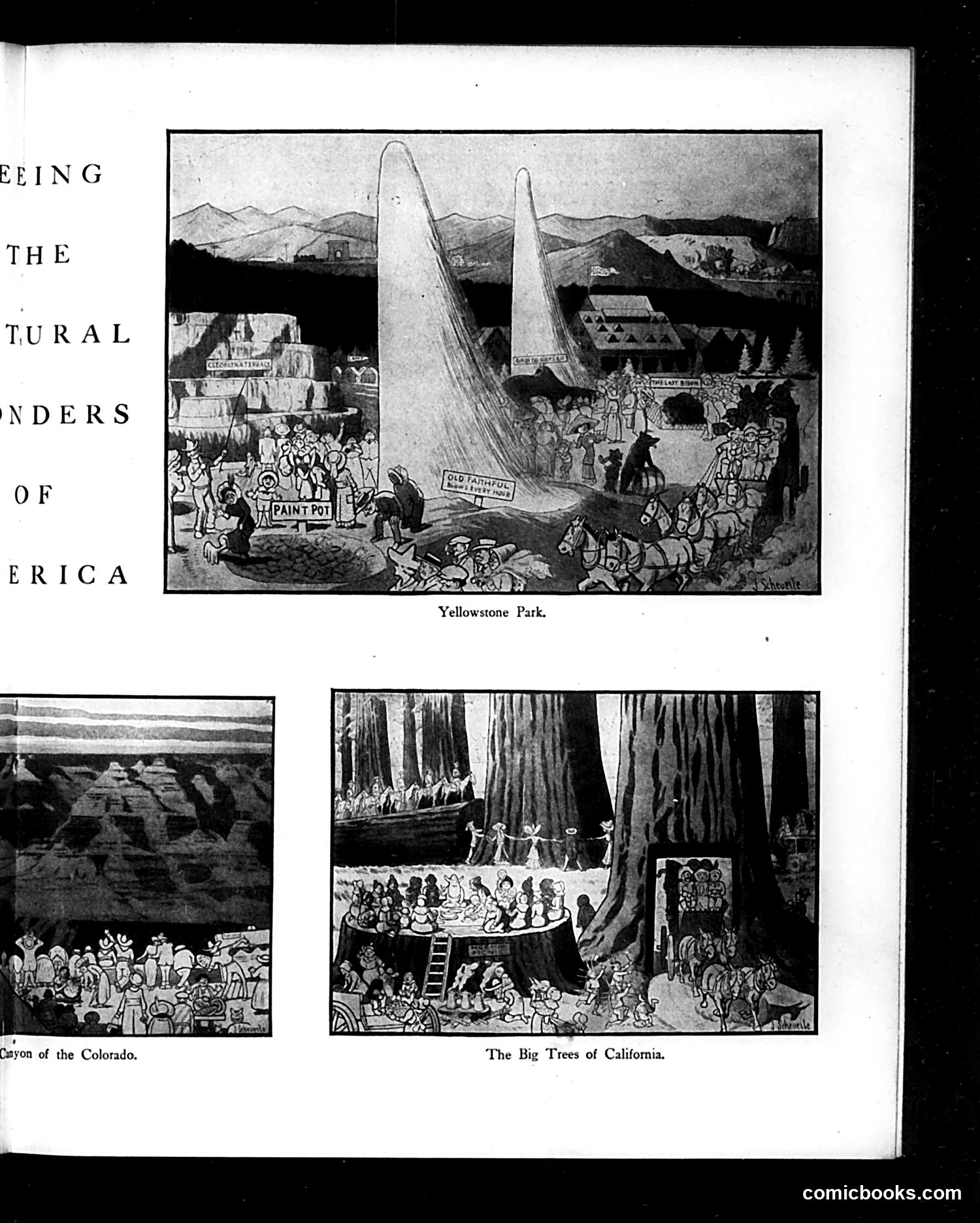
This page from *Judge* magazine features three illustrated scenes celebrating American natural wonders: Yellowstone Park (top), the Canyon of the Colorado (bottom left), and the Big Trees of California (bottom right). The cartoons depict crowds of tourists visiting these sites, drawn in a humorous style with exaggerated figures. The satire likely mocks the emerging "tourist culture" of late-19th/early-20th century America—the way Americans traveled to marvel at natural landmarks, often in crowded, commercialized fashion. Details like the "Paint Pot" sign at Yellowstone suggest the cartoonist is gently ridiculing how these sublime natural wonders were being packaged and commodified for mass consumption. The page title fragment "SEEING...THE NATURAL WONDERS OF AMERICA" reinforces this theme of tourism and spectacle.
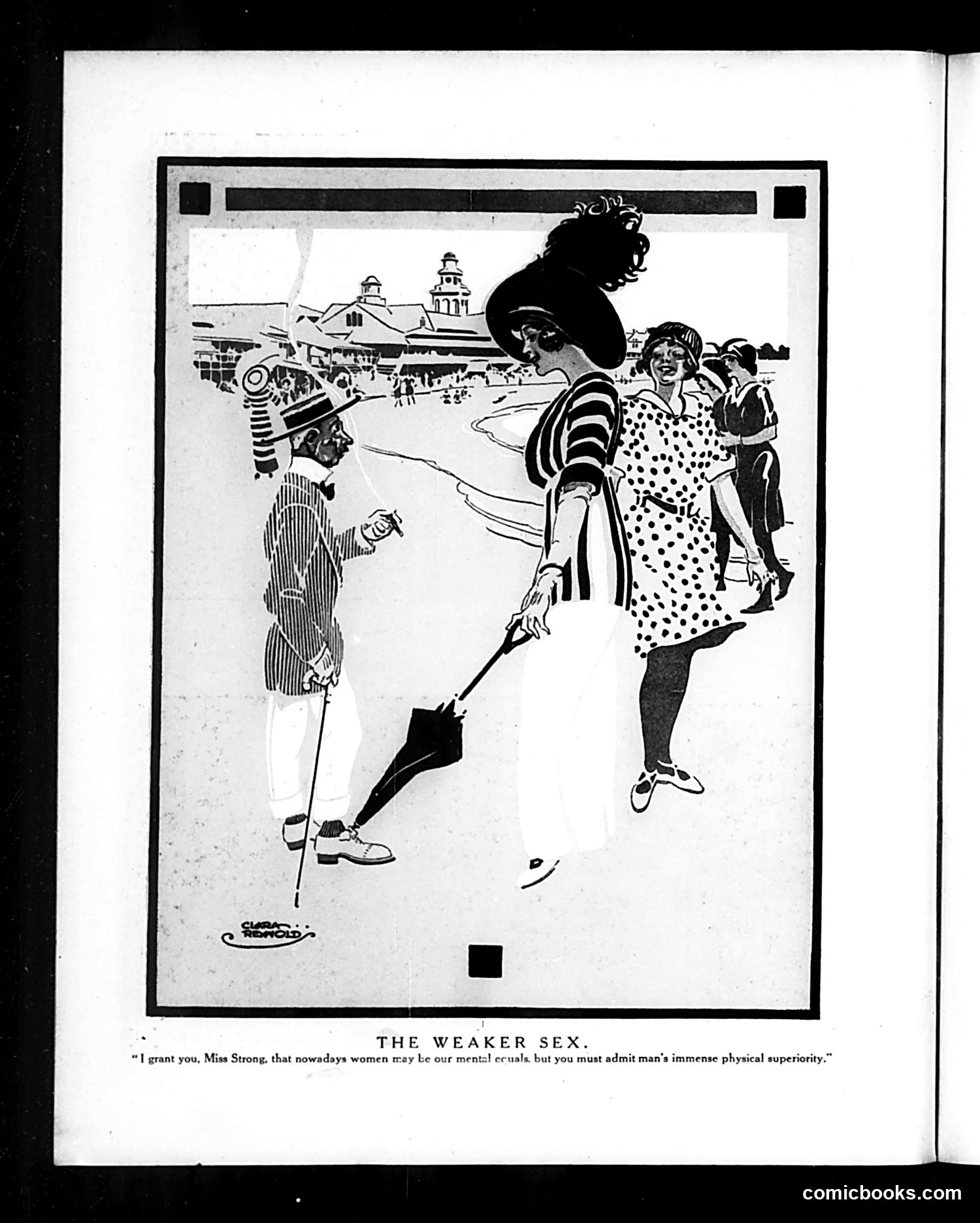
This cartoon satirizes early 20th-century arguments about women's equality. A woman identified as "Miss Strong" plays golf while a man watches, establishing the setup for debate about gender capabilities. The caption quotes the man conceding that "nowadays women may be our mental equals, but you must admit man's immense physical superiority." The cartoon appears to mock this claim by depicting Miss Strong actively engaged in sports—golf specifically—suggesting women possess physical capability contrary to the man's assertion. The satire targets the common argument that while women might match men intellectually, they remained physically inferior. By showing a woman confidently playing golf alongside others at what appears to be a public venue, Judge ridicules this gendered distinction about physical prowess.
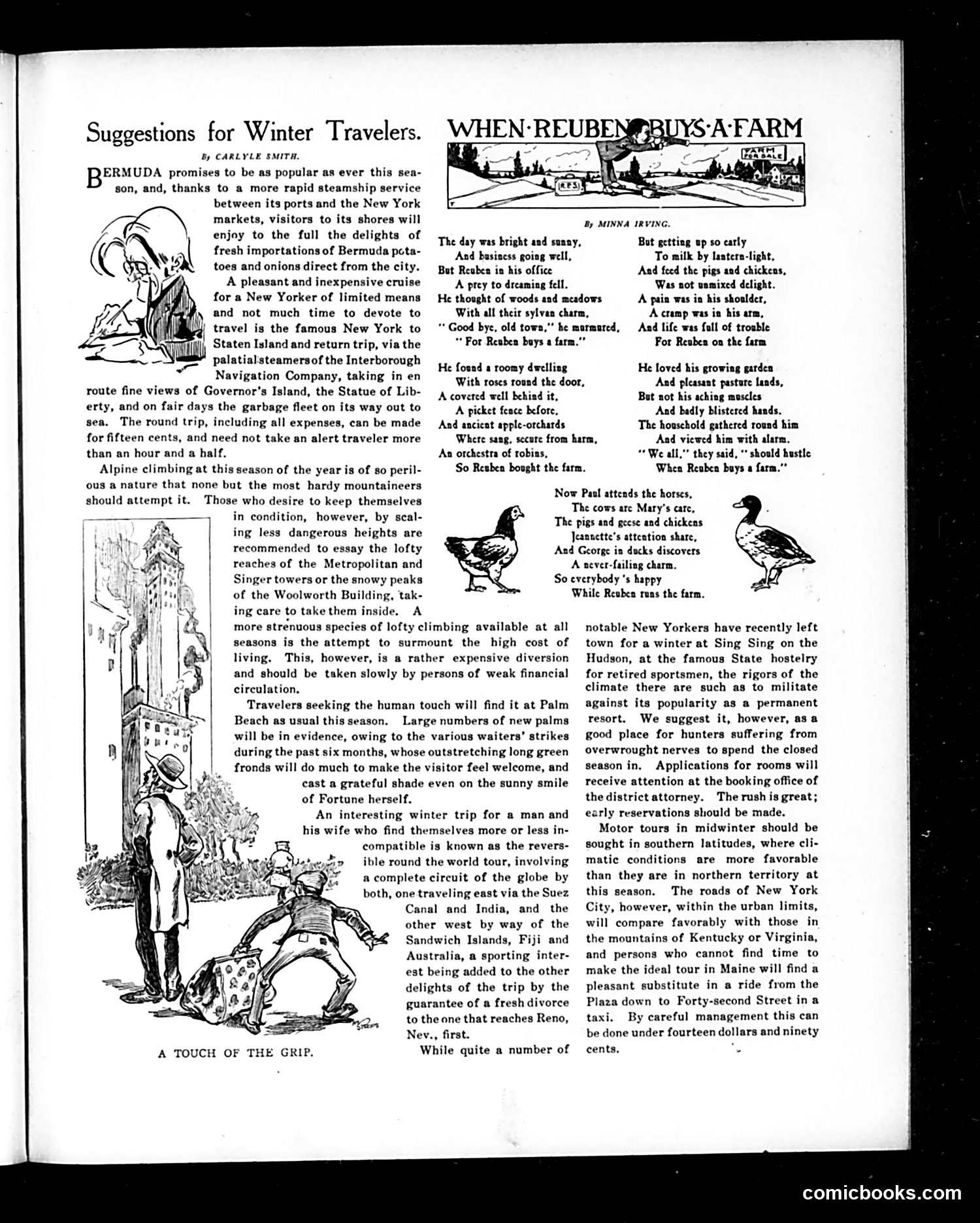
This page contains two distinct pieces of satirical commentary on 1920s American life: **"Suggestions for Winter Travelers"** (left) by Carlyle Smith mocks wealthy New Yorkers' travel pretensions through absurdist recommendations. Instead of genuine exotic destinations, the author suggests laughably cheap local options: a Staten Island ferry ride past garbage dumps ("fifteen cents"), or climbing skyscrapers as alpine training. The satire targets both class aspirations and New York's environmental problems, while jabs at "Palm Beach" note how waiters' strikes create bare landscapes. The final "reversible round the world tour" jokes about wealthy couples traveling separately with the hope of divorcing before reaching Reno, Nevada (then the divorce capital). **"When Reuben Buys a Farm"** (right) by Minna Irving uses verse to satirize urban romantics fleeing city life. Reuben daydreams about pastoral bliss but discovers farming brutal—shoulder pain, blistered hands, exhaustion. The ironic resolution: he becomes a gentleman farmer while family members handle actual labor, mocking his inability to sustain genuine rural commitment. Both pieces target middle-to-upper-class pretension and the gap between idealized fantasy and gritty reality.
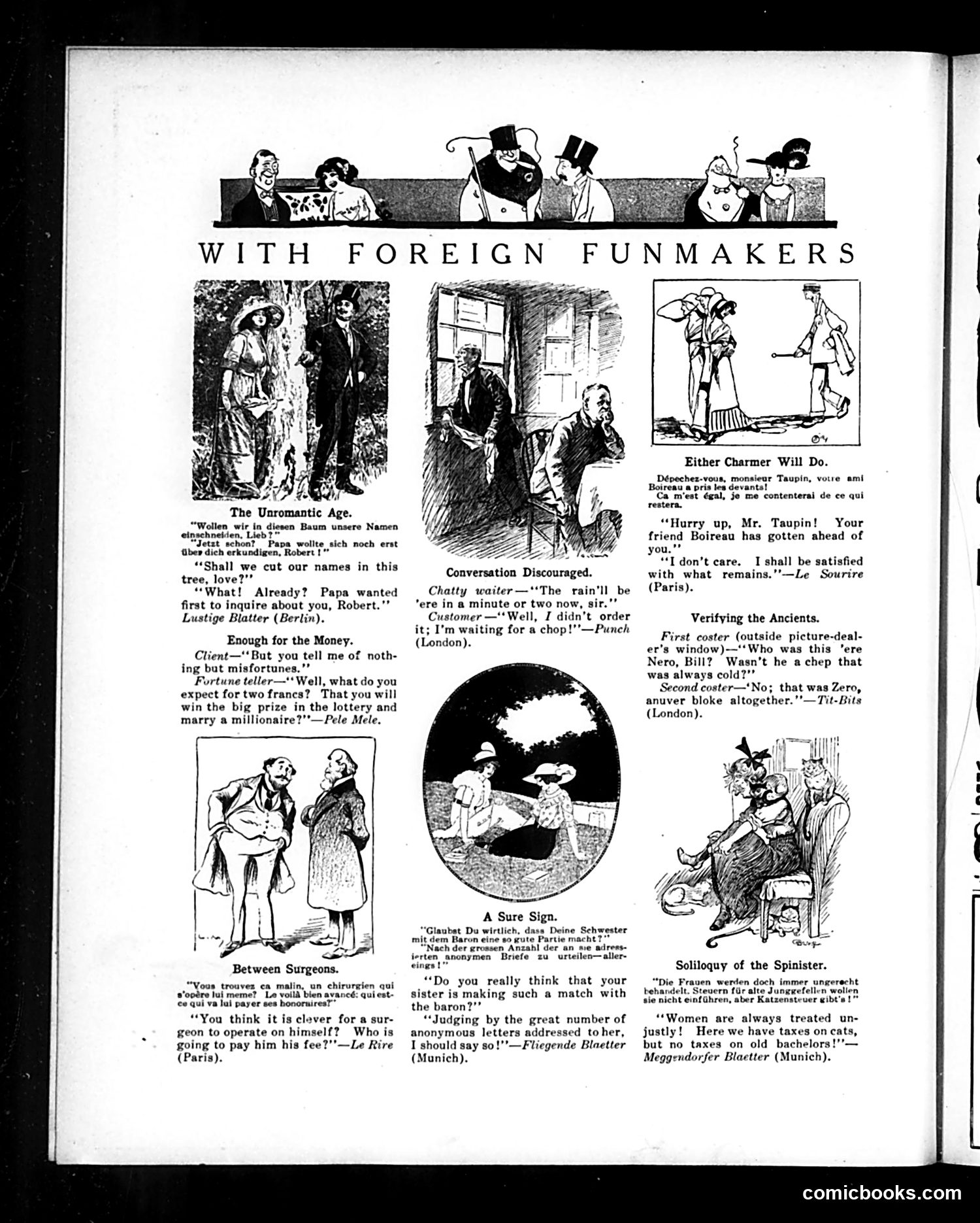
This page compiles brief jokes and cartoons from European satirical publications, translated for American readers. The content reflects early 20th-century social humor: **Key items include:** - A German couple's romance (carving names in trees) - A fortune teller's cynical honesty about cheap readings - A surgeon operating on himself (absurd self-reliance) - A waiter discussing rain as if it's a menu item (Punch's dry British humor) - Anonymous love letters confirming a woman's desirability - Cockney workers confusing "Nero" with "Zero" - A spinster's complaint about bachelor taxes versus cat taxes The page demonstrates Judge's editorial strategy of showcasing European wit to American audiences, suggesting cosmopolitan sophistication. Most jokes exploit class anxieties, gender dynamics, and wordplay typical of pre-WWI satire. The format presents comedy as an international phenomenon, with attributions to Berlin, Paris, and London publications establishing cultural prestige.
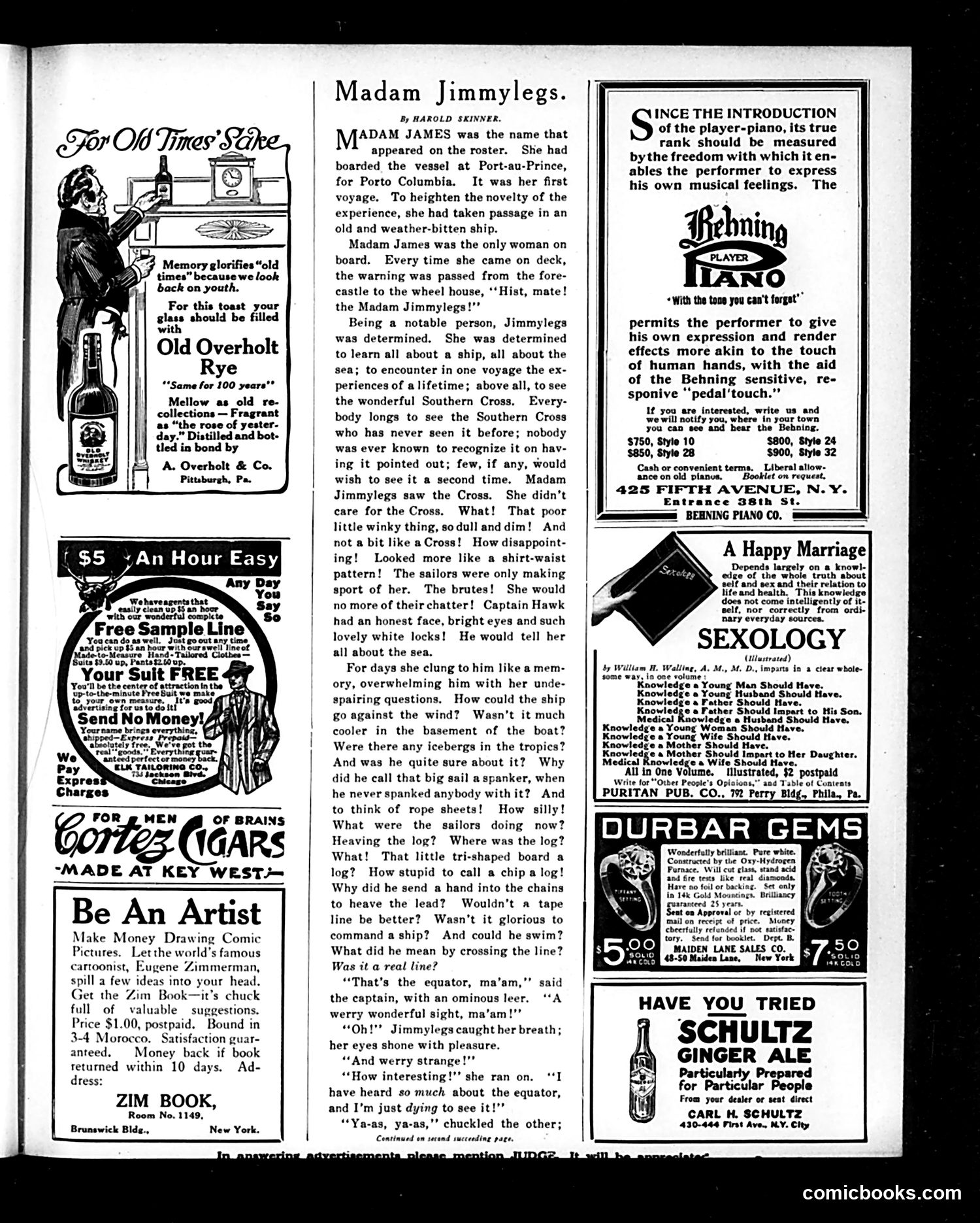
This story satirizes a female passenger's irritating ignorance and relentless questioning aboard a ship. "Madam James" (nicknamed "Jimmylegs" by the crew) is the sole woman passenger determined to learn everything about maritime life. The humor derives from her comically absurd questions: she mistakes the Southern Cross constellation for a dull shirt-waist pattern, asks if the ship's basement is cooler, questions why a sail is called a "spanker" if nobody spanks it with it, and calls rope "sheets" silly. Captain Hawk endures her "despairing questions" with barely concealed annoyance. The satire targets both her gender-stereotyped ignorance of seafaring and her relentless, overwhelming persistence. The story's comedic tension builds toward her asking to see the equator, which the captain hints (with "ominous leer") will involve some maritime initiation ritual—a traditional sailors' prank on ship crossing.
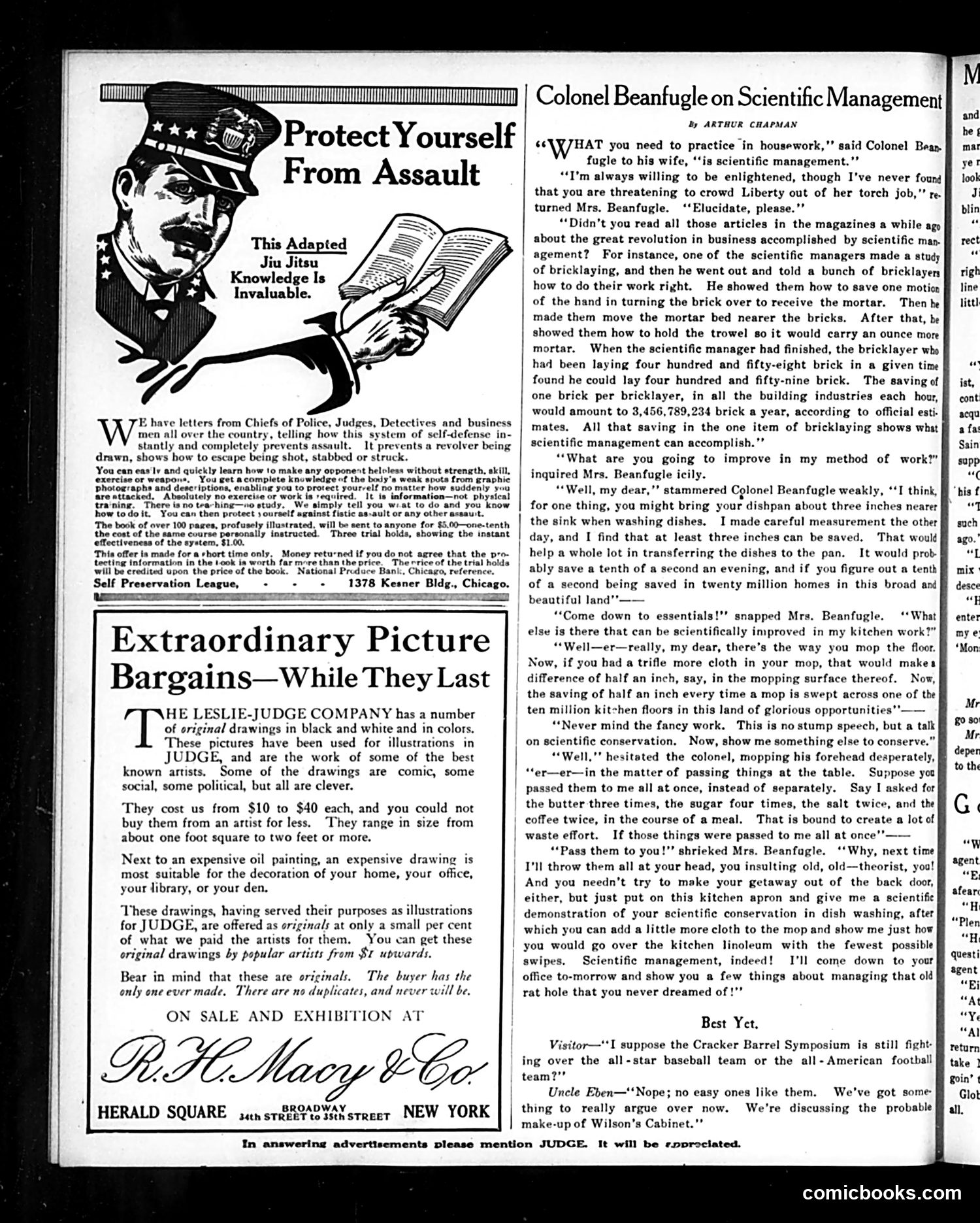
**The Main Cartoon: "Protect Yourself From Assault"** This is an advertisement disguised as public service, promoting a self-defense manual through jiu jitsu instruction. The caricatured military figure (likely representing authority/expertise) hawks a $5 book claiming to teach fighting techniques without physical training—purely through reading. The satire targets both the gullible public and dubious mail-order schemes common to the era. The exaggerated promises ("instantly and completely prevent assault") mock the pseudoscientific marketing language of early 1900s self-help industries. **"Colonel Beanfugle on Scientific Management"** This humorous dialogue satirizes the "scientific management" craze (Frederick Taylor's efficiency movement) sweeping American business. Colonel Beanfugle lectures his wife about applying industrial optimization to housework, using bricklaying as an example—saving one motion per brick yields marginal gains. The joke: applying rigid industrial methodology to domestic life produces absurdly trivial results, mocking how enthusiastically Americans adopted corporate efficiency principles for every aspect of life.
This page contains three humorous short stories typical of *Judge* magazine's satirical content: **"Madam Jimmylegs"** concludes a nautical tale where a captain tricks a woman into seeing a mosquito through a marine glass as a "camel"—a joke about gullibility and optical illusion. **"The Count at Home"** mocks social climbing. A nouveau-riche American who "cut a swell" (showed off wealth) at Newport encounters the same man working as a barber in Paris, now playing servant with the phrase "Monsieur is next!"—satirizing the pretension of European titles and American social aspiration. **"Goin' Visitin'"** presents rural dialect humor: a humble farmer named Josiah confidently books train tickets for himself and "Melvina" to Harpersville (18 miles away), treating modest local travel as grand adventure comparable to Niagara Falls tourism. The page is primarily **advertising** (foot warmers, Pears' Soap, Gibson's Rye whiskey, Northern Pacific Railway), with satirical fiction filling remaining space—typical *Judge* layout blending commerce with humor.
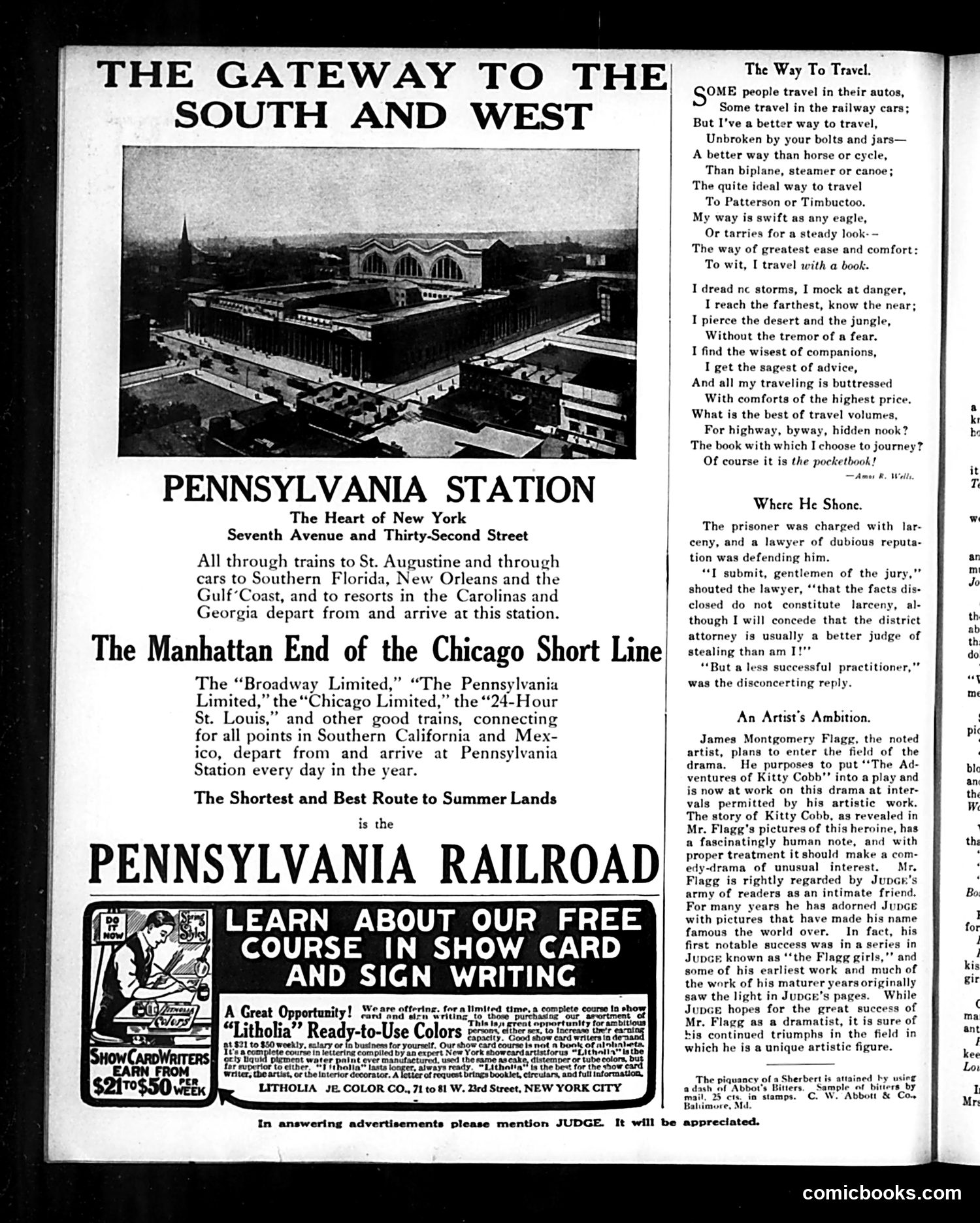
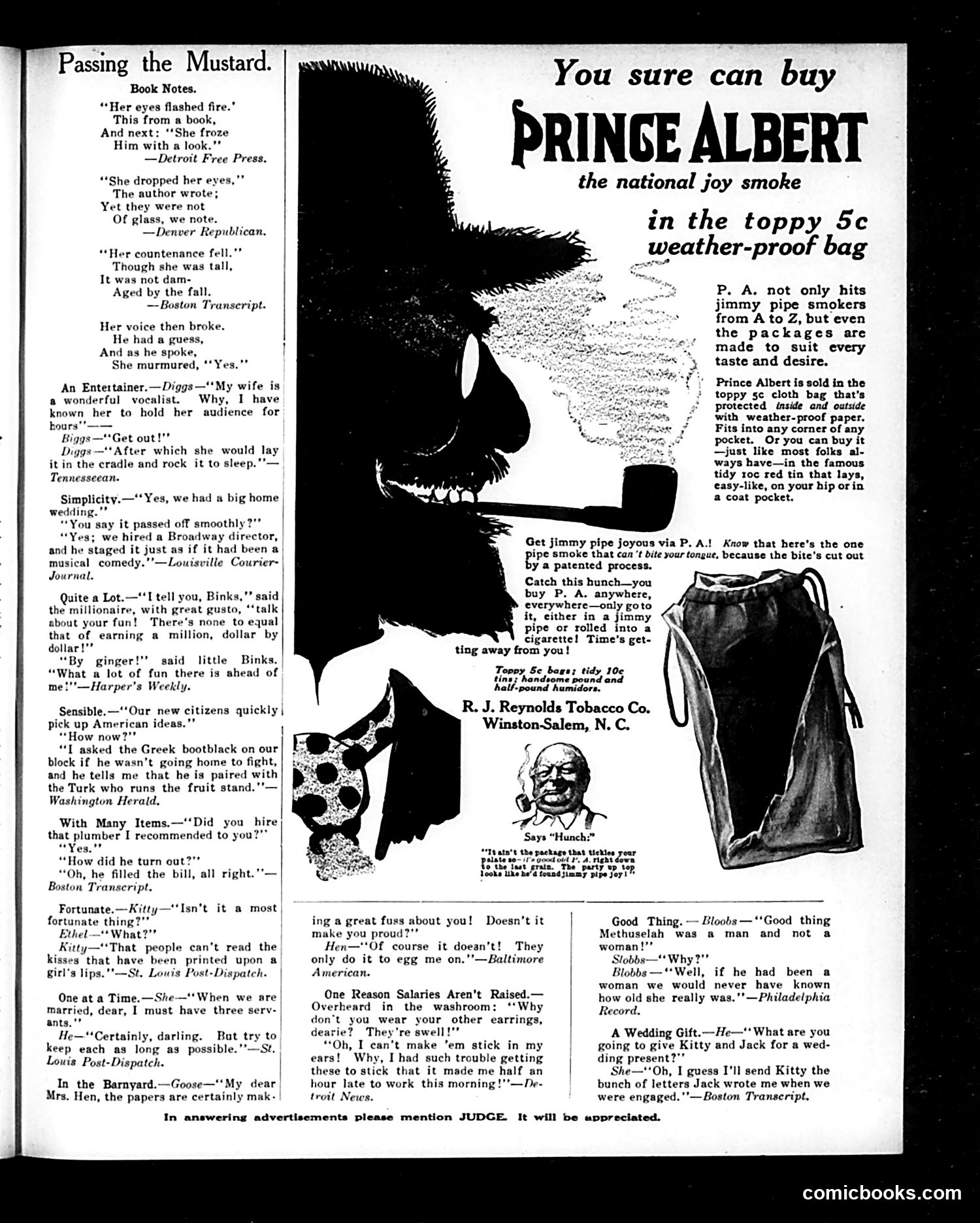
This page from *Judge* magazine contains several short humorous pieces typical of early 20th-century American humor: **"Passing the Mustard"** consists of literary parodies mocking overwrought Victorian prose—authors using impossible metaphors like "dropped her eyes" (implying physical eyeballs falling) or "her voice then broke" (suggesting literal breakage). The remaining jokes are brief social satires: husbands complaining about wives' chattiness, a millionaire boasting about earning money, a Greek immigrant quickly adopting American attitudes about ethnic conflict, and complaints about women's fashion accessories (earrings) causing workplace tardiness. **The Prince Albert tobacco advertisement** dominates the right side, promoting cigarette tobacco in a weather-proof bag—typical of period advertising claims about convenience and quality. The humor relies on puns, literal interpretations of figurative language, and gentle mockery of contemporary social behaviors and gender dynamics—reflecting attitudes and comedic sensibilities now largely dated.
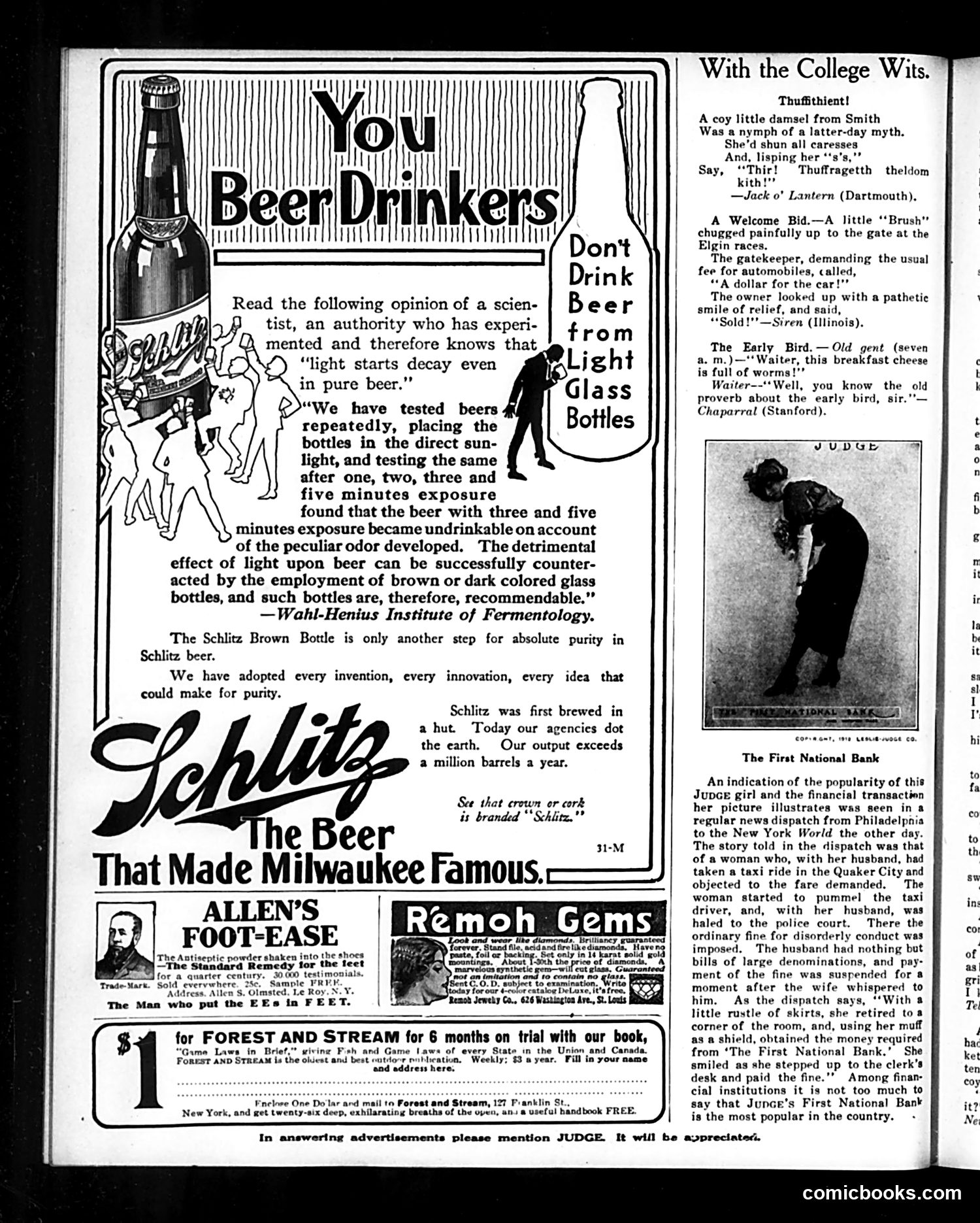
This page contains **multiple advertisements and humor columns**, not political cartoons. The main **Schlitz beer advertisement** (dominant left side) promotes brown bottles by citing the "Wahl-Henius Institute of Fermentology"—a scientific authority claiming light degrades beer quality. The ad argues brown/dark bottles prevent this problem. The cartoon figures are generic celebratory drinkers, not specific caricatures. The **right column** contains brief college humor pieces mocking contemporary social types: a suffragette girl (referencing the women's voting rights movement), and satirical anecdotes about automobiles and dining. These are lightweight campus jokes rather than sharp political satire. Below are smaller ads for **Allen's Foot-Ease** powder and **Forest and Stream** magazine, plus a brief story about "The First National Bank"—a humorous anecdote about a woman who cleverly uses her First National Bank credentials to impress a taxi driver and settle a dispute. The page reflects early 20th-century advertising culture and gentle collegiate humor, with the suffragette reference being the only topical social commentary visible.
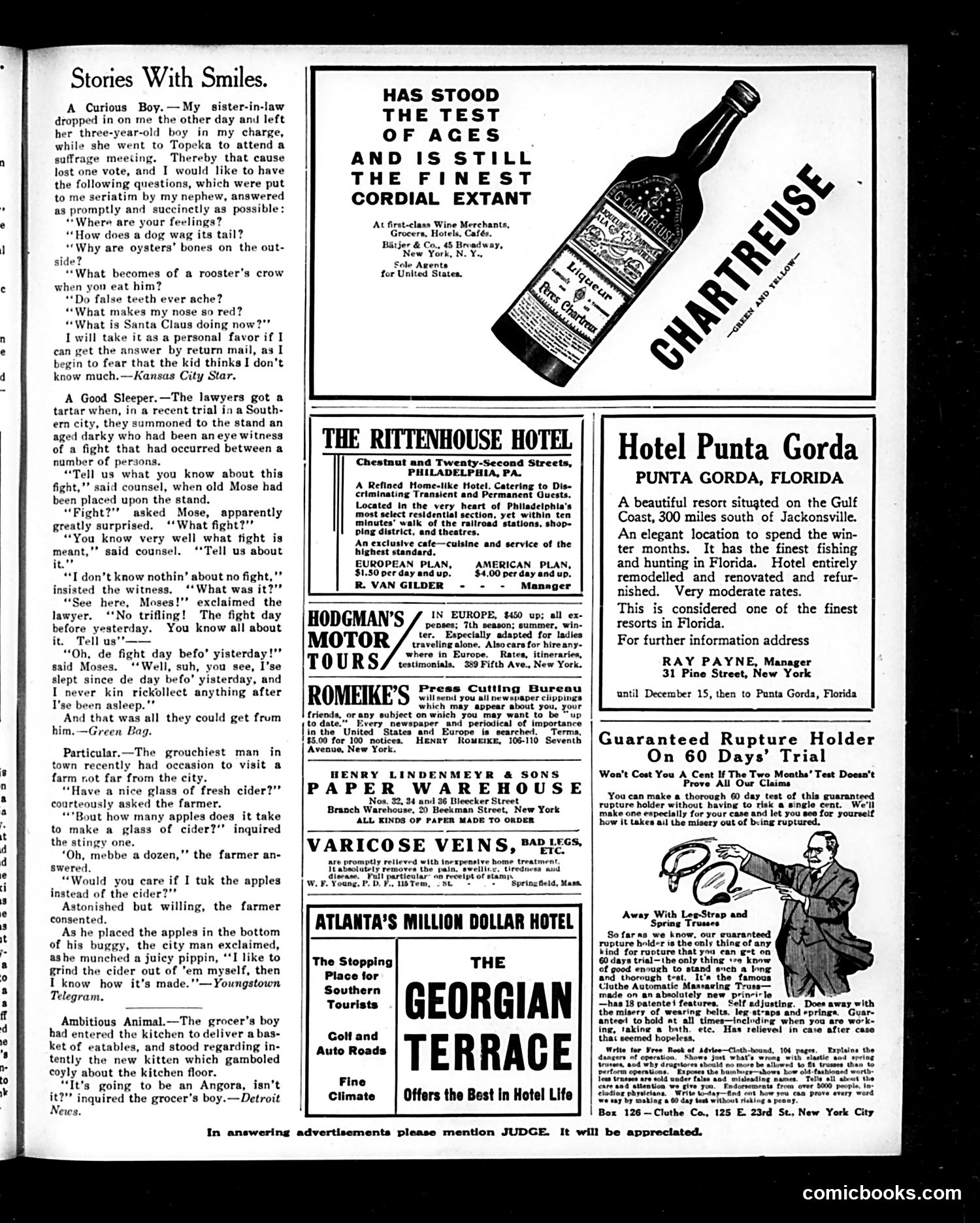
This is primarily a **humor and advertising page** from *Judge* magazine, not a political cartoon page. The content consists of four brief humorous anecdotes in the "Stories With Smiles" section, followed by period advertisements. The jokes rely on comedic misunderstandings and dialect humor typical of early 20th-century American magazines: 1. **"A Curious Boy"**: A child asks unanswerable questions; the joke is parental frustration. 2. **"A Good Sleeper"**: Features an African American witness ("Mose") using dialect who claims to have slept through everything—the humor derives from racial stereotyping common to the era. 3. **"Particular"**: A penny-pinching city visitor exploits a farmer's hospitality. 4. **"Ambitious Animal"**: A grocer's boy makes a pun about a kitten becoming "an Angora." The advertisements promote hotels, wine cordials, and various services—no political content is evident on this page.
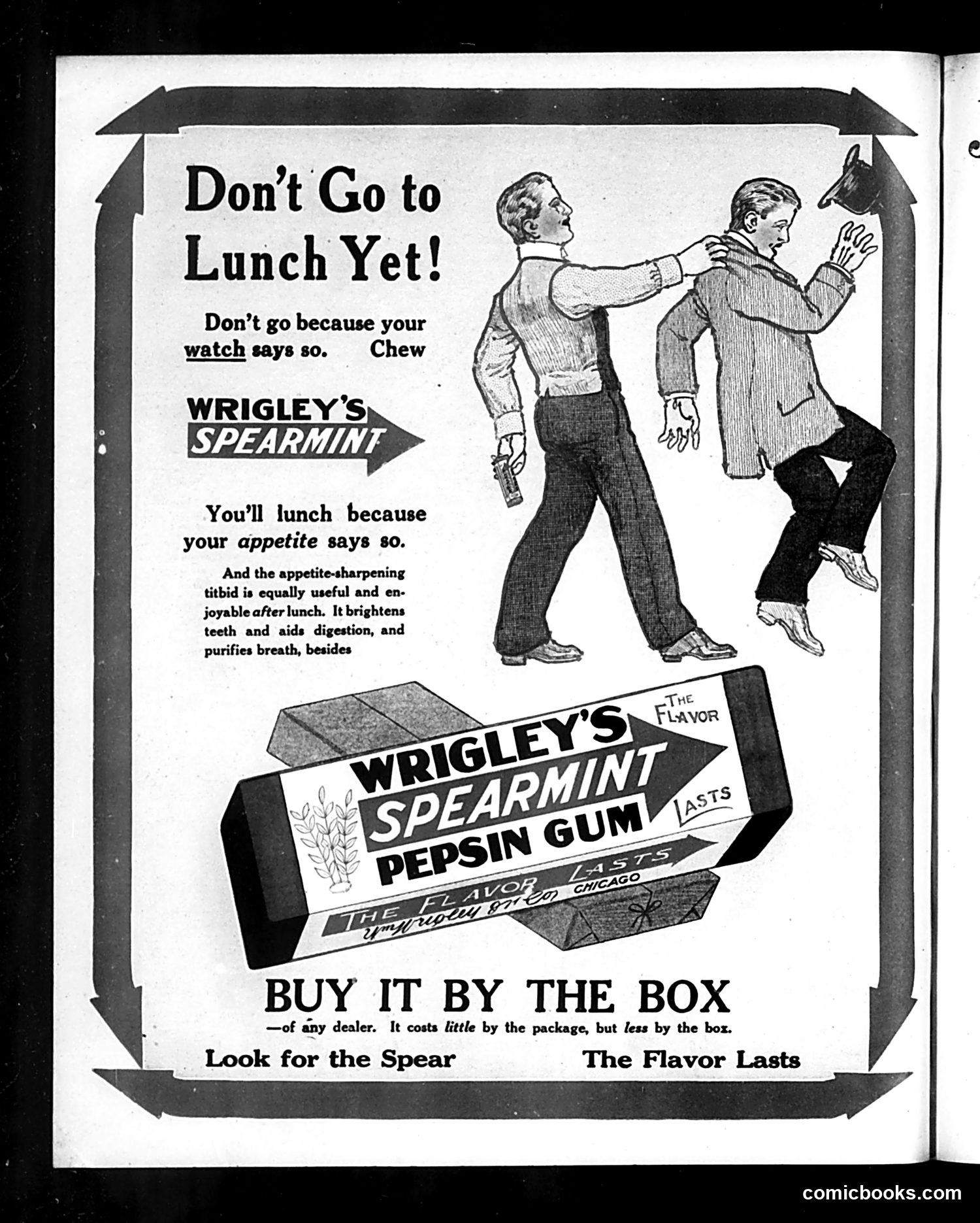
This is a **Wrigley's Spearmint gum advertisement**, not political satire. The ad uses humor to promote chewing gum by playing on social timing and appetite. The joke depicts two businessmen: one checking his watch (implying it's not yet lunchtime), while the other appears hungry and eager to eat. The ad's message is paradoxical—don't let your watch tell you when to lunch; instead, let your appetite decide. Wrigley's Spearmint gum is positioned as the solution: chewing it will sharpen your appetite, making you hungry regardless of the time, while also freshening your breath and improving digestion. The ad emphasizes buying gum "by the box" for cost savings and includes the brand's slogan: "The Flavor Lasts."