
Judge, 1913-01-18 · page 9 of 24
Judge — January 18, 1913 — page 9: what you’re looking at
What you’re looking at
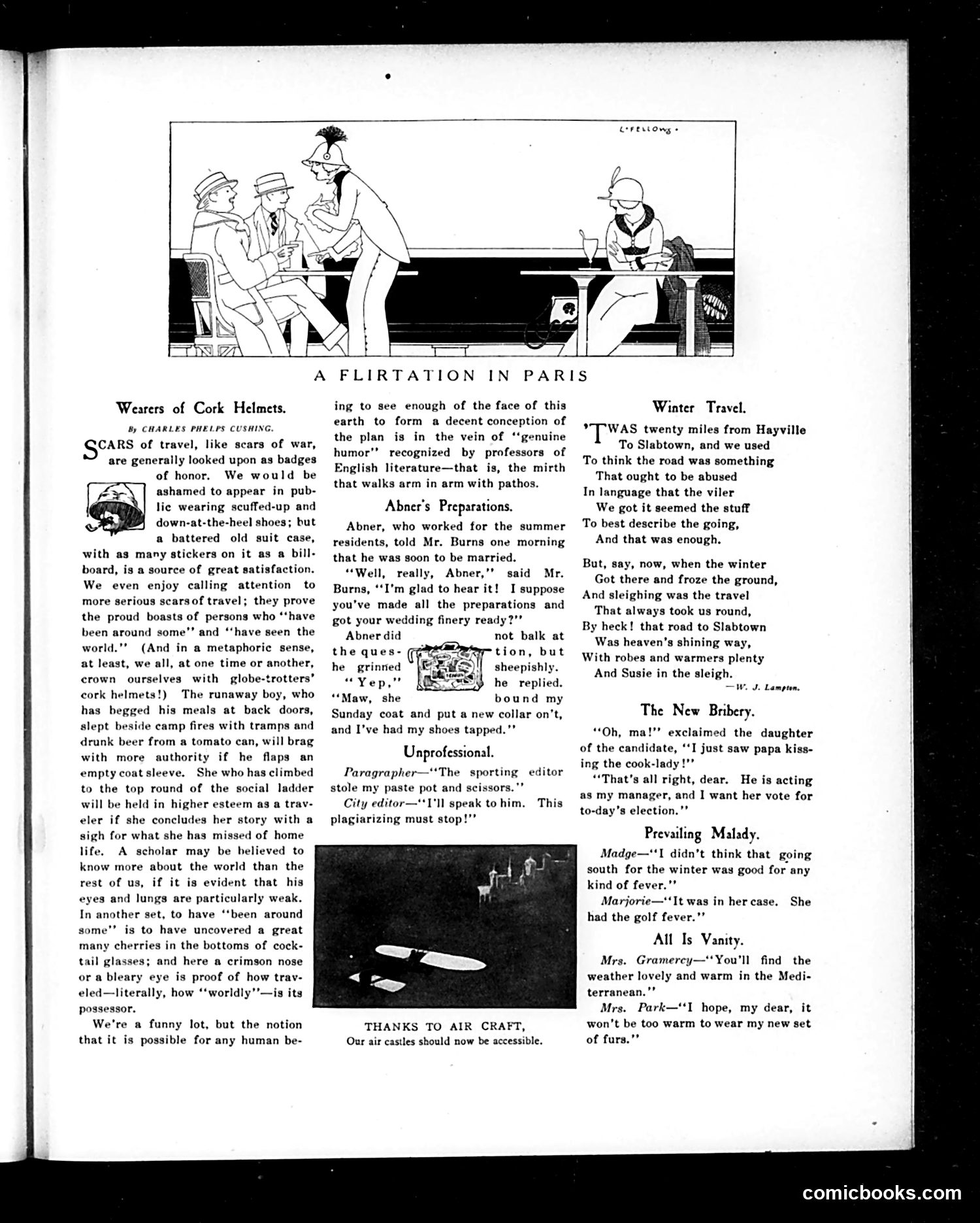
This page contains multiple satirical pieces typical of early 20th-century American humor. **"A Flirtation in Paris"** (top cartoon) depicts a flirtation scene at what appears to a café, with the humor relying on visual social dynamics rather than specific identifiable figures. **"Wearers of Cork Helmets"** satirizes travelers' pretension—people who boast about worn luggage and travel scars as badges of worldliness, whether from genuine adventure or merely excessive drinking. The "cork helmet" references the colonial traveler stereotype. **Abner's Preparations** humorously contrasts rural simplicity with expectation: a working-class man's wedding preparations consist only of his mother binding his coat and having shoes repaired—no elaborate finery. The remaining pieces mock contemporary vanities: editors stealing supplies, a politician's daughter using the family cook for votes, and a wealthy woman more concerned with wearing new furs than actual climate comfort. The overall tone criticizes American pretension, materialism, and class-based absurdities through gentle, domestic humor rather than sharp political commentary.
📄 Transcribed text from this page (OCR, searchable)
Machine-transcribed from the original scan — historical spelling and the odd misread are preserved.
Conenvowy + A FLIRTATION Wearers of Cork Helmets. By CHARLES PHELPS CUSHING. CARS of travel, like scars of war, are generally looked upon as badges of honor, We would be (ea ashamed to appear in pub- lie wearing scuffed-up and Pr down-at-the-heel shoes; but a battered old suit case, with as many stickers on it as a bill- board, is a source of great satisfaction. We even enjoy calling attention to more serious scarsof travel; they prove the proud boasts of persons who ‘‘have been around some”’ and ‘‘have seen the world.’’ (And in a metaphoric sense, at least, we all, at one time or another, crown ourselves with globe-trotters’ cork helmets!) The runaway boy, who has begged his meals at back doors, slept beside camp fires with tramps and drunk beer from a tomato can, will brag with more authority if he flaps an empty coat sleeve. She who has climbed to the top round of the social ladder will be held in higher esteem as a trav- eler if she concludes her story with a sigh for what she has missed of home life. A scholar may be believed to know more about the world than the rest of us, if it is evident that his eyes and lungs are particularly weak. In another set, to have ‘‘been around some”’ is to have uncovered a great many cherries in the bottoms of cock- tail glasses; and here a crimson nose or a bleary eye is proof of how trav- eled—literally, how ‘‘worldly’’—! possessor. We're a funny lot, but the notion that it is possible for any human be- ing to see enough of the face of this earth to form a decent conception of the plan is in the vein of ‘genuine humor’? recognized by professors of English literature—that is, the mirth that walks arm in arm with pathos. Abner’s Preparations. Abner, who worked for the summer residents, told Mr. Burns one morning that he was soon to be married. “Well, really, Abner,” said Mr. Burns, ‘I'm glad to hear it! I suppose you've made all the preparations and got your wedding finery ready?"* Abner did not balk at the ques- tion, but he grintied sheepishly. “Yep,” he replied. “*Maw, she bound my Sunday coat and put a new collar on’t, and I've had my shoes tapped.” Unprofessional. Paragrapher—‘‘The sporting editor stole my paste pot and scissors City editor—"T'll speak to him, This plagiarizing must stop!"’ THANKS TO AIR CRAFT, Our air castles should now be accessible. IN PARIS Winter Travel. "Tas twenty miles from Hayville To Slabtown, and we used To think the road was something That ought to be abused In language that the viler We got it seemed the stuff To best describe the going, And that was enough. But, say, now, when the winter Got there and froze the ground, And sleighing was the travel That always took us round, By heck! that road to Slabtown Was heaven's shining way, With robes and warmers plenty And Susie in the sleigh. —W. J. Lampton, The New Bribery. “Oh, ma!’’ exclaimed the daughter of the candidate, ‘I just saw papa kiss- ing the cook-lady !’" “That's all right, dear. He is acting as my manager, and I want her vote for to-day’s election.”” Prevailing Malady. Madge—‘'! didn’t think that going south for the winter was good for any kind of fever.” Marjorie—‘‘It was in her case. had the golf fever.’” All Is Vanity. Mrs. Gramercy—*You'll find the weather lovely and warm in the Medi- terranean.’’ Mrs. Park—‘‘I hope, my dear, it won't be too warm to wear my new set of furs.’” She comicbooks.com