
Judge, 1913-01-18 · page 4 of 24
Judge — January 18, 1913 — page 4: what you’re looking at
What you’re looking at
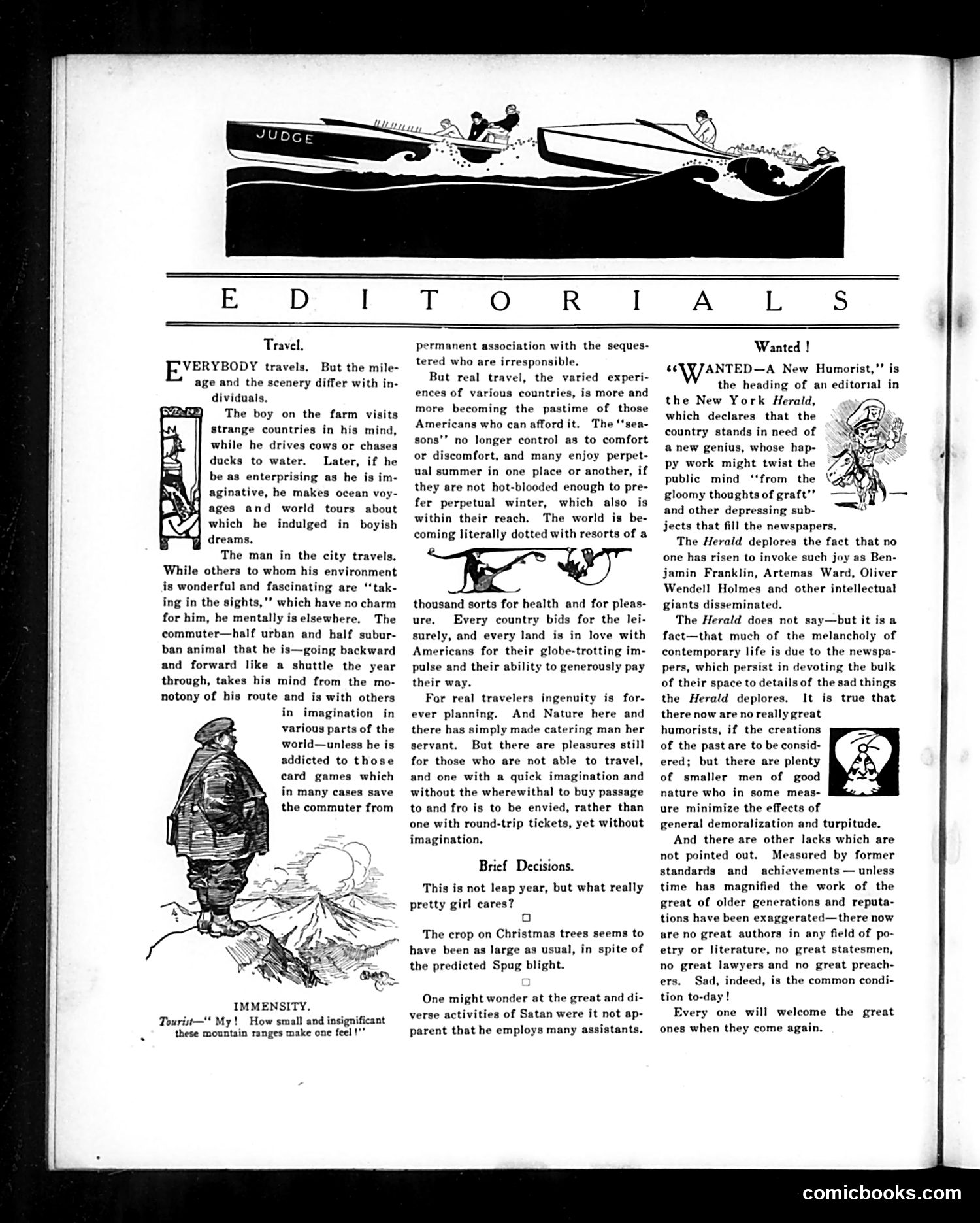
This page contains editorial commentary rather than political cartoons. The main article, "Travel," discusses Americans' leisure tourism habits, noting that while travel broadens some minds, it often fails to inspire imagination in others. The piece criticizes those who travel with "round-trip tickets" but lack genuine curiosity about the world. The "Wanted!" section on the right humorously announces that the New York *Herald* seeks "a new humorist," deploring the loss of great American writers like Benjamin Franklin and Oliver Wendell Holmes. The editorial sarcastically suggests current humorists lack the intellectual caliber of earlier generations. Small decorative illustrations accompany the text, typical of the era's magazine design.
📄 Transcribed text from this page (OCR, searchable)
Machine-transcribed from the original scan — historical spelling and the odd misread are preserved.
E ——— D T O R L S$ A Travel. VERYBODY travels. But the mile- age and the scenery differ with in- dividuals. The boy on the farm visits Strange countries in his mind, while he drives cows or chases ducks to water. Later, if he be as enterprising as he is im- aginative, he makes ocean voy- ages and world tours about which he indulged in boyish dreams. The man in the city travels. While others to whom his environment is wonderful and fascinating are ‘‘tak- ing in the sights,"’ which have no charm for him, he mentally iselsewhere. The commuter—half urban and half subur- ban animal that he is—going backward and forward like a shuttle the year through, takes his mind from the mo- notony of his route and is with others in imagination in various parts of the world—unless he is addicted to those card games which in many cases save the commuter from IMMENSITY. Tourist—' My! How small and insignificant these mountain ranges make one feel !"" permanent association with the seques- tered who are irresponsible. But real travel, the varied experi- ences of various countries, is more and more becoming the pastime of those Americans who can afford it. The ‘‘sea- sons’’ no longer control as to comfort or discomfort, and many enjoy perpet- ual summer in one place or another, if they are not hot-blooded enough to pre- fer perpetual winter, which also is within their reach, The world is be- coming literally dotted with resorts of a thousand sorts for health and for pleas- ure. Every country bids for the lei- surely, and every land is in love with Americans for their globe-trotting im- pulse and their ability to generously pay their way. For real travelers ingenuity is for- ever planning. And Nature here and there has simply made catering man her servant. But there are pleasures still for those who are not able to travel, and one with a quick imagination and without the wherewithal to buy passage to and fro is to be envied, rather than one with round-trip tickets, yet without imagination. Brief Decisions. This is not leap year, but what really pretty girl cares? a The crop on Christmas trees seems to have been as large as usual, in spite of the predicted Spug blight. One might wonder at the great and di- verse activities of Satan were it not ap- parent that he employs many assistants. Wanted ! “ce ANTED—A New Humorist,’’ is the heading of an editorial in the New York Herald, which declares that the country stands in need of a new genius, whose hap- py work might twist the public mind ‘‘from the gloomy thoughts of graft’’ and other depressing sub- jects that fill the newspapers. The Herald deplores the fact that no one has risen to invoke such joy as Ben- jamin Franklin, Artemas Ward, Oliver Wendell Holmes and other intellectual giants disseminated. The Herald does not say—but it isa fact—that much of the melancholy of contemporary life is due to the newspa- pers, which persist in devoting the bulk of their space to details of the sad things. the Herald deplores, It is true that there now are no really great humorists, if the creations of the past are to be consid- fe. ered; but there are plenty a of smaller men of good nature who in some meas- ure minimize the effects of general demoralization and turpitude. And there are other lacks which are not pointed out. Measured by former standards and achievements — unless time has magnified the work of the great of older generations and reputa- tions have been exaggerated—there now are no great authors in any field of po- etry or literature, no great statesmen, no great lawyers and no great preach- ers. Sad, indeed, is the common condi- tion to-day! Every one will welcome the great ones when they come again. comicbooks.com