
Judge, 1913-01-18 · page 6 of 24
Judge — January 18, 1913 — page 6: what you’re looking at
What you’re looking at
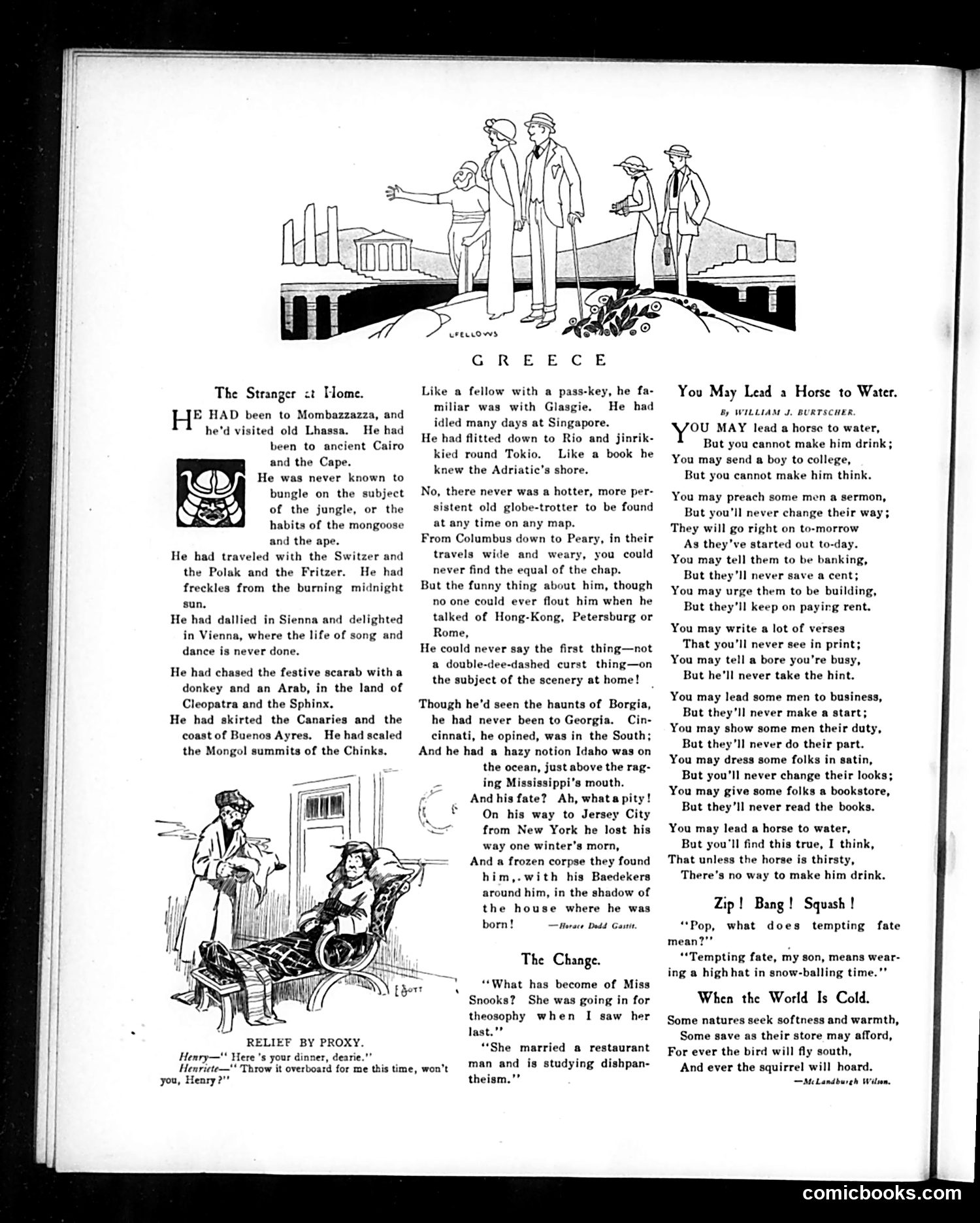
This page mocks a well-traveled man who has visited exotic locations worldwide—Cairo, Vienna, Singapore, Rio, Tokyo—yet remains ignorant about his own hometown. The joke: despite his extensive globetrotting credentials and knowledge of famous landmarks, he cannot describe local scenery, believes Cincinnati is in the South, and fatally loses his way traveling between New York and Jersey City in winter. The satire targets a specific type of early 20th-century traveler: those who collected exotic experiences and could name-drop foreign cities but lacked practical knowledge or genuine cultural understanding. It's a gentle mockery of superficial worldliness and the irony that familiarity with distant places doesn't equal actual competence or wisdom about one's surroundings. The accompanying poem "You May Lead a Horse to Water" reinforces the theme: you cannot force understanding or change on anyone, regardless of effort or opportunity.
📄 Transcribed text from this page (OCR, searchable)
Machine-transcribed from the original scan — historical spelling and the odd misread are preserved.
The Stranger <t Tome. E HAD been to Mombazzazza, and he'd visited old Lhassa. He had been to ancient Cairo and the Cape. He was never known to bungle on the subject of the jungle, or the habits of the mongoose and the ape. He had traveled with the Switzer and the Polak and the Fritzer. He had freckles from the burning midnight sun, He had dallied in Sienna and delighted in Vienna, where the life of song and dance is never done. He had chased the festive scarab with a donkey and an Arab, in the land of Cleopatra and the Sphinx. He had skirted the Canaries and the coast of Buenos Ayres. He had scaled the Mongol summits of the Chinks. RELIEF BY PROXY. Henry—* Here 's your dinner, dearie."” Henricte—'* Throw it overboard for me this time, won't you, Henry ?"" Like a fellow with a pass-key, he fa- miliar was with Glasgie. He had idled many days at Singapore. He had flitted down to Rio and jinrik- kied round Tokio. Like a book he knew the Adriatic’s shore. No, there never was a hotter, more per- sistent old globe-trotter to be found at any time on any map. From Columbus down to Peary, in their travels wide and weary, you could never find the equal of the chap. But the funny thing about him, though no one could ever flout him when he talked of Hong-Kong, Petersburg or Rome, He could never say the first thing—not a double-dee-dashed curst thing—on the subject of the scenery at home! Though he'd seen the haunts of Borgia, he had never been to Georgia. Cin- cinnati, he opined, was in the South; And he had a hazy notion Idaho was on the ocean, just above the rag- ing Mississippi’s mouth. And his fate? Ah, whata pity! On his way to Jersey City from New York he lost his way one winter's morn, And a frozen corpse they found him,.with his Baedekers around him, in the shadow of the house where he was born! Horace Dodd Gastit The Change. “‘What has become of Miss Snooks? She was going in for theosophy when I saw her las She married a restaurant man and is studying dishpan- theism.’” You May Lead a Horse to Water. By WILLIAM J, BURTSCHER. OU MAY lead a horse to water, But you cannot make him drink; You may send a boy to college, But you cannot make him think. You may preach some men a sermon, But you'll never change their way; They will go right on to-morrow As they've started out to-day. You may tell them to be banking, But they'll never save a cent; You may urge them to be building, But they'll keep on paying rent. You may write a lot of verses That you'll never see in print; You may tell a bore you're busy, But he'll never take the hint. You may lead some men to business, But they'll never make a start; You may show some men their duty, But they’ll never do their part. You may dress some folks in satin, But you'll never change their looks; You may give some folks a bookstore, But they'll never read the books. You may lead a horse to water, But you'll find this true, I think, That unless the horse is thirsty, There's no way to make him drink. Zip! Bang! Squash ! “Pop, what does tempting fate mean?” : “Tempting fate, my son, means wear- ing a high hat in snow-balling time." When the World Is Cold. Some natures seek softness and warmth, Some save as their store may afford, For ever the bird will fly south, And ever the squirrel will hoard. —MLandburch Wiliam, comicbooks.com