
Judge, 1913-01-18 · page 7 of 24
Judge — January 18, 1913 — page 7: what you’re looking at
What you’re looking at
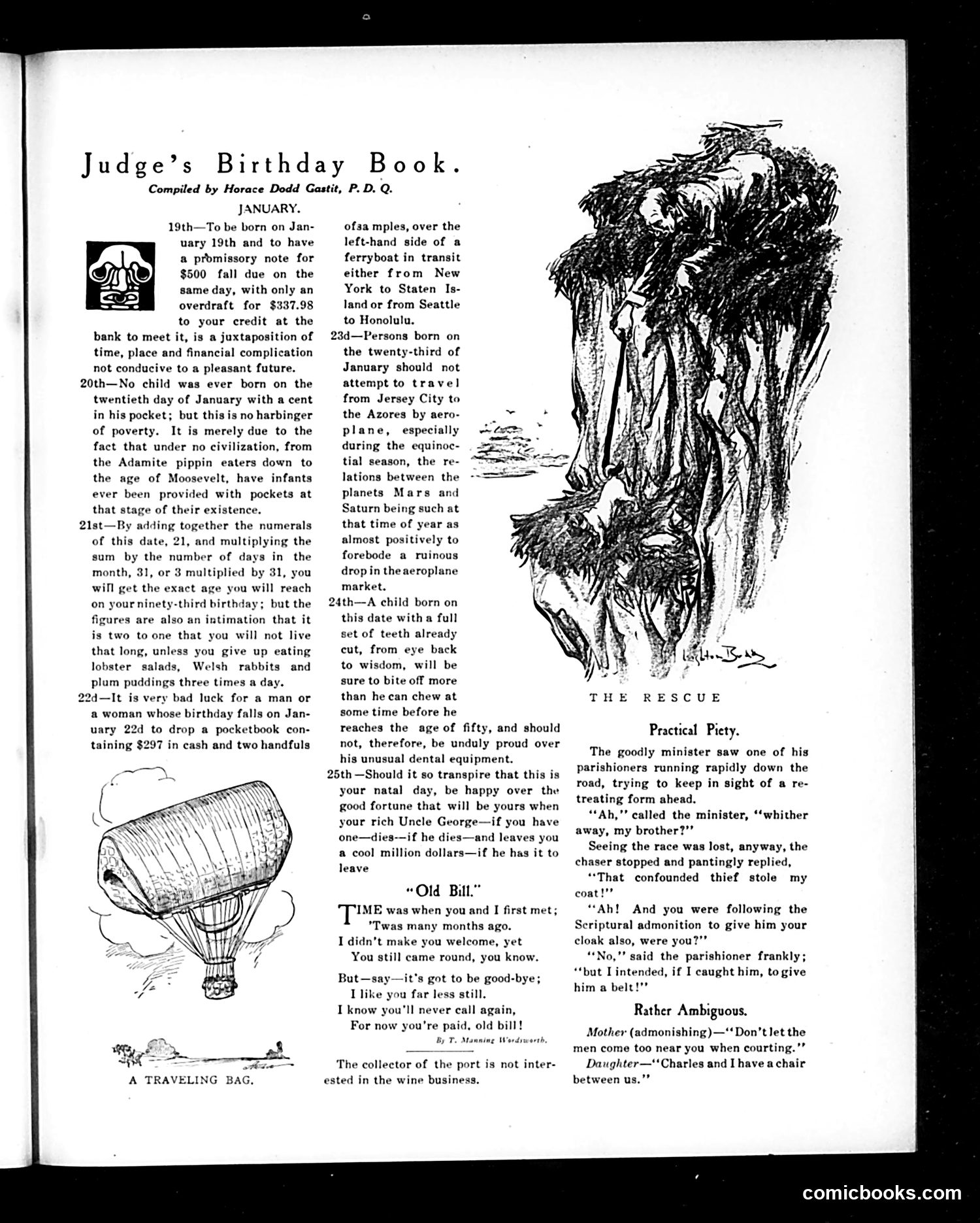
This page from Judge's "Birthday Book" is satirical commentary on superstition and bad luck, presented as absurdist humor typical of the era. The main text mocks the notion that birth dates determine fortune. Each January entry offers increasingly ridiculous "predictions"—a man born January 19th facing a $500 promissory note with insufficient bank credit; children born in January supposedly never having pocket money; calculations proving January 21st births lead to early death unless one stops eating rich foods. The satire peaks with entries warning against specific foolish acts (dropping money from ferries, flying aeroplane to the Azores during equinox season) as though astrological timing makes them particularly dangerous. Three separate humor pieces follow: "Old Bill" (a poem about a creditor finally paid off), "Practical Piety" (a minister misinterpreting a parishioner's violent pursuit of a thief as Christian charity), and "Rather Ambiguous" (a daughter's chaperonage joke). The illustrations—a hot-air balloon and a cliff rescue—are decorative rather than commentary.
📄 Transcribed text from this page (OCR, searchable)
Machine-transcribed from the original scan — historical spelling and the odd misread are preserved.
Judge’s Birthday Book. Compiled by Horace Dodd Gastit, P. D. Q. JANUARY. 19th—To be born on Jan- uary 19th and to have a promissory note for $500 fall due on the same day, with only an overdraft for $337.98 to your credit at the bank to meet it, is a juxtaposition of time, place and financial complication not conducive to a pleasant future. 20th—No child was ever born on the twentieth day of January with a cent in his pocket; but this is no harbinger of poverty. It is merely due to the fact that under no zation, from the Adamite pippin eaters down to the age of Moosevelt, have infants ever been provided with pockets at that stage of their existence. 21st—By adding together the numerals of this date, 21, and multiplying the sum by the number of days in the month, 31, or 3 multiplied by 31, you will get the exact age you will reach on your ninety-third birthday; figures are also an intimation that it is two to one that you will not live that long, unless you give up eating lobster salads, Welsh rabbits and plum puddings three times a day. 22d—It is very bad luck for a man or a woman whose birthday falls on Jan- uary 22d to drop a pocketbook con- taining $297 in cash and two handfuls A TRAVELING BAG, ofaa mples, over the left-hand side of a ferryboat in transit either from New York to Staten Is- land or from Seattle to Honolulu. 23d—Persons born on the twenty-third of January should not attempt to travel from Jersey City to the Azores by aero- plane, especially during the equinoc- tial season, the re- lations between the planets Mars and Saturn being such at that time of almost posi forebode a ruinous drop in the aeroplane market. 24th—A child born on this date witha full set of teeth already cut, from eye back to wisdom, will be sure to bite off more than he can chew at some time before he reaches the age of fifty, and should not, therefore, be unduly proud over his unusual dental equipment. 25th —Should it so transpire that this is your natal day, be happy over the good fortune that will be yours when your rich Uncle George—if you have one—dies—if he dies—and leaves you a cool million dollars—if he has it to leave “Old Bill.” Tie was when you and I first met; 'Twas many months ago. I didn’t make you welcome, yet You still came round, you know. But—say—it's got to be good-bye; lL like you far less still. I know you'll never call again, For now you're paid, old bill! By T. Manning Wordsworth The collector of the port is not inter- ested in the wine business. THE RESCUE Practical Piety. The goodly minister saw one of his parishioners running rapidly down the road, trying to keep in sight of a re- treating form ahead. “‘Ah,"’ called the minister, ‘‘whither away, my brother?’’ Seeing the race was lost, anyway, the chaser stopped and pantingly replied, “That confounded thief stole my coat!"” “Ah! And you were following the Scriptural admonition to give him your cloak also, were you?” “No,’’ said the parishioner frankly; “‘but I intended, if I caught him, to give him a belt!"" Rather Ambiguous. Mother (admonishing)—‘ Don’t let the men come too near you when courting.’” Daughter—‘Charles and I have a chair between us.”” comicbooks.com