
A complete issue · 25 pages · 1912
Judge — December 28, 1912
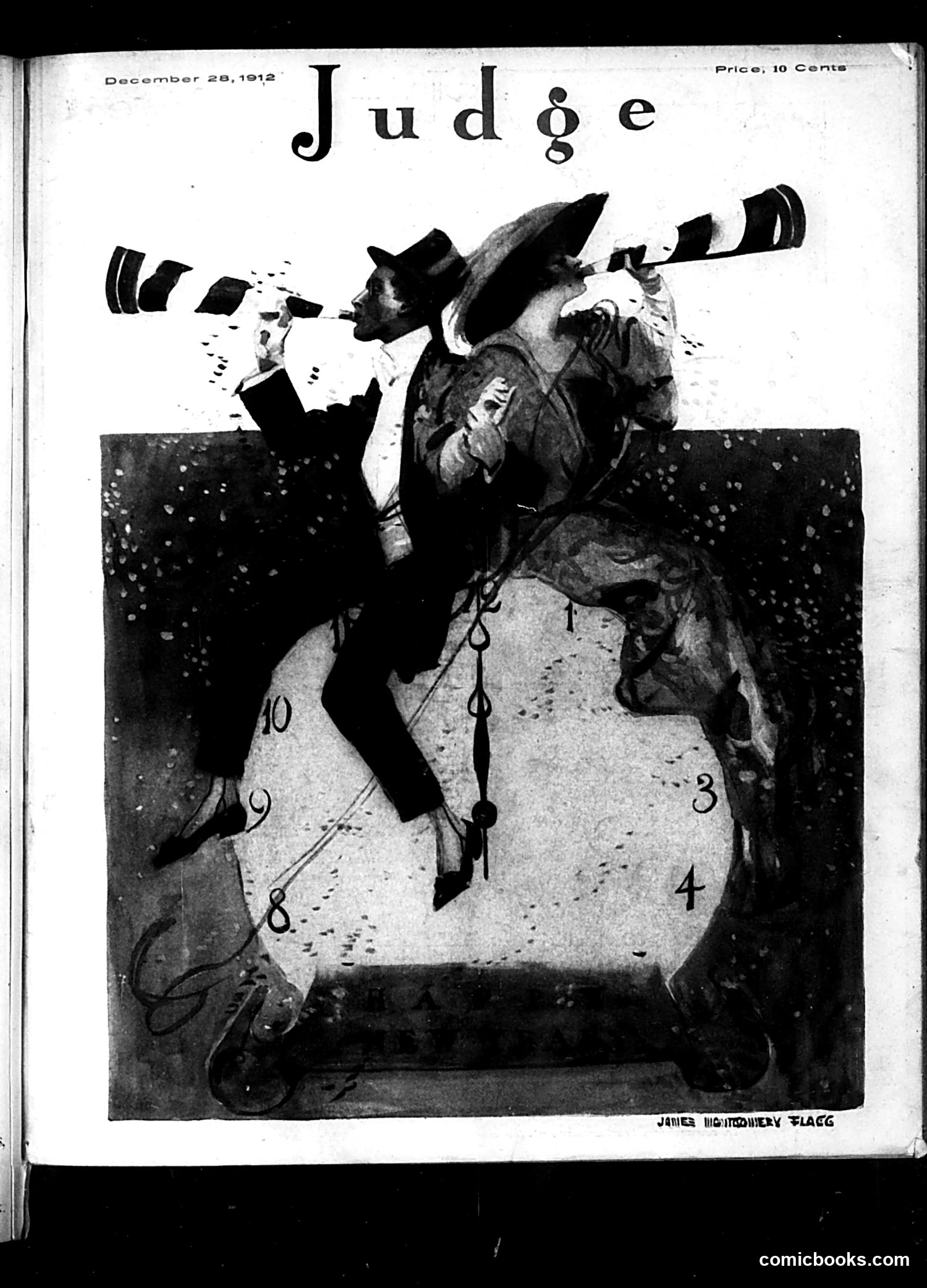
This satirical cover depicts a man in formal attire (top hat and coat) peering through a large telescope at a clock face. The telescope barrel is broken into pieces, and scattered debris flies outward—suggesting the instrument is malfunctioning or has exploded. The cartoon likely satirizes someone's failed attempt to "see into the future" or predict upcoming events. Given the December 1912 date (following the U.S. presidential election), this may reference political predictions that proved wrong, or someone's attempt to forecast economic or social outcomes that backfired. The "Judge" credit at bottom is the magazine's attribution. Without additional text identifying the specific figure or target, the exact subject remains unclear, though the visual joke centers on the futility of prediction.
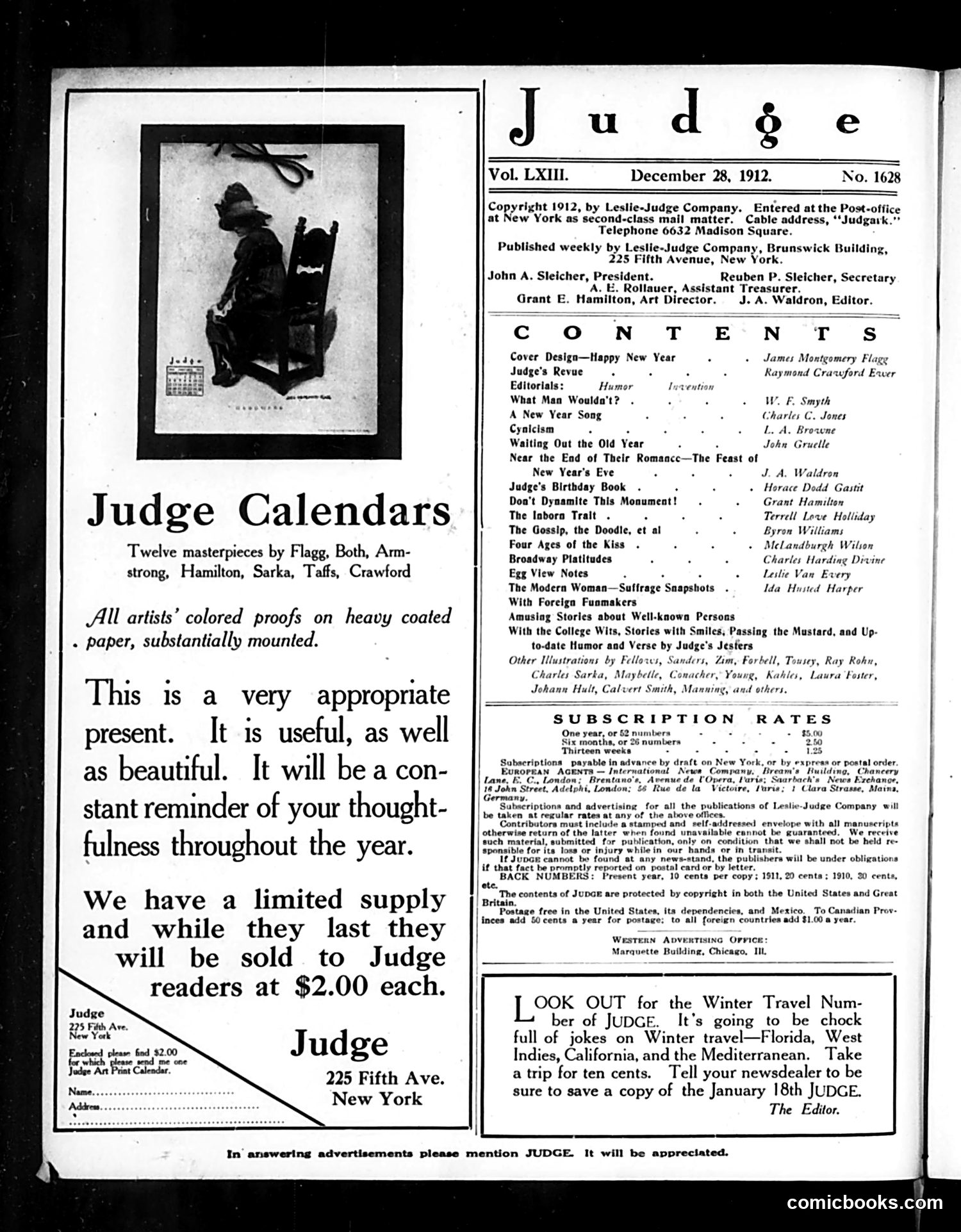
This page is primarily **advertising for Judge calendars**, not political satire. The left side features an ad for "Judge Calendars—Twelve masterpieces by Flagg, Both, Armstrong, Hamilton, Sarka, Taffs, Crawford." The calendar image shows a silhouetted figure in formal dress (appears to be a New Year's themed illustration). The ad emphasizes the calendars as appropriate gifts—"useful, as well as beautiful" and "a constant reminder of your thoughtfulness throughout the year." Priced at $2.00, with limited supply. The right page shows the magazine's table of contents and subscription rates ($5.00 yearly). There's a brief editor's note promoting the Winter Travel issue. **This is fundamentally a commercial page**, not satirical commentary, typical of magazines' self-promotion before the modern advertising industry developed.
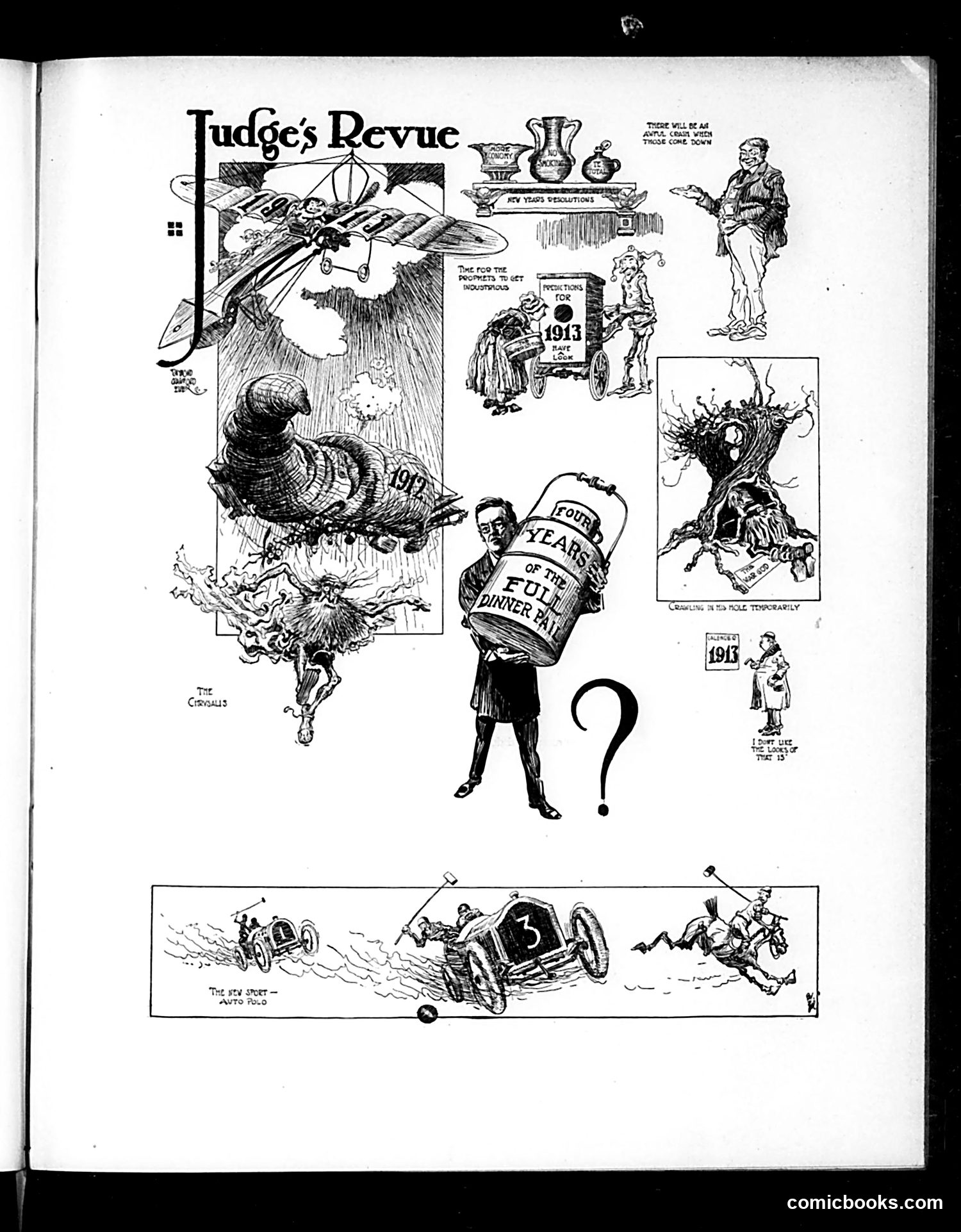
This 1913 satirical page from *Judge* magazine presents several vignettes mocking contemporary issues and figures: **Central image**: A man holds a bottle labeled "Four Years of the Dinner Pail" with a question mark, likely referencing economic hardship or broken campaign promises about prosperity (the "full dinner pail" was a Republican campaign slogan). **Surrounding sketches** appear to lampoon: - Aviation/modern technology (top left airplane scene) - Political corruption or scandal (various small figures) - Social upheaval (the uprooted tree labeled "Uprooting in the Race Temporarily") - Sports/auto racing (bottom panel showing "The New Sport—Auto Polo") **Overall theme**: The page satirizes 1913 American politics, economics, and modern life's uncertainties, using the "dinner pail" as a central metaphor for unfulfilled economic promises to working people.
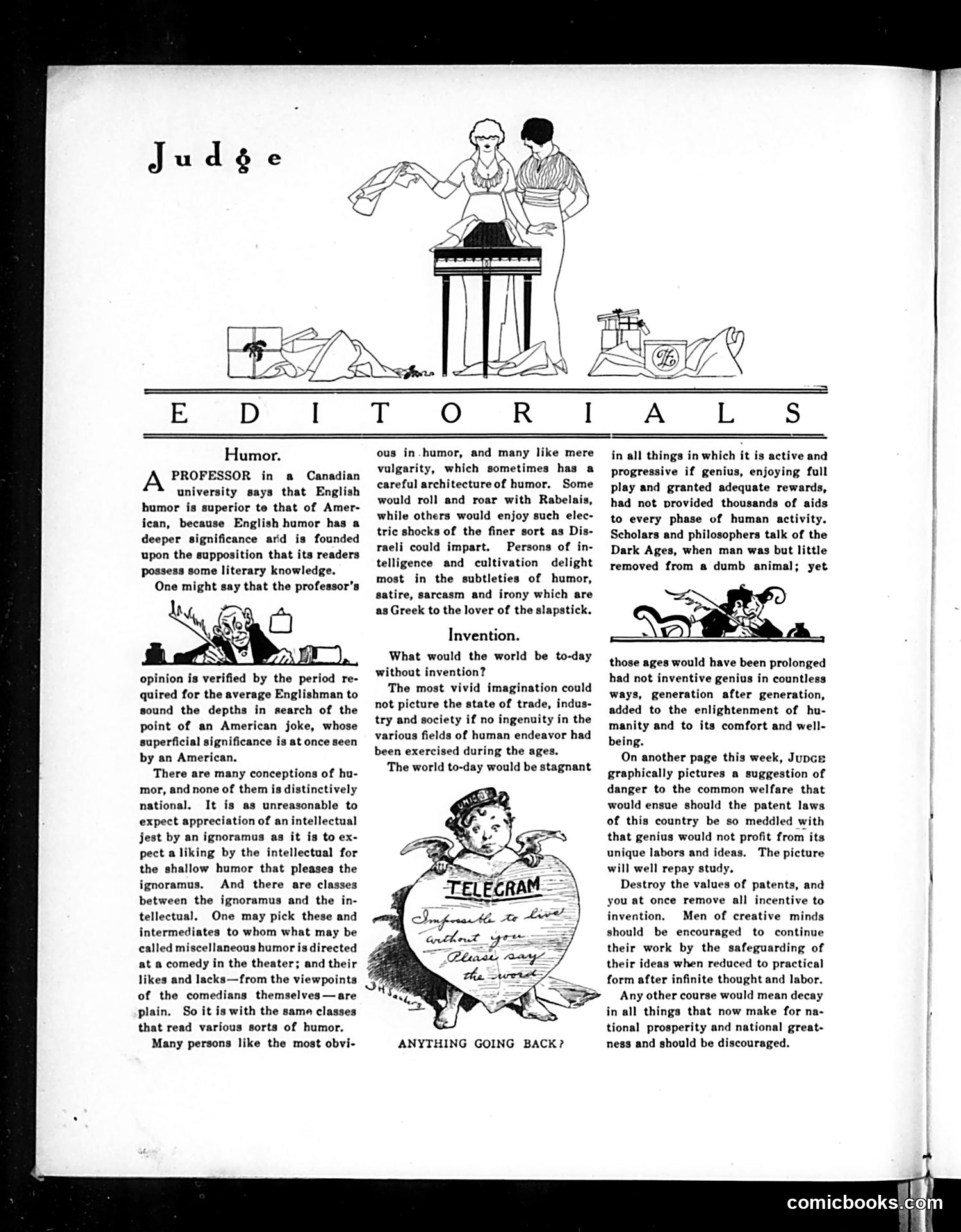
This editorial page discusses **humor** and **invention** as national traits. The top illustration depicts a "Judge" (presumably representing American judicial authority or common sense) weighing competing interests—suggesting editorial judgment on important matters. The **humor section** argues that American humor, while sometimes crude, has intellectual depth superior to English humor. It defends satire and irony as legitimate intellectual tools, rejecting the notion that wit is shallow entertainment. The **invention section** warns against over-regulating patents, arguing that restricting inventors' profits would stifle innovation and harm national prosperity. The telegram illustration ("ANYTHING GOING BACK?") appears to mock communication about failed business ventures. The page advocates protecting intellectual property and creative freedom as essential to American progress.
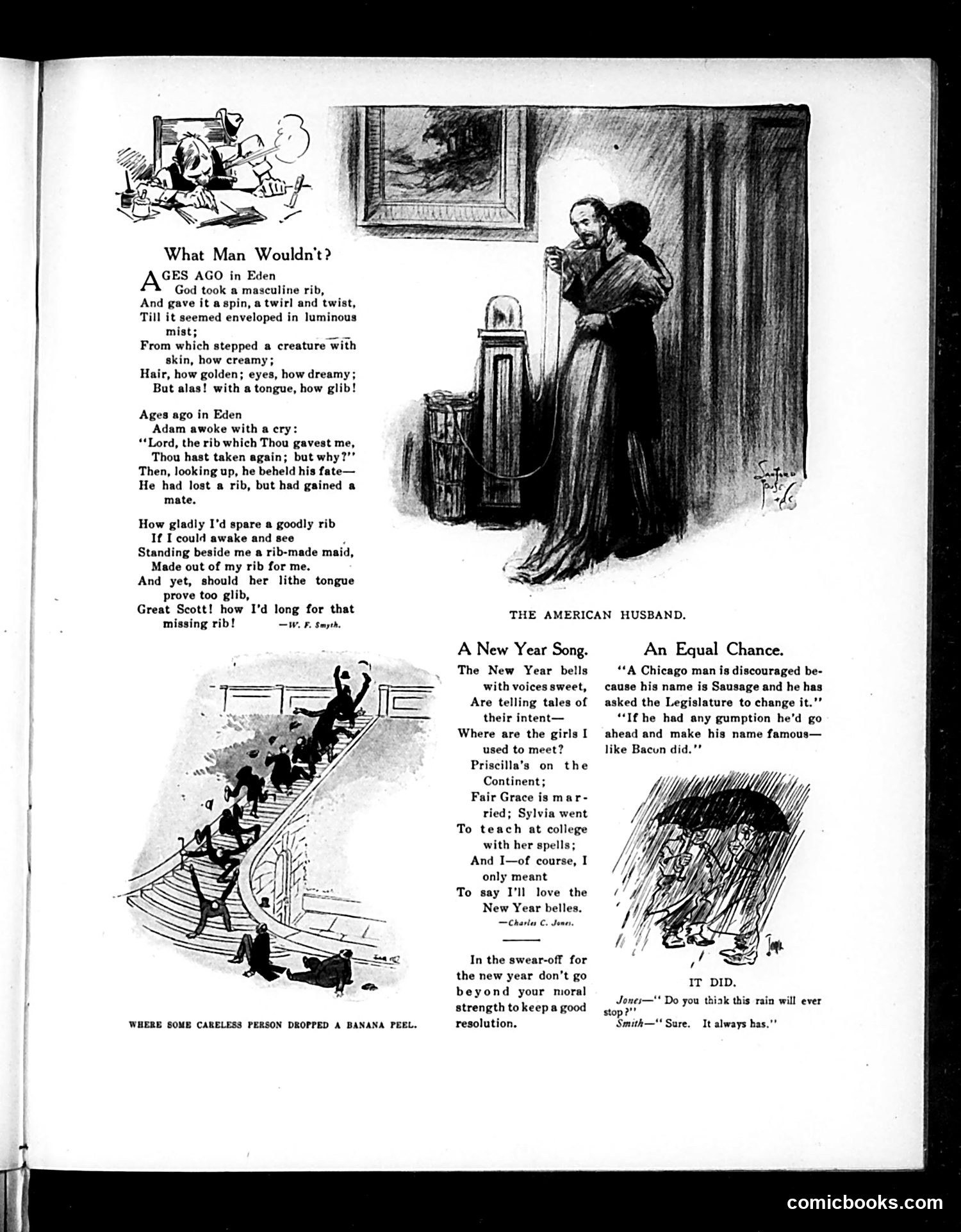
This page contains humorous poetry and illustrations rather than political cartoons. **"What Man Wouldn't?"** is a poem by W.F. Smith riffing on the Adam and Eve creation story, joking that any man would regret losing a rib to gain a wife—playing on misogynistic humor about marriage as a bad deal for men. The other pieces are lighthearted New Year's content: "A New Year Song" about where girls have gone, "An Equal Chance" mocking a Chicago man wanting to change his embarrassing surname, and brief comedic sketches like "Where Some Careless Person Dropped a Banana Peel" and "It Did" (about rain and resolutions). The humor is genteel and domestic rather than political—typical satirical magazine filler of the era.
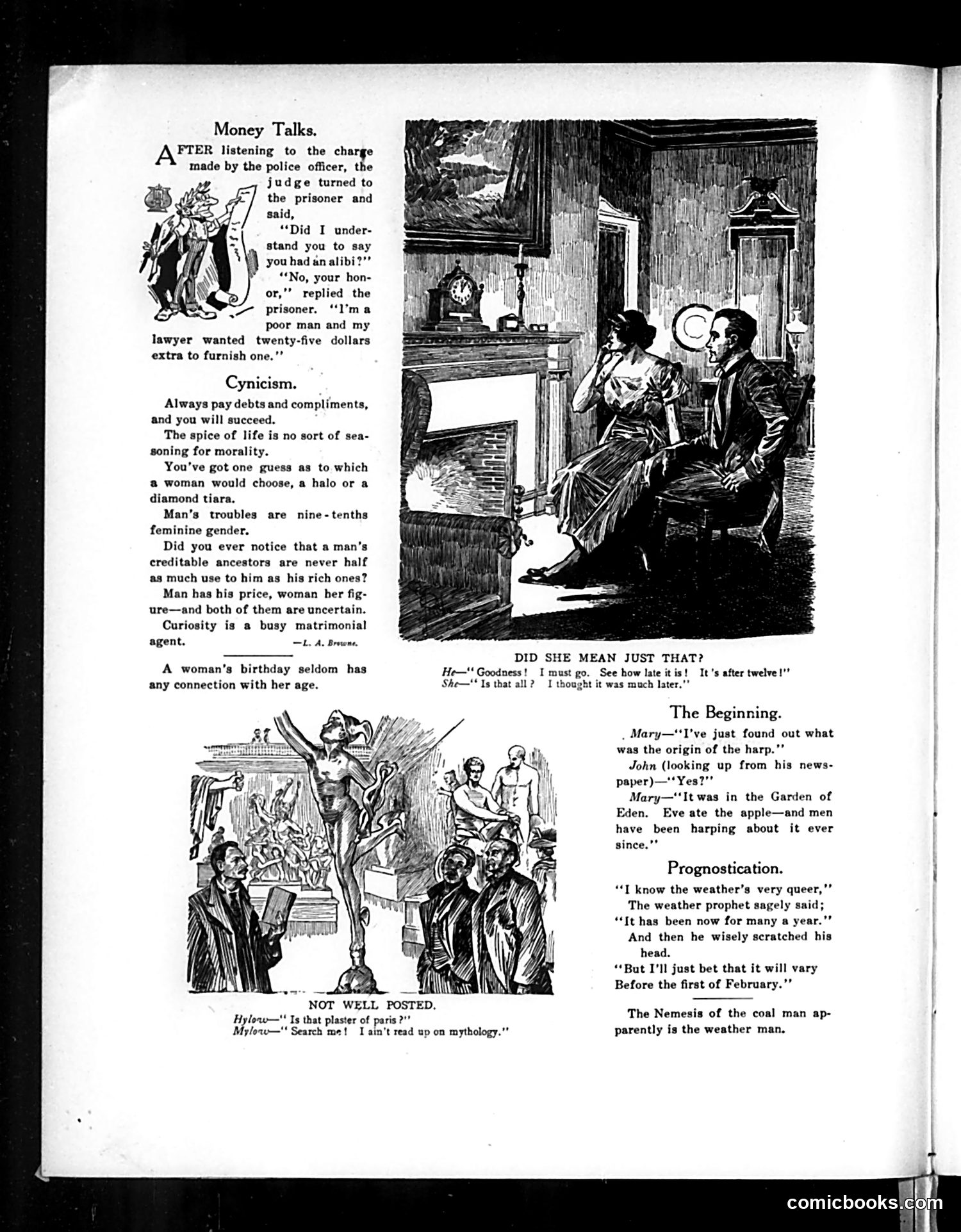
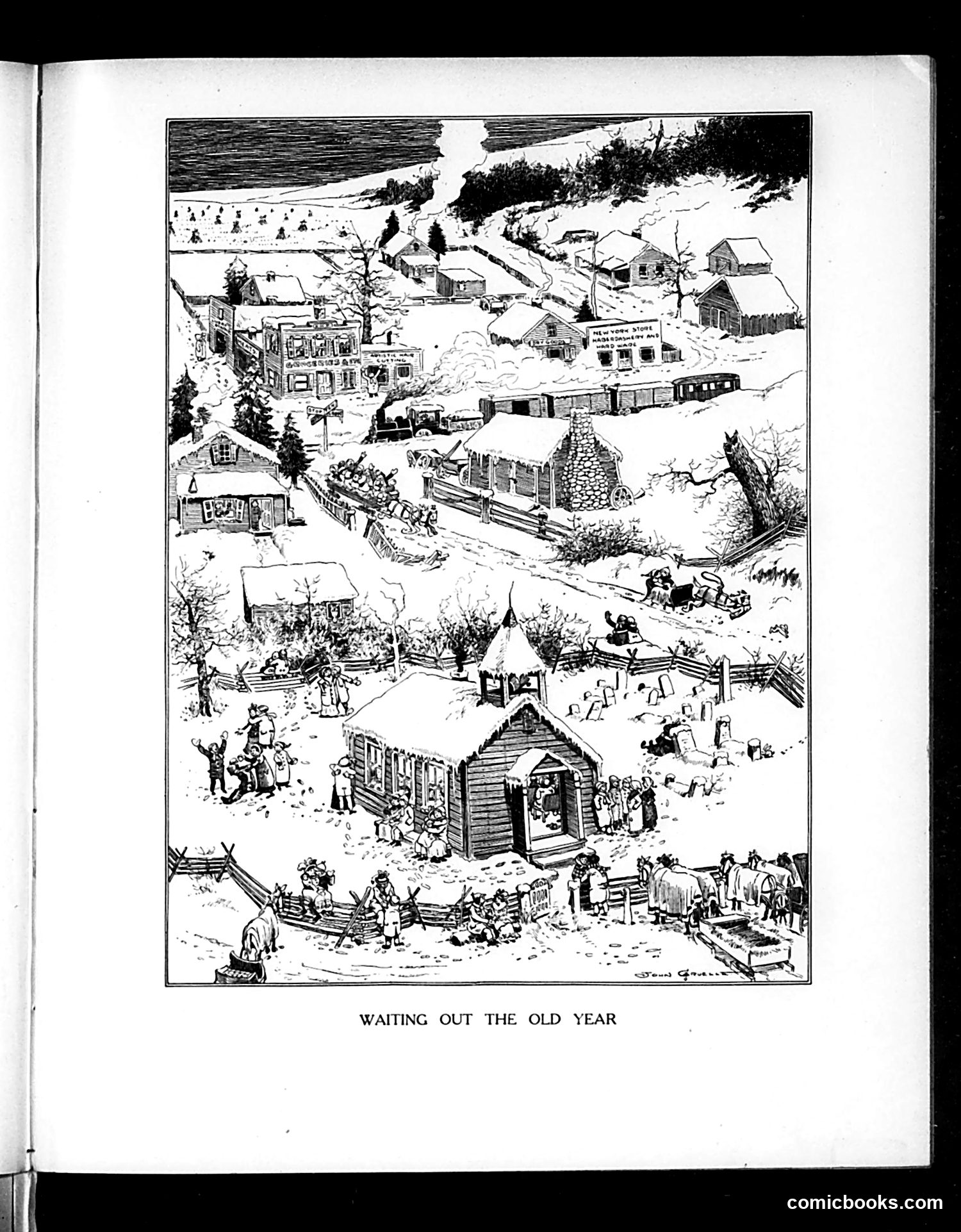
This illustration depicts a small rural American town during New Year's Eve celebrations, likely from the early 20th century. The scene shows various community activities: a church service, people gathered outside buildings, trains at a station, sledding, and winter festivities. The title suggests this is about how ordinary Americans in small towns marked the transition between years—through religious observance, family gatherings, and local social events. The cartoon appears to be nostalgic rather than satirical, celebrating traditional small-town American life and customs. It contrasts the simple, communal way rural communities "waited out" the old year with potentially more elaborate urban celebrations. The detailed depiction emphasizes togetherness and timeless traditions rather than mocking any particular group or political position.
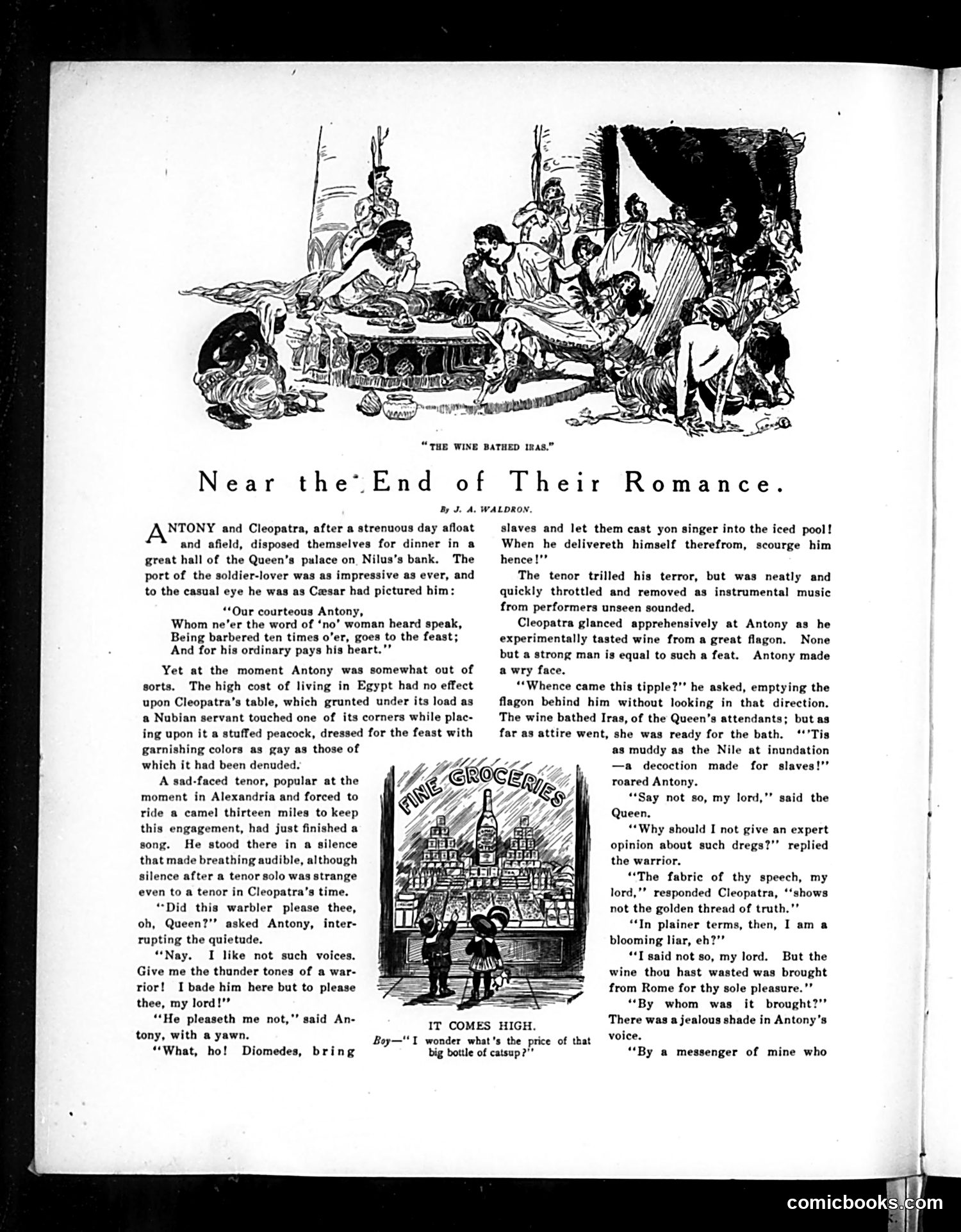
This is a comedic retelling of Shakespeare's *Antony and Cleopatra*, satirizing the famous historical couple through domestic complaint and petty bickering rather than grand tragedy. The joke targets the "high cost of living"—a contemporary economic concern inserted into ancient Egypt. Antony complains about expenses while lounging at Cleopatra's lavish feast. When a hired tenor performs poorly, they casually order him drowned. Antony then insults the wine (shipped expensively from Rome), which drenches an attendant. The humor pivots on deflating romance: instead of passionate lovers, they're a quarreling couple obsessing over wasteful spending and quality complaints. The small advertisement panel ("IT COMES HIGH") reinforces the economic theme—even in ancient times, luxury goods were overpriced. The satire mocks both classical pretension and contemporary consumer anxieties, suggesting even legendary romances dissolve into mundane domestic discord.
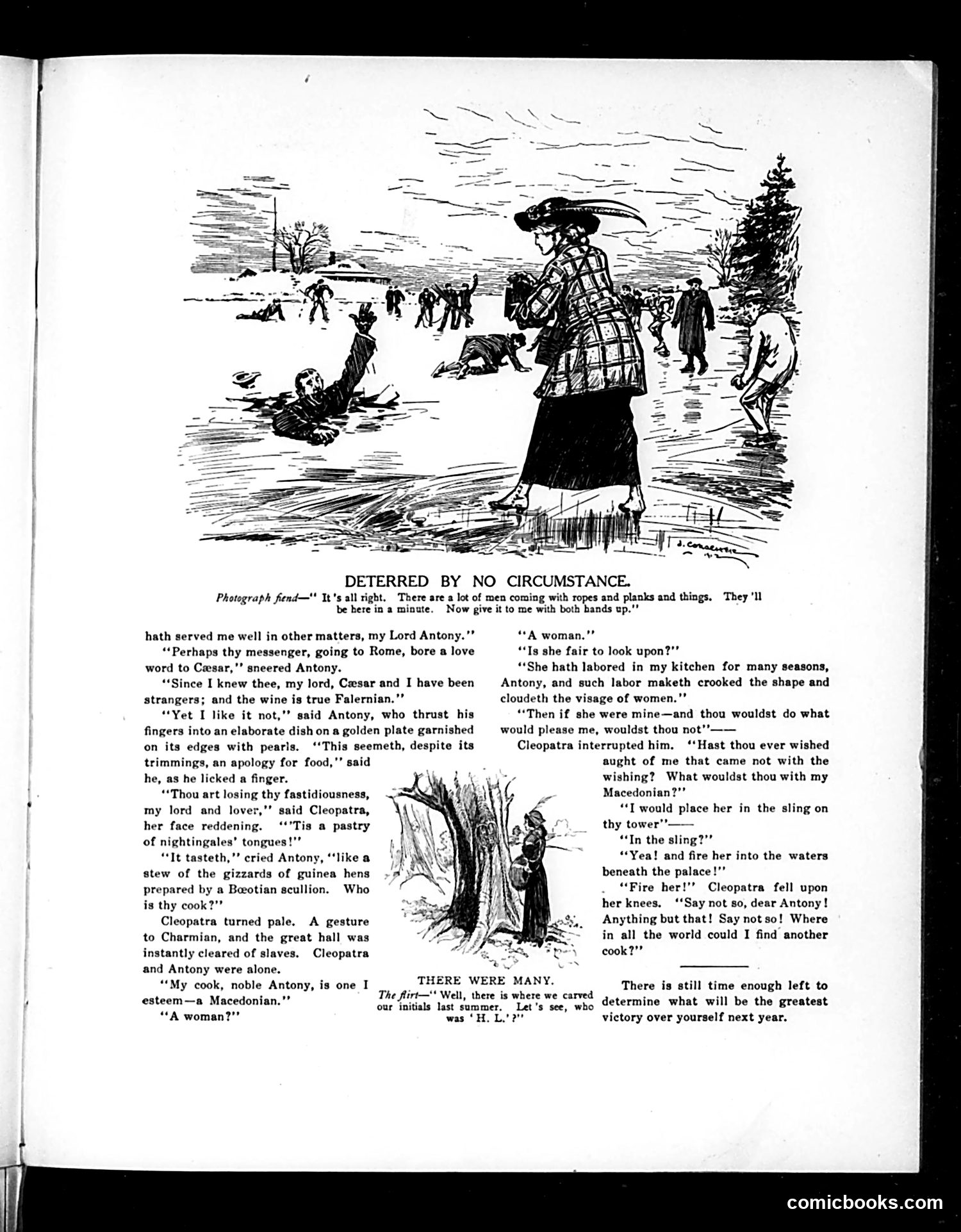
This page contains two distinct pieces: **Top illustration & dialogue**: A satirical scene spoofing romantic historical drama (appears to reference *Antony and Cleopatra*). The joke is deflating—when Antony threatens to catapult Cleopatra's beloved cook into the sea out of jealousy, Cleopatra's desperate response isn't romantic anguish but purely practical: "Where in all the world could I find another cook?" The satire mocks both overwrought theatrical passion and the reality that domestic convenience matters more than dramatic emotion. **Bottom illustration & caption**: "The Flirt"—a separate brief comedic scene showing a couple examining carved initials on a tree from last summer, reflecting on past romantic inscriptions. The caption's New Year's resolution message about "victory over yourself" suggests gentle mockery of flirtation and romantic indiscretion. Both pieces use humor to deflate sentimental romance with mundane reality or mild social critique typical of *Judge* magazine's satirical approach.
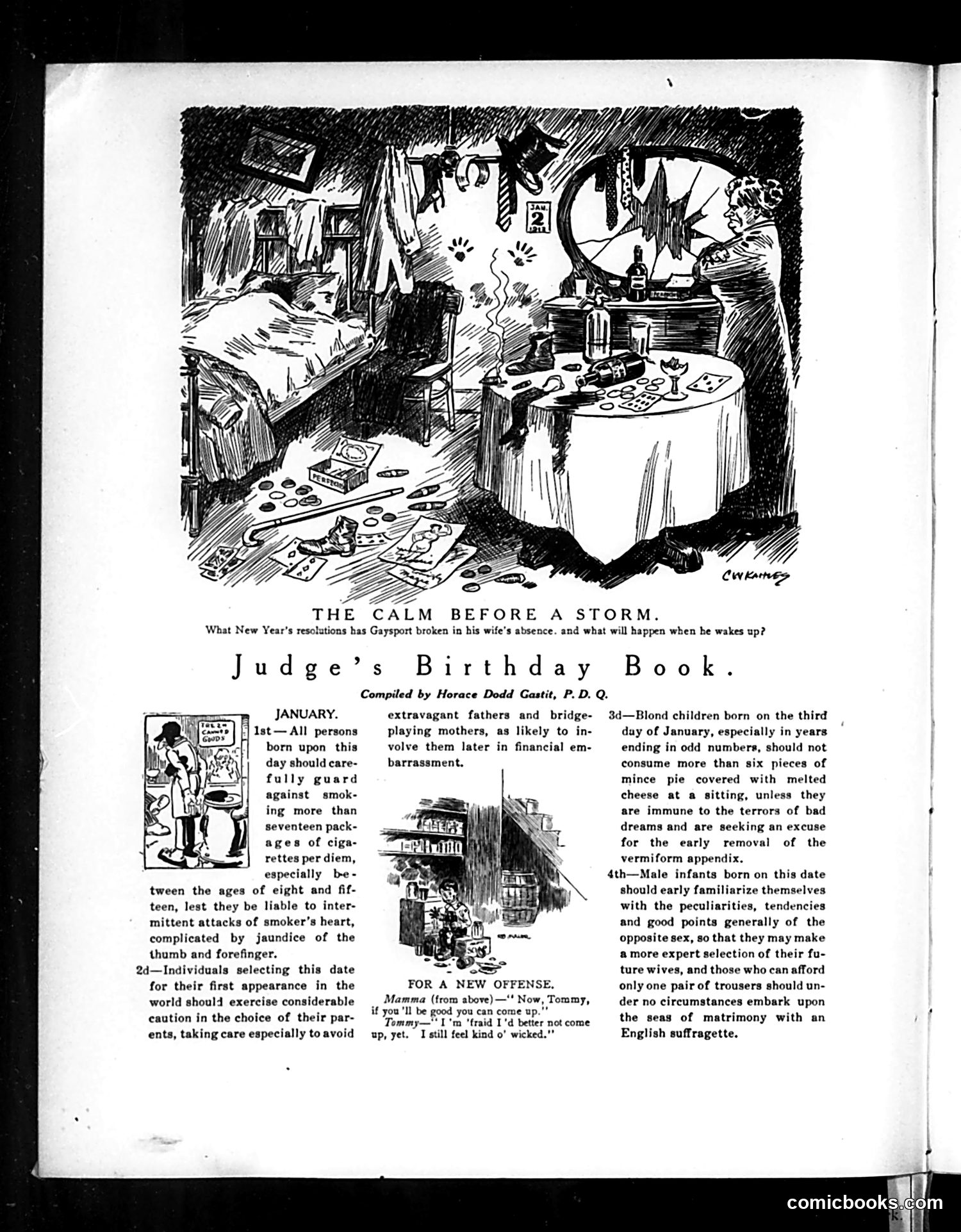
The main cartoon depicts a man's bedroom/study during his wife's absence—showing gambling paraphernalia (cards, coins, bottles) scattered about. The satire humorously asks what resolutions this character "Gaysport" has already broken and what consequences await when his wife returns. It's a domestic comedy about marital discord and a husband's misbehavior during his spouse's absence. Below this is "Judge's Birthday Book," a recurring feature offering absurdist "advice" for children born on specific January dates. The humor is satirical pseudo-science: warnings about excessive cigarette smoking for young children, cautions about selecting "good parents," and humorous restrictions on mince pie consumption. A small secondary joke shows a boy refusing to come upstairs, claiming he "still feels kind o' wicked"—playing on the period's moralistic child-rearing attitudes. The suffragette reference in the 4th entry reflects early 20th-century anxieties about women's rights activism, treating it as a marital hazard—typical of Judge's conservative satirical stance.
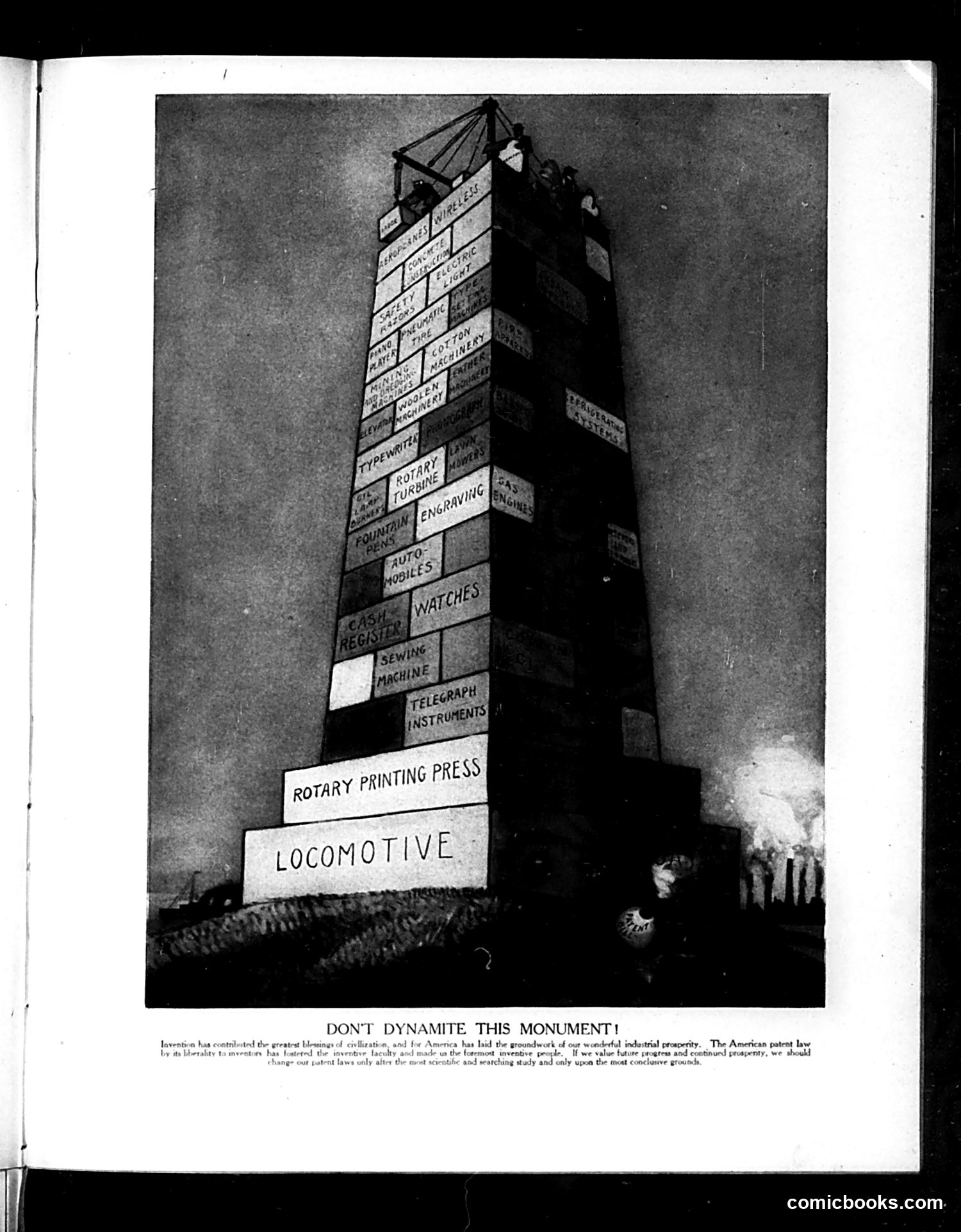
This is a satirical illustration showing a tall tower constructed from stacked inventions, each labeled on horizontal bands: locomotive, rotary printing press, telegraph instruments, sewing machine, cash register, watches, automobiles, and others ascending to a roof-like top. The cartoon celebrates American industrial innovation and patents as foundational to national progress and prosperity. The caption "DON'T DYNAMITE THIS MONUMENT!" appears to warn against policies or actions that might damage patent protections or intellectual property rights. The accompanying text (partially OCR'd) references how "invention has contributed the greatest blessings of civilization" and warns that weakening patent laws could harm "continued prosperity." This likely reflects early 20th-century debates over patent reform, with the cartoon arguing that strong patent protections built American industrial superiority.
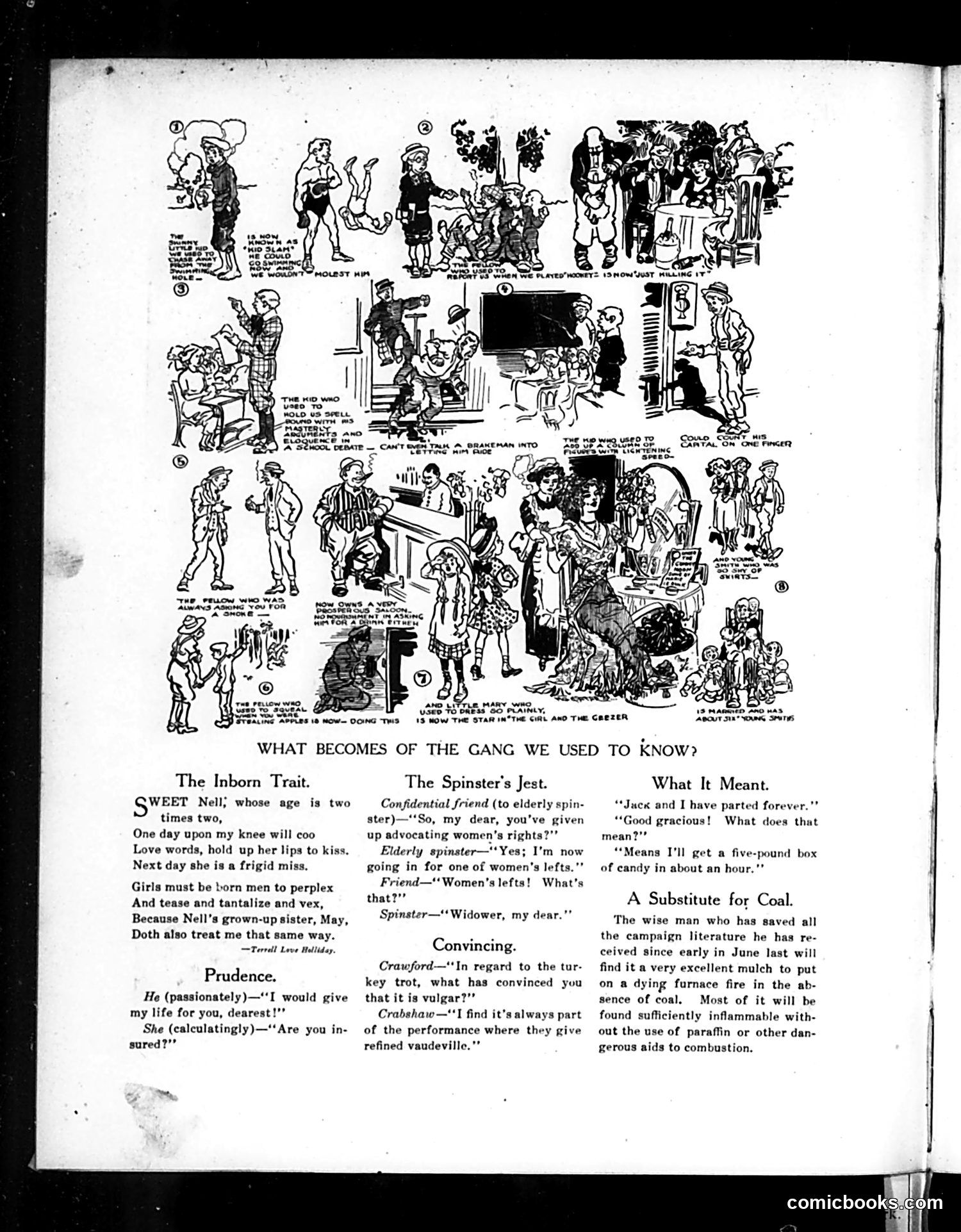
This page presents a series of short comic vignettes and jokes satirizing contemporary social behaviors and attitudes, circa early 20th century. The top section contains numbered cartoon scenes depicting various life scenarios—likely showing how childhood acquaintances turn out as adults (the title's theme). Below are brief humorous exchanges mocking: - **Gender dynamics**: Women's inconsistency in romantic behavior ("The Inborn Trait") - **Marriage mercenary attitudes**: A woman calculating marriage value by insurance status ("Prudence") - **Feminism's evolution**: A spinster abandoning women's rights advocacy to pursue widowers ("The Spinster's Jest") - **Dance morality**: Debate over whether the turkey trot dance is vulgar ("Convincing") - **Sentimental manipulation**: A woman claiming to break up with "Jack" to receive candy ("What It Meant") - **Political satire**: Campaign literature being worthless—only useful as furnace fuel ("A Substitute for Coal") The overall tone mocks changing social mores, female behavior, and contemporary politics through brief, cynical jokes typical of Judge magazine's satirical approach.
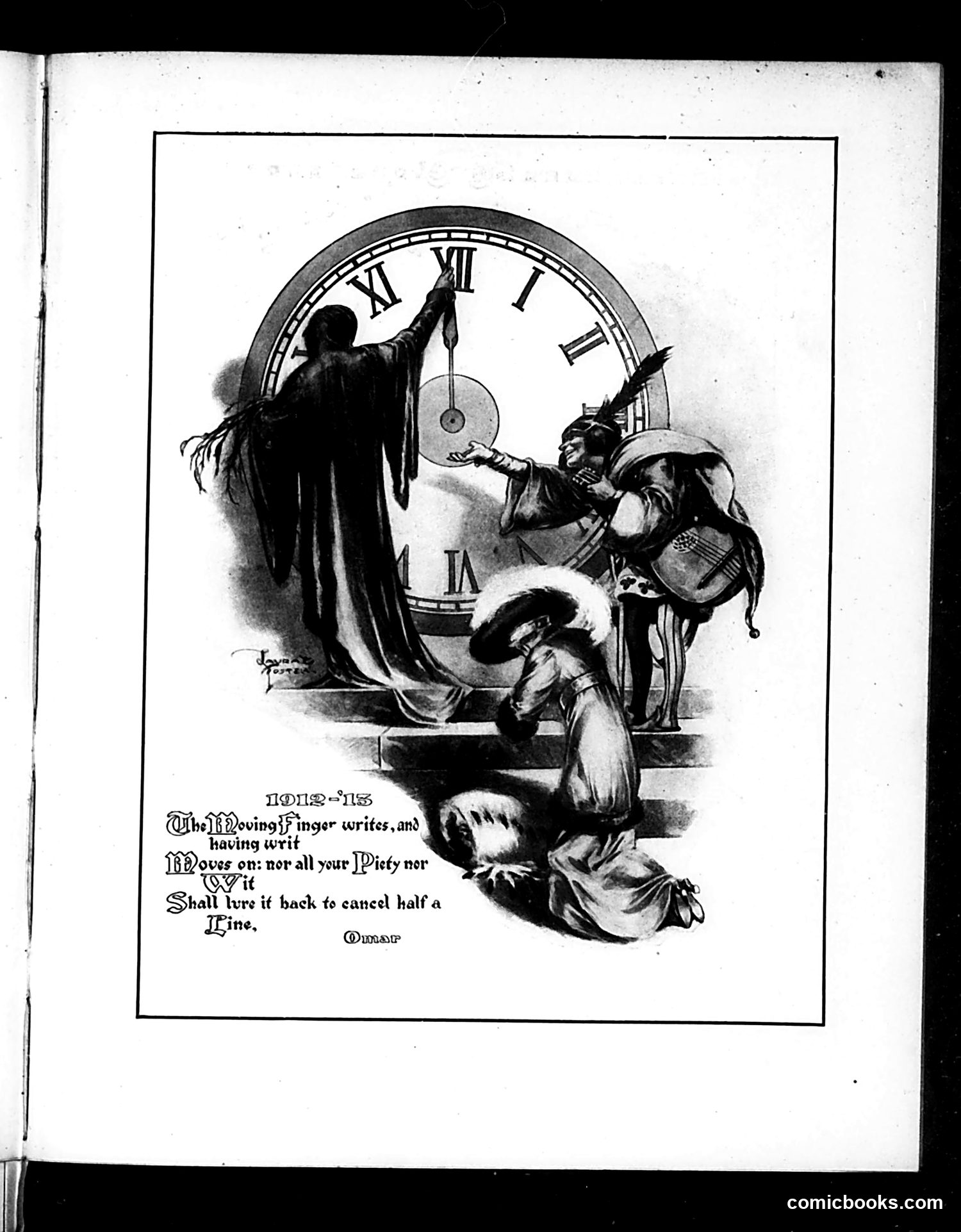
This illustration depicts allegorical figures (appearing to represent Time or Fate) manipulating a large clock face. The robed figure on the left resembles Death or a similar temporal force, while armored figures below interact with the clock's mechanisms. The quoted text is from **Omar Khayyam's *Rubaiyat***: "The Moving Finger writes; and, having writ, / Moves on: nor all your Piety nor Wit / Shall lure it back to cancel half a Line." This famous passage expresses the philosophical inevitability of fate and the irreversibility of time. The satire likely critiques human attempts to control or manipulate time, destiny, or irreversible consequences through willpower or morality alone—a commentary on human hubris or futile resistance to inevitable change. Without additional context or a visible date, the specific historical/political target remains unclear, though the theme suggests commentary on determinism versus human agency.
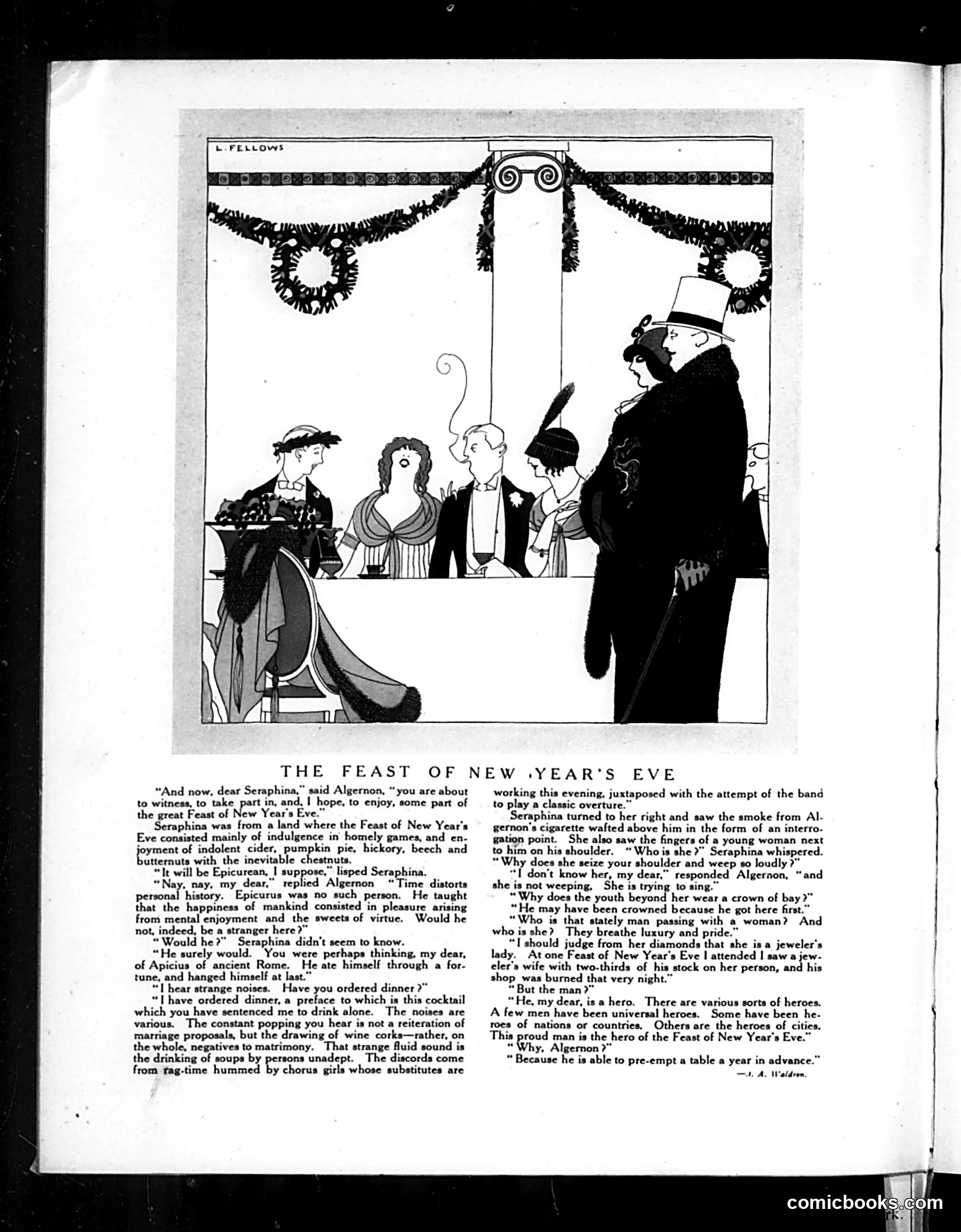
This satirical illustration depicts a New Year's Eve party where Algernon instructs a visiting woman named Seraphina on the evening's customs. The joke critiques upper-class New Year's celebration as superficial excess and social posturing. Algernon pedantically corrects Seraphina's reference to Epicurus, explaining that true epicureanism meant philosophical pleasure, not gluttony—yet the surrounding scene contradicts this: guests drinking heavily, chorus girls singing badly, people shouting over noise. The "hero of the Feast" is merely a man wealthy enough to reserve a table a year in advance, not someone of actual virtue or accomplishment. The cartoon mocks how wealthy New York society conflates material display (a jeweler's wife dripping in diamonds) with distinction, and how New Year's Eve itself becomes an exercise in conspicuous consumption rather than genuine enjoyment.
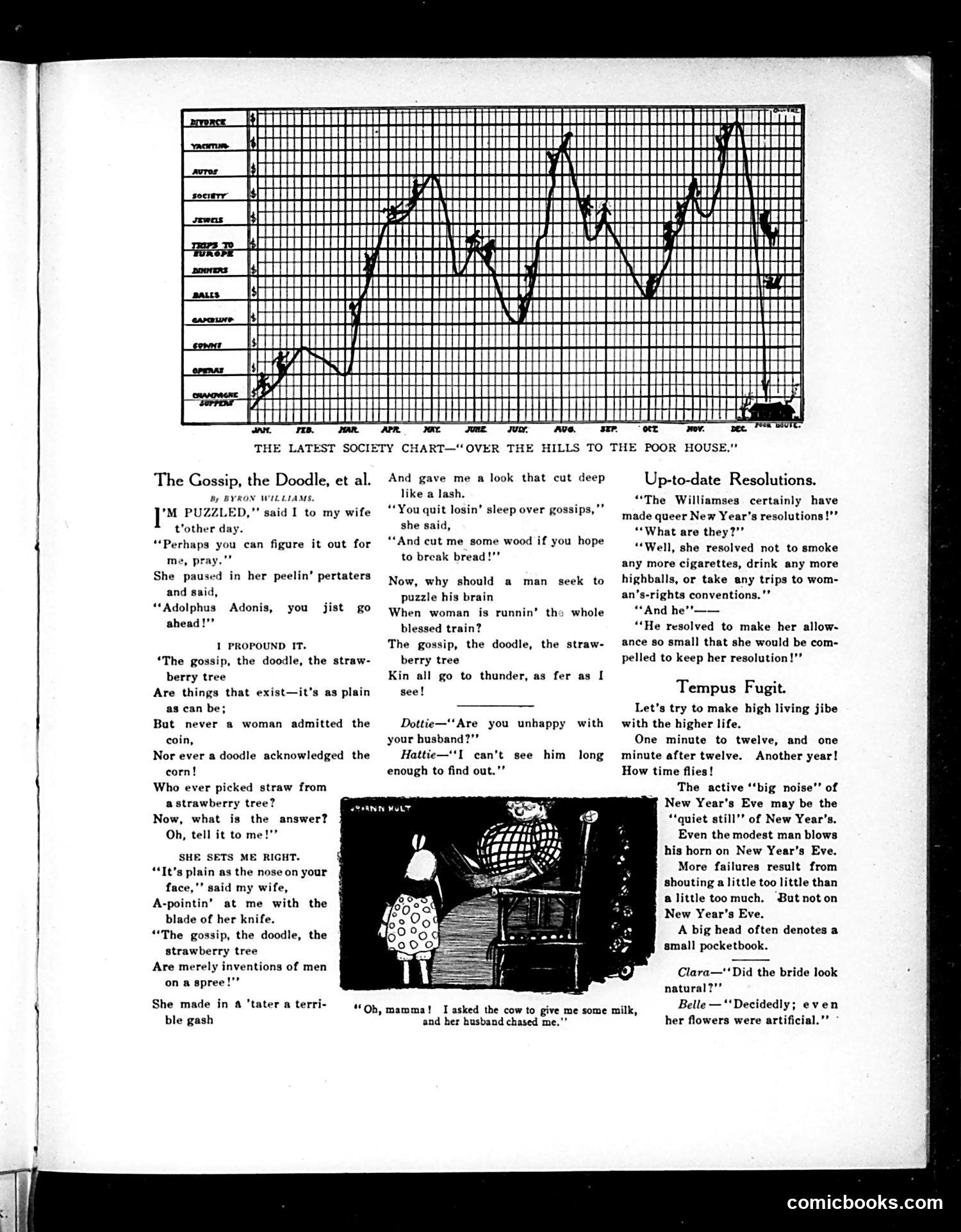
This page contains humorous verse and short jokes satirizing early 20th-century American social life. The main poem, "The Gossip, the Doodle, et al." by Byron Williams, uses a domestic dispute to mock men's philosophical puzzles while celebrating women's practical common sense. A husband poses riddles about invented things ("gossip," "doodle," "strawberry tree"); his wife cuts through the nonsense, declaring these male inventions born of drunken frivolity, and redirects him to chop wood for survival. The surrounding brief jokes target women's changing roles—New Year's resolutions humor their cigarette-smoking and convention-attending, while a couple's dialogue mocks absent husbands. The "Society Chart" graph appears satirical social commentary on changing class or lifestyle trends. Overall, the page reflects early 1900s gender tensions: celebrating women's practicality while gently mocking their new social freedoms and the anxieties these caused.
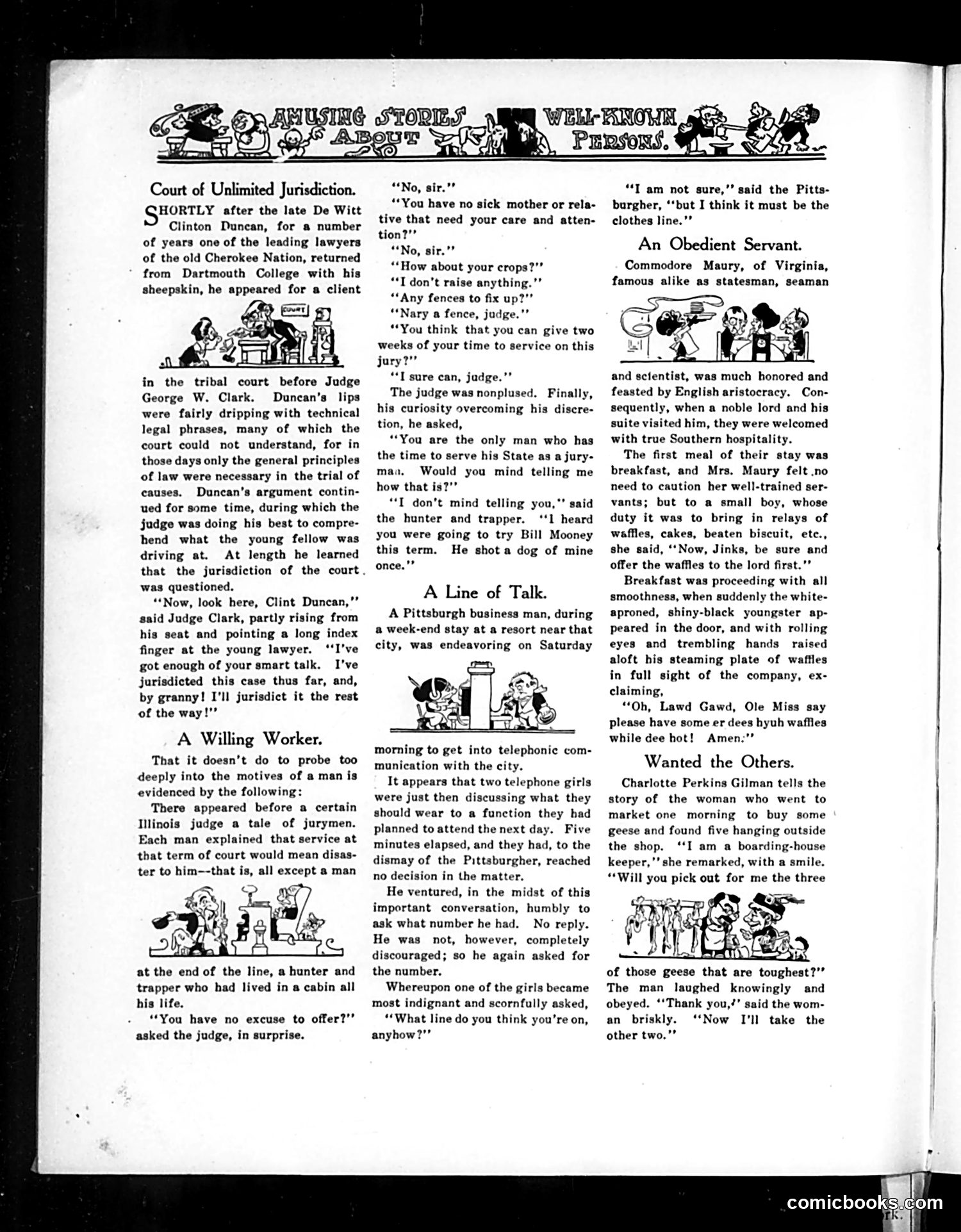
This page contains four separate humorous anecdotes satirizing American legal and social customs: 1. **"Court of Unlimited Jurisdiction"**: Mocks frontier/Cherokee Nation jurisprudence by showing Judge Clark dismissing a young lawyer's technical arguments. The judge declares he'll "jurisdict" the case however he pleases, satirizing informal, arbitrary frontier justice where formal legal procedure means nothing. 2. **"A Willing Worker"**: A hunter applying for jury duty admits he has no excuses—he actually *wants* to serve. The punchline reveals his motive: the defendant shot his dog, making this not civic duty but revenge. 3. **"A Line of Talk"**: A Pittsburgh businessman trying to make a phone call gets blocked by two telephone operators discussing their clothing for an upcoming event. When he interrupts, one sarcastically asks what "line" he thinks he's on, and he quips it must be the "clothes line"—wordplay mocking telephone operators' inattention to business. 4. **"Wanted the Others"**: References Commodore Maury's Southern hospitality to English visitors, with a servant anecdote (text cuts off). The tone throughout is gently satirical of American institutions and social pretension.
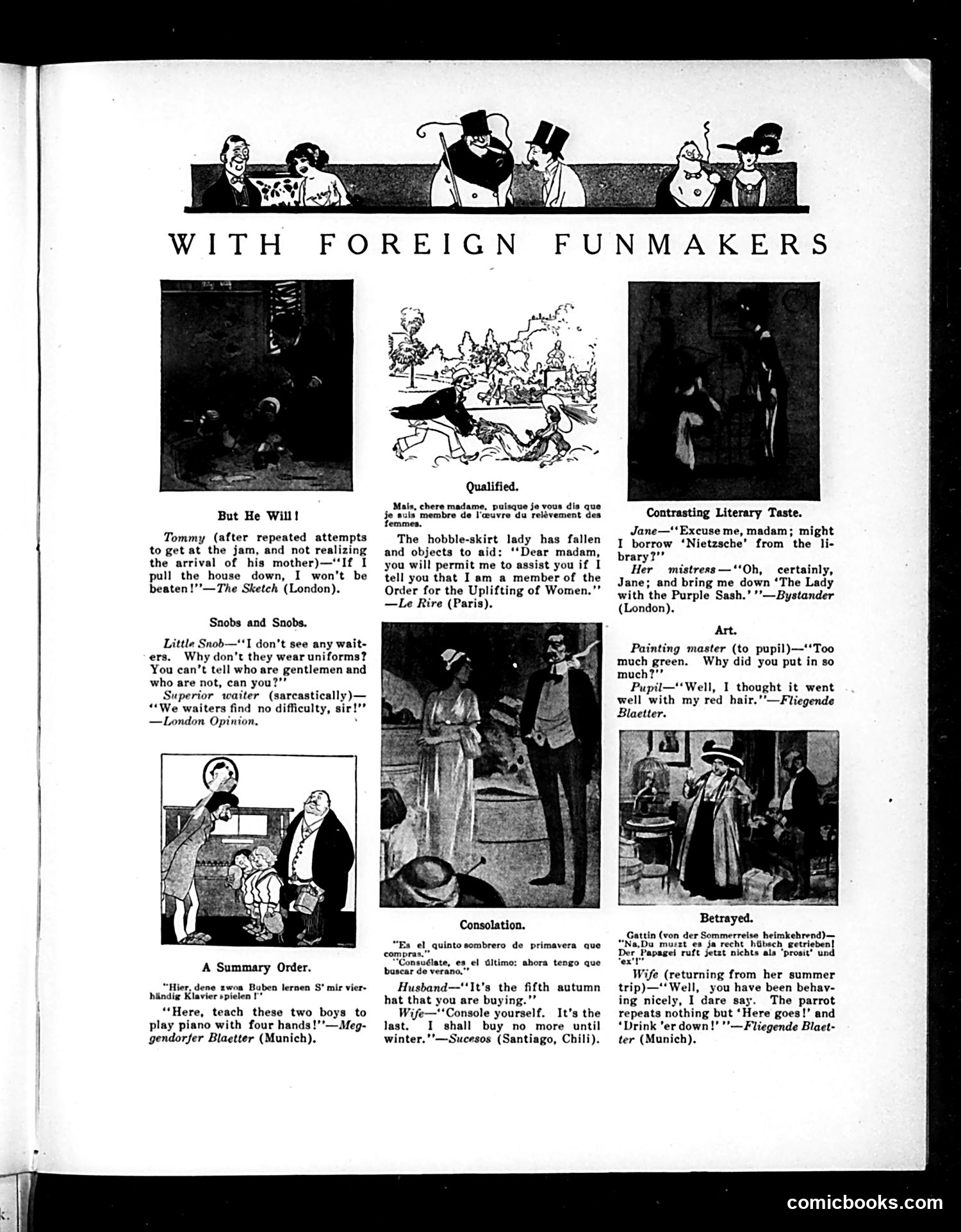
This page collects short humorous anecdotes from European satirical publications, translated for American readers. The jokes rely on social observations rather than political content: **Key themes:** - **Class distinction**: A waiter can identify gentlemen by behavior, not uniforms; a maid borrows "Nietzsche" while her employer reads frivolous literature - **Gender/fashion satire**: A woman in a restrictive hobble skirt refuses aid unless the helper belongs to the "Order for the Uplifting of Women" (ironic, given the skirt's impracticality); a wife buys her fifth autumn hat despite promises to stop - **Domestic life**: A child's determination to reach jam; a German father teaching piano; a husband discovers his wife's infidelities through a parrot's learned phrases The humor is gentle, middle-class oriented, and relies on recognizing social pretension and domestic absurdities. The selection demonstrates Judge's international outlook, reprinting jokes from London Opinion, Le Rire (Paris), and German publications.
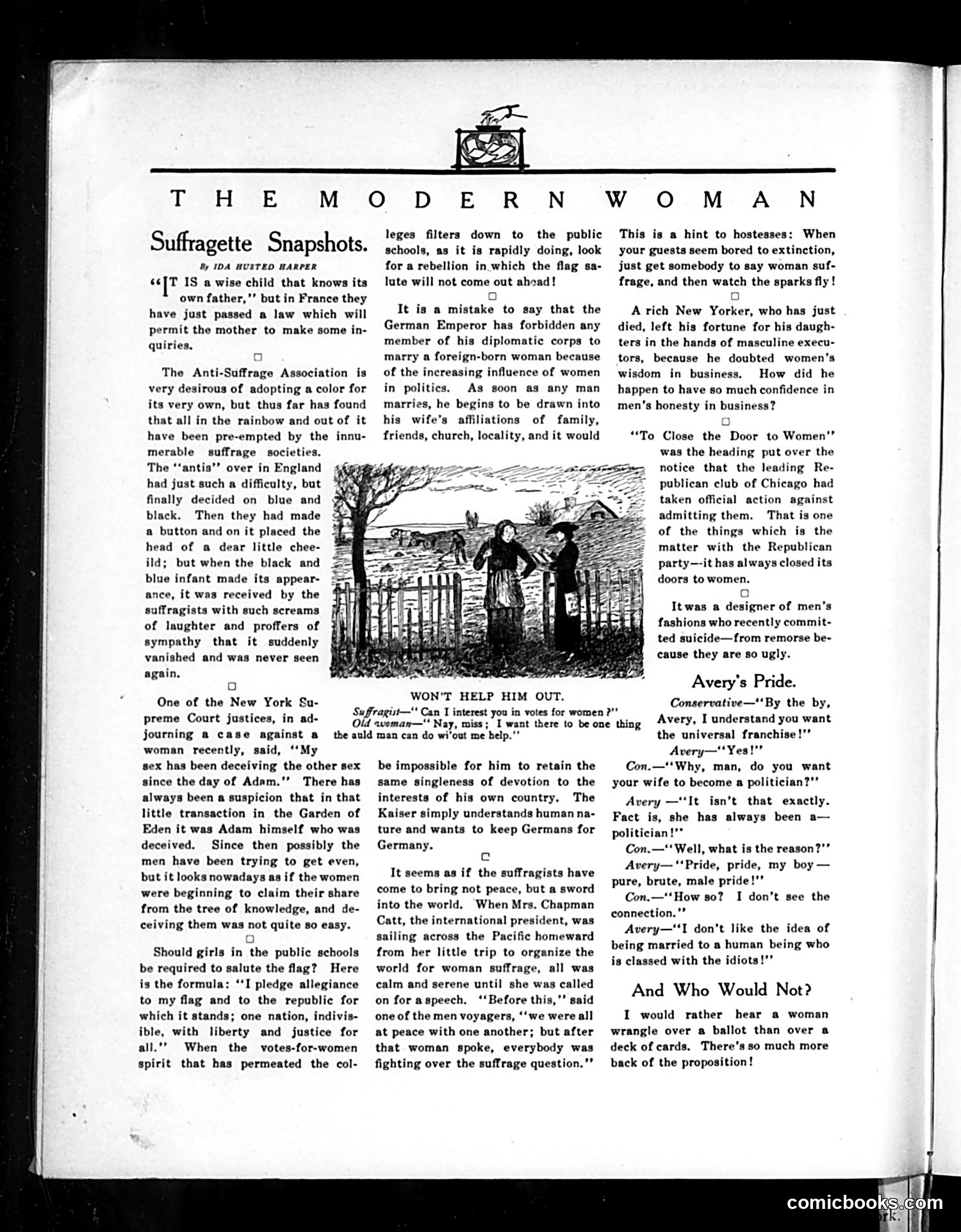
This page collects anti-suffrage commentary by Ida Husted Harper, using sardonic anecdotes to mock the women's voting rights movement. The humor targets suffragists by portraying them as disruptive and unreasonable. The cartoon depicts an old woman rejecting a suffragist's pitch, saying she wants her husband to retain *one* thing he can do without her help—a jab at wives' supposed controlling influence. Other items mock suffragists as divisive (Mrs. Chapman Catt supposedly starts shipboard arguments), argue women's political influence corrupts men's loyalty to country (the Kaiser's ban on diplomatic marriages), and warn that teaching girls the Pledge of Allegiance will inspire flag-salute rebellions. The satire assumes readers oppose women's suffrage. It ridicules the movement as inherently chaotic and emasculating, while portraying anti-suffragists as sensible defenders of natural order.
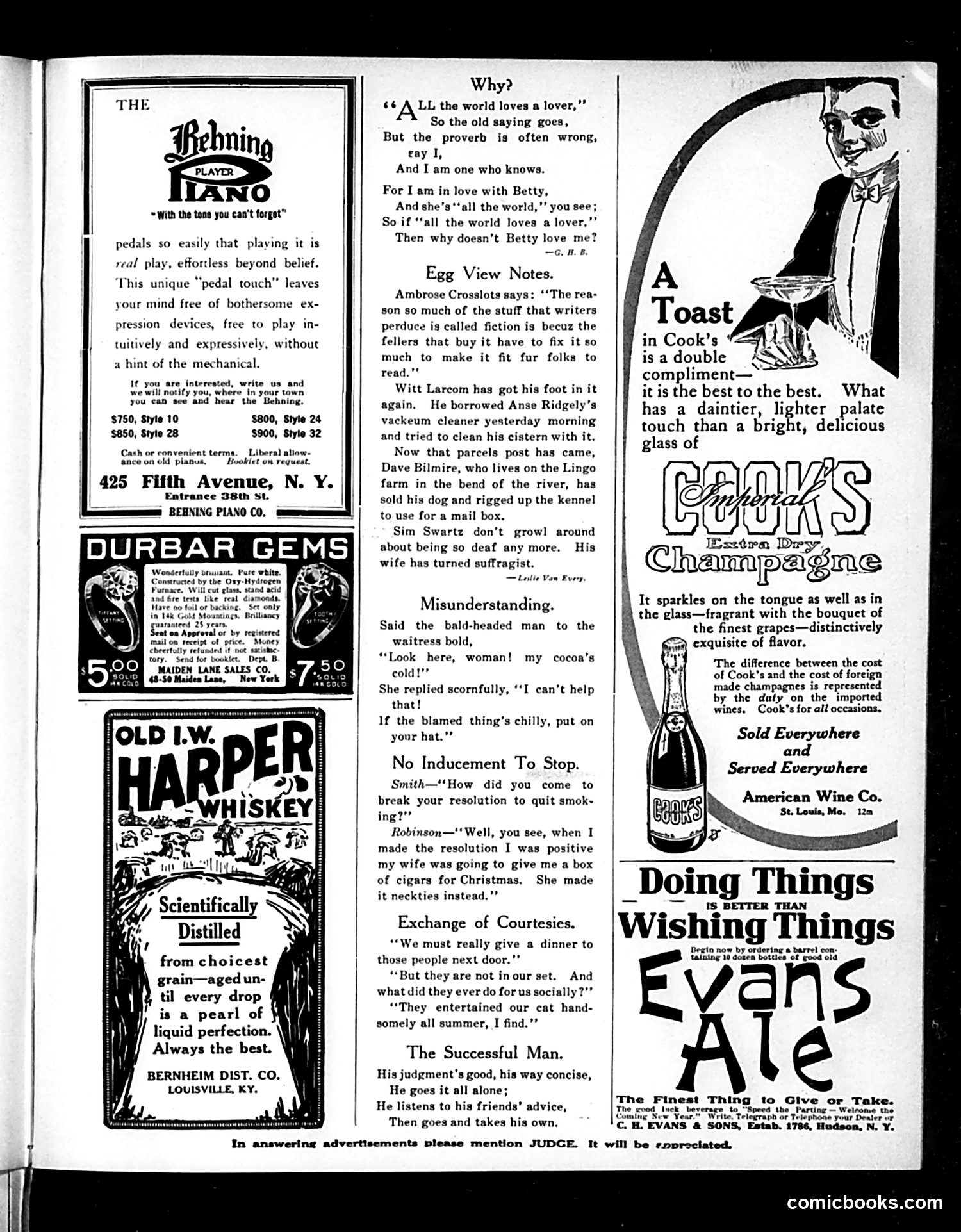
This is primarily an **advertising page** from Judge magazine, featuring multiple product advertisements interspersed with short humorous pieces typical of the publication. The **editorial content** includes several brief comic anecdotes: - A romantic poem about unrequited love with "Betty" - "Egg View Notes"—rural gossip column featuring folksy characters and their mishaps - Short joke pieces ("Misunderstanding," "No Inducement to Stop," "Exchange of Courtesies," "The Successful Man") These sketches employ **early-20th-century American humor**: wordplay, domestic situations, and gentle satire of human nature. The "Egg View" section appears to mock rural dialect and small-town life. **Advertisements** promote pianos, diamonds, whiskey, and champagne—luxuries targeting affluent readers. One ad references "suffragist" wives, suggesting contemporary women's rights debates. The page reflects Judge's audience: educated, prosperous Americans interested in satirical commentary on manners, marriage, and modern life, alongside consumer goods.
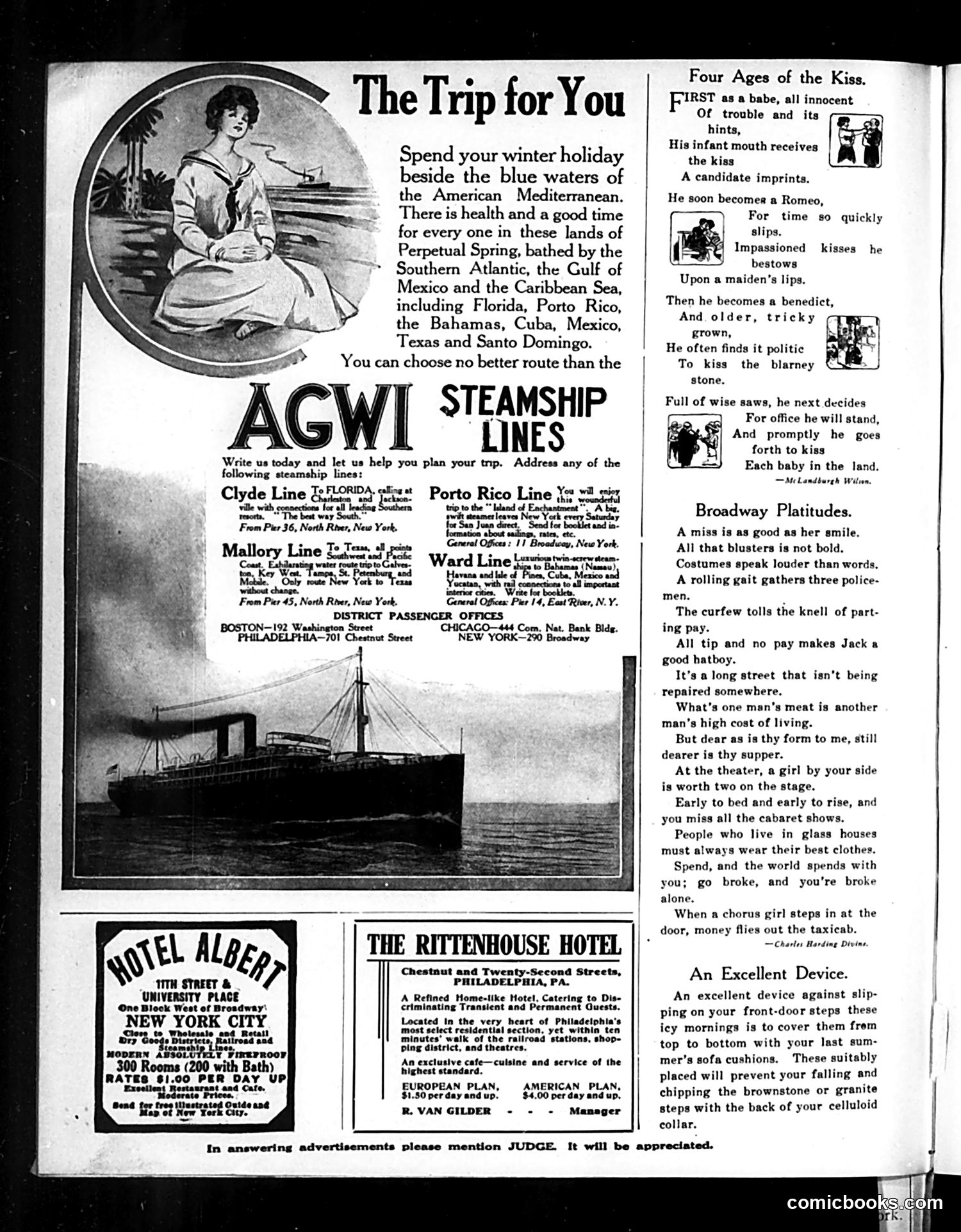
This page is primarily **advertising** with supplementary satirical content. The main advertisement promotes AGWI Steamship Lines, encouraging winter vacations to Caribbean and Gulf destinations (Florida, Cuba, Puerto Rico, etc.) with an illustration of a stylish woman gazing seaward. The satirical content appears in two sections: **"Four Ages of the Kiss"** is a humorous poem tracking a man's relationship to kissing through life stages—from innocent infancy through romantic youth, married middle age, and finally political adulthood, where he cynically kisses babies for votes. This satirizes politicians' performative public behavior. **"Broadway Platitudes"** offers mock-serious aphorisms that parody self-help sayings and sentimental wisdom, often subverting them with cynical observations about modern urban life (chorus girls, taxi costs, repair work, economic struggle). The final "Excellent Device" about icy steps is absurdist humor. The page reflects early-20th-century Judge magazine's blend of travel advertising, social satire, and lighthearted commentary on urban manners and politics.
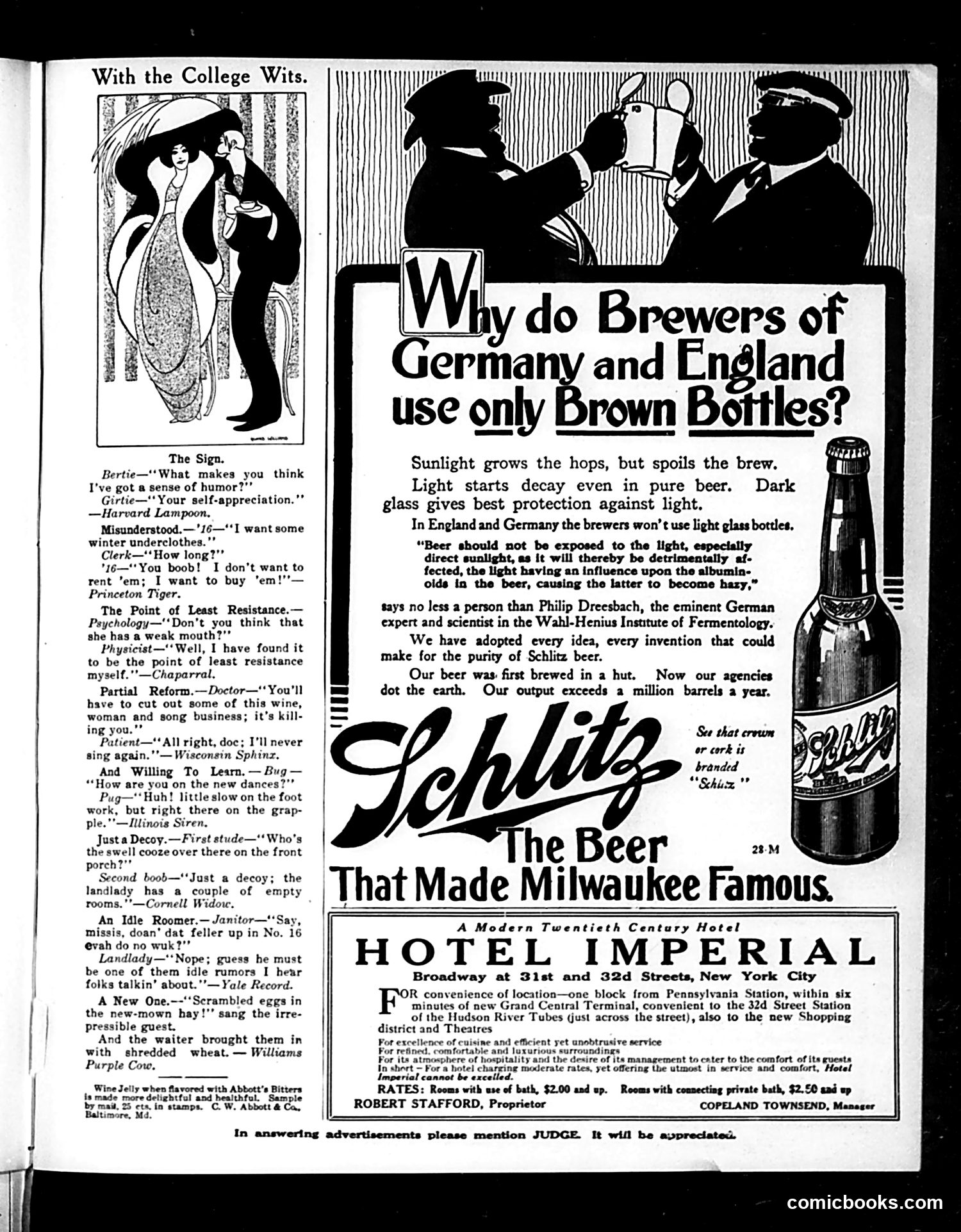
This page combines college humor jokes (left side) with a major beer advertisement (center-right). The **college jokes** are brief, wry quips from various university humor magazines (Harvard Lampoon, Princeton Tiger, Wisconsin Sphinx, etc.). They mock college students' pretensions, romantic mishaps, and misunderstandings—typical of early 20th-century campus humor. The **Schlitz advertisement** addresses why German and English brewers use only brown bottles. It claims sunlight spoils beer by affecting its chemical composition, citing authority from "Philip Dreesbach, the eminent German expert." The ad emphasizes Schlitz's purity and modern scientific methods, boasting of "a million barrels a year" output. This reflects the era's marketing strategy: establishing beer as a scientifically-vetted, respectable product rather than frivolous indulgence. The Hotel Imperial ad below further positions beer-drinking within refined, modern hospitality culture. Both ads suggest middle-class consumption standards circa 1910s.
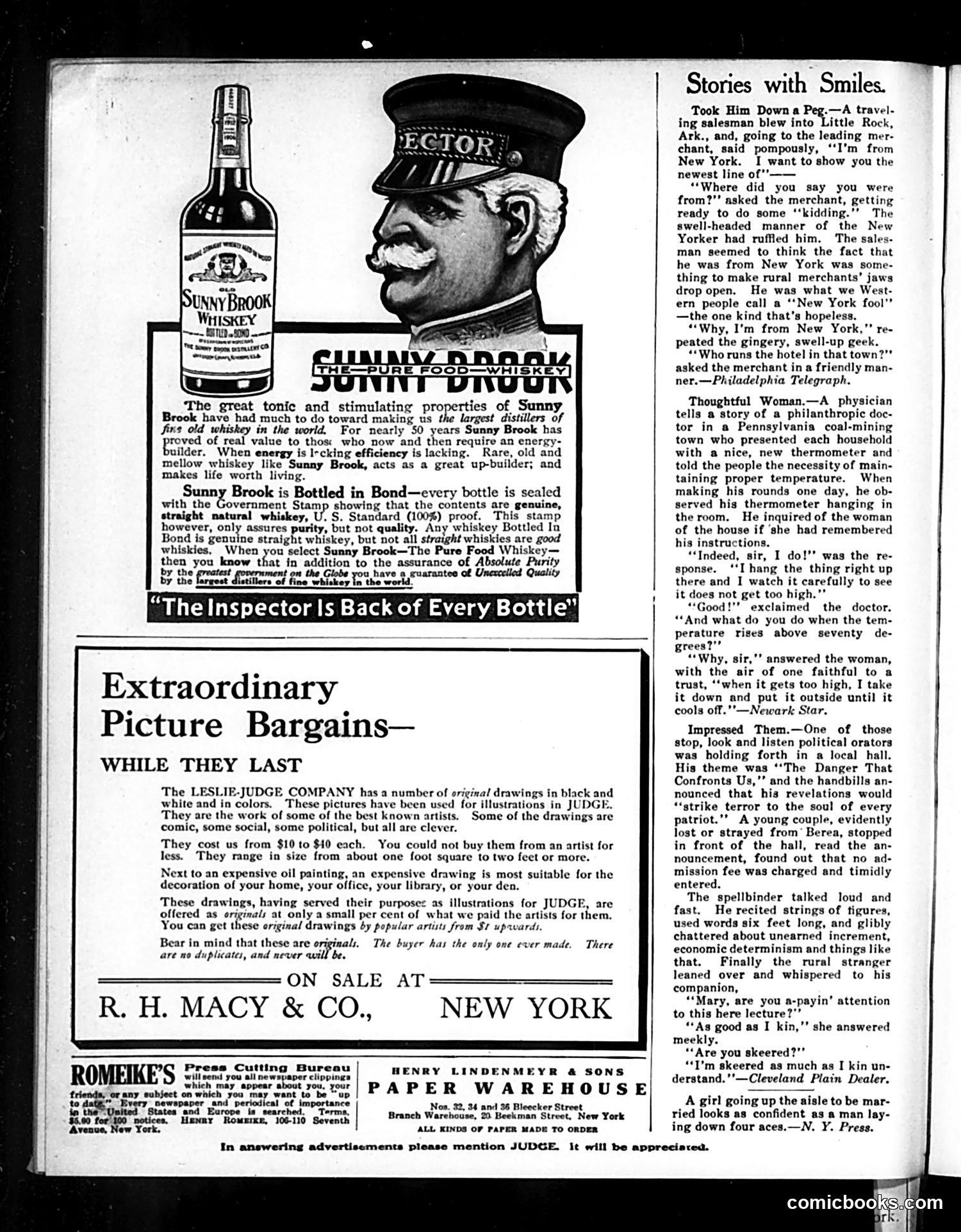
This page is primarily **advertising**, not political satire. The dominant content is a Sunny Brook Whiskey ad featuring a mustachioed man in a porter's cap—a generic "working man" figure used to sell whiskey as an "energy-builder" and tonic. The page includes small comedic anecdotes in "Stories with Smiles" (right column)—lighthearted tales mocking a pompous New York salesman and describing a doctor distributing thermometers. These represent mild, non-political humor typical of Judge's lighter content. Below are ads for Leslie-Judge Company's original artwork for sale, a press-clipping bureau, and a paper warehouse. **Context for moderns:** The whiskey ad reflects early 20th-century marketing normalizing alcohol as medicinal. The New York salesman joke reflects regional stereotypes about big-city smugness versus rural practicality—a recurring American theme.
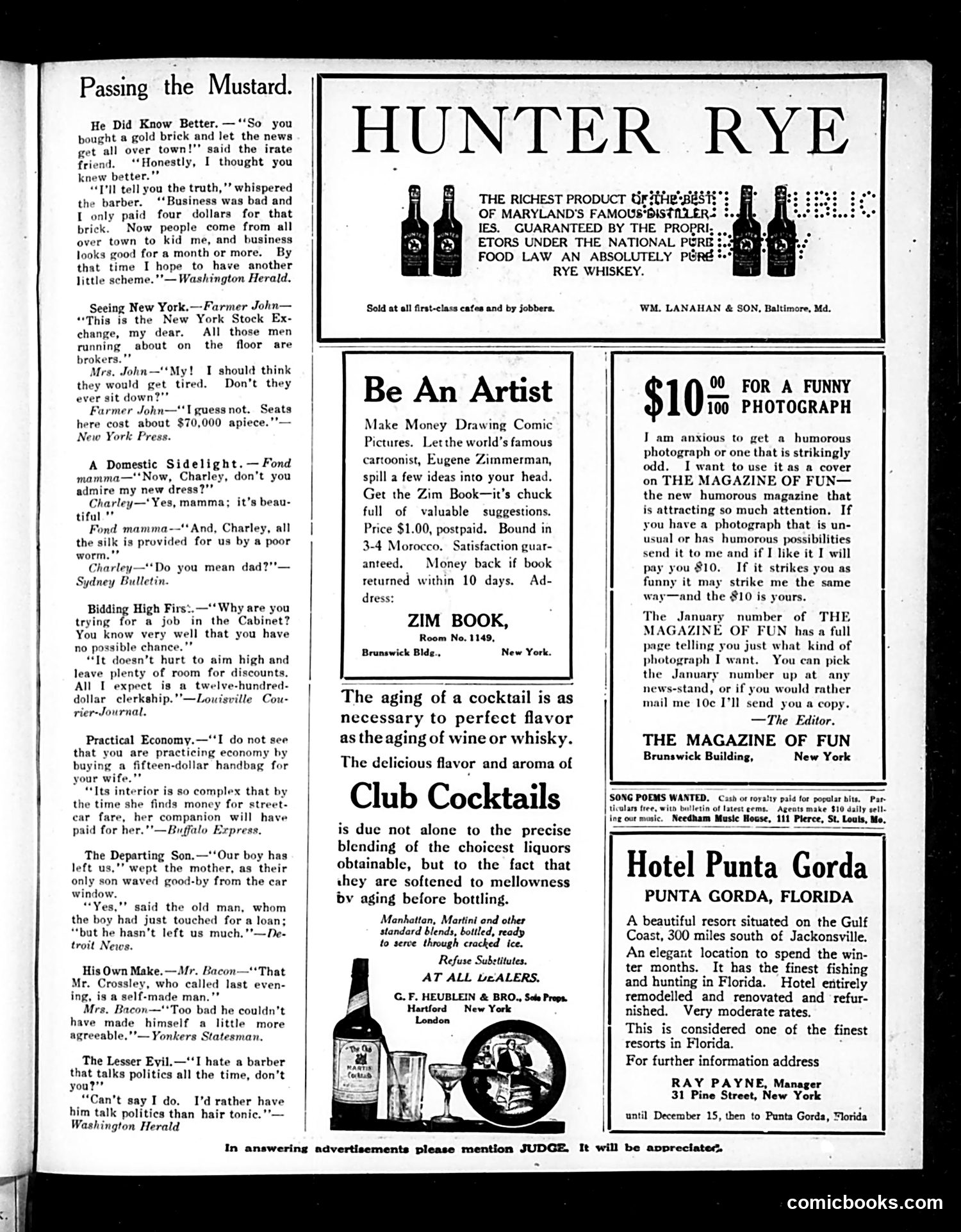
This page from *Judge* magazine contains several brief satirical anecdotes mocking American society, plus period advertisements. **"Passing the Mustard"** collects short jokes about human nature: a barber who profits from being duped into buying a fake gold brick; farmers amazed that stock exchange seats cost $70,000 (implying brokers never sit, a joke about wealth and exhaustion); a child's innocent quip that his mother's dress silk comes from "dad" (implying fathers are silkworms/provide money); and politicians aiming for cabinet positions with absurdly low salary expectations, accepting "discounts" on what they'd demand. The humor targets **materialism, financial schemes, and pretension** common to the era. The Cabinet joke satirizes **political corruption**—officials expected to accept bribes or negotiate their salaries downward. **Advertisements** include Hunter Rye whiskey (emphasizing purity under federal food law), a "Be An Artist" correspondence course, and a resort in Florida. The overall tone reflects *Judge*'s satirical focus on American greed, social climbing, and the absurdities of modern commercial life circa 1910s.
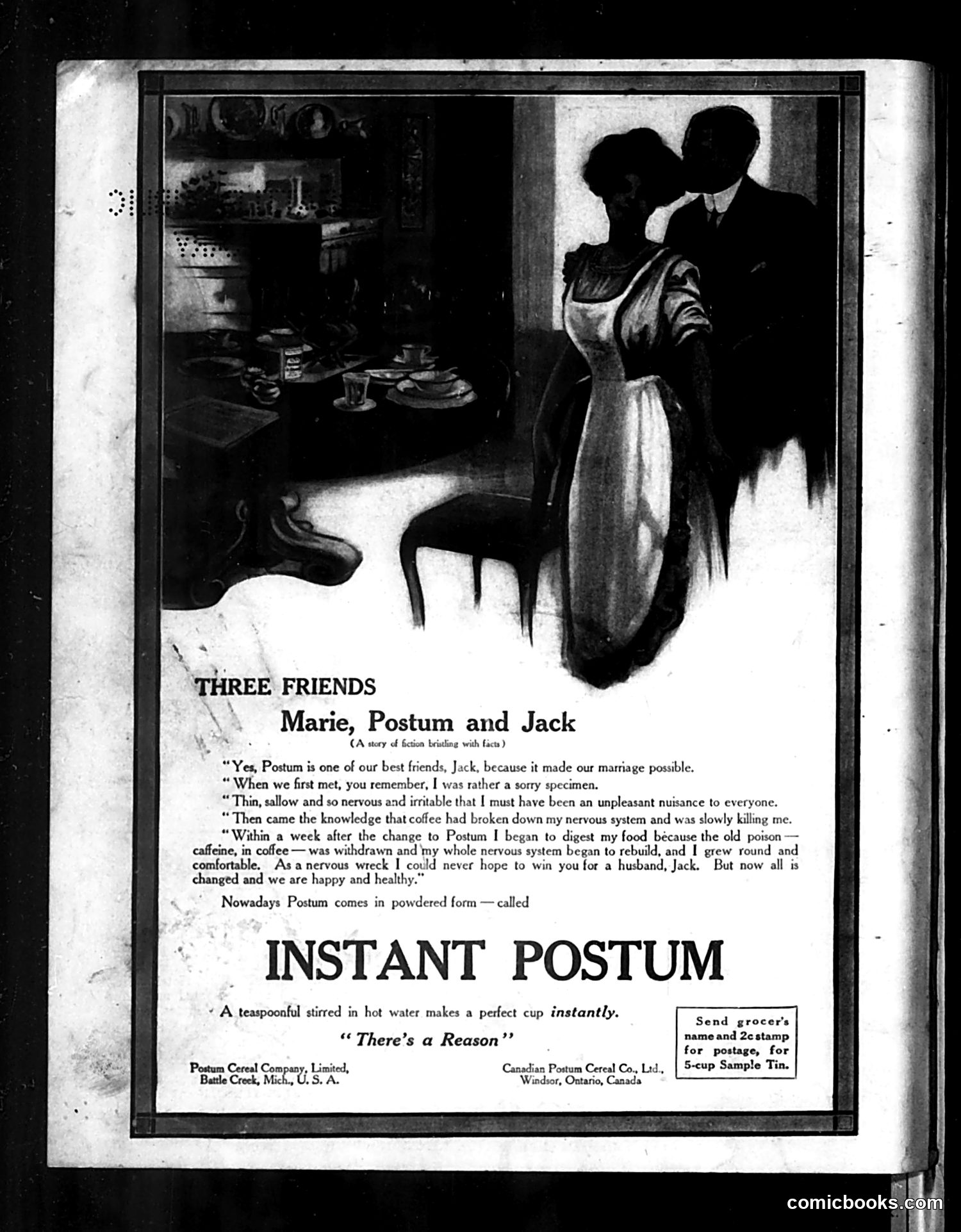
This is not satire but a **product advertisement** disguised as romantic narrative fiction. The "story" presents a marriage success tale: a woman claims coffee's caffeine ruined her health, making her "thin, sallow and nervous," unfit for marriage. Switching to Postum (a caffeine-free coffee substitute) allegedly restored her digestion, composure, and attractiveness, enabling her to win "Jack" as a husband. The advertisement exploits early-20th-century health anxieties about caffeine's effects on nerves and digestion—genuine medical concerns of the era. By framing the product within an intimate personal narrative rather than direct claims, it appeals emotionally to readers, particularly women worried about marriageability and health. The tagline "There's a Reason" was Postum's actual marketing slogan, suggesting scientific backing without specifics. The offer of a sample tin targets consumer conversion.
I cannot reliably analyze this image. The page appears to be almost entirely black or severely degraded, making it impossible to discern cartoon illustrations, caricatures, or satirical content. While there is a thin light stripe visible on the left edge (possibly the magazine's spine or binding), no readable artwork or text is visible in the main body of the page. To provide accurate historical context about the political satire or jokes intended, I would need a clearer image where the cartoon(s) and accompanying text are legible. I cannot responsibly speculate about content I cannot see.