
Judge, 1912-12-28 · page 8 of 25
Judge — December 28, 1912 — page 8: what you’re looking at
What you’re looking at
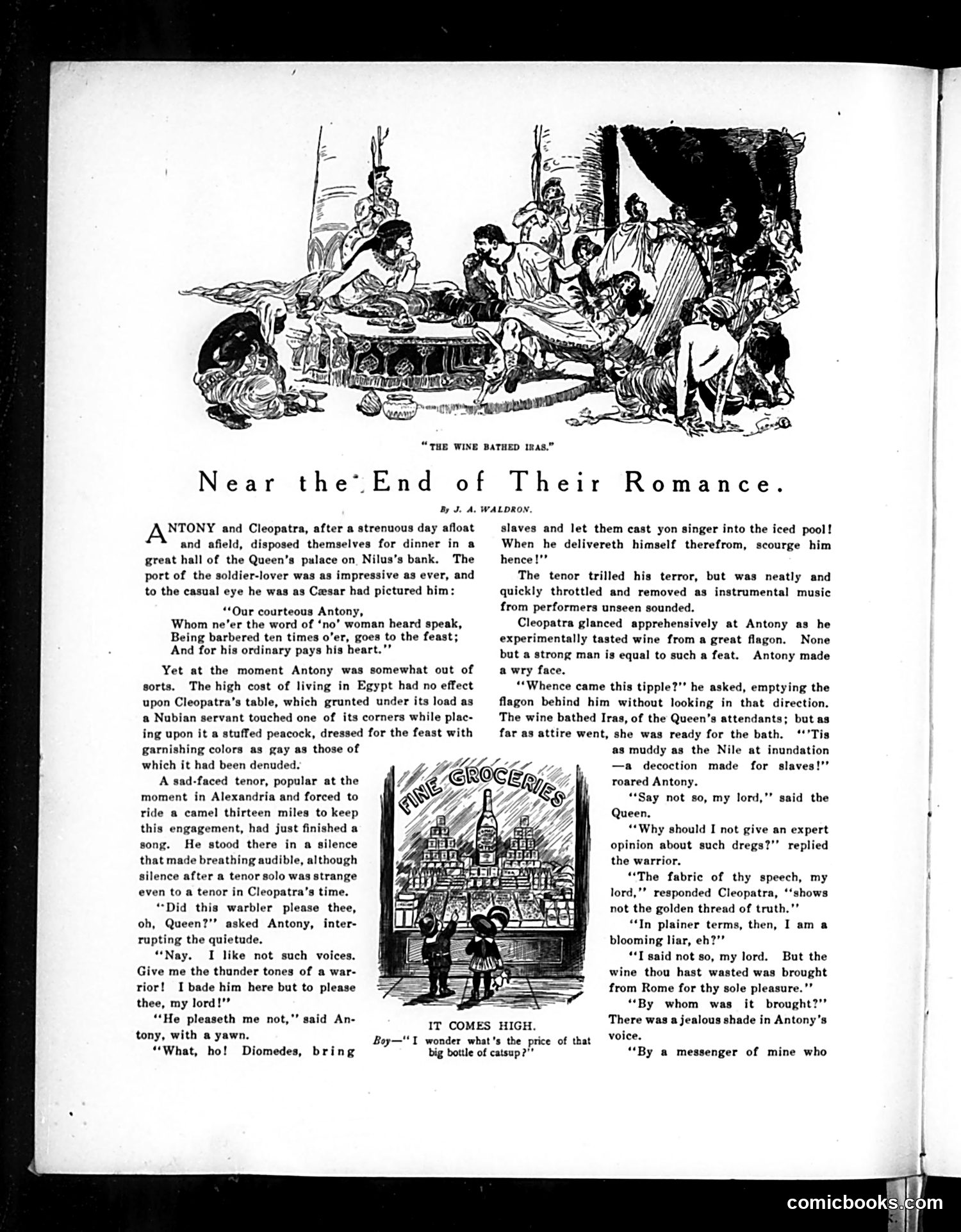
This is a comedic retelling of Shakespeare's *Antony and Cleopatra*, satirizing the famous historical couple through domestic complaint and petty bickering rather than grand tragedy. The joke targets the "high cost of living"—a contemporary economic concern inserted into ancient Egypt. Antony complains about expenses while lounging at Cleopatra's lavish feast. When a hired tenor performs poorly, they casually order him drowned. Antony then insults the wine (shipped expensively from Rome), which drenches an attendant. The humor pivots on deflating romance: instead of passionate lovers, they're a quarreling couple obsessing over wasteful spending and quality complaints. The small advertisement panel ("IT COMES HIGH") reinforces the economic theme—even in ancient times, luxury goods were overpriced. The satire mocks both classical pretension and contemporary consumer anxieties, suggesting even legendary romances dissolve into mundane domestic discord.
📄 Transcribed text from this page (OCR, searchable)
Machine-transcribed from the original scan — historical spelling and the odd misread are preserved.
Near “THE WINE BATHED 1,8.” the”. End of Their Romance. By J. A, WALDRON. ANTONY and Cleopatra, after a strenuous day afloat and afield, disposed themselves for dinner in a great hall of the Queen's pulace on Nilus’s bank. The port of the soldier-lover was as impressive as ever, and to the casual eye he was as Cesar had pictured him: “Our courteous Antony, Whom ne'er the word of ‘no’ woman heard speak, Being barbered ten times o’er, goes to the feast; And for his ordinary pays his heart.’’ Yet at the moment Antony was somewhat out of sorts. The high cost of living in Egypt had no effect upon Cleopatra’s table, which grunted under its load as a Nubian servant touched one of its corners while plac- ing upon it a stuffed peacock, dressed for the feast with garnishing colors as gay as those of which it had been denuded. A sad-faced tenor, popular at the moment in Alexandria and forced to ride a camel thirteen miles to keep this engagement, had just finished a song. He stood there in a silence that made breathing audible, although silence after a tenor solo was strange even to a tenor in Cleopatra’s time. “Did this warbler please thee, oh, Queen?”’ asked Antony, inter- rupting the quietude. “Nay. I like not such voices. Give me the thunder tones of a war- rior! I bade him here but to please thee, my lord!"” “He pleaseth me not," said An- tony, with a yawn. “What, ho! Diomedes, bring IT COMES HIGH. Boy—"I wonder what's the price of that big bottle of catsup?”” slaves and let them cast yon singer into the iced pool! When he delivereth himself therefrom, scourge him hence !"" The tenor trilled his terror, but was neatly and quickly throttled and removed as instrumental music from performers unseen sounded. Cleopatra glanced apprehensively at Antony as he experimentally tasted wine from a great flagon. None but a strong man is equal to such a feat. Antony made awry face. “‘Whence came this tipple?” he asked, emptying the flagon behind him without looking in that direction. The wine bathed Iras, of the Queen’s attendants; but as ttire went, she was ready for the bath. ‘'’Tis as muddy as the Nile at inundation —a decoction made for slaves!’’ roared Antony. “*Say not so, my lord,”’ said the Queen. “*Why should I not give an expert opinion about such dregs?”’ replied the warrior. “The fabric of thy speech, my lord,’? responded Cleopatra, ‘‘shows not the golden thread of truth."’ “In plainer terms, then, I am a blooming liar, eh?”’ “T said not so, my lord. But the wine thou hast wasted was brought from Rome for thy sole pleasure.’” “By whom was it brought?’’ There was a jealous shade in Antony’s voice. “By a messenger of mine who r comicbooks!