
Judge, 1912-12-28 · page 14 of 25
Judge — December 28, 1912 — page 14: what you’re looking at
What you’re looking at
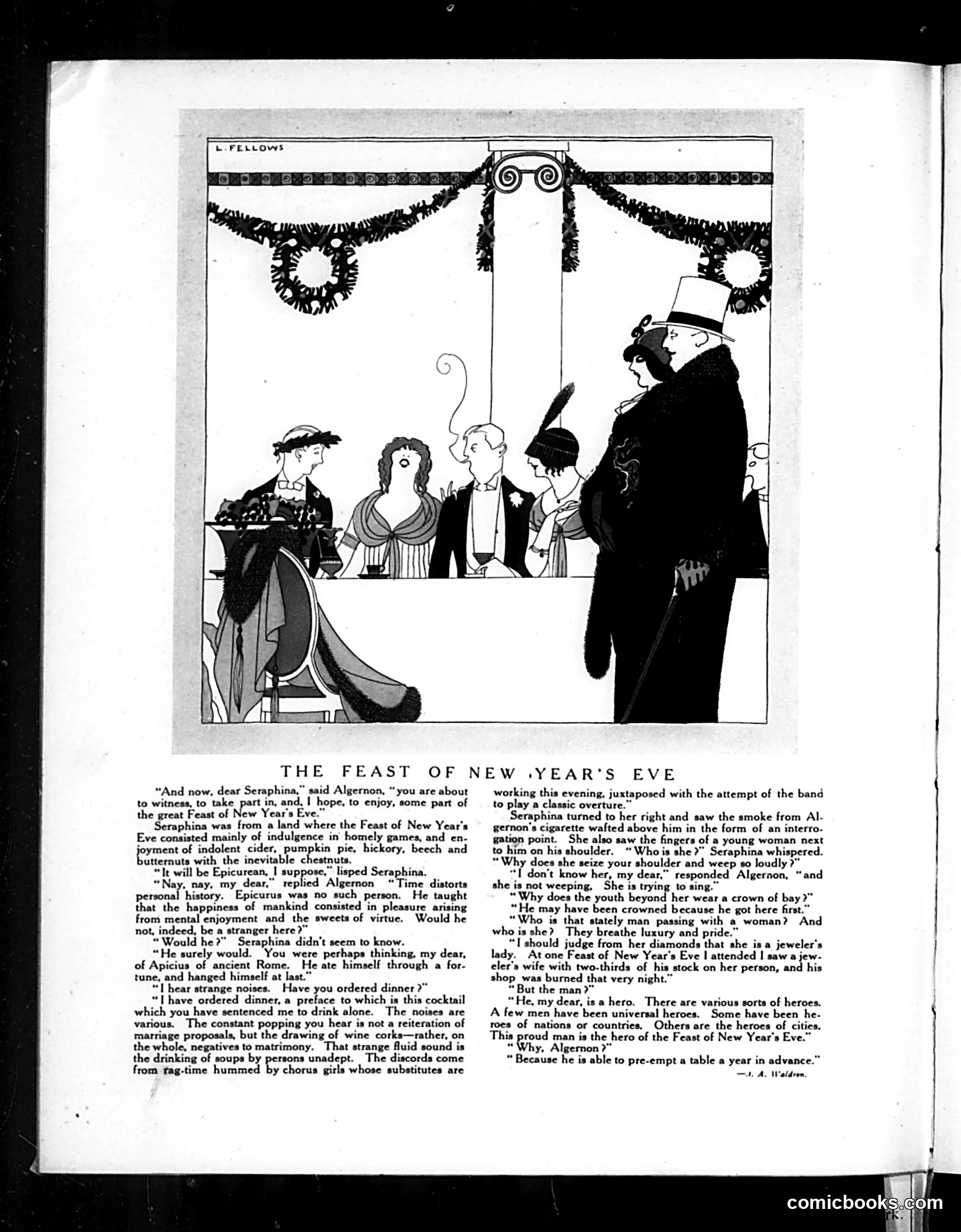
This satirical illustration depicts a New Year's Eve party where Algernon instructs a visiting woman named Seraphina on the evening's customs. The joke critiques upper-class New Year's celebration as superficial excess and social posturing. Algernon pedantically corrects Seraphina's reference to Epicurus, explaining that true epicureanism meant philosophical pleasure, not gluttony—yet the surrounding scene contradicts this: guests drinking heavily, chorus girls singing badly, people shouting over noise. The "hero of the Feast" is merely a man wealthy enough to reserve a table a year in advance, not someone of actual virtue or accomplishment. The cartoon mocks how wealthy New York society conflates material display (a jeweler's wife dripping in diamonds) with distinction, and how New Year's Eve itself becomes an exercise in conspicuous consumption rather than genuine enjoyment.
📄 Transcribed text from this page (OCR, searchable)
Machine-transcribed from the original scan — historical spelling and the odd misread are preserved.
L-FELLOWS “And now, dear Seraphina,” said Algernon, “you are about to witness, to take part in, and, | hope, to enjoy, some part of the great Feast of New Year's Eve.” Seraphina was from a land where the Feast of New Year's Eve consisted mainly of indulgence in homely games, and en- joyment of indolent cider, pumpkin pie, hickory, beech and uutternuts with the inevitable chestnuts. “It will be Epicurean, | supposes, lisped Sera, “Nay, nay, my dear,” replied Al . personal history. Epicurus was no such person. He taught that the happiness of mankind consisted in pleasure arising from mental enjoyment and the sweets of virtue. Would he not, indeed, be a stranger here?” “Would he?” Seraphina didn’t seem to know. “He surely would. You were perhaps thinking, my dear, of Apicius of ancient Rome. He ate himself through a for- tune, and hanged himself at last.” “hear strange noises. Have you ordered dinner ?” “Ihave ordered dinner, a preface to which is this cocktail which you have sentenced me to drink alone. The noises are various. The constant popping you hear is not a reiteration of marriage proposals, but the drawing of wine corks—rather, on the whole, negatives to matrimony. That strange fluid sound is the drinking of soups by persons unadept. The discords come froca’fag-time hummed by chorus girls whoee eubstitutes are THE FEAST OF NEW +sYEAR'S EVE working this evening, juxtaposed with the attempt of the band to play a classic overture.” Seraphina turned to her right and saw the smoke from Al- gernon’s cigarette wafted above him in the form of an interro- gation point. She also saw the fi to him on his shoulder. “Why does she seize your shoul: “I don’t know her, my dear,” responded Algernon, “and she is not weeping, She is trying to sing.” “Why does the youth beyond her wear a crown of bay ? “He may have been crowned because he got here first.” “Who is that stately man passing with a woman? And who is she? They breathe luxury and pride.” “I should judge from her diamonds that she is a jeweler's lady. Atone Feast of New Year's Eve | attended | saw a jew- eler’s wife with two-thirds of stock on her person, and his shop was burned that very nig! “ But the man ?’ “He, my dea: ahero. There are various sorts of heroes. A few men have been universal heroes. Some have been he- roes of nations or countries, Others are the heroes of cities. This Rroud man is the hero of the Feast of New Year's Eve.” y. Algernon ?” “ Because he is able to pre-empt a table a year in advance.” 4. A, Waldron, 4 comicbooks