
Judge, 1912-12-28 · page 16 of 25
Judge — December 28, 1912 — page 16: what you’re looking at
What you’re looking at
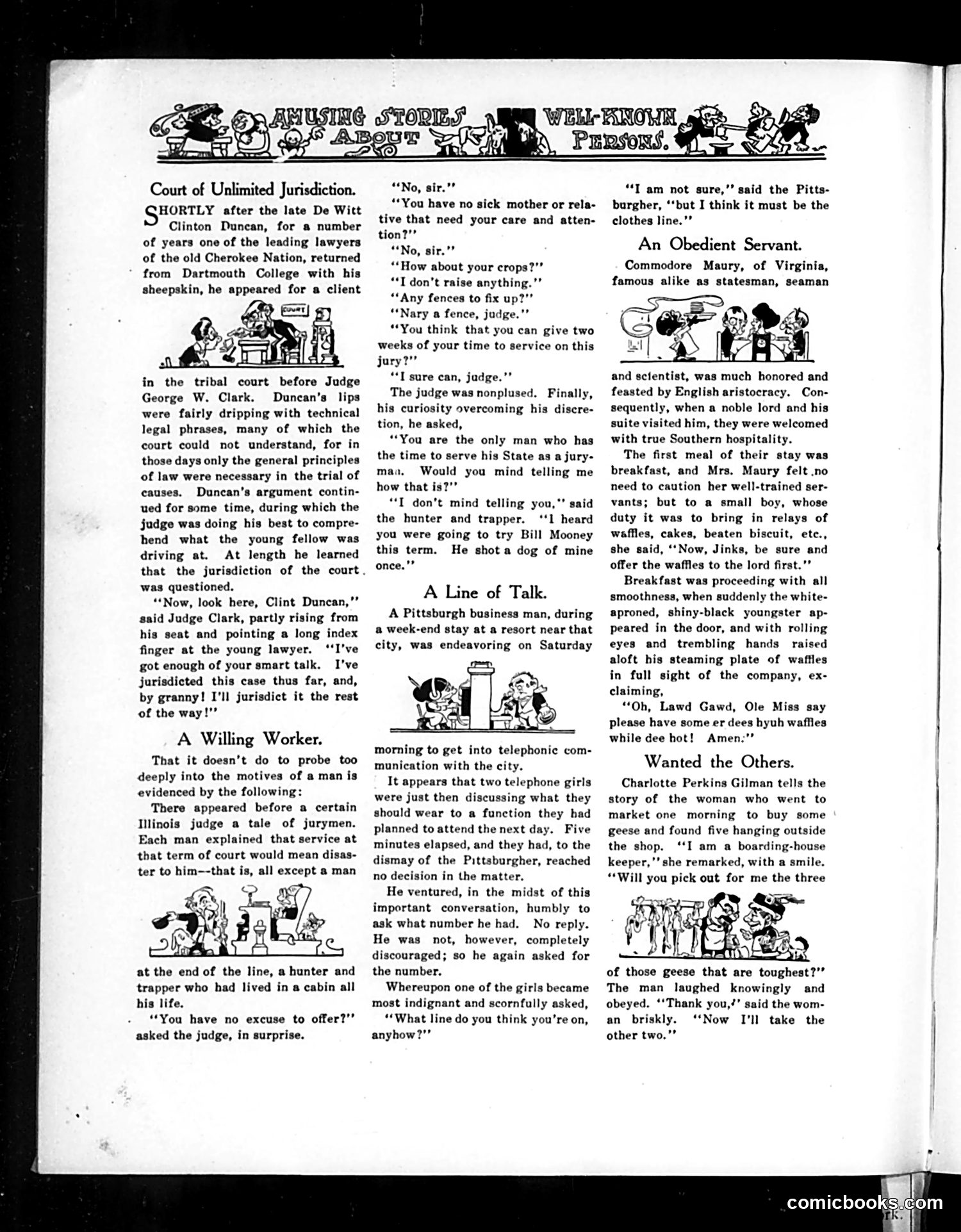
This page contains four separate humorous anecdotes satirizing American legal and social customs: 1. **"Court of Unlimited Jurisdiction"**: Mocks frontier/Cherokee Nation jurisprudence by showing Judge Clark dismissing a young lawyer's technical arguments. The judge declares he'll "jurisdict" the case however he pleases, satirizing informal, arbitrary frontier justice where formal legal procedure means nothing. 2. **"A Willing Worker"**: A hunter applying for jury duty admits he has no excuses—he actually *wants* to serve. The punchline reveals his motive: the defendant shot his dog, making this not civic duty but revenge. 3. **"A Line of Talk"**: A Pittsburgh businessman trying to make a phone call gets blocked by two telephone operators discussing their clothing for an upcoming event. When he interrupts, one sarcastically asks what "line" he thinks he's on, and he quips it must be the "clothes line"—wordplay mocking telephone operators' inattention to business. 4. **"Wanted the Others"**: References Commodore Maury's Southern hospitality to English visitors, with a servant anecdote (text cuts off). The tone throughout is gently satirical of American institutions and social pretension.
📄 Transcribed text from this page (OCR, searchable)
Machine-transcribed from the original scan — historical spelling and the odd misread are preserved.
Court of Unlimited Jurisdiction. HORTLY after the late De Witt Clinton Duncan, for a number of years one of the leading lawyers of the old Cherokee Nation, returned from Dartmouth College with his sheepskin, he appeared for a client in the tribal court before Judge George W. Clark. Duncan's lips were fairly dripping with technical legal phrases, many of which the court could not understand, for in those days only the general principles of law were necessary in the trial of causes. Duncan's argument contin- ued for some time, during which the judge was doing his best to compre- hend what the young fellow was driving at. At length he learned that the jurisdiction of the court. was questioned. “Now, look here, Clint Duncan,’’ said Judge Clark, partly rising from his seat and pointing a long index finger at the young lawyer. ‘I’ve got enough of your smart talk. I've jurisdicted this case thus far, and, by granny! I'll jurisdict it the rest of the way!"’ A Willing Worker. That it doesn’t do to probe too deeply into the motives of a man is evidenced by the following: There appeared before a certain Illinois judge a tale of jurymen. Each man explained that service at that term of court would mean disas- ter to him—-that is, all except a man at the end of the line, a hunter and trapper who had lived in a cabin all his life. “You have no excuse to offer?’’ asked the judge, in surprise. “No, sir.’” “You have no sick mother or rela- tive that need your care and atten- tion?” “No, sir.” “*How about your crops?”’ “I don’t raise anything.’’ “Any fences to fix up?" “Nary a fence, judge."” **You think that you can give two weeks of your time to service on this jury?” “T sure can, jadge.’’ The judge was nonplused. Finally, his curiosity overcoming his discre- tion, he asked, “You are the only man who has the time to serve his State as a jury- man. Would you mind telling me how that is?” “I don’t mind telling you,"’ said the hunter and trapper. ‘‘l heard you were going to try Bill Mooney this term. He shot a dog of mine once.’’ A Line of Talk. A Pittsburgh business man, during a week-end stay at a resort near that city, was endeavoring on Saturday morning to get into telephonic com- munication with the city. It appears that two telephone girls were just then discussing what they should wear to a function they had planned to attend the next day. Five minutes elapsed, and they had, to the dismay of the Pittsburgher, reached no decision in the matter. He ventured, in the midst of this important conversation, humbly to ask what number he had. No reply. He was not, however, completely discouraged; so he again asked for the number. Whereupon one of the girls became most indignant and scornfully asked, “What line do you think you’re on, anyhow?" “TI am not sure,’’ said the Pitts- burgher, ‘‘but I think it must be the clothes line.”” An Obedient Servant. Commodore Maury, of Virginia, famous alike as statesman, seaman and scientist, was much honored and feasted by English aristocracy. Con- sequently, when a noble lord and his suite visited him, they were welcomed with true Southern hospitality. The first meal of their stay was breakfast, and Mrs. Maury felt .no need to caution her well-trained ser- vants; but to a small boy, whose duty it was to bring in relays of waffles, cakes, beaten biscuit, ete., she said, ‘‘Now, Jinks, be sure and offer the waffles to the lord first."” Breakfast was proceeding with all smoothness, when suddenly the white- aproned, shiny-black youngster ap- peared in the door, and with rolling eyes and trembling hands raised aloft his steaming plate of waffles in full sight of the company, ex- claiming, “Oh, Lawd Gawd, Ole Miss say please have some er dees hyuh waffles while dee hot! Amen: Wanted the Others. Charlotte Perkins Gilman tells the story of the woman who went to market one morning to buy some geese and found five hanging outside the shop. ‘I am a boarding-house keeper,’’ she remarked, with a smile. “Will you pick out for me the three of those geese that are toughest?” The man laughed knowingly and obeyed. ‘Thank you,?’ said the wom- an briskly. ‘‘Now I'll take the other two.’” comicbooks,