
Judge, 1912-12-28 · page 4 of 25
Judge — December 28, 1912 — page 4: what you’re looking at
What you’re looking at
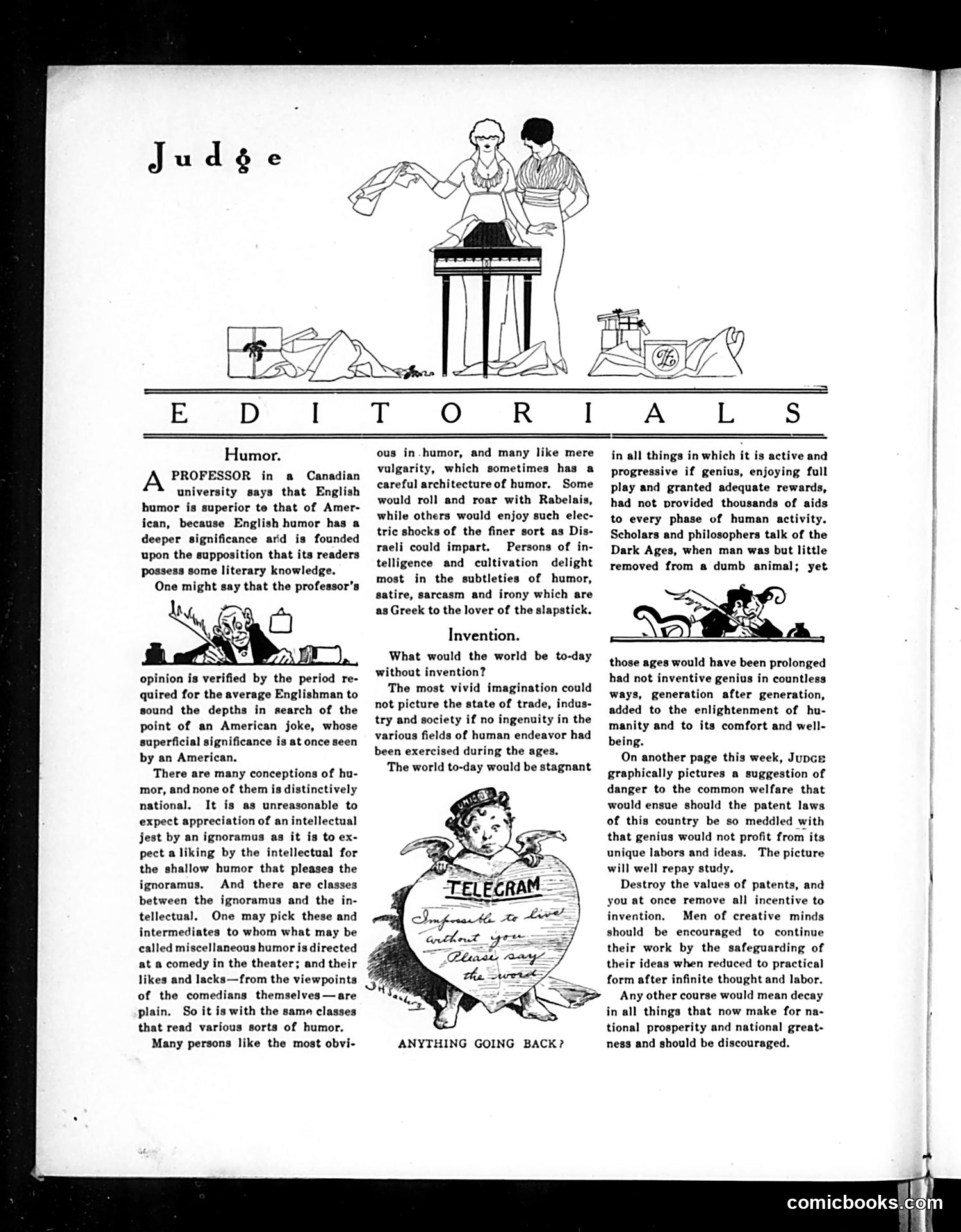
This editorial page discusses **humor** and **invention** as national traits. The top illustration depicts a "Judge" (presumably representing American judicial authority or common sense) weighing competing interests—suggesting editorial judgment on important matters. The **humor section** argues that American humor, while sometimes crude, has intellectual depth superior to English humor. It defends satire and irony as legitimate intellectual tools, rejecting the notion that wit is shallow entertainment. The **invention section** warns against over-regulating patents, arguing that restricting inventors' profits would stifle innovation and harm national prosperity. The telegram illustration ("ANYTHING GOING BACK?") appears to mock communication about failed business ventures. The page advocates protecting intellectual property and creative freedom as essential to American progress.
📄 Transcribed text from this page (OCR, searchable)
Machine-transcribed from the original scan — historical spelling and the odd misread are preserved.
Humor. PROFESSOR in a Canadian university says that English humor is superior te that of Amer- ican, because English humor has a deeper significance arid is founded upon the supposition that its readers possess some literary knowledge. One might say that the professor's opinion is verified by the period re- quired for the average Englishman to sound the depths in search of the point of an American joke, whose superficial significance is at once seen by an American. There are many conceptions of hu- mor, and none of them is distinctively national. It is as unreasonable to expect appreciation of an intellectual jest by an ignoramus as it is to ex- pect a liking by the intellectual for the shallow humor that pleases the ignoramus. And there are classes between the ignoramus and the in- tellectual. One may pick these and intermediates to whom what may be called miscellaneous humor is directed at a comedy in the theater; and their likes and lacks—from the viewpoints of the comedians themselves—are plain. So it is with the same classes that read various sorts of humor. Many persons like the most obvi- ous in-humor, and many like mere vulgarity, which sometimes has a careful architectureof humor. Some would roll and roar with Rabelais, while others would enjoy such elec- tric shocks of the finer sort as Dis- raeli could impart. Persons of in- telligence and cultivation delight most in the subtleties of humor, satire, sarcasm and irony which are as Greek to the lover of the slapstick. Invention. What would the world be to-day without invention? The most vivid imagination could not picture the state of trade, indus- try and society if no ingenuity in the various fields of human endeavor had been exercised during the ages. The world to-day would be stagnant sy EELEGRA —— i Ae Cr. Cthrat your af TT Phiaik, a4 ANYTHING GOING BACK? LS in all things in which it is active and progressive if genius, enjoying full play and granted adequate rewards, had not provided thousands of aids to every phase of human activity. Scholars and philosophers talk of the Dark Ages, when man was but little removed from a dumb animal; yet those ages would have been prolonged had not inventive genius in countless ways, generation after generation, added to the enlightenment of hu- manity and to its comfort and well- being. On another page this week, Jupce graphically pictures a suggestion of danger to the common welfare that would ensue should the patent laws of this country be so meddled with that genius would not profit from its unique labors and ideas. The picture will well repay study, Destroy the values of patents, and you at once remove all incentive to invention. Men of creative minds should be encouraged to continue their work by the safeguarding of their ideas when reduced to practical form after infinite thought and labor. Any other course would mean decay in all things that now make for na- tional prosperity and national great- ness and should be discouraged. comicbooks: | | |