
A complete issue · 24 pages · 1912
Judge — November 2, 1912
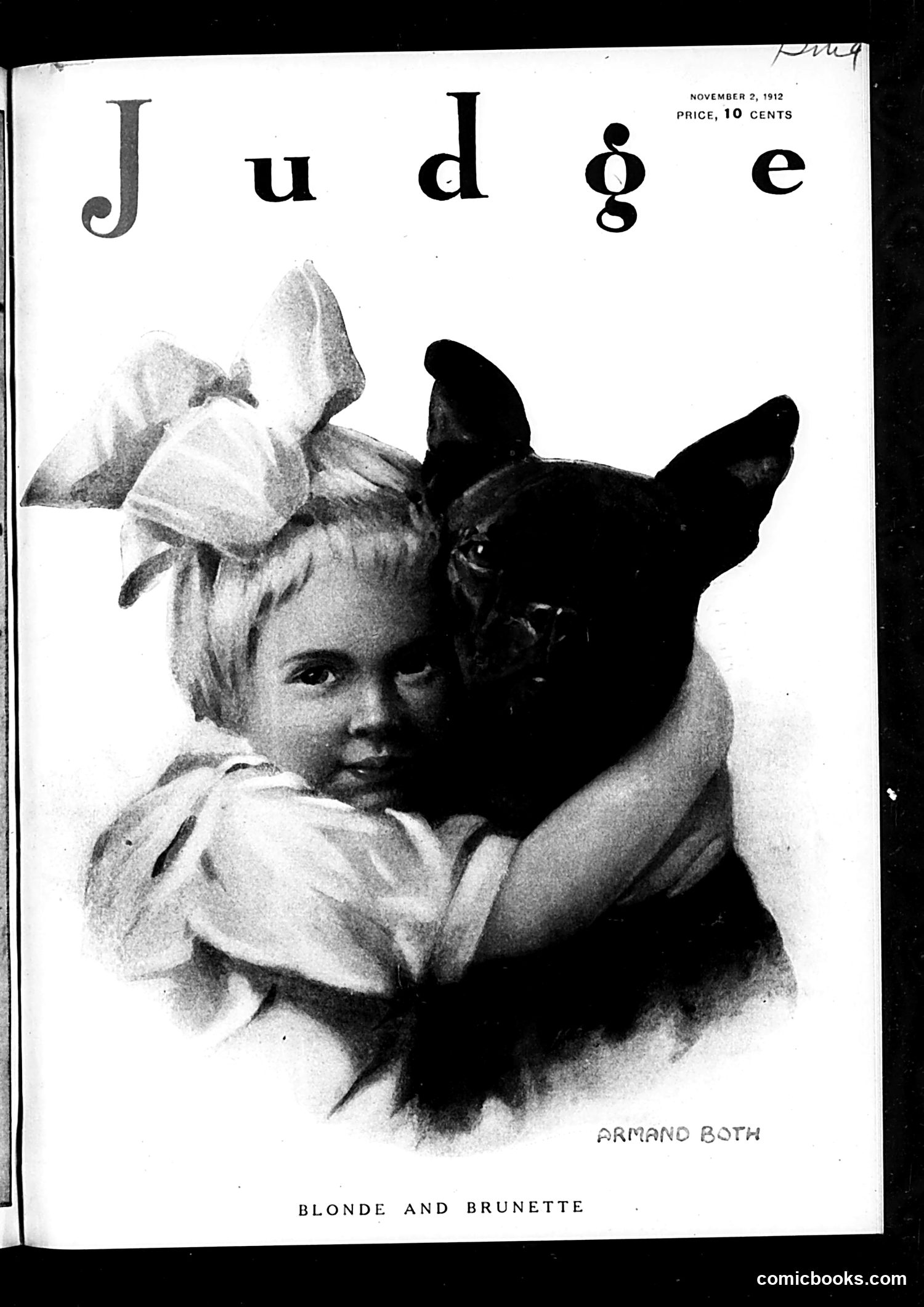
This cover by artist Armand Both depicts a young child with a blonde-haired doll and a black cat, titled "Blonde and Brunette." The image likely satirizes contemporary discussions about physical appearance or racial/ethnic characteristics common in early 20th-century American humor. The "blonde and brunette" contrast may reference popular beauty standards of the era or possibly comment on ethnic divisions that were frequent subjects of period satire. Without additional context from the magazine's interior, the specific satirical target remains unclear—whether it critiques beauty pageants, romantic preferences, or social attitudes toward appearance. The price (10 cents) and date confirm this as an authentic 1912 Judge publication, when such visual comparisons were standard satirical fare.
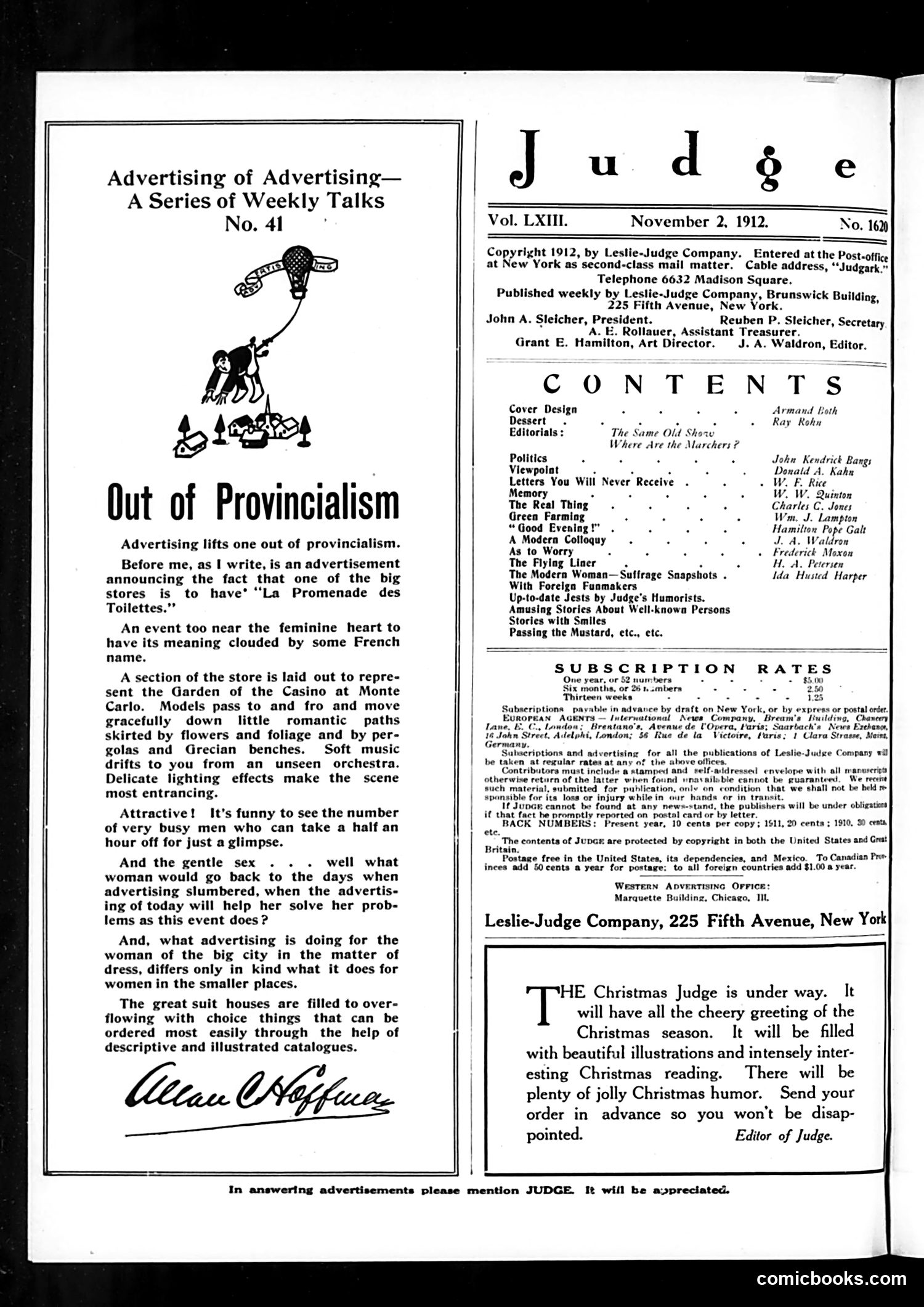
This page contains an advertisement titled "Out of Provincialism" promoting a department store's "La Promenade des Toilettes" section. The ad argues that advertising helps elevate women beyond provincial concerns by introducing them to fashionable urban trends—specifically a display modeled after Monte Carlo's Casino gardens. The accompanying illustration shows a woman figure holding what appears to be a torch or promotional banner, surrounded by decorative elements. The ad's argument reflects early 20th-century assumptions that consumer culture and exposure to cosmopolitan European aesthetics would culturally improve women, particularly in smaller American towns. The tone is patronizing by modern standards, positioning fashion consumption as enlightenment and urban sophistication as inherently superior to rural life.
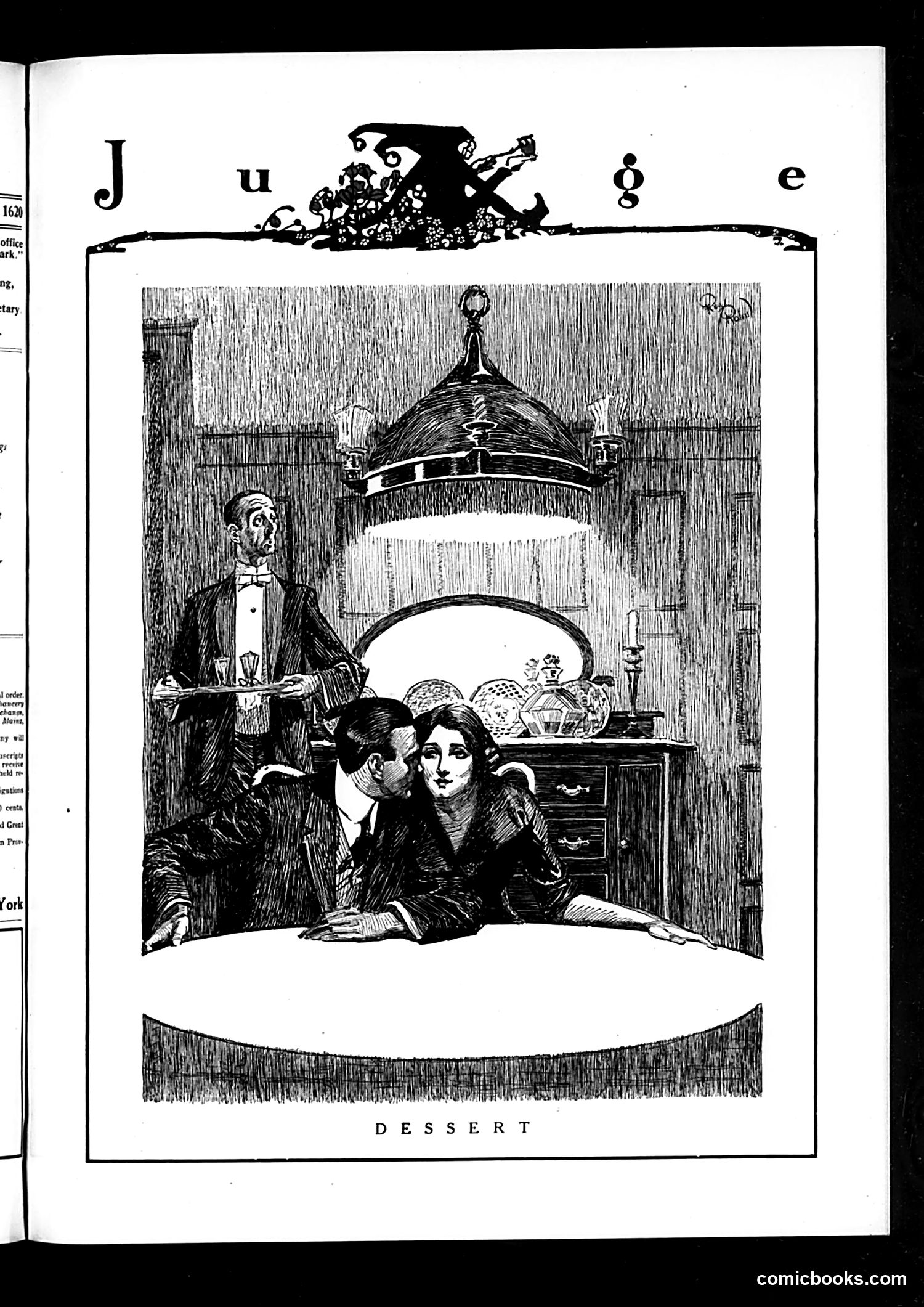
This page from *Judge* magazine shows a cartoon titled "DESSERT" depicting an elegant dinner scene. A well-dressed couple sits intimately at a table while a formal servant stands in the background. Above them hangs an elaborate suspended lamp or chandelier. The letters "J u g g e" spell "Judge" at the top. The satire appears to play on the double meaning of "dessert"—the sweet course following dinner versus romantic "desserts" (intimate moments). The formal, wealthy setting with attentive servants emphasizes the contrast between outward propriety and private behavior. The cartoon seems to satirize upper-class romantic conventions: how the wealthy maintain formal appearances in public while pursuing pleasure privately. Without additional context, the specific social commentary remains somewhat ambiguous, though it likely critiques either romantic hypocrisy or leisure-class indulgence.
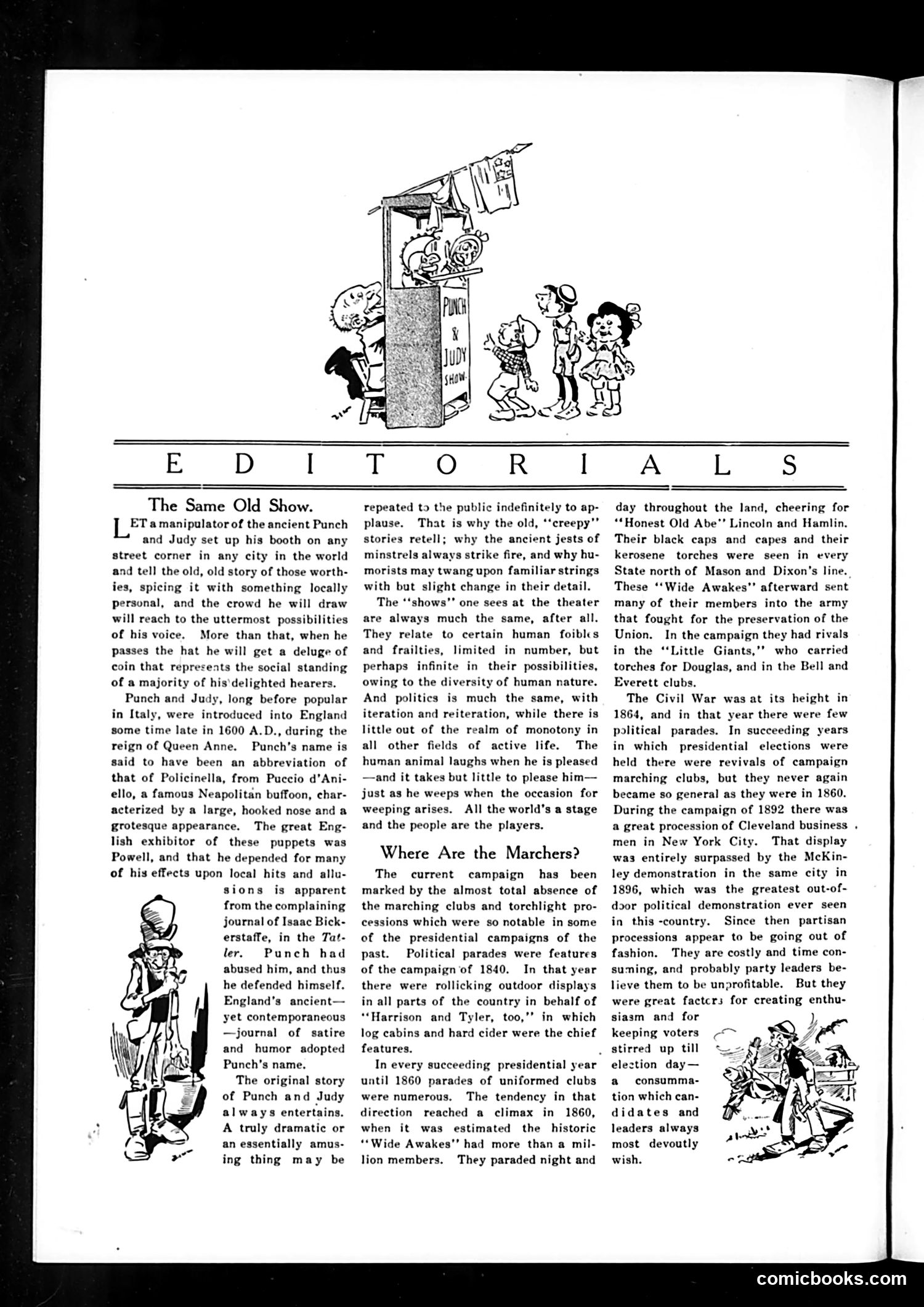
This page discusses **Punch and Judy**, the traditional puppet show entertainment, and draws parallels to American political campaigns. The main text argues that political campaigns, like Punch and Judy shows, are essentially repetitive entertainment—the same basic stories recycled with minor variations to please audiences. The author notes that regardless of era or location, the core elements remain unchanged. The page references the **1892 presidential campaign** and mentions the **"Wide Awakes"** (Civil War-era marching clubs that were revived for political purposes). It criticizes the apparent decline of theatrical political parades and marching demonstrations compared to earlier campaigns, suggesting such spectacles were becoming less popular. The cartoons illustrate Punch and Judy performers and marching club members, visualizing the comparison between puppet theater and political theater.
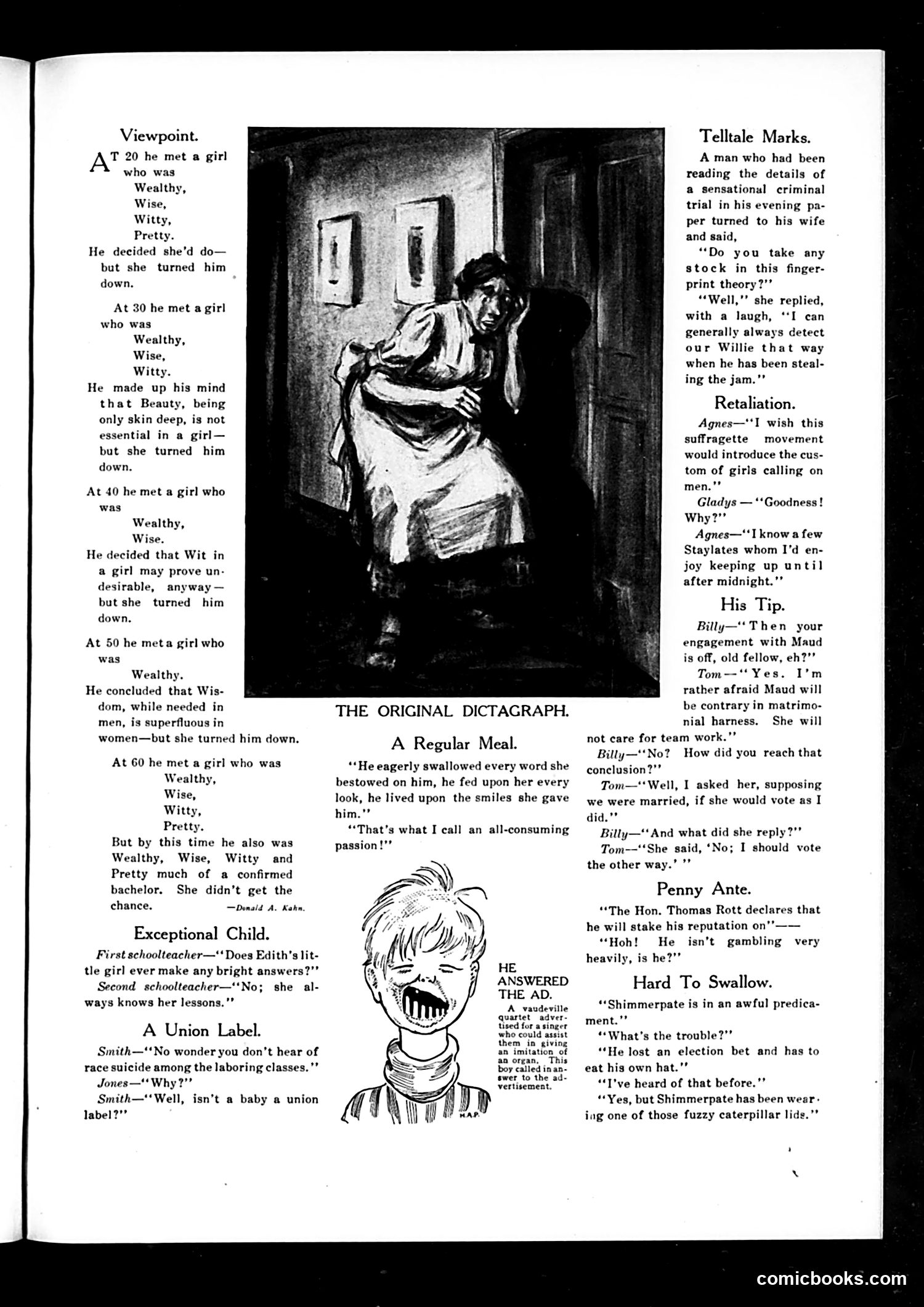
This page contains humor pieces and anecdotes rather than political cartoons. The content includes: **"Viewpoint"** - A satirical essay about a man meeting progressively wealthy, wise, witty, and pretty women at ages 20, 30, 40, 50, and 60, each rejecting him. It comments on bachelor life and changing dating prospects with age. **"The Original Dictagraph"** - A dialogue mocking a woman who obsessively analyzes her husband's words and expressions, suggesting controlling relationship behavior. **"Exceptional Child"** - A brief joke about a schoolgirl. **"A Union Label"** - A joke about labor union membership. The remaining pieces ("His Tip," "Penny Ante," "Hard To Swallow") are short quips about engagement, gambling, and political bets. The page emphasizes domestic humor and social commentary on marriage, gender dynamics, and contemporary attitudes rather than explicit political satire.
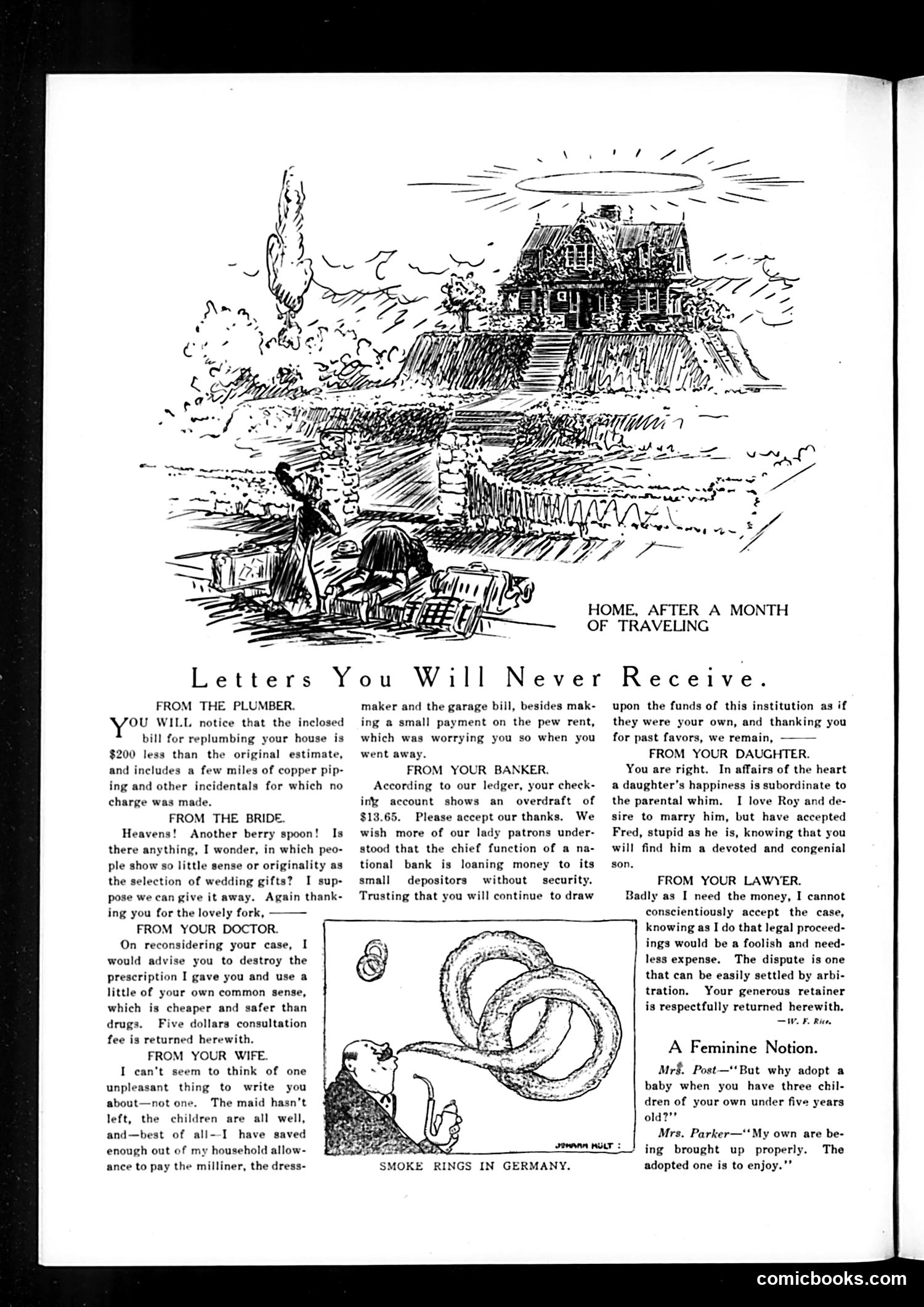
This satirical piece mocks the gap between idealistic fantasy and reality. The premise imagines thank-you letters a traveler will *never* actually receive upon returning home—each from a professional or family member who, in reality, behaves opposite to these virtuous letters. The satire targets common frustrations: plumbers who overcharge, doctors who charge for useless prescriptions, bankers who enable overdrafts, wives who overspend, lawyers who take dubious cases, and daughters who marry for money despite parental objection. Each "letter" presents the ideal professional or family member—honest, selfless, ethical—knowing readers recognize the actual behavior is the reverse. The minor cartoon showing "smoke rings in Germany" appears unrelated to the main satire, likely a separate visual joke about German culture or habits. The "Feminine Notion" at bottom satirizes women's logic about child-rearing, suggesting adopting a child specifically to spoil while raising one's own "properly"—mocking perceived female inconsistency or hypocrisy in parenting.
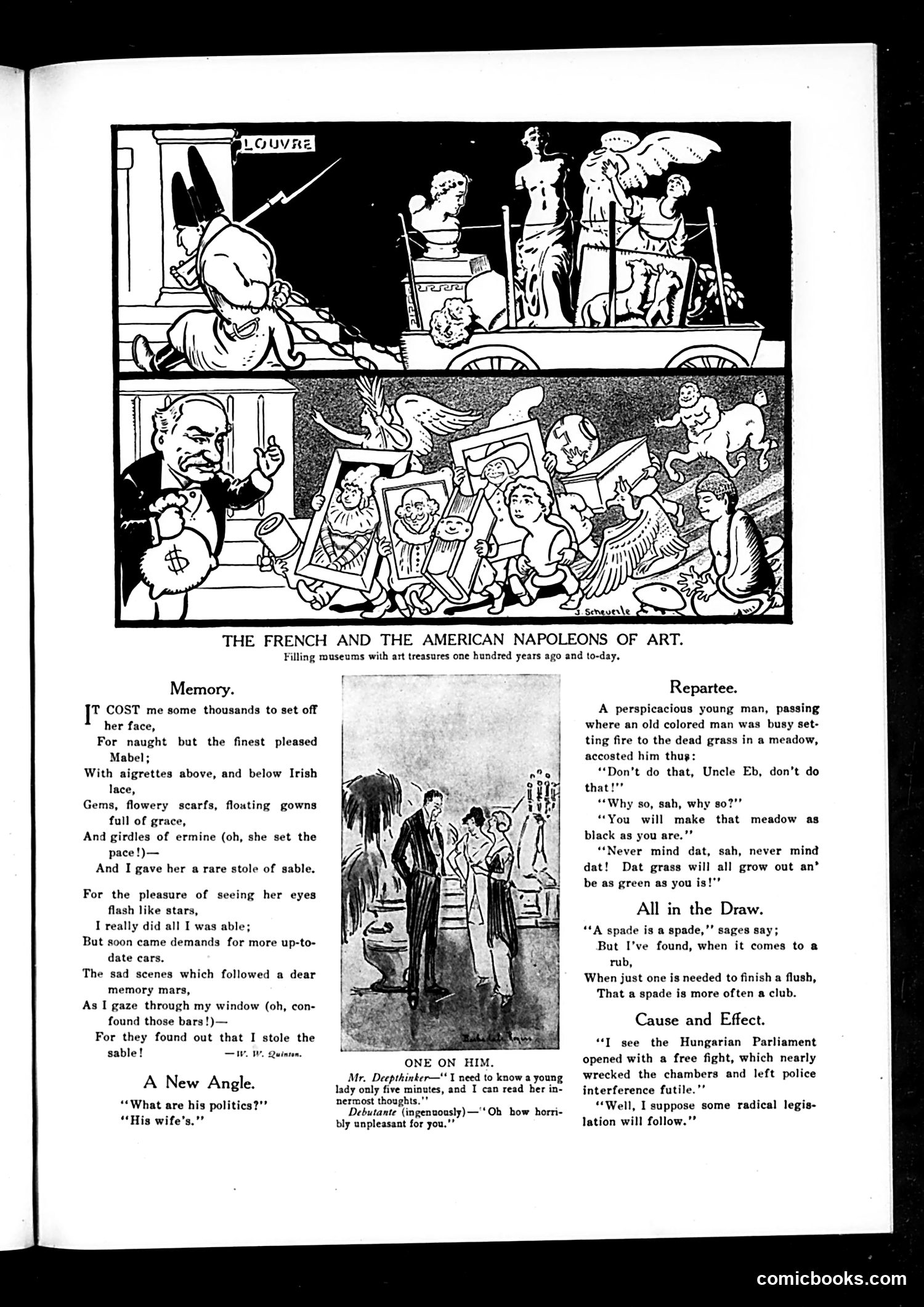
The top cartoon, "The French and the American Napoleons of Art," compares museum acquisition practices. The upper panel shows classical statuary being displayed (labeled "LOUVRE"), while the lower panel depicts a greedy figure with a money bag surrounded by cherubs and artworks—satirizing wealthy American collectors who aggressively purchased European art treasures for private museums, mirroring how Napoleon once looted them. Below are brief humorous vignettes typical of Judge's humor: - **"Memory"** and **"A New Angle"**: Mock domestic situations and marital dynamics - **"One on Him"**: A joke about mind-reading pretense - **"Repartee"**: A racial dialect joke about burning meadow grass (reflecting period attitudes) - **"All in the Draw"**: A card-playing pun - **"Cause and Effect"**: References the Hungarian Parliament's violent session, linking political chaos to radical legislation The page blends satirical commentary on art collecting with lighter social humor typical of early 20th-century American magazines.
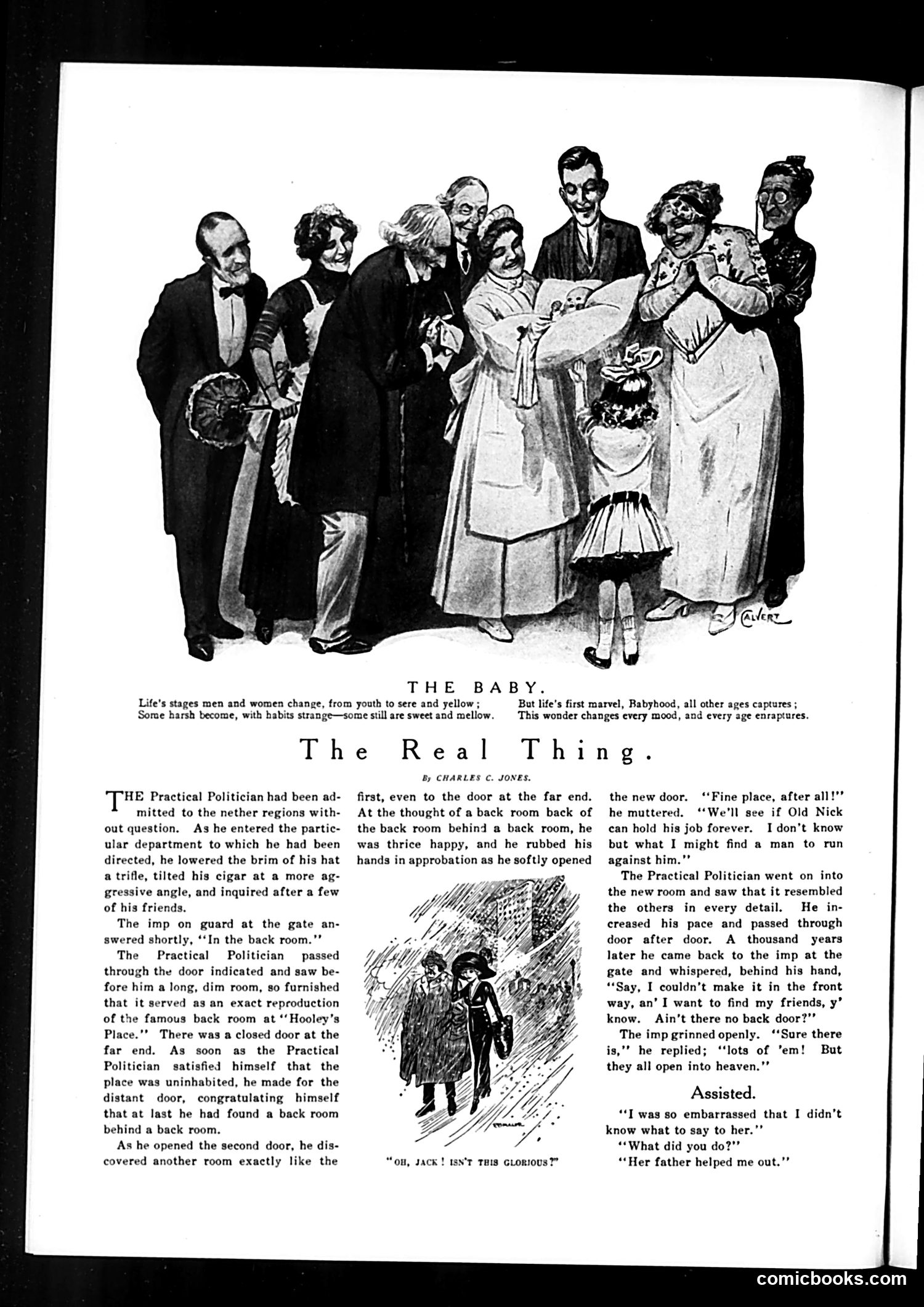
This page contains two distinct pieces satirizing different targets. **Top illustration & poem ("The Baby"):** A sentimental domestic scene celebrating infancy, contrasting with the cynical story below—likely satirizing Victorian sentimentality about children. **Main story ("The Real Thing"):** A political allegory mocking corrupt "Practical Politicians." The protagonist enters Hell seeking "back rooms" (spaces for backroom political dealing and corruption). He discovers an infinite regression of identical back rooms—a clever metaphor suggesting that corruption and political scheming are endless and inescapable, even in the afterlife. The final joke about heaven's doors reveals the satirical point: politicians are so devoted to backroom dealings that they've forgotten legitimate ("front") entrances entirely. The "Old Nick" (the Devil) cannot keep his "job" because there's always another corrupt politician ready to replace him. This mocks late-19th-century American machine politics and moral hypocrisy.
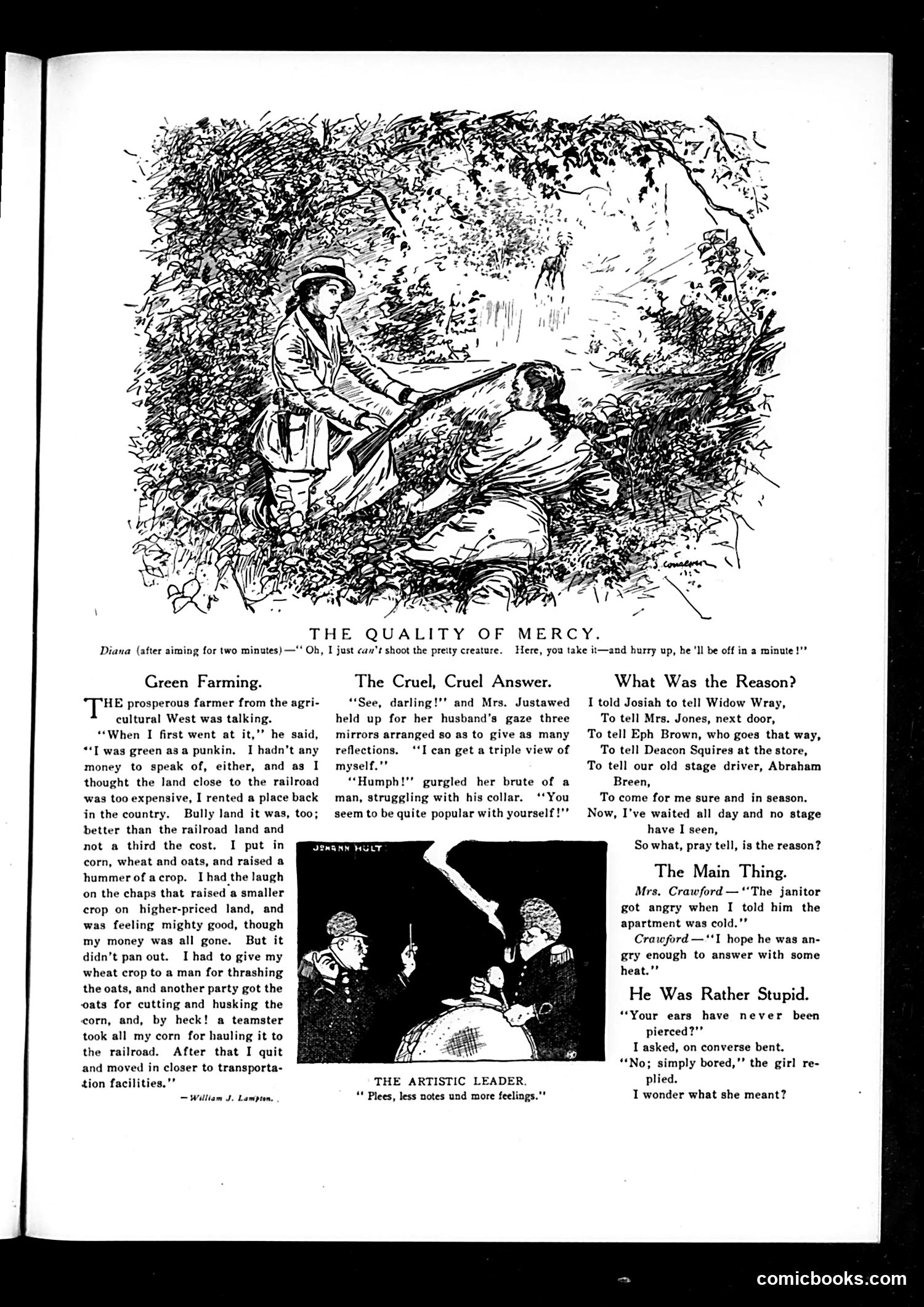
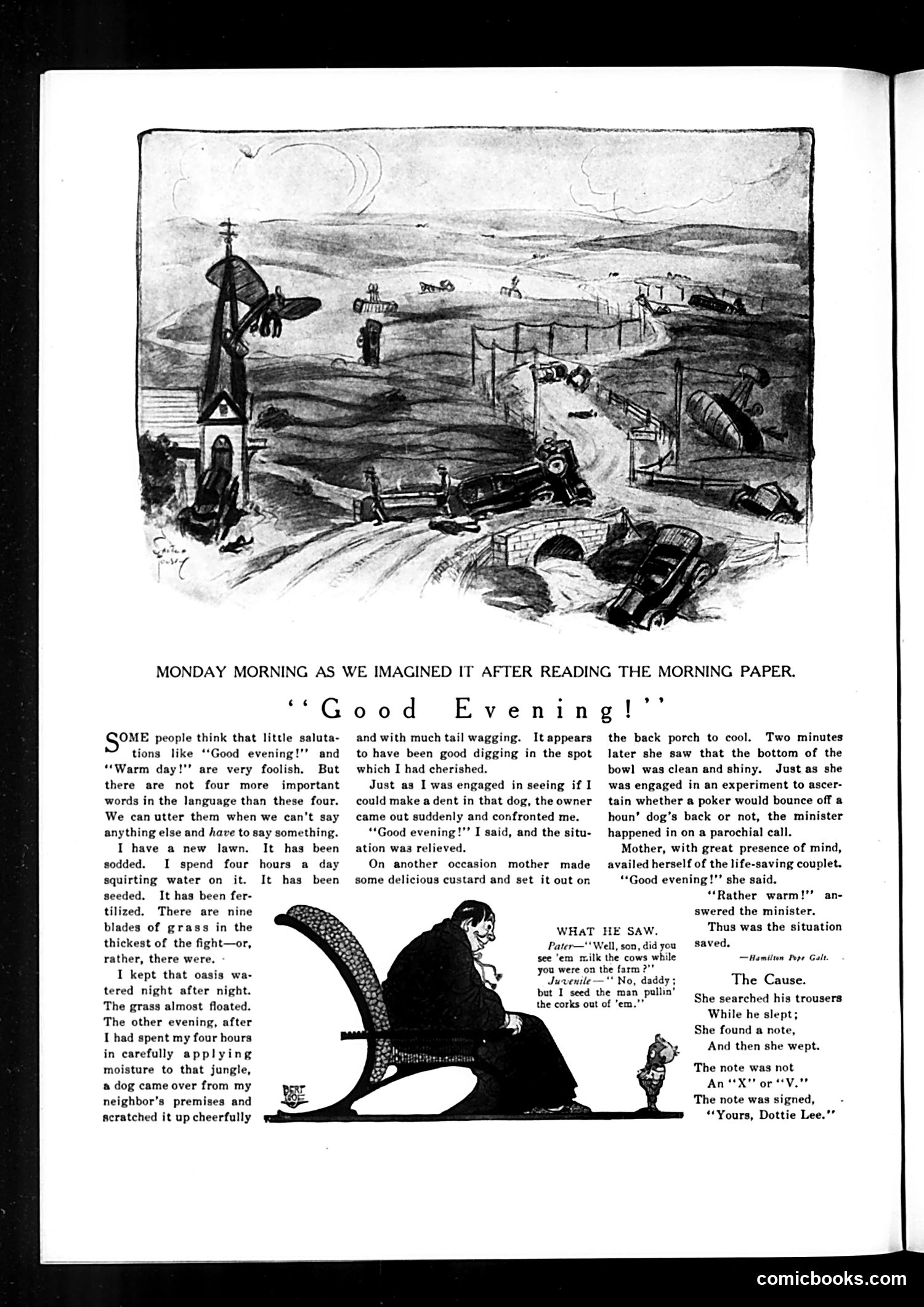
This page satirizes the power of polite social conventions to defuse awkward situations. The main article describes two domestic disasters—a neighbor's dog destroying the narrator's prized lawn, and another dog eating a custard dessert—where potential confrontations are smoothly resolved by simply exchanging pleasantries like "Good evening!" and "Rather warm!" The satire's point: trivial courtesies are society's lubricant. The phrases themselves are meaningless, yet they're so socially powerful that they prevent conflict and allow people to save face in embarrassing moments. By treating these minor salutations as lifesavers, Judge mocks both their actual importance and society's reliance on them to paper over real problems. The top illustration depicts the chaos described—wrecked vehicles and destruction—as "imagined" chaos from reading sensational newspaper headlines, contrasting fantasy with mundane reality. The smaller poem at bottom appears unrelated: a domestic drama involving infidelity, resolving the page's satirical tone.
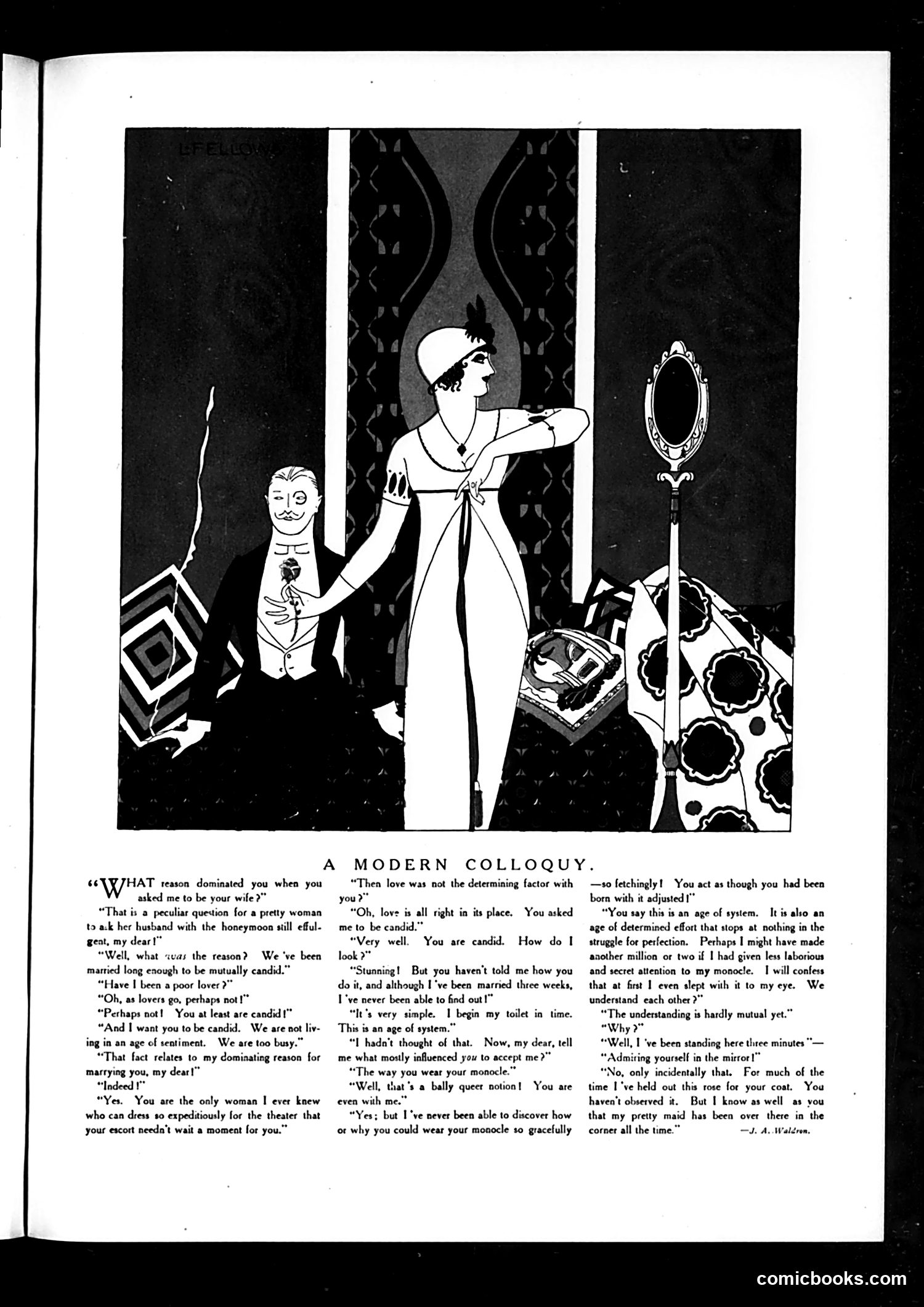
This illustrated dialogue satirizes early 20th-century upper-class courtship and marriage. A fashionably dressed couple exchanges witty banter about why they married each other. The satire targets the era's obsession with superficial elegance and efficiency over genuine sentiment. The husband married his wife because she dresses quickly for theater outings—not for love. The wife married him for his skill wearing a monocle. Both explicitly reject "sentiment" as outdated, claiming they live in "an age of system" and practicality. The final joke undermines their shallow priorities: while the wife holds a rose for his coat and admires herself in a mirror, her maid waits unnoticed in the corner—suggesting the couple's vanity and inattention blind them to those around them. The cartoon mocks modern marriage as reduced to trivial concerns and performative sophistication, lacking genuine connection or awareness.
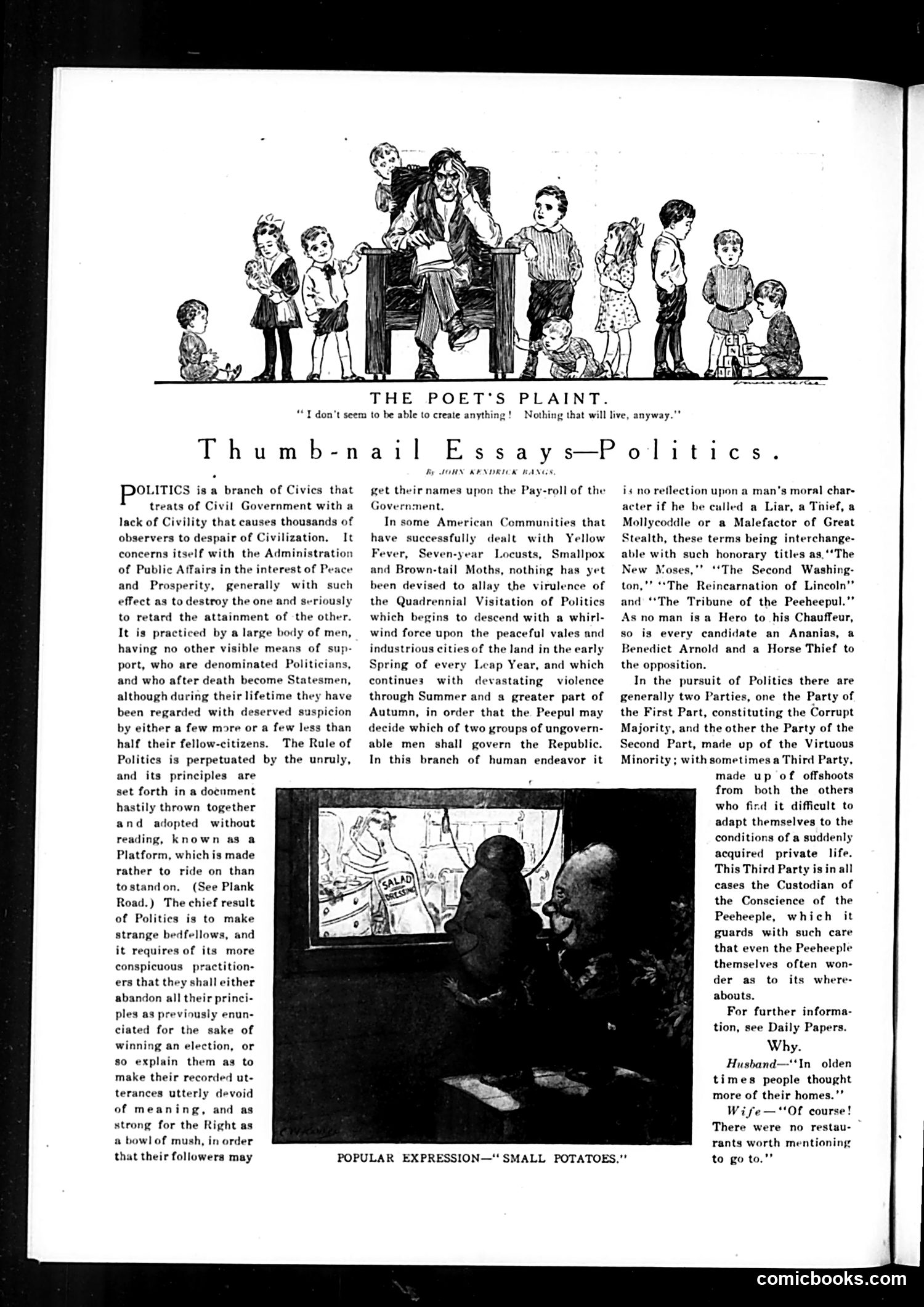
This is a satirical essay by John Kendrick Bangs titled "Thumb-nail Essays—Politics," accompanied by two cartoons. **The main illustration** ("The Poet's Plaint") shows a disheveled, exhausted figure—likely representing a writer or artist—surrounded by demanding children. The caption suggests creative depletion: "I don't seem to be able to create anything! Nothing that will live, anyway." **The essay itself** is a biting definition of American politics as fundamentally corrupt and hypocritical. Bangs argues that politicians routinely abandon or obfuscate their principles to win elections, that moral character is irrelevant to political success, and that the system produces "strange bedfellows." He mocks the quadrennial (every four years) election cycle as a plague and satirizes how politicians are praised with grandiose titles ("The Second Washington," "Tribune of the People") regardless of actual character. **The inset cartoon** ("Small Potatoes") appears to show people viewing a political map or election results—visual commentary on electoral insignificance. The satire targets political hypocrisy, corruption, and the performative nature of campaigns—themes surprisingly timeless for what appears to be early-20th-century commentary.
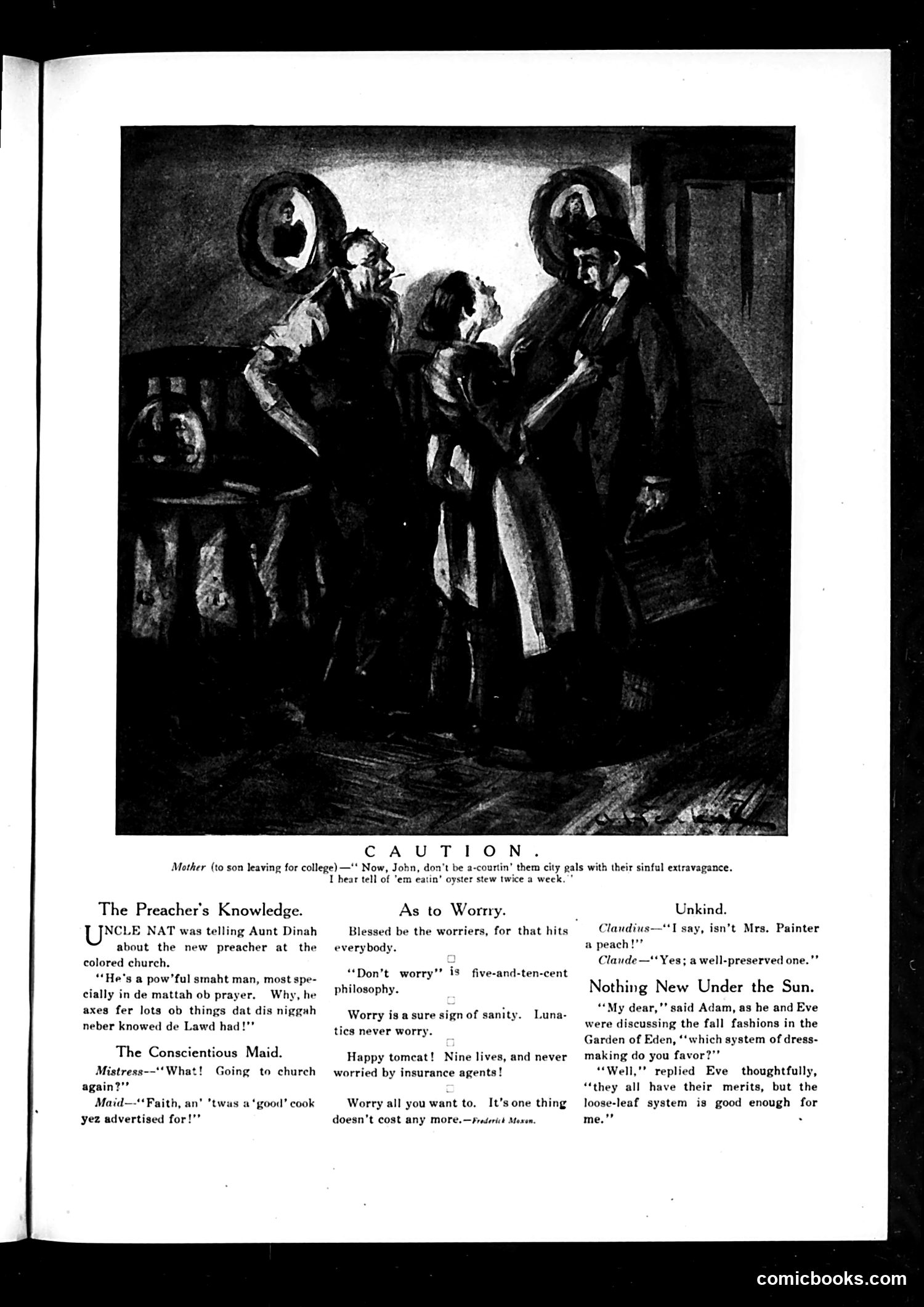
This page contains several brief satirical pieces typical of the era: **"CAUTION"** (top image): A Victorian-era cartoon warning young men leaving for college about city women's extravagance and "sinful" behavior—reflecting period anxieties about urban moral corruption. **"The Preacher's Knowledge"**: A dialect-heavy joke mocking an African American preacher's theological ignorance, using the racist vernacular common to the era. **"The Conscientious Maid"**: A brief Irish-servant stereotype joke about employment turnover. **"As to Worry"** and other text pieces: General philosophical observations on worry and fashion, unremarkable by modern standards. **"Nothing New Under the Sun"**: A pun about Adam and Eve discussing fashion systems—the "loose-leaf" reference is a contemporary joke about the then-novel loose-leaf binder system. The page reflects Judge's typical mix: social commentary targeting perceived character flaws alongside racial and ethnic stereotypes normalized for early 20th-century audiences. The offensive language and caricatures reflect the publication's period prejudices.
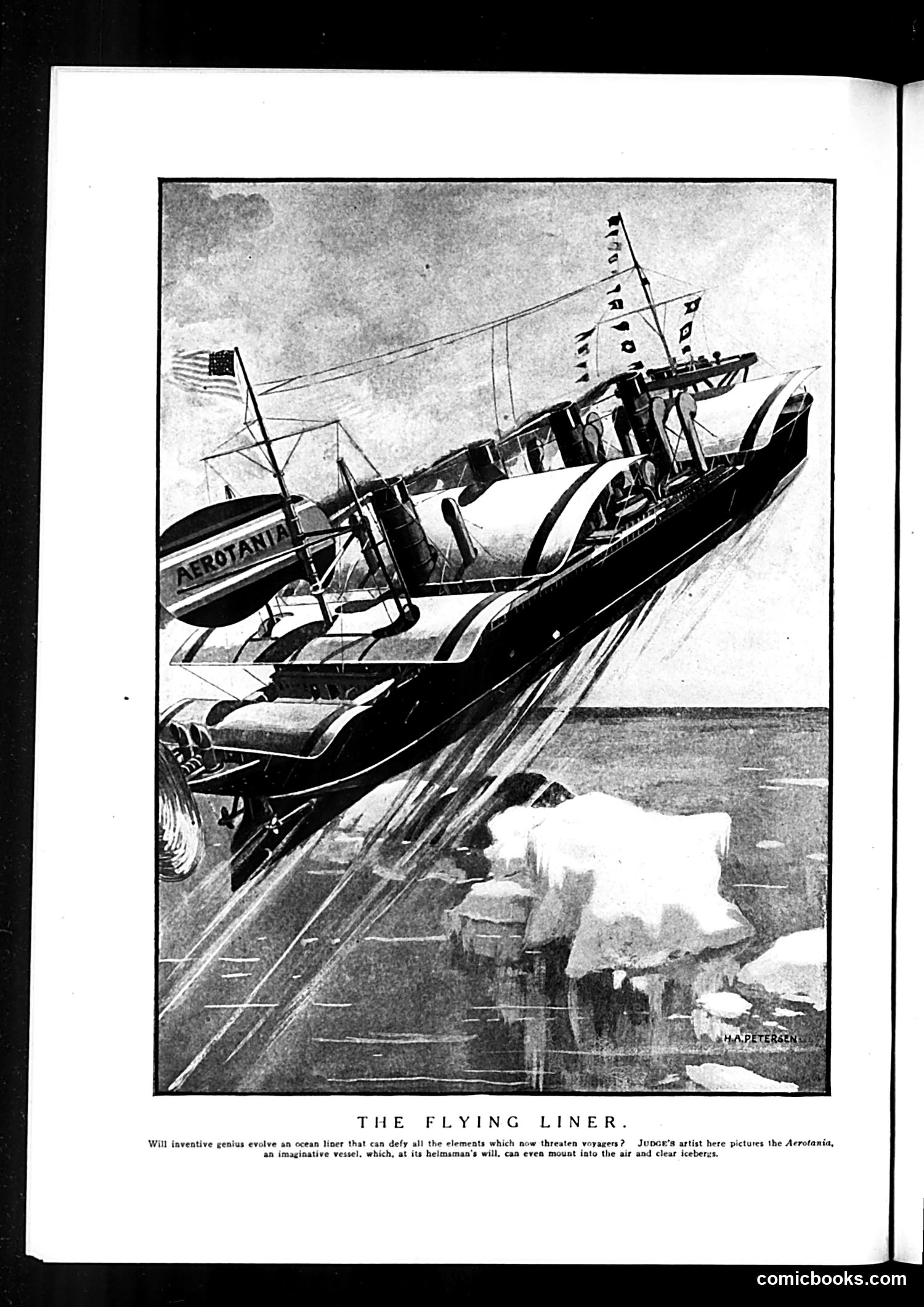
This is speculative satire about technological progress in ocean travel. The cartoon depicts an imaginary ship called the "Acrotania" equipped with wings and propellers, imagining a vessel that could literally fly to escape maritime hazards—particularly icebergs, a major concern following the Titanic disaster (1912). The satire mocks both the era's unbridled faith in technological solutions and the desperate desire to make ocean travel "unsinkable." Rather than improving safety through better design or navigation, the cartoon absurdly suggests humanity might simply fly over dangers entirely. The image shows the vessel mounted on what appears to be a launch ramp or catapult system, emphasizing the fantastical nature of the proposal. Judge's humor lies in taking this impossible idea seriously as commentary on contemporary anxieties about sea travel safety.
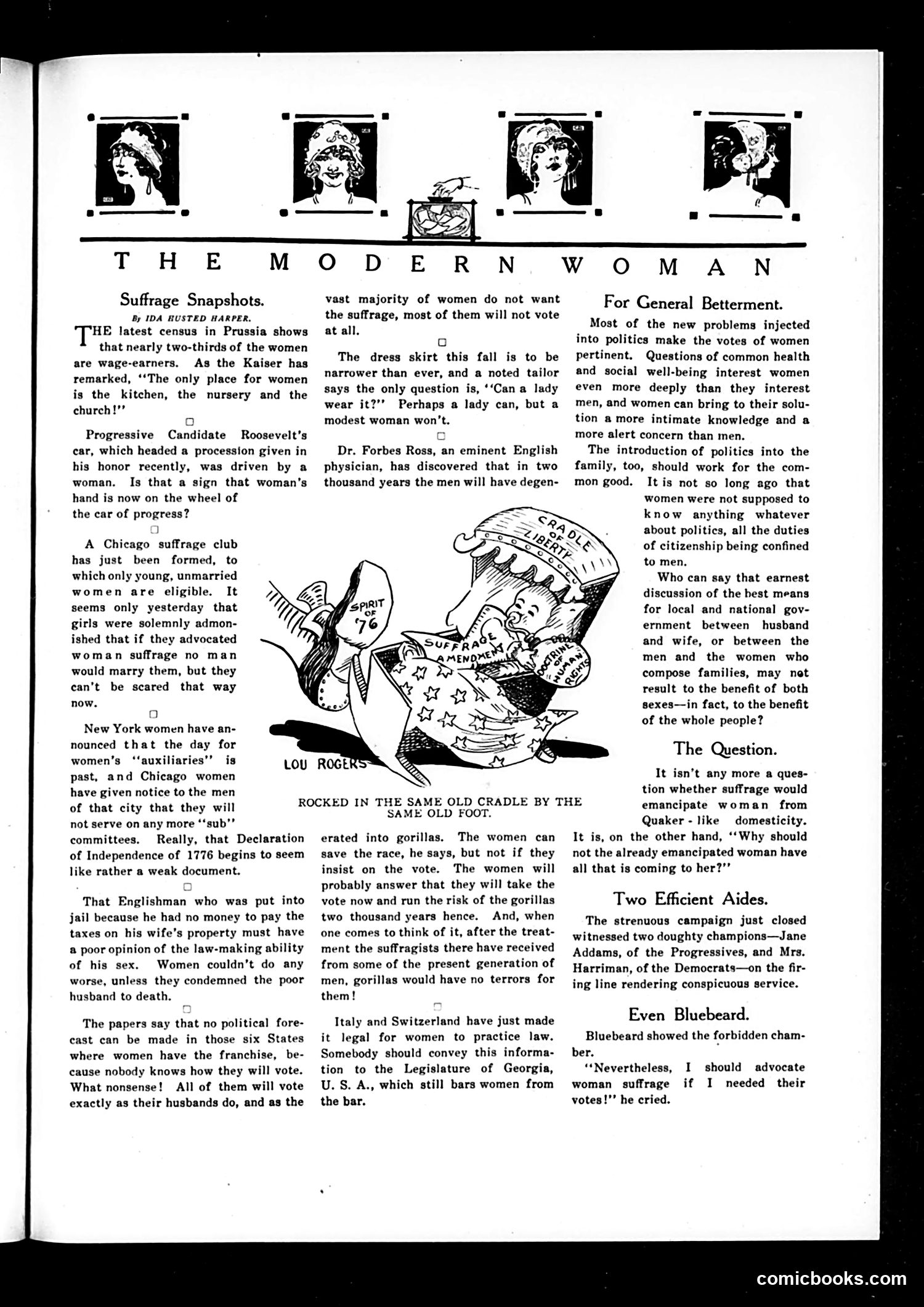
This *Judge* magazine page satirizes the women's suffrage debate through columnist Ida Husted Harper's commentary and a central cartoon. **The Cartoon:** "Rocked in the Same Old Cradle by the Same Old Foot" depicts Lou Rogers (likely the cartoonist herself) as an infant in a cradle labeled with suffrage-related terms, rocked by a foot—suggesting women's rights movements remain trapped in repetitive, infantilized patterns despite progress. **The Satire's Targets:** Harper mocks anti-suffrage arguments through exaggeration. She presents absurd claims (men will become gorillas; women will vote identically to husbands) to expose their illogic. She notes progress ironically: a woman driving Roosevelt's car, unmarried women forming suffrage clubs despite warnings no man would marry them, and women demanding equal committee participation. **The Point:** The column argues women already work, think politically, and deserve citizenship rights. Anti-suffrage rhetoric appears outdated compared to women's demonstrated competence and the practical value women voters would bring to public health and family-centered policy issues.
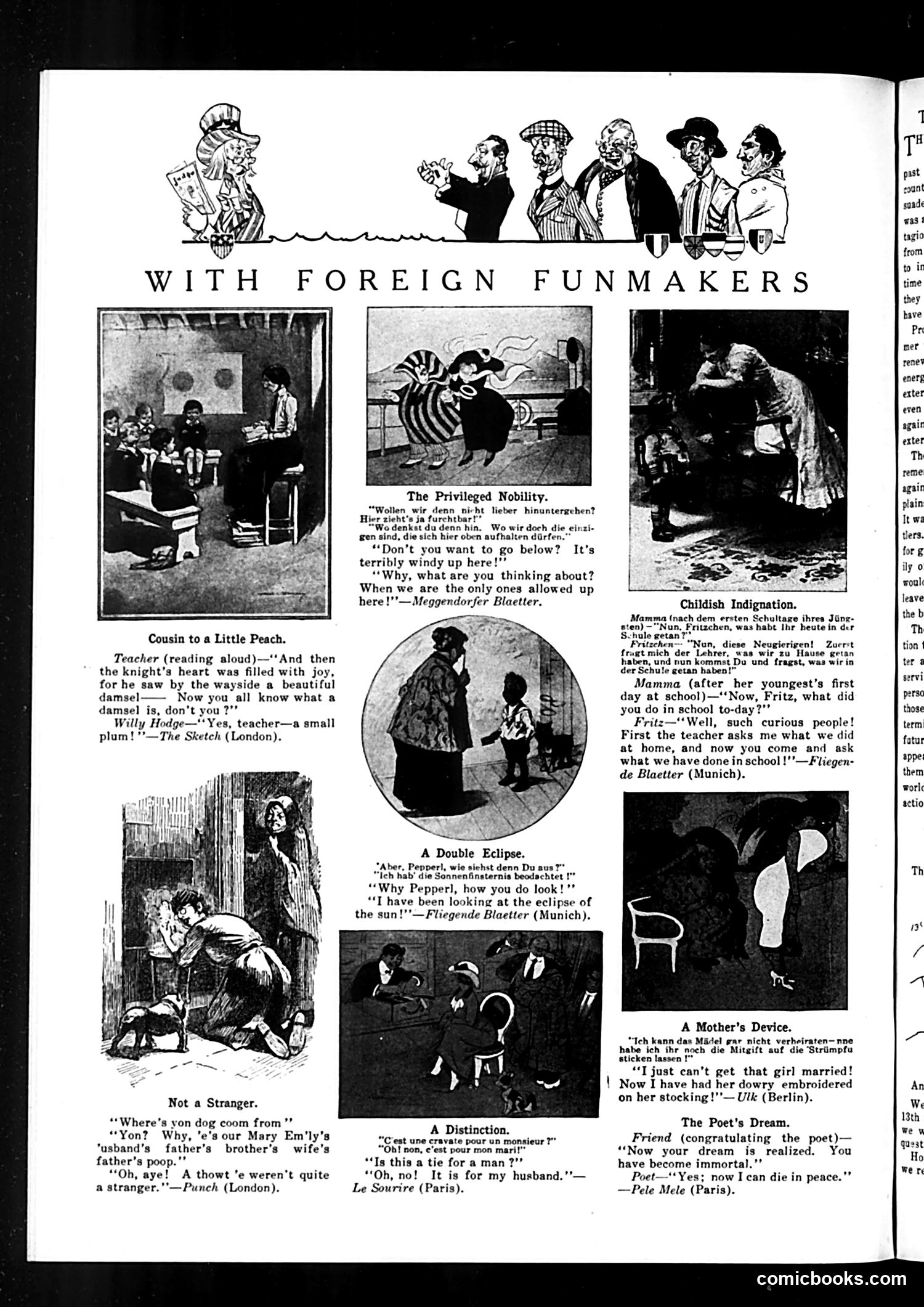
This page collects brief humorous anecdotes translated from European satirical publications (The Sketch, Punch, Meggendorfer Blaetter, Fliegende Blaetter, Le Sourire, and Ulk). Each cartoon illustrates a joke relying on linguistic or cultural misunderstanding: **The jokes exploit:** - Dialect confusion ("damsel" misheard as "small plum") - Social pretension (claiming exclusive access to a windy rooftop) - Physical mishap (sunburned face from eclipse-watching) - Class distinction (a tie for a "husband" vs. a "man") - Childish literalism (resenting repeated questioning) - Dowry embroidery as marriage obstacle - Poetic immortality as death wish The page's framing—showing caricatured "foreign funmakers" at top—suggests Judge is presenting European humor as exotic entertainment for American readers. These gentle, domestic scenarios emphasize universal human foibles: vanity, confusion, and the gap between expectation and reality.
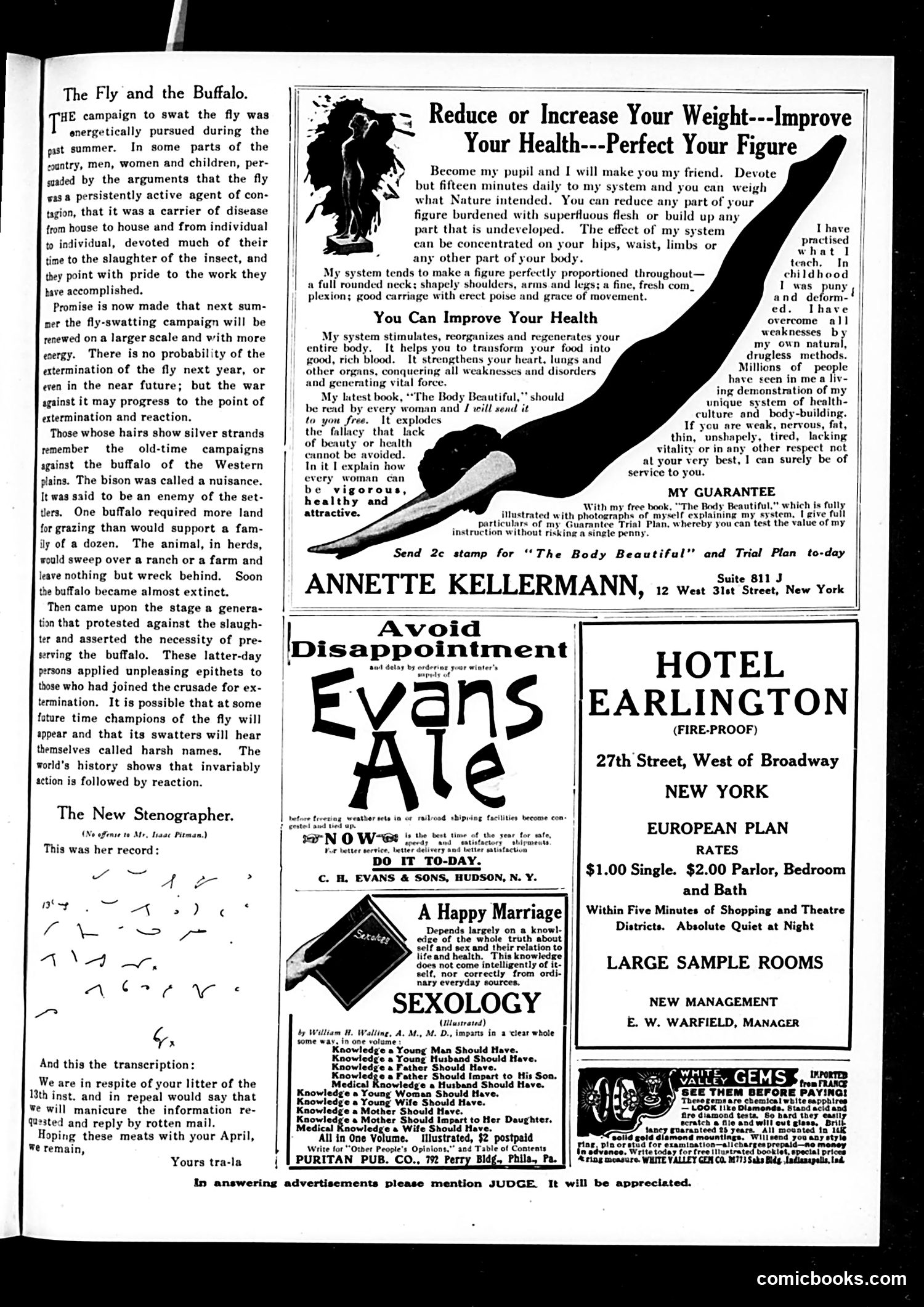
This is primarily an **advertising page** from Judge magazine, not a political cartoon. The main content consists of commercial advertisements for various products and services popular in the early 20th century. Notable ads include: - **Annette Kellermann's** weight-loss/fitness system, featuring her silhouette - **Evans Ale** beer - **Hotel Earlington** in New York - **Sexology** book (relationship/health knowledge guide) - **White Gems** jewelry The page opens with two brief editorial pieces: "The Fly and the Buffalo" (discussing a public health campaign against flies) and "The New Stenographer" (a humorous account of a secretary's poor transcription skills). These aren't satirical political cartoons but rather light humor pieces typical of Judge's content—the magazine balanced social commentary with entertainment and advertising revenue.
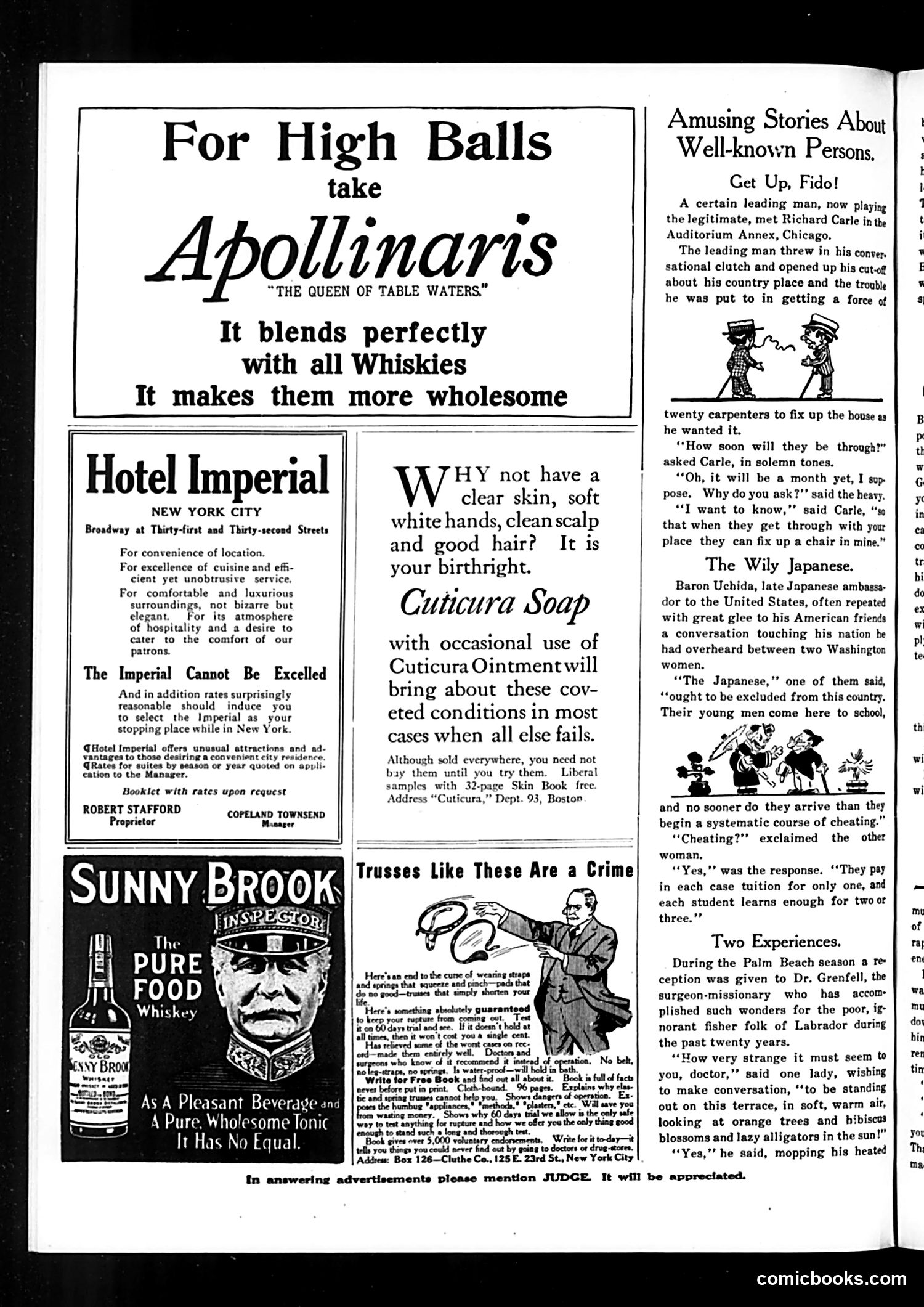
This page is primarily **advertisements** interspersed with humor columns, typical of Judge magazine's format. **Key content:** The **"Trusses Like These Are a Crime"** illustration (center-right) is the main satirical cartoon. It depicts a man hawking a medical truss (a support device for hernias/rupture) with exaggerated medical claims—a common fraudulent medical device of the era. Judge satirizes quack medicine and false advertising that exploited desperate patients. The lengthy ad copy's promises of "guaranteed" cures and "60-day trials" parody the manipulative marketing language endemic to early 1900s medical fraud. **Humor columns** recount anecdotes mocking: - A verbose actor bragging about his country estate - Japanese diplomats, playing on contemporary American stereotypes and xenophobia regarding Japanese immigration and education The ads for Apollinaris water, Cuticura soap, and Hotel Imperial represent typical period advertising—promoting "wholesome" products and luxury accommodations to middle-class readers. This reflects early-1900s concerns: health-care fraud, immigration anxiety, and consumer culture marketing.
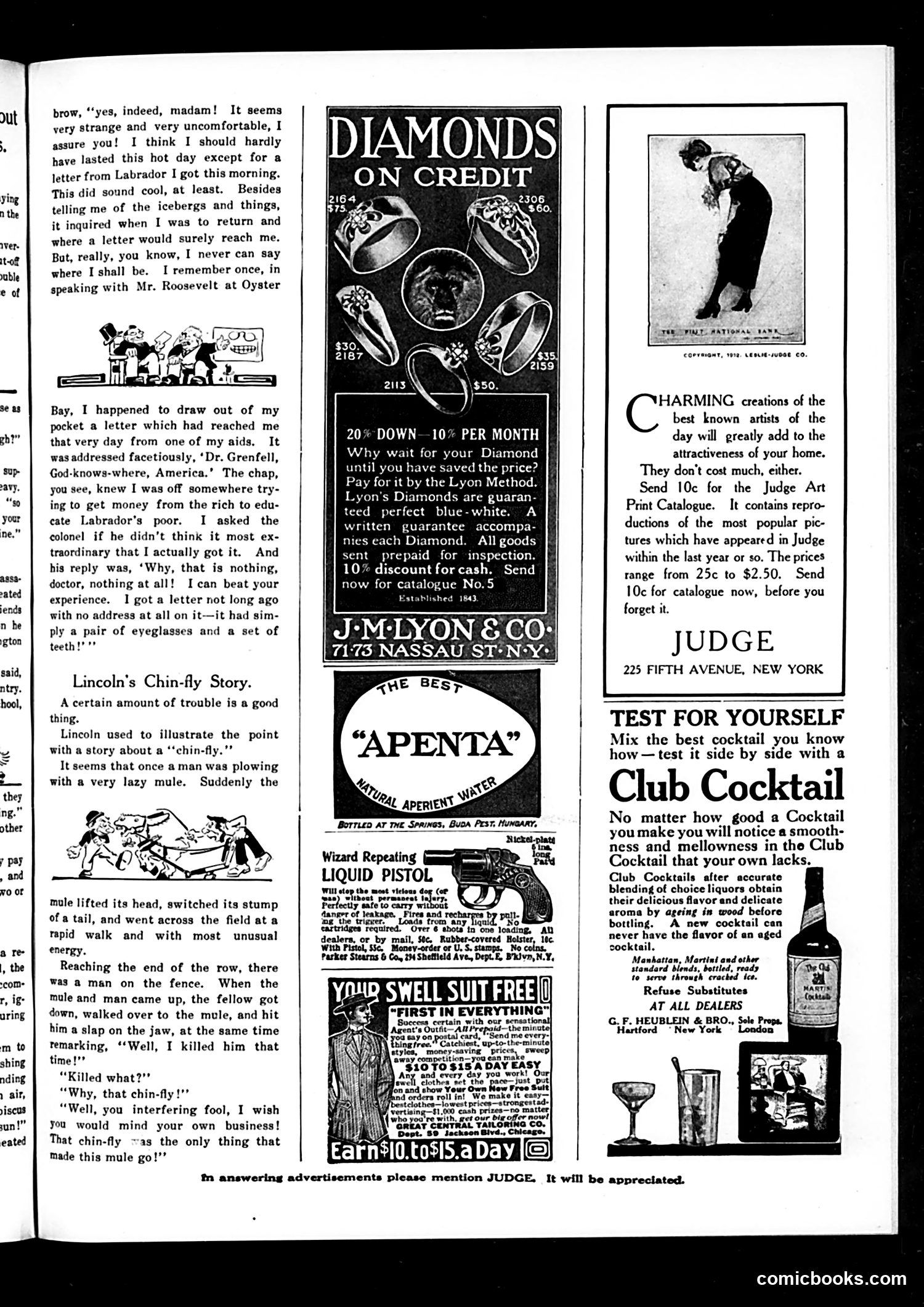
This page contains two distinct humorous stories: **"Lincoln's Chin-fly Story"** presents a tall tale attributed to Abraham Lincoln illustrating that adversity drives productivity. A lazy mule works energetically only when bothered by a chin-fly; when a farmer kills the fly to "help," the mule stops working entirely. The moral: problems, however annoying, serve a purpose. The upper text appears to be a dialogue about receiving mail in remote locations, referencing Theodore Roosevelt and a charitable figure (likely Dr. Grenfell, who worked in Labrador). The joke climaxes with Roosevelt claiming he received a letter addressed only with eyeglasses and teeth—suggesting such absurdist mail delivery is unremarkable compared to other unlikely occurrences. The page is primarily **advertisements** for diamonds, cocktails, liquid pistol toys, and tailoring services—typical Judge magazine revenue. The small cartoons accompanying the stories are generic comedic illustrations rather than pointed political satire. This appears a lighter entertainment-focused issue rather than one emphasizing political commentary.
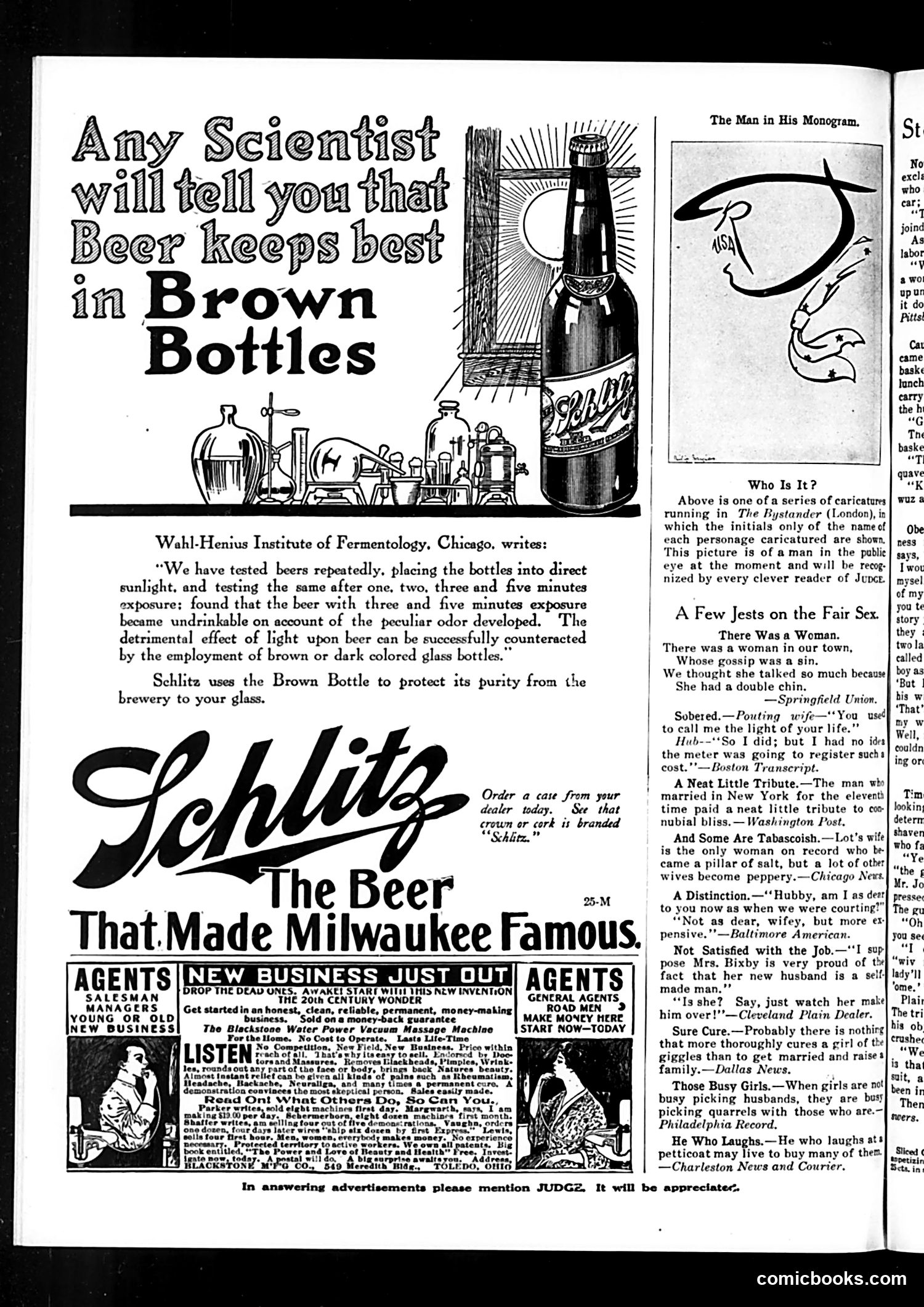
This page is primarily **advertising**, not political satire. The dominant content is a Schlitz beer advertisement claiming brown bottles preserve beer quality better than clear glass—supported by a fake scientific authority (the "Wahl-Henius Institute of Fermentology"). The ad uses pseudo-scientific language to market a practical advantage: brown glass blocks light that degrades beer. The smaller right-hand column contains **lighthearted humor** typical of Judge magazine: short jokes mocking wives, marriage, and gender relations. These are crude by modern standards but represent the era's casual domestic satire. Topics include a gossipy woman, a husband's buyer's remorse about marriage, and women's supposedly irrational behavior. At top right is a caricature puzzle ("The Man in His Monogram") from a London publication, where readers guess the public figure from initials—entertainment for the period's educated readers. The page reflects early 20th-century advertising techniques and social attitudes rather than substantive political content.
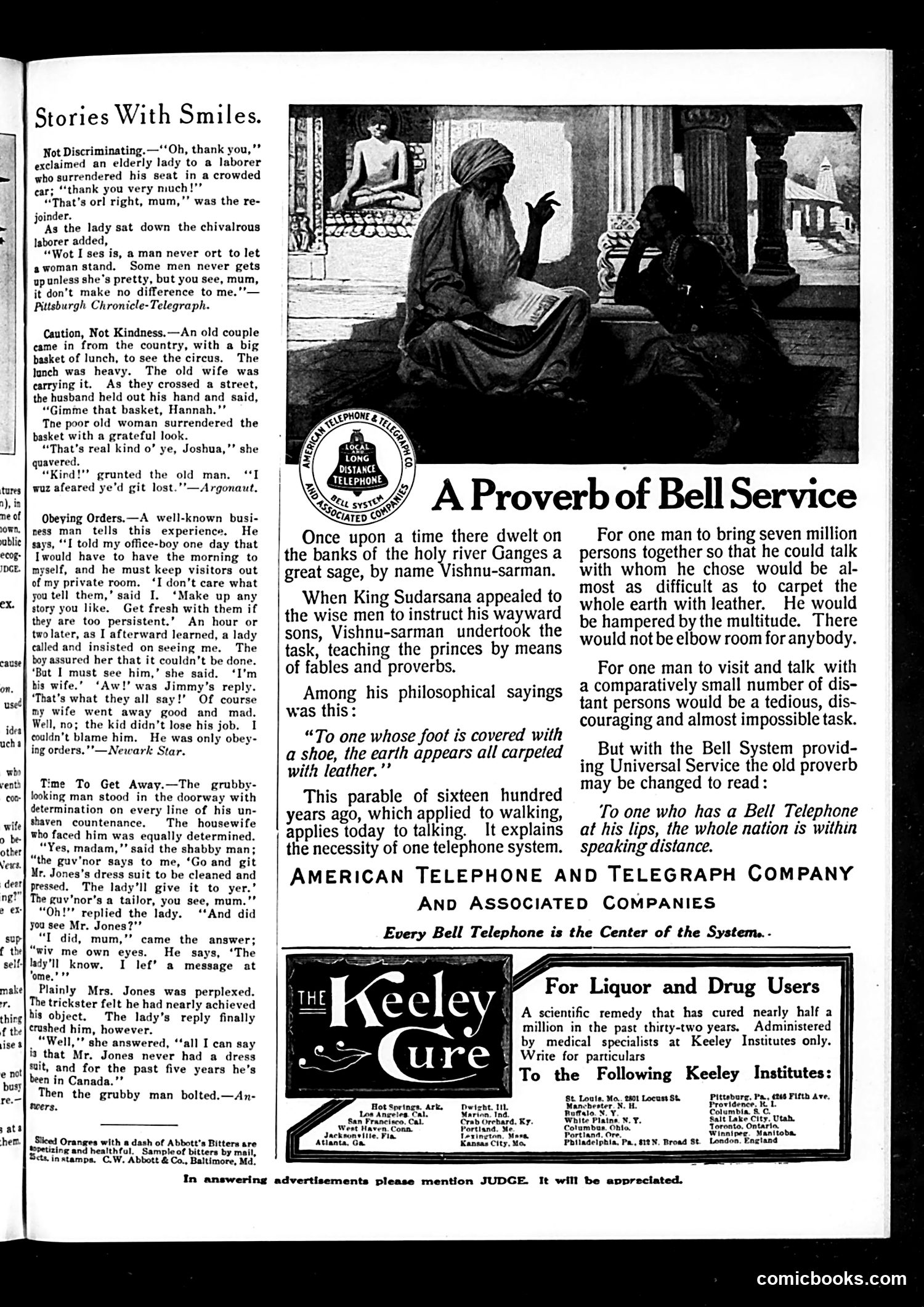
This page contains primarily humorous short stories ("Stories With Smiles") and two major advertisements—not political cartoons. The stories are lighthearted anecdotes about working-class and domestic life, featuring dialect humor typical of early 20th-century magazines. They rely on misunderstandings and unexpected twists: a laborer's non-discriminatory kindness, an elderly husband's self-interested concern masquerading as chivalry, an office boy following orders too literally, and a con man's scheme unraveling. The main illustrated feature is a Bell Telephone advertisement titled "A Proverb of Bell Service," which uses an ancient Indian parable about a sage named Vishnu-sarman to suggest that just as the proverb "To one whose foot is covered with a shoe, the earth appears carpeted" once applied, now the Bell System makes universal communication similarly universal. Two advertisements appear below: one for "The Keeley Cure" (a treatment for alcohol and drug addiction) and one for Abbott's Bitters (a medicinal product). The page functions primarily as advertising and light entertainment rather than satire.
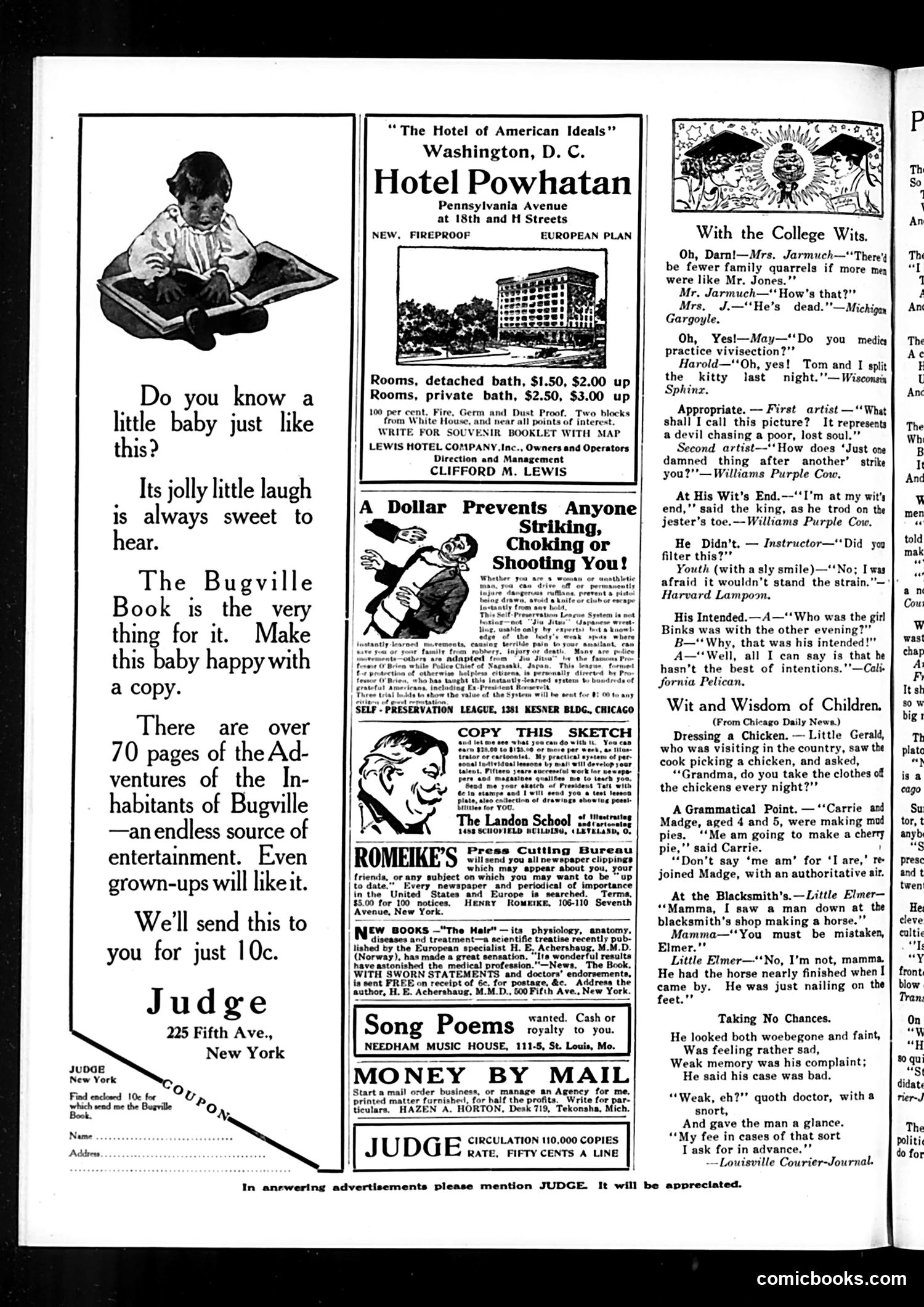
This page is primarily **advertising and humor columns** rather than political satire. The left side promotes **Judge's own publications**: a children's book called "Bugville Book" featuring insect adventures. The center features hotel and business advertisements typical of early 1900s magazines. The right side contains **"With the College Wits"** and **"Wit and Wisdom of Children"** — light comedic columns. These are **domestic humor** rather than political satire: jokes about marriages ("fewer quarrels if more men were like Mr. Jones—he's dead"), college pranks, and children's innocent misunderstandings of adult concepts (a child assuming chickens remove their "clothes" nightly like humans). One advertisement promotes a **"Self-Preservation League"** device preventing "Choking or Shooting," suggesting early 1900s anxieties about violence, though the specifics remain unclear from this image alone. The content reflects **period attitudes** toward courtship, family life, and childhood innocence rather than explicit political commentary.
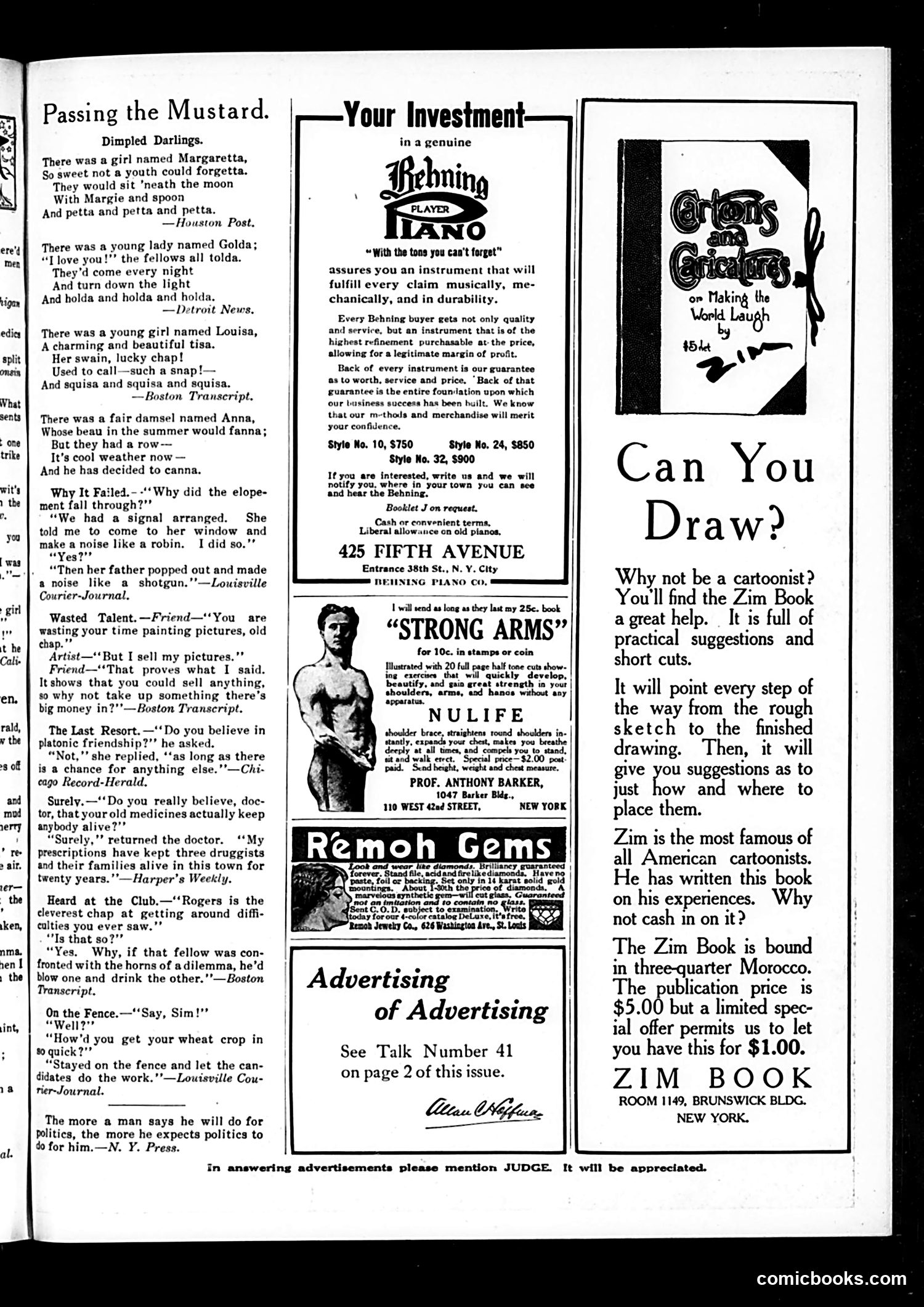
This page is primarily **humorous verse and light advertising**, not political satire. The left column features comic poems about romantic "dimpled darlings" — young women with suggestive names (Margaretta, Golda, Louisa, Anna) whose courtship activities are described through rhyming wordplay: "petta and petta," "holda and holda," "squisa and squisa." The jokes trade on innocent-sounding repetition with implied physical intimacy. Below are brief anecdotes: a failed elopement, wasted artistic talent, platonic friendship skepticism, and a doctor whose prescriptions enrich local druggists rather than cure patients — typical light humor of the era. The right side contains advertisements: a Behning piano ($750-$900), a "Strong Arms" bodybuilding manual, the Nulife shoulder brace, Remoh Gems jewelry, and the Zim Book for aspiring cartoonists ($1.00). The page reflects early 20th-century American magazine content: flirtation humor, self-improvement products, and gentle mockery of doctors and professionals.
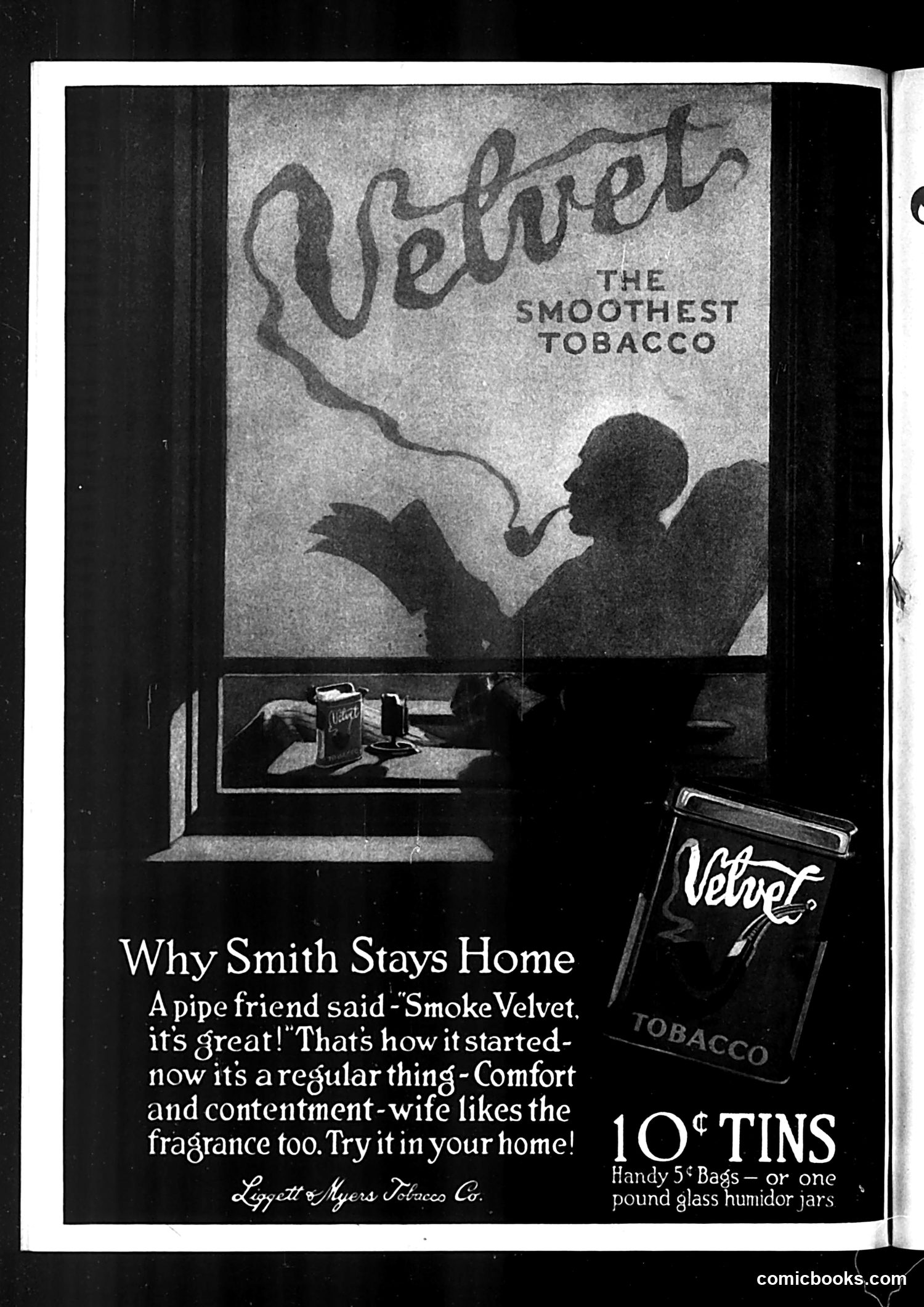
This is a **tobacco advertisement**, not political satire. The page shows a stylized silhouette of a man smoking a pipe against a projected image reading "Velvet—The Smoothest Tobacco." The ad's narrative, titled "Why Smith Stays Home," presents a domestic appeal: a man named Smith began smoking Velvet pipe tobacco on a friend's recommendation and now stays home regularly because the tobacco provides "comfort and contentment"—and notably, his wife approves of the fragrance. This reflects early 20th-century advertising strategy: marketing tobacco as enhancing domestic life rather than encouraging vice. The tagline—that even wives appreciate it—was meant to normalize pipe smoking as a respectable home activity. The product was sold by **Liggett & Myers Tobacco Co.** at 10-cent tins or in bulk glass humidor jars.