
Judge, 1912-11-02 · page 15 of 24
Judge — November 2, 1912 — page 15: what you’re looking at
What you’re looking at
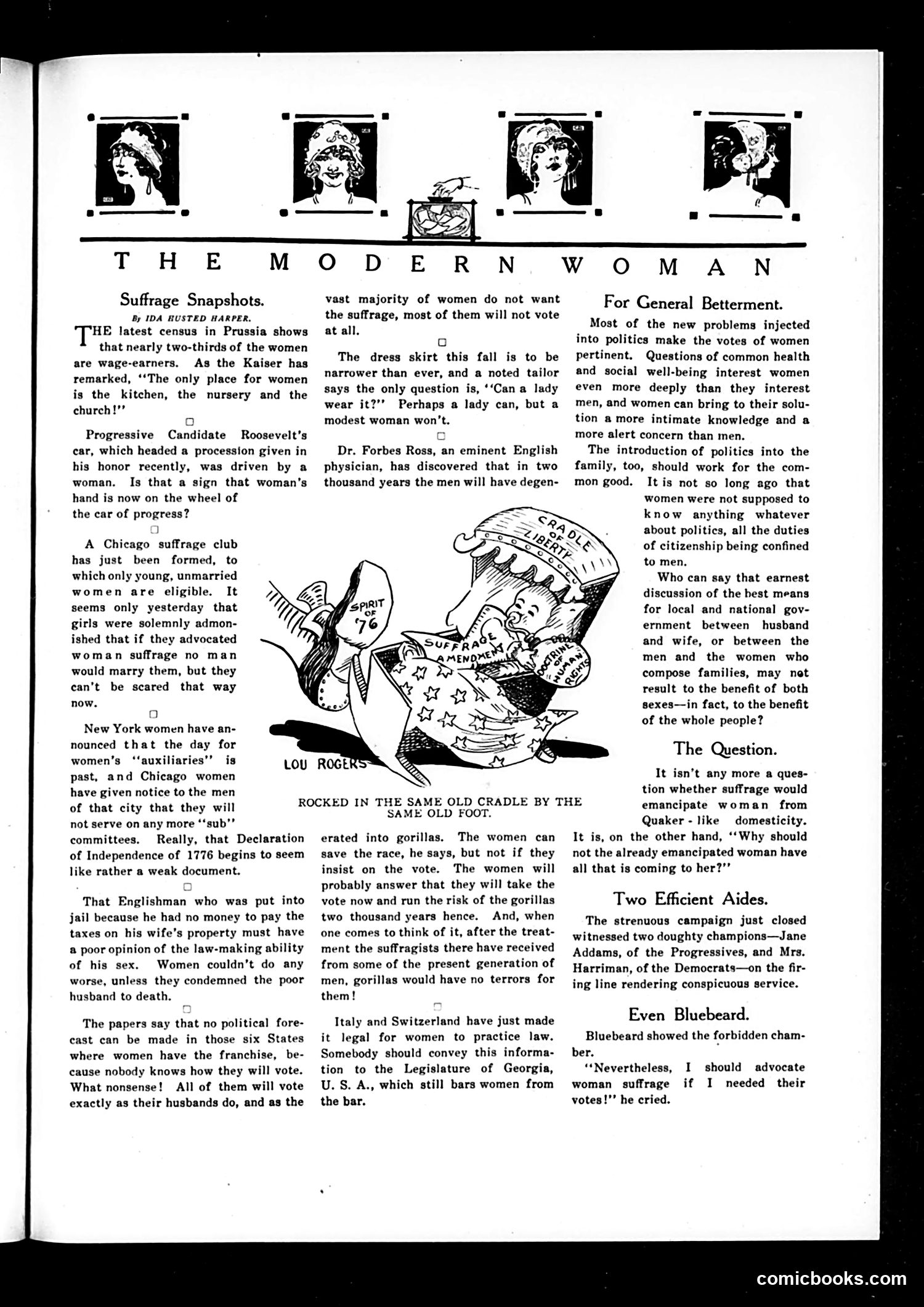
This *Judge* magazine page satirizes the women's suffrage debate through columnist Ida Husted Harper's commentary and a central cartoon. **The Cartoon:** "Rocked in the Same Old Cradle by the Same Old Foot" depicts Lou Rogers (likely the cartoonist herself) as an infant in a cradle labeled with suffrage-related terms, rocked by a foot—suggesting women's rights movements remain trapped in repetitive, infantilized patterns despite progress. **The Satire's Targets:** Harper mocks anti-suffrage arguments through exaggeration. She presents absurd claims (men will become gorillas; women will vote identically to husbands) to expose their illogic. She notes progress ironically: a woman driving Roosevelt's car, unmarried women forming suffrage clubs despite warnings no man would marry them, and women demanding equal committee participation. **The Point:** The column argues women already work, think politically, and deserve citizenship rights. Anti-suffrage rhetoric appears outdated compared to women's demonstrated competence and the practical value women voters would bring to public health and family-centered policy issues.
📄 Transcribed text from this page (OCR, searchable)
Machine-transcribed from the original scan — historical spelling and the odd misread are preserved.
T H E Suffrage Snapshots. By IDA HUSTED HARPER. HE latest census in Prussia shows that nearly two-thirds of the women are wage-earners. As the Kaiser has remarked, ‘‘The only place for women is the kitchen, the nursery and the church!’’ 4 Progressive Candidate Roosevelt's car, which headed a procession given in his honor recently, was driven by a woman. Is that a sign that woman's hand is now on the wheel of the car of progress? A Chicago suffrage club has just been formed, to which only young, unmarried women are eligible. It seems only yesterday that girls were solemnly admon- ished that if they advocated woman suffrage no man would marry them, but they can’t be scared that way now. Qo New York women have an- nounced that the day for women’s ‘‘auxiliaries’’ is past, and Chicago women have given notice to the men of that city that they will not serve on any more ‘‘sub’’ committees. Really, that Declaration of Independence of 1776 begins to seem like rather a weak document. That Englishman who was put into jail because he had no money to pay the taxes on his wife’s property must have a poor opinion of the law-making ability of his sex. Women couldn’t do any worse, unless they condemned the poor husband to death. The papers say that no political fore- cast can be made in those six States where women have the franchise, be- cause nobody knows how they will vote. What nonsense! All of them will vote exactly as their husbands do, and as the MODERN vast majority of women do not want the suffrage, most of them will not vote at all. is] The dress skirt this fall is to be narrower than ever, and a noted tailor says the only question is, ‘‘Can a lady wear it?’’ Perhaps a lady can, but a modest woman won't. Dr. Forbes Ross, an eminent English physician, has discovered that in two thousand years the men will have degen- ROCKED IN THE SAME OLD CRADLE BY THE SAME OLD FOOT. erated into gorillas. The women can save the race, he says, but not if they insist on the vote. The women will probably answer that they will take the vote now and run the risk of the gorillas two thousand years hence. And, when one comes to think of it, after the treat- ment the suffragists there have received from some of the present generation of men, gorillas would have no terrors for them! Italy and Switzerland have just made it legal for women to practice law. Somebody should convey this informa- tion to the Legislature of Georgia, U. S. A., which still bars women from the bar. Ww OM AN For General Betterment. Most of the new problems injected into politics make the votes of women pertinent. Questions of common health and social well-being interest women even more deeply than they interest men, and women can bring to their solu- tion a more intimate knowledge and a more alert concern than men. The introduction of politics into the family, too, should work for the com- mon good. Itis not so long ago that women were not supposed to know anything whatever about politics, all the duties of citizenship being confined to men. Who can say that earnest discussion of the hest means for local and national gov- ernment between husband and wife, or between the men and the women who compose families, may net result to the benefit of both sexes—in fact, to the benefit of the whole people? The Question. It isn’t any more a ques- tion whether suffrage would emancipate woman from Quaker - like domesticity. It is, on the other hand, ‘‘Why should not the already emancipated woman have all that is coming to her?’”’ Two Efficient Aides. The strenuous campaign just closed witnessed two doughty champions—Jane Addams, of the Progressives, and Mrs. Harriman, of the Democrats—on the fir- ing line rendering conspicuous service. Even Bluebeard. Bluebeard showed the forbidden cham- ber. . vertheless, I should advocate woman suffrage if I needed their votes!’’ he cried. comicbooks.com