
Judge, 1912-11-02 · page 4 of 24
Judge — November 2, 1912 — page 4: what you’re looking at
What you’re looking at
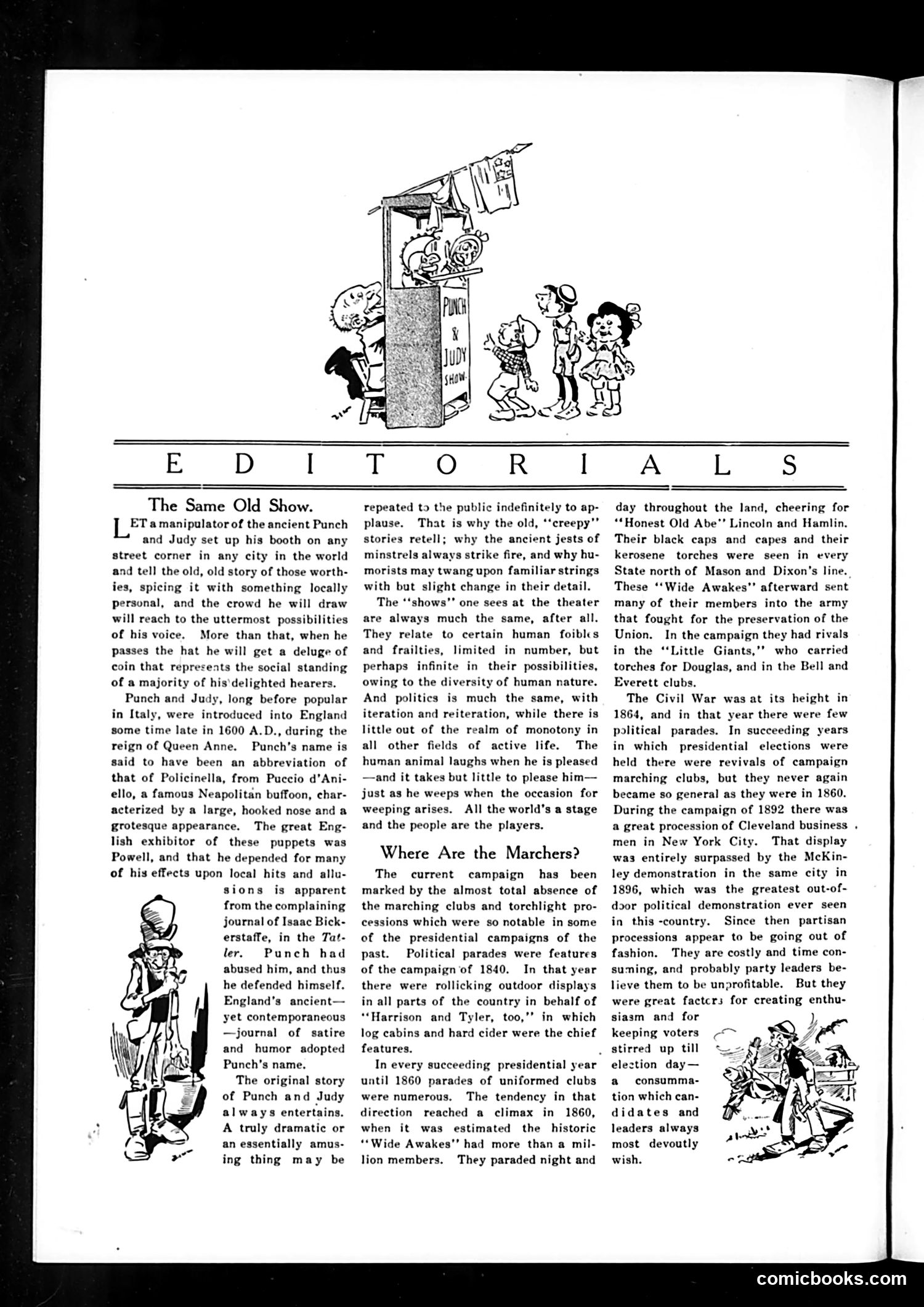
This page discusses **Punch and Judy**, the traditional puppet show entertainment, and draws parallels to American political campaigns. The main text argues that political campaigns, like Punch and Judy shows, are essentially repetitive entertainment—the same basic stories recycled with minor variations to please audiences. The author notes that regardless of era or location, the core elements remain unchanged. The page references the **1892 presidential campaign** and mentions the **"Wide Awakes"** (Civil War-era marching clubs that were revived for political purposes). It criticizes the apparent decline of theatrical political parades and marching demonstrations compared to earlier campaigns, suggesting such spectacles were becoming less popular. The cartoons illustrate Punch and Judy performers and marching club members, visualizing the comparison between puppet theater and political theater.
📄 Transcribed text from this page (OCR, searchable)
Machine-transcribed from the original scan — historical spelling and the odd misread are preserved.
E D L S$ The Same Old Show. LET amanipalator of the ancient Punch and Judy set up his booth on any street corner in any city in the world and tell the old, old story of those worth- ies, spicing it with something locally personal, and the crowd he will draw will reach to the uttermost possibilities of his voice. More than that, when he passes the hat he will get a deluge of coin that represents the social standing of a majority of his'delighted hearers. Punch and Judy, long before popular in Italy, were introduced into England some time late in 1600 A.D., during the reign of Queen Anne. Punch’s name is said to have been an abbreviation of that of Policinella, from Puccio d’Ani- ello, a famous Neapolitan buffoon, char- acterized by a large, hooked nose and a grotesque appearance. The great Eng- lish exhibitor of these puppets was Powell, and that he depended for many of his effects upon local hits and allu- sions is apparent from the complaining journal of Isaac Bick- erstaffe, in the Tat- ler. Punch had abused him, and thus he defended himself. England's ancient— yet contemporaneous —journal of satire and humor adopted Punch’s name. The original story of Punch and Judy always entertains. A truly dramatic or an essentially amus- ing thing may be repeated to the public indefinitely to ap- plause. That is why the old, ‘‘creepy"’ stories retell; why the ancient jests of minstrels always strike fire, and why hu- morists may twang upon familiar strings with but slight change in their detail. The ‘‘shows”’ one sees at the theater are always much the same, after all. They relate to certain human foibks and frailties, limited in number, but perhaps infinite in their possibilities, owing to the diversity of human nature. And politics is much the same, with iteration and reiteration, while there is little out of the realm of monotony in all other fields of active life. The human animal laughs when he is pleased —and it takes but little to please him— just as he weeps when the occasion for weeping arises. All the world’s a stage and the people are the players. Where Are the Marchers? The current campaign has been marked by the almost total absence of the marching clubs and torchlight pro- cessions which were so notable in some of the presidential campaigns of the past. Political parades were features of the campaign of 1840. In that year there were rollicking outdoor displays in all parts of the country in behalf of ‘*Harrison and Tyler, too,’’ in which log cabins and hard cider were the chief features. In every succeeding presidential year until 1860 parades of uniformed clubs were numerous, The tendency in that direction reached a climax in 1860, when it was estimated the historic ‘‘Wide Awakes’’ had more than a mil- lion members. They paraded night and day throughout the land, cheering for “*Honest Old Abe’’ Lincoln and Hamlin. Their black caps and capes and their kerosene torches were seen in every State north of Mason and Dixon’s line. These ‘‘Wide Awakes”’ afterward sent many of their members into the army that fought for the preservation of the Union. In the campaign they had rivals in the ‘‘Little Giants,'’ who carried torches for Douglas, and in the Bell and Everett clubs. The Civil War was at its height in 1864, and in that year there were few political parades. In succeeding years in which presidential elections were held there were revivals of campaign marching clubs, but they never again became so general as they were in 1860. During the campaign of 1892 there was a great procession of Cleveland business men in New York City. That display was entirely surpassed by the McKin- ley demonstration in the same city in 1896, which was the greatest out-of- door political demonstration ever seen in this -country. Since then partisan processions appear to be going out of fashion. They are costly and time con- suming, and probably party leaders be- lieve them to be unprofitable. But they were great factcrs for creating enthu- siasm and for keeping voters . Stirred up till election day— a consumma- tion which can- didates and leaders always most devoutly wish. comicbooks.com