
Judge, 1912-11-02 · page 16 of 24
Judge — November 2, 1912 — page 16: what you’re looking at
What you’re looking at
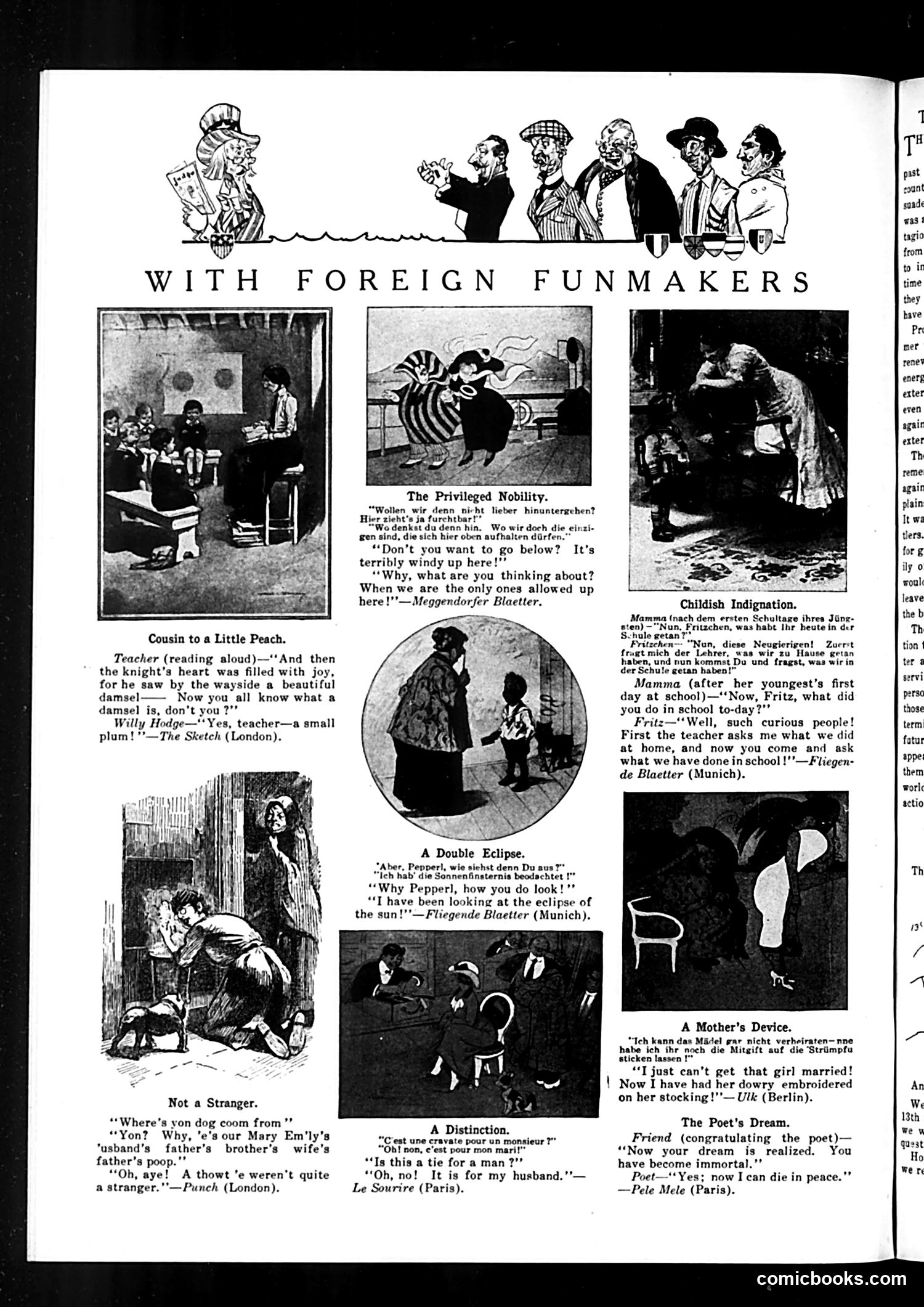
This page collects brief humorous anecdotes translated from European satirical publications (The Sketch, Punch, Meggendorfer Blaetter, Fliegende Blaetter, Le Sourire, and Ulk). Each cartoon illustrates a joke relying on linguistic or cultural misunderstanding: **The jokes exploit:** - Dialect confusion ("damsel" misheard as "small plum") - Social pretension (claiming exclusive access to a windy rooftop) - Physical mishap (sunburned face from eclipse-watching) - Class distinction (a tie for a "husband" vs. a "man") - Childish literalism (resenting repeated questioning) - Dowry embroidery as marriage obstacle - Poetic immortality as death wish The page's framing—showing caricatured "foreign funmakers" at top—suggests Judge is presenting European humor as exotic entertainment for American readers. These gentle, domestic scenarios emphasize universal human foibles: vanity, confusion, and the gap between expectation and reality.
📄 Transcribed text from this page (OCR, searchable)
Machine-transcribed from the original scan — historical spelling and the odd misread are preserved.
Cousin to a Little Peach. Teacher (reading aloud)—‘‘And then the knight’s heart was filled with joy, for he saw by the wayside a beautiful damsel Now you all know what a damsel is, don't you ?”” Willy Hodge 8, teacher—a small plum! '’—The Sketch (London). Not a Stranger. **Where’s yon dog coom from ’* “Yon? Why, 'e’s our Mary Em'ly’s ‘usband’s father’s brother's wife's father’s poop.”’ “Oh, aye! A thowt 'e weren't quite a stranger."’—Punch (London). n wir denn nicht lieber hinuntergehen? Hier zieht’s ja furchtbar!” “Wo denkst du denn hin, Wo wir doch die einzi- gen sind, die sich hier oben aufhalten dirfen.” “Don’t you want to go below? It’s terribly windy up here!’ “Why, what are you thinking about? When we are the only ones allowed up here !"’—Meggendorfer Blaetter. A Double Eclipse. ‘Aber. Pepper!, wie siehst denn Du aus?” “Ieh hab’ die Sonnenfinsternis beodachtet !” “‘Why Pepperl, how you do look!” “T have been looking at the eclipse of the sun!’’—Fliegende Blaetter (Munich). A Distinction. “Crest une cravate pour un monsieur ?” “Ob! non, ‘est pour mon mari!” “Is this a tie for a man?” “Oh, no! It is for my husband.’’— Le Sourire (Paris). LYNN SO RSET Childish Indignation. Mamma (nach dem ersten Schultage ihres Jing- sten)—“Nun, Fritzchen, was habt Ihr heute in der Schule getan?? Fritzchen~ “Nun, diese Neugicrigen! Zucrst fragt mich der Lehrer, was wir zu Hause getan haben, und nun kommst Du und fragst, was wir in der Schule getan haben!” Mamma (after her youngest’s first day at school)—‘‘Now, Fritz, what did you do in school to-day?’’ Fritz—‘‘Well, such curious people! First the teacher asks me what we did at home, and now you come and ask what we have done in school !"’—Fliegen- de Blaetter (Munich). A Mother’s Device. “Ich kann das Midel gar nicht verheiraten—nne habe ich thr noch die Mitgift auf die ‘Strimpfa sticken lassen !” “I just can’t get that girl married! | Now I have had her dowry embroidered on her stocking !’’"— Ulk (Berlin). The Poet's Dream. Friend (congratulating the poet)— “Now your dream is realized. You have become immortal.”’ Poet—‘*Yes; now I can die in peace.”’ —Pele Mele (Paris). comicbooks.com