
A complete issue · 24 pages · 1912
Judge — June 22, 1912
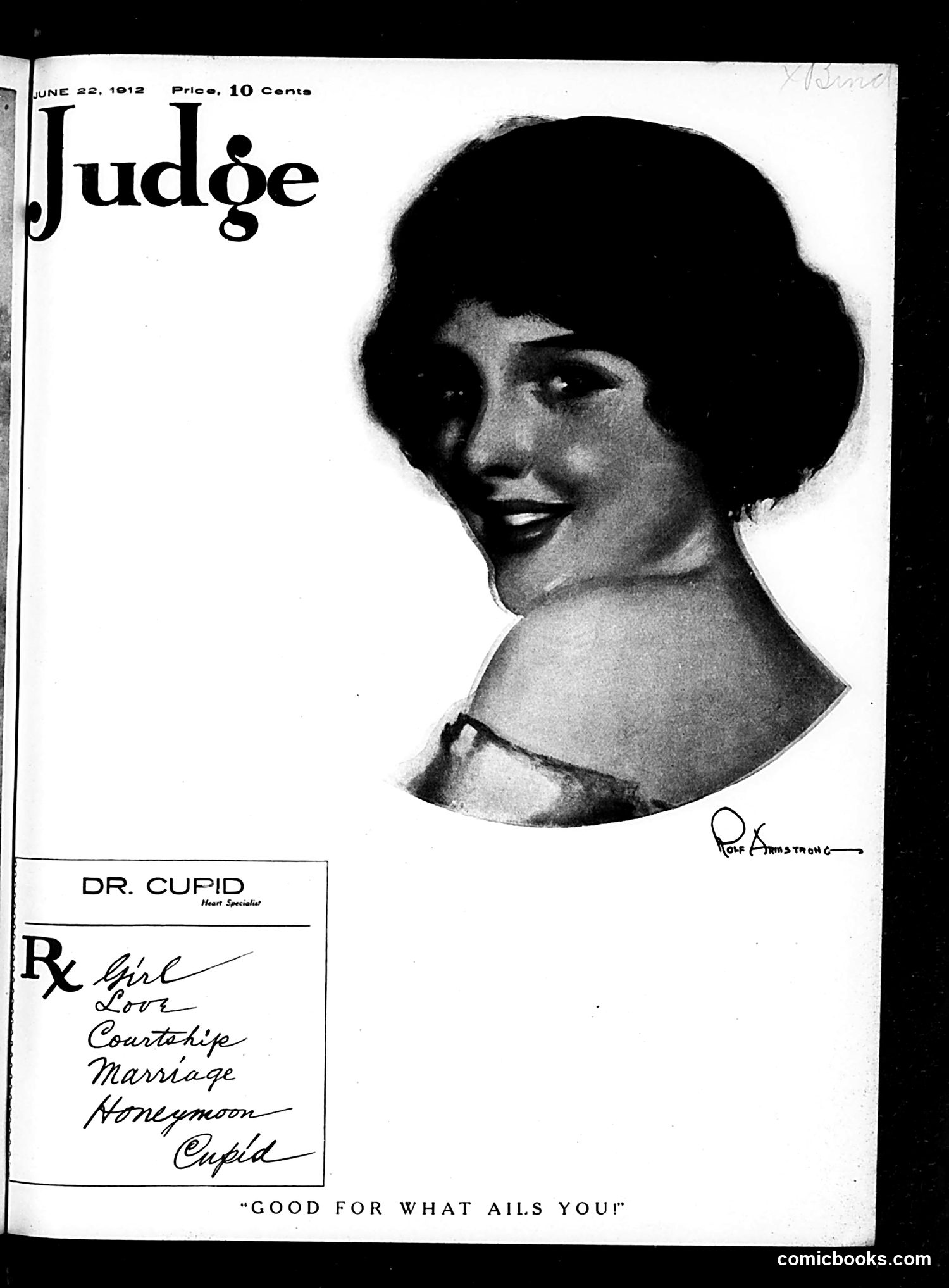
This is primarily a **magazine cover featuring a portrait** rather than a political cartoon. The image shows a woman's head in profile with 1912-era styling (bobbed hair, bare shoulders). The accompanying **"Dr. Cupid" prescription box** is satirical advertising, listing romantic remedies: "Girl, Love, Courtship, Marriage, Honeymoon, Cupid" — playing on the period's common "advice column" trope where love and relationships were treated as prescribable solutions to life's problems. The tagline **"Good for What Ails You"** reinforces this mock-medical humor, suggesting romance as a universal cure-all. The overall content appears to be **light social satire about courtship and marriage**, common Judge magazine fare during the early 20th century.
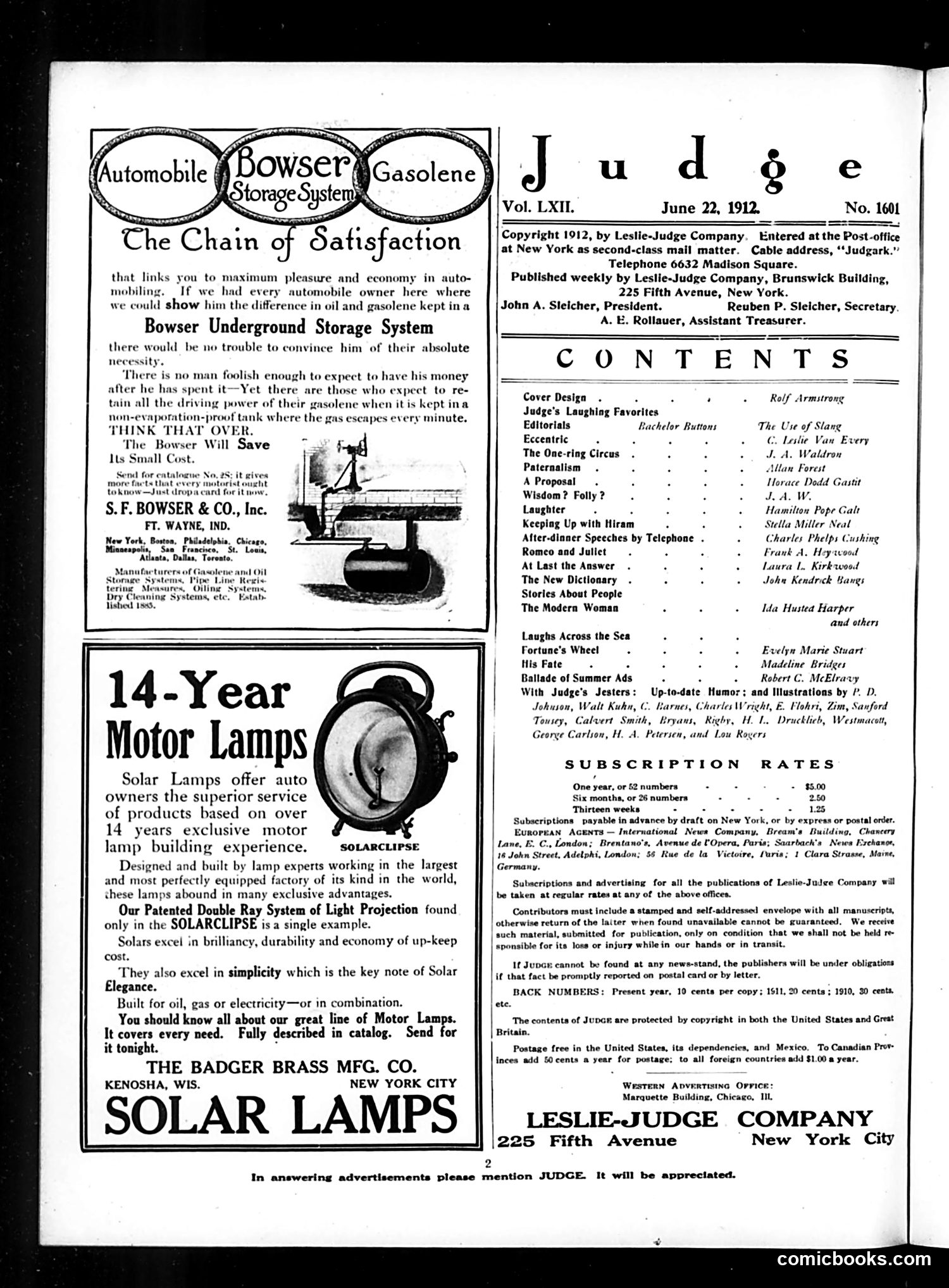
This page is primarily **advertising and table of contents**, not political satire. The advertisements promote automotive storage systems (Bowser Underground Storage System), motor lamps (Solar Lamps by Badger Brass), and gasoline products—reflecting early 1900s automobile industry growth. The contents listing indicates Judge's typical mix: humor columns ("Judge's Laughing Favorites"), satirical pieces ("Eccentric," "A Proposal"), and social commentary. Authors credited include established humorists of the era like Ralf Armstrong and Hamilton Pope Gabb. The magazine itself was America's leading humor and satire publication, though this particular page showcases **commercial advertising** rather than political cartoons or social commentary. The focus on automobile-related ads reflects the era's fascination with emerging automotive technology.
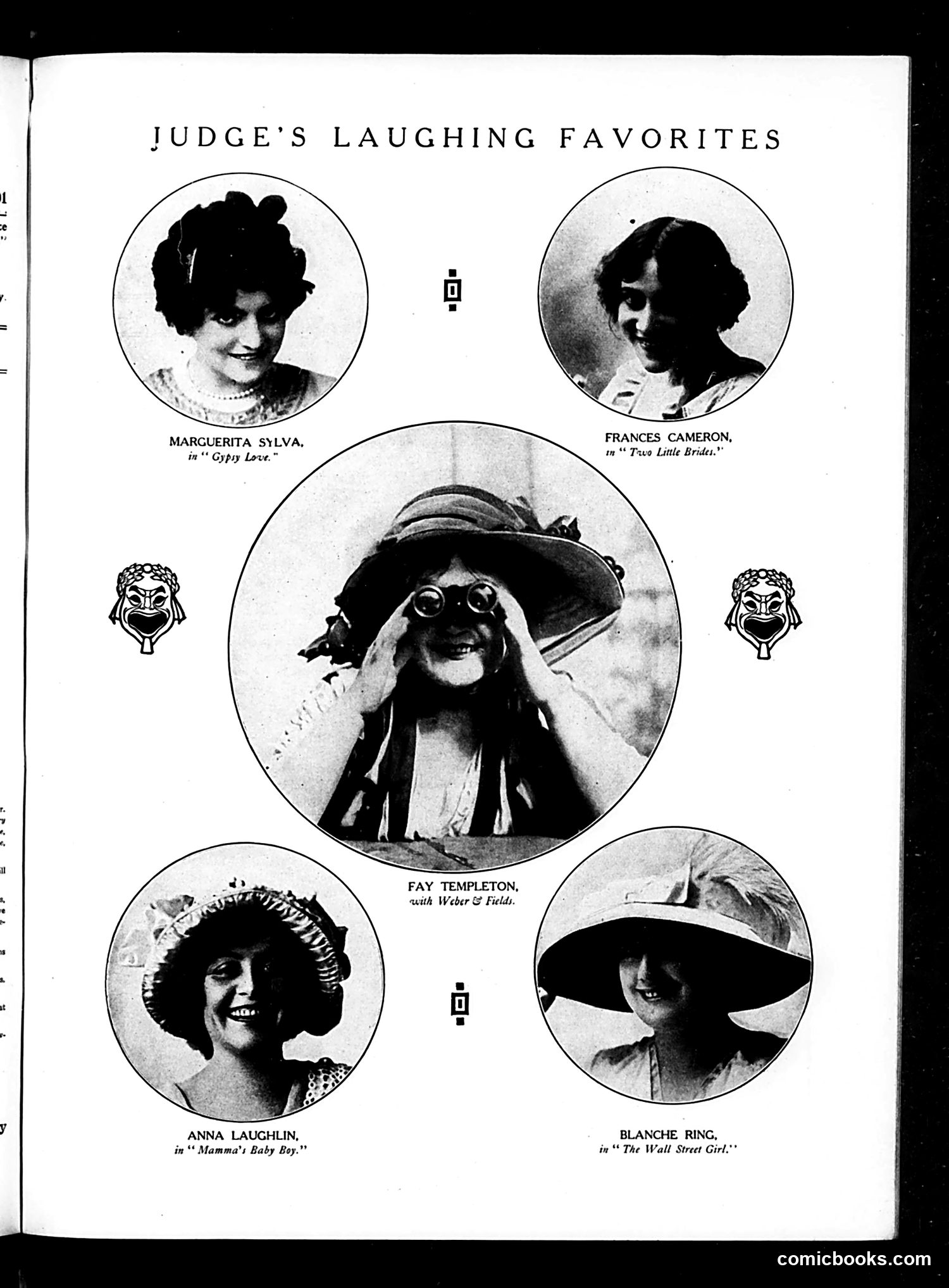
This page features five women performers from silent-era films, presented as the magazine's comedy favorites. The layout identifies them by name and film title: - **Marguerita Sylva** in "Gipsy Love" - **Frances Cameron** in "Two Little Brides" - **Fay Templeton** with Weber & Fields - **Anna Laughlin** in "Mamma's Baby Boy" - **Blanche Ring** in "The Wall Street Girl" This appears to be a light entertainment feature celebrating popular comedic actresses of the silent film era, likely from the 1910s. The page functions as a celebrity showcase rather than political satire—Judge magazine, despite its satirical reputation, regularly featured entertainment content highlighting stage and film performers popular with its readers. The decorative masks emphasize the theatrical/comedic theme.
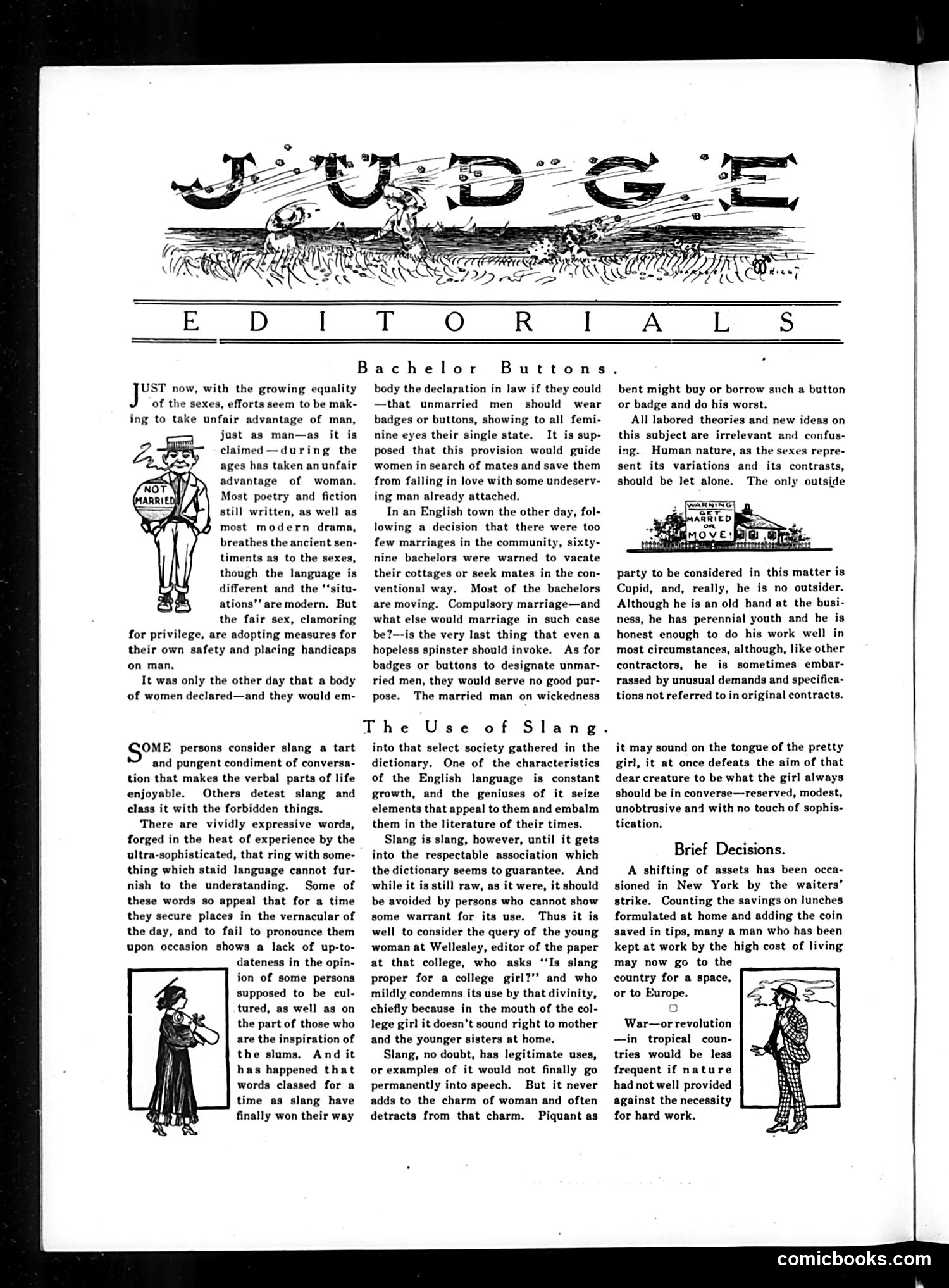
This page contains three separate editorial pieces on social issues rather than political cartoons: 1. **"Bachelor Buttons"** discusses unmarried men wearing badges to signal their status—a proposal debated in English towns. The satire mocks both the idea itself and broader debates about gender equality and marriage conventions. 2. **"The Use of Slang"** critiques informal speech, particularly among young women. The author questions whether slang is appropriate for "college girls" while acknowledging it has legitimate linguistic roots. The piece represents period anxieties about propriety and women's education. 3. **"Brief Decisions"** offers short commentary on economic strikes and tropical warfare. The accompanying illustrations are period-appropriate figure drawings rather than caricatures. The page reflects early-20th-century concerns about social propriety, gender roles, and linguistic standards.
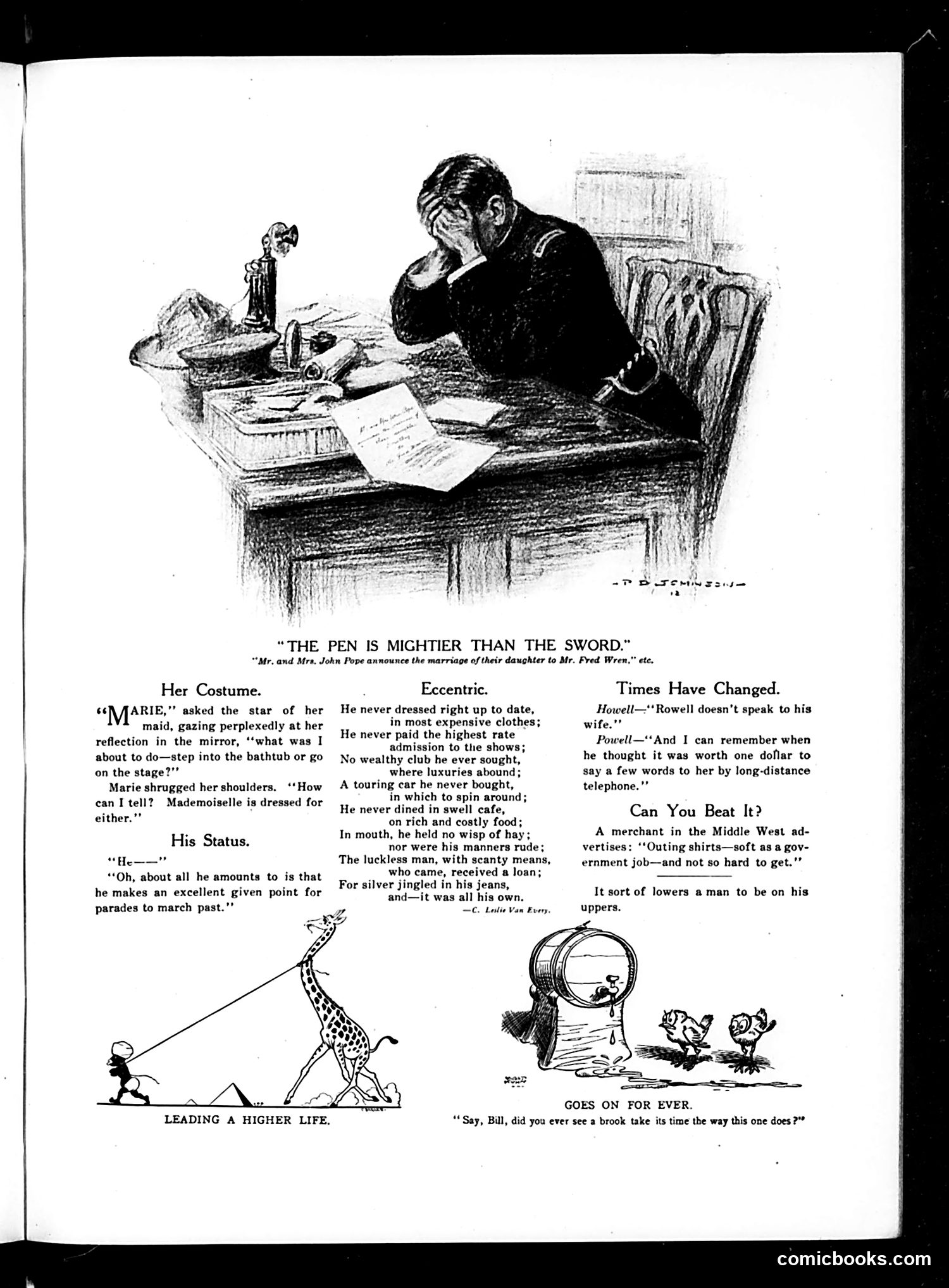
The main cartoon at top depicts a man at a desk receiving news about his daughter's marriage, with the caption "The Pen is Mightier Than the Sword" referencing Mr. and Mrs. John Pope announcing their daughter's marriage to Mr. Fred Wren. Below are four satirical sections mocking various social types: - **"Her Costume"**: Marie's pretentious fashion choices - **"His Status"**: A man of modest means trying to appear wealthy - **"Eccentric"**: Critiques someone who never adopts modern fashions or behaviors - **"Times Have Changed"**: Contrasts old attitudes (Rowell, Powell) with current values, specifically regarding telephone communication The bottom cartoons use visual metaphor—one shows someone "leading a higher life" (pulling a giraffe), and another depicts a cow's endless productivity ("Goes on for Ever"). The page satirizes class pretension, generational change, and the gap between appearance and reality in Gilded Age society.
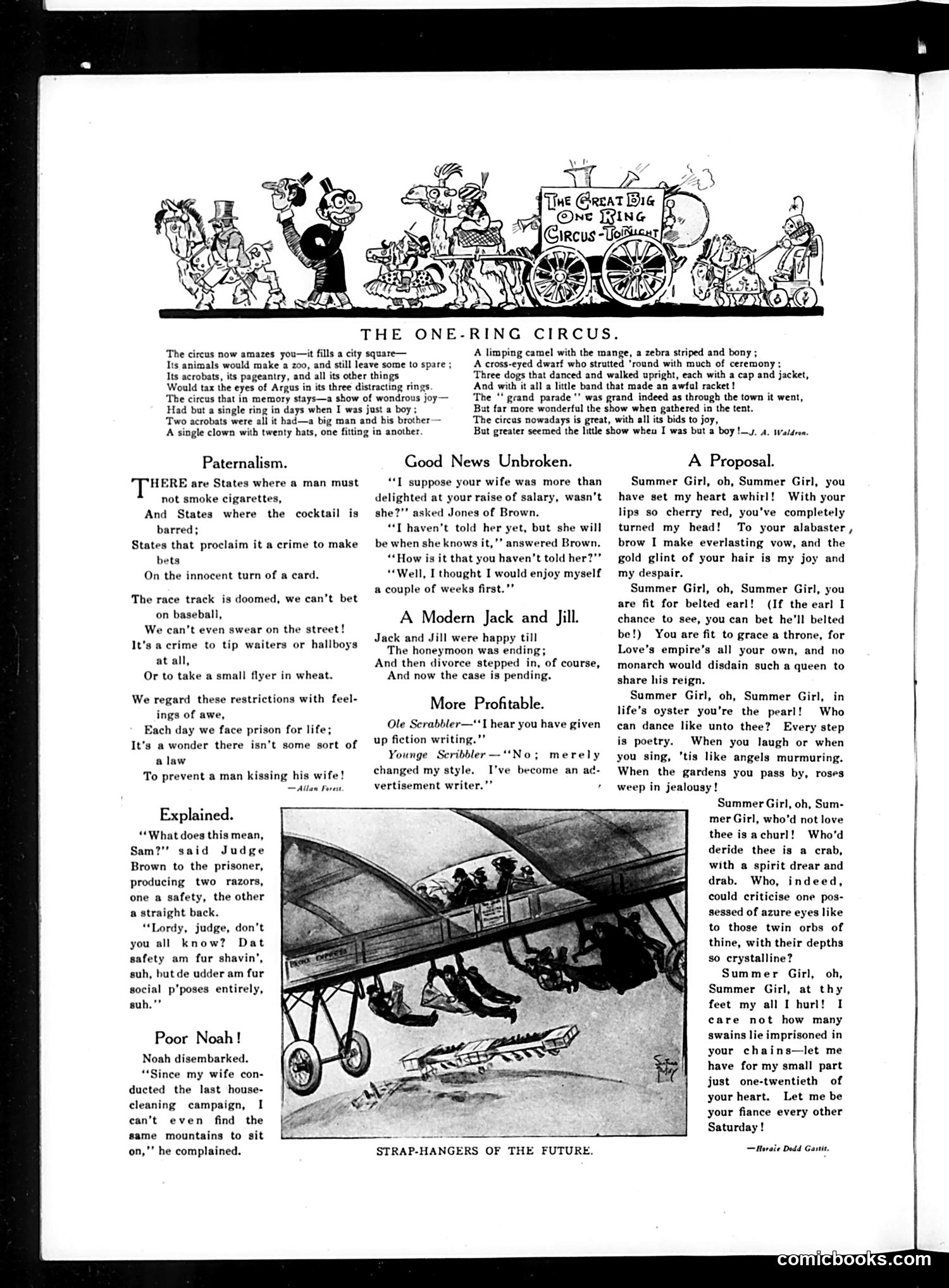
This page from Judge magazine contains several distinct satirical pieces: **"The One-Ring Circus"** (top): A nostalgic poem contrasting modern elaborate circuses with simpler childhood versions. The accompanying illustration depicts an ornate circus parade, emphasizing how commercial entertainment has grown more extravagant. **"Paternalism"** (left column): Satirizes excessive state regulation—prohibitions on smoking, gambling, drinking, and tipping. The humor lies in exaggerating regulatory overreach, climaxing in a joke about preventing men from kissing their wives. **"Explained"** (center): A racial stereotype joke using dialect humor common to the era, depicting a Black prisoner explaining the difference between safety and "straight back" razors with a pun on "social purposes." **"Strap-Hangers of the Future"** (center image): Shows people suspended from an airplane, satirizing futuristic transportation concepts. **"A Proposal"** and other brief pieces offer romantic and domestic humor typical of the magazine's lighter content. The page reflects early 20th-century Judge magazine's mix of social commentary, crude racial humor, and whimsical predictions about modern life.
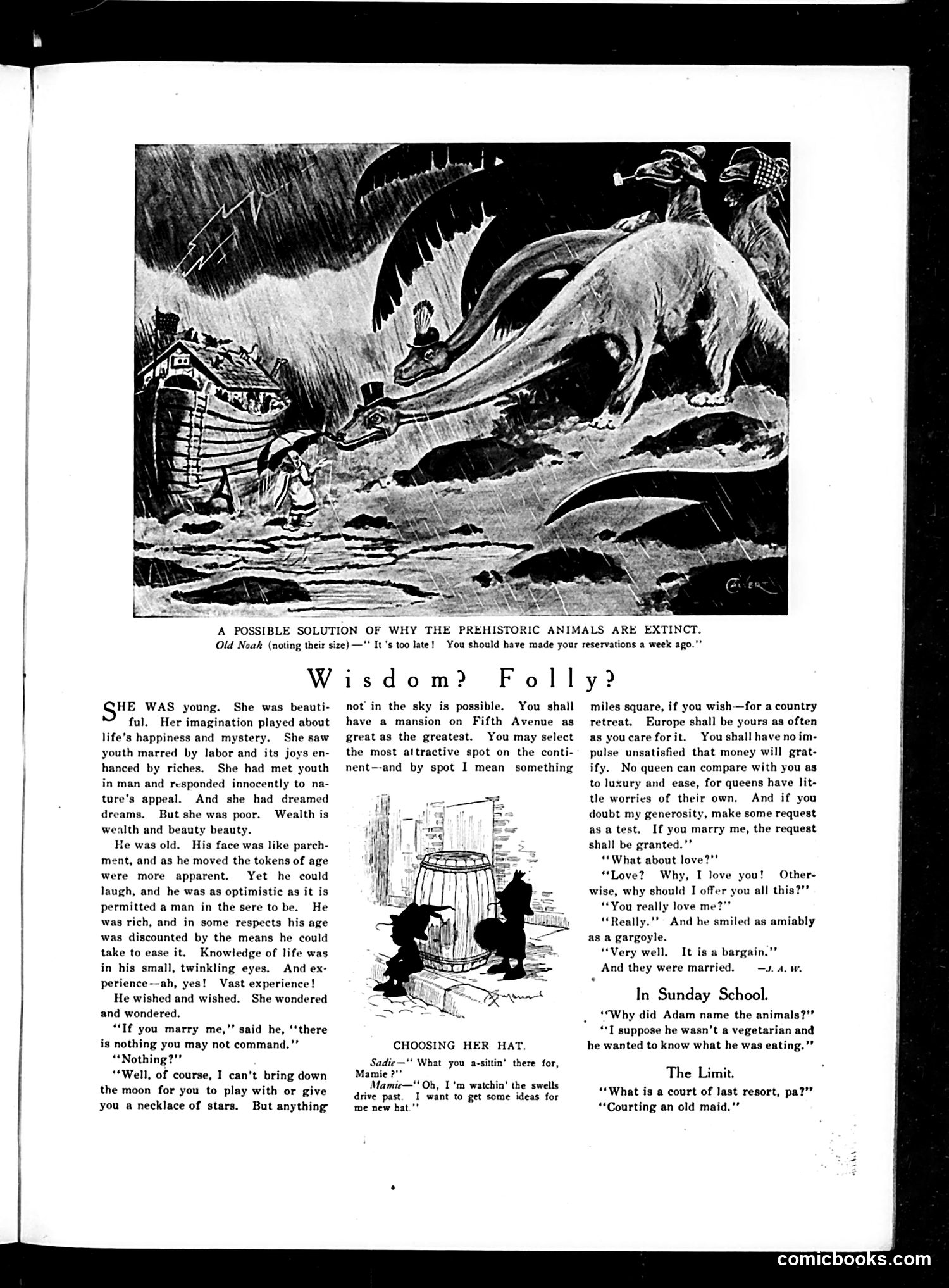
The main cartoon depicts **Noah's Ark during the flood**, with the caption "It's too late! You should have made your reservations a week ago." This is a satirical jab at **wealthy New York society's obsession with exclusive accommodations and advance bookings**—comparing it absurdly to securing passage on Noah's Ark itself. The joke mocks the rich's anxiety about being excluded from fashionable retreats. The larger story, "Wisdom? Folly?", contrasts a poor young woman with an old wealthy man. He offers her unlimited luxury and Fifth Avenue mansions in exchange for marriage, but when she asks about love, he dismisses the question. The satire criticizes **transactional marriages between youth and wealth**, suggesting her acceptance represents folly despite material comfort. The page's shorter jokes about hat-shopping and courtship are typical light satirical humor of the era, poking fun at gender stereotypes and social pretension.
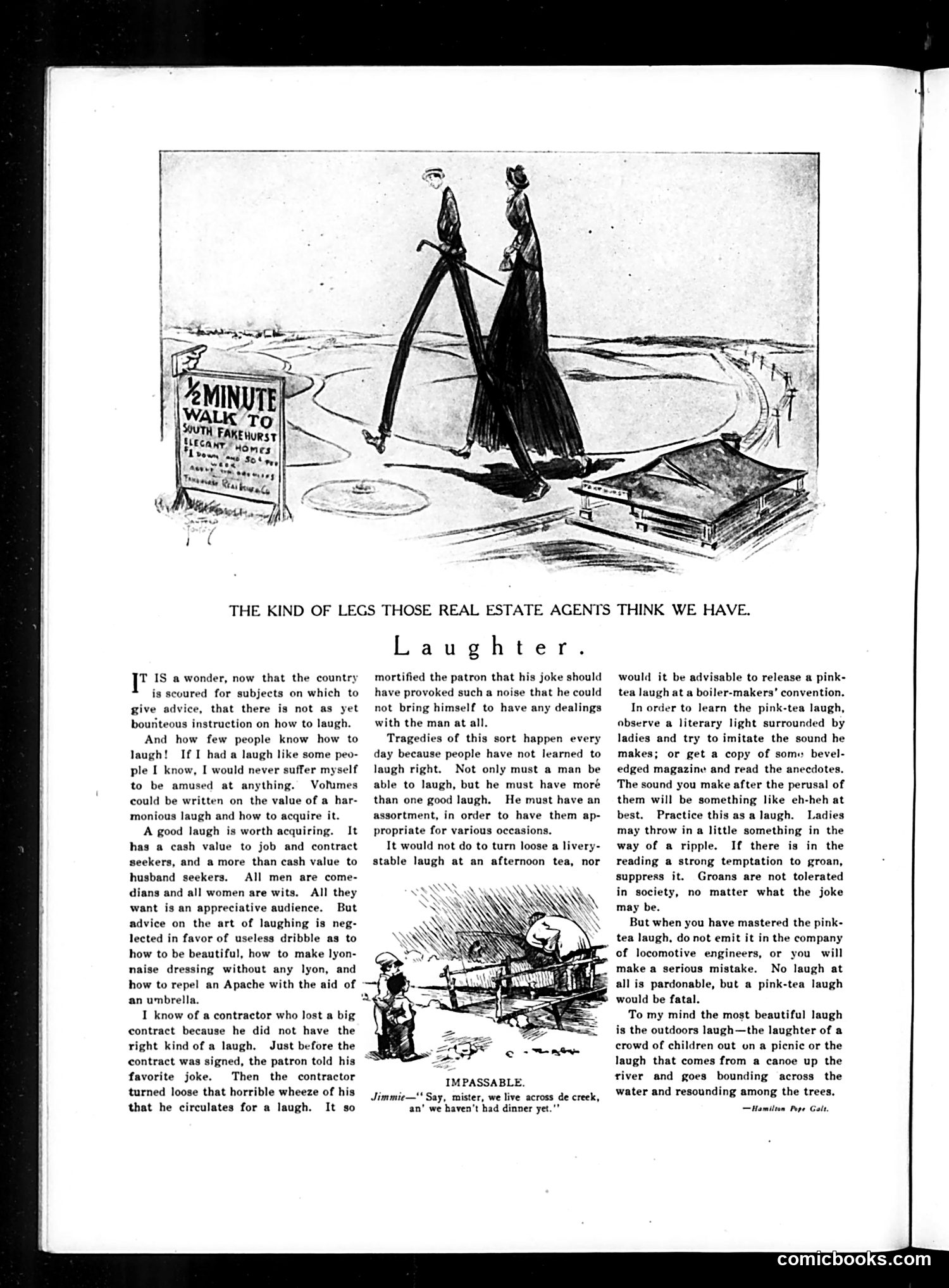
The cartoon satirizes **real estate agents' exaggerated sales pitches**. The illustration shows a surveyor with impossibly long, spindly legs measuring South Parkurst land, suggesting agents stretch the truth about property dimensions and value to absurd degrees—their claims are as physically implausible as those cartoon legs. The accompanying article, titled "Laughter," shifts to an essay on proper laughing etiquette. It's a humorous critique of social pretension, advising readers that different occasions require different laughs: a refined "pink-tea laugh" for literary gatherings, versus an "outdoors laugh" for genuine joy. The tone mocks how society demands artificial, context-appropriate behavior even for something as natural as laughing. Both elements mock American social conventions and commercial dishonesty of the era with satirical wit typical of *Judge* magazine's approach.
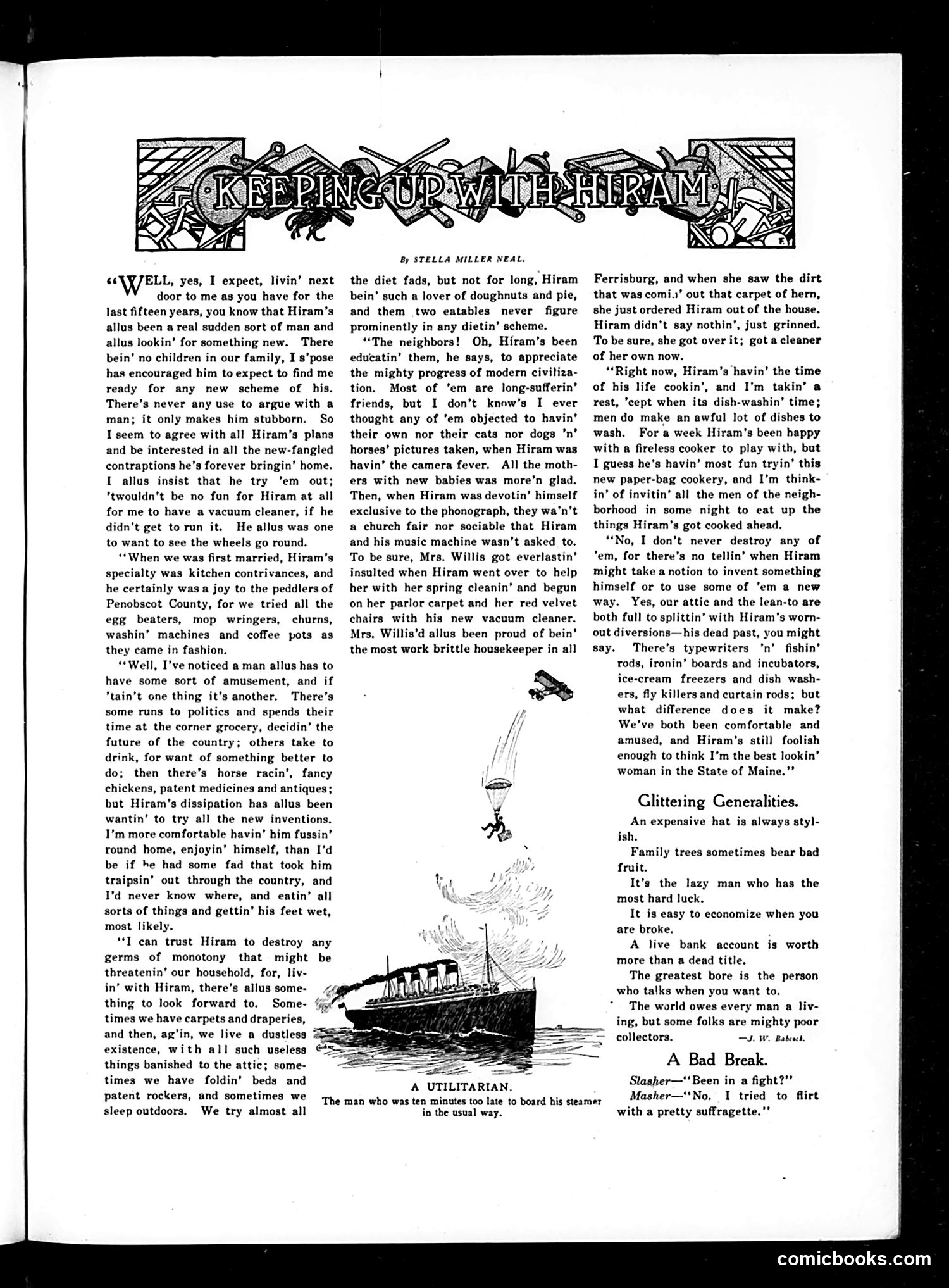
This is a humorous domestic sketch by Stella Miller Neal satirizing the American obsession with new consumer gadgets and labor-saving devices in the early 20th century. The narrator, a long-suffering wife, describes her husband Hiram as a compulsive adopter of every new household invention—vacuum cleaners, phonographs, cameras, egg beaters, washing machines. She presents this as his harmless "dissipation" (vice), preferable to drinking or gambling, yet exhausting for everyone around him, including neighbors who must endure his demonstrations. The satire targets both Hiram's perpetual restlessness and the broader cultural moment of technological enthusiasm. His neighbors tolerate his "progress" with weary politeness. The joke is that modernity keeps the household in constant flux—carpets appear and disappear, diets change, even sleeping arrangements shift—yet Hiram remains unchanged, still loving doughnuts and pies. The accompanying illustrations and brief quips ("Glittering Generalities," "A Bad Break") continue the magazine's satirical tone about contemporary American life.
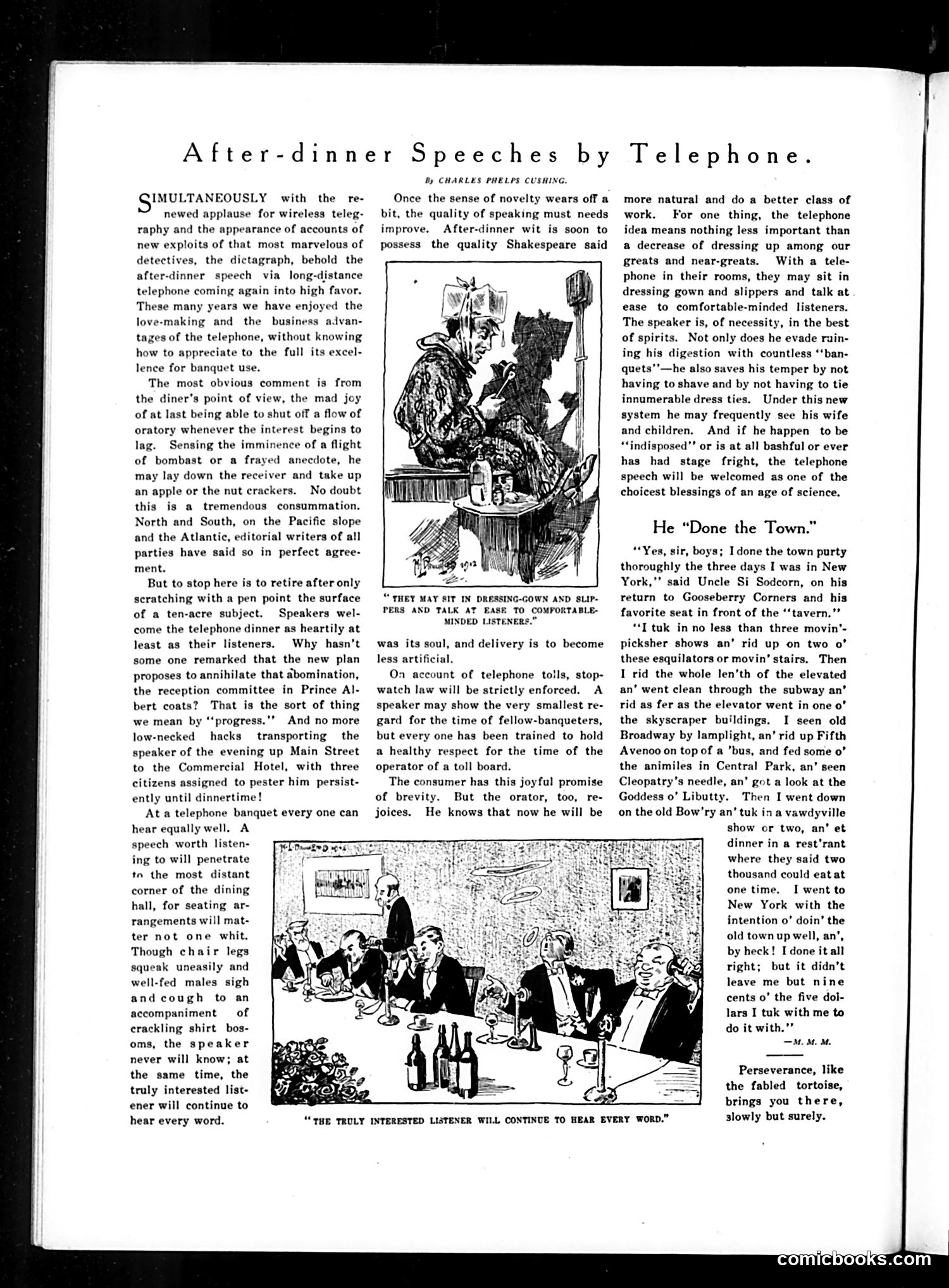
This 1910s-era satirical piece mocks the emerging technology of telephone speeches at formal dinners. The author argues that while listeners benefit from easily tuning out boring speakers, the real advantage goes to speakers themselves—they can now avoid the social ordeal of formal banquets. The satire targets the pretensions of after-dinner orators: no more uncomfortable formal wear, no need to socialize with tedious "reception committees" in formal dress, no shaving or tying cravats, and ability to speak from home in a dressing gown. The cartoons show both the speaker's comfort (first illustration) and diners who can now ignore the speech while eating (second illustration). The piece celebrates how technology liberates the speaker from the exhausting performance rituals of upper-class formal dining, while mocking how little speakers actually cared about their audiences' comfort—they mainly wanted to avoid the social theater themselves.
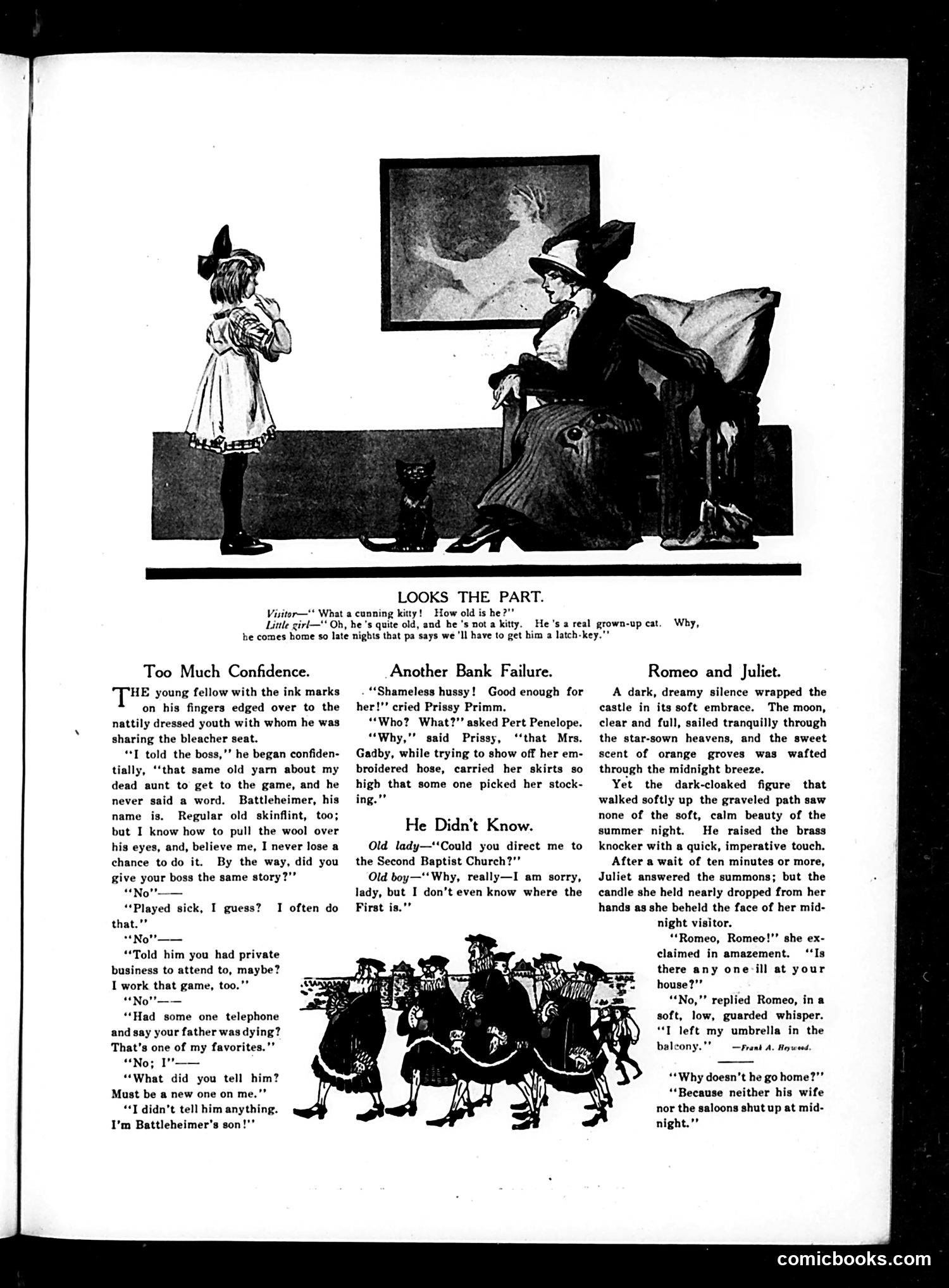
This page contains four separate humorous sketches typical of early 20th-century satirical magazines: 1. **"Looks the Part"**: A visitor mistakes an elderly cat for a kitten; the joke is the cat stays out so late that the father jokes they'll need to give it a latch-key (house key)—comparing the cat's behavior to a dissolute human. 2. **"Too Much Confidence"**: A working-class employee boasts to a stranger about fooling his boss with excuses. The punchline: the stranger is actually Battleheimer, his boss's son—exposing the foolishness of his bragging. 3. **"Another Bank Failure"**: Social gossip about a woman who lifted her skirts immodestly high while showing off her stockings, resulting in theft—satirizing vanity and impropriety. 4. **"Romeo and Juliet"**: A parody of Shakespeare where Romeo arrives at Juliet's window not for romance but because he left his umbrella on the balcony. The closing joke mocks husbands avoiding home because wives and bars both close at midnight. The page satirizes human folly, workplace dynamics, social pretension, and domestic life.
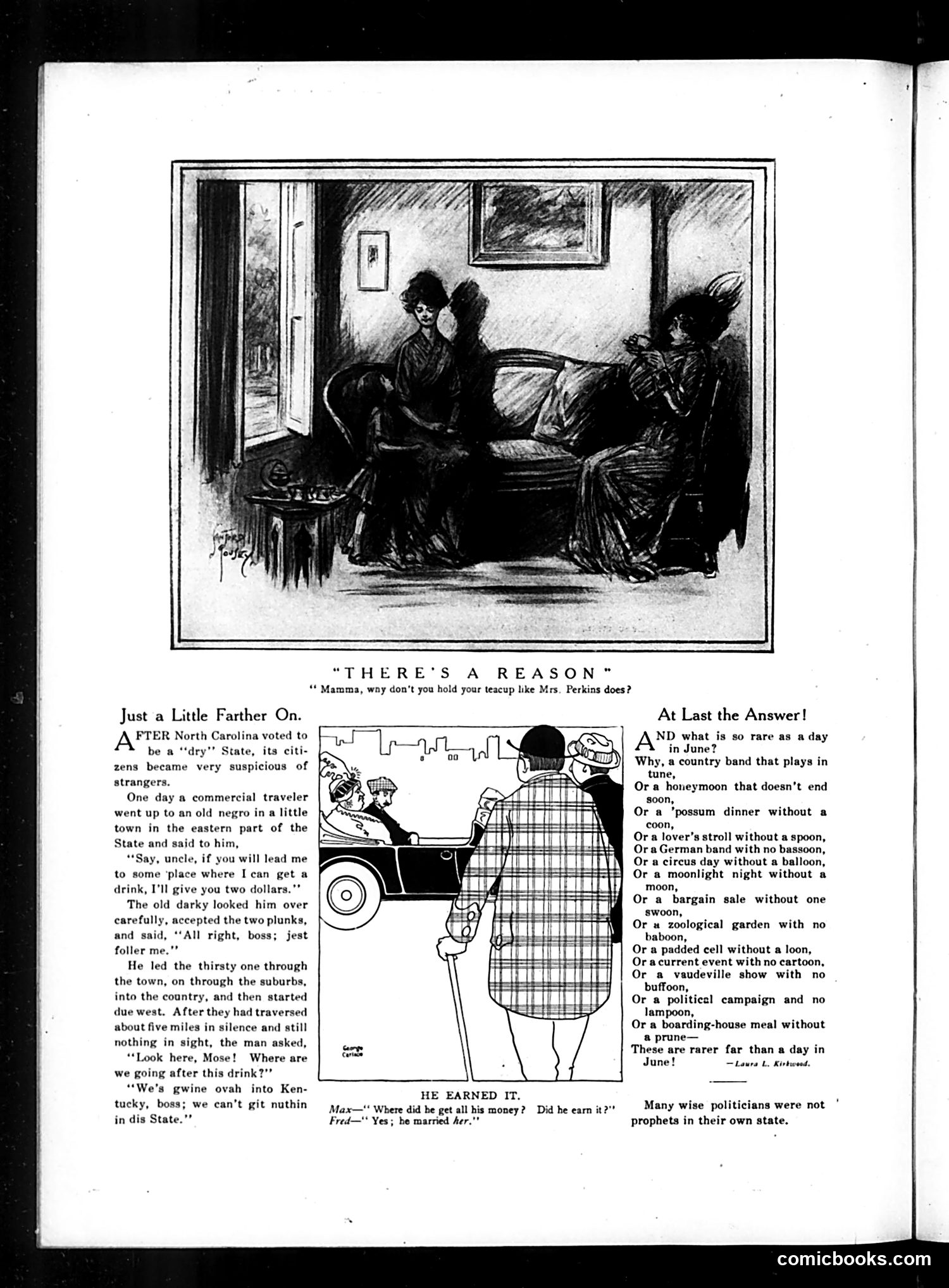
This page contains three distinct satirical pieces from Judge magazine: 1. **"Just a Little Farther On"**: A racist dialect joke about Prohibition. After North Carolina votes "dry" (banning alcohol), a traveling salesman pays a Black man to guide him to alcohol. The punchline: the man leads him five miles into Kentucky because you "can't git nuthin in dis State"—mocking both Prohibition enforcement and relying on a racist stereotype of Black dialect speech. 2. **"There's a Reason"** (top illustration): A domestic humor cartoon about a woman's etiquette, captioning an interior scene with women and tea. 3. **"He Earned It"**: A one-liner joke where a man acquired wealth by marrying a wealthy woman. 4. **"At Last the Answer!"**: A humorous poem by Laura L. Kirkwood listing paradoxes rarer than a June day, ending with a political jab: politicians aren't prophets in their own states—likely referencing failed predictions about Prohibition's success. The page reflects early 20th-century satirical humor mixing crude racial caricature with political and social commentary.
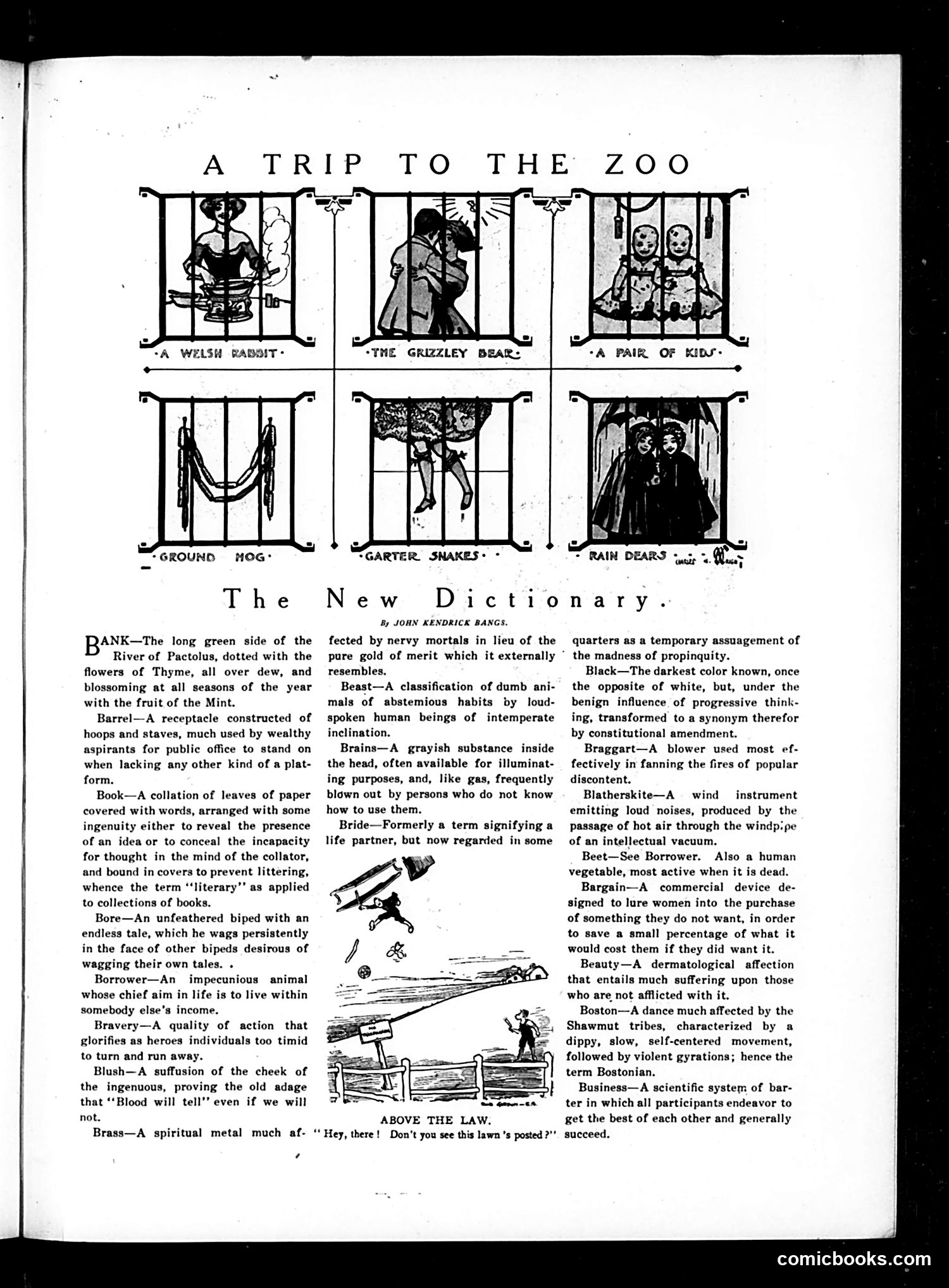
This Judge page combines two satirical features. The top section presents zoo animals in cages with humorous labels playing on double meanings: "A Welsh Rabbit" (the dish, not an animal), "Garter Shakes" (garters, not snakes), and "Rain Dears" (a pun). These mock visitors' expectations at actual zoos. The main content is "The New Dictionary" by John Kendrick Bangs, a popular humorist. It offers cynical redefinitions of common words, satirizing contemporary society. Examples include defining "Barrel" as a platform for political candidates lacking substance, "Borrower" as someone living off others' income, and "Business" as mutual deception. The cartoon "Above the Law" shows someone ignoring a "Posted" sign, mocking disregard for rules. Overall, the page uses wordplay and mock-definitions to critique political corruption, materialism, pretension, and social hypocrisy—typical Judge magazine fare attacking prominent follies of the era.
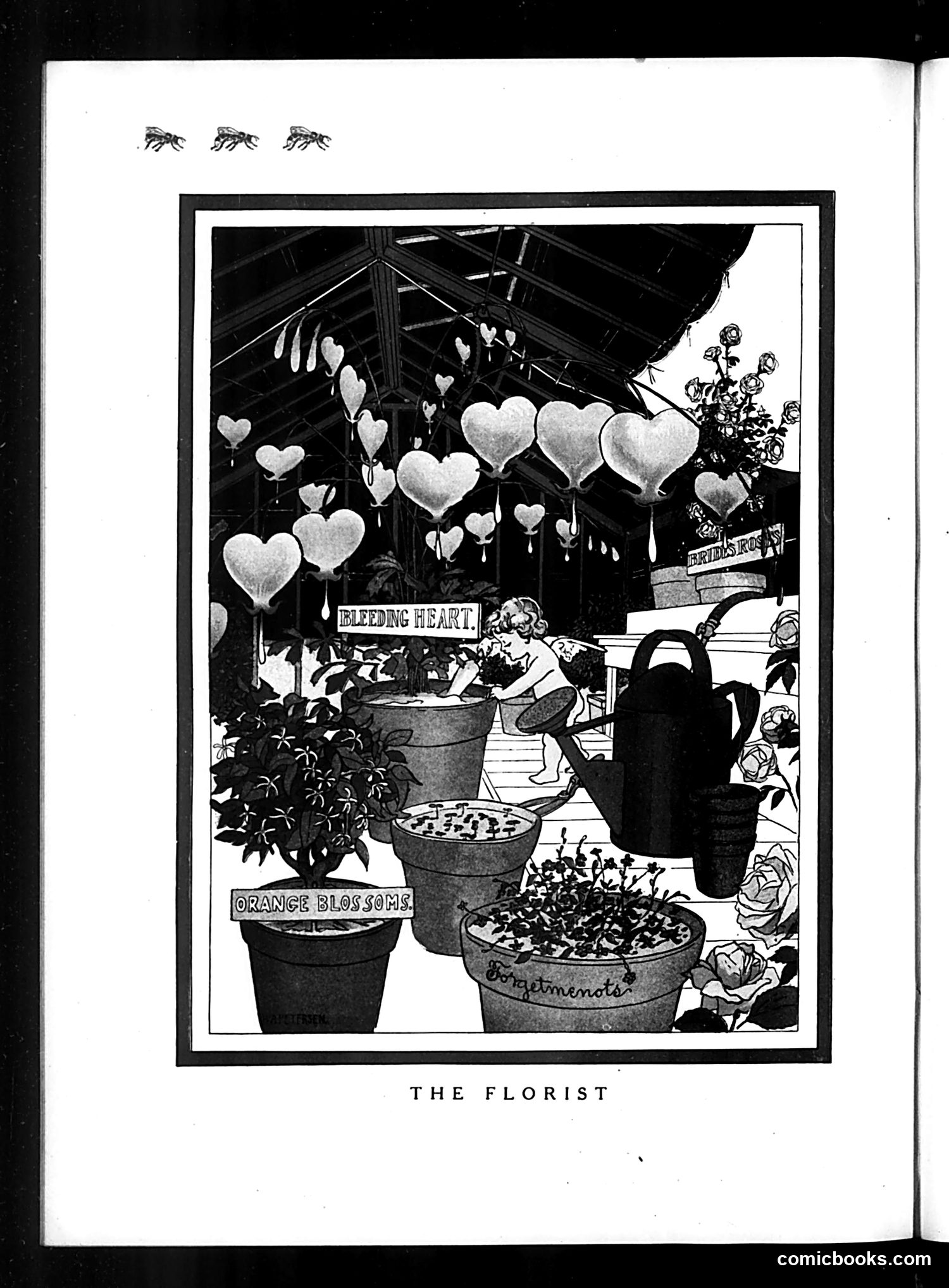
This is a straightforward illustration rather than a political cartoon. It depicts a florist's greenhouse or shop interior, titled "The Florist." The scene shows various potted plants and flowers arranged for sale, including labeled specimens like "Bleeding Heart" and "Orange Blossoms." A figure (appearing to be a florist or shop worker) tends to the plants near a watering can. Heart-shaped flowers hang decoratively from the greenhouse ceiling. The image appears to be a gentle, domestic scene celebrating floristry as a profession or business. Without additional context about the magazine issue's date or surrounding content, the satirical intent—if any—remains unclear. It may simply be an appreciative illustration of flower cultivation and retail.
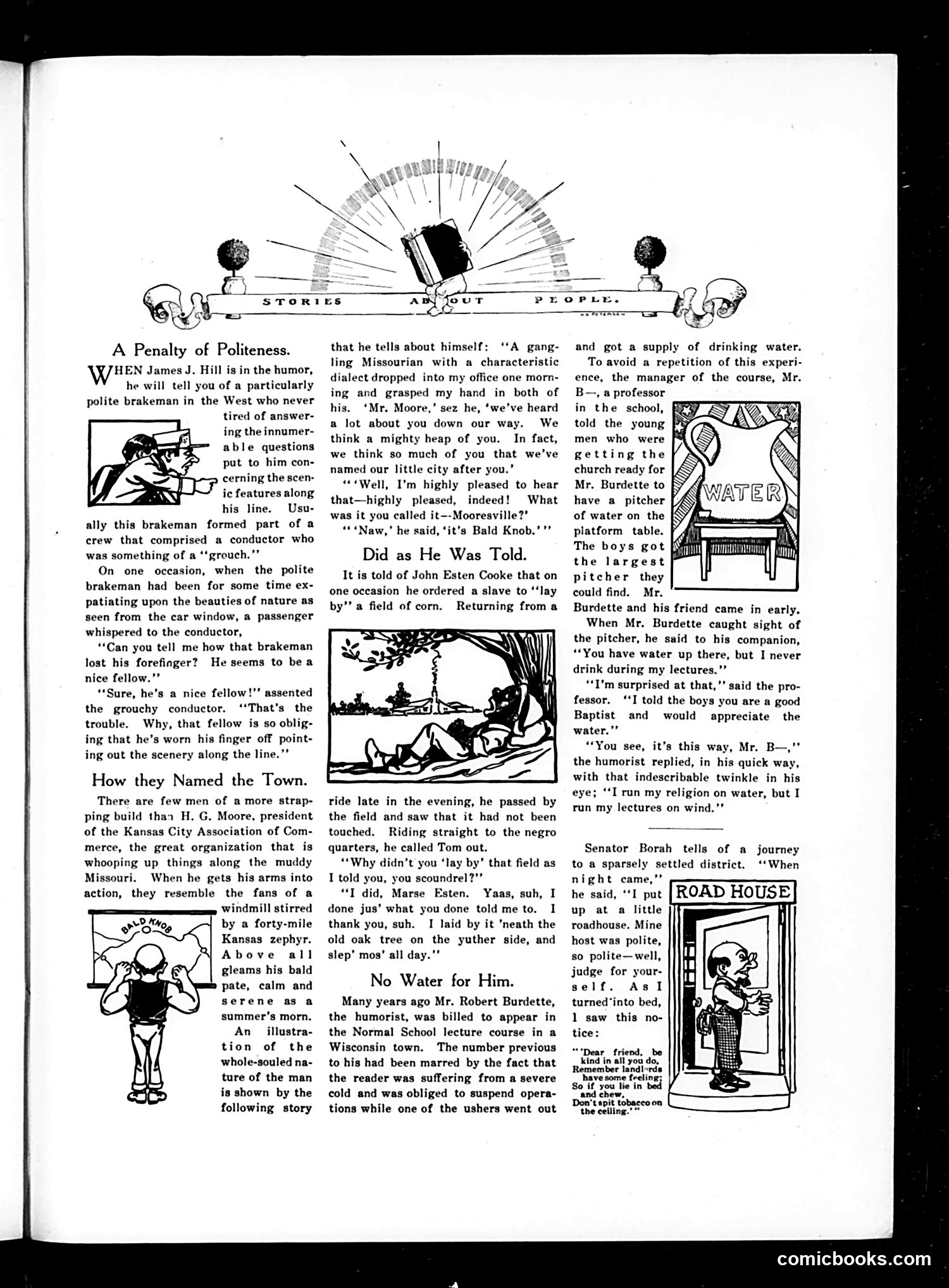
This page from *Judge* magazine contains three humorous anecdotes satirizing politeness and absent-mindedness among prominent figures. **"A Penalty of Politeness"** mocks an overly-obliging railroad brakeman whose excessive helpfulness (pointing out scenery) has worn away his finger—a visual joke about the consequences of servility. **"How they Named the Town"** features H.G. Moore, a Kansas City businessman, whose pride is deflated when a visitor reveals the town named after him is actually called "Bald Knob"—a crude reference to Moore's baldness. The joke ridicules his vanity. **"No Water for Him"** describes humorist Robert Burdette's witty rejoinder when offered water before a lecture: he "runs his religion on water" but "lectures on wind"—a self-deprecating quip about his own verbose speaking style. The page also includes a brief anecdote about John Esten Cooke and an enslaved man misinterpreting orders, reflecting the period's casual racism in its humor. The central theme is deflating pomposity through wit and misunderstanding.
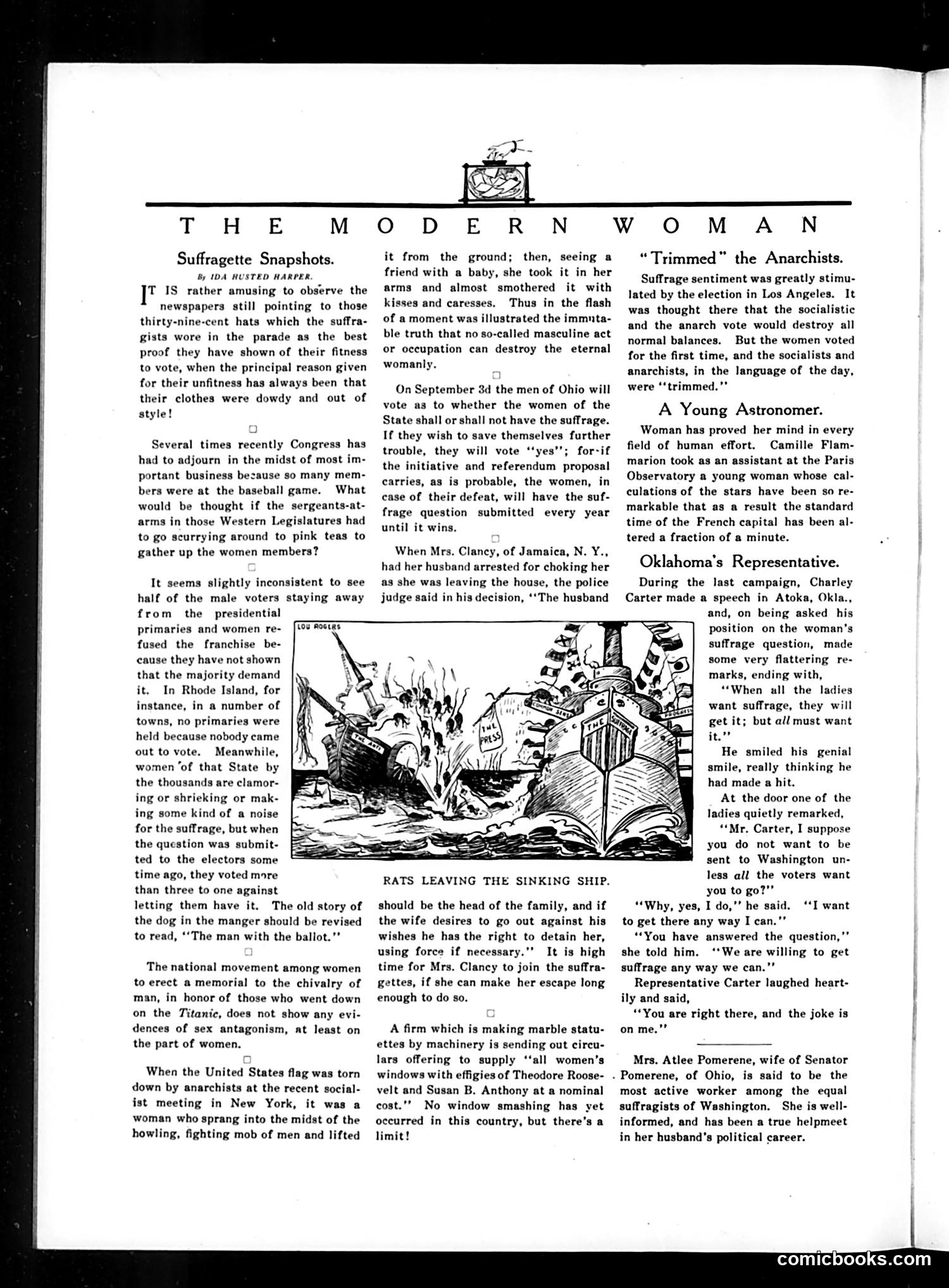
This page from *Judge* satirizes opponents of women's suffrage through multiple arguments favoring voting rights. **Main cartoon** ("Rats Leaving the Sinking Ship"): depicts male politicians abandoning what appears to be a capsizing vessel—likely representing the political establishment threatened by women gaining the vote. **Key satirical points:** - The opening section mocks anti-suffrage logic: opponents criticized suffragists' "dowdy" clothing while simultaneously arguing women were unfit to vote due to being too fashionable. - References to male legislators abandoning Congress for baseball games, yet claiming women would be distracted from serious business. - Stories of women's actual accomplishments (an astronomer altering French timekeeping, women voting strategically in Los Angeles against anarchists/socialists) counter claims of female incompetence. - A domestic violence case satirizes male "family authority" while advocating for women's independence and voting power. The page argues women deserve suffrage through demonstrated competence and logic.
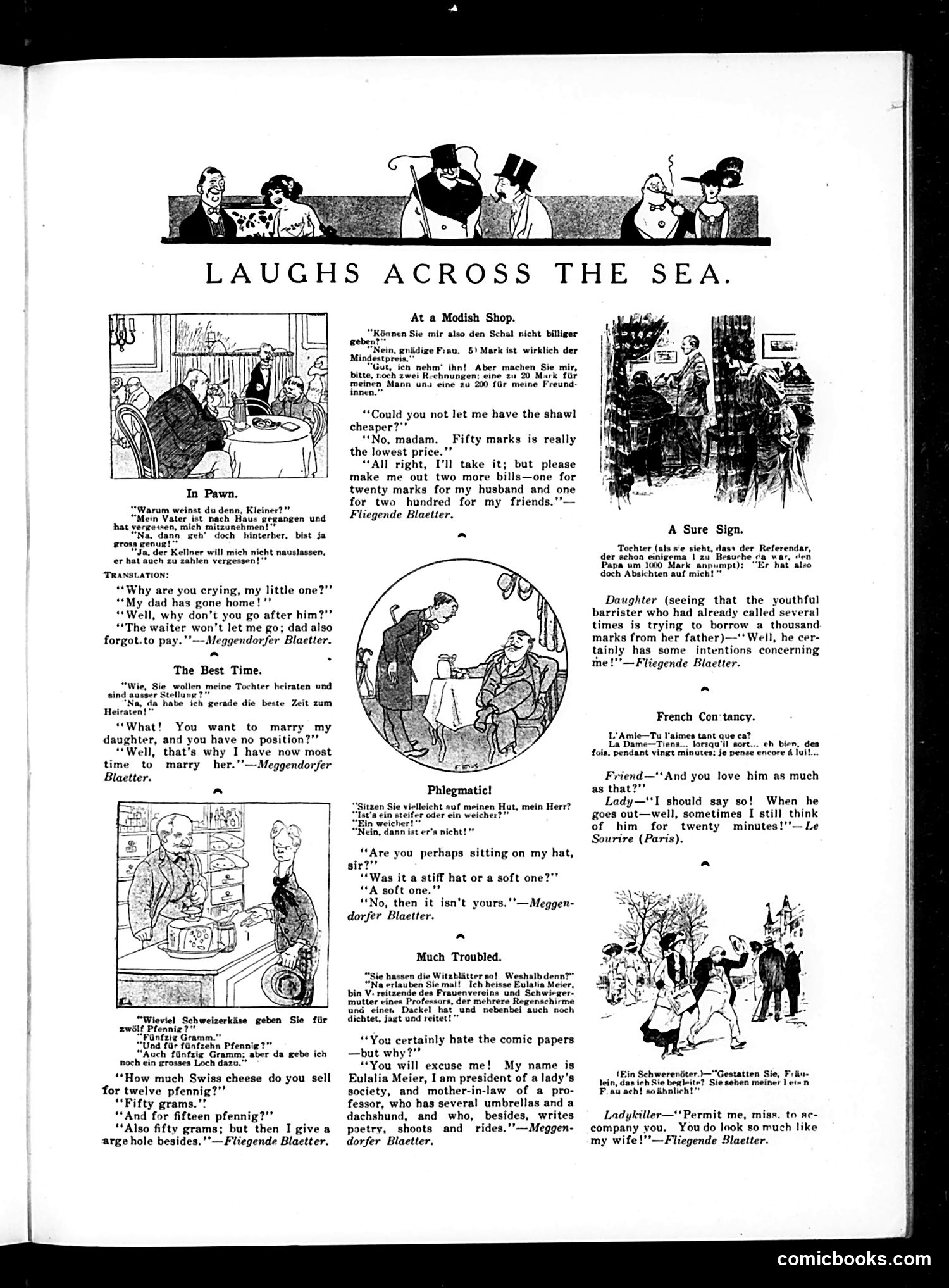
This page presents humorous cartoons and jokes translated from German and French publications, representing international humor circa early-to-mid 20th century. The jokes rely on period-specific social anxieties and gender dynamics: **"In Pawn"**: A child is trapped in a restaurant because her father left without paying—satirizing parental irresponsibility. **"The Best Time"**: A jobless suitor claims unemployment is actually ideal for marriage, mocking courtship customs and economic precarity. **"Swiss Cheese"**: A cheesemonger compensates for higher prices by literally including larger holes in the product—a classic joke about value deception. **"At a Modish Shop"**: A woman inflates bills to deceive her husband and impress friends, satirizing feminine materialism and marital deception. **"Much Troubled"**: An offended woman lists her credentials (society president, professor's wife, poet, hunter, rider) to explain why comic papers insult her—mocking pretentious self-importance. **"French Constancy"**: A woman admits she only remembers her lover for twenty minutes after he leaves—satirizing shallow romantic devotion. The humor targets universal human foibles: dishonesty, vanity, marital friction, and social pretense.
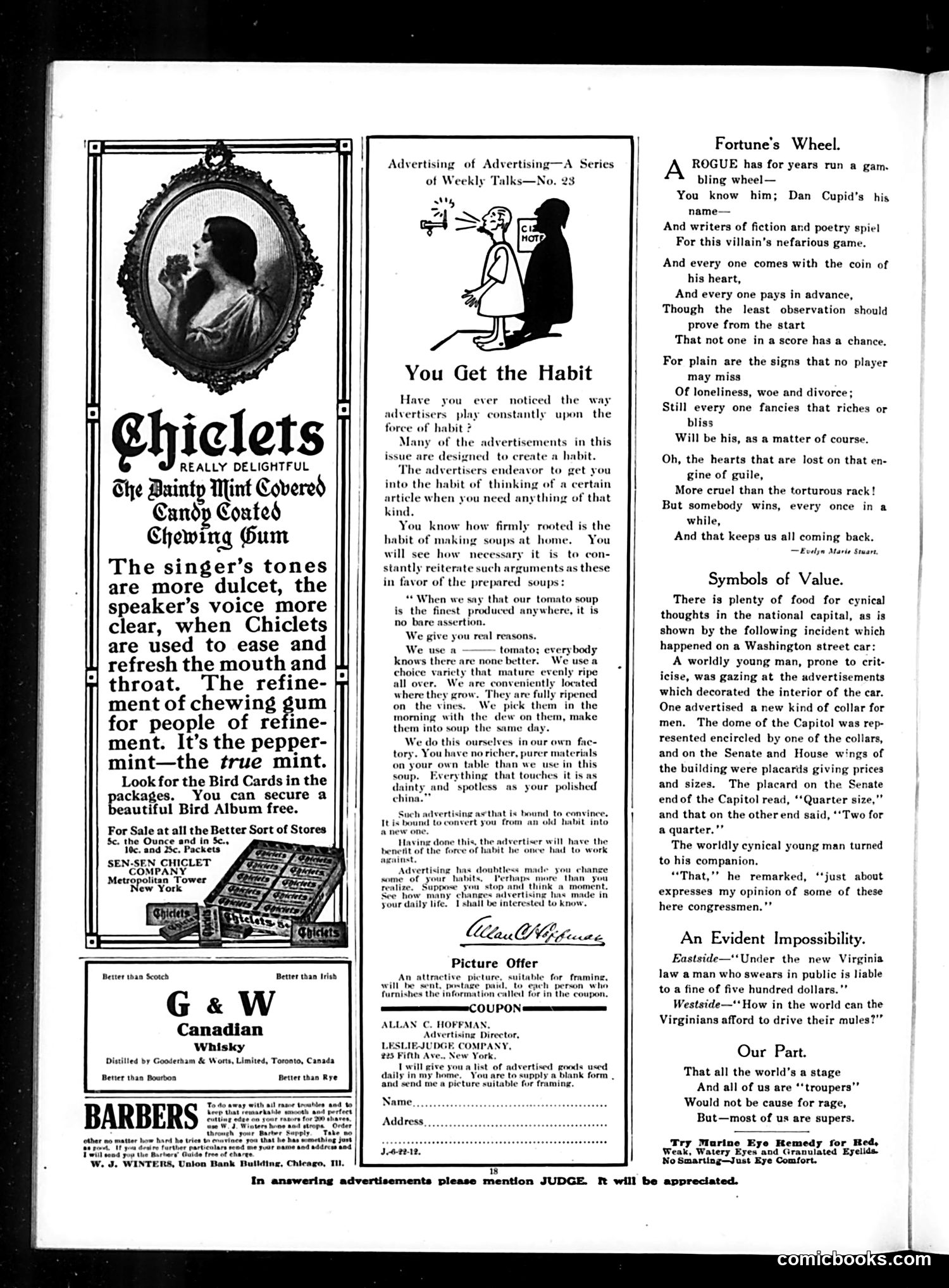
This Judge magazine page is primarily **advertising with editorial content**, not political cartoons. The main items are: 1. **Chiclets gum advertisement**: Uses the appealing image of a refined woman to market mentholated chewing gum as a product for "people of refinement." 2. **"You Get the Habit" article**: Discusses advertising psychology—how repetitive ads create consumer habits, using soup-making as an example of deeply ingrained domestic practices advertisers exploit. 3. **"Fortune's Wheel" poem**: Satirizes romantic love as a rigged gambling game run by "Dan Cupid," where people knowingly risk heartbreak for rare happiness—a cynical commentary on romance. 4. **"Symbols of Value" anecdote**: A satirical short piece where a young man observes Capitol building advertisements and makes a cutting joke equating congressmen's value to cheap collars ("Quarter size" / "Two for a quarter"). The page reflects early-20th-century concerns about advertising's manipulative power and includes typical period cynicism about both love and politics.
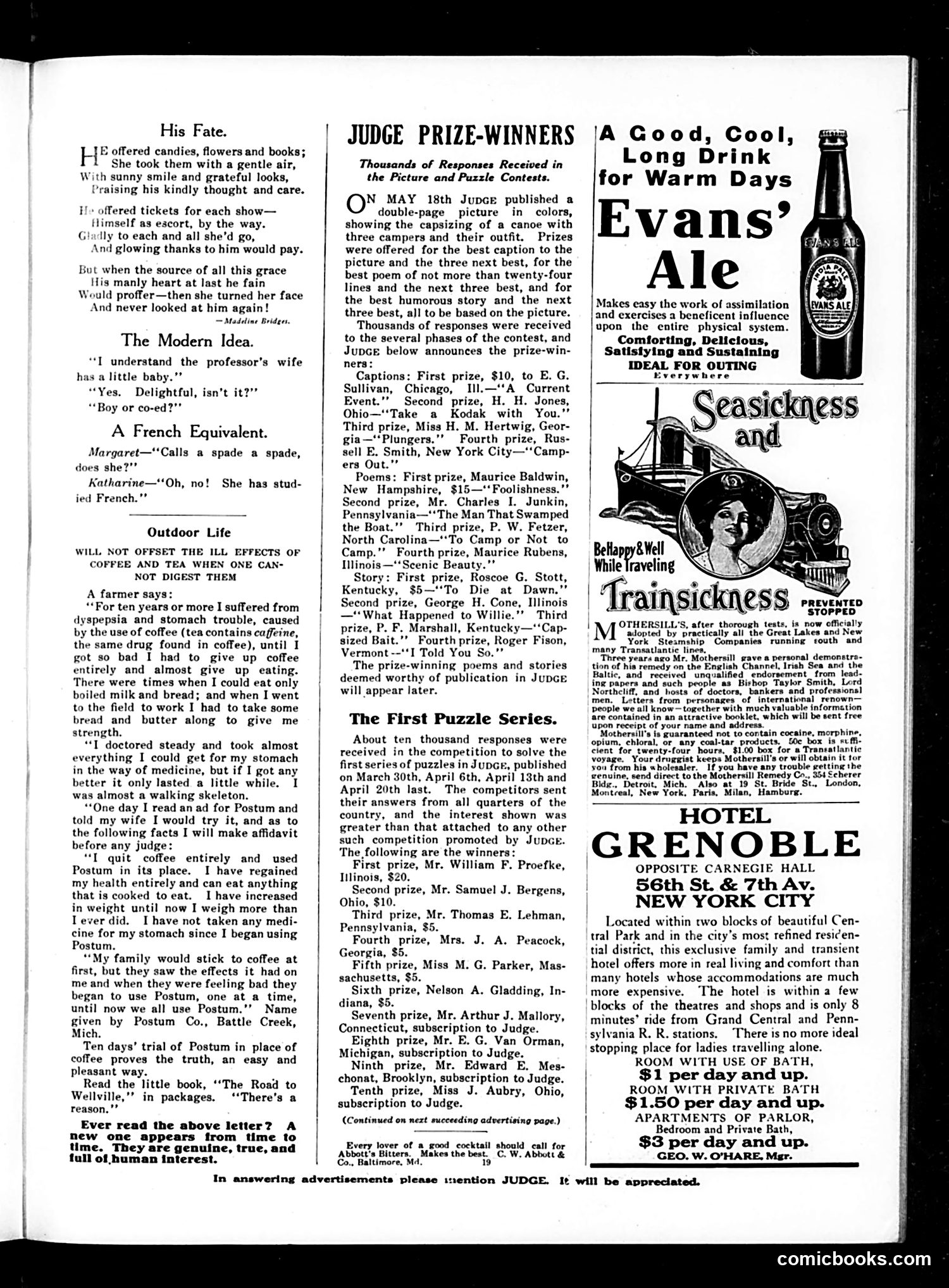
This page is primarily **advertisements and contest announcements**, not satirical cartoons. The top sections ("His Fate," "The Modern Idea," "A French Equivalent") are brief **humorous prose pieces** typical of Judge's filler content: the first depicts a man's unrequited love; the second makes a joke about modern women's education ("co-ed"); the third satirizes pretentious French-speaking women. The bulk of the page announces **Judge's picture and puzzle contest winners** from May 18th—a canoe-capsizing illustration that generated thousands of entries. Winners received cash prizes and their work would be published. The advertisements promote **Evans' Ale** (a drink for hot weather) and **Hotel Grenoble** (NYC lodging), plus **Mothersill's** seasickness remedy, which apparently received endorsements from notable figures including Lord Northcliffe. The embedded testimonial about **Postum** (a coffee substitute) suggests contemporaries blamed caffeine-containing beverages for digestive problems—a common concern of this era. **Overall: This is a typical magazine page mixing humor, contests, and advertisements—not satirical political content.**
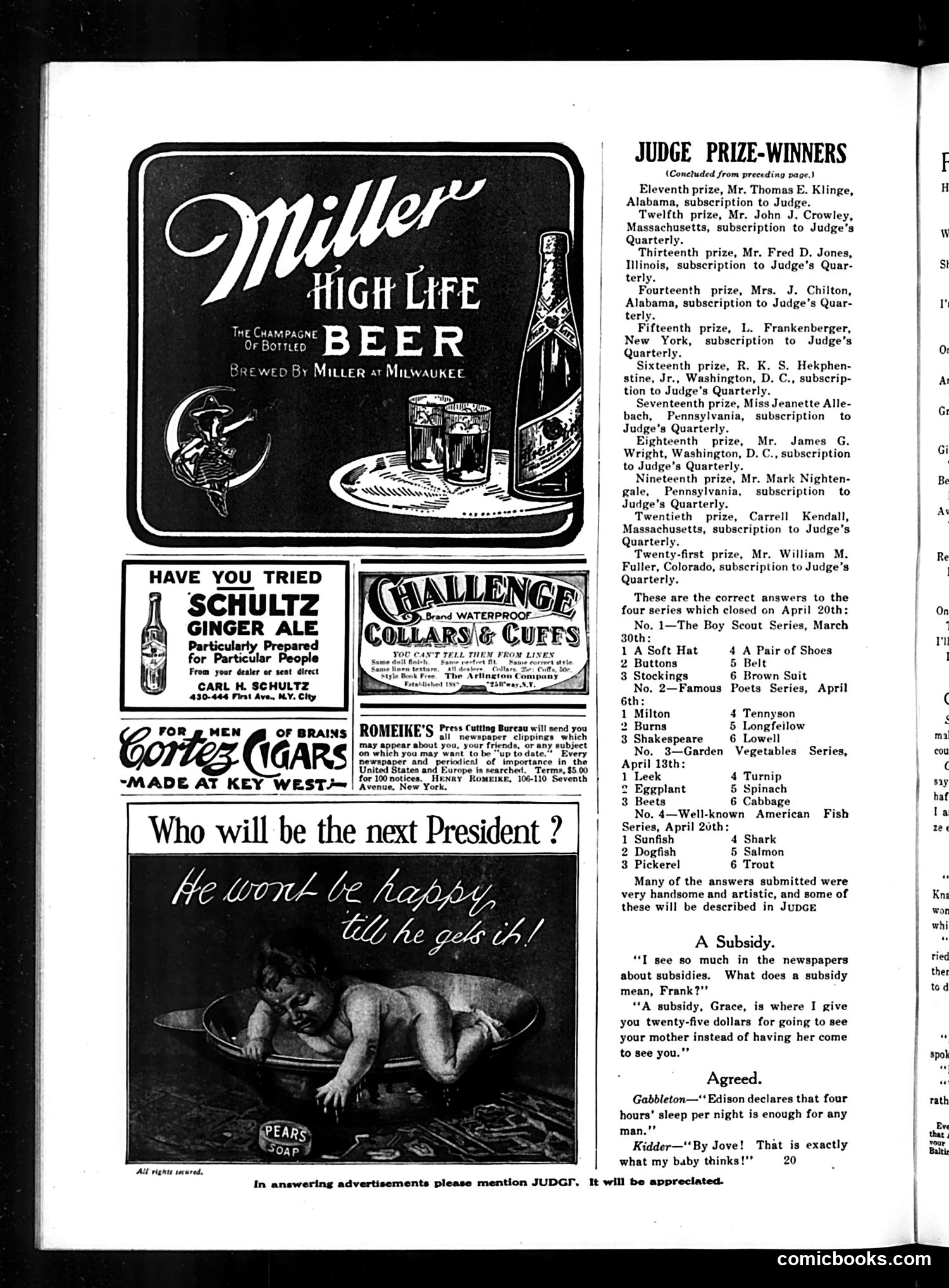
This page is primarily **advertisements and contest results** rather than political satire. The main cartoon—"Who will be the next President?"—depicts a sleeping figure on a bed with the caption "He won't be happy till he gets it!" Below sits a Pears' Soap advertisement, suggesting the cartoon likely mocks a political figure's obsessive ambition for the presidency, though the specific figure is unclear without additional context. The page mostly contains: - Prize announcements from Judge's contests - Period advertisements (Miller beer, Schultz ginger ale, Pears' soap, Cortés cigars) - Brief humorous dialogue pieces ("A Subsidy," "Agreed") offering light social commentary on topics like subsidies and sleep requirements The satire is gentle rather than pointed. The overall tone reflects early 20th-century magazine humor—focused on commercial sponsorships and reader engagement contests rather than sharp political critique.
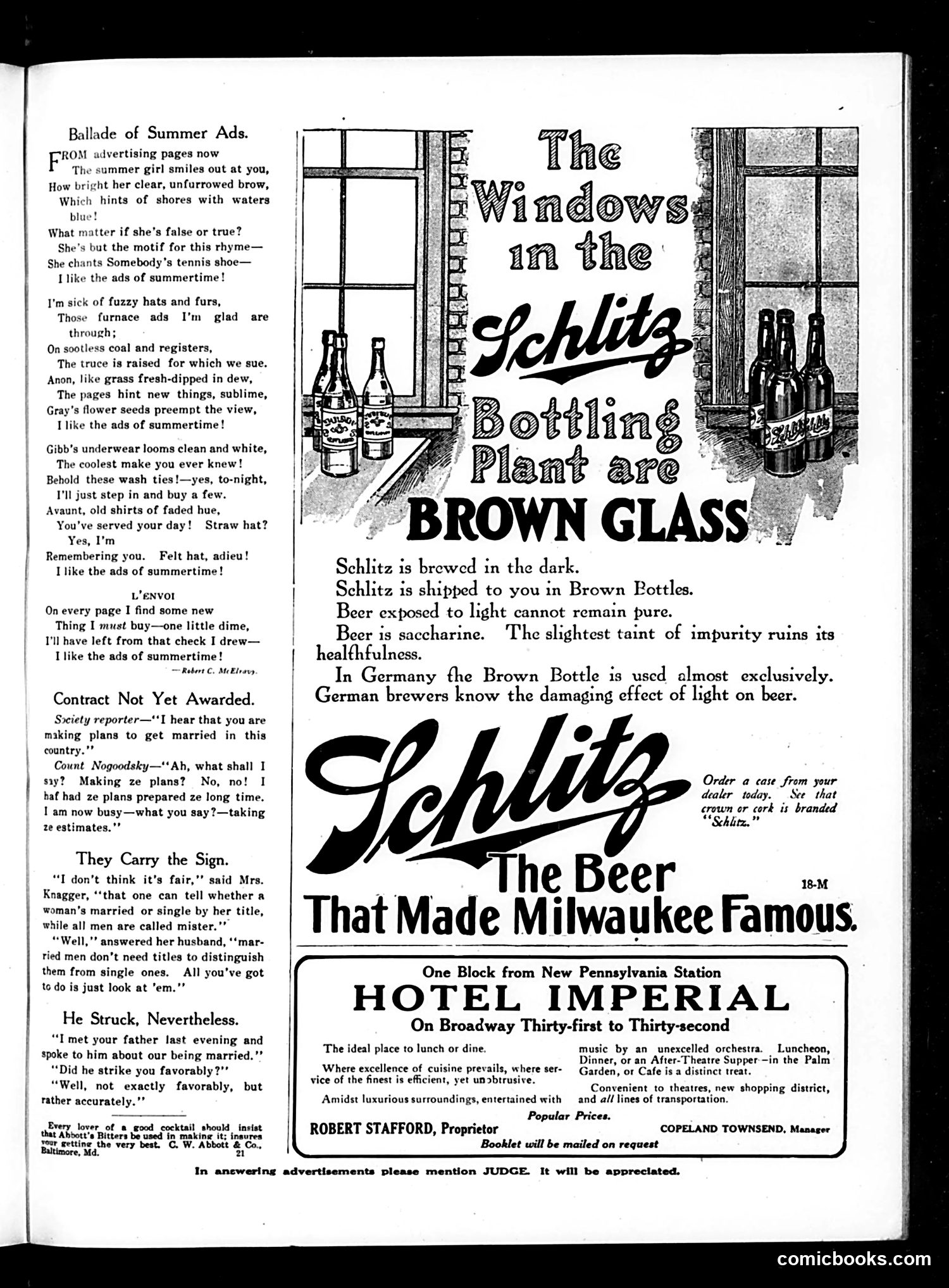
This page combines satirical poetry with advertisements, typical of Judge's format. **"Ballade of Summer Ads"** is a humorous poem mocking seasonal advertising cycles. The poet complains about winter ads for furnaces and furs, then cheerfully admits that summer advertising—featuring the idealized "summer girl" selling tennis shoes, underwear, straw hats—manipulates him into wanting to buy everything despite having little money left ("I'll have left from that check I drew"). **The three comic bits** below satirize human nature: one mocks European fortune-hunters obtaining marriage "estimates" in America; another jokes that married men need no title to distinguish them from bachelors (implying wives recognize their husbands); the third plays on "strike you favorably"—the father literally struck the suitor instead. The large **Schlitz beer advertisement** emphasizes brown bottles protecting beer from light damage, citing German brewing standards as authority. This represents typical early-20th-century advertising claims about product superiority. The **Hotel Imperial ad** promotes a Broadway location near theaters and shopping. Overall, this reflects Jazz Age consumer culture and advertising's growing persuasive power.
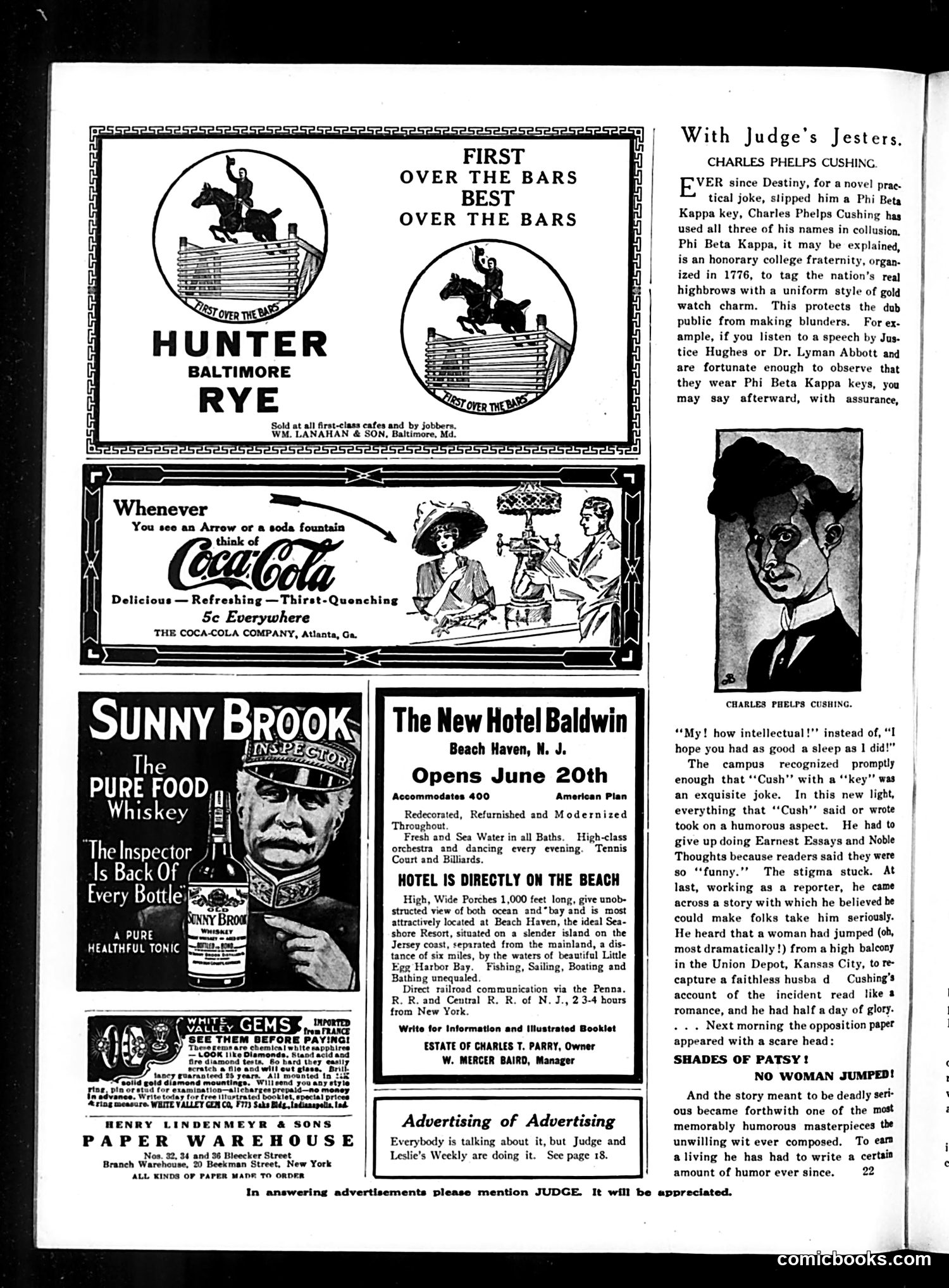
This page is primarily **advertising and humorous commentary** rather than political satire. The main content is a profile of Charles Phelps Cushing, a Judge magazine writer, illustrated with his portrait. **The Cushing Article:** The piece describes how Cushing, who received an honorary Phi Beta Kappa key (a symbol of intellectual achievement), became typecast as a humorist. The joke: his colleagues treated everything he said as a joke because of the "key." Later, when working as a reporter, Cushing wrote a serious story about a woman jumping from a Kansas City train station. The next day, a rival newspaper revealed the woman hadn't actually jumped—undermining his dramatic account. The irony: his attempt at serious journalism became his most "humorous masterpiece" precisely because it failed. **The satire's point:** Cushing is trapped by reputation; his earnestness is perpetually undermined by others' expectations. **Surrounding ads** promote whiskey, Coca-Cola, and a New Jersey hotel—typical period advertising with no satirical content visible here.
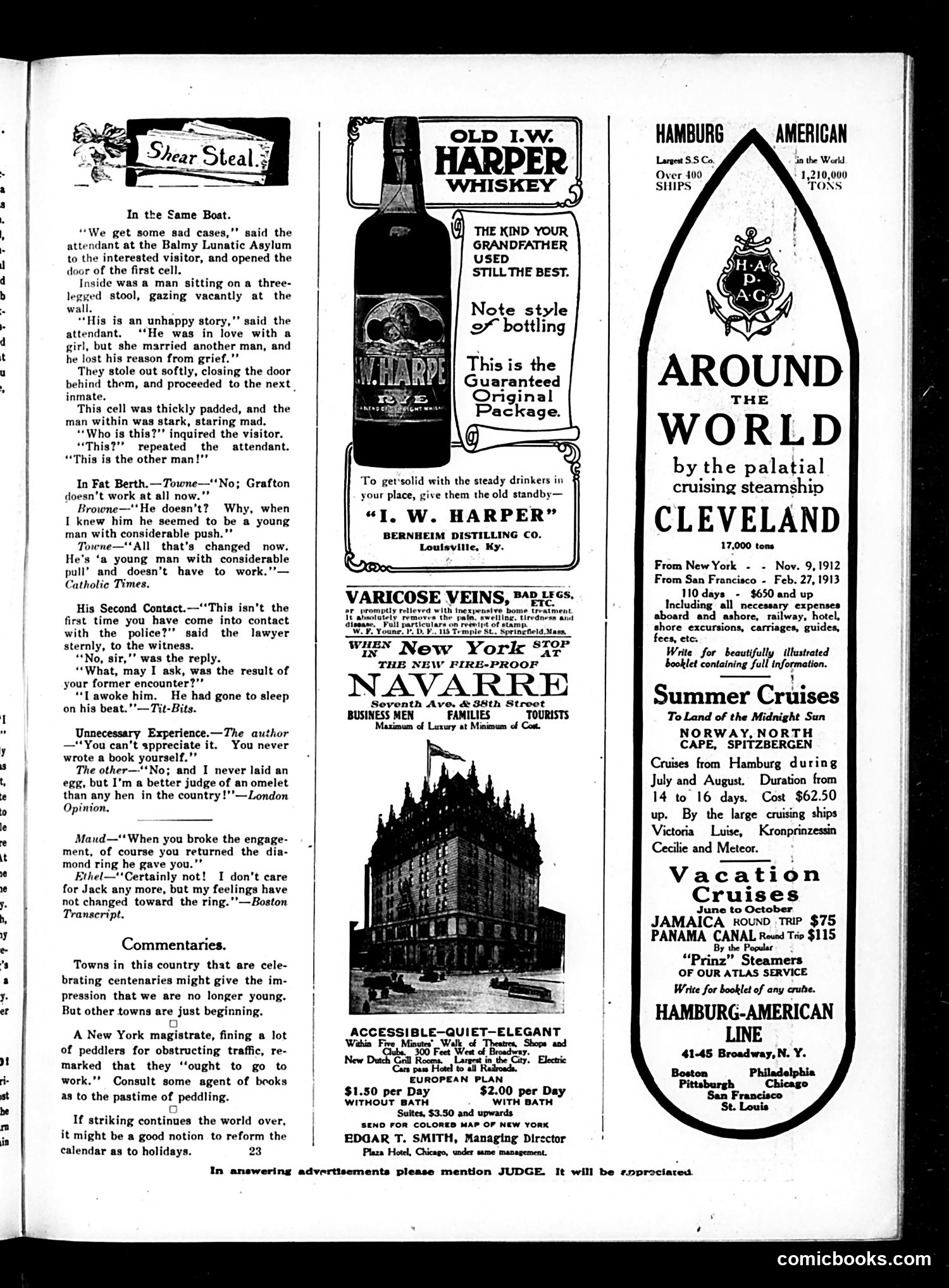
This page features a darkly comic short story rather than a visual cartoon. The joke plays on the phrase "in the same boat" (meaning shared circumstances). **The Setup:** An asylum attendant shows a visitor two inmates. The first man lost his sanity from unrequited love—a girl married another man instead of him. **The Punchline:** When shown the second violent, raving inmate, the attendant reveals: "This is the other man!"—the one the girl *actually* married. **The Satire:** The joke mocks romantic disappointment by suggesting that *both* the rejected suitor and the woman's actual husband are equally driven mad by the situation. Marriage itself is implicitly presented as a form of insanity, a common theme in early 20th-century satirical humor. The irony is that both men—one who lost the girl and one who won her—end up institutionalized, making them truly "in the same boat." The surrounding content includes other brief humorous anecdotes and period advertisements (whiskey, steamship cruises, hotels).
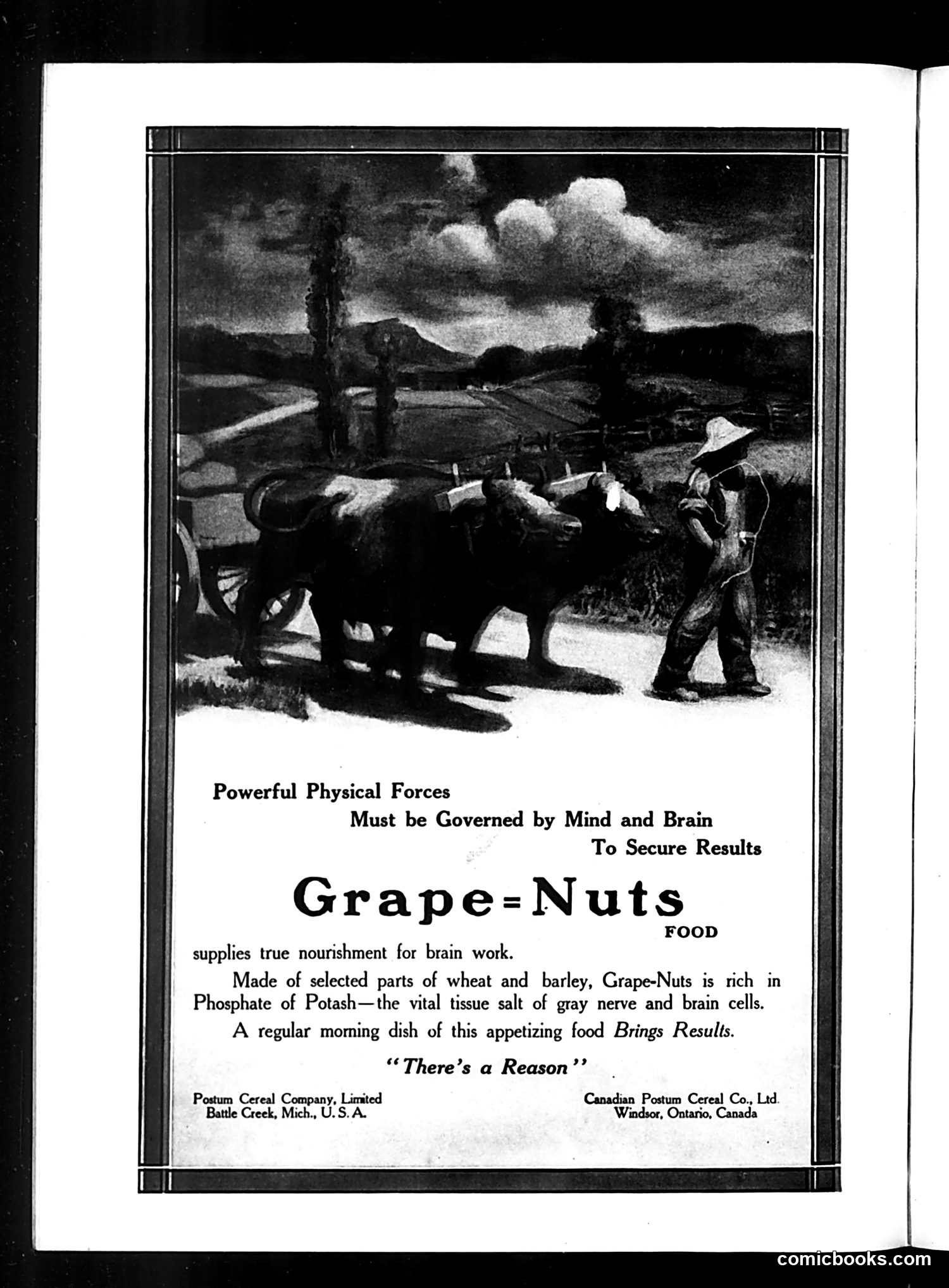
This page is primarily a **cereal advertisement**, not political satire. It features a vintage Grape-Nuts ad using an oxen-pulling-a-plow image to illustrate its marketing concept. The ad's logic: just as oxen require a strong "mind and brain" to direct their "powerful physical forces," humans need proper nutrition (specifically Grape-Nuts cereal) to govern their mental and physical capabilities effectively. The cereal claims to supply "Phosphate of Potash" essential for "gray nerve and brain cells." The catchphrase "There's a Reason" was Grape-Nuts's actual historical slogan. This represents early 20th-century marketing that linked food consumption to mental/physical performance—reflecting period pseudoscientific beliefs about nutrition and cerebral function. The appeal targets readers seeking competitive advantage through dietary optimization.