
Judge, 1912-06-22 · page 13 of 24
Judge — June 22, 1912 — page 13: what you’re looking at
What you’re looking at
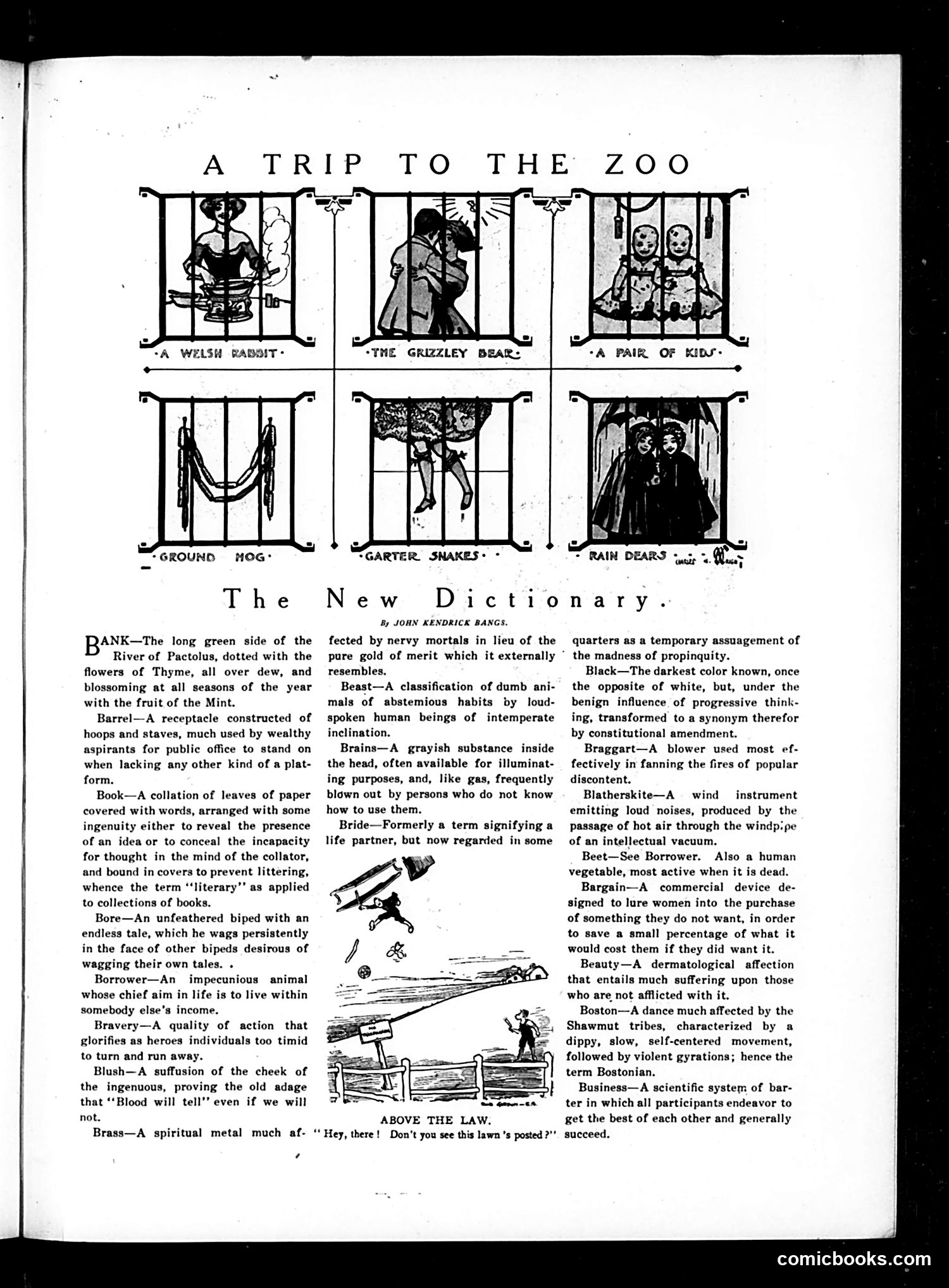
This Judge page combines two satirical features. The top section presents zoo animals in cages with humorous labels playing on double meanings: "A Welsh Rabbit" (the dish, not an animal), "Garter Shakes" (garters, not snakes), and "Rain Dears" (a pun). These mock visitors' expectations at actual zoos. The main content is "The New Dictionary" by John Kendrick Bangs, a popular humorist. It offers cynical redefinitions of common words, satirizing contemporary society. Examples include defining "Barrel" as a platform for political candidates lacking substance, "Borrower" as someone living off others' income, and "Business" as mutual deception. The cartoon "Above the Law" shows someone ignoring a "Posted" sign, mocking disregard for rules. Overall, the page uses wordplay and mock-definitions to critique political corruption, materialism, pretension, and social hypocrisy—typical Judge magazine fare attacking prominent follies of the era.
📄 Transcribed text from this page (OCR, searchable)
Machine-transcribed from the original scan — historical spelling and the odd misread are preserved.
HOG: The ANK—The long green side of the River of Pactolus, dotted with the flowers of Thyme, all over dew, and blossoming at all seasons of the year with the fruit of the Mint. Barrel—A receptacle constructed of hoops and staves, much used by wealthy aspirants for public office to stand on when lacking any other kind of a plat- form. Book—A collation of leaves of paper covered with words, arranged with some ingenuity either to reveal the presence of an idea or to conceal the incapacity for thought in the mind of the collator, and bound in covers to prevent littering, whence the term ‘‘literary’’ as applied to collections of books. Bore—An unfeathered biped with an endless tale, which he wags persistently in the face of other bipeds desirous of wagging their own tales. . Borrower—An impecunious animal whose chief aim in life is to live within somebody else’s income. Bravery—A quality of action that glorifies as heroes individuals too timid to turn and run away. Blush—A suffusion of the cheek of the ingenuous, proving the old adage that ‘‘Blood will tell’? even if we will not. Brass—A spiritual metal much af- * GROUND ’ New By JOHN KENDRICK BANGS. fected by nervy mortals in lieu of the pure gold of merit which it externally resembles, Beast—A classification of dumb ani- mals of abstemious habits by loud- spoken human beings of intemperate inclination. Brains—A grayish substance inside the head, often available for illuminat- ing purposes, and, like gas, frequently blown out by persons who do not know how to use them. Bride—Formerly a term signifying a life partner, but now regarded in some ABOVE THE LAW. Dictionary quarters as a temporary assuagement of * the madness of propinquity. Black—The darkest color known, once the opposite of white, but, under the benign influence of progressive think- ing, transformed to a synonym therefor by constitutional amendment. Braggart—A blower used most ef- fectively in fanning the fires of popular discontent. Blatherskite—A = wind emitting loud noises, produced by the passage of hot air through the windp:pe of an intellectual vacuum. Beet—See Borrower. Also a human vegetable, most active when it is dead. Bargain—A commercial device de- signed to lure women into the purchase of something they do not want, in order to save a small percentage of what it would cost them if they did want it. Beauty—A dermatological affection that entails much suffering upon those who are not afflicted with it. Boston—A dance much affected by the Shawmut tribes, characterized by a dippy, slow, self-centered movement, followed by violent gyrations; hence the term Bostonian. Business—A scientific system of bar- ter in which all participants endeavor to get the best of each other and generally instrument “Hey, there! Don't you see this lawn 's posted ?’’ succeed. comicbooks.com