
Judge, 1912-06-22 · page 4 of 24
Judge — June 22, 1912 — page 4: what you’re looking at
What you’re looking at
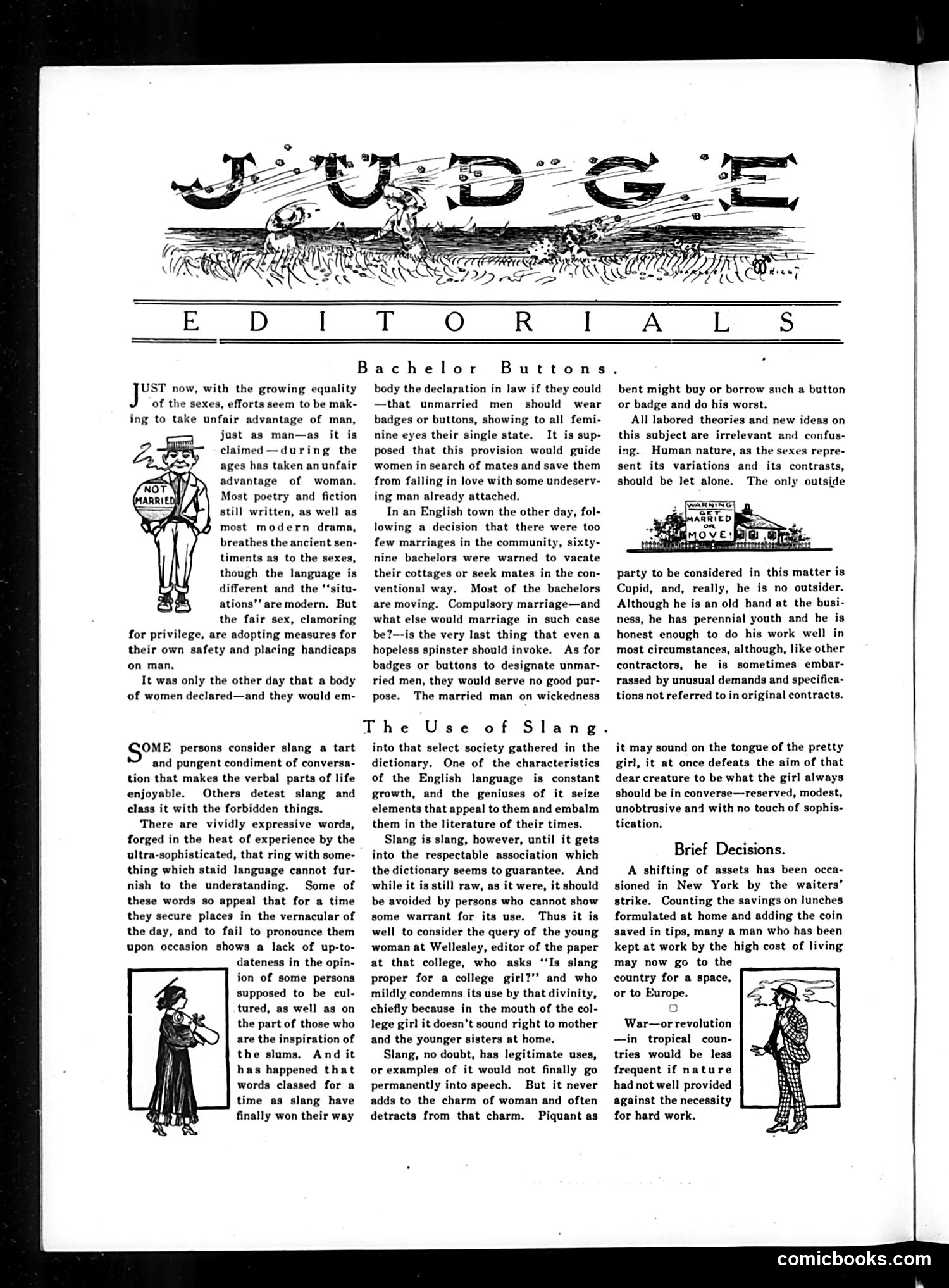
This page contains three separate editorial pieces on social issues rather than political cartoons: 1. **"Bachelor Buttons"** discusses unmarried men wearing badges to signal their status—a proposal debated in English towns. The satire mocks both the idea itself and broader debates about gender equality and marriage conventions. 2. **"The Use of Slang"** critiques informal speech, particularly among young women. The author questions whether slang is appropriate for "college girls" while acknowledging it has legitimate linguistic roots. The piece represents period anxieties about propriety and women's education. 3. **"Brief Decisions"** offers short commentary on economic strikes and tropical warfare. The accompanying illustrations are period-appropriate figure drawings rather than caricatures. The page reflects early-20th-century concerns about social propriety, gender roles, and linguistic standards.
📄 Transcribed text from this page (OCR, searchable)
Machine-transcribed from the original scan — historical spelling and the odd misread are preserved.
UST now, with the growing equality of the sexes, efforts seem to be mak- ing to take unfair advantage of man, just as man—as it is claimed —during the ages has taken anunfair advantage of woman. Most poetry and fiction still written, as well as most modern drama, breathes the ancient sen- timents as to the sexes, though the language is different and the ‘‘situ- ations’’ are modern. But the fair sex, clamoring for privilege, are adopting measures for their own safety and placing handicaps on man. It was only the other day that a body of women declared—and they would em- Some persons consider slang a tart and pungent condiment of conversa- tion that makes the verbal parts of life enjoyable. Others detest slang and class it with the forbidden things. There are vividly expressive words, forged in the heat of experience by the ultra-sophisticated, that ring with some- thing which staid language cannot fur- nish to the understanding. Some of these words so appeal that for a time they secure places in the vernacular of the day, and to fail to pronounce them upon occasion shows a lack of up-to- dateness in the opin- jon of some persons supposed to be cul- tured, as well as on the part of those who are the inspiration of the slums. And it has happened that words classed for a time as slang have finally won their way Bachelor body the declaration in law if they could —that unmarried men should wear badges or buttons, showing to all femi- nine eyes their single state. It is sup- posed that this provision would guide women in search of mates and save them from falling in love with some undeserv- ing man already attached. In an English town the other day, fol- lowing a decision that there were too few marriages in the community, sixty- nine bachelors were warned to vacate their cottages or seek mates in the con- ventional way. Most of the bachelors are moving. Compulsory marriage—and what else would marriage in such case be?—is the very last thing that evena hopeless spinster should invoke. As for badges or buttons to designate unmar- ried men, they would serve no good pur- pose. The married man on wickedness The Use of Slang into that select society gathered in the dictionary. One of the characteristics of the English language is constant growth, and the geniuses of it seize elements that appeal to them and embalm them in the literature of their times. Slang is slang, however, until it gets into the respectable association which the dictionary seems to guarantee. And while it is still raw, as it were, it should be avoided by persons who cannot show some warrant for its use. Thus it is well to consider the query of the young woman at Wellesley, editor of the paper at that college, who asks “‘Is slang proper for a college girl?” and who mildly condemns its use by that divinity, chiefly because in the mouth of the col- lege girl it doesn’t sound right to mother and the younger sisters at home. Slang, no doubt, has legitimate uses, or examples of it would not finally go permanently into speech. But it never adds to the charm of woman and often detracts from that charm. Piquant as Buttons. bent might buy or borrow such a button or badge and do his worst. All labored theories and new ideas on this subject are irrelevant and confus- ing. Human nature, as the sexes repre- sent its variations and its contrasts, should be let alone. The only outside party to be considered in this matter is Cupid, and, really, he is no outsider. Although he is an old hand at the busi- ness, he has perennial youth and he is honest enough to do his work well in most circumstances, although, like other contractors, he is sometimes embar- rassed by unusual demands and specifica- tions not referred to in original contracts. it may sound on the tongue of the pretty girl, it at once defeats the aim of that dear creature to be what the girl always should be in converse—reserved, modest, unobtrusive and with no touch of sophis- tication. Brief Decisions. A shifting of assets has been occa- sioned in New York by the waiters’ strike. Counting the savings on lunches formulated at home and adding the coin saved in tips, many a man who has been kept at work by the high cost of living may now go to the country for a space, or to Europe. War—or revolution —in tropical coun- tries would be less frequent if nature had not well provided against the necessity for hard work. comicbooks.com