
Judge, 1912-06-22 · page 10 of 24
Judge — June 22, 1912 — page 10: what you’re looking at
What you’re looking at
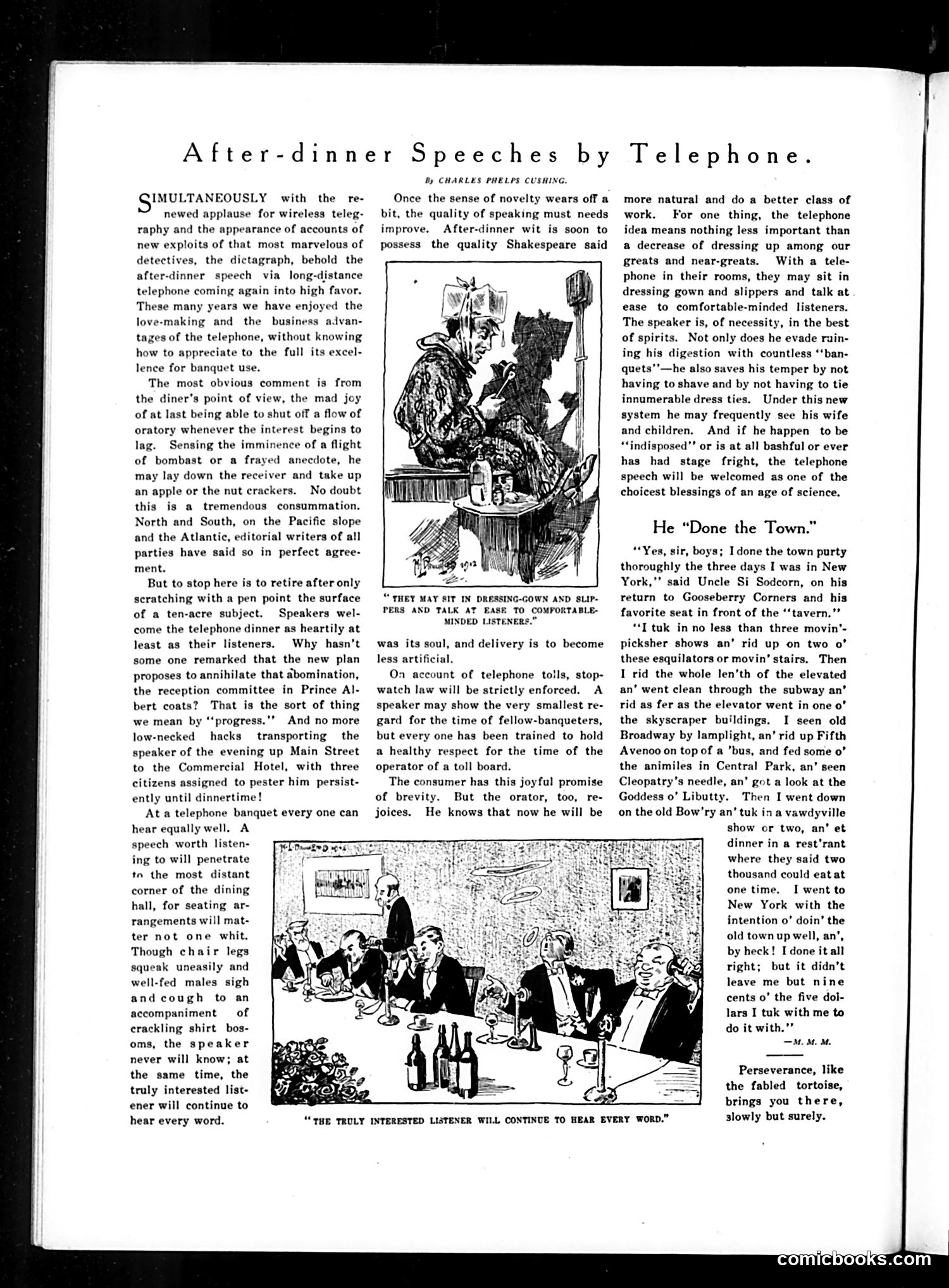
This 1910s-era satirical piece mocks the emerging technology of telephone speeches at formal dinners. The author argues that while listeners benefit from easily tuning out boring speakers, the real advantage goes to speakers themselves—they can now avoid the social ordeal of formal banquets. The satire targets the pretensions of after-dinner orators: no more uncomfortable formal wear, no need to socialize with tedious "reception committees" in formal dress, no shaving or tying cravats, and ability to speak from home in a dressing gown. The cartoons show both the speaker's comfort (first illustration) and diners who can now ignore the speech while eating (second illustration). The piece celebrates how technology liberates the speaker from the exhausting performance rituals of upper-class formal dining, while mocking how little speakers actually cared about their audiences' comfort—they mainly wanted to avoid the social theater themselves.
📄 Transcribed text from this page (OCR, searchable)
Machine-transcribed from the original scan — historical spelling and the odd misread are preserved.
G/MULTANEOUSLY with the re- newed applause for wireless teleg- raphy and the appearance of accounts of new exploits of that most marvelous of detectives, the dictagraph, behold the after-dinner speech via long-distance telephone coming again into high favor. These many years we have enjoyed the love-making and the business advan- tages of the telephone, without knowing how to appreciate to the full its excel- lence for banquet use. The most obvious comment is from the diner's point of view, the mad joy of at last being able to shut off a flow of oratory whenever the interest begins to lag. Sensing the imminence of a flight of bombast or a frayed anecdote, he may lay down the receiver and take up an apple or the nut crackers. No doubt this is a tremendous consummation. North and South, on the Pacific slope and the Atlantic, editorial writers of all parties have said so in perfect agree- ment. But to stop here is to retire after only scratching with a pen point the surface of a ten-acre subject. Speakers wel- come the telephone dinner as heartily at least as their listeners. Why hasn't some one remarked that the new plan proposes to annihilate that abomination, the reception committee in Prince Al- bert coats? That is the sort of thing we mean by “‘progress.’’ And no more low-necked hacks transporting the speaker of the evening up Main Street to the Commercial Hotel, with three citizens assigned to pester him persist- ently until dinnertime! Ata telephone banquet every one can hear equally well. A speech worth listen- ing to will penetrate { te the most distant corner of the dining hall, for seating ar- rangements will mat- ter not one whit. Though chair legs squeak uneasily and well-fed males sigh andcough to an accompaniment of crackling shirt bos- oms, the speaker never will know; at the same time, the truly interested list- ener will continue to hear every word. PlOwEro wee After-dinner Speeches by Telephone. By CHARLES PHELPS CUSHING. Once the sense of novelty wears off a bit, the quality of speaking must needs improve. After-dinner wit is soon to possess the quality Shakespeare said “ THEY MAY SIT IN DRESSING-GOWN AND SLIP- PERS AND TALK AT EASE TO COMPORTABLE- MINDED LISTENERS.” was its soul, and delivery is to become less artificial. On account of telephone tolls, stop- watch law will be strictly enforced. A speaker may show the very smallest re- gard for the time of fellow-banqueters, but every one has been trained to hold a healthy respect for the time of the operator of a toll board. The consumer has this joyful promise of brevity. But the orator, too, re- joices. He knows that now he will be “THE TRULY INTERESTED LISTENER WILL CONTINUE TO HEAR EVERY WORD.’ more natural and do a better class of work. For one thing, the telephone idea means nothing less important than a decrease of dressing up among our greats and near-greats. With a tele- phone in their rooms, they may sit in dressing gown and slippers and talk at ease to comfortable-minded listeners. The speaker is, of necessity, in the best of spirits. Not only does he evade rain- ing his digestion with countless ‘‘ban- quets’’—he also saves his temper by not having to shave and by not having to tie innumerable dress ties. Under this new system he may frequently see his wife and children. And if he happen to be “‘indisposed”’ or is at all bashful or ever has had stage fright, the telephone speech will be welcomed as one of the choicest blessings of an age of science. He “Done the Town.” “Yes, sir, boys; Idone the town purty thoroughly the three days I was in New York,’’ said Uncle Si Sodcorn, on his return to Gooseberry Corners and his favorite seat in front of the ‘‘tavern. “T tuk inno less than three movi picksher shows an’ rid up on two o° these esquilators or movin’ stairs. Then I rid the whole len’th of the elevated an’ went clean through the subway an’ rid as fer as the elevator went in one o° the skyscraper buildings. I seen old Broadway by lamplight, an’ rid up Fifth Avenoo on top of a ’bus, and fed some o° the animiles in Central Park, an’ seen Cleopatry’s needle, an’ got a look at the Goddess 0’ Libutty. Then I went down on the old Bow’ry an’ tuk in a vawdyville show or two, an’ et dinner in a rest’rant where they said two thousand could eat at one time. I went to New York with the intention 0’ doin’ the old town up well, an’, by heck! I done it all right; but it didn’t leave me but nine cents 0’ the five dol- lars I tuk with me to do it with.’” —M. M. M. Perseverance, like the fabled tortoise, brings you there, » slowly but surely.