
Judge, 1912-06-22 · page 15 of 24
Judge — June 22, 1912 — page 15: what you’re looking at
What you’re looking at
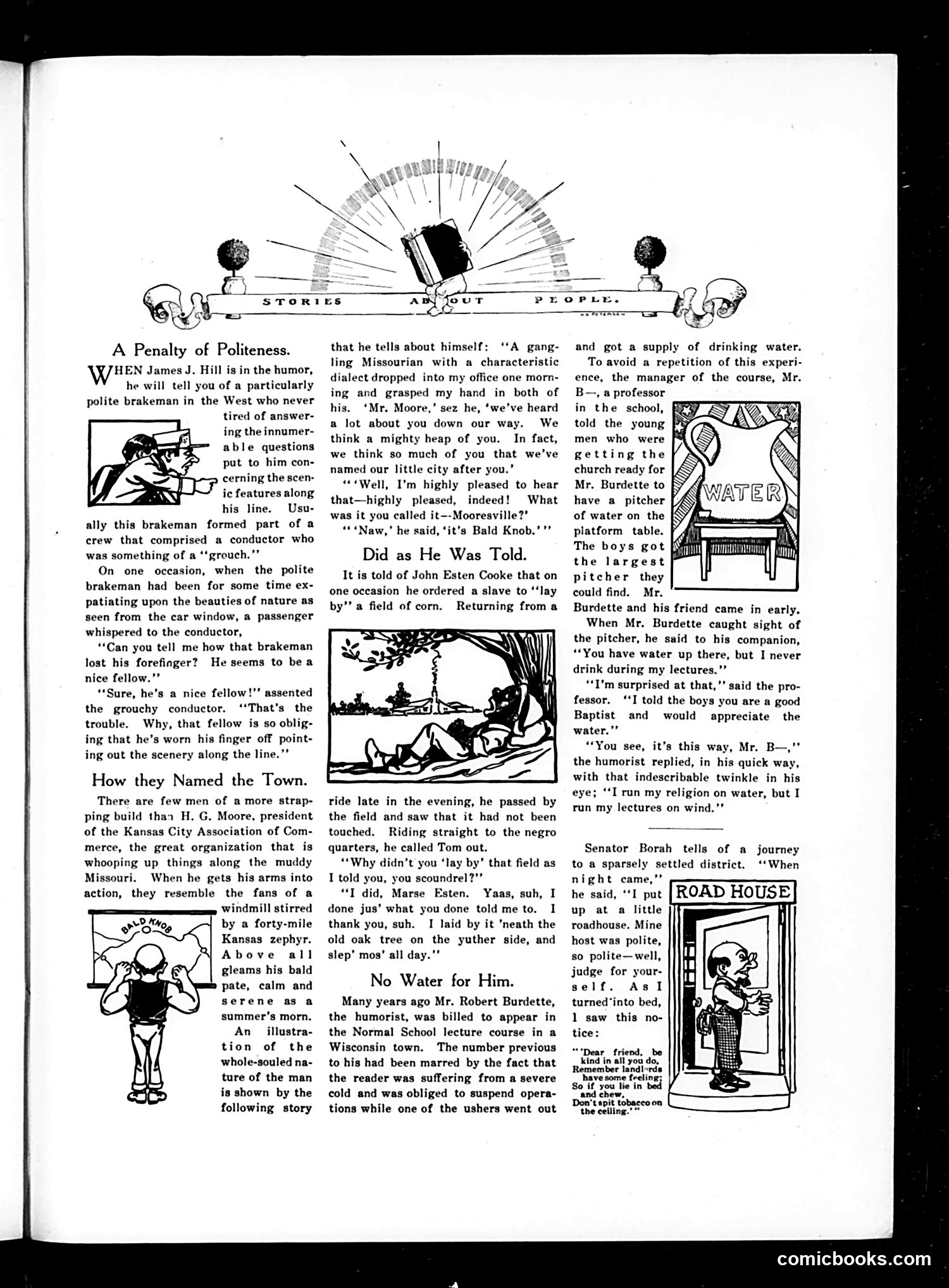
This page from *Judge* magazine contains three humorous anecdotes satirizing politeness and absent-mindedness among prominent figures. **"A Penalty of Politeness"** mocks an overly-obliging railroad brakeman whose excessive helpfulness (pointing out scenery) has worn away his finger—a visual joke about the consequences of servility. **"How they Named the Town"** features H.G. Moore, a Kansas City businessman, whose pride is deflated when a visitor reveals the town named after him is actually called "Bald Knob"—a crude reference to Moore's baldness. The joke ridicules his vanity. **"No Water for Him"** describes humorist Robert Burdette's witty rejoinder when offered water before a lecture: he "runs his religion on water" but "lectures on wind"—a self-deprecating quip about his own verbose speaking style. The page also includes a brief anecdote about John Esten Cooke and an enslaved man misinterpreting orders, reflecting the period's casual racism in its humor. The central theme is deflating pomposity through wit and misunderstanding.
📄 Transcribed text from this page (OCR, searchable)
Machine-transcribed from the original scan — historical spelling and the odd misread are preserved.
A Penalty of Politeness. HEN James J. Hill is in the humor, he will tell you of a particularly polite brakeman in the West who never tired of answer- ing the innumer- able questions put to him con- cerning the scen- ic features along his line. Usu- ally this brakeman formed part of a crew that comprised a conductor who was something of a ‘‘grouch.’” On one occasion, when the polite brakeman had been for some time ex- patiating upon the beauties of nature as seen from the car window, a passenger whispered to the conductor, ‘Can you tell me how that brakeman lost his forefinger? He seems to be a nice fellow.”’ “*Sure, he’s a nice fellow!’’ assented the grouchy conductor. ‘‘That’s the trouble. Why, that fellow is so oblig- ing that he’s worn his finger off point- ing out the scenery along the line.”’ How they Named the Town. There are few men of amore strap- ping build than H. G. Moore, president of the Kansas City Association of Com- merce, the great organization that is whooping up things along the muddy Missouri. When he gets his arms into action, they resemble the fans of a windmill stirred by a forty-mile Kansas zephyr. Above all gleams his bald pate, calm and serene as a summer's morn. An illustra- tion of the whole-souled na- ture of the man is shown by the following story ry PO that he tells about himself: ‘‘A gang- ling Missourian with a characteristic dialect dropped into my office one morn- ing and grasped my hand in both of his. ‘Mr. Moore,’ sez he, ‘we’ve heard a lot about you down our way. We think a mighty heap of you. In fact, we think so much of you that we've named our little city after you.’ “*Well, I'm highly pleased to hear that—highly pleased, indeed! What was it you called it—-Mooresville?’ “«*Naw,’ he said, ‘it’s Bald Knob.’’’ Did as He Was Told. It is told of John Esten Cooke that on one occasion he ordered a slave to ‘‘lay by’’ a field of corn. Returning from a ride late in the evening, he passed by the field and saw that it had not been touched. Riding straight to the negro quarters, he called Tom out. “*Why didn’t you ‘lay by’ that field as I told you, you scoundrel?’’ “I did, Marse Esten. Yaas, suh, I done jus’ what you done told me to. I thank you, suh. I laid by it ‘neath the old oak tree on the yuther side, and slep’ mos’ all day."’ No Water for Him. Many years ago Mr. Robert Burdette, the humorist, was billed to appear in the Normal School lecture course in a Wisconsin town. The number previous to his had been marred by the fact that the reader was suffering from a severe cold and was obliged to suspend opera- tions while one of the ushers went out and got a supply of drinking water. To avoid a repetition of this experi- ence, the manager of the course, Mr. B-—, a professor in the school, told the young P men who were getting the church ready for Mr. Burdette to have a pitcher of water on the platform table. [ The boys got [Mm the largest ' pitcher they could find. Mr. Burdette and his friend came in early. When Mr. Burdette caught sight of the pitcher, he said to his companion, “You have water up there, but I never drink during my lectures.’’ “I'm surprised at that,’ said the pro- fessor. ‘‘I told the boys you are a good Baptist and would appreciate the water."” “You see, it’s this way, Mr. B—,’’ the humorist replied, in his quick way, with that indescribable twinkle in his eye; ‘I run my religion on water, but I run my lectures on wind.’’ Senator Borah tells of a journey to a sparsely settled district. ‘*When night came,”’ he said, “I put | ROAD HOUSE up at a little Er roadhouse. Mine host was polite, so polite—well, judge for your- self. AslI turned‘into bed, 1 saw this no- tice: "Dear friend, be kind in all you do, Remember landI-rds have some feeling; So if you lie in and chew, pit tobaccoon the ceiling.’ comicbooks.com