
A complete issue · 24 pages · 1912
Judge — March 30, 1912
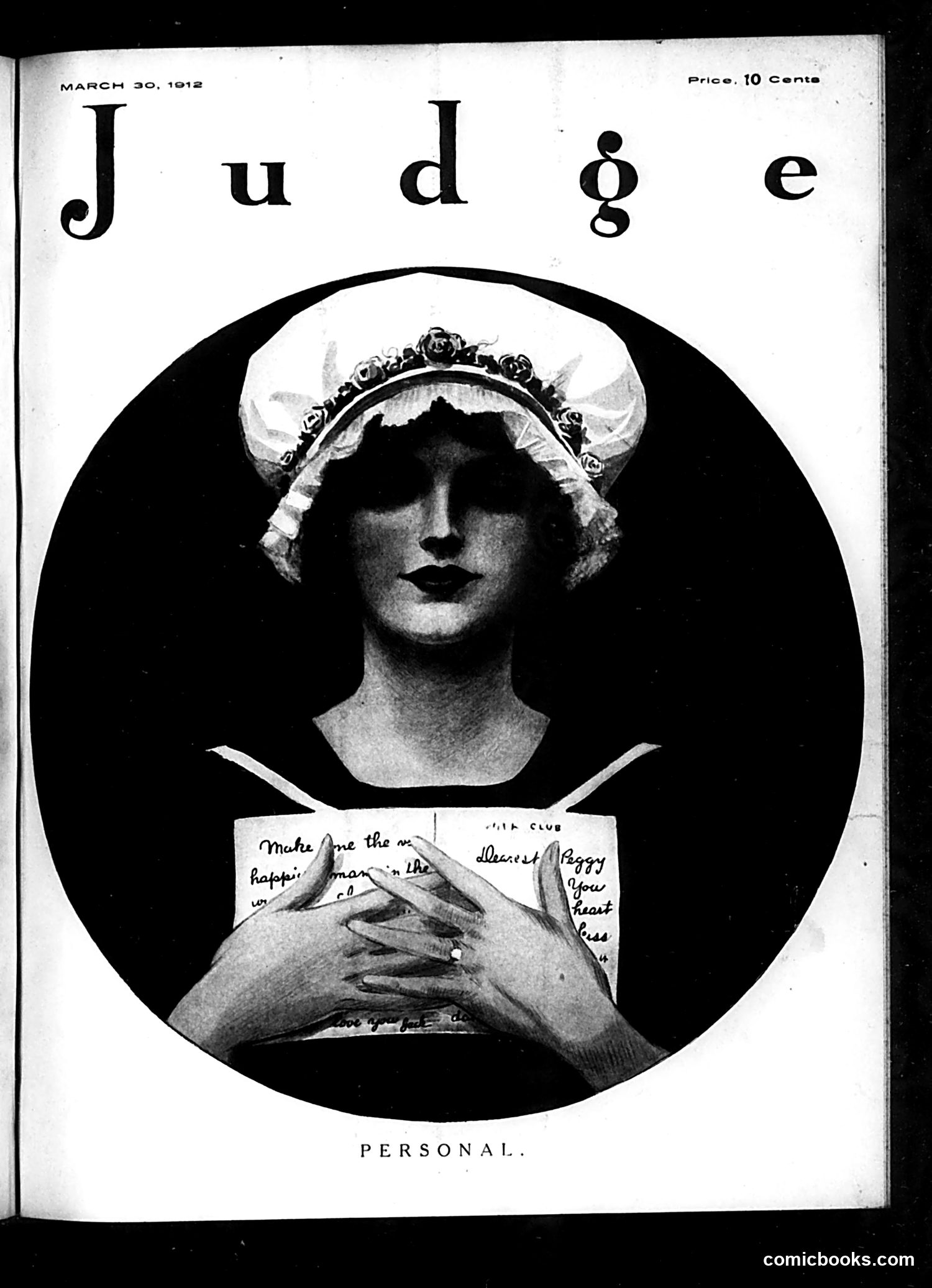
This cover features a woman in an elegant white bonnet holding what appears to be a personal letter or note. The section is titled "Personal," suggesting this relates to private correspondence or intimate matters. The image likely satirizes early 1900s social conventions around women's private lives and correspondence. The ornate hat and formal pose suggest upper-class femininity, while the prominently displayed handwritten note implies gossip or scandal—possibly mocking society's preoccupation with women's personal affairs or romantic correspondence. Without clearer text on the note itself, the specific target of satire remains unclear, but the overall tone appears to mock genteel society's fascination with women's private business during the Progressive Era.
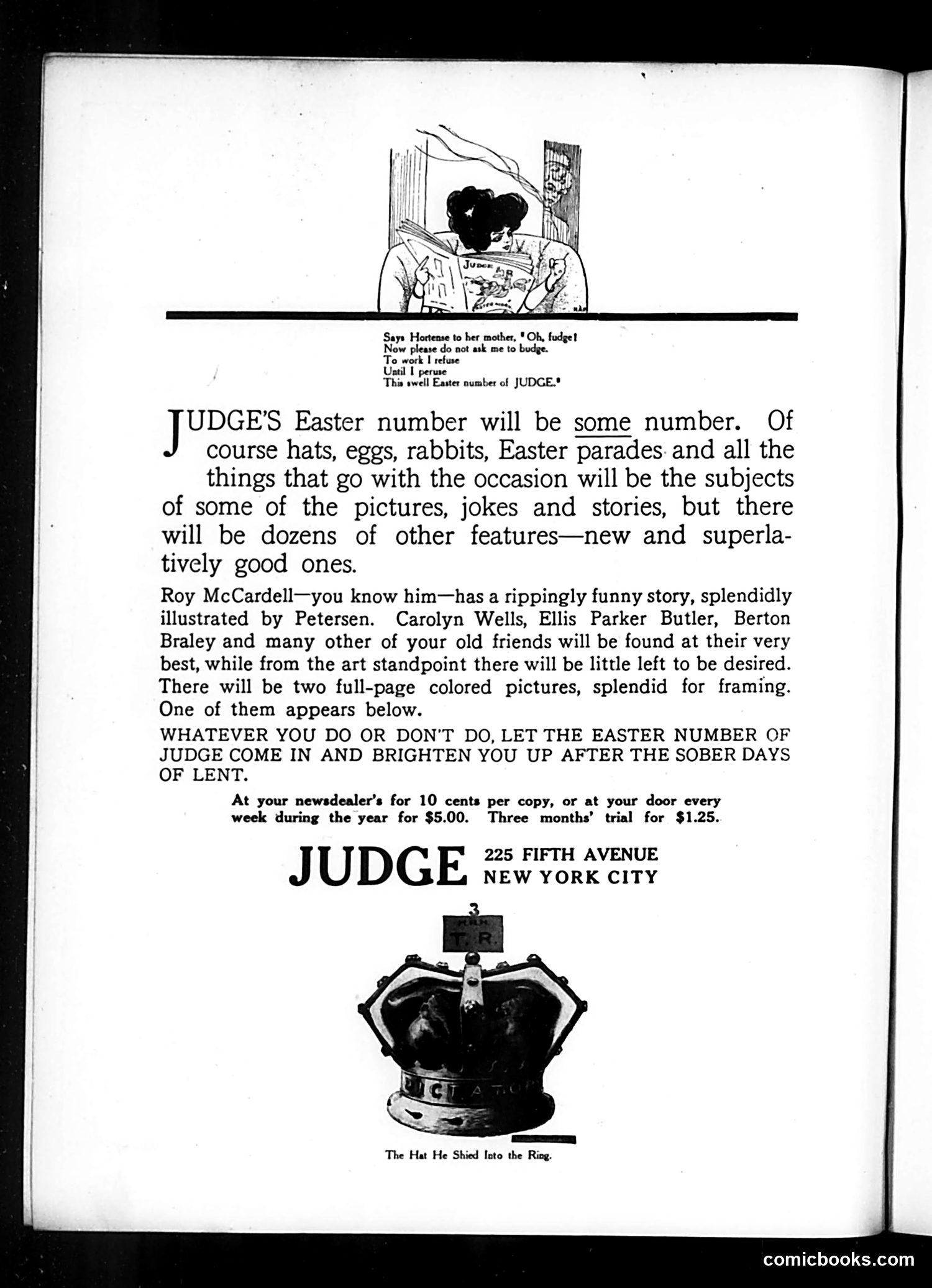
This is primarily a **magazine advertisement** for Judge's Easter issue, not a political cartoon. The small illustration at the top shows a figure (likely representing "Hootense") asking their mother not to be asked to "budge" until they've read Judge's Easter number. The ad promises Easter-themed content (hats, eggs, rabbits, parades) alongside other features by notable contributors like Roy McCardell and illustrators Petersen and Carolyn Wells. It emphasizes "dozens of other features—new and superlatively good ones." The crown emblem at bottom appears to be Judge's logo ("The Hat He Shied Into the Ring"). **Pricing**: 10 cents per copy, $5 yearly subscription, or $1.25 for three-month trial. The publication was located at 225 Fifth Avenue, New York City.
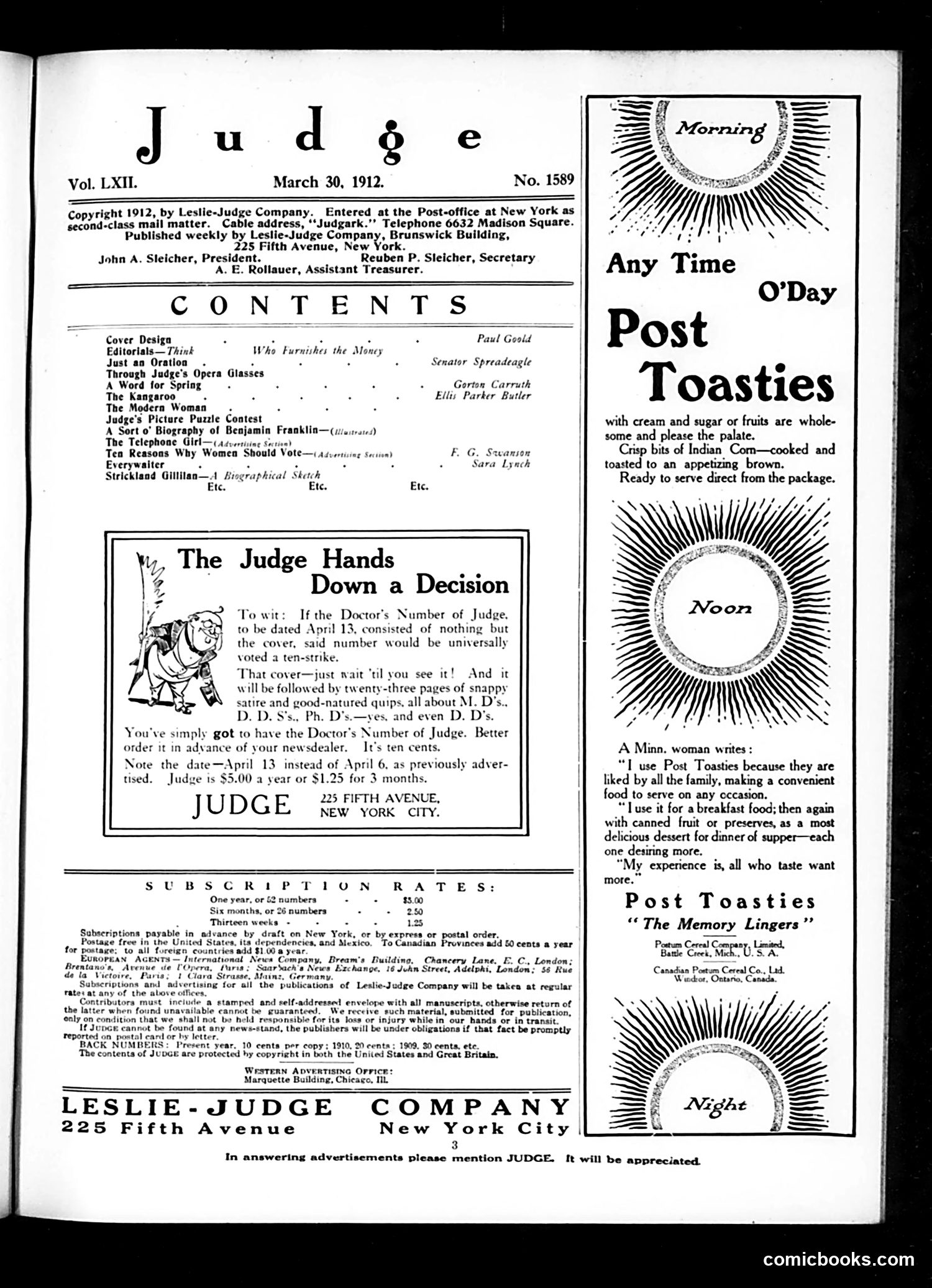
This page is primarily **advertising and subscription information** rather than political satire. The main content is "The Judge Hands Down a Decision"—a playful advertisement promoting Judge magazine's subscription offer. The cartoon shows a judge figure announcing that if readers want the "Doctor's Number" (a special April 13 issue), they must subscribe. The joke is a lighthearted legal pun: the judge "hands down a decision" requiring readers to order Judge at ten cents, framing the magazine as a judicial necessity. The right side features a Post Toasties cereal advertisement using sun/clock imagery for "Morning," "Noon," and "Night" service suggestions—typical early 20th-century food marketing. The page reflects **1912 consumer culture** rather than political commentary.
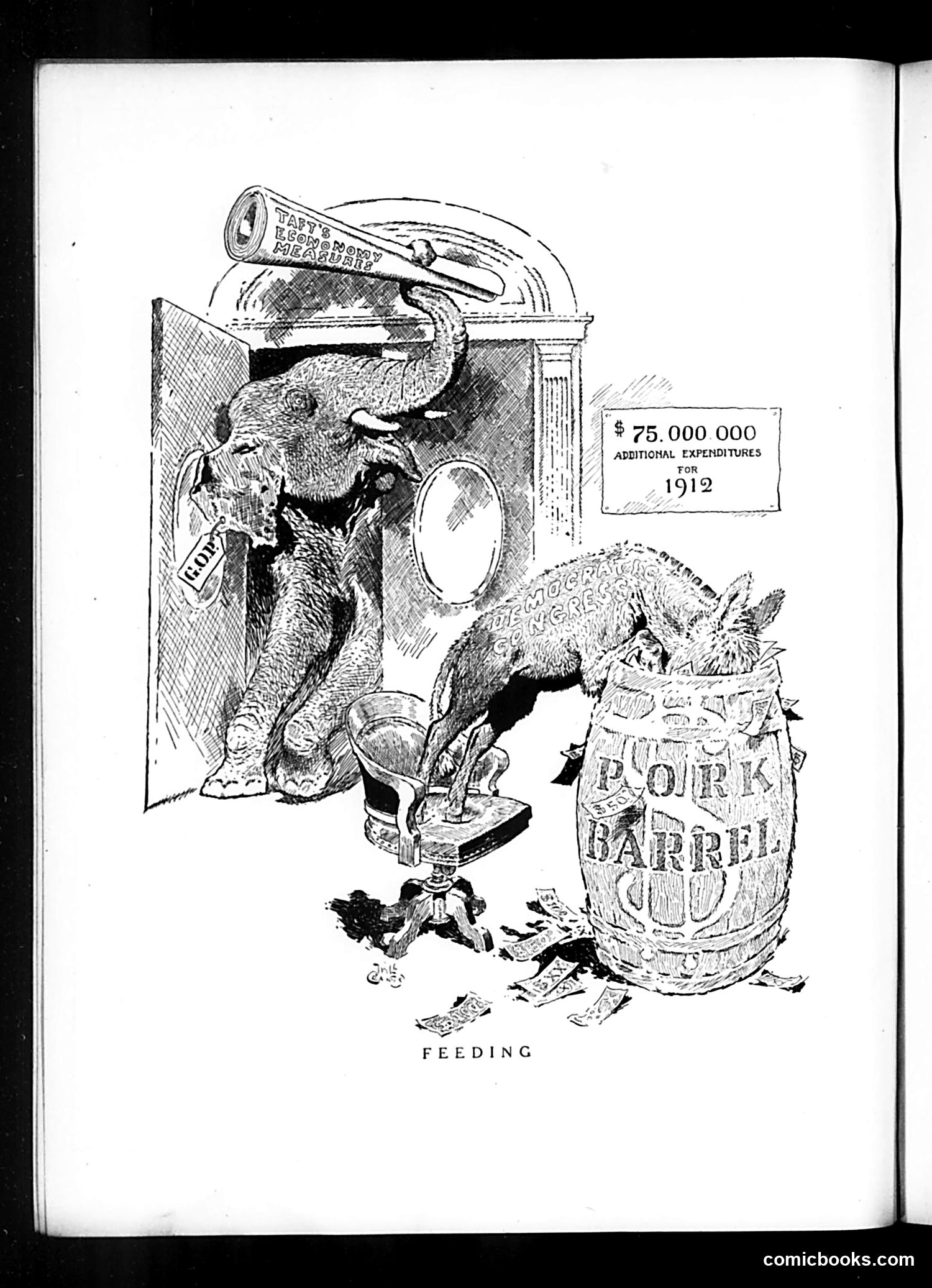
This 1912 political cartoon titled "Feeding" satirizes government spending waste. An elephant (the Republican Party symbol) is being stuffed with enormous expenditures through a funnel labeled "Taft's [icebergs?] extra treasury" while simultaneously attempting to feed a pig labeled "Pork Barrel." Money scattered on the ground suggests fiscal irresponsibility. The $75,000,000 figure referenced represents additional 1912 expenditures—a massive sum for the era. The cartoon critiques President William Howard Taft's administration for wasteful spending and corruption ("pork barrel" politics), where government funds benefit special interests rather than public good. The grotesque imagery emphasizes how bloated and unsustainable this spending has become.
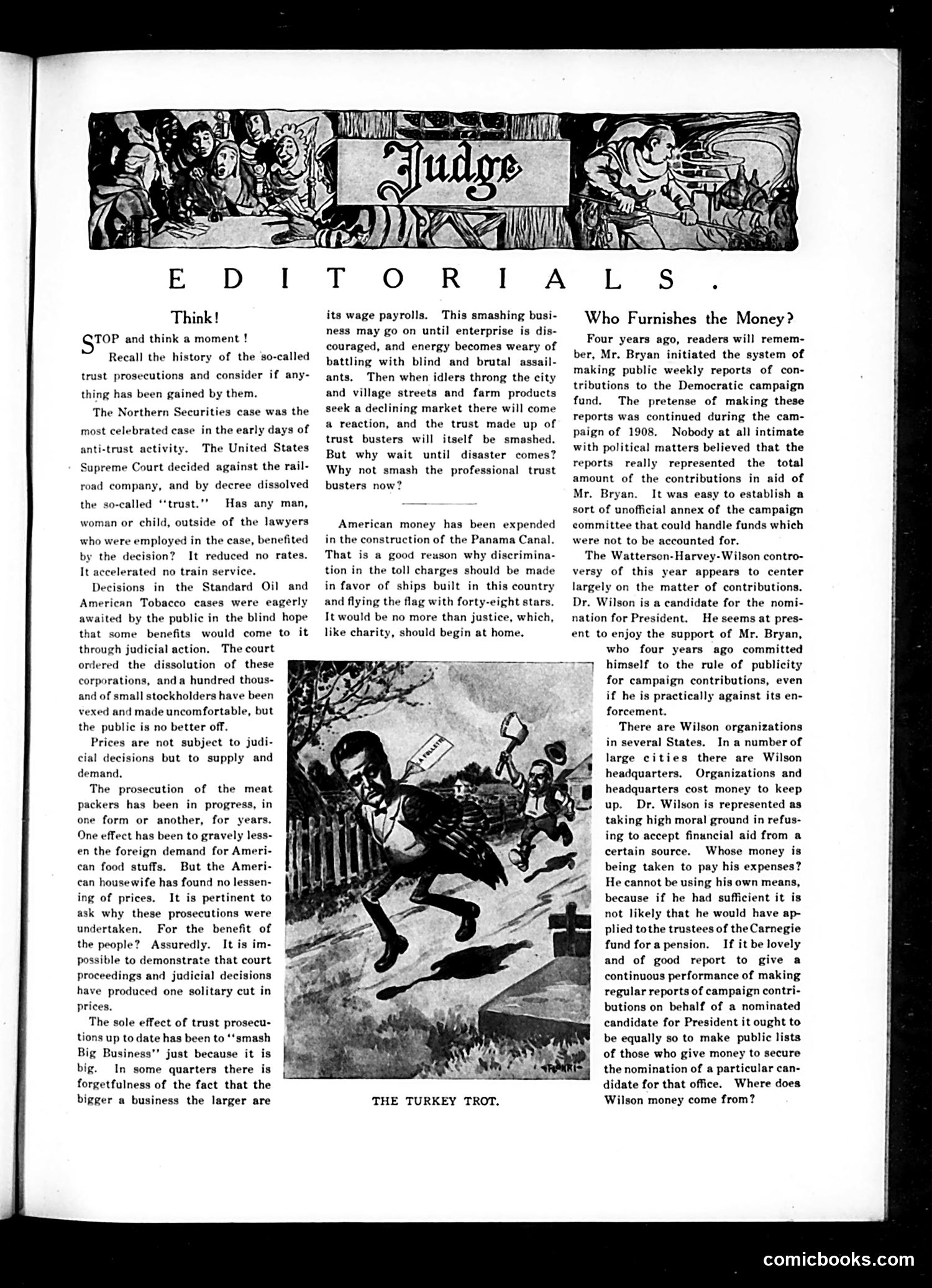
This cartoon satirizes the "Turkey Trot," a popular ragtime dance of the early 1900s that scandalized conservative Americans. The figure shown performing an exaggerated, undignified dance move represents the dance itself—depicted as chaotic and ridiculous. The accompanying editorials criticize trust prosecutions and campaign financing. The "Turkey Trot" image serves as visual metaphor for wasteful, undisciplined activity. The right column discusses Wilson's campaign contributions and questions whether his organization is accountable for its funding sources, suggesting financial impropriety. Together, the cartoon and text mock both modern social trends (the dance) and political hypocrisy—attacking "big business" while potentially engaging in questionable fundraising practices themselves.
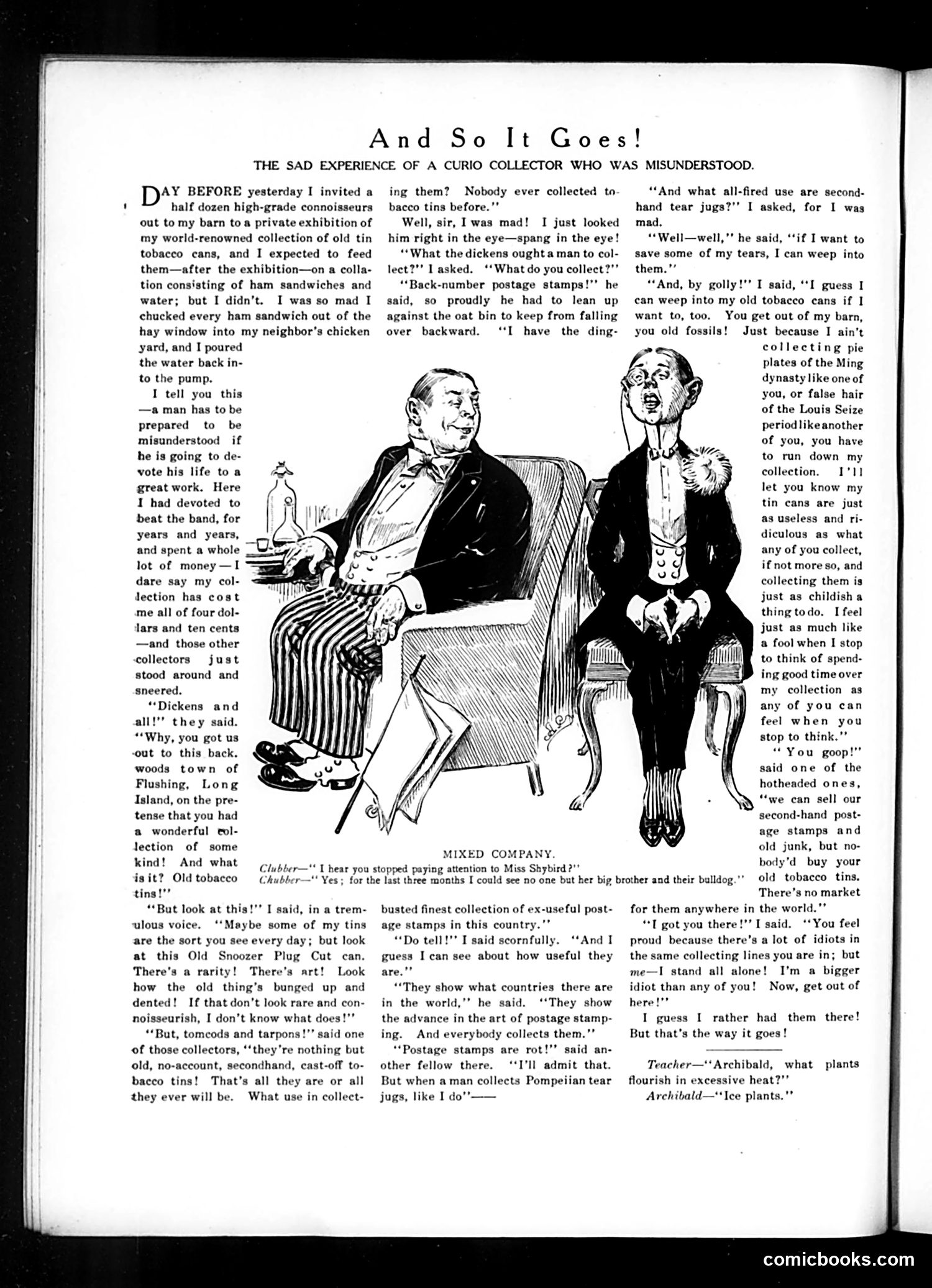
This humorous piece satirizes the pretensions of *curio collectors* and hobbyists more broadly. The narrator has devoted years and modest money ($4.10) to collecting old tobacco tins, which he treats as serious artifacts worthy of exhibition. When he invites fellow "connoisseurs" to his barn, they mock his collection mercilessly—dismissing the tins as worthless junk. The joke exposes the *arbitrary and subjective nature of collecting hobbies*. The other collectors defend their own pursuits (postage stamps, Pompeiian tear jugs, Ming dynasty pie plates) with equal reverence, yet dismiss tobacco tins as useless. The narrator's frustrated retort—that all their collections are equally pointless and childish—undercuts the entire enterprise. The satire targets the pretentious justifications collectors use to elevate their hobbies into "refined" pursuits, revealing the folly in treating any obscure object as culturally significant.
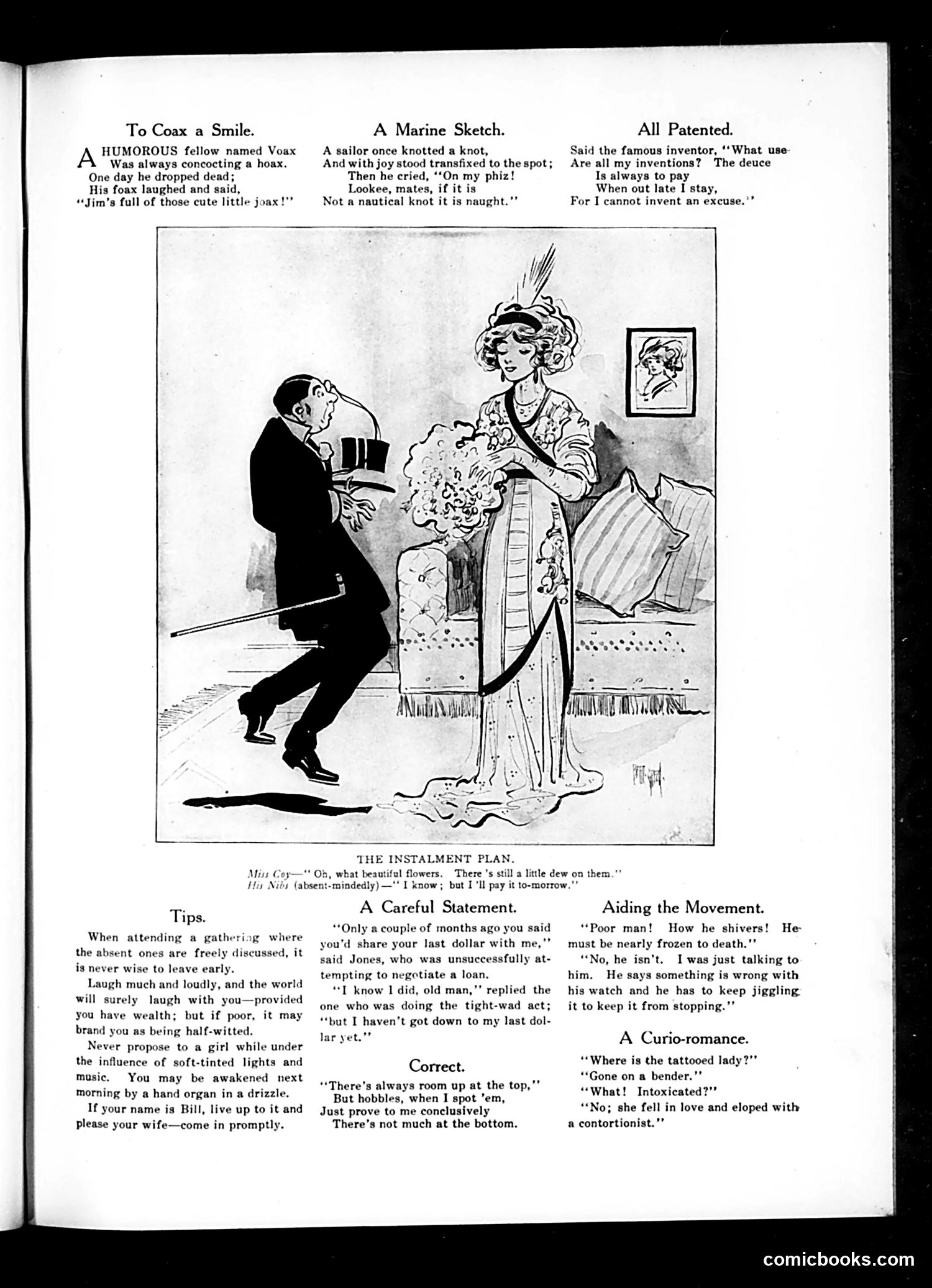
This page collects brief humorous verses and jokes typical of early 20th-century satirical magazines. The main cartoon, "The Instalment Plan," depicts a man purchasing flowers from a woman on credit—a commentary on consumer debt and the growing practice of buying goods through installment payments rather than paying upfront. The surrounding jokes are light social satire: one mocks an inventor who can't excuse his tardiness despite inventing numerous devices; another jokes about financial hypocrisy (a man unwilling to share his "last dollar" despite earlier promises); others offer cynical "tips" on social behavior and courtship. The content reflects early 1900s anxieties about modern consumer culture, changing social customs around dating and proposals, and class-based humor. There's no specific political reference—these are generic observations about human nature and contemporary middle-class life meant to provoke knowing laughter from Judge's affluent readership.
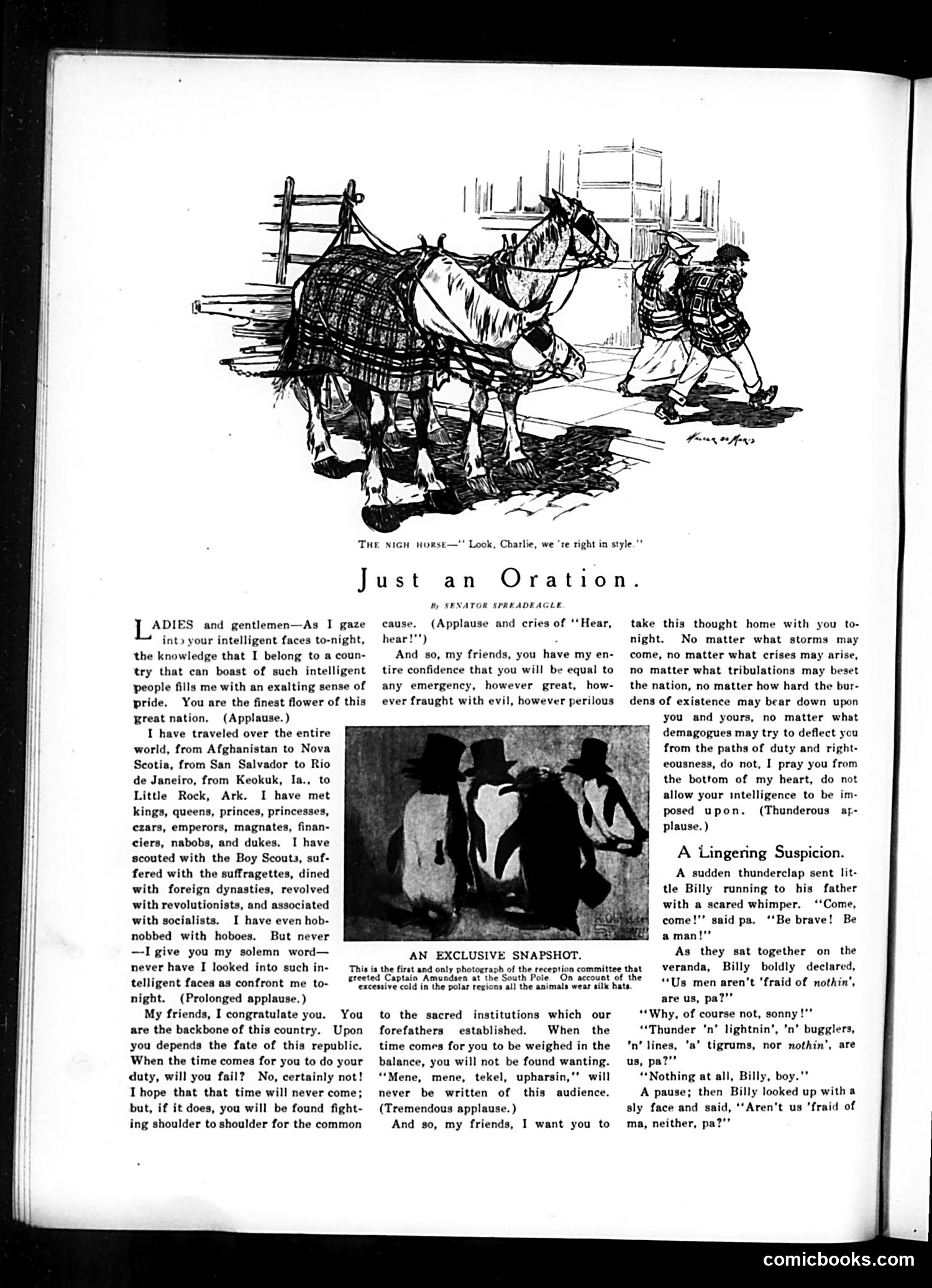
This Judge magazine page contains two satirical pieces: **"Just an Oration"** (top): A senator's flattering speech to constituents is mocked through exaggerated praise ("finest flower of this great nation"). The satire targets politicians' empty rhetoric—the senator claims to have traveled globally meeting royalty and revolutionaries, yet speaks only in vapid platitudes about duty and intelligence. The biblical reference "Mene, mene, tekel, upharsin" (a warning of divine judgment) undercuts his reassurances. The joke is that such speeches manipulate audiences through hollow compliments while saying nothing substantive. **"An Exclusive Snapshot"** (center): A caption jokes that polar explorer Captain Amundsen's reception committee at the South Pole wore silk hats despite extreme cold—absurdist humor poking fun at formal dignity in impossible circumstances. **"A Lingering Suspicion"** (bottom): A father and son discuss what they're "not afraid of"—thunder, lightning, tigers—but Billy slyly suggests they *are* afraid of mother. This gentle domestic humor reflects early 20th-century gender dynamics, where wives held domestic authority over husbands.
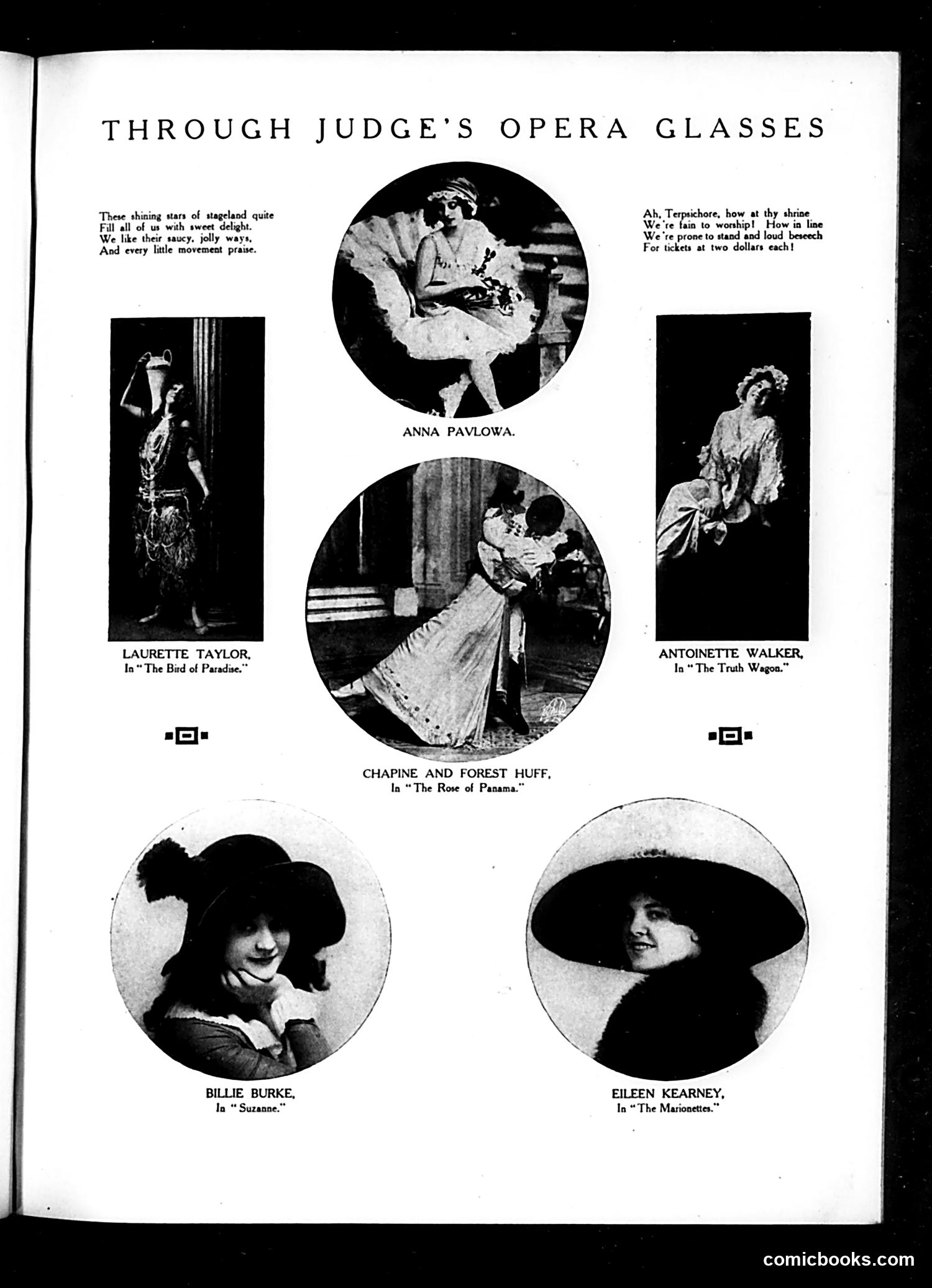
This page showcases theatrical performers of the era through photographs, framed as a tribute to stage entertainment. The title invokes opera glasses (binoculars used by theater audiences), positioning Judge magazine as observing Broadway stars. The verse celebrates actresses and dancers—their "saucy, jolly ways" and "every little movement"—while the closing couplet contains mild satire: audiences willingly pay "two dollars each" for tickets despite the high cost, suggesting both the performers' appeal and audiences' eager (perhaps excessive) spending on theater. The featured actresses—Anna Pavlowa, Laurette Taylor, Antoinette Walker, Billie Burke, Eileen Kearney, and Chapine and Forest Huff—represent popular stage attractions of the period. This is essentially illustrated theatrical promotion disguised as lighthearted social commentary about the theater-going public's devotion to performers and willingness to spend money on entertainment.
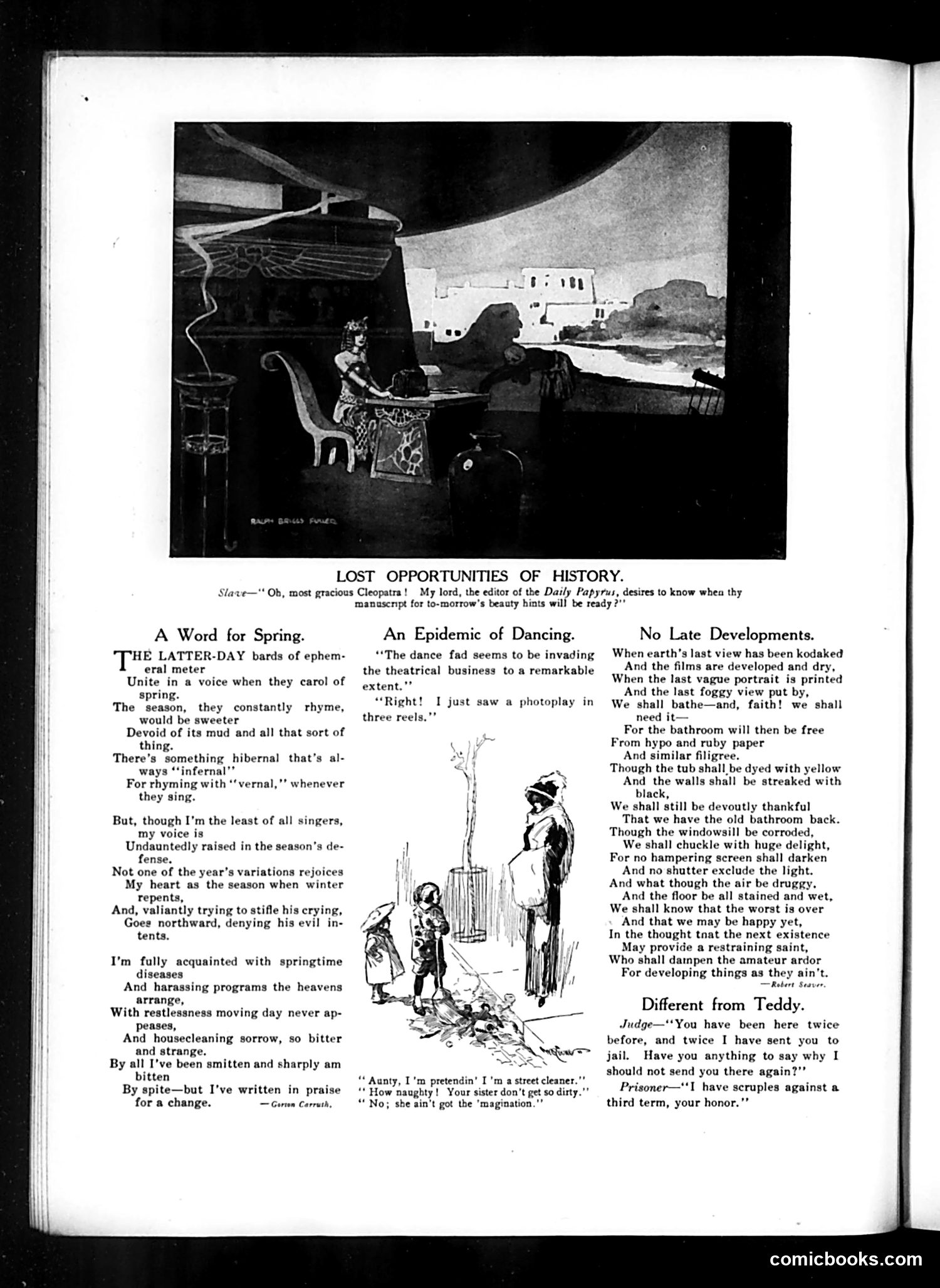
**Top Image: "Lost Opportunities of History"** Shows an ancient Egyptian scene (identifiable by the architecture and costume) where a slave addresses Cleopatra. The satire: a slave asks when the Pharaoh will have beauty tips ready for the *Daily Papyrus* newspaper—anachronistically treating ancient Egypt as if it had modern media and beauty culture. The joke mocks both contemporary obsession with beauty advice columns and the absurdity of projecting modern concerns onto history. **"Different from Teddy" Cartoon (bottom right)** A judge questions a repeat offender appearing for a third time. The prisoner claims he has "scruples against a third term." This references Theodore Roosevelt's presidency—he served two full terms, then avoided seeking a third. The joke: the criminal uses "third term" language to humorously sidestep further punishment, as if political precedent might apply to his sentencing. **Other Content** The page includes poems about spring and photography darkroom humor, unrelated to political satire.
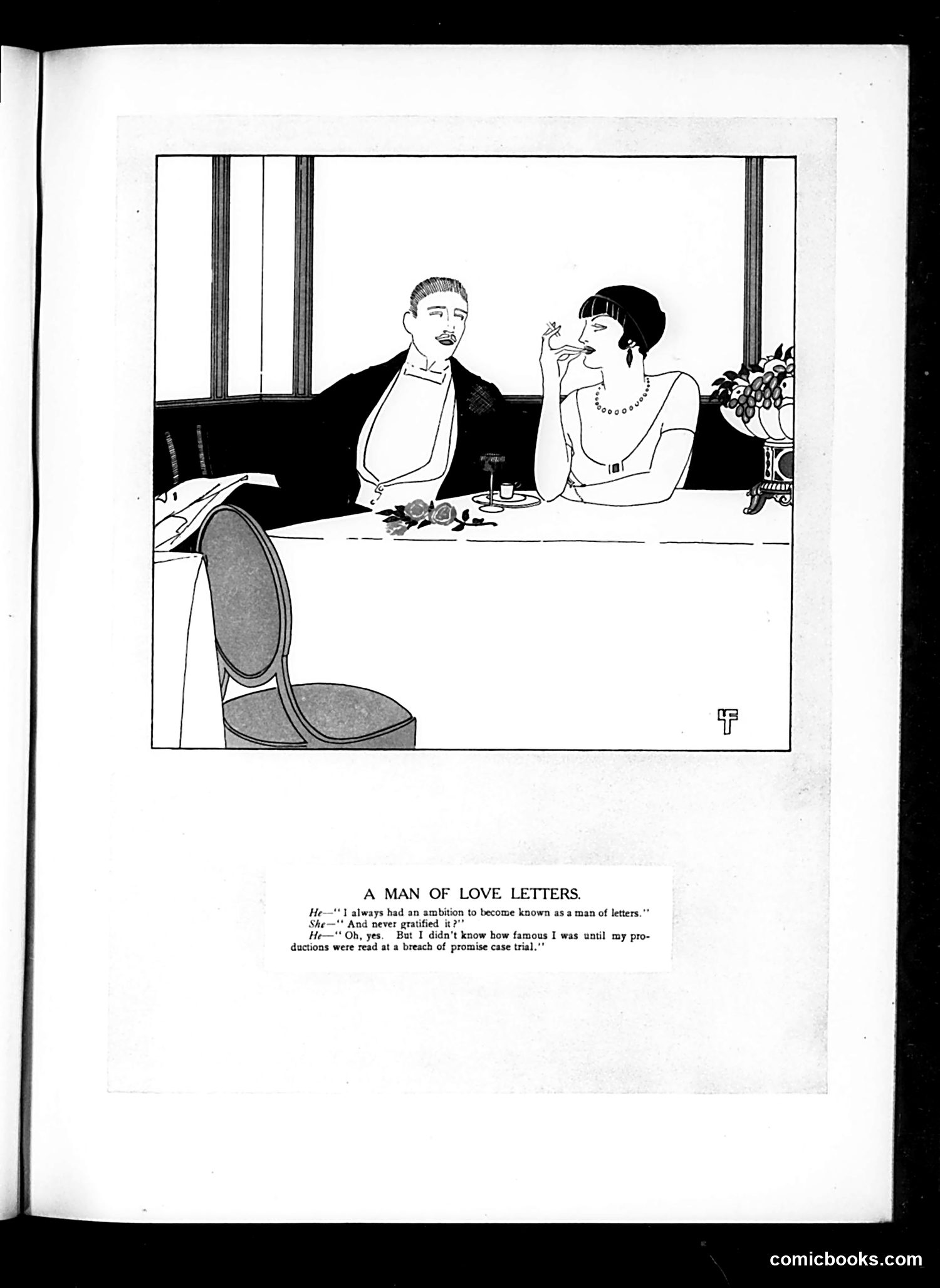
This cartoon satirizes a man's embarrassing notoriety. He claims to have achieved his ambition of becoming "a man of letters" (known for literary work), but his letters actually became famous—not for literary merit, but because they were read aloud as evidence in a "breach of promise" trial (a lawsuit where someone sued for breaking an engagement or romantic commitment). The joke is that his intimate love letters, intended to be private, became public spectacle in court. The woman's skeptical expression suggests she finds his explanation absurd. The satire mocks both his naive pride in unwanted publicity and the era's common legal practice of publicly exposing romantic correspondence in lawsuits, which was considered scandalous and humiliating.
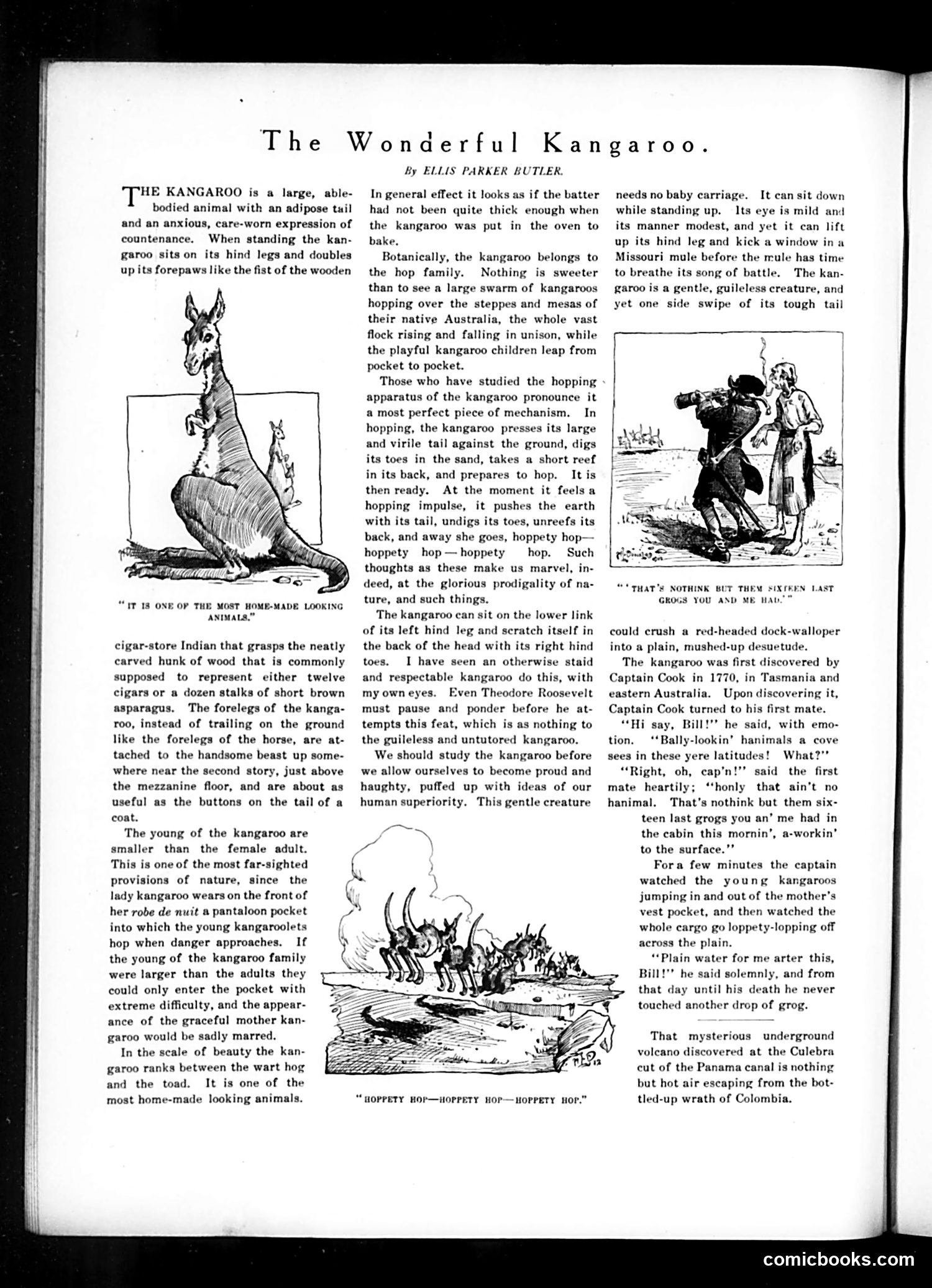
This is a humorous essay by Ellis Parker Butler about kangaroos, not political satire. Butler uses absurdist, deadpan humor to describe the animal's peculiar anatomy—its small useless front legs, powerful tail, and unusual hopping mechanism—comparing it unflattering to a "home-made looking" creature that appears "half-baked." The piece includes factual elements (Captain Cook's 1770 discovery) mixed with ridiculous observations (kangaroos belonging to the "hop family," mothers carrying joeys in a "pantaloon pocket"). The cartoons illustrate the text literally: one shows a kangaroo's characteristic posture; another depicts the hopping motion. The humor relies on treating the kangaroo's oddities with mock-serious scientific language, creating comedy through incongruity. This is pure satirical commentary on nature itself rather than contemporary politics—entertainment for Judge's readers interested in witty natural history pieces.
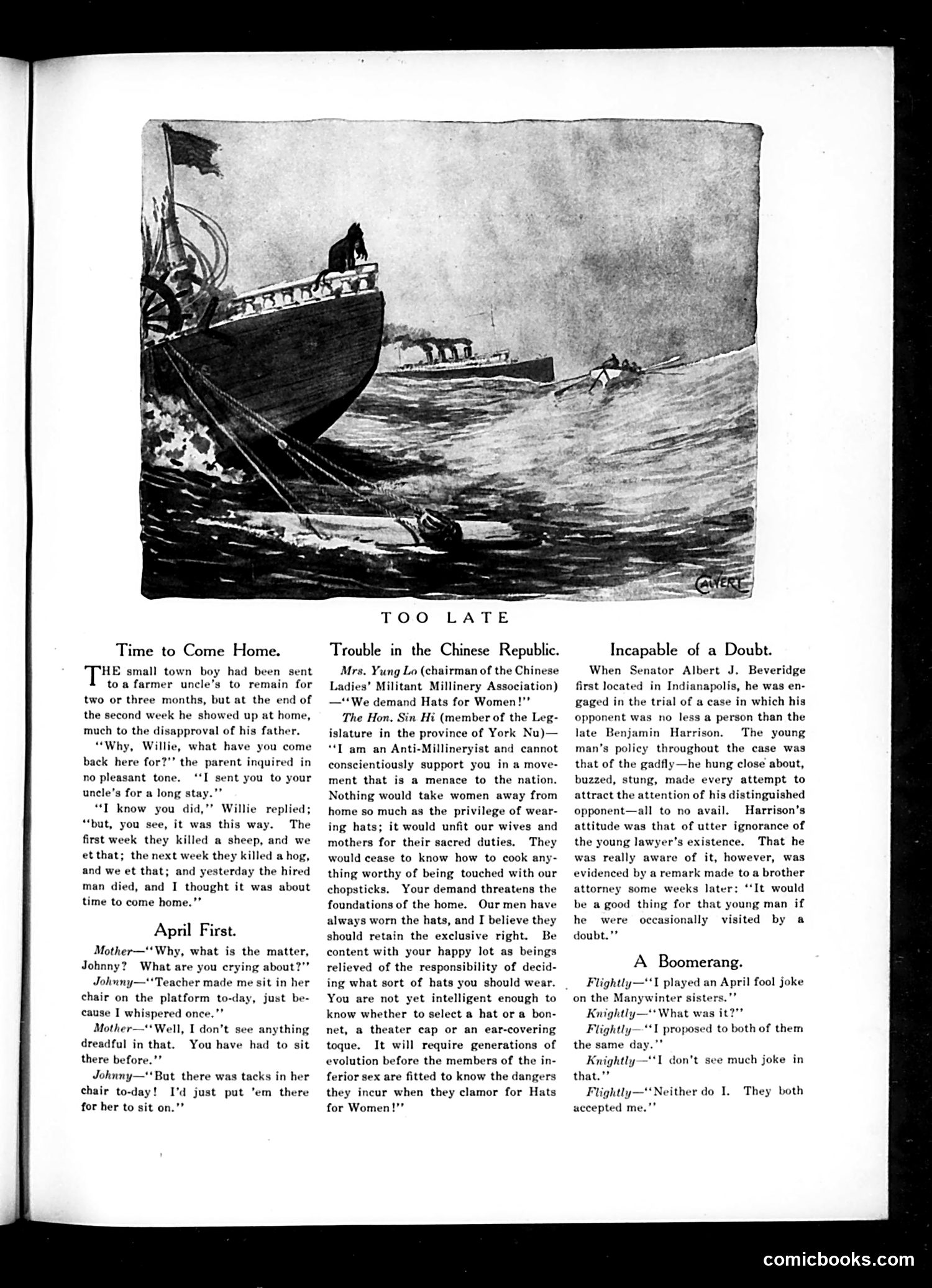
The page contains three satirical pieces: **"Too Late"** (top illustration): A political cartoon depicting the "Chinese Republic" turmoil. It mocks anti-feminist resistance to women's rights—specifically, a legislator opposing women wearing hats, arguing it would distract them from domestic duties and threaten the home's foundations. The satire targets paternalistic arguments used to deny women autonomy and equality. **"April First"** and **"A Boomerang"**: Brief humorous anecdotes about practical jokes backfiring—a boy prematurely leaving his uncle's (mistaking deaths for food), a child placing tacks in a teacher's chair, and a man proposing to two sisters simultaneously. The Chinese Republic story likely references early 20th-century modernization debates in China, using the absurd "hat controversy" to satirize American opposition to women's suffrage and independence—a contemporary social issue Judge's audience would recognize as their own fight.
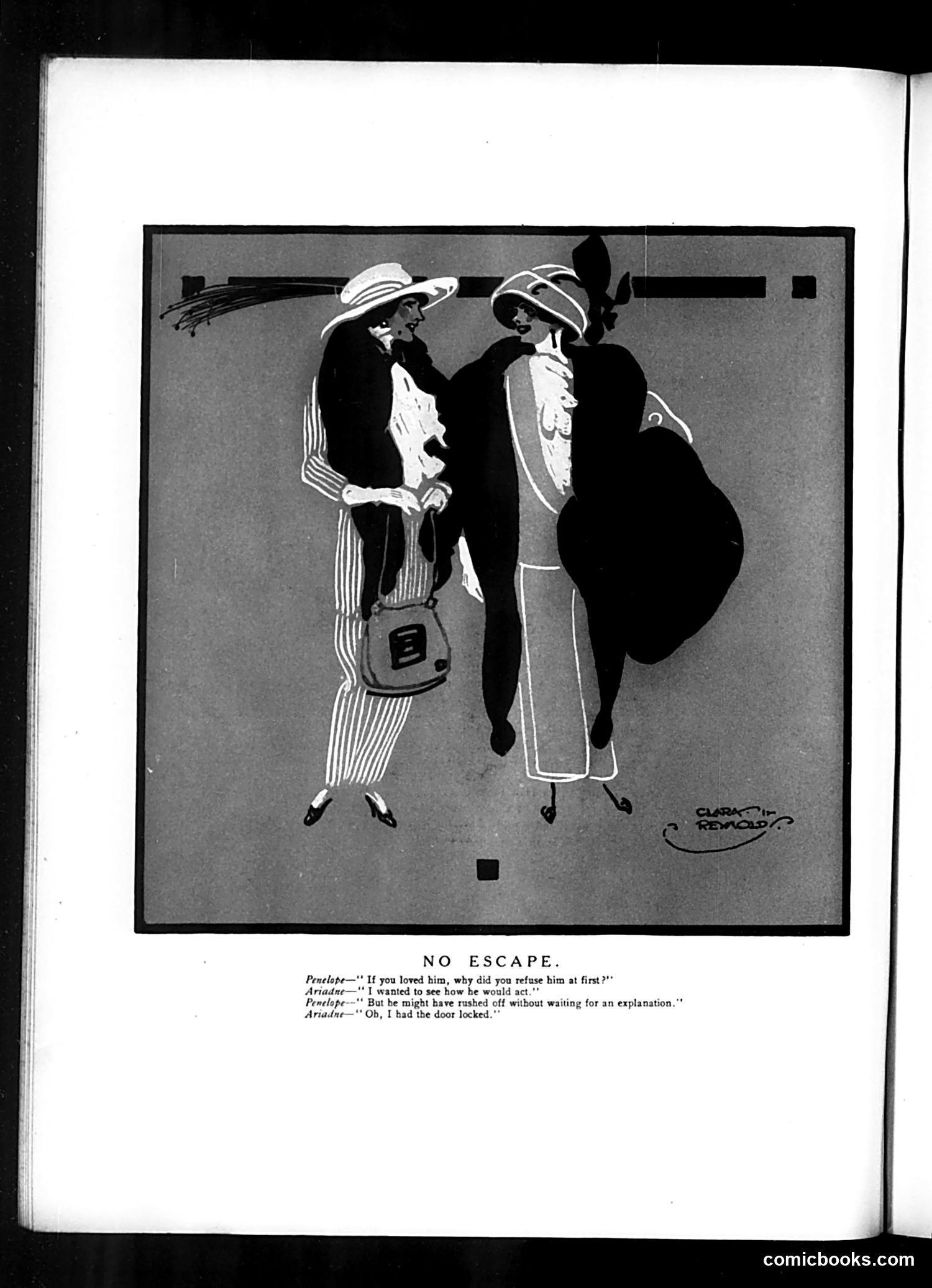
This cartoon depicts two fashionably dressed women in conversation, titled "No Escape." The dialogue reveals a domestic comedy scenario: one woman asks why the other refused a man initially, and the response indicates she wanted to see how he'd behave if refused. The punchline—"Oh, I had the door locked"—suggests the man was trapped and couldn't leave, forcing the woman to observe his true character under duress. The satire targets courtship customs and female strategy in romantic pursuit. It mocks both the manipulative tactics women employed to test suitors and the social expectations around male persistence in wooing. The stylish 1920s fashion and art deco styling suggest this reflects Jazz Age attitudes about gender relations and dating practices of that era.
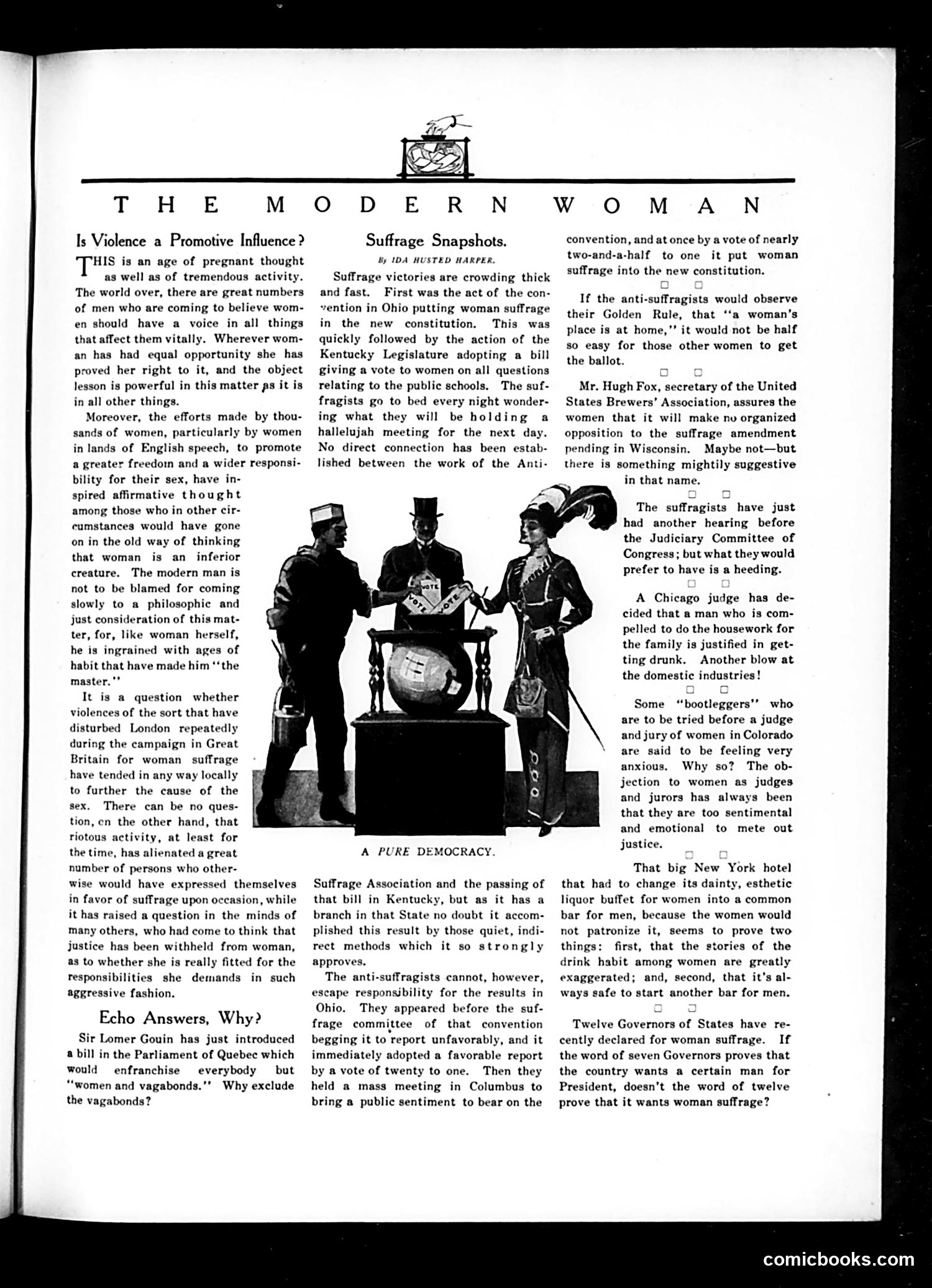
This 1912 satirical piece mocks both suffragettes and anti-suffrage opponents during America's women's voting rights campaign. **The Main Cartoon ("A Pure Democracy"):** Three figures in formal dress surround a globe labeled "WORLD," apparently deciding its fate. This satirizes how male power brokers control global affairs while excluding women from political participation—the irony of calling this "pure democracy." **The Text's Targets:** - **British suffragettes' violent tactics**: Judge criticizes property destruction and riots as counterproductive, alienating potential male supporters - **Anti-suffragists' hypocrisy**: The author notes that anti-suffrage arguments paradoxically *helped* suffrage victories in Ohio and Kentucky by appearing before committees - **Male condescension**: References to women being "too sentimental" for jury duty and the Quebec bill excluding women alongside "vagabonds"—grouping women with society's lowest class **The Satire:** Judge presents suffragists' growing victories while mocking both sides—violent activists and obstinate male opponents—suggesting the real obstacle isn't women's fitness for voting, but entrenched male privilege defended through absurd arguments.
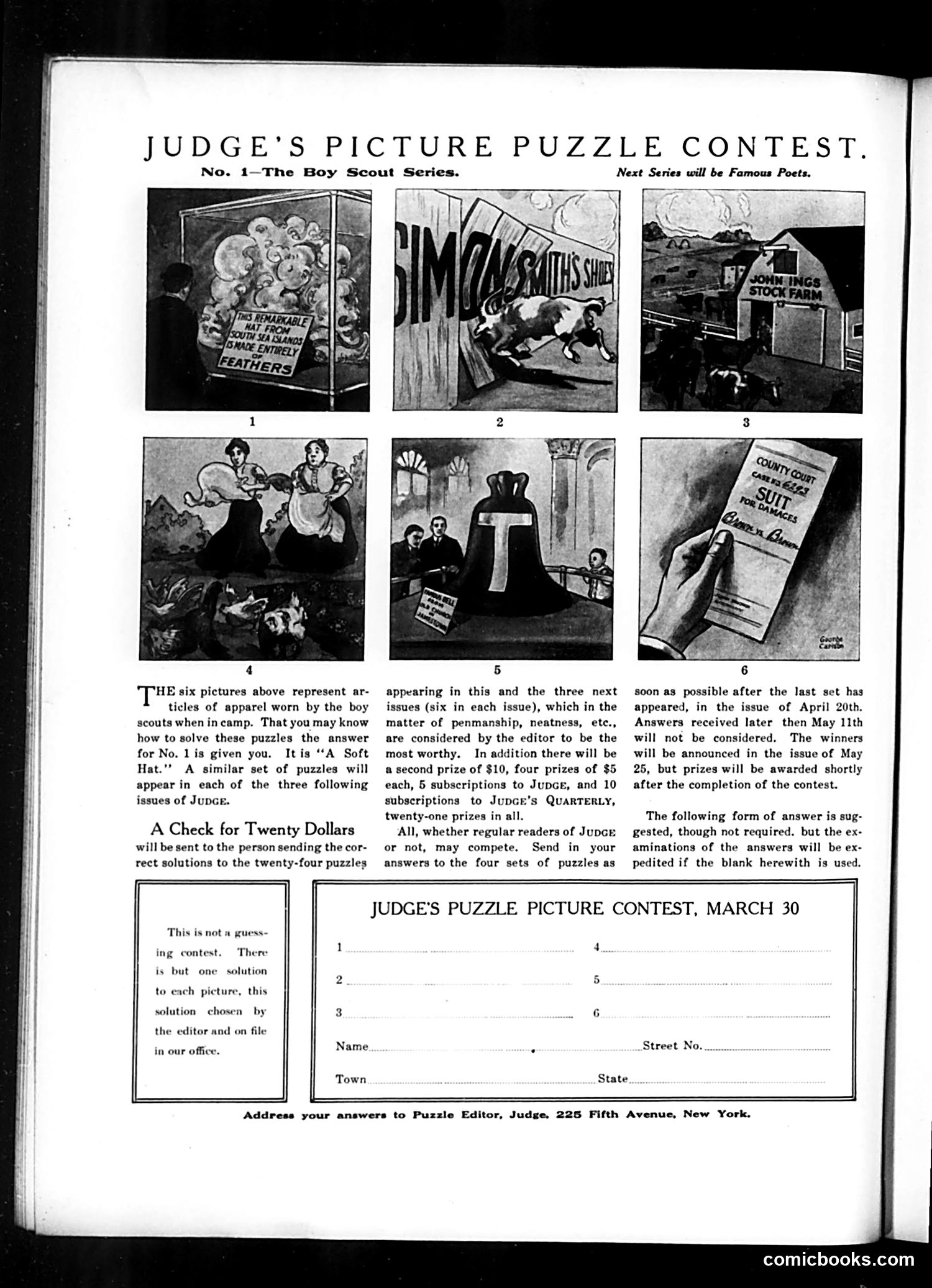
This page presents a **puzzle competition** rather than satirical content. Judge magazine is running a contest where readers must identify six pieces of boy scout camping apparel shown in photographs/illustrations. The first answer ("A Soft Hat") is provided as an example. The contest spans four issues with six puzzles each (24 total). Contestants compete for cash prizes: $20 for complete correct solutions, plus secondary prizes totaling $10, $5 each, and magazine subscriptions. The "Next Series will be Famous Poets" indicates Judge plans similar visual puzzles featuring literary figures afterward. This reflects **early 20th-century** popular engagement with Boy Scouts as an American institution, and demonstrates how magazines monetized reader participation through competitions. The emphasis on "penmanship, neatness" in judging reveals period values about presentation and decorum.
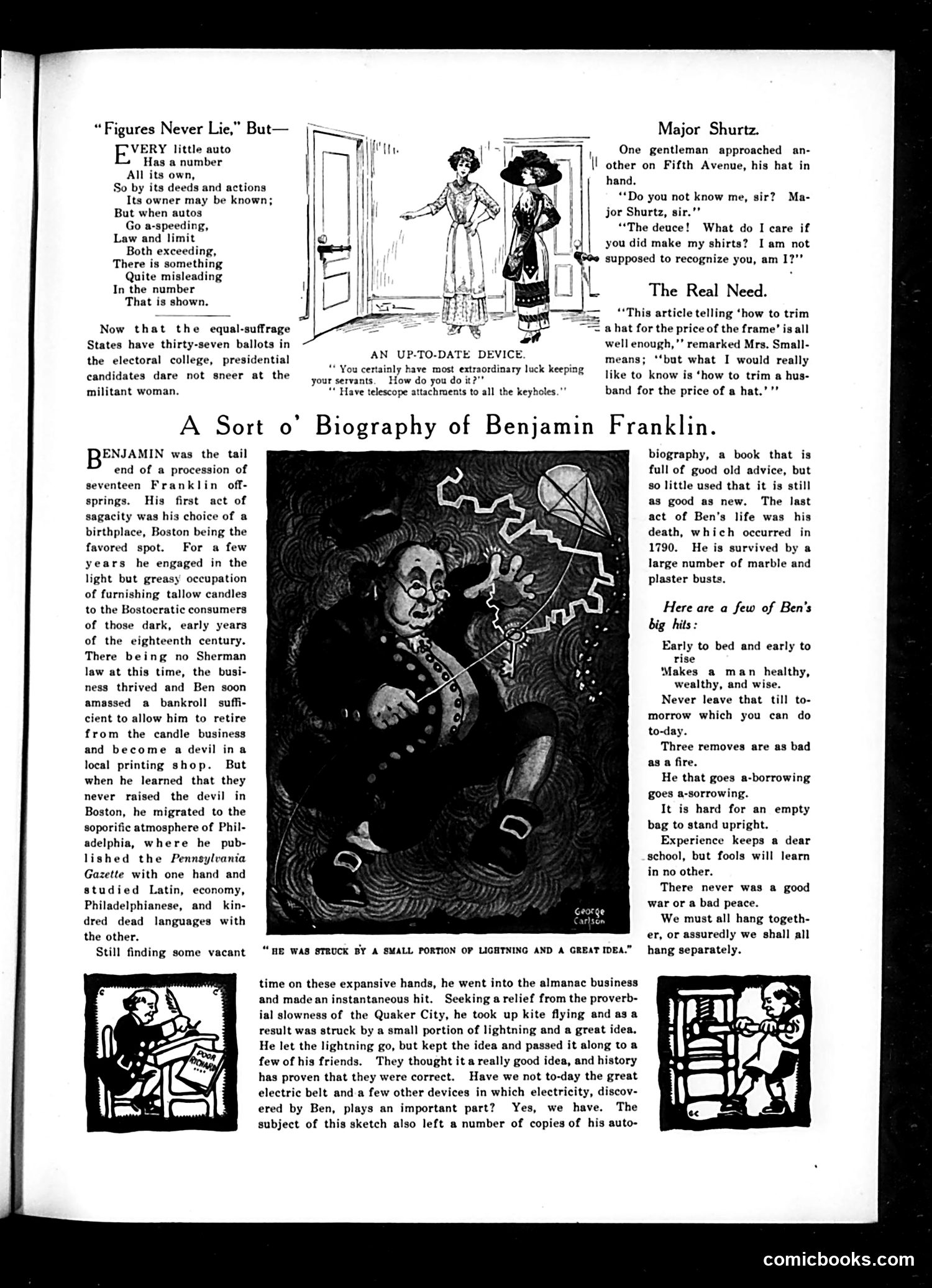
This page contains several satirical pieces mocking early 20th-century social concerns: **"An Up-to-Date Device"** jokes about surveillance in servant-employer relations—the lady uses telescope attachments on keyholes to spy on her staff, reflecting anxiety about household privacy and servant trustworthiness. **"Major Shurtz"** satirizes class pretension: a man who once made shirts for a wealthy gentleman now expects recognition as an equal on Fifth Avenue. The gentleman's dismissal ("I am not supposed to recognize you") mocks both the servant's aspirations and the class system's rigid boundaries. **"The Real Need"** uses marital humor to critique consumer culture—Mrs. Smallmeans finds articles about economical hat-trimming useless compared to managing her husband's expenses. **Benjamin Franklin biography** is affectionate satire, portraying Franklin as a practical schemer who stumbled into electricity's discovery through kite-flying, then commercialized it. The humor lies in reducing a Founding Father to an opportunistic inventor and early entrepreneur. The page's opening verse jokes about automobile license plates being poor identifiers of owner character—speeding cars display honest numbers yet carry dishonest drivers.
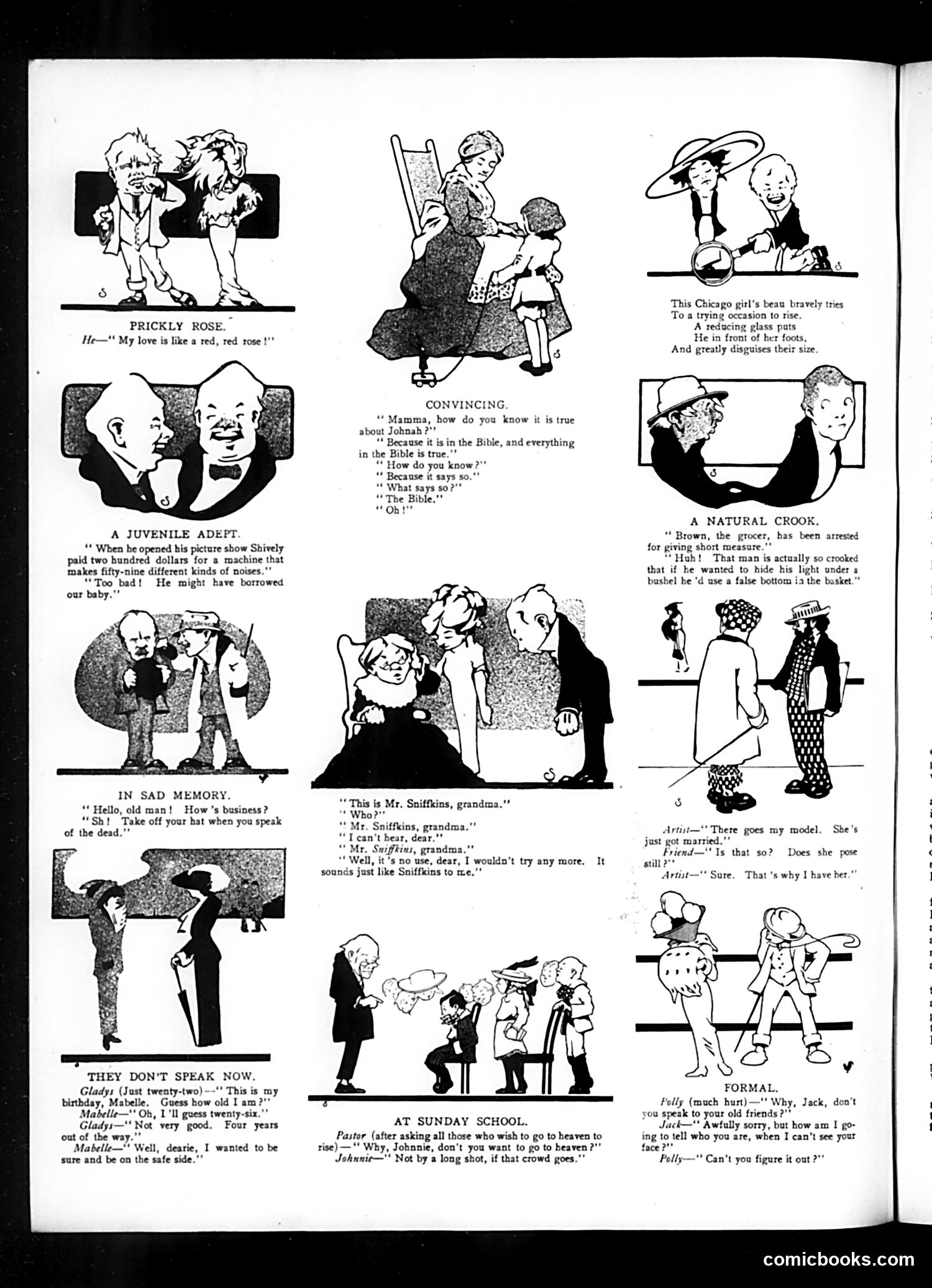
This page contains multiple brief satirical cartoons and jokes typical of *Judge* magazine's social commentary. Key targets include: **"Prickly Rose"**: Mocks sentimental romantic clichés—a man's flowery declaration meets a woman's skeptical response. **"Convincing"**: Satirizes circular religious reasoning, where a child questions how we know the Bible is true, and the answer is simply "because the Bible says so"—critique of unthinking faith. **"Natural Crook"**: Jokes about a grocer's dishonesty, suggesting moral crookedness runs so deep he'd cheat even while pretending righteousness. **"At Sunday School"**: A child refuses heaven if "that crowd" (hypocritical church attendees) goes there—mocking religious hypocrisy. **"They Don't Speak Now"**: References deceased people—likely referring to estranged relationships or death ending communication. The remaining cartoons mock vanity, aging women's insecurity about age, and social awkwardness. Overall, the page satirizes hypocrisy, pretense, and human foolishness in early 20th-century American society.
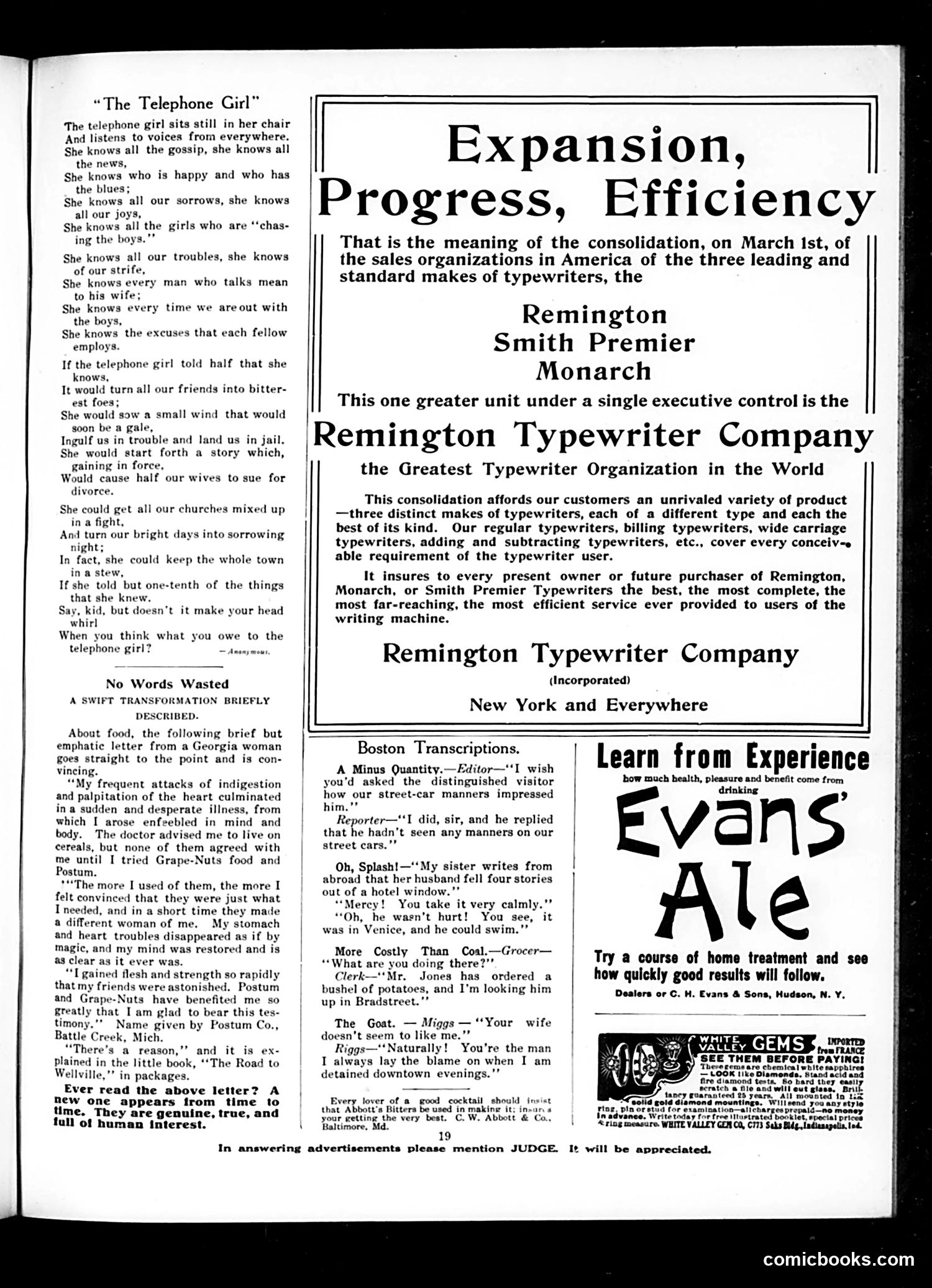
This page contains two distinct elements: **"The Telephone Girl" Poem (Left):** A satirical verse celebrating the telephone operator's access to private information. The piece humorously acknowledges that switchboard operators—who physically connected calls and could overhear conversations—held tremendous power over their communities. The poem suggests operators knew everyone's secrets: infidelities, financial troubles, family disputes, and social indiscretions. The joke centers on society's dependence on their discretion; if operators revealed what they heard, it would destroy marriages, friendships, and reputations. This reflects early-20th-century anxiety about privacy invasion through new communication technology and the unique position of (typically female) telephone operators. **Remington Typewriter Advertisement (Right):** Corporate announcement of a 1912 consolidation merging three typewriter manufacturers—Remington, Smith-Premier, and Monarch—into a unified "Remington Typewriter Company." The advertisement emphasizes business efficiency and market dominance, promising customers superior product variety and service. The page is primarily advertising with satirical content.
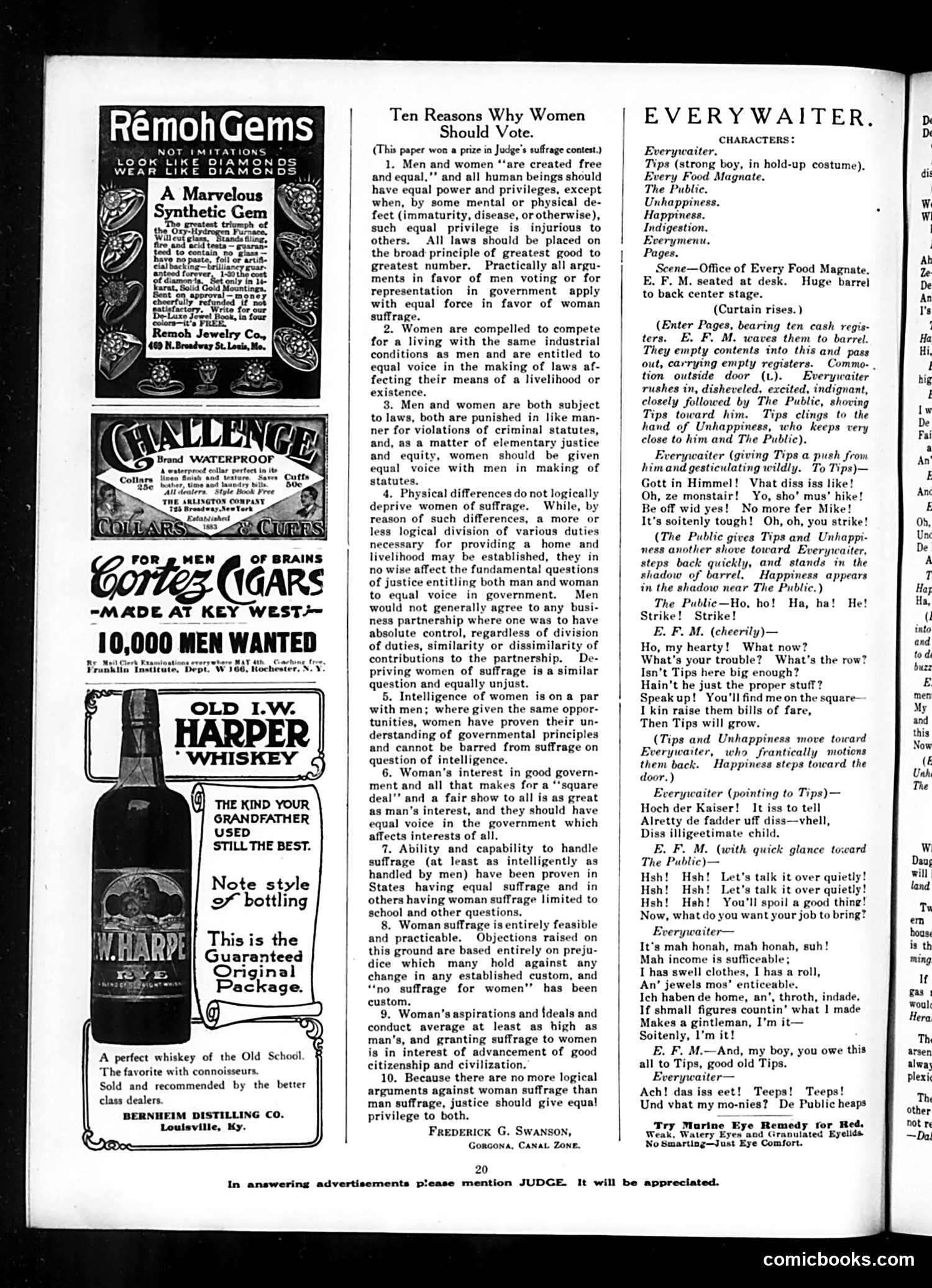
This page is primarily **advertising and editorial content**, not a political cartoon. The substantive piece is "Ten Reasons Why Women Should Vote"—an essay that won a prize in Judge magazine's suffrage contest. It presents straightforward pro-suffrage arguments: women are equal to men intellectually, subject to the same laws, deserve equal voice in government, and have proven capable of voting where allowed. The arguments address common objections by emphasizing logic, justice, and practical capability rather than emotion. The right column shows "Everywaiter," a short theatrical sketch satirizing restaurant staff and demanding customers. It's unrelated to suffrage. The left side contains vintage advertisements for whiskey, jewelry, and cigars—typical period product placement with no political significance. The page demonstrates Judge magazine's mixed format: serious advocacy journalism alongside humor and commerce.
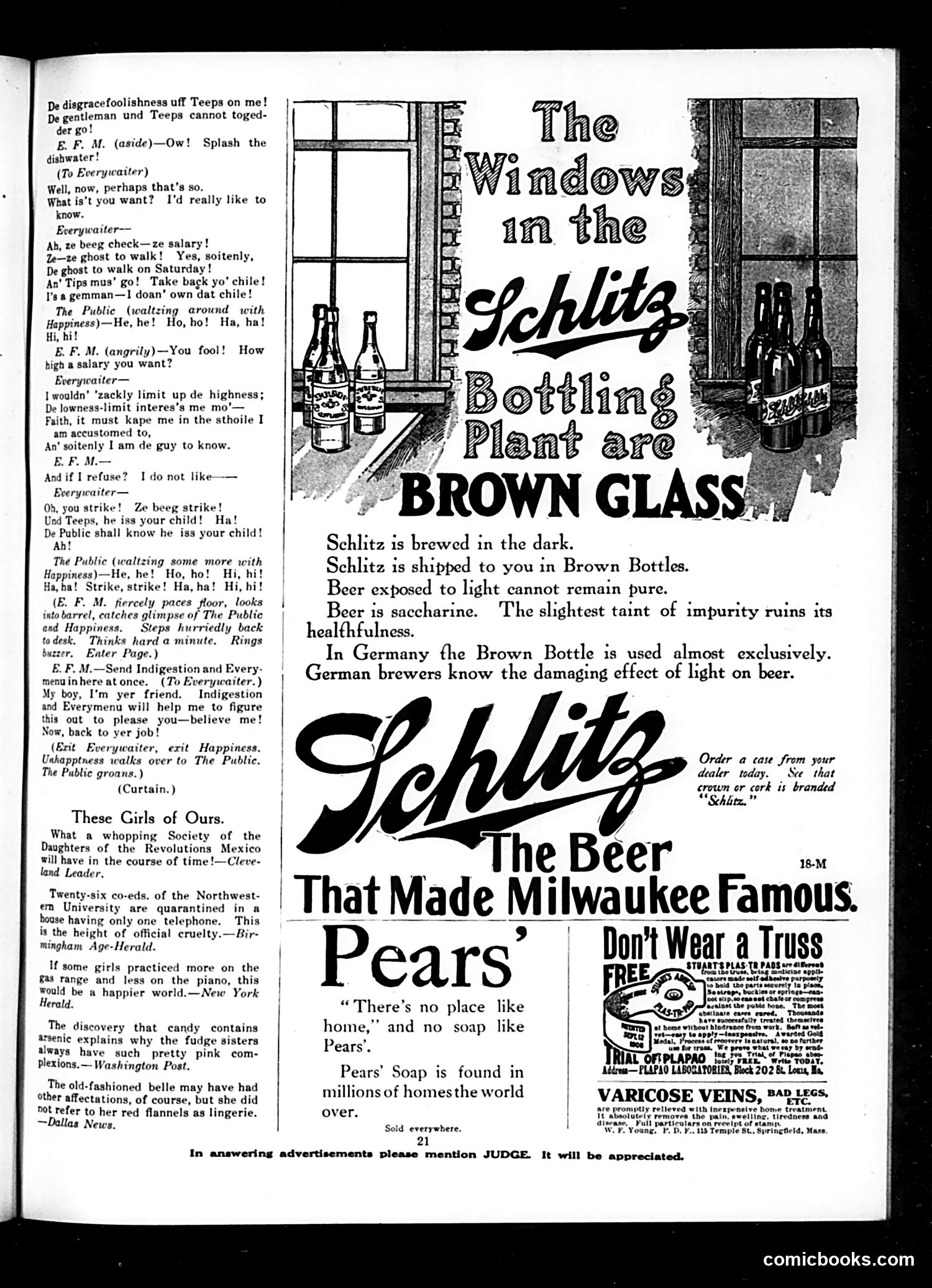
This page contains a satirical comic dialogue about **restaurant labor disputes**, likely from the early 1900s. The main cartoon depicts a conflict between a restaurant manager (E.F.M.), a waiter ("Everywaiter"), and an abstract figure representing "The Public" and "Happiness." The joke satirizes **tipping culture and wage disputes**: the waiter demands both a proper salary ("ze beg check") and tips ("ze ghost to walk"), threatening a strike if refused. When the manager resists, the waiter threatens to expose this to the public, turning the strike into a leverage point. The manager capitulates, realizing bad publicity from a strike is worse than conceding. The satire mocks how restaurant workers used public pressure as a negotiating tactic, while also suggesting the absurdity of the tipping system itself—workers demanding guaranteed wages *plus* tips. The remainder of the page consists of period advertisements (Schlitz beer, Pears' soap, medical devices) unrelated to the cartoon's social commentary.
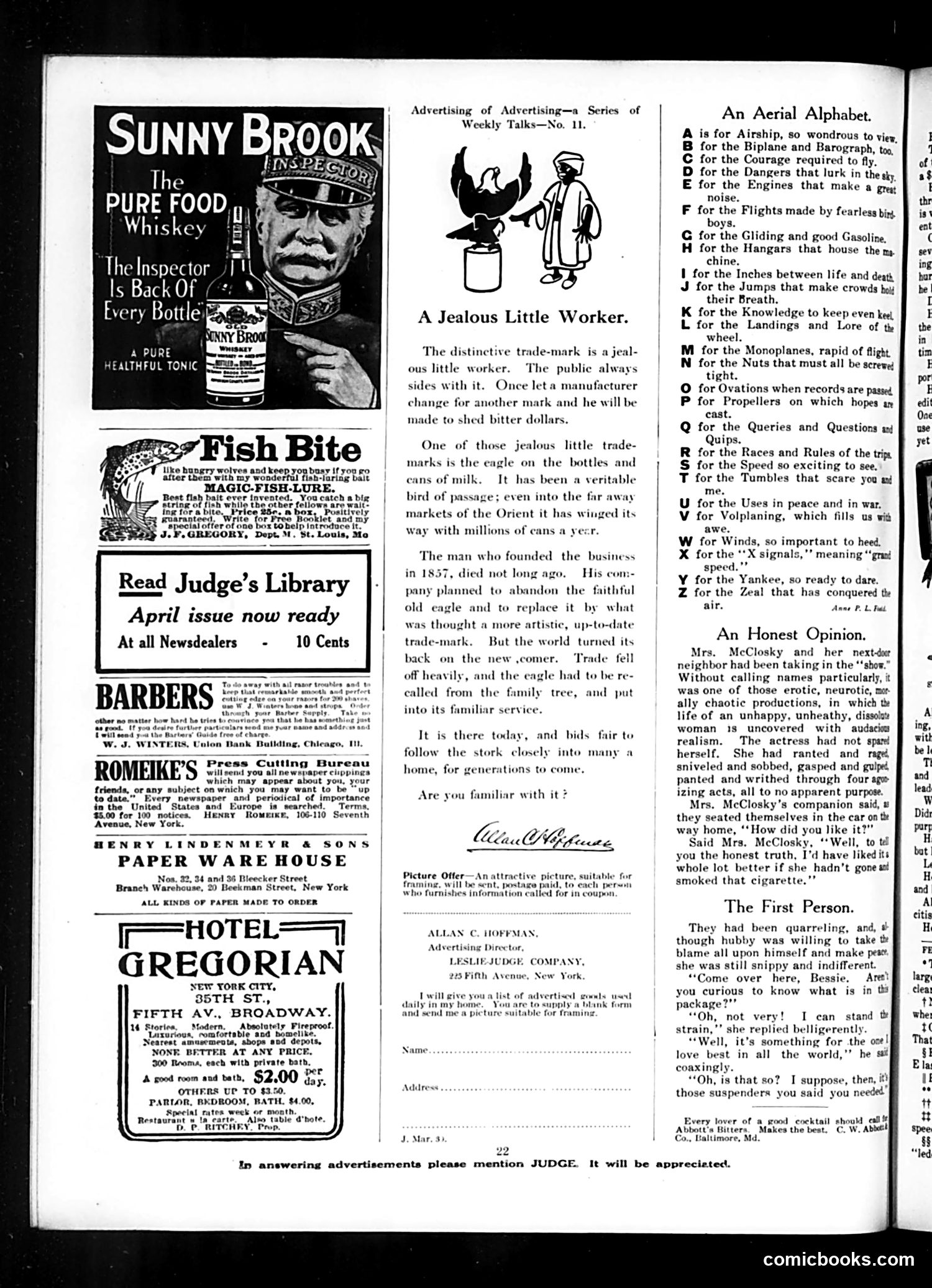
This page is primarily **advertising and filler content** from Judge magazine, with no significant political cartoons or social satire. The main editorial content is "An Aerial Alphabet"—a lighthearted alphabetical poem about early aviation (biplanes, monoplanes, propellers). This reflects early 1900s fascination with pioneering flight technology, treating aviation as thrilling and dangerous frontier activity. The article "A Jealous Little Worker" discusses **trademark branding**, using an eagle on milk bottles as an example of successful brand identity that endures even when companies attempt replacement designs. This is instructional advertising commentary, not satire. The remaining content consists of **commercial advertisements**: Sunny Brook whiskey (invoking "Pure Food" regulations), fish lures, a hotel, paper warehouses, and barber services—typical of Judge's revenue model. There are no identifiable political figures or satirical commentary on this page. It represents the magazine's standard mix of light humor, instructional articles about commerce, and paid advertising.
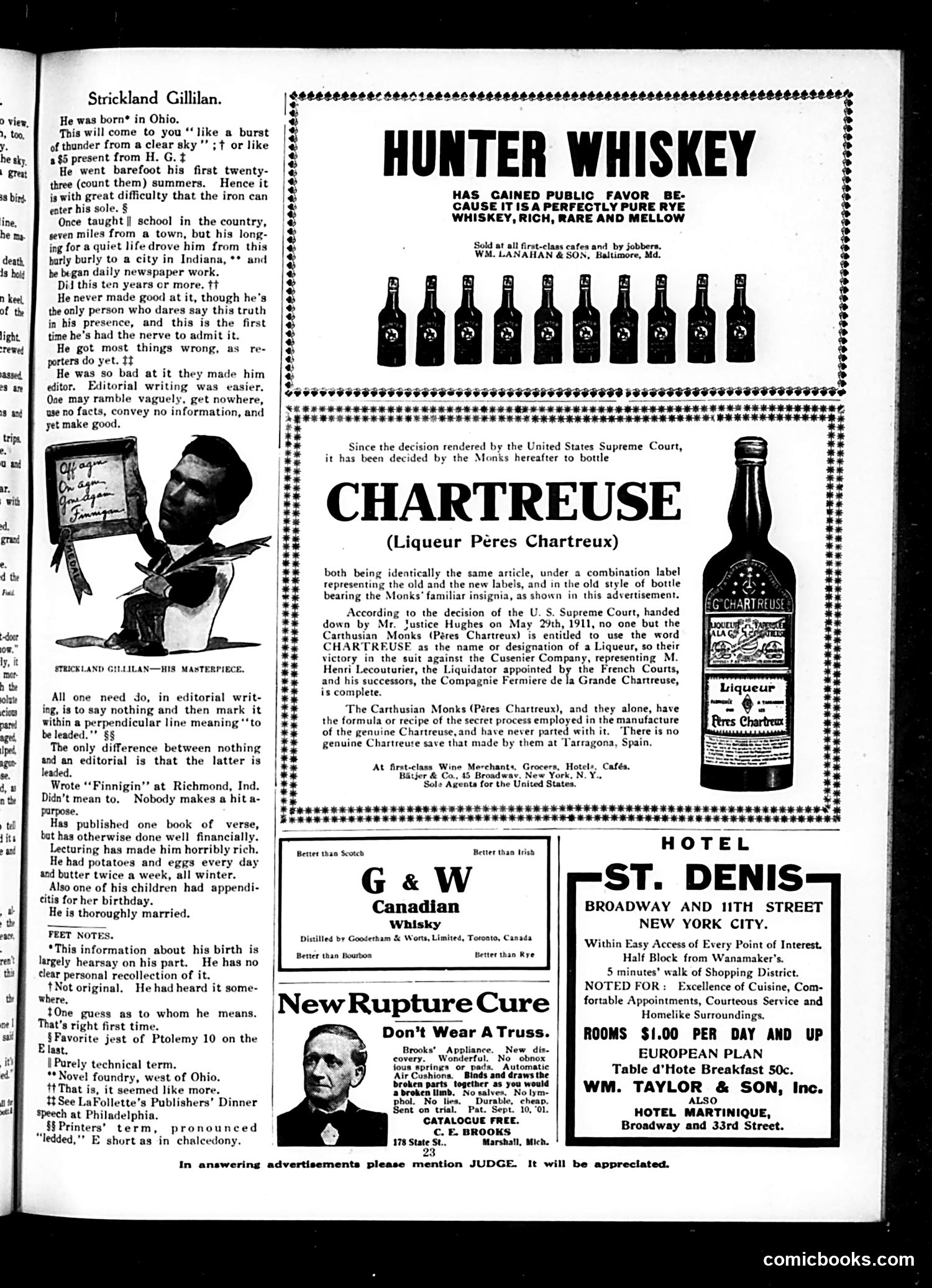
This page is primarily a biographical sketch of poet/humorist Strickland Gillilan, with extensive footnotes using typographical humor. The main text describes Gillilan's Ohio birth, barefoot childhood, failed newspaper career, accidental literary success with "Finnigin," and modest prosperity through lecturing. The satire centers on editorial writing: Gillilan became editor precisely *because* he was terrible at reporting—his vagueness and factual errors suited editorial work perfectly, where one can "say nothing" and mark it for typographical spacing ("leaded"), making editorial content essentially empty filler. The page is otherwise dominated by period advertisements for whiskey (Hunter), Canadian whiskey (G&W), liqueur (Chartreuse—noting a 1911 Supreme Court decision protecting the Monks' trademark), a medical device (rupture cure), and New York hotels.
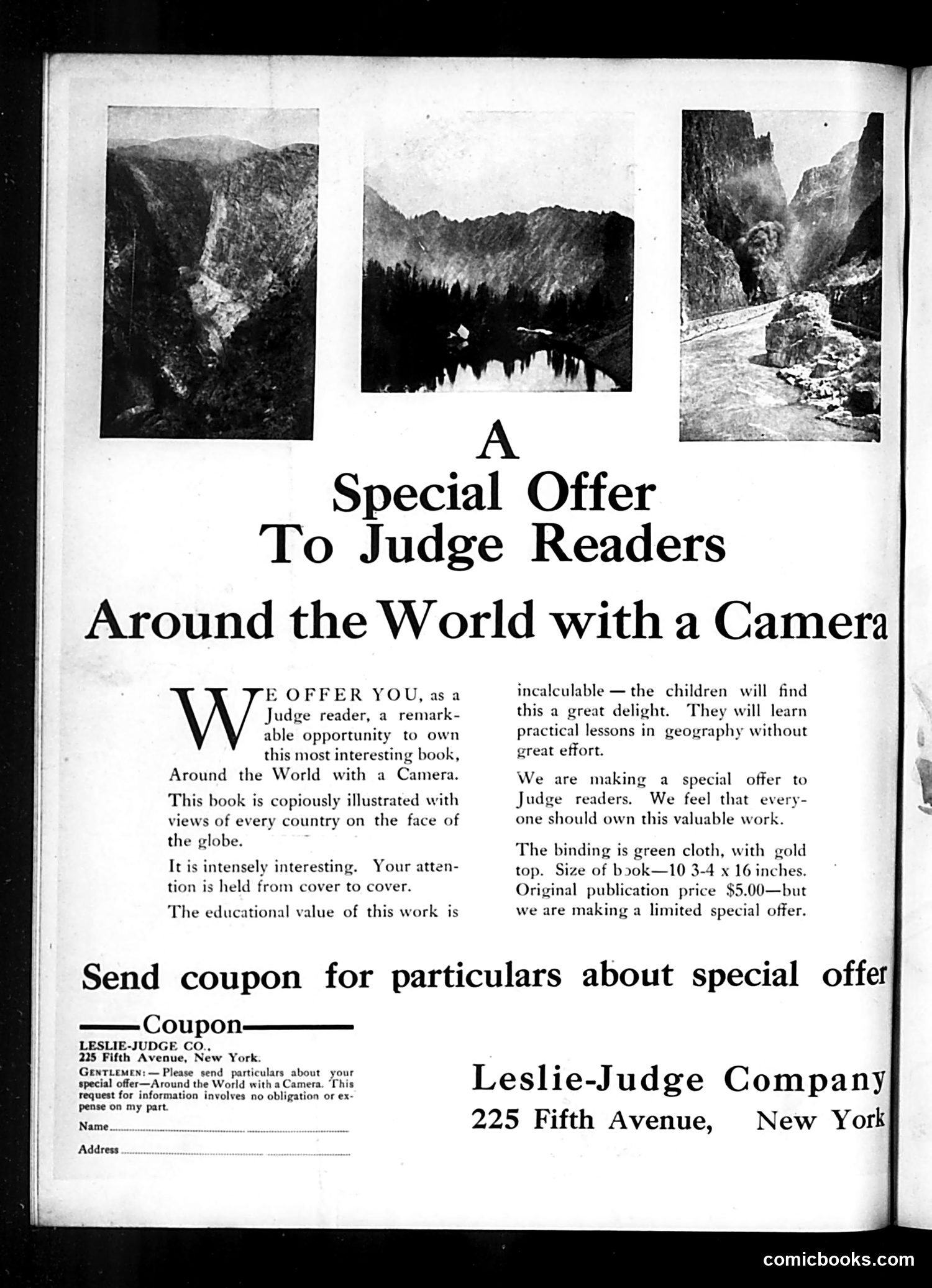
This page is **advertising, not satire or political commentary**. It's a book advertisement for *Around the World with a Camera*, placed in Judge magazine by the Leslie-Judge Company (the magazine's publisher, located at 225 Fifth Avenue, New York). The three black-and-white photographs show scenic landscapes—mountain valleys, lakes, and canyon views—illustrating the book's geographic content. The text emphasizes the book's educational value for children and general readers, highlighting its illustrations of "every country on the face of the globe." The "special offer" to Judge readers references a reduced price from the original $5.00. The coupon invites readers to request information without obligation. This is straightforward commercial promotion typical of early 20th-century magazine advertising, not satirical content.