
Judge, 1912-03-30 · page 5 of 24
Judge — March 30, 1912 — page 5: what you’re looking at
What you’re looking at
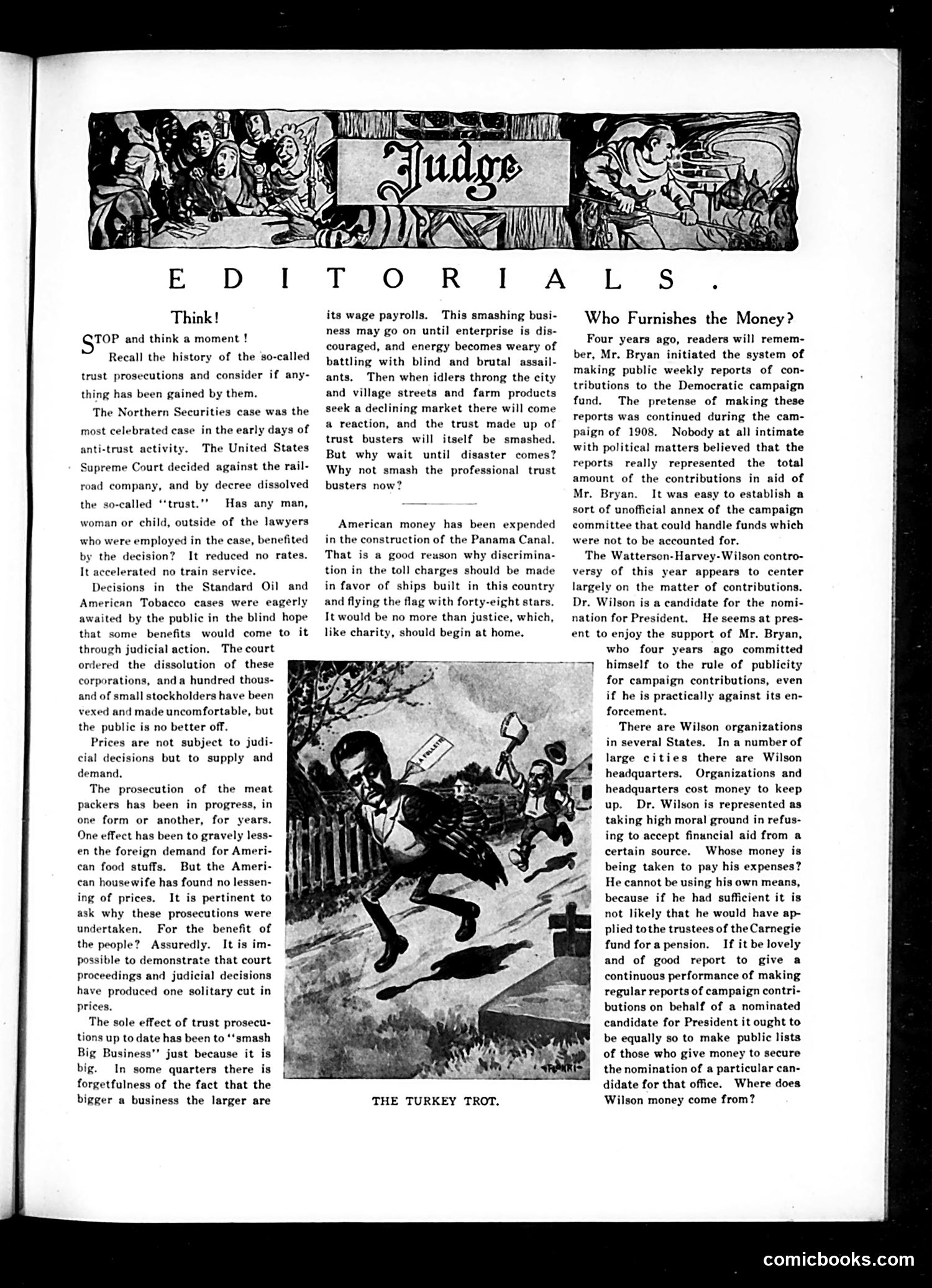
This cartoon satirizes the "Turkey Trot," a popular ragtime dance of the early 1900s that scandalized conservative Americans. The figure shown performing an exaggerated, undignified dance move represents the dance itself—depicted as chaotic and ridiculous. The accompanying editorials criticize trust prosecutions and campaign financing. The "Turkey Trot" image serves as visual metaphor for wasteful, undisciplined activity. The right column discusses Wilson's campaign contributions and questions whether his organization is accountable for its funding sources, suggesting financial impropriety. Together, the cartoon and text mock both modern social trends (the dance) and political hypocrisy—attacking "big business" while potentially engaging in questionable fundraising practices themselves.
📄 Transcribed text from this page (OCR, searchable)
Machine-transcribed from the original scan — historical spelling and the odd misread are preserved.
gro and think a moment ! Recall the history of the so-called trust prosecutions and consider if any- thing has been gained by them. The Northern Securities case was the most celebrated case in the early days of The United States Supreme Court decided against the rail- anti-trust activ road company, and by decree dissolved the so-called ‘‘trust.’" Has any man, woman or child, outside of the lawyers who were employed in the case, benefited by the decision? It reduced no rates. It accelerated no train service. Decisions in the Standard Oil American Tobacco cases were eagerly awaited by the public in the blind hope that some benefits would come to it through judicial action, The court ordered the dissolution of these corporations, anda hundred thous- and of small stockholders have been vexed and made uncomfortable, but the public is no better off. Prices are not subject to judi- cial decisions but to supply and demand. The prosecution of the meat packers has been in progress, in one form or another, for years. One effect has been to gravely less- en the foreign demand for Ameri- can food stuffs. But the Ameri- can housewife has found no lessen- ing of prices. It is pertinent to ask why these prosecutions were undertaken, For the benefit of the people? Assuredly. It is im- possible to demonstrate that court proceedings and judicial decisions have produced one solitary cut in prices, The sole effect of trust prosecu- tions up to date has been to ‘smash Big Business’? just because it is big. In some quarters there is forgetfulness of the fact that the bigger a business the larger are and ms aca iflh its wage payrolls. This smashing busi- ness may go on until enterprise is dis- couraged, and energy becomes weary of battling with blind and brutal assail- ants. Then when idlers throng the city and village streets and farm products seek a declining market there will come a reaction, and the trust made up of trust busters will itself be smashed. But why wait until disaster comes? Why not smash the professional trust busters now? American money has been expended in the construction of the Panama Canal. That is a good reuson why discrimina- tion in the toll charges should be made in favor of ships built in this country and flying the flag with forty-eight stars. It would be no more than justice, which, like charity, should begin at home. THE TURKEY TROT. yA Who Furnishes the Money? Four years ago, readers will remem- ber, Mr. Bryan initiated the system of making public weekly reports of con- tributions to the Democratic campaign fund. The pretense of making these reports was continued during the cam- paign of 1908. Nobody at all intimate with political matters believed that the reports really represented the total amount of the contributions in aid of Mr. Bryan. It was easy to establish a sort of unofficial annex of the campaign committee that could handle funds which were not to be accounted for. The Watterson-Harvey-Wilson contro- versy of this year appears to center largely on the matter of contributions. Dr. Wilson is a candidate for the nomi- nation for President. He seems at pres- ent to enjoy the support of Mr. Bryan, who four years ago committed himself to the rule of publicity for campaign contributions, even if he is practically against its en- forcement. There are Wilson organizations in several States. In a number of large cities there are Wilson headquarters. Organizations and headquarters cost money to keep up. Dr. Wilson is represented as taking high moral ground in refus- ing to accept financial aid from a certain source. Whose money is being taken to pay his expenses? He cannot be using his own means, because if he had sufficient it is not likely that he would have ap- plied tothe trustees of the Carnegie fund fora pension. If it be lovely and of good report to give a continuous performance of making regular reports of campaign contri- butions on behalf of a nominated candidate for President it ought to be equally so to make public lists of those who give money to secure the nomination of a particular can- didate for that office. Where does Wilson money come from? comicbooks.com