
Judge, 1912-03-30 · page 12 of 24
Judge — March 30, 1912 — page 12: what you’re looking at
What you’re looking at
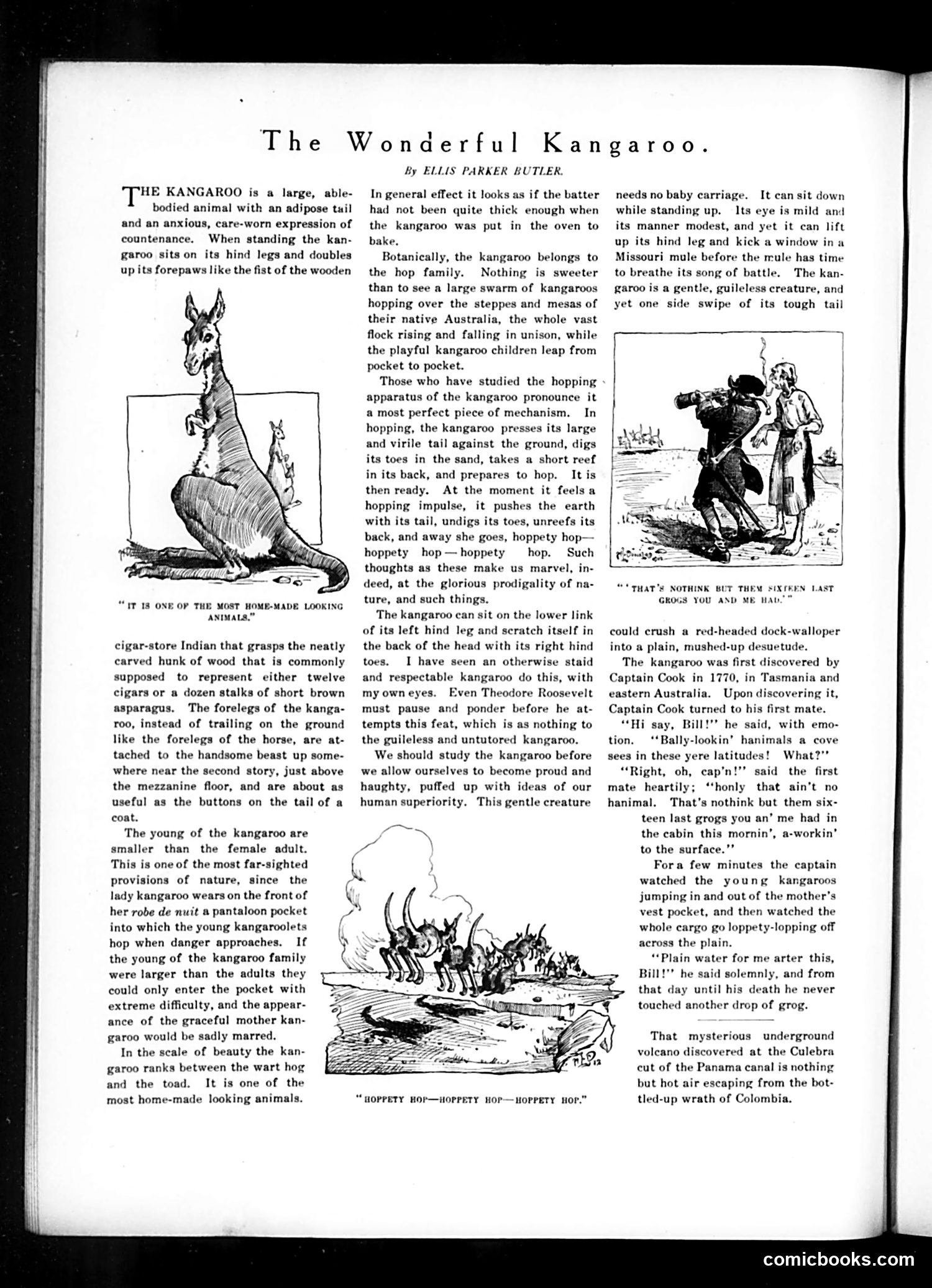
This is a humorous essay by Ellis Parker Butler about kangaroos, not political satire. Butler uses absurdist, deadpan humor to describe the animal's peculiar anatomy—its small useless front legs, powerful tail, and unusual hopping mechanism—comparing it unflattering to a "home-made looking" creature that appears "half-baked." The piece includes factual elements (Captain Cook's 1770 discovery) mixed with ridiculous observations (kangaroos belonging to the "hop family," mothers carrying joeys in a "pantaloon pocket"). The cartoons illustrate the text literally: one shows a kangaroo's characteristic posture; another depicts the hopping motion. The humor relies on treating the kangaroo's oddities with mock-serious scientific language, creating comedy through incongruity. This is pure satirical commentary on nature itself rather than contemporary politics—entertainment for Judge's readers interested in witty natural history pieces.
📄 Transcribed text from this page (OCR, searchable)
Machine-transcribed from the original scan — historical spelling and the odd misread are preserved.
The THe KANGAROO is a large, able- bodied animal with an adipose tail and an anxious, care-worn expression of countenance. When standing the kan- garoo sits on its hind legs and doubles up its forepaws like the fist of the wooden “IT 18 ONE OP THE MOST HOME-MADE LOOKING ANIMALS,” cigar-store Indian that grasps the neatly carved hunk of wood that is commonly supposed to represent either twelve cigars or a dozen stalks of short brown asparagus, The forelegs of the kanga- roo, instead of trailing on the ground like the forelegs of the horse, are at- tached to the handsome beast up some- where near the second story, just above the mezzanine floor, and are about as useful as the buttons on the tail of a coat. The young of the kangaroo are smaller than the female adult. This is one of the most far-sighted provisions of nature, since the lady kangaroo wears on the front of her robe de nuit a pantaloon pocket into which the young kangaroolets hop when danger approaches. If the young of the kangaroo family were larger than the adults they could only enter the pocket with extreme difficulty, and the appear- ance of the graceful mother kan- garoo would be sadly marred. In the scale of beauty the kan- garoo ranks between the wart hog and the toad. It is one of the most home-made looking animals. Wonderful By ELLIS PARKER BUTLER. In general effect it looks as if the batter had not been quite thick enough when the kangaroo was put in the oven to bake. Botanically, the kangaroo belongs to the hop family. Nothing is sweeter than to see a large swarm of kangaroos hopping over the steppes and mesas of their native Australia, the whole vast flock rising and falling in unison, while the playful kangaroo children leap from pocket to pocket. Those who have studied the hopping apparatus of the kangaroo pronounce it a most perfect piece of mechanism. In hopping, the kangaroo presses its large and virile tail against the ground, digs its toes in the sand, takes a short reef in its back, and prepares to hop. It is then ready. At the moment it feels a hopping impulse, it pushes the earth with its tail, undigs its toes, unreefs its back, and away she goes, hoppety hop— hoppety hop—hoppety hop. Such thoughts as these make us marvel, in- deed, at the glorious prodigality of na- ture, and such things. The kangaroo can sit on the lower link of its left hind leg and scratch itself in the back of the head with its right hind toes. I have seen an otherwise staid and respectable kangaroo do this, with my own eyes. Even Theodore Roosevelt must pause and ponder before he at- tempts this feat, which is as nothing to the guileless and untutored kangaroo. We should study the kangaroo before we allow ourselves to become proud and haughty, puffed up with ideas of our human superiority. This gentle creature “WOPPETY HOP—HOPPETY HOP—HoPPETY Hor.” Kangaroo. needs no baby carriage. It can sit down while standing up. Its eye is mild and its manner modest, and yet it can lift up its hind leg and kick a window ina Missouri mule before the mule has time to breathe its song of battle. The kan- garoo is a gentle, guileless creature, and yet one side swipe of its tough tail “THAT'S NOTHINK BUT THEM SIXPREN LAST GROGS YOU AND ME HAD!” could crush a red-headed dock-walloper into a plain, mushed-up desuetude. The kangaroo was first discovered by Captain Cook in 1770, in Tasmania and eastern Australia. Upon discovering it, Captain Cook turned to his first mate. “Hi say, Bill!’ he said, with emo- “‘Bally-lookin’ hanimals a cove sees in these yere latitudes!) What?" “Right, oh, cap’n!’’ said the first mate heartily; ‘‘honly that ain’t no hanimal. That's nothink but them teen last grogs you an’ me had in the cabin this mornin’, a-workin to the surface.’’ Fora few minutes the captain watched the young kangaroos jumping in and out of the mother’s vest pocket, and then watched the whole cargo go loppety-lopping off across the plain. ‘Plain water for me arter this, Bill!"" he said solemnly, and from that day until his death he never touched another drop of grog. tion. That mysterious underground volcano discovered at the Culebra cut of the Panama canal is nothing but hot air escaping from the bot- tled-up wrath of Colombia. comicbooks.com