
Judge, 1912-03-30 · page 15 of 24
Judge — March 30, 1912 — page 15: what you’re looking at
What you’re looking at
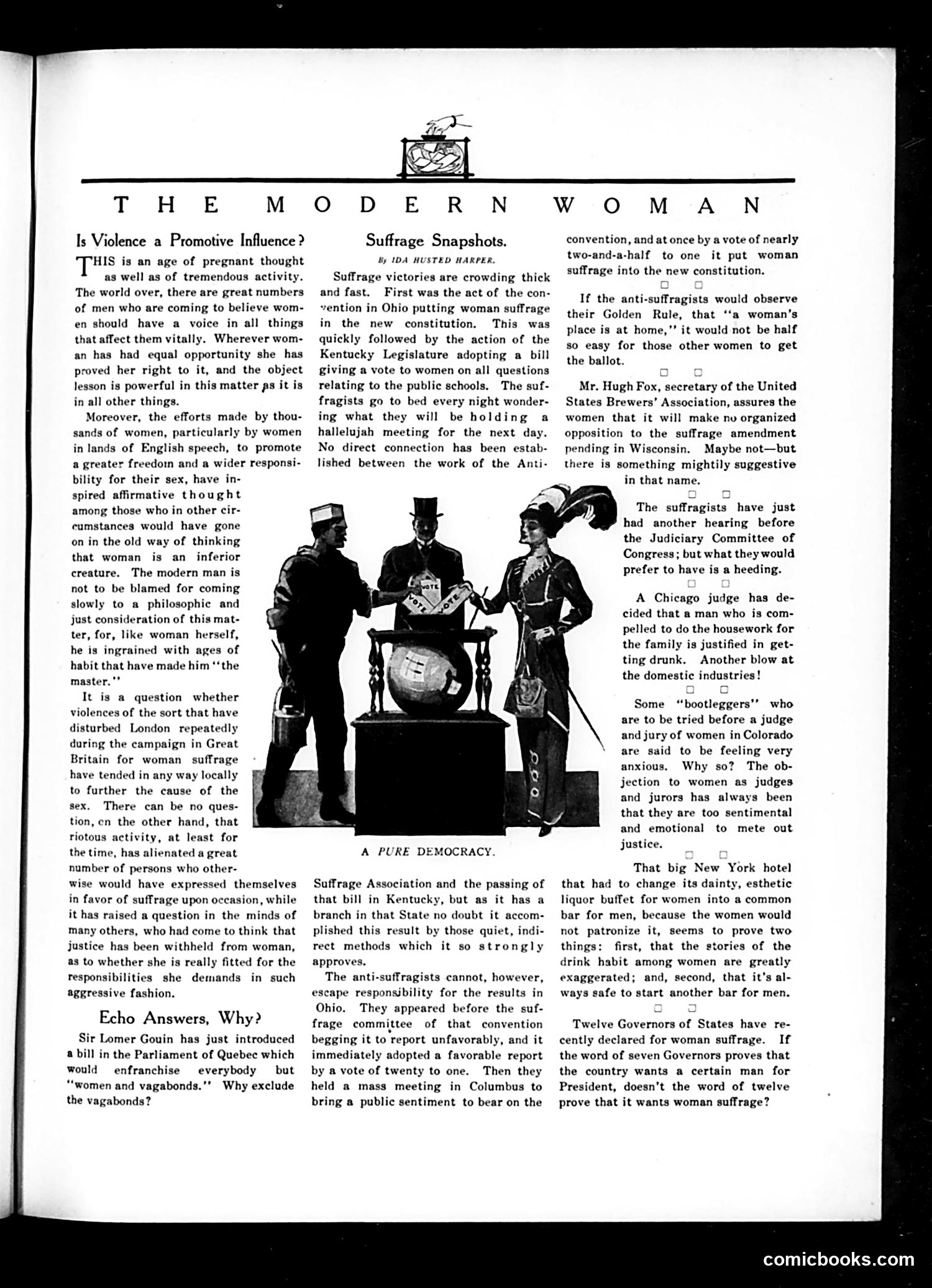
This 1912 satirical piece mocks both suffragettes and anti-suffrage opponents during America's women's voting rights campaign. **The Main Cartoon ("A Pure Democracy"):** Three figures in formal dress surround a globe labeled "WORLD," apparently deciding its fate. This satirizes how male power brokers control global affairs while excluding women from political participation—the irony of calling this "pure democracy." **The Text's Targets:** - **British suffragettes' violent tactics**: Judge criticizes property destruction and riots as counterproductive, alienating potential male supporters - **Anti-suffragists' hypocrisy**: The author notes that anti-suffrage arguments paradoxically *helped* suffrage victories in Ohio and Kentucky by appearing before committees - **Male condescension**: References to women being "too sentimental" for jury duty and the Quebec bill excluding women alongside "vagabonds"—grouping women with society's lowest class **The Satire:** Judge presents suffragists' growing victories while mocking both sides—violent activists and obstinate male opponents—suggesting the real obstacle isn't women's fitness for voting, but entrenched male privilege defended through absurd arguments.
📄 Transcribed text from this page (OCR, searchable)
Machine-transcribed from the original scan — historical spelling and the odd misread are preserved.
T H E Is Violence a Promotive Influence ? HIS is an age of pregnant thought as well as of tremendous activity. The world over, there are great numbers of men who are coming to believe wom- en should have a voice in all things that affect them vitally. Wherever wom- an has had equal opportunity she has proved her right to it, and the object lesson is powerful in this matter as it is in all other things. Moreover, the efforts made by thou- sands of women, particularly by women in lands of English speech, to promote a greater freedotn and a wider responsi- bility for their sex, have in- spired affirmative thought among those who in other cir- cumstances would have gone on in the old way of thinking that woman is an inferior creature. The modern man is not to be blamed for coming slowly to a philosophic and just consideration of this mat- ter, for, like woman herself, he is ingrained with ages of habit that have made him ‘‘the master." It is a question whether violences of the sort that have disturbed London repeatedly during the campaign in Great Britain for woman suffrage have tended in any way locally to further the cause of the sex. There can be no ques- tion, on the other hand, that riotous activity, at least for the time, has alienated a great number of persons who other- wise would have expressed themselves in favor of suffrage upon occasion, while it has raised a question in the minds of many others, who had come to think that justice has been withheld from woman, as to whether she is really fitted for the responsib' s she demands in such aggressive fashion. Echo Answers, Why? Sir Lomer Gouin has just introduced a bill in the Parliament of Quebec which would enfranchise everybody but “women and vagabonds.’’ Why exclude the vagabonds? A M O D E RN Suffrage Snapshots. By IDA HUSTED HARPER. Suffrage victories are crowding thick and fast. First was the act of the con- vention in Ohio putting woman suffrage in the new constitution. This was quickly followed by the action of the Kentucky Legislature adopting a bill giving a vote to women on all questions relating to the public schools. The suf- fragists go to bed every night wonder- ing what they will be holding a hallelujah meeting for the next day. No direct connection has been estab- lished between the work of the Anti- A PURE DEMOCRACY. Suffrage Association and the passing of that bill in Kentucky, but as it has a branch in that State no doubt it accom- plished this result by those quiet, indi- rect methods which it so strongly approves. The anti-suffragists cannot, however, escape responsibility for the results in Ohio. They appeared before the suf- frage committee of that convention begging it to report unfavorably, and it immediately adopted a favorable report by a vote of twenty to one. Then they held a mass meeting in Columbus to bring a public sentiment to bear on the Ww OM A N convention, and at once by a vote of nearly two-and-a-half to one it put woman suffrage into the new constitution. If the anti-suffragists would observe their Golden Rule, that ‘‘a woman’s place is at home,’ it would not be half so easy for those other women to get the ballot. Mr. Hugh Fox, secretary of the United States Brewers’ Association, assures the women that it will make nv organized opposition to the suffrage amendment pending in Wisconsin. Maybe not—but there is something mightily suggestive in that name. The suffragists have just had another hearing before the Judiciary Committee of Congress; but what they would prefer to have is a heeding. A Chicago judge has de- cided that a man who is com- pelled to do the housework for the family is justified in get- ting drunk. Another blow at the domestic industries! Some “bootleggers’’ who are to be tried before a judge and jury of women in Colorado are said to be feeling very anxious. Why so? The ob- jection to women as judges and jurors has always been that they are too sentimental and emotional to mete out justice. That big New York hotel that had to change its dainty, esthetic liquor buffet for women into a common bar for men, because the women would not patronize it, seems to prove two things: first, that the stories of the drink habit among women are greatly exaggerated; and, second, that it’s al- ways safe to start another bar for men. Twelve Governors of States have re- cently declared for woman suffrage. If the word of seven Governors proves that the country wants a certain man for President, doesn't the word of twelve prove that it wants woman suffrage? comicbooks.com