
A complete issue · 30 pages · 1911
Judge — March 25, 1911
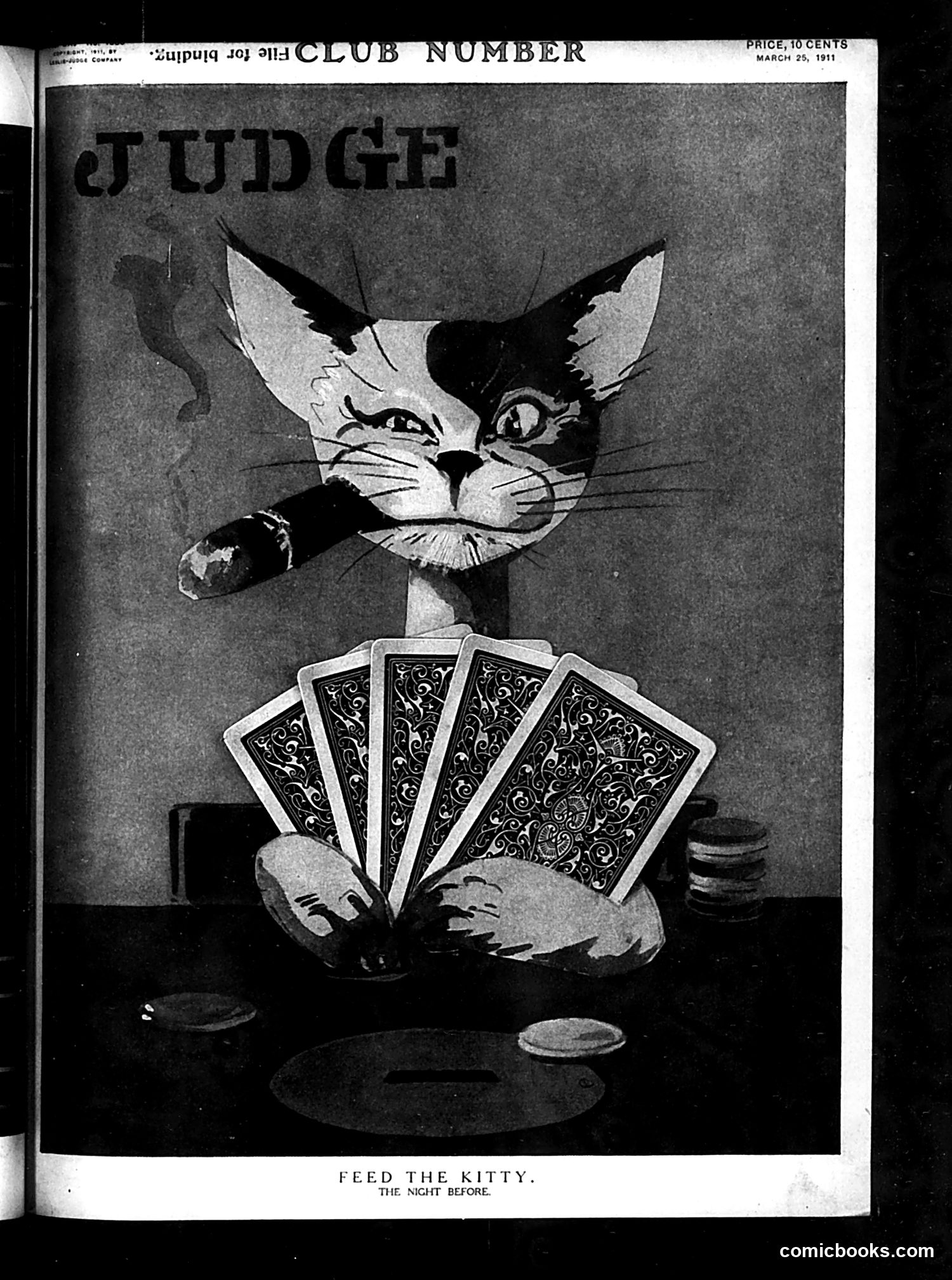
This Judge magazine cover from March 25, 1911, depicts an anthropomorphized cat as a card player holding a poker hand, with coins scattered on the table. The caption "Feed the Kitty" is a pun—referring both to literally feeding a cat and to the gambling term "kitty" (the pot of pooled money in card games). The cartoon satirizes gambling, likely criticizing the practice of poker and card games popular among men at the time. The "night before" subtitle appears to reference anticipation of consequences. The image uses the innocent figure of a cat to mock human vice, a common satirical device in Judge's humor, making gambling seem foolish and animalistic.
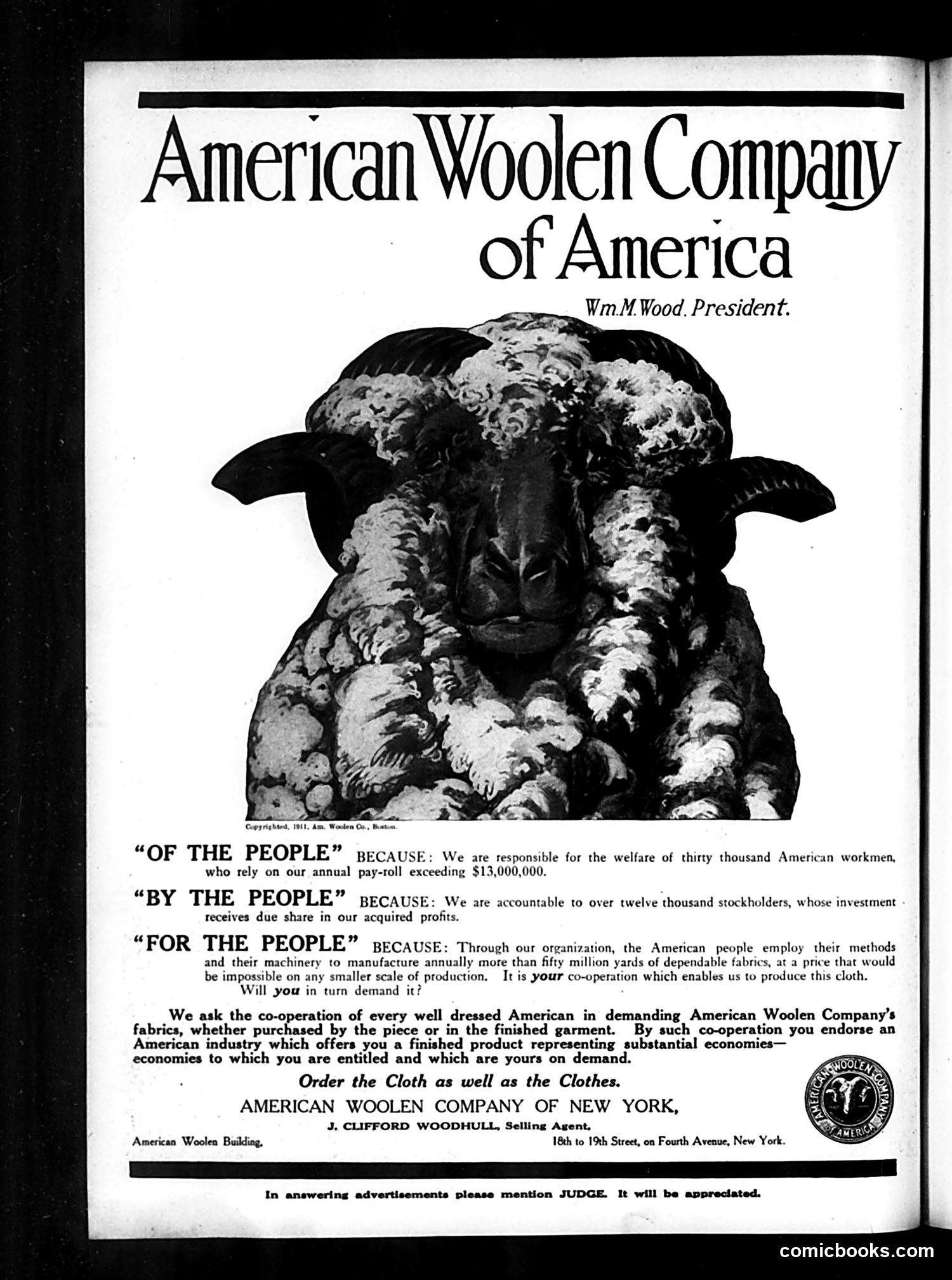
This page is primarily a **corporate advertisement**, not satire. The American Woolen Company of America uses patriotic language and the "of/by/for the people" framework (echoing Lincoln's Gettysburg Address) to market woolen fabrics and finished garments. The sheep image serves as a straightforward product symbol, not political caricature. The ad emphasizes American manufacturing, employment (30,000 workers), and shareholder value (12,000 stockholders). The rhetorical strategy—invoking democratic principles to promote consumption and American industry—reflects early 20th-century corporate messaging that equated buying American-made goods with civic duty. This appears to be a sincere pitch rather than satirical commentary, using patriotic framing to encourage consumer support for domestic manufacturing during an era of protectionist sentiment.
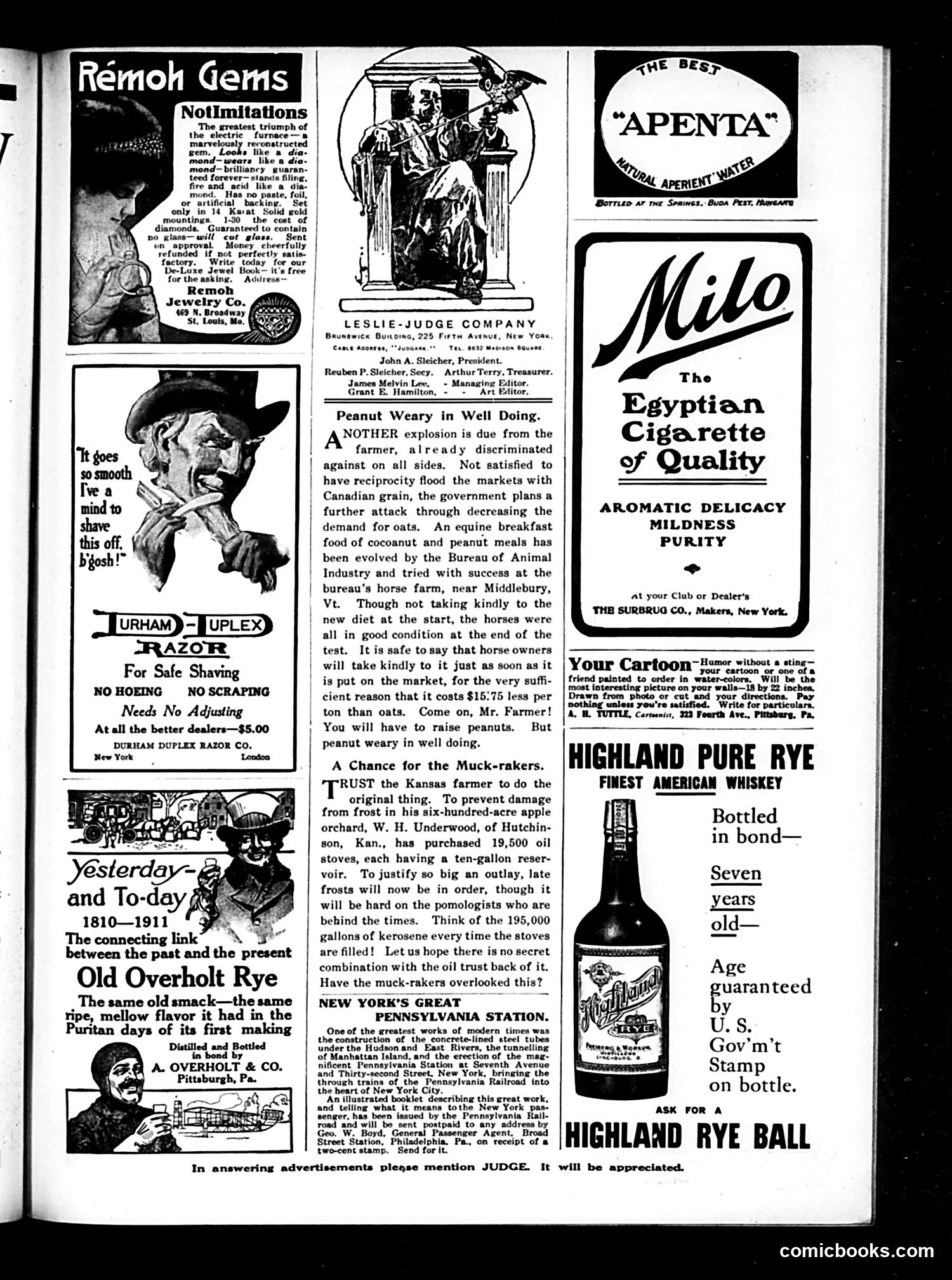
This page is primarily **advertisements** interspersed with brief editorial content from what appears to be an early 20th-century issue. The cartoons are minor—a caricatured face for an "Urharn Duplex Razor" ad and another illustration for "Old Overholt Rye" whiskey. These aren't political satire but rather product marketing using exaggerated facial features common in that era's advertising. The editorial content discusses agricultural issues: farmer grievances about grain markets, experimentation with alternative livestock feed, and frost protection for apple orchards. These suggest concerns about American agricultural economics and innovation during this period. The page demonstrates Judge's mixed commercial-editorial model, with satirical magazine content sharing space with patent medicines, cigarettes, whiskey, and razors—reflecting early 1900s publishing practices.
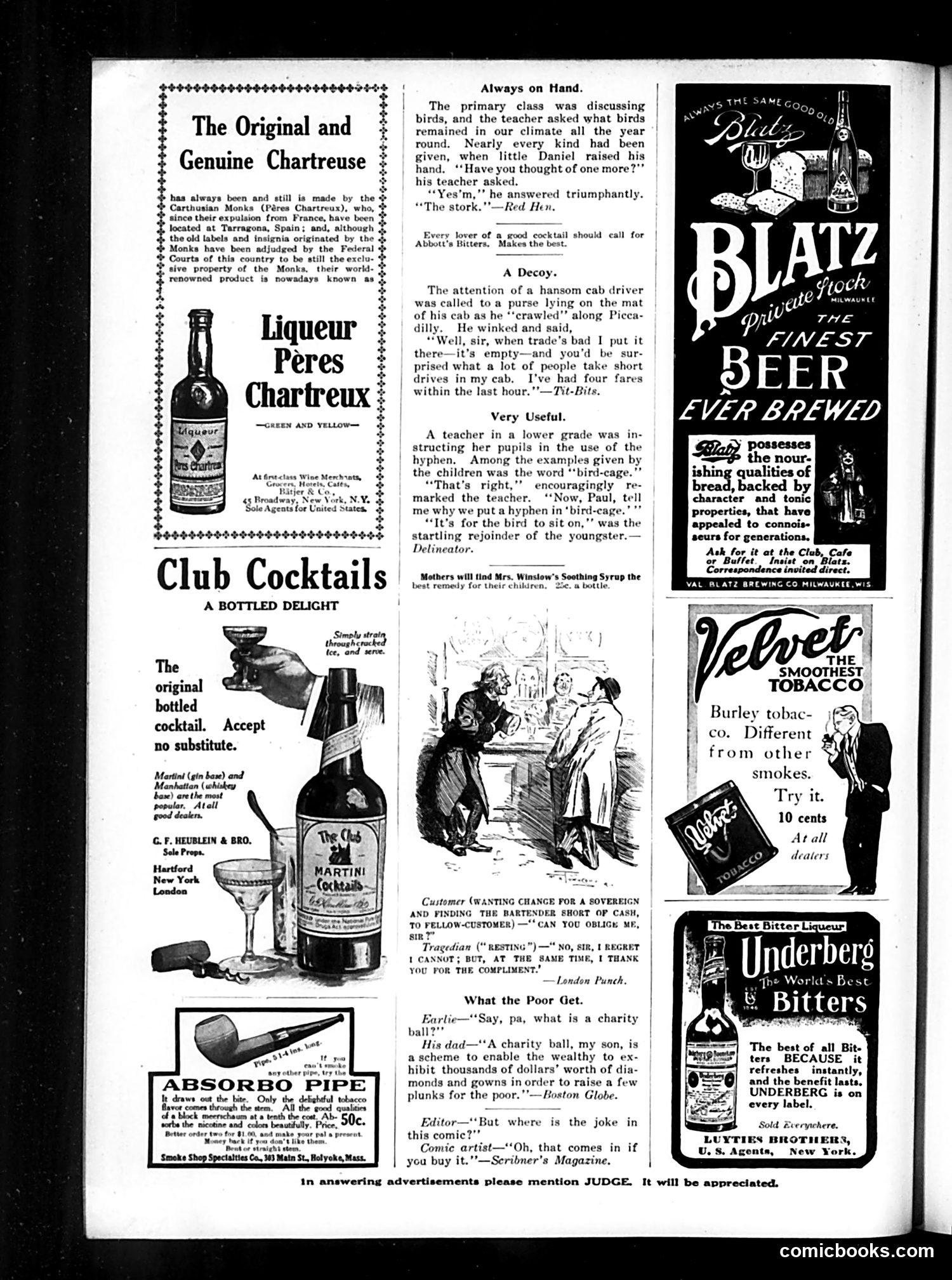
This page is primarily **advertising**, not political satire. The dominant content includes liqueur and beer advertisements (Chartreuse, Blatz Private Stock, Velvet tobacco, Underberg bitters) typical of early 20th-century Judge magazine. The small cartoon labeled "Customer (Wanting Change for a Sovereign and Finding the Bartender Short of Cash...)" depicts a humorous bar exchange where a customer requests change from a sovereign (British gold coin) but the bartender is short on cash. The dialogue suggests the bartender wants to keep the coin as a tip instead. Below, a brief comic dialogue about charity balls serves as filler content between advertisements rather than substantive satire. The page reflects Judge's reliance on advertising revenue and light humor rather than political commentary.
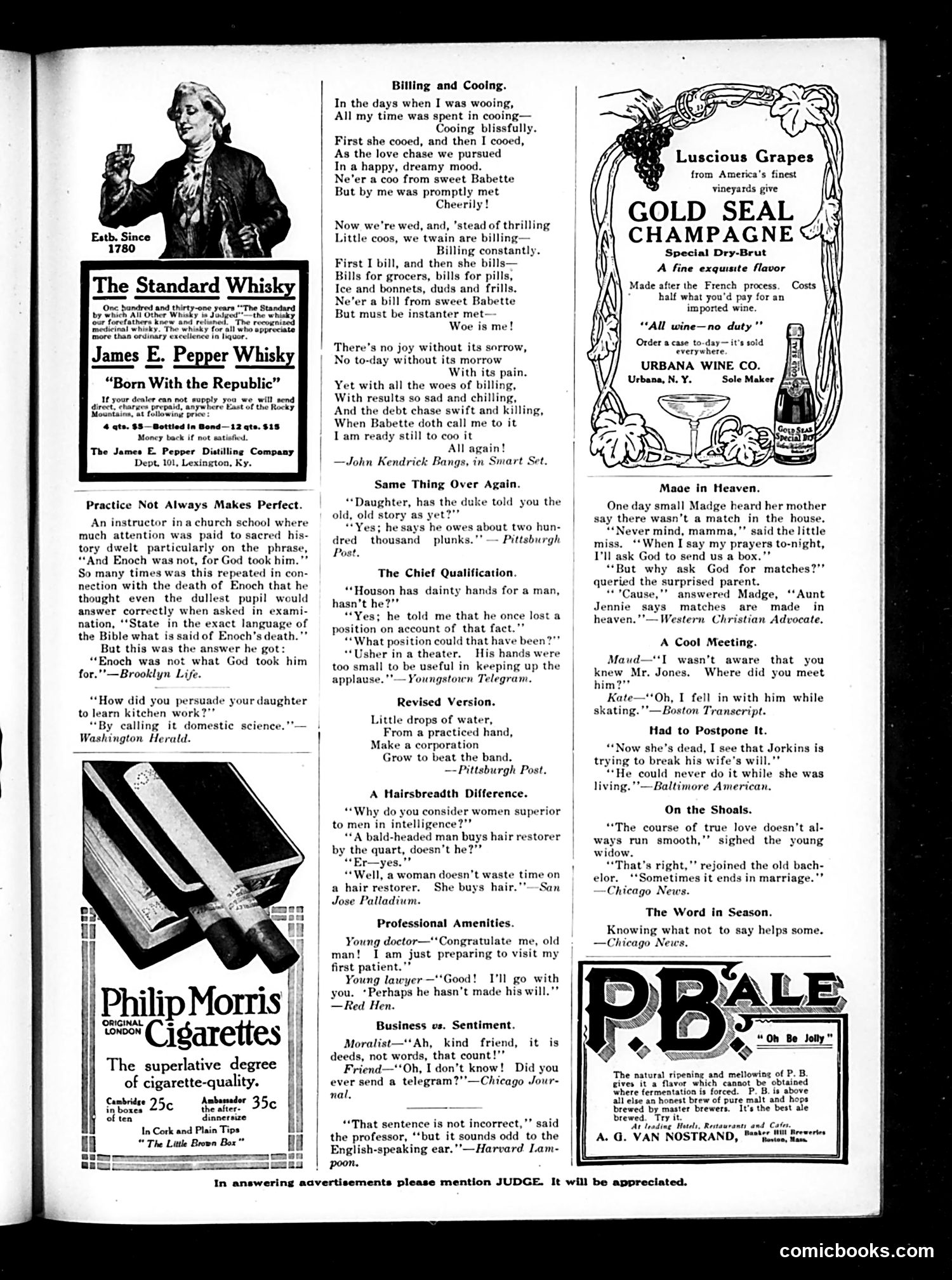
This page is **primarily advertising** with scattered humorous content rather than political cartoons. The main advertisements include: - **James E. Pepper Whisky** ("Born with the Republic") - **Philip Morris Cigarettes** - **Gold Seal Champagne** by Urbana Wine Co. - **P.B. Ale** beer The text includes brief humor pieces and jokes typical of Judge's satirical style—witty observations about marriage, relationships, and social behaviors. For example, "Practice Not Always Makes Perfect" mocks ineffective instruction, while other snippets jest about women's intelligence and domestic life. Without clear political cartoons or identifiable caricatures, this appears to be a typical issue mixing advertisements with light social humor rather than targeting specific political figures or events.
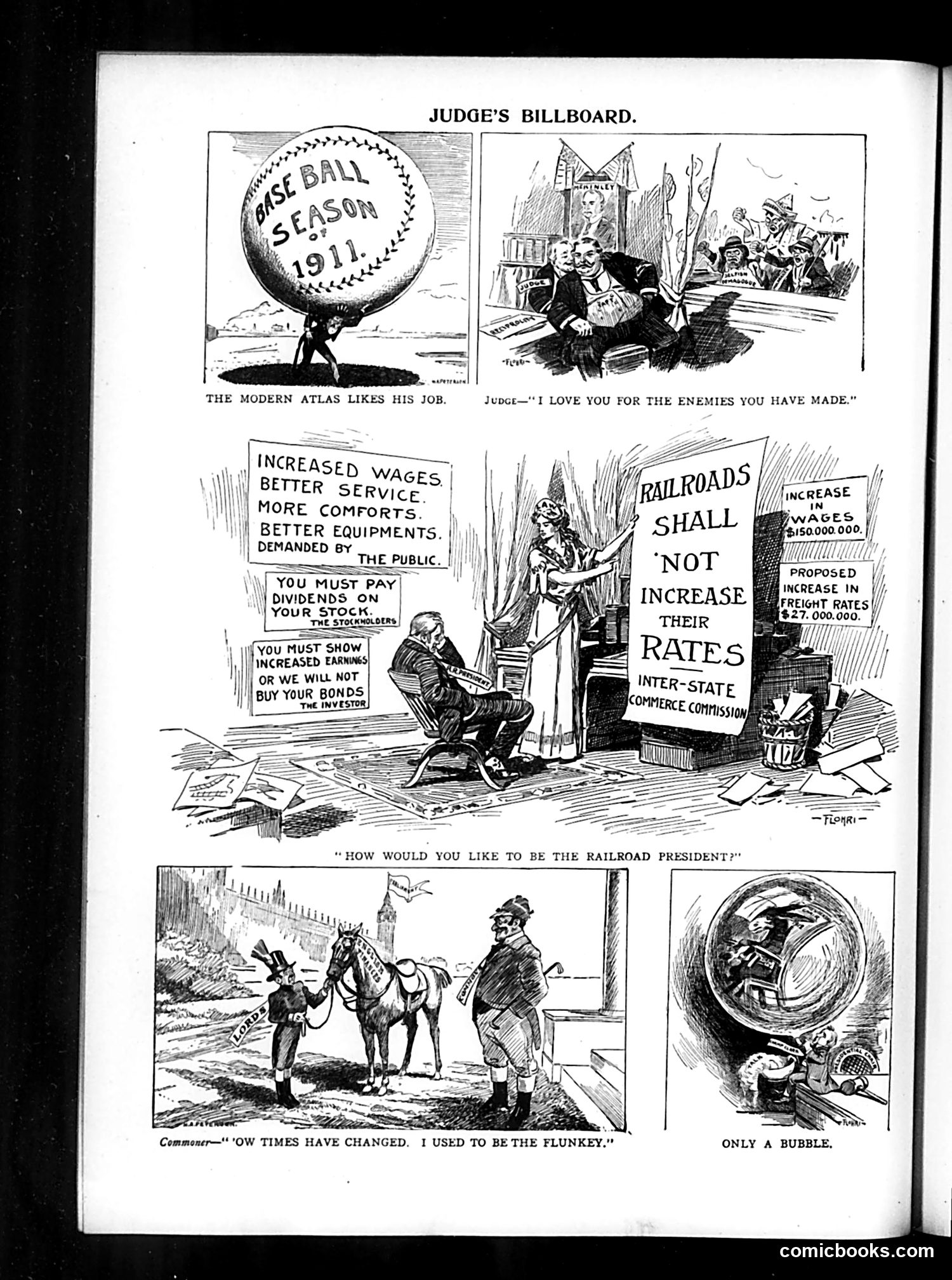
This page satirizes railroad industry pressures and corporate hypocrisy during the Progressive Era. **Top panel**: A figure (representing the railroad industry) holds a baseball labeled "Base Ball Season 1911," suggesting the sport's popularity. The Judge (representing public opinion/justice) praises him for the "enemies you have made"—corporations despised by reformers. **Middle panel**: The railroad president faces contradictory demands: the public demands wage increases and better service; stockholders demand no rate increases; the Inter-State Commerce Commission restricts rate hikes. The cartoonist satirizes the impossible position of pleasing all stakeholders while maintaining profits. **Bottom panels**: One shows a farmhand ("flunkey") noting times have changed—likely referencing the shift in power dynamics. The final image depicts the railroad industry as merely "a bubble," suggesting its economic foundation is unstable or illusory. The overall message: railroads face unsustainable pressure from competing interests and lack genuine solutions.
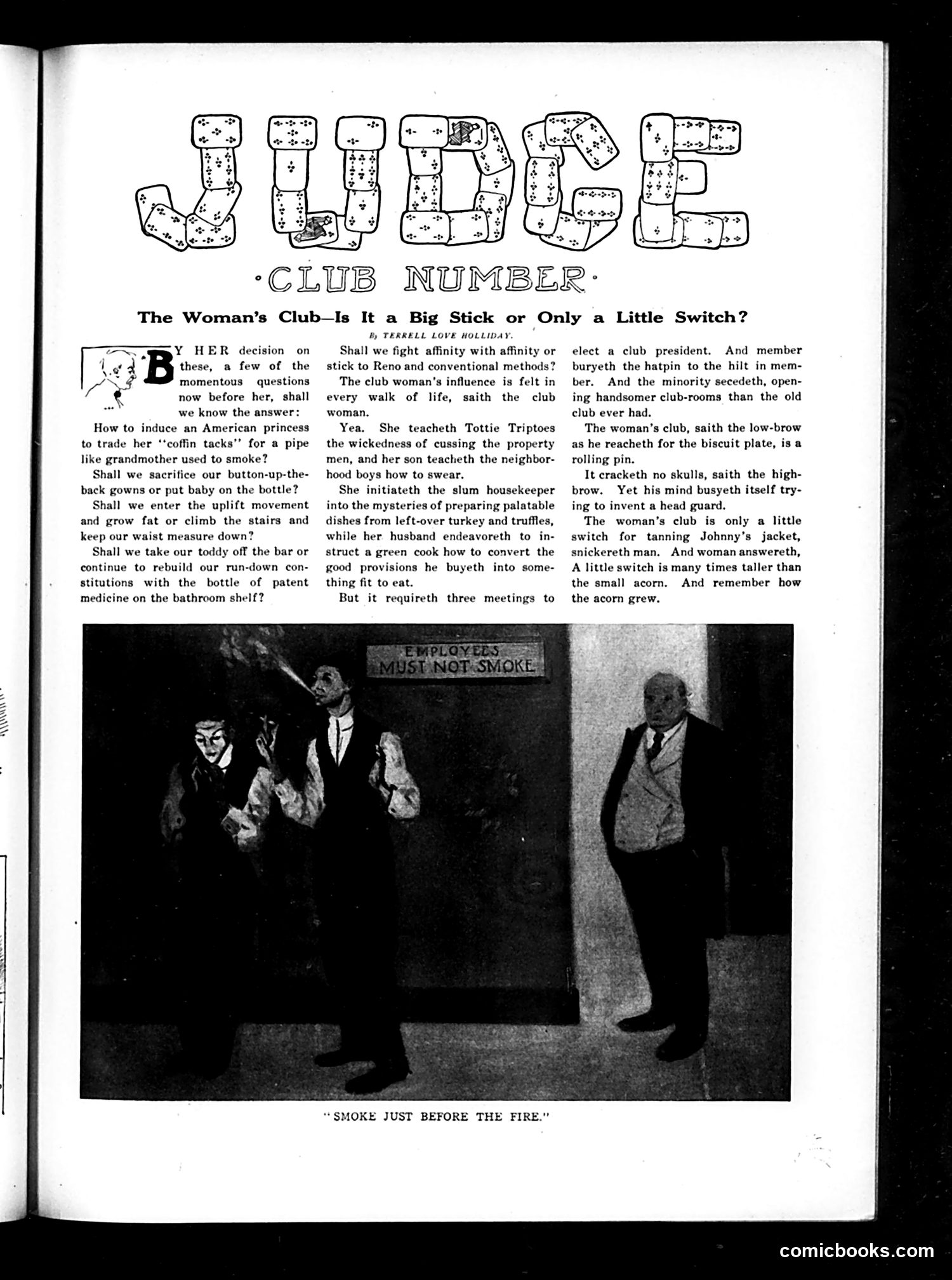
This page satirizes the emerging women's club movement of the early 20th century, which was reshaping American social and political life. The article, by Terrell Love Holliday, mocks club women through exaggerated contradictions: they claim broad influence over society yet waste time on trivial decisions like electing presidents; they preach morality to others while their own families ignore their teachings; they advise the poor on cooking fancy dishes while their own household staff fails. The satire's core joke appears in the final exchanges: men dismiss women's clubs as harmless ("a little switch"), but the woman's response invokes the acorn metaphor—suggesting small things grow into mighty forces. The photograph captioned "Smoke Just Before the Fire" likely illustrates this tension humorously. The piece reflects anxious male attitudes toward women gaining organizational power and public voice during this period.
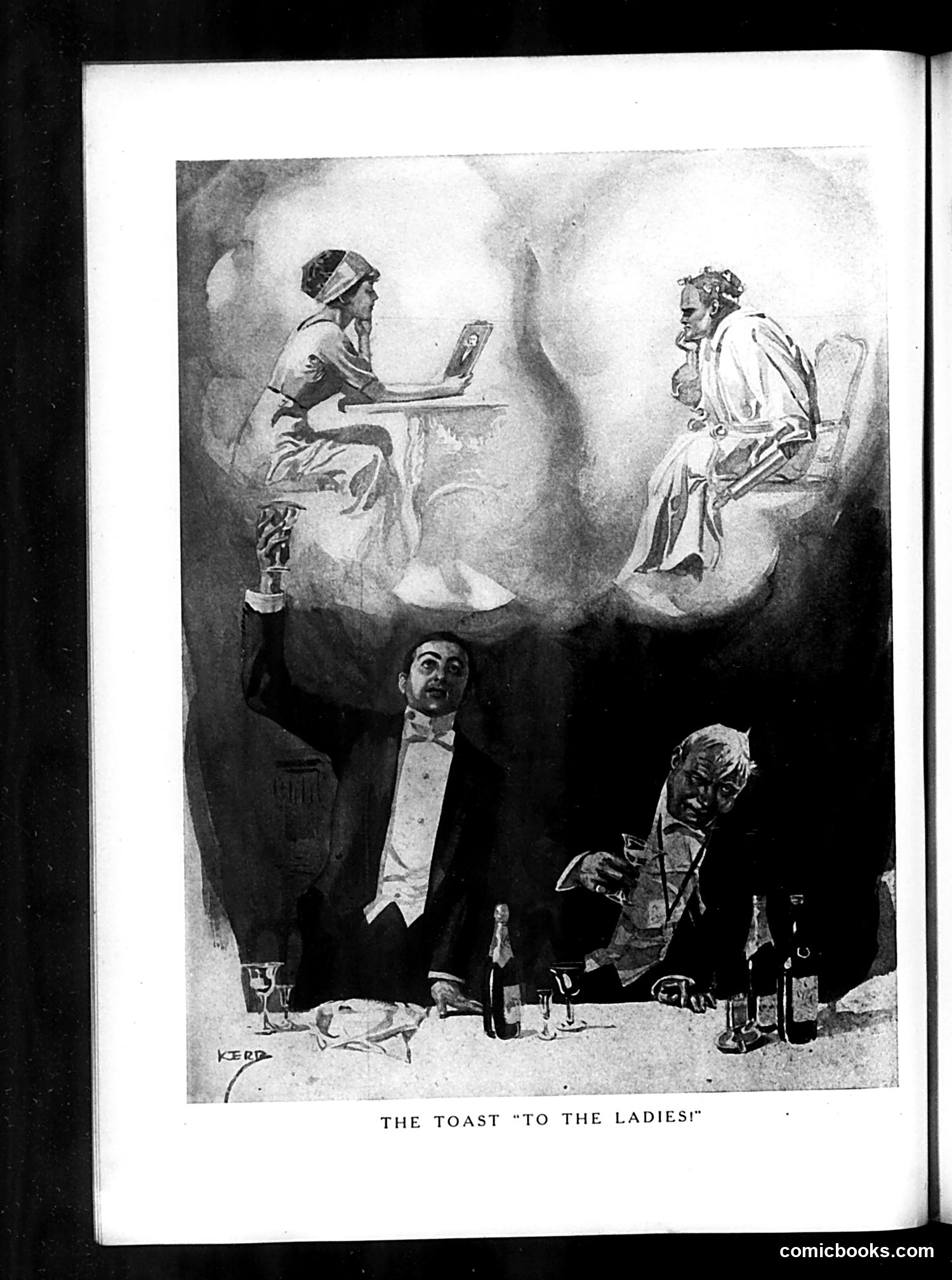
This satirical illustration depicts a formal dinner scene. A man in formal evening wear stands raising his glass in a toast, with bottles and place settings visible below. Above him, ethereal female figures appear in clouds—two women in period dress engaged in what seems to be casual domestic activity (one appears to be reading or writing). The satire likely mocks the Victorian convention of toasting "the ladies"—a ritual where men would ceremoniously honor women while the women themselves remained absent from the gathering. By depicting the actual ladies as ghostly, removed presences engaged in mundane activities, Judge magazine satirizes the gap between romantic male rhetoric about womanhood and women's actual lives and agency. The joke highlights the performative nature of such gallant gestures.
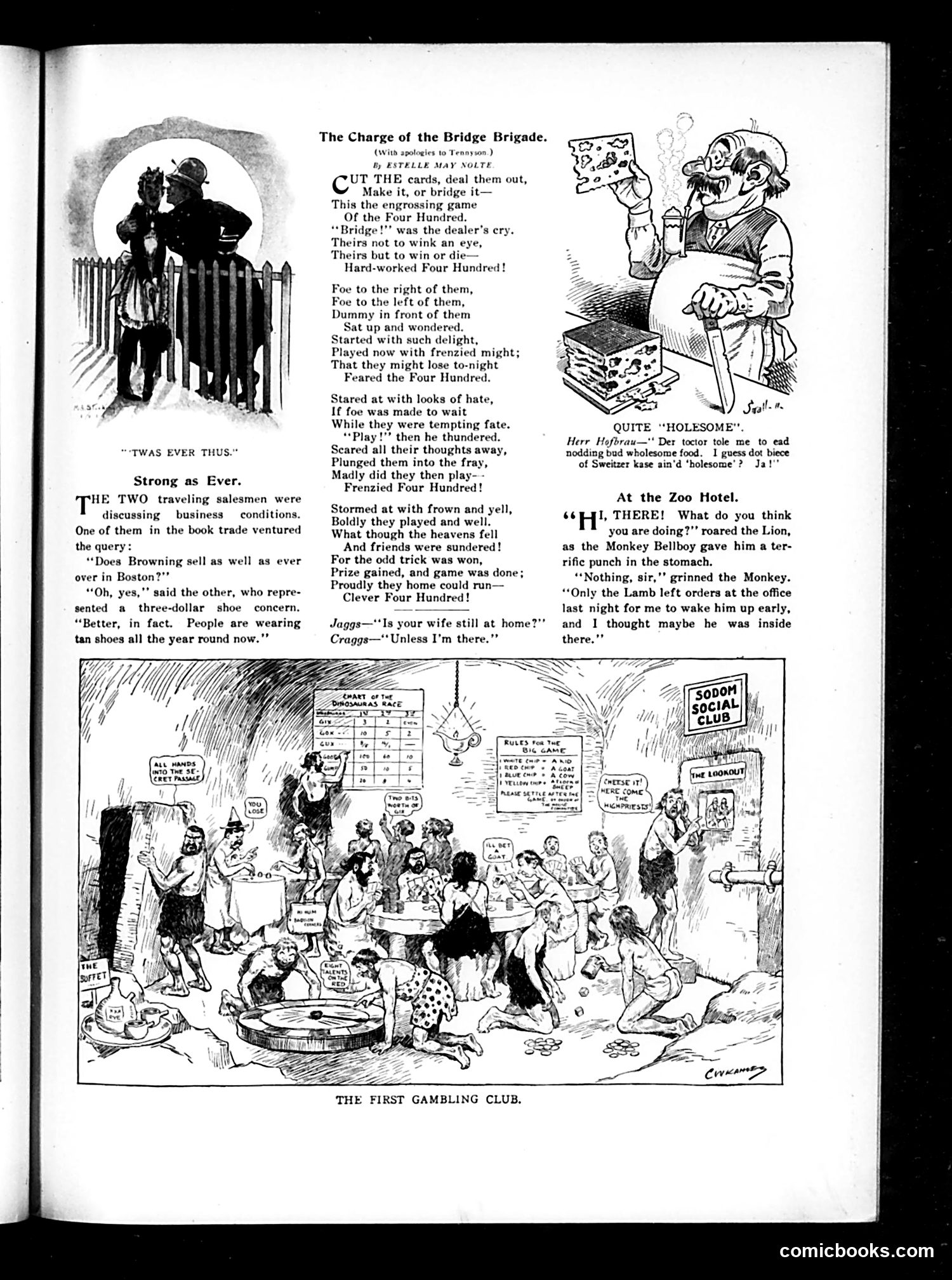
This page contains three main satirical pieces mocking upper-class leisure and excess: **"The Charge of the Bridge Brigade"** parodies Tennyson's "Charge of the Light Brigade," comparing wealthy socialites (the "Four Hundred"—a term for New York's elite) obsessively playing bridge card games to soldiers in battle. The satire suggests their card games are trivial yet consuming, treating a parlor game with military intensity. **"The First Gambling Club"** cartoon depicts children gambling and playing games, satirizing how gambling has become normalized entertainment even for the young, presented as innocent "club" activity. The other brief jokes mock: - Browning's continued popularity in Boston (likely poet Robert Browning) - Shoe sales trends among the wealthy - A German immigrant's malapropisms about wholesome food Overall, the page ridicules wealthy society's frivolous obsessions (card games, gambling) and class pretensions, while gently mocking immigrants and commercial culture.
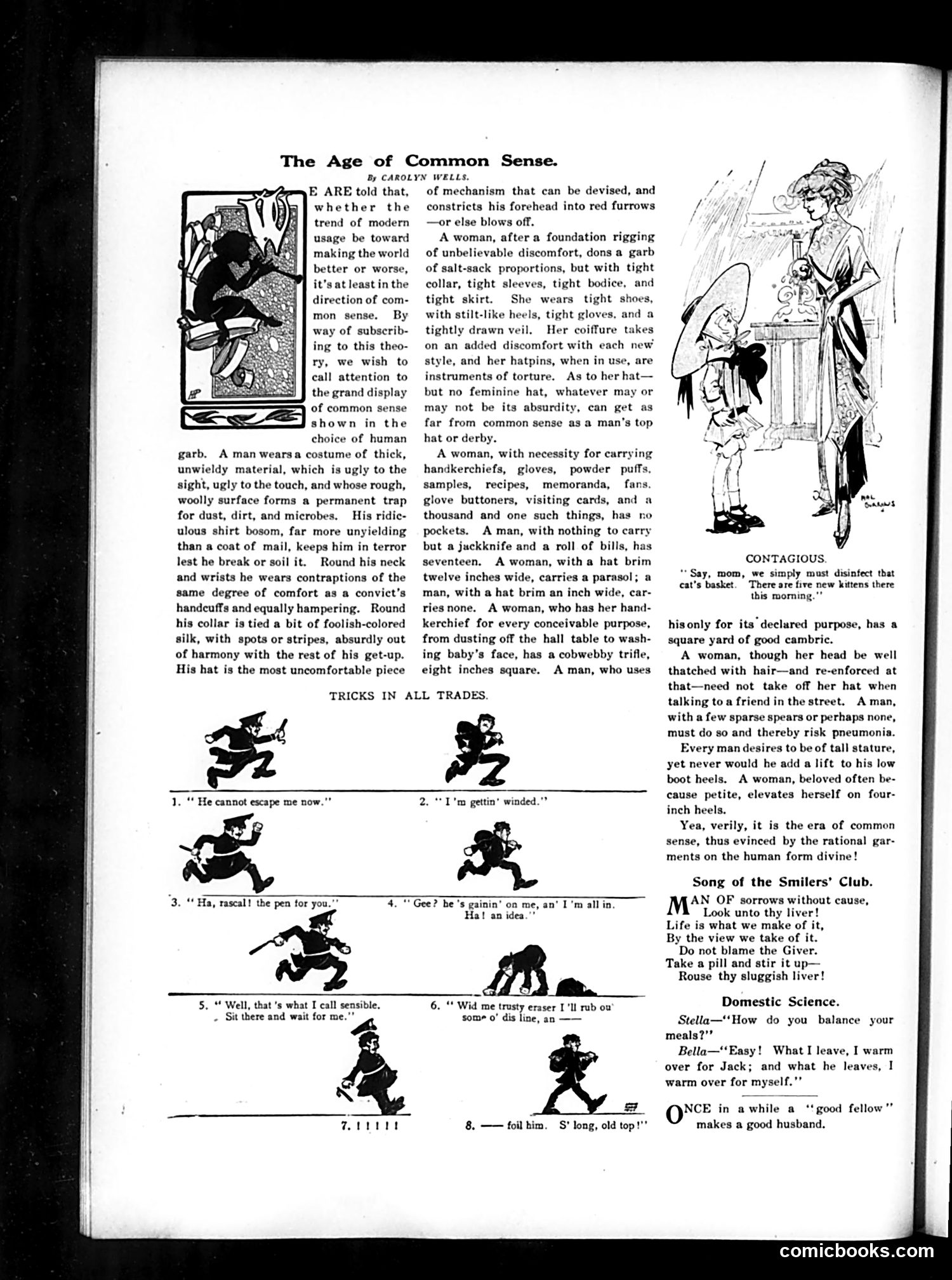
This essay by Carolyn Wells mocks the impracticality of both men's and women's clothing, arguing that despite claims of modern "common sense," fashion remains fundamentally illogical. **The satire's points:** **Men's clothing** is criticized as heavy, uncomfortable, and impractical—stiff shirt fronts, restrictive collars, uncomfortable hats that leave forehead marks, yet men have seventeen pockets for minimal items. **Women's clothing** is portrayed as even more absurd: tight corsets, seventeen restrictive layers, yet *no pockets* despite needing to carry numerous items. Their hats are wider but equally impractical; they wear four-inch heels to appear petite; their handkerchiefs are decorative trifles rather than functional. **The irony:** Both sexes wear clothing that violates common sense—men won't remove hats (risking pneumonia), women elevate themselves precariously on heels—yet society accepts this as normal. The "Tricks in All Trades" cartoons below appear unrelated comic sketches. The piece argues that despite supposed progress, fashion remains governed by tradition and vanity rather than rationality.
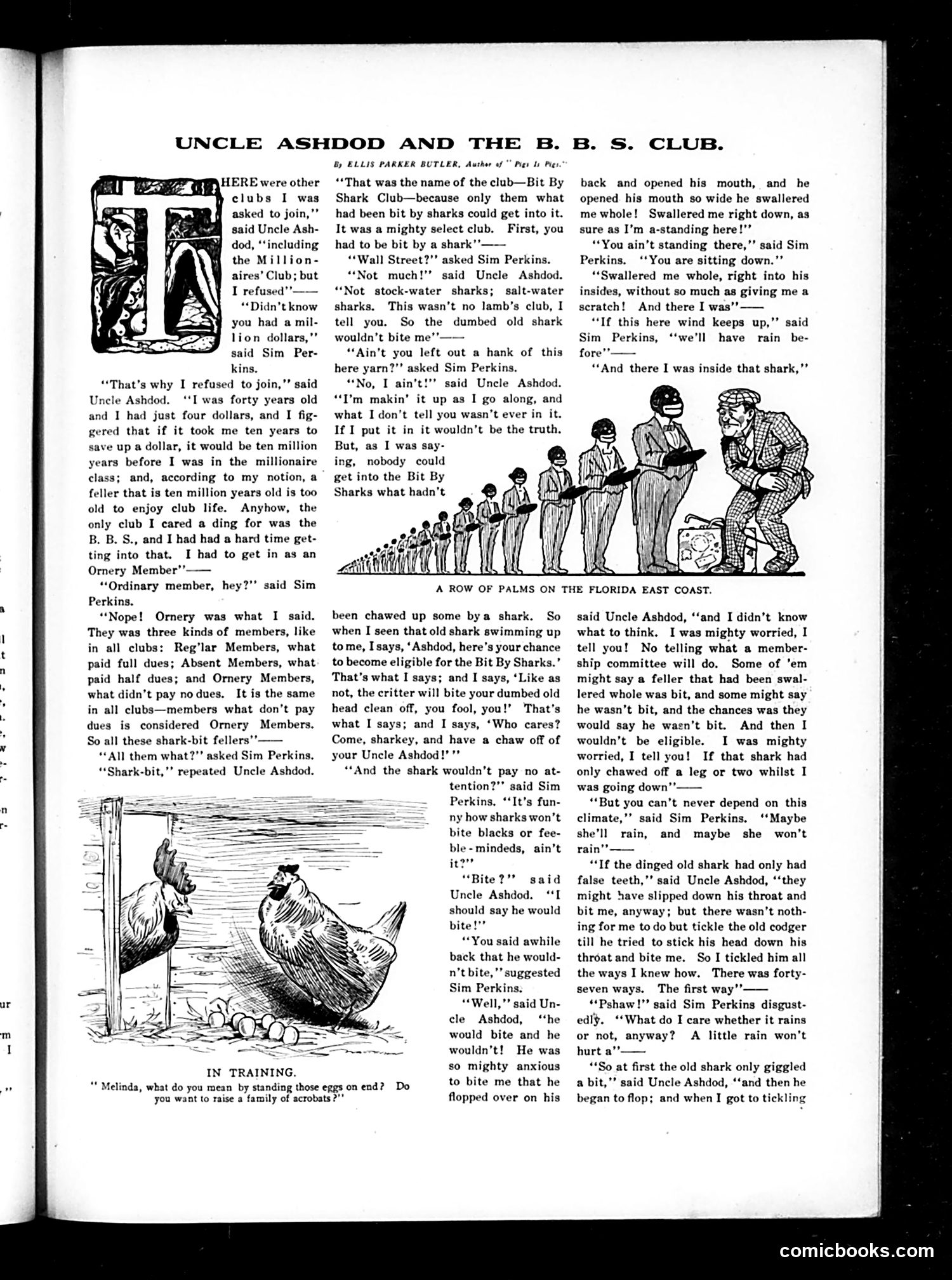
This humorous story by Ellis Parker Butler features Uncle Ashdod recounting his membership in the "Bit By Shark Club"—a fictional, exclusive organization requiring members to have been attacked by sharks. The joke centers on Ashdod's tall tale: he claims a shark swallowed him whole, then disputes whether this counts as being "bit," since the shark never actually bit him—creating absurd logical complications for club membership eligibility. The story is pure comedic fiction with no political satire. The humor derives from folksy dialect, exaggeration, and Ashdod's mock-serious debate with Sim Perkins about technicalities. A secondary cartoon shows a woman standing eggs on end, joking about raising "acrobat" chicks—simple visual humor unrelated to the main story.
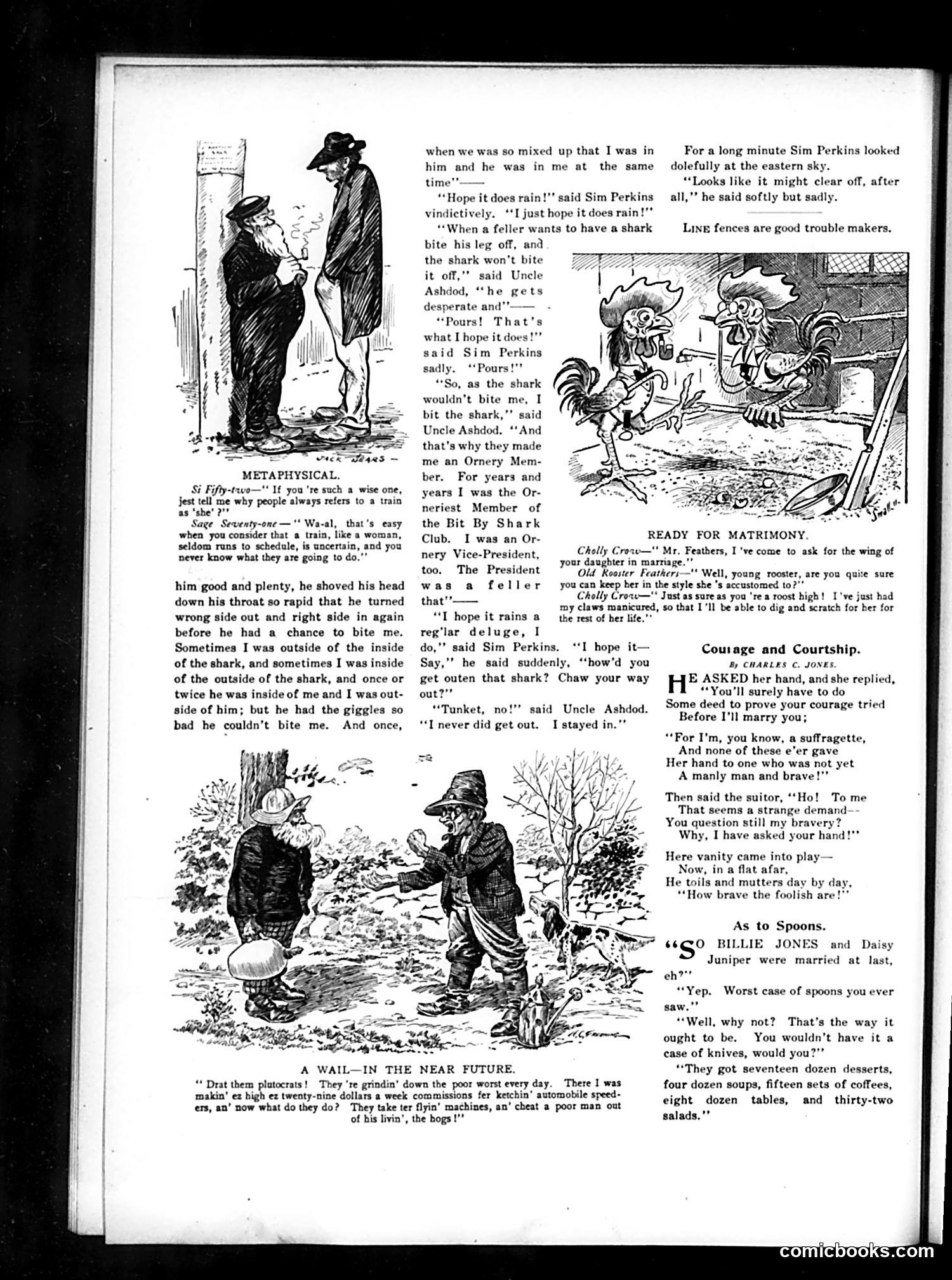
This page contains multiple humorous pieces typical of early-20th-century American satire: **"Metaphysical"**: A joke contrasting trains with women—both are unreliable and unpredictable, a common sexist trope of the era. **Uncle Ashdod's shark story**: A tall tale about a man who got stuck inside a shark and couldn't escape, told to a frustrated farmer (Sim Perkins) hoping for rain. The absurdist humor depends on the ridiculous premise. **"A Wail—In the Near Future"**: Social commentary on labor displacement. A worker laments losing his job catching speeding automobiles when people switch to flying machines—satirizing fears of technological unemployment and corporate indifference to workers ("plutocrats"). **Animal courtship cartoons**: "Ready for Matrimony" and "Courage and Courtship" use anthropomorphized birds and romantic scenarios for gentle humor about marriage expectations and gender roles. **"As to Spoons"**: A joke about newlyweds receiving excessive wedding gifts—seventeen dozen desserts and thirty-two salads but apparently few spoons, mocking excessive gift-giving customs. The page blends physical comedy, social anxiety, and relationship humor typical of Judge's satirical approach.
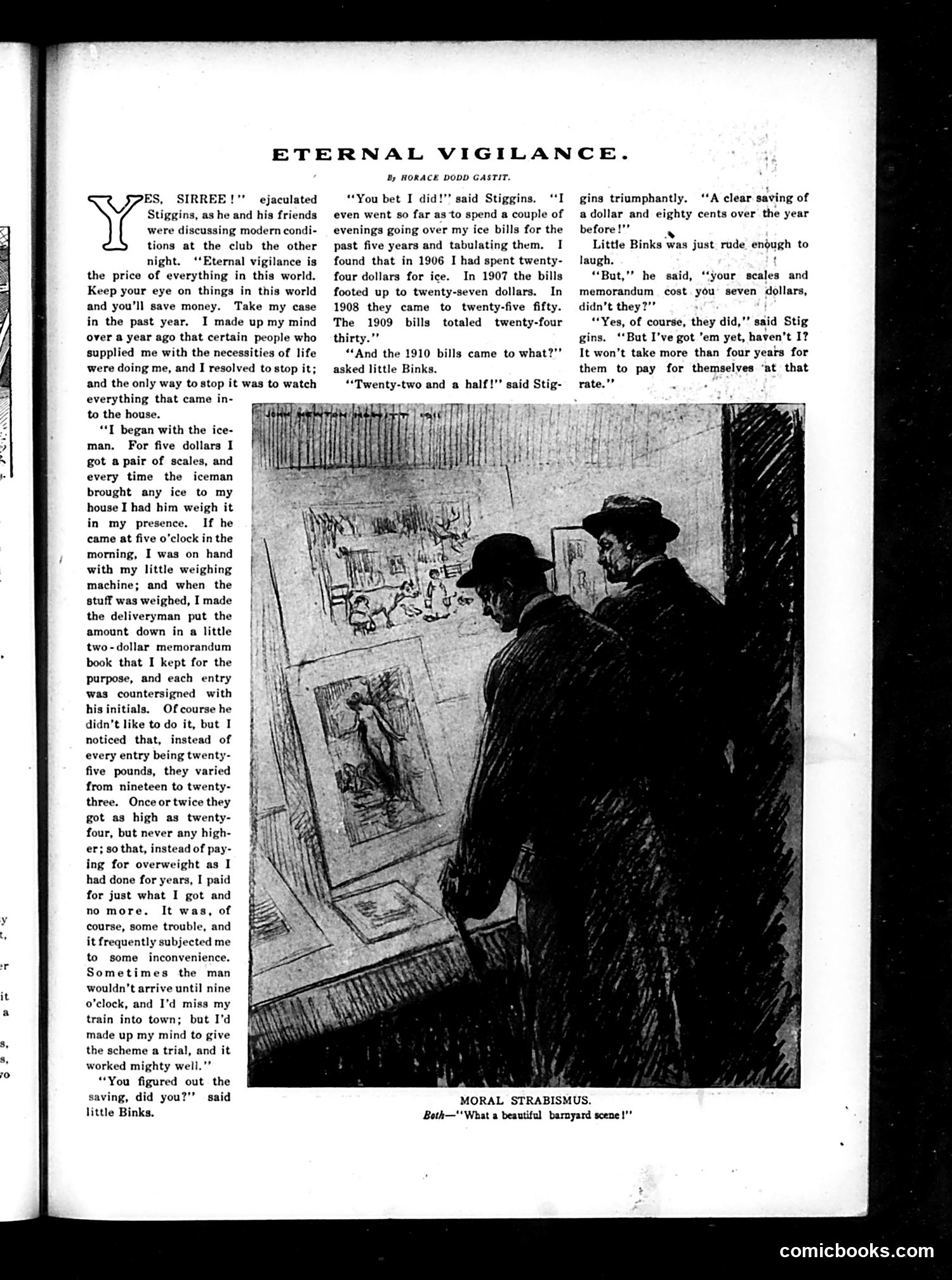
This story by Horace Dodd Gastit mocks penny-pinching obsessiveness. The character Stiggins boasts of catching his iceman short-weighing deliveries by installing scales and keeping a signed ledger—inconveniencing himself greatly (missing trains) to save roughly $1.80 annually over five years. The joke's punchline: his monitoring equipment cost $7, requiring four years just to break even on his microscopic savings. Little Binks's laughter highlights the absurdity—Stiggins achieved "eternal vigilance" at enormous personal cost for negligible gain. The accompanying illustration (captioned "Moral Strabismus"—crossed-eye vision representing distorted perspective) shows two figures examining a picture, each seeing different things. This reinforces the satire: Stiggins's vigilance has given him warped vision, unable to see his scheme's fundamental futility. The piece critiques miserly obsession and self-defeating penny-pinching logic common among certain wealthy Americans.
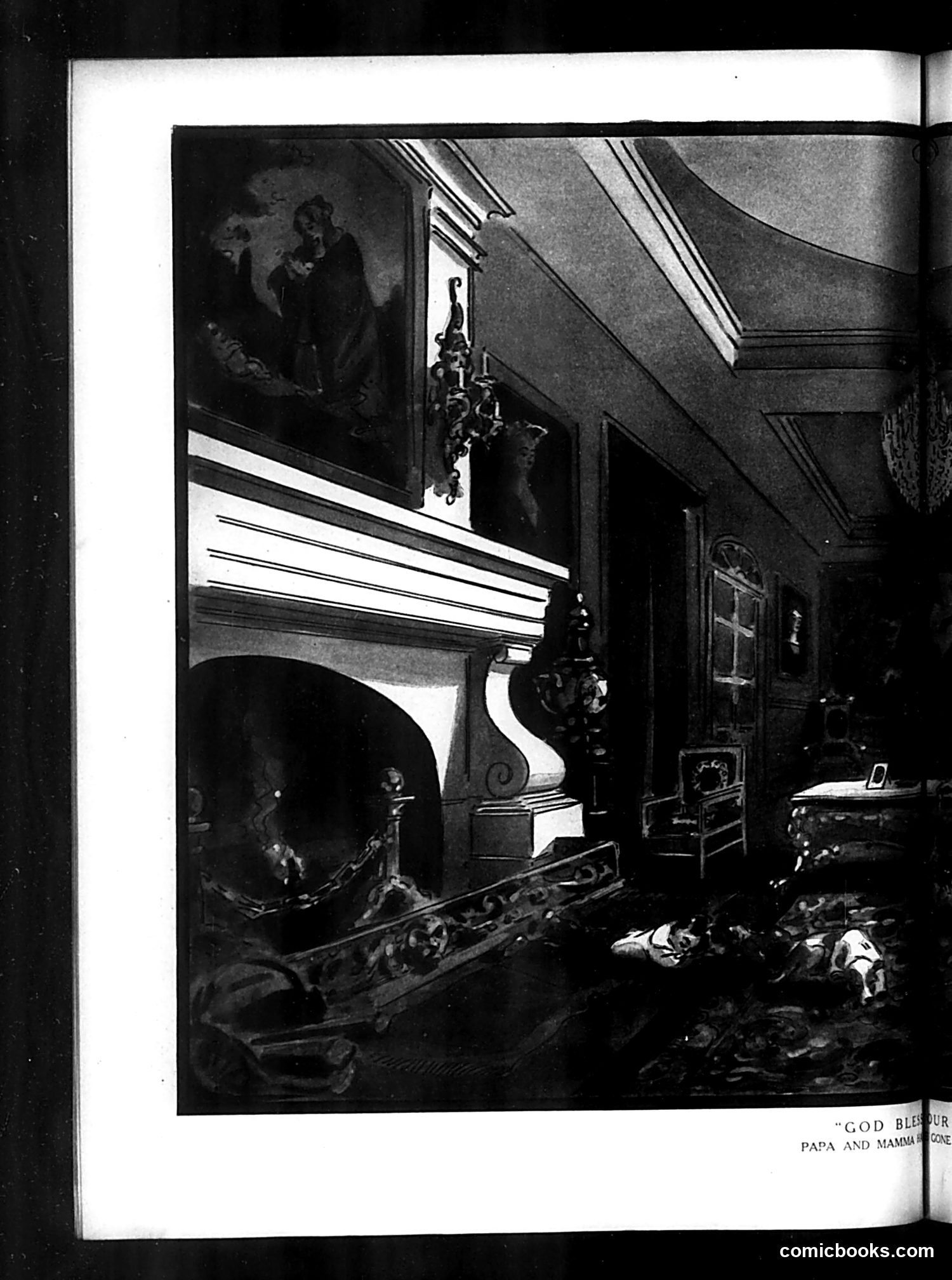
This appears to be a dramatic scene from a theatrical production or narrative illustration rather than a political cartoon. The image shows an ornate interior with classical architectural details—a fireplace with decorative molding, elegant furnishings, and what appears to be figures in period dress. The caption "GOD BLESS OUR PAPA AND MAMMA" suggests a sentimental domestic scene, possibly depicting children or young people in a moment of filial piety or family devotion. The Gothic or dramatic lighting and composition give it a theatrical quality. Without clearer text or additional context identifying the specific play, novel, or satirical subject being referenced, I cannot definitively explain the cartoon's satirical intent or political meaning to a modern reader. The image quality and OCR errors obscure the full caption and any explanatory text that would clarify the reference.
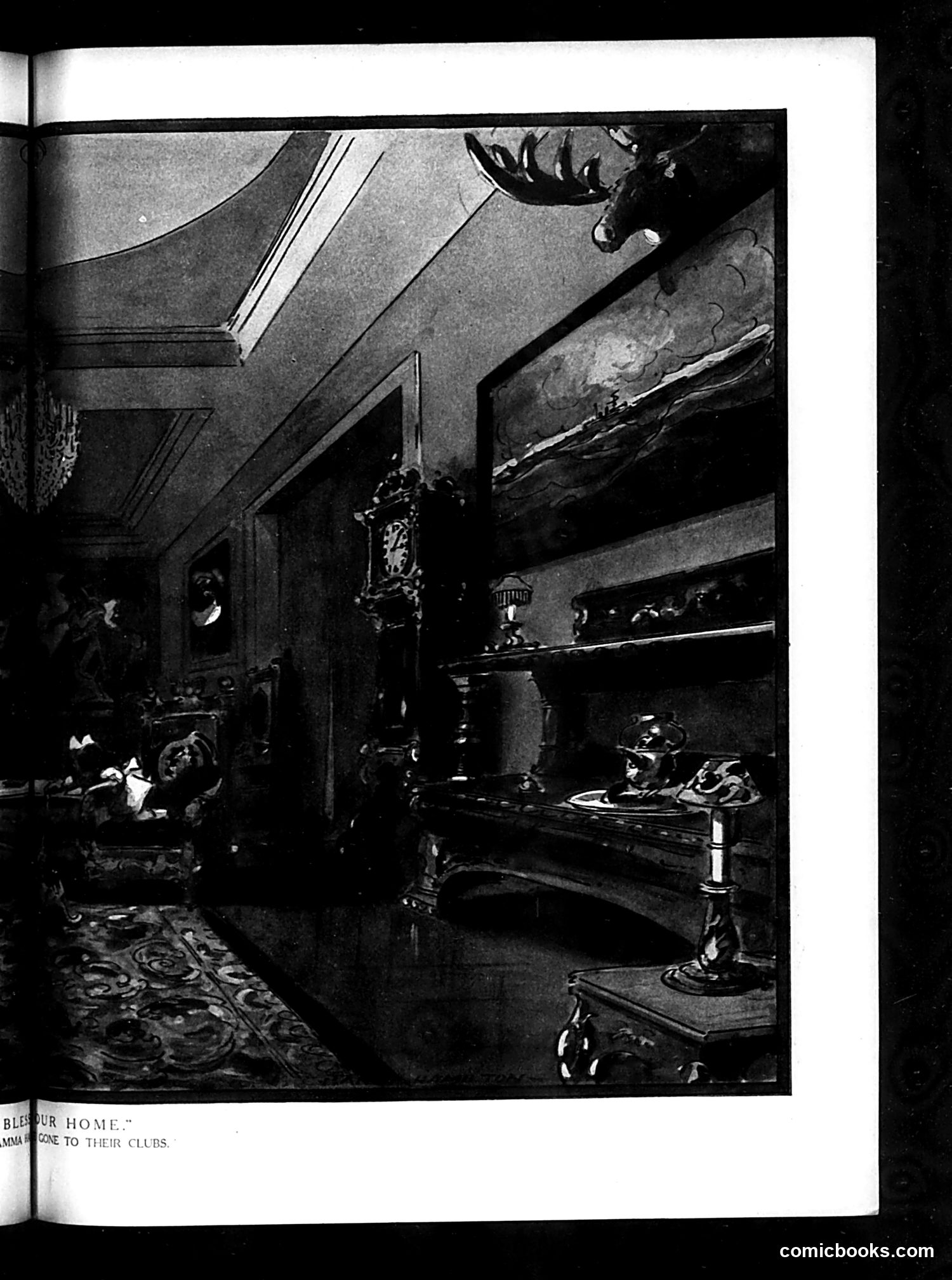
This appears to be a page from *Judge* magazine showing an interior illustration rather than a political cartoon. The black-and-white image depicts an ornately decorated room with elaborate furnishings, including a piano, decorative objects, and what appears to be wealthy residents. The visible text fragment reads "BLENT OUR HOME" and mentions "GONE TO THEIR CLUBS," suggesting the illustration relates to domestic life and social habits of the wealthy. Without the complete caption or article text, the specific satirical point is unclear. However, the juxtaposition of an opulent home with people absent at their clubs likely satirizes either: the materialism of the wealthy, the neglect of domestic life for club society, or the priorities of the leisure class. The exact social or political commentary cannot be determined from the visible evidence alone.
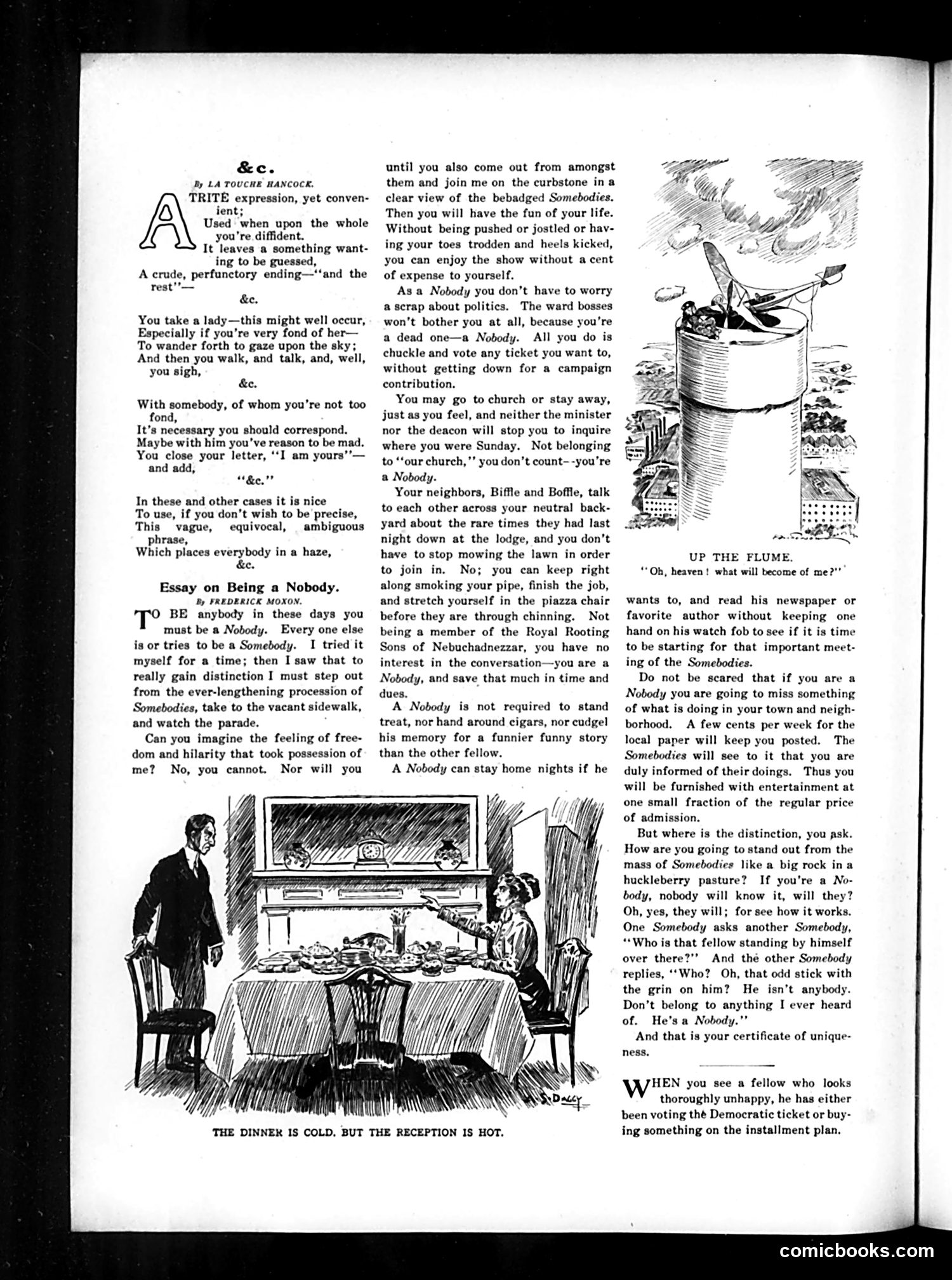
This page contains two distinct pieces of satire targeting early 20th-century American social conventions. **"&c." (by La Touche Hancock):** A humorous essay mocking the overuse of "&c." (et cetera) as a lazy conversational and literary device—people use it when they lack precision, confidence, or wish to be vague. The piece satirizes how this abbreviation lets people dodge clarity in letters, courtship, and social situations. **"Essay on Being a Nobody" (by Frederick Moxon):** The main satire argues that paradoxically, choosing to be a "Nobody"—refusing civic participation, church membership, lodge societies, and political involvement—actually grants freedom and distinction. The satire cuts both ways: it mocks civic institutions' demands on members while suggesting that non-participation is itself a form of social rebellion. The cartoon below depicts a dinner scene where "the dinner is cold, but the reception is hot"—likely illustrating social awkwardness or marital discord amid formality. The piece reflects turn-of-the-century anxieties about conformity, organizational membership, and civic duty.
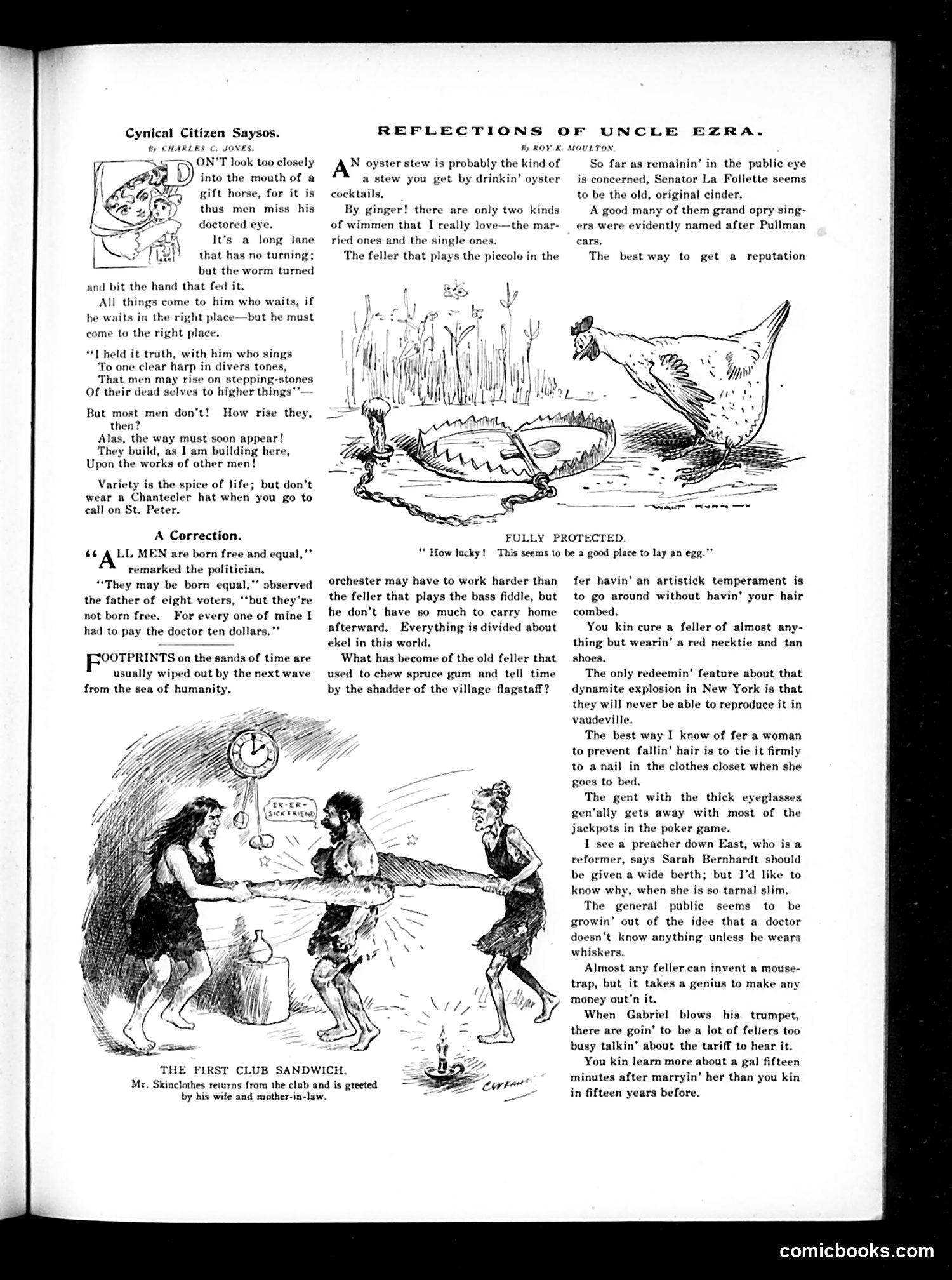
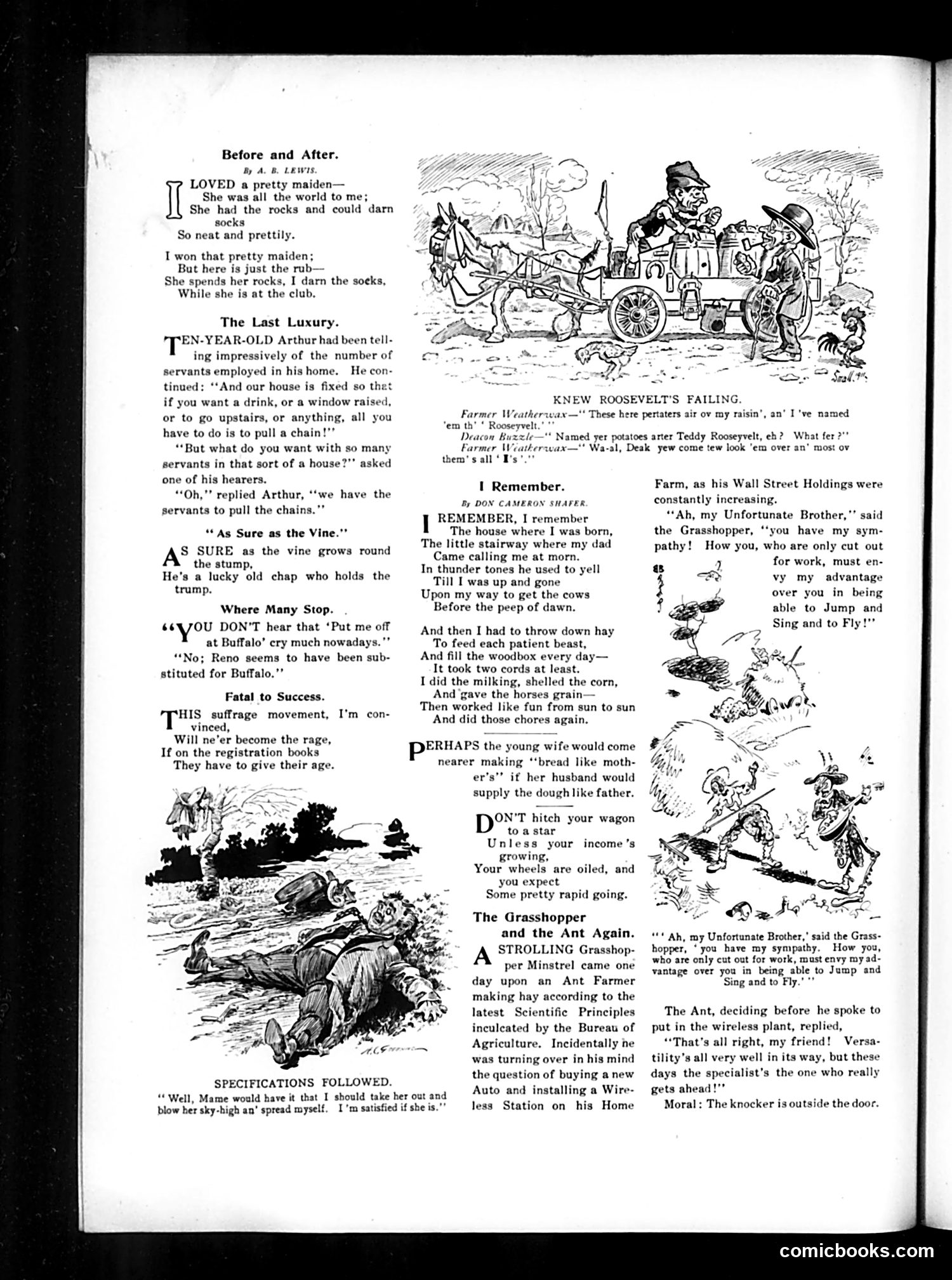
This page contains several satirical pieces mocking early 1900s social changes: **"Before and After"** ridicules the "New Woman"—a wife who abandons domestic duties (darning socks) for club activities while her husband must now do the housework. **"The Last Luxury"** jokes about wealthy families with so many servants they need additional servants just to pull service chains—absurd over-automation of the rich. **"Where Many Stop"** references Reno, Nevada, which was known as a divorce destination where residency requirements were loose, replacing Buffalo as the punchline destination—commenting on rising divorce rates. **"Fatal to Success"** mocks women's suffrage, suggesting women won't support voting rights because registration requires disclosing their age (playing on period vanity humor). **"Knew Roosevelt's Failing"** and **"The Grasshopper and the Ant Again"** appear to reference Theodore Roosevelt and contain dialect humor typical of the era. The latter retells Aesop's fable with modern Wall Street/financial speculation themes, suggesting wealth-seeking over honest labor. The page reflects Progressive Era anxieties about changing gender roles, labor, and consumerism.
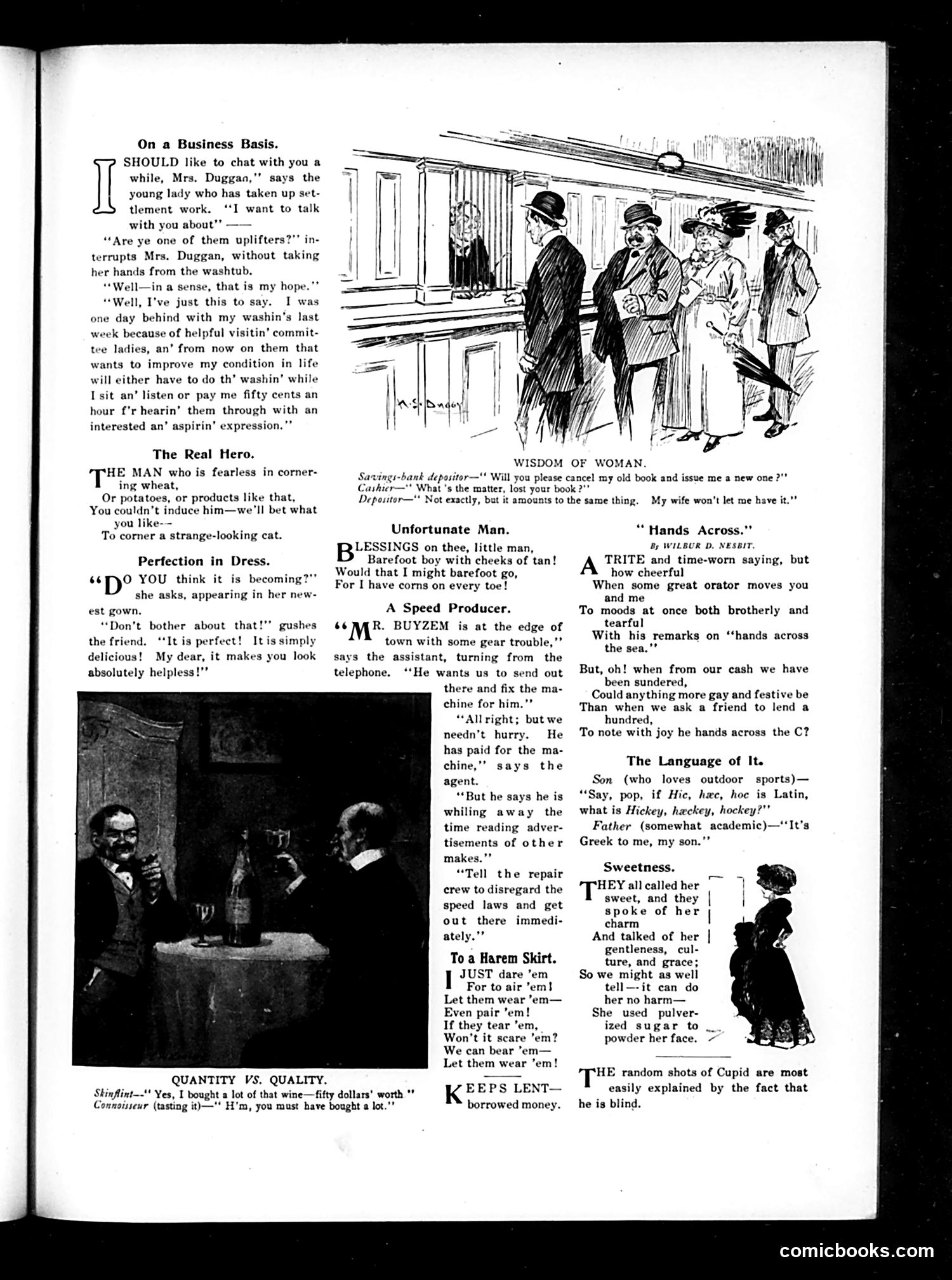
This page collects short humorous sketches satirizing early 20th-century American social types and situations: **"On a Business Basis"** mocks "settlement workers"—wealthy reformers who visited poor neighborhoods claiming to "uplift" the working class. Mrs. Duggan's response is cutting: if they want to improve her life, they should do her laundry while she listens, or pay her fifty cents per hour for tolerating their self-righteous advice. **"Perfection in Dress"** ridicules fashion obsession: a woman's friend calls a new gown "perfect" and "makes you look absolutely helpless"—suggesting fashionable dress rendered women decorative but incapable. **"A Speed Producer"** satirizes advertising: a customer reads competitors' ads instead of complaining about repair delays, prompting urgent service. **"Hands Across"** puns on the sentimental phrase "hands across the sea" (international brotherhood), twisted to mean lending money—specifically a "C" (hundred dollars). Other items joke about harem skirts, rural dialect, and female vanity. The tone throughout is lighthearted mockery of social pretension and consumer culture.
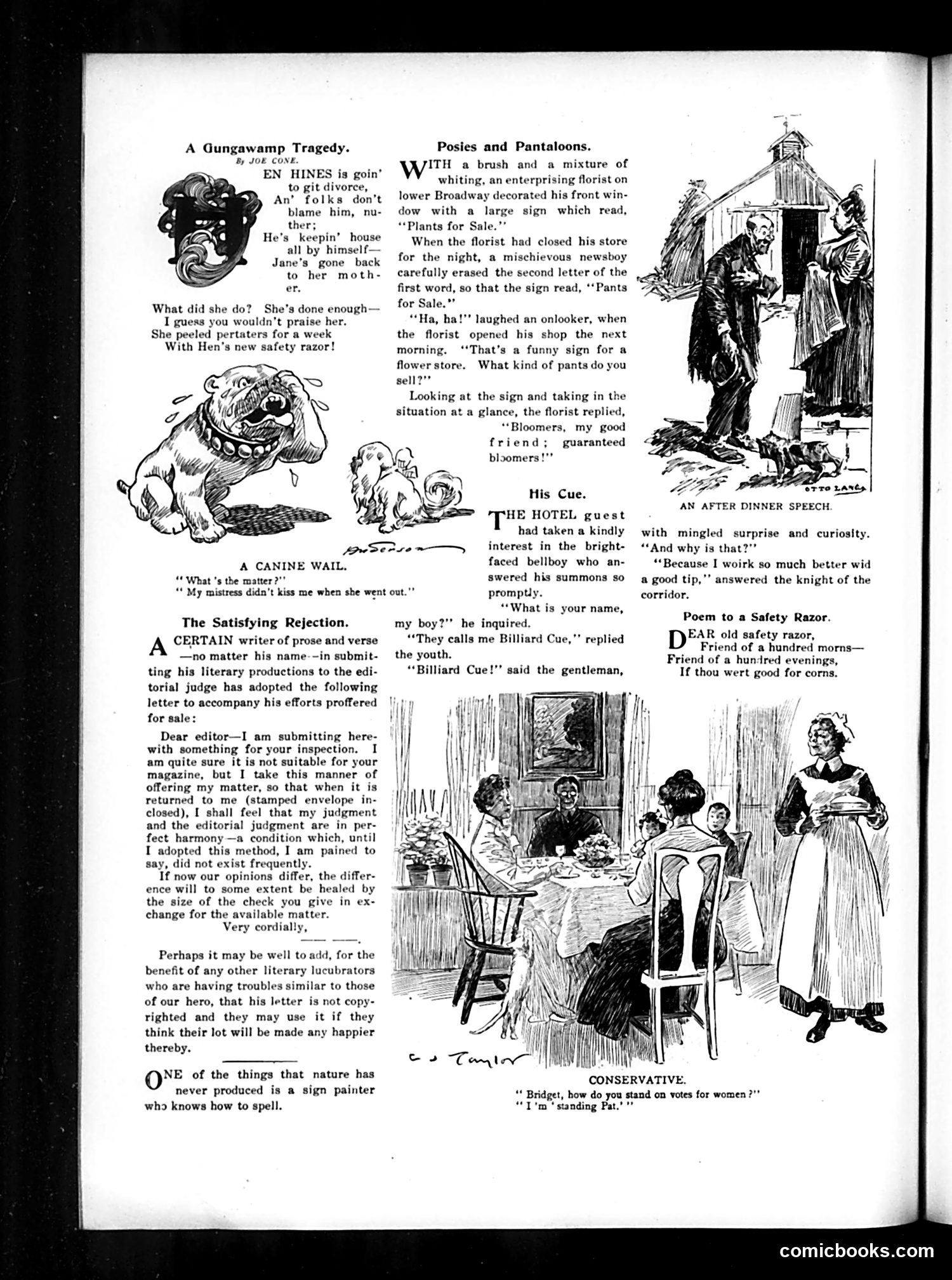
This Judge magazine page contains multiple short humorous pieces satirizing early 20th-century American life: **"A Gungawamp Tragedy"** mocks domestic disputes through a rural dialect story where a wife abandons housekeeping, having used her husband's new safety razor to peel potatoes—absurd misuse of a modern convenience. **"Posies and Pantaloons"** jokes about a florist's sign reading "Plants for Sale" that a mischievous newsboy alters to "Pants for Sale." The florist's witty response—claiming to sell "bloomers" (women's undergarments)—plays on the double meaning. **"His Cue"** features wordplay: a bellboy named "Billiard Cue" explains his nickname means he "works better with a good tip." **"Conservative"** satirizes women's suffrage debates through a maid named Bridget who, when asked about voting rights for women, replies she's "standing Pat"—a pun suggesting political conservatism while implying she literally stands by her employer (Pat). The cartoons mock spelling errors, modern conveniences, servant culture, and the emerging women's suffrage movement—reflecting early 1900s social attitudes.
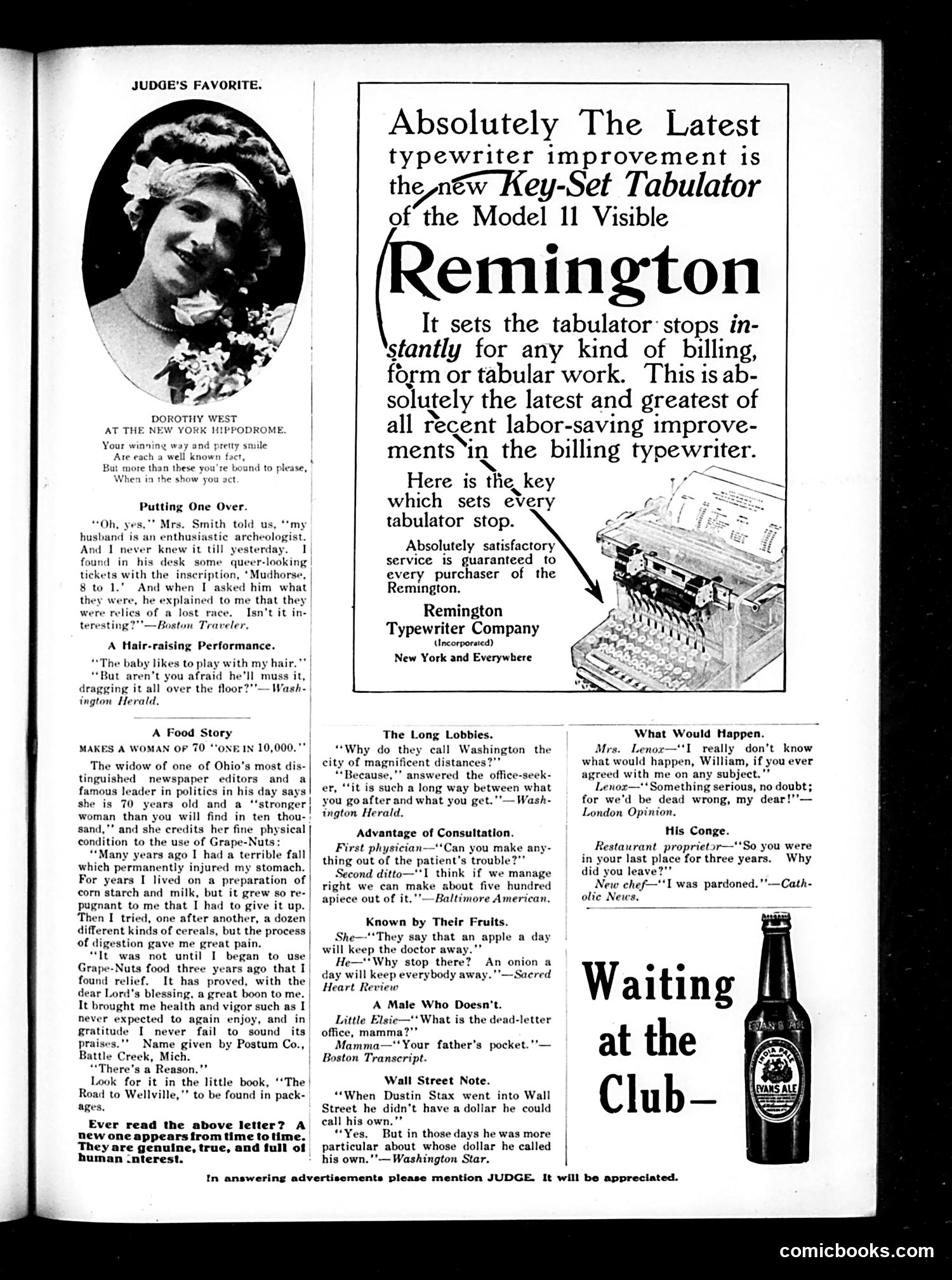
This page is primarily **advertising and humor content** rather than political cartoons. The main visual element is a photograph labeled "Judge's Favorite" featuring Dorothy Webb "at the New York Hippodrome," accompanied by brief theatrical-style jokes. The bulk of the page contains: 1. **A major Remington typewriter advertisement** promoting the "Key-Set Tabulator" as a labor-saving innovation for billing work 2. **Multiple short humor pieces** typical of Judge magazine's format—brief anecdotes poking fun at everyday situations: wives catching husbands at horse races, babies pulling hair, doctors colluding over fees, Wall Street con artists, marital disagreements, etc. 3. **A Grape-Nuts cereal testimonial advertisement** featuring a 70-year-old widow's health recovery story The satirical humor targets familiar early 20th-century subjects: marital dynamics, professional duplicity, and social pretension. The "Wall Street Note" joke subtly critiques financial dishonesty. Overall, this represents Judge's typical mix of entertainment advertising and genteel social satire for middle-class readers.
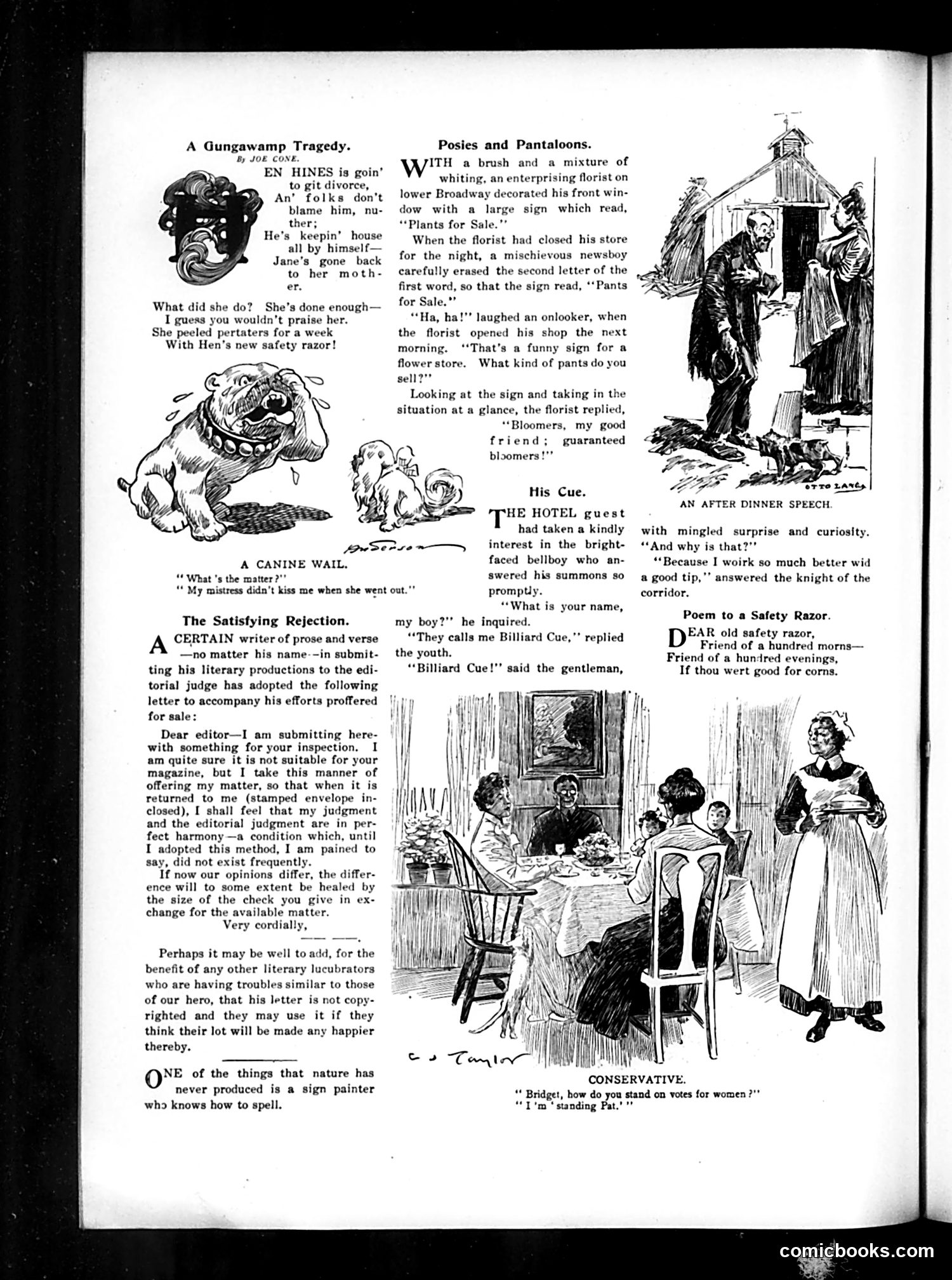
This page contains five separate humorous pieces typical of early 20th-century American satire: **"A Gungawamp Tragedy"**: A rural domestic comedy where a man's wife left him after he used his new safety razor to peel potatoes—damaging the blade. The joke relies on the novelty of safety razors as household items. **"A Canine Wail"**: A dog complains his mistress didn't kiss him goodbye—gentle sentimental humor. **"The Satisfying Rejection"**: A writer submits work with a letter preemptively claiming it's unsuitable, so rejection won't sting. The satire targets writerly ego and the submission process. **"Posies and Pantaloons"**: A prankster alters a florist's "Plants for Sale" sign to "Pants for Sale." The florist's witty response ("Bloomers...guaranteed bloomers") plays on double meaning—the flower variety and women's undergarments. **"Conservative"**: A brief political cartoon where an Irish maid ("Bridget") claims she's "standing Pat" on women's suffrage—a pun suggesting she supports the status quo while literally standing with someone named Pat.
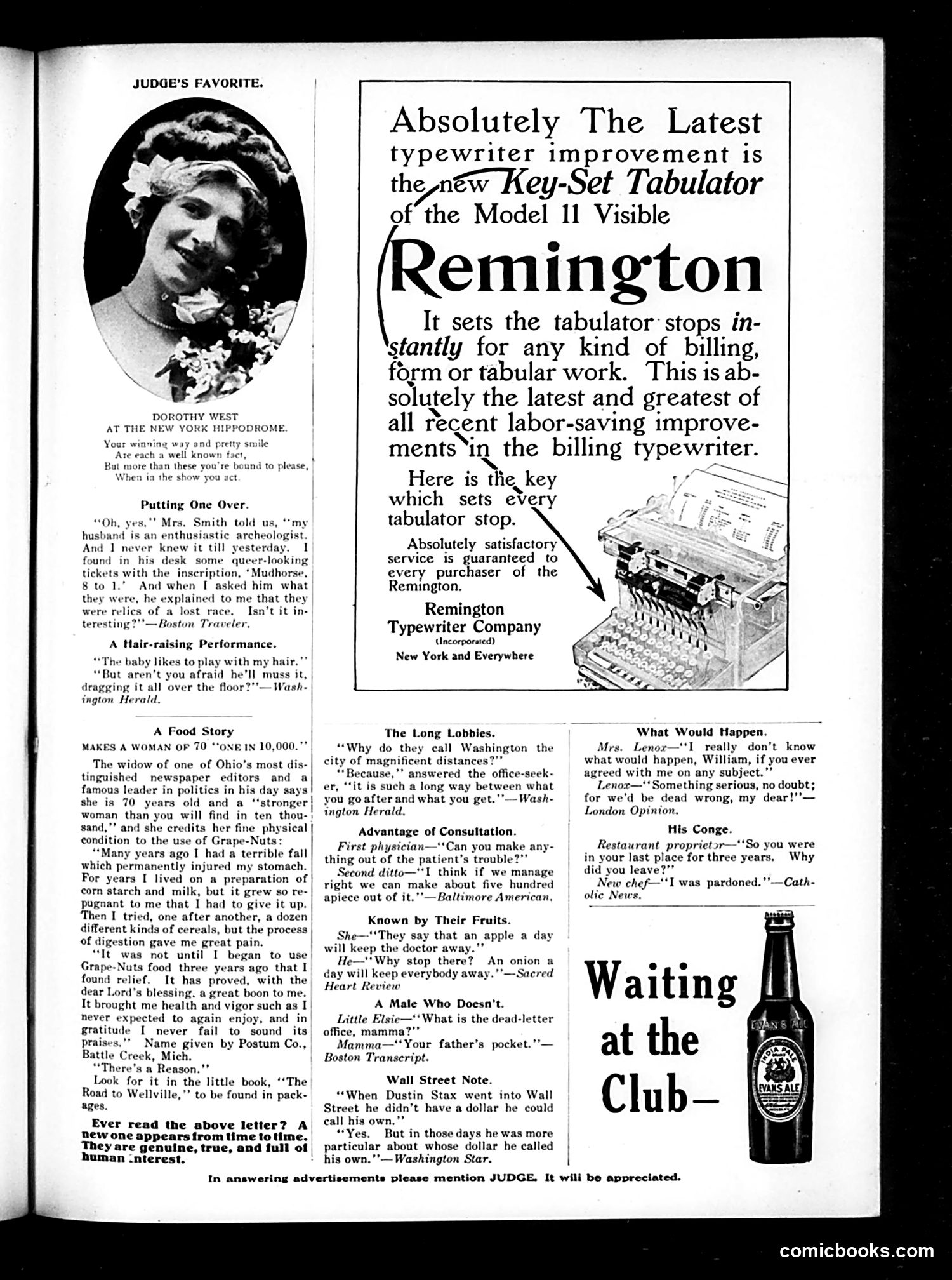
This page from *Judge* (a satirical weekly) contains mostly **humorous anecdotes and advertisements** rather than political cartoons. The top features "Judge's Favorite"—Dorothy West, a performer at the New York Hippodrome, with brief comic quips about her charm. Below are **short jokes** satirizing everyday situations: a wife discovering her husband's betting tickets hidden as "archaeological relics"; a physician-patient consultation where two doctors plan to charge five hundred dollars each; and Washington office-seekers complaining about the long distance between effort and reward. The largest content is a **Remington typewriter advertisement** highlighting the "Key-Set Tabulator" as a labor-saving innovation for billing work. Additional humor mocks Wall Street speculation, marital disagreement, and bureaucratic inefficiency. The **Grape-Nuts testimonial** is a fake health advertisement common to the era. Overall, this reflects early-20th-century satirical humor: mild workplace jokes, domestic comedy, and gentle jabs at politicians and businessmen—typical of *Judge's* family-friendly satirical approach.
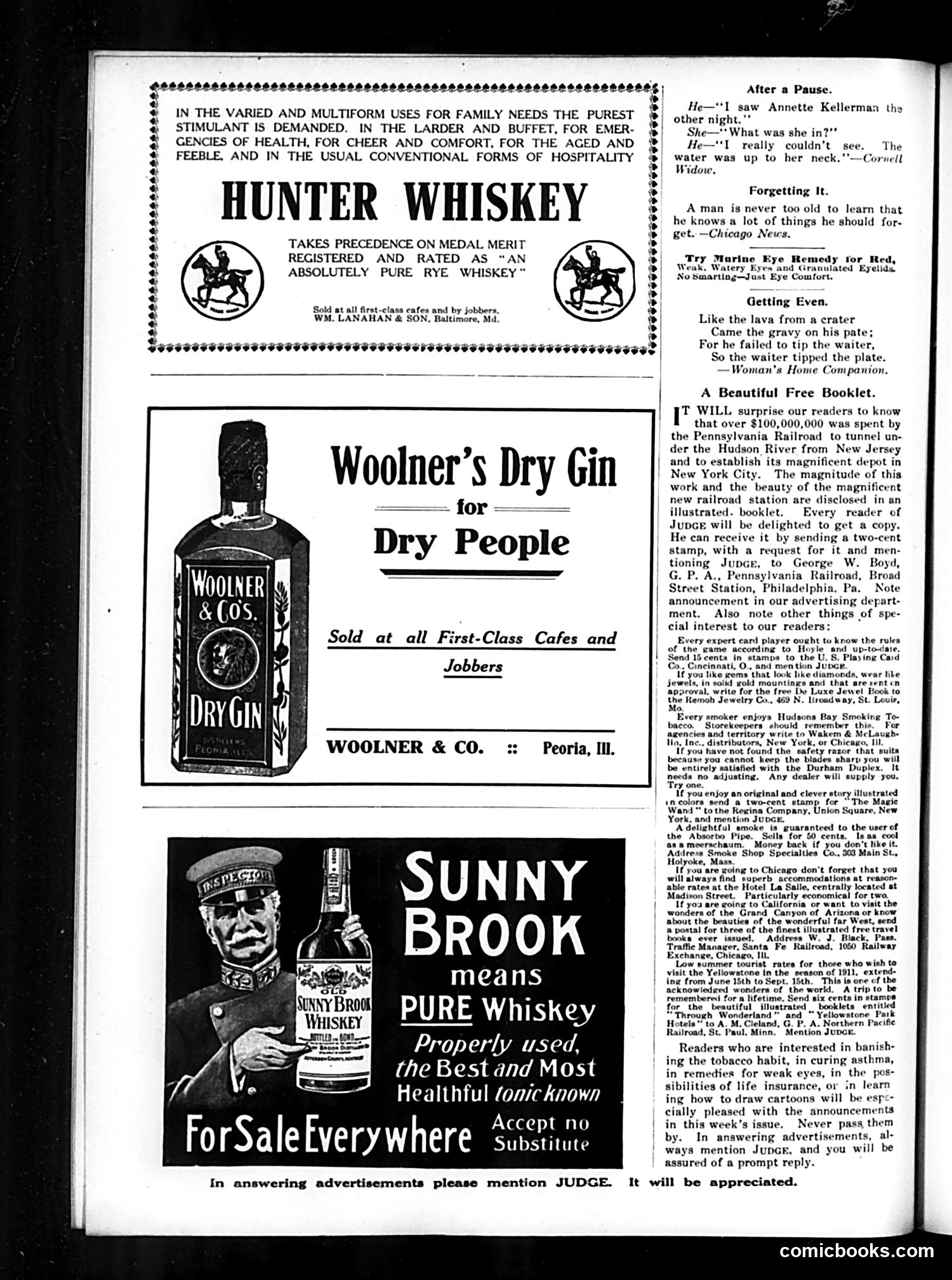
This page from *Judge* magazine is primarily **advertising**, not political satire. It contains several liquor and product advertisements typical of the early 1900s. The small jokes at top right reference **Annette Kellerman**, a famous swimmer and actress known for wearing revealing swimming costumes in films—shocking for the era. The humor relies on the risqué implication. The whiskey and gin advertisements are noteworthy for their claims: they market alcohol as medicine and health tonics for "emergencies of health" and "the aged and feeble"—reflecting the pre-Prohibition era when alcohol was widely promoted for medicinal purposes. This practice would become illegal after 1920. The page offers free promotional booklets (Pennsylvania Railroad depot, playing cards, jewelry catalogs), reflecting early 20th-century direct marketing strategies. The content reflects prevailing attitudes about alcohol's social acceptability and supposed health benefits.
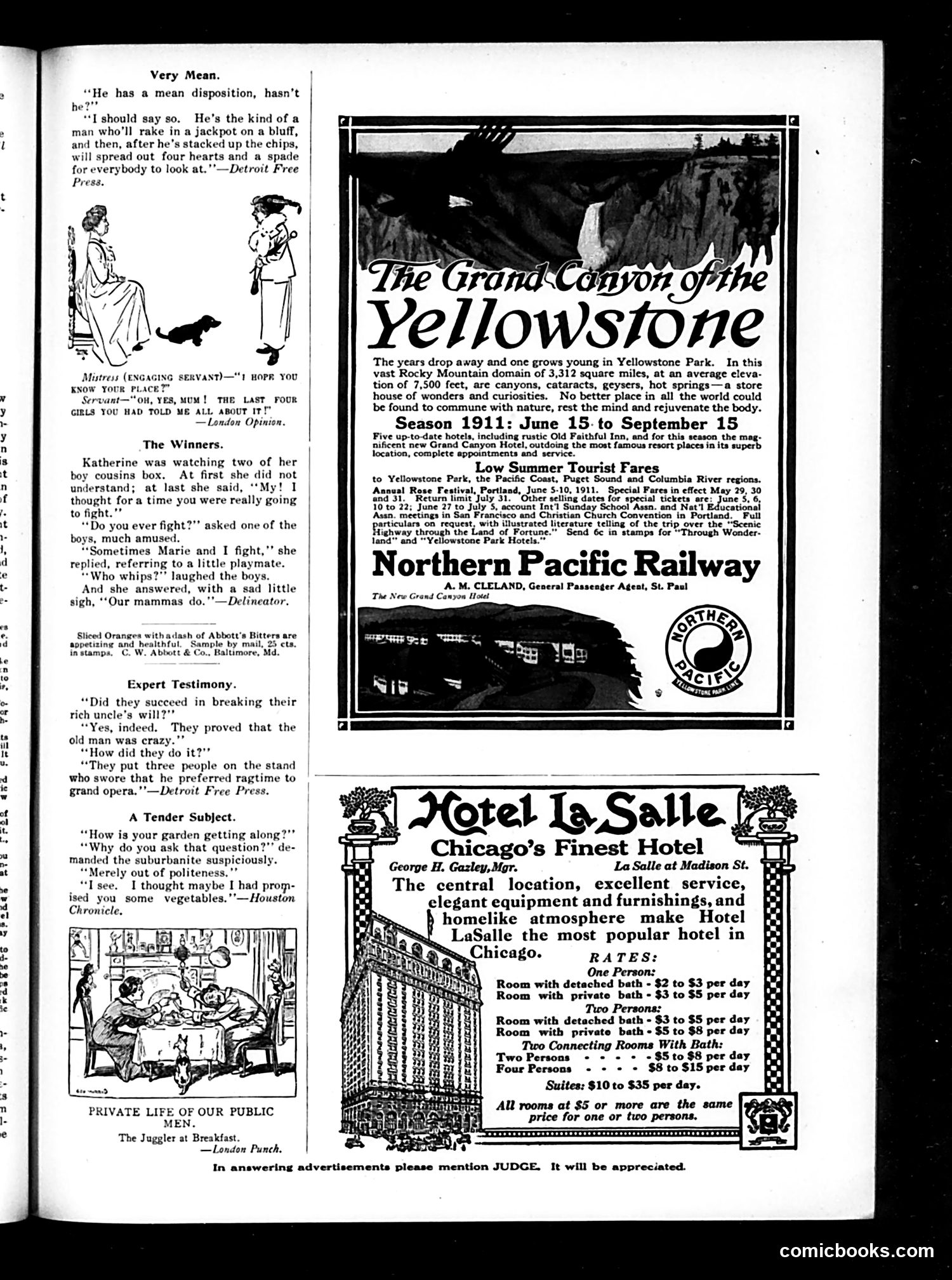
This page consists primarily of **advertisements and short humor pieces**, typical of Judge magazine's format. The cartoons and jokes mock human behavior: a poker player who reveals his bluff afterward (poor sportsmanship), a servant who knows her "place" through gossip from predecessors, a child naive about fighting, and lawyers proving an uncle "crazy" merely for preferring ragtime to opera (absurd legal reasoning). The illustrated cartoon "Private Life of Our Public Men" shows a juggler at breakfast—likely satirizing politicians or public figures who must constantly "juggle" competing demands. **The majority of the page is advertising**: Northern Pacific Railway promoting Yellowstone Park tourism (1911 season), and Hotel LaSalle in Chicago competing for travelers' patronage with room rates ($2-$35 per day). The humor reflects early-20th-century middle-class anxieties about propriety, servants, legal absurdities, and family dynamics—nothing politically charged.
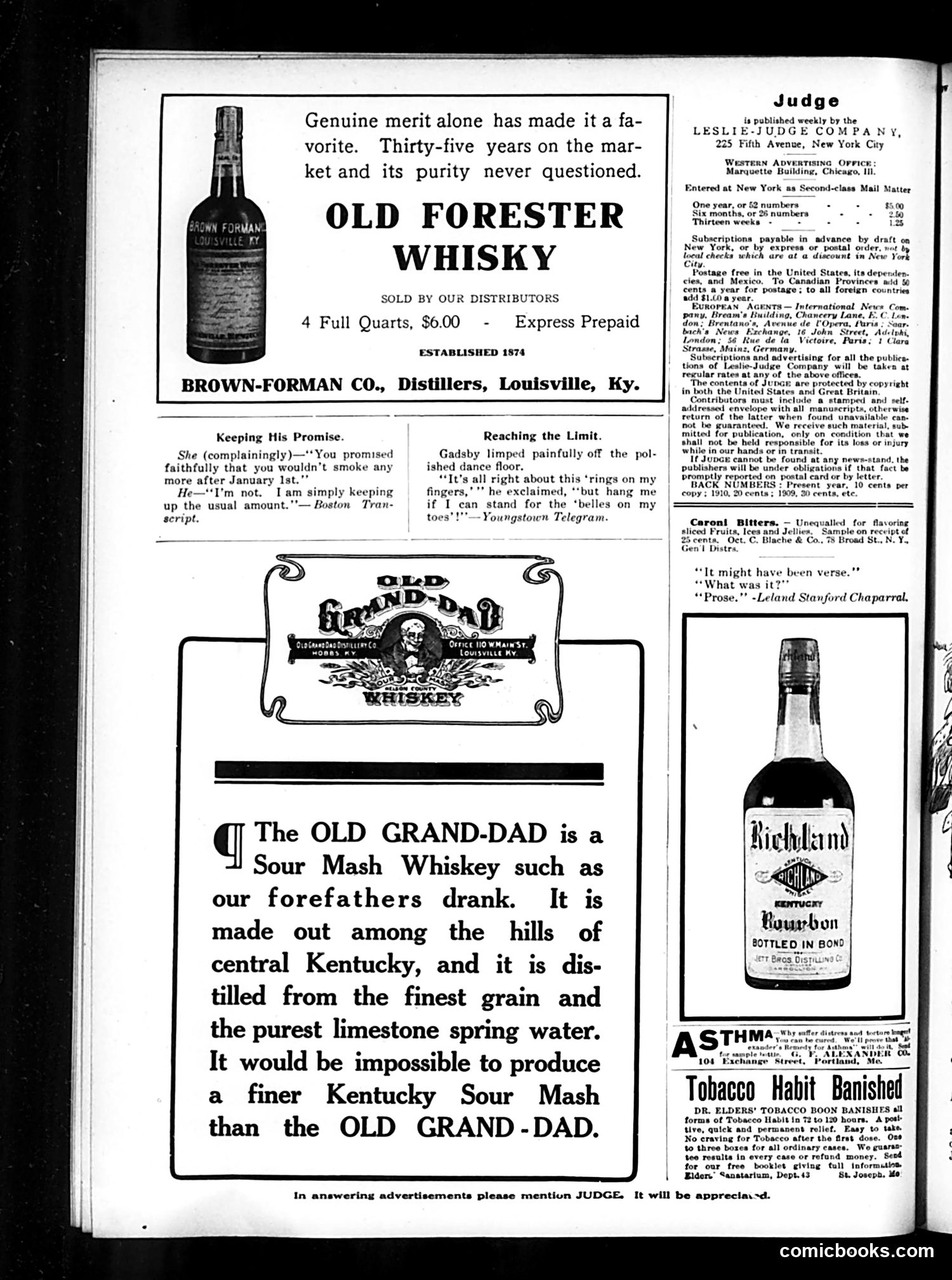
This page is primarily **advertisements and magazine masthead information**, not political satire. The content includes: **Two brief comic anecdotes:** - "Keeping His Promise": A husband claims he's not smoking more after January 1st—he's simply maintaining his "usual amount" (implying he always smoked heavily) - "Reaching the Limit": A man complains about rings on his fingers from dancing but won't tolerate similar marks on his toes These are mild domestic humor pieces with no political content. **Advertisements** dominate: Old Forester Whisky, Old Grand-Dad Whisky, Highland Bourbon, Caroni Bitters, and Dr. Elders' Tobacco Boon (a smoking-cessation product). The page reflects **early 20th-century consumer culture**—notably advertising alcohol and tobacco remedies simultaneously, which modern readers would find contradictory. The magazine's masthead indicates Judge was a national publication with international distribution.
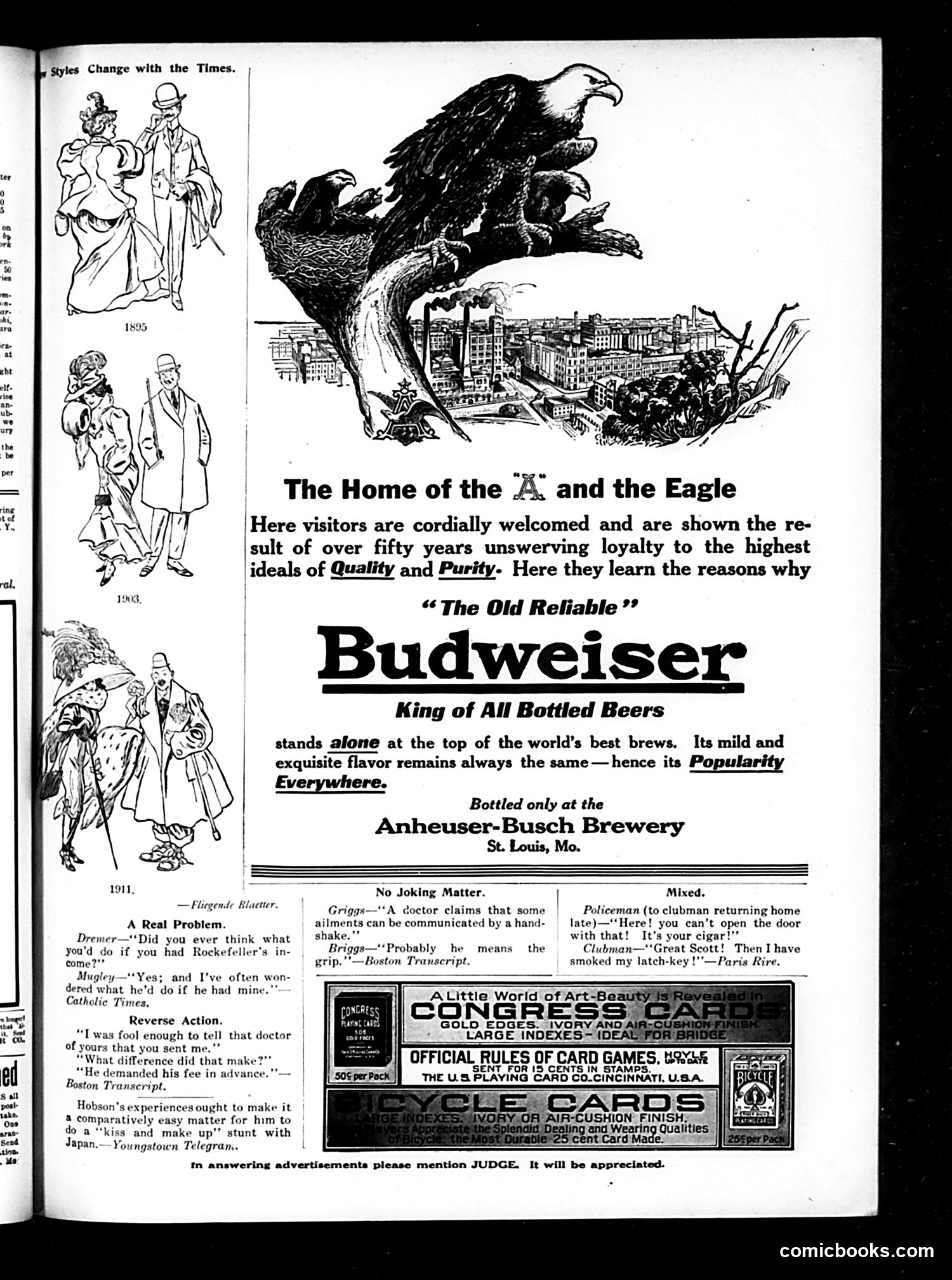
This page is primarily a **Budweiser advertisement** disguised as editorial content, typical of early 20th-century magazine advertising. The left column shows "Styles Change with the Times"—fashion illustrations from 1895, 1903, and 1911, documenting women's and men's clothing evolution over decades. The main content is a large Budweiser beer ad featuring an eagle protecting a city skyline, emphasizing the brewery's "fifty years unswerving loyalty to the highest ideals of Quality and Purity." The ad targets middle-class aspirations by positioning the beer as premium and reliable. Below are four unrelated short jokes ("No Joking Matter," "A Real Problem," "Mixed," "Reverse Action") typical of Judge's humor section—mostly puns and domestic comedy. The bottom advertises trading cards and bicycle cards (playing cards with decorative designs). **Context for modern readers**: This reflects an era when advertising seamlessly blended with editorial content, and when beer marketing emphasized wholesome "quality" values rather than lifestyle imagery.
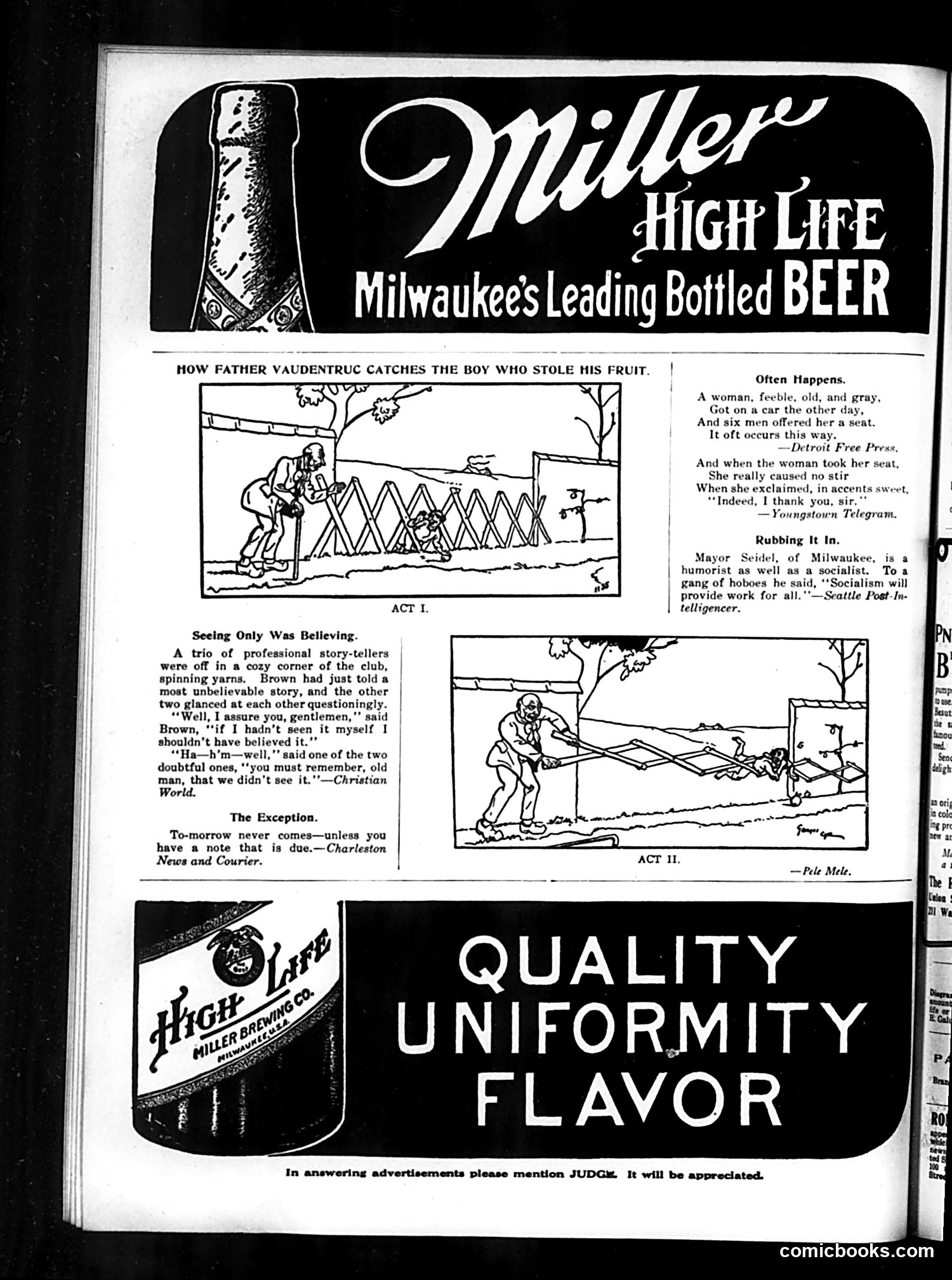
This is primarily a **beer advertisement** for Miller High Life, described as "Milwaukee's Leading Bottled Beer." The main content is a two-panel comic strip titled "How Father Vaudentruc Catches the Boy Who Stole His Fruit," showing a man setting a trap with an expandable fence to catch a fruit thief—a slapstick scenario with no clear political meaning. The page also includes several **brief humorous anecdotes** from other sources (newspapers and magazines), touching on everyday social situations: a woman receiving offered seats on a streetcar, and Milwaukee's socialist Mayor Seidel joking about socialism providing employment. These scattered jokes serve as filler content typical of Judge magazine's format. The overall page functions as an advertisement leveraging the magazine's satirical humor brand to sell beer through claims of "Quality Uniformity Flavor." There are no identifiable caricatures or specific political targets—just general social humor paired with commercial messaging.
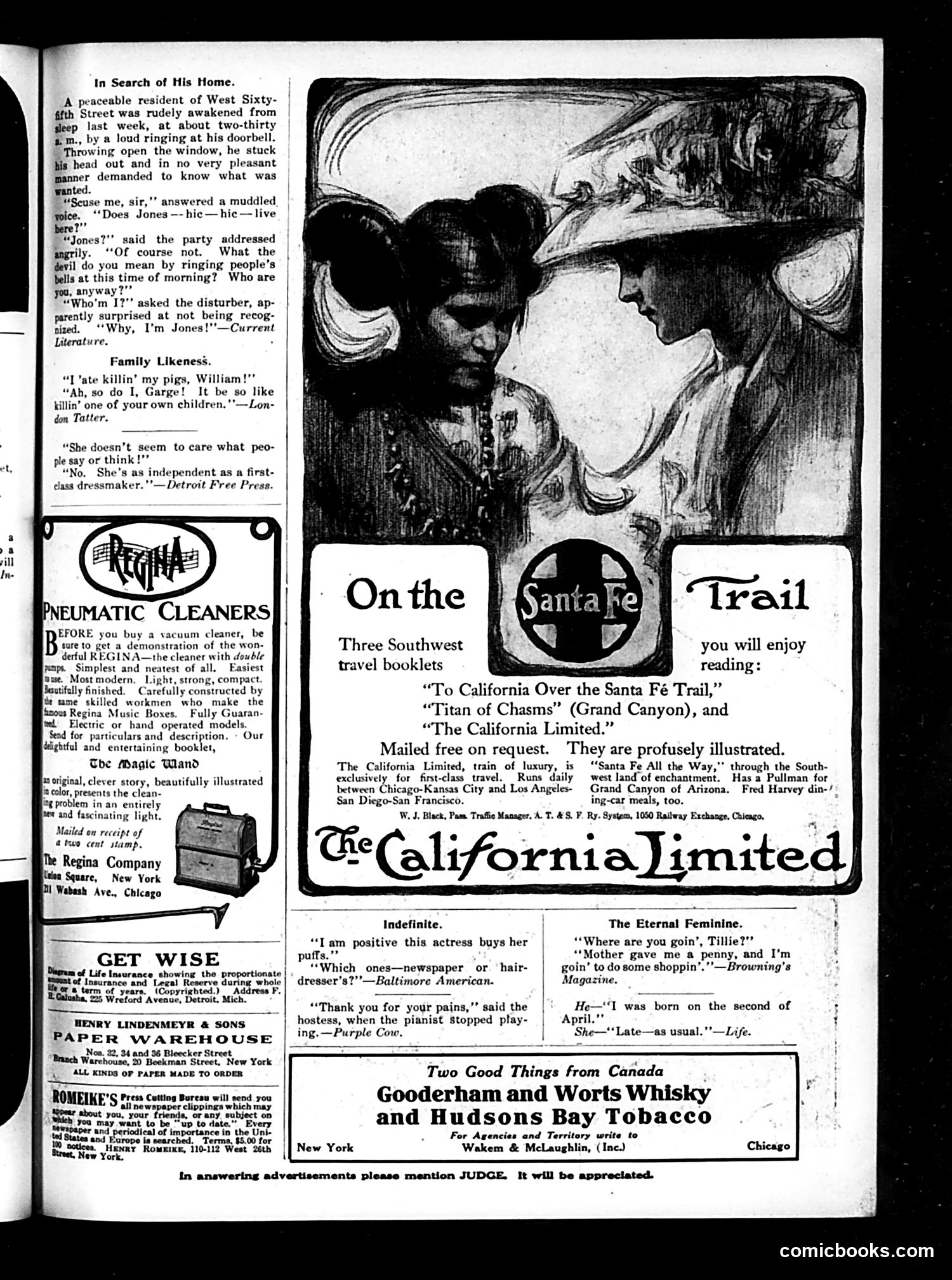
This page contains **short humor pieces and advertisements** rather than political cartoons. The satirical content includes: **"In Search of His Home"**: A drunk man rings a stranger's doorbell at 2:30 a.m. looking for someone named Jones, then reveals *he himself is Jones*—the humor lies in his obliviousness and poor judgment while intoxicated. **Shorter jokes** mock working-class speech patterns and gender stereotypes ("Family Likeness," "The Eternal Feminine") typical of early 20th-century Judge humor. **Advertisements dominate** the lower half, promoting vacuum cleaners, paper warehouses, train travel (Santa Fe Railway), and Canadian whisky/tobacco—standard commercial content. The page reflects **period attitudes**: casual mockery of working-class accents, stereotypical femininity, and heavy advertising integration. No specific political figures or events are referenced; this is general-interest satirical humor for Judge's middle-class readership.
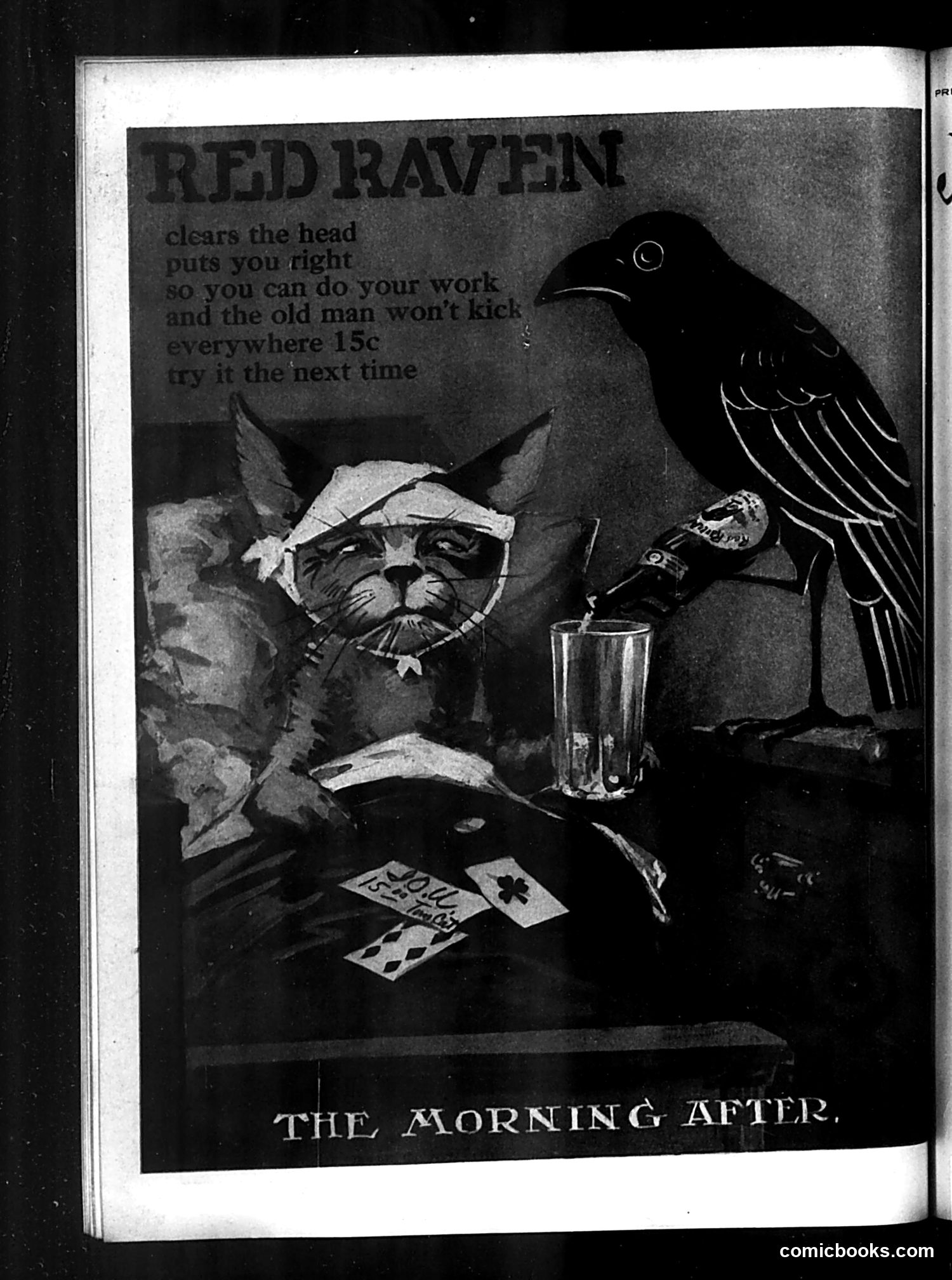
This is a vintage advertisement for "Red Raven," a patent medicine priced at 15 cents. The cartoon depicts a hungover man (with a bandaged head, suggesting a headache) sitting at a table with playing cards and a glass, accompanied by a raven perched nearby. The ad's text promises the product "clears the head, puts you right so you can do your work and the old man won't kick everywhere." This satirizes common hangover remedies of the era while making a dark joke: the raven suggests the man has overindulged, and the reference to "the old man" kicking implies domestic abuse—presented here as an inevitable consequence of drinking that Red Raven supposedly prevents. The title "The Morning After" reinforces the hangover scenario.