
Judge, 1911-03-25 · page 13 of 30
Judge — March 25, 1911 — page 13: what you’re looking at
What you’re looking at
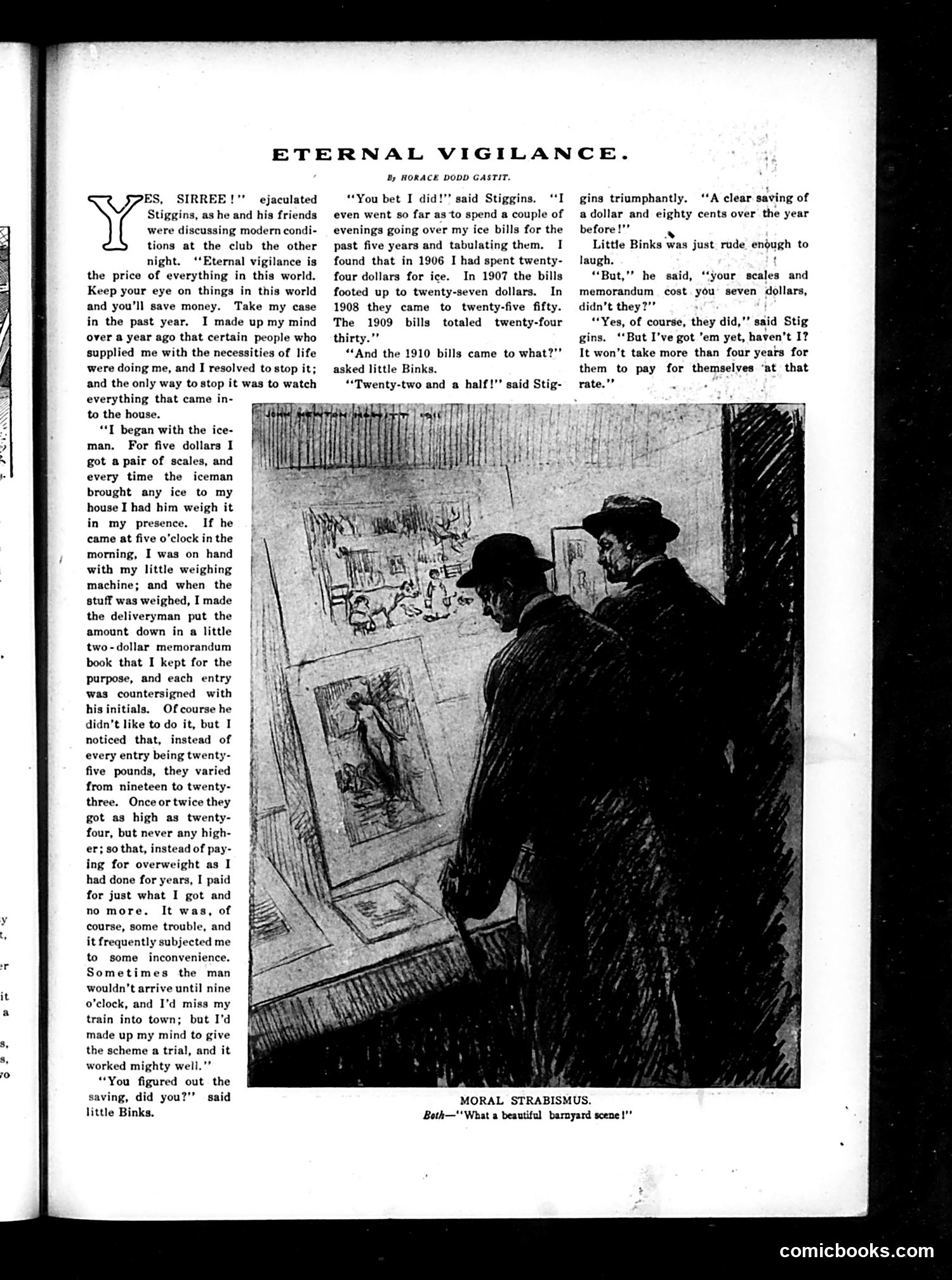
This story by Horace Dodd Gastit mocks penny-pinching obsessiveness. The character Stiggins boasts of catching his iceman short-weighing deliveries by installing scales and keeping a signed ledger—inconveniencing himself greatly (missing trains) to save roughly $1.80 annually over five years. The joke's punchline: his monitoring equipment cost $7, requiring four years just to break even on his microscopic savings. Little Binks's laughter highlights the absurdity—Stiggins achieved "eternal vigilance" at enormous personal cost for negligible gain. The accompanying illustration (captioned "Moral Strabismus"—crossed-eye vision representing distorted perspective) shows two figures examining a picture, each seeing different things. This reinforces the satire: Stiggins's vigilance has given him warped vision, unable to see his scheme's fundamental futility. The piece critiques miserly obsession and self-defeating penny-pinching logic common among certain wealthy Americans.
📄 Transcribed text from this page (OCR, searchable)
Machine-transcribed from the original scan — historical spelling and the odd misread are preserved.
ETERNAL VIGILANCE. ES, SIRREE!"' ejaculated Stiggins, as he and his friends were discussing modern condi- tions at the club the other night. ‘Eternal vigilance is the price of everything in this world. Keep your eye on things in this world and you'll save money. Take my case in the past year. I made up my mind over a year ago that certain people who supplied me with the necessities of life were doing me, and I resolved to stop it; and the only way to stop it was to watch everything that came in- to the house. “I began with the ice- man. For five dollars I got a pair of scales, and every time the iceman brought any ice to my house I had him weigh it in my presence. If he came at five o'clock in the morning, I was on hand with my little weighing machine; and when the stuff was weighed, I made the deliveryman put the amount down in a little two-dollar memorandum book that I kept for the purpose, and each entry was countersigned with his initials. Ofcourse he didn’t like to do it, but I noticed that, instead of every entry being twenty- five pounds, they varied from nineteen to twenty- three. Once or twice they got as high as twenty- four, but never any high- er; so that, instead of pay- ing for overweight as I had done for years, I paid for just what I got and no more. It was, of course, some trouble, and it frequently subjected me to some inconvenience. Sometimes the man wouldn’t arrive until nine o'clock, and I'd miss my train into town; but I'd made up my mind to give the scheme a trial, and it worked mighty well."’ “You figured out the saving, did you?’’ said little Binks. By HORACE DODD GASTIT. “You bet I did!’’ said Stiggins. ‘I even went so far as to spend a couple of evenings going over my ice bills for the past five years and tabulating them. I found that in 1906 I had spent twenty- four dollars for ice. In 1907 the bills footed up to twenty-seven dollars. In 1908 they came to twenty-five fifty. The 1909 bills totaled twenty-four thirty.” “And the 1910 bills came to what?” asked little Binks. “Twenty-two and a half!’’ said Stig- gins triumphantly. ‘‘A clear saving of adollar and eighty cents over the year before !"’ . Little Binks was just rude endugh to laugh. t “But,” he said, ‘your scales and memorandum cost you seven dollars, didn’t they?” “Yes, of course, they did,’’ said Stig gins. ‘But I've got ’em yet, haven’t I? It won’t take more than four years for them to pay for themselves ‘at that rate.”’ . MORAL STRABISMUS. Both—''What a beautiful barnyard scene |’" comicbooks.com