
A complete issue · 24 pages · 1911
Judge — January 21, 1911
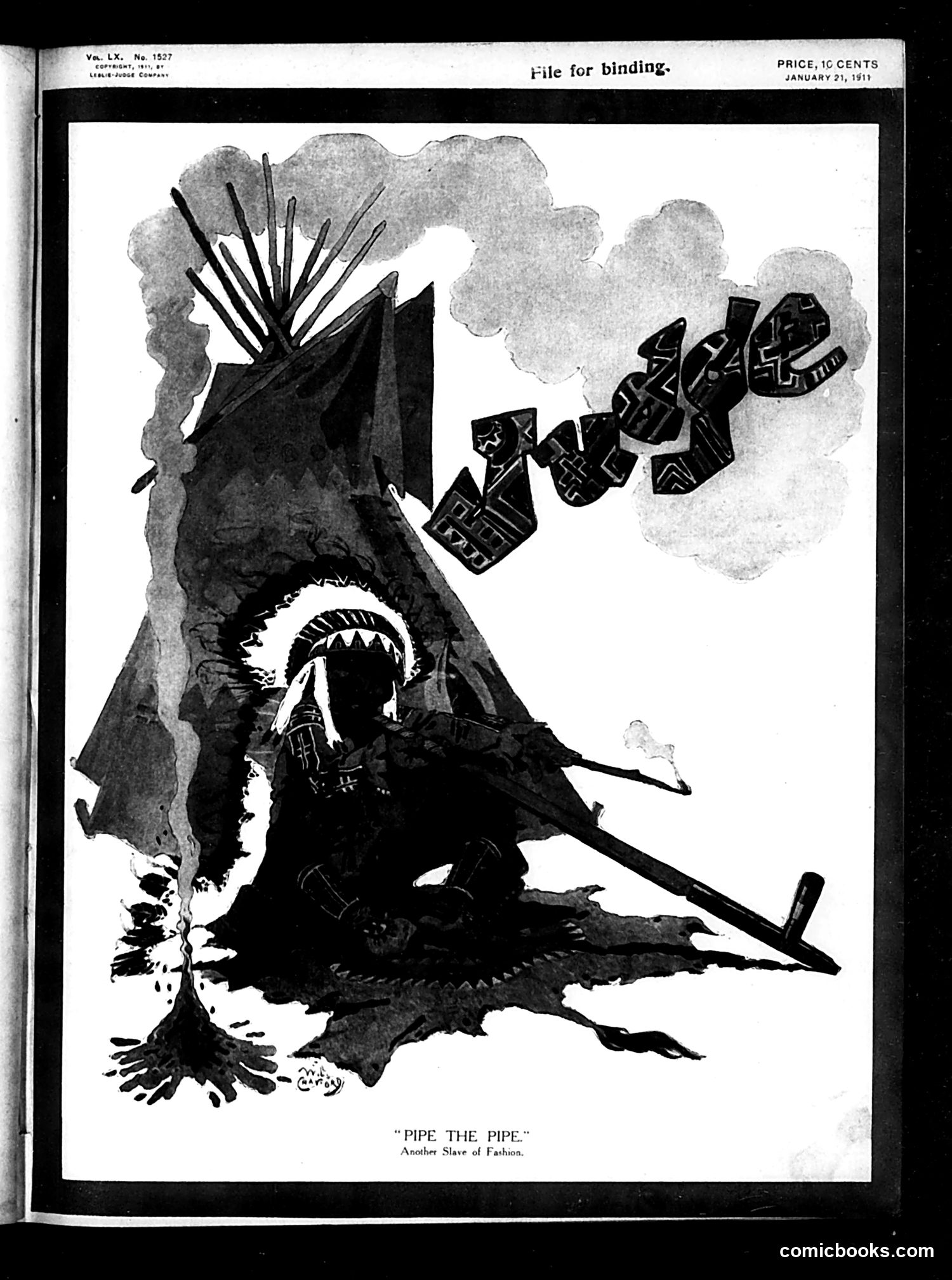
This 1911 political cartoon mocks a fashion trend through exaggerated imagery. The title "Pipe the Pipe: Another Slave of Fashion" suggests ridicule of people following fashion trends blindly. The central figure appears to be a fashionably-dressed woman depicted as grotesquely distorted—her silhouette contorted into an unnatural shape by corsetry or restrictive clothing. The volcanic eruption, skeletal imagery, and chaos surrounding her suggest the physical and moral damage caused by pursuing extreme fashion. The small figures fleeing in the upper right may represent people escaping this fashion "disaster." The overall message critiques how fashion enslaves followers, particularly women, forcing them into physically harmful and undignified positions for vanity's sake—a common Progressive-era complaint about restrictive Victorian/Edwardian dress codes.
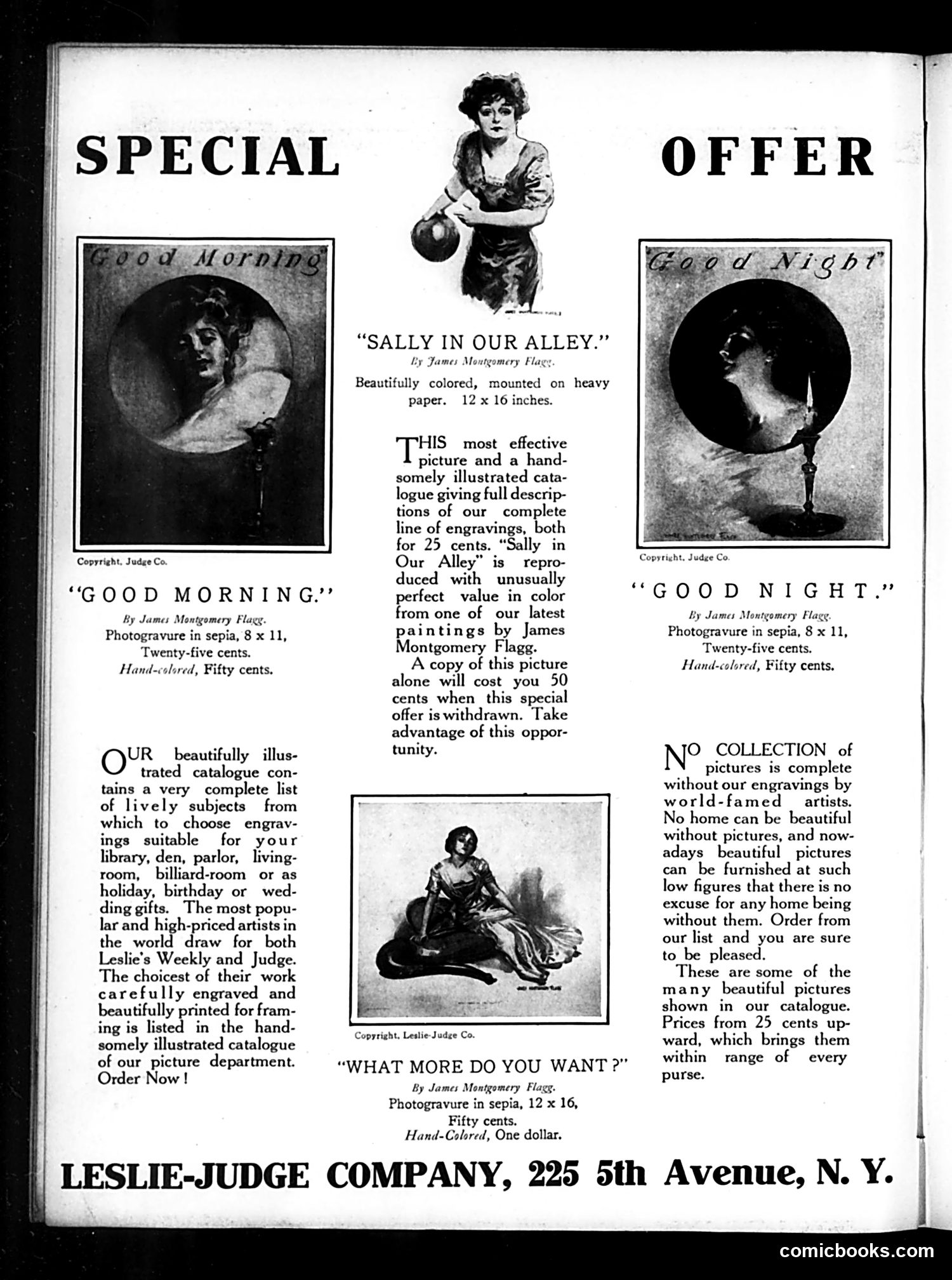
This page is primarily **advertising, not satire or political commentary**. The Leslie-Judge Company is promoting engravings and prints for home decoration, featuring works by artist James Montgomery Flagg. The four images shown—"Good Morning," "Good Night," "Sally in Our Alley," and "What More Do You Want?"—appear to be sentimental genre scenes typical of early 20th-century domestic art. They depict attractive women in various poses and situations. The text emphasizes that quality artwork should be affordable for every home, with prices starting at 25 cents. The company positions itself as offering reproductions of works by "world-famed artists" at accessible prices. This is essentially a mail-order catalog page from *Judge* magazine, not editorial content.
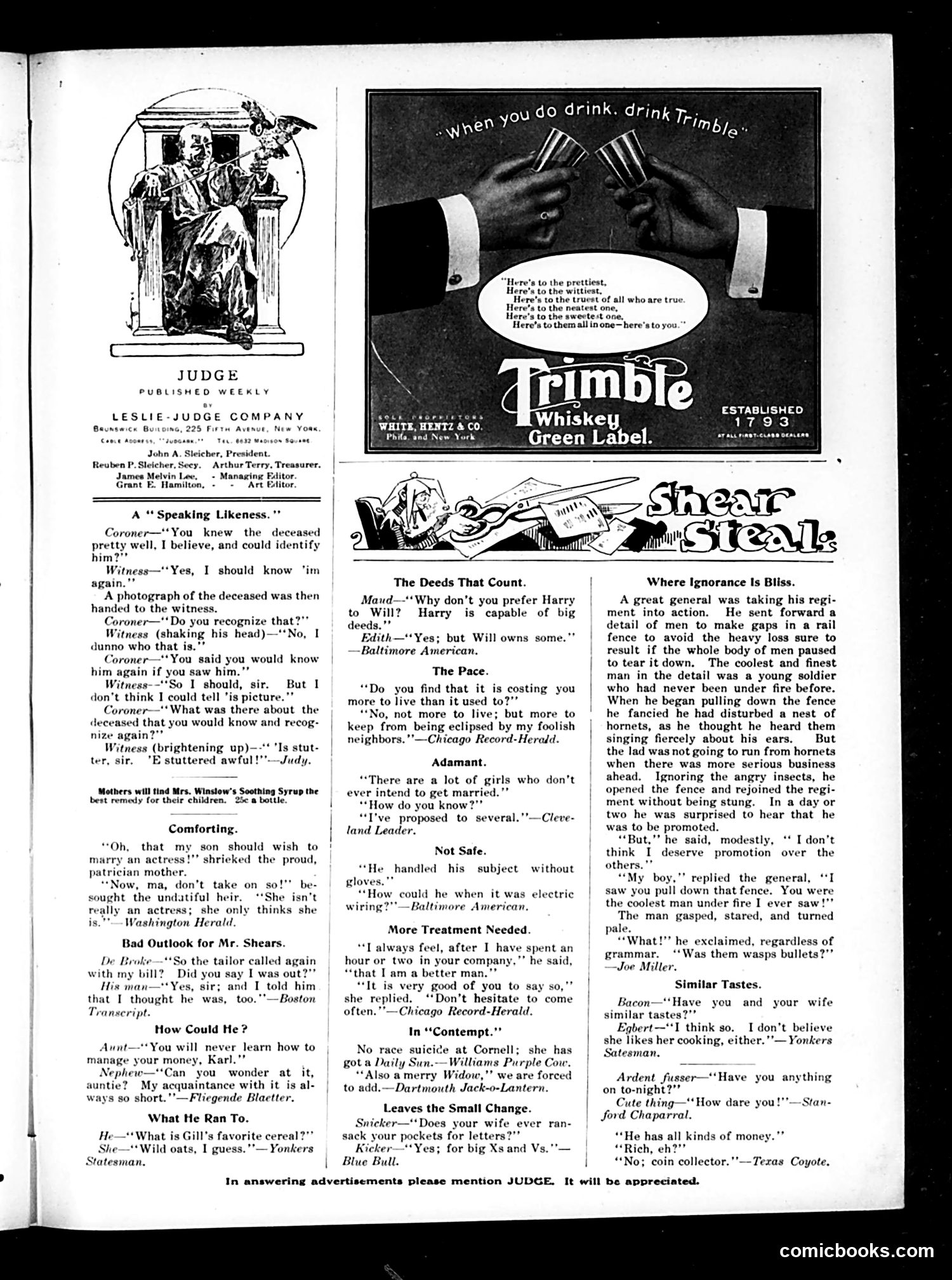
This page is primarily **advertising and humor columns**, not political cartoons. The main content includes: **Trimble Whiskey Advertisement** (center-right): Features two men toasting with the slogan "when you do drink, drink Trimble." The ad includes a drinking toast poem promoting the brand's quality and longevity (established 1793). **Humor Columns** (left and right): Short jokes and witty exchanges on everyday topics—marriage, tailors, cooking, wealth—typical of Judge's satirical humor section. These mock domestic life, class pretensions, and social conventions of the era. **No identifiable political figures or events** appear on this page. It represents Judge's general satirical approach to American society through light domestic humor rather than political commentary.
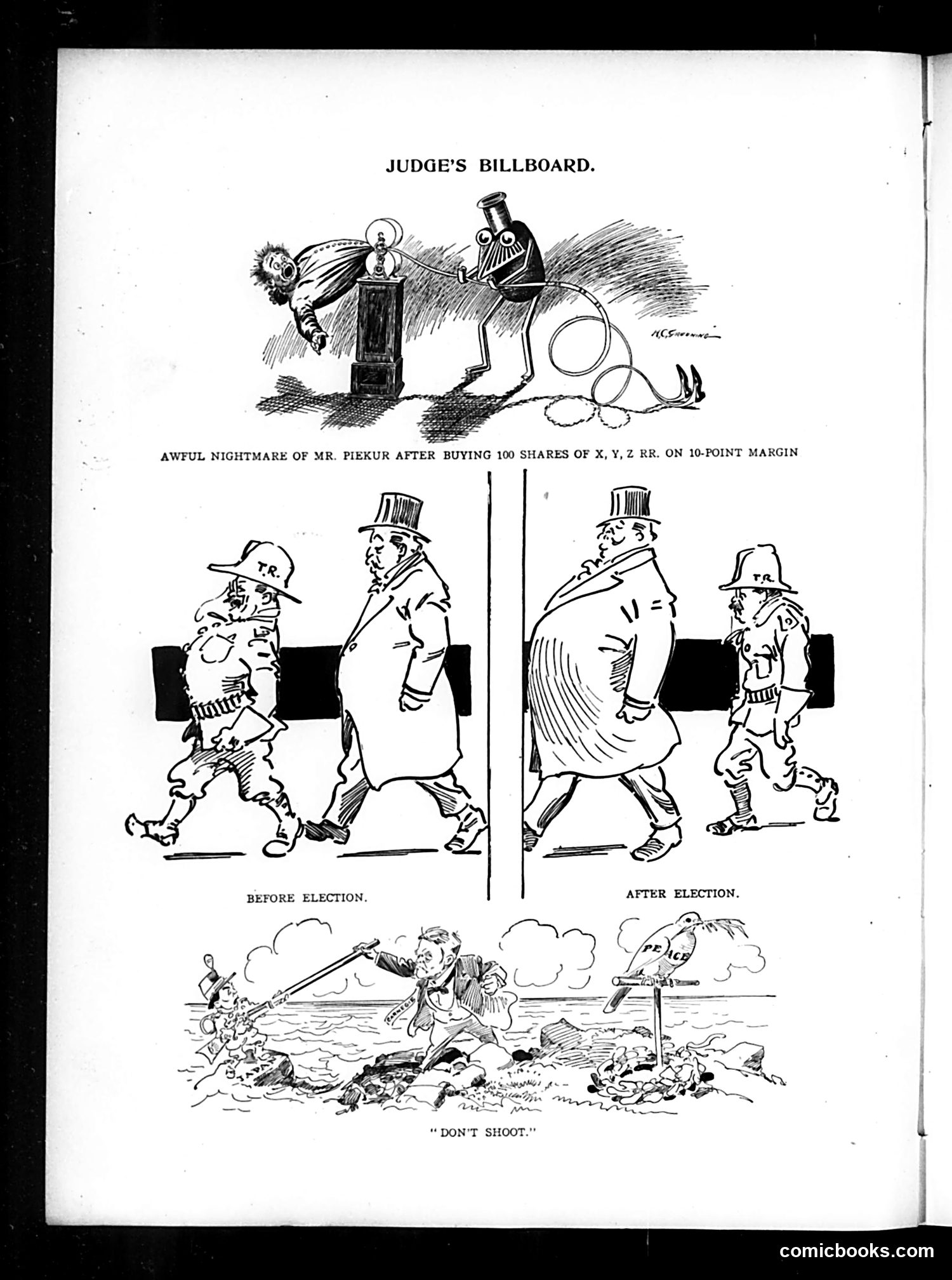
This page from Judge magazine contains three satirical cartoons: **Top cartoon**: Shows a nightmarish vision of Mr. Piekur after buying railroad shares (X, Y, Z) on a 10-point margin—a risky financial practice. The imagery depicts financial ruin through grotesque, surreal consequences. **Middle panel**: Contrasts "Before Election" versus "After Election," showing figures marked "T.R." (Theodore Roosevelt) in different states. On the left, they appear lean and aggressive; on the right, the central figure is notably bloated, suggesting corruption or self-enrichment upon gaining power. **Bottom cartoon**: Titled "Don't Shoot," depicts a battlefield scene, likely commenting on political violence or aggressive rhetoric during a contentious period. The page satirizes financial speculation, political hypocrisy, and electoral consequences.
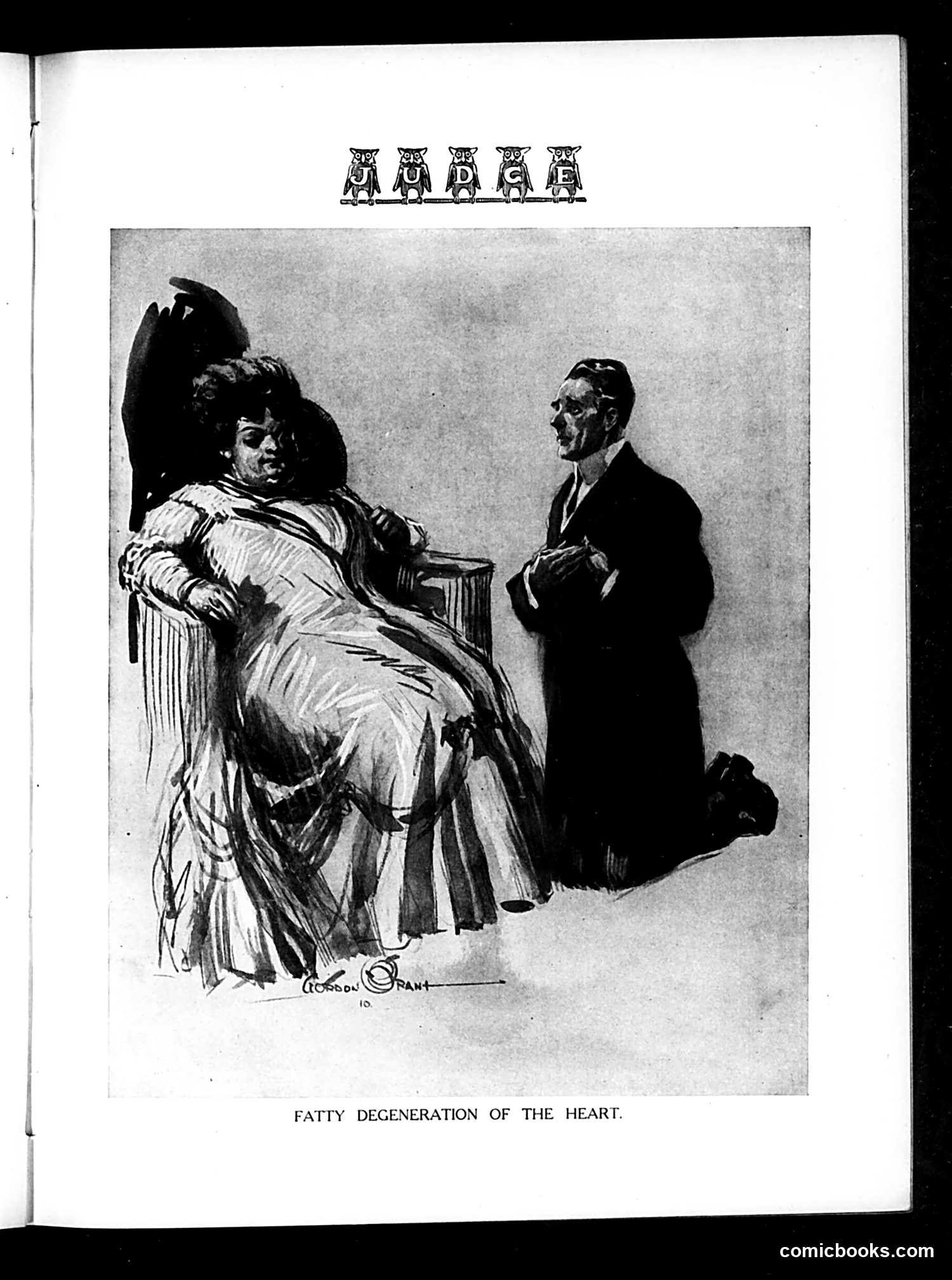
This Judge magazine cartoon depicts a medical condition through social satire. The illustration shows a woman of considerable size seated in a chair, with a man in dark clothing standing beside her—likely a doctor or physician examining or consulting with her. The title "Fatty Degeneration of the Heart" is a medical term referring to organ deterioration caused by fat accumulation. The satire appears to use this condition metaphorically to mock a woman for physical appearance while suggesting moral or character failings. The cartoon exemplifies late 19th/early 20th-century medical humor that conflated physical size with disease, poor character, and social criticism—reflecting period attitudes about bodies, gender, and class that modern readers would recognize as offensive and medically unfounded.
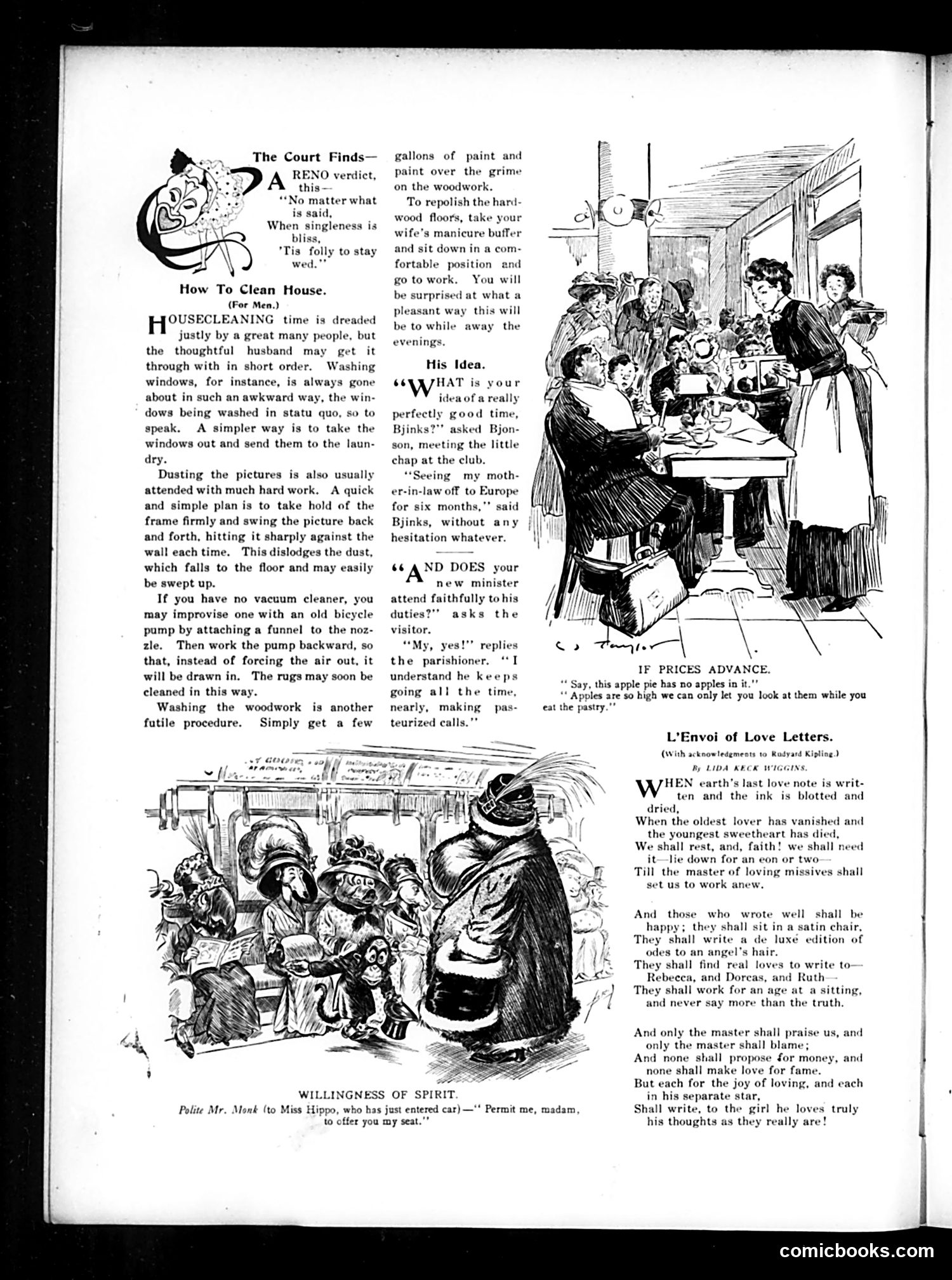
This page contains several distinct satirical pieces from an early 20th-century American magazine: **"The Court Finds"** references a Reno divorce verdict, likely alluding to Nevada's then-liberal divorce laws. The joke suggests that staying single is preferable to marriage. **"How To Clean House (For Men)"** is absurdist humor mocking husbands' incompetence at housework—suggesting ridiculous "solutions" like sending windows to the laundry or painting over dirt rather than cleaning properly. **"His Idea"** jokes about a man's ideal vacation being his mother-in-law's six-month European absence—a common complaint about in-laws. **"If Prices Advance"** satirizes wartime or post-war inflation, showing a baker charging full price for apple pie containing no apples, letting customers merely "look at them" while eating pastry—commentary on scarcity and price-gouging. **"L'Envoi of Love Letters"** is a Kipling-esque poem about the afterlife, suggesting devoted letter-writers receive heavenly reward. The page blends domestic humor, social commentary on marriage/divorce, and economic satire typical of Judge's early-century editorial voice.
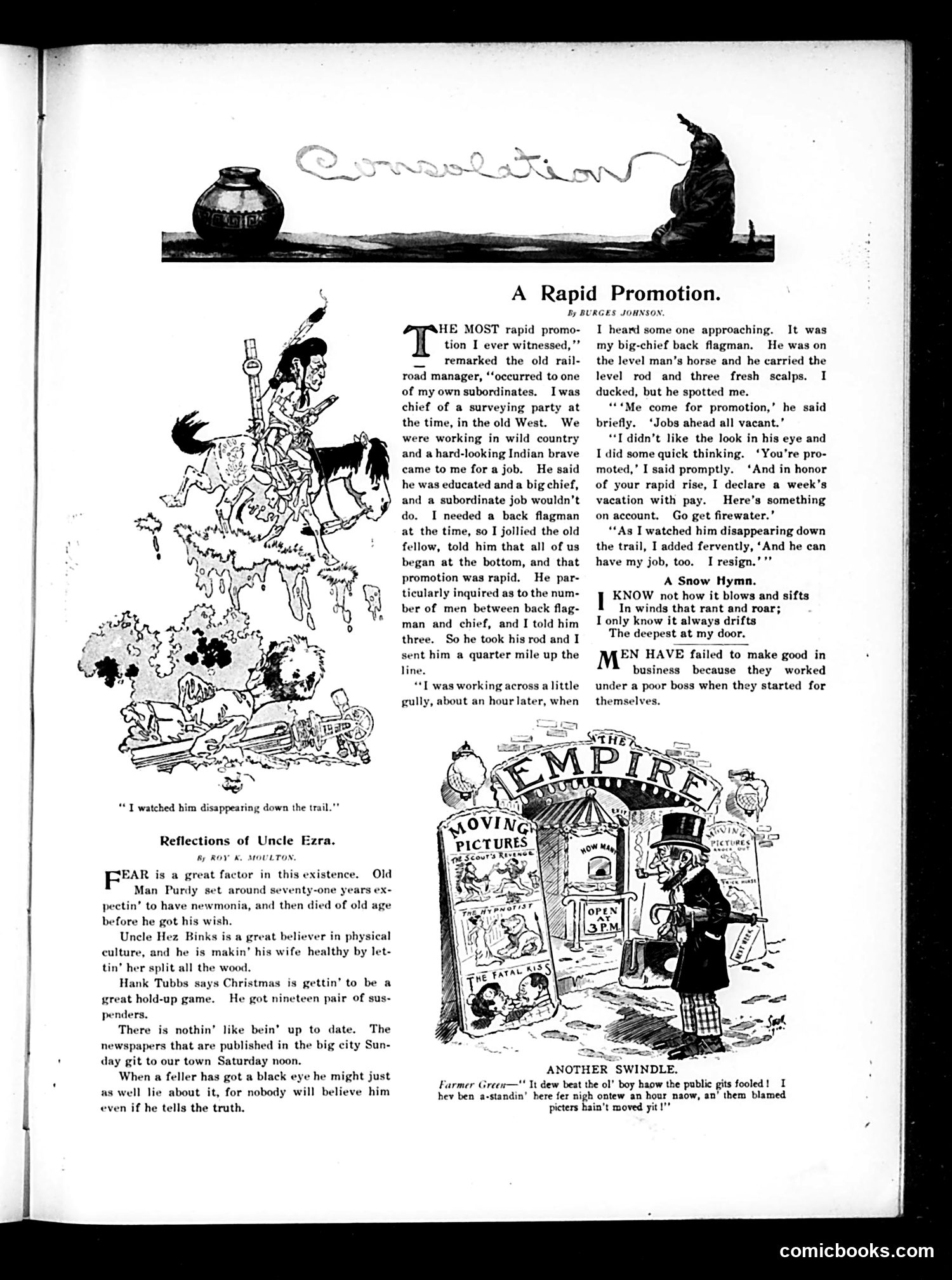
This is a tall tale exploiting racist stereotypes common to early 20th-century American humor. A railroad manager in the Old West hires an educated Native American who demands a high position. The manager tricks him by promoting him rapidly through deception—making him a "back flagman" a quarter mile away, claiming three men separate that rank from chief. The Indian returns with three fresh scalps, demanding further promotion. The terrified manager, now fearing violence, immediately "promotes" him again and sends him away with a week's pay, relieved to be rid of him. The joke depends on depicting Native Americans as savage, easily duped, and violent—reflecting prejudices of the era. The humor derives from the manager's cleverness in exploiting both the employee's ambition and stereotyped assumptions about Indigenous brutality. The page's other content includes rural humor and a sight gag about a farmer fooled by static movie posters.
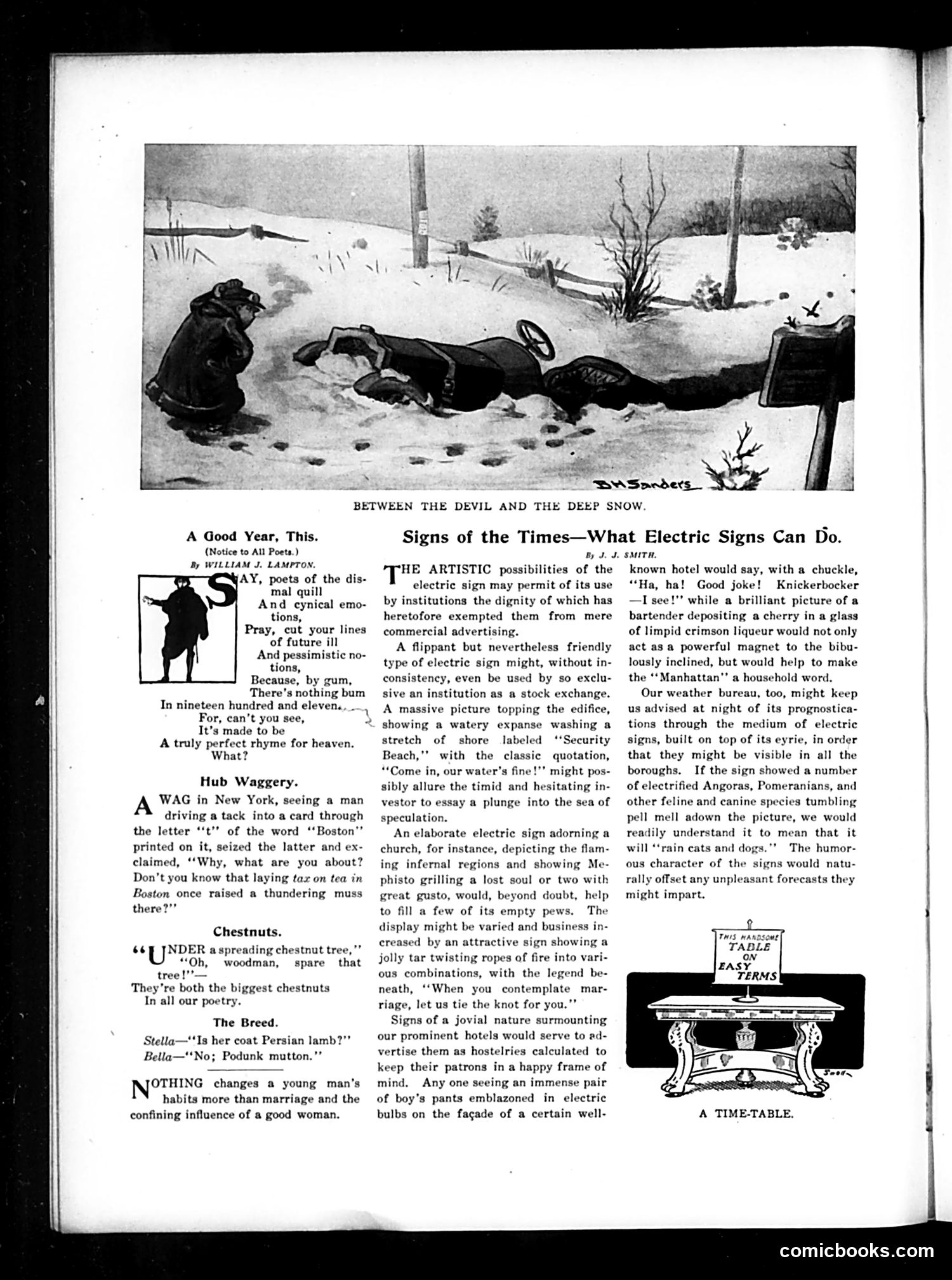
**Top Illustration:** "Between the Devil and the Deep Snow" depicts a car accident in winter—a figure lies in the snow beside an overturned vehicle. The title suggests being trapped between two dire alternatives, likely satirizing the dangers of early automobiles. **Text Content:** The page contains several humor pieces and one substantial article on electric signage. The "Good Year" poem celebrates 1911 optimistically. Brief jokes mock outdated poetry ("Under the Spreading Chestnut Tree"), Boston's colonial tax history, and courtship. **Main Article—"Signs of the Times":** J.J. Smith satirizes how electric signs (newly available technology) could humorously advertise traditionally dignified institutions. He proposes absurd applications: churches advertising with images of hell, stock exchanges with "Security Beach" signs luring investors, hotels advertising with giant electric pants, and weather bureaus displaying "raining cats and dogs" literally. The satire mocks both the commercialization of serious institutions and the literalness of electric advertising. This represents early-20th-century skepticism toward rapid commercialization and new technology.
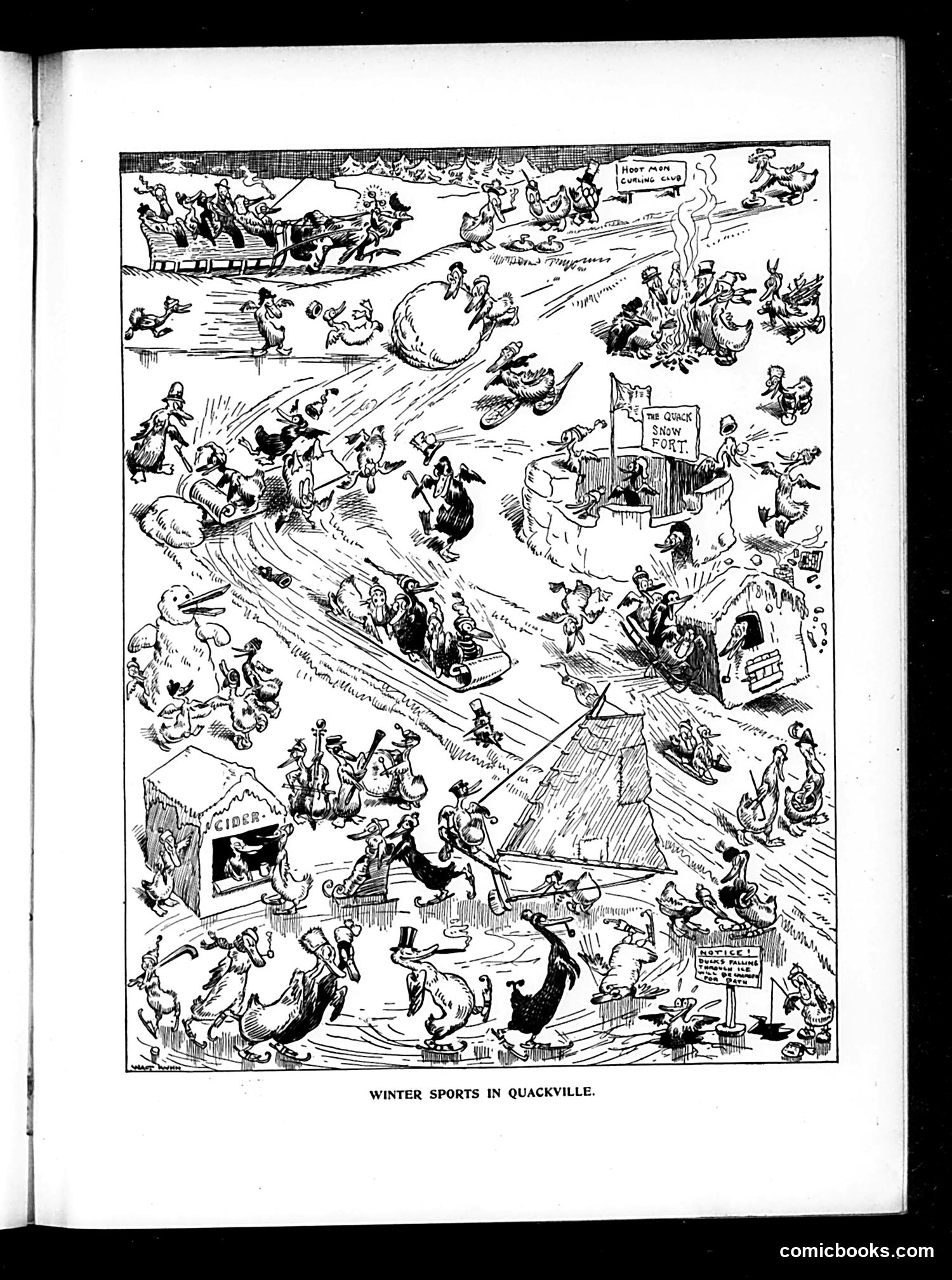
This is a humorous illustrated scene depicting winter activities in a place called "Quackville"—likely a satirical reference to quack doctors or fraudulent medical practitioners. The densely packed cartoon shows numerous figures engaged in winter sports (sledding, ice skating, snowball fights) amid various structures including a "Cider" stand and what appears to be a "Snow Fort." The satire seems to mock fraudulent medical practitioners and their dubious practices by portraying them in a chaotic winter carnival setting. The "Quackville" title suggests Judge magazine is ridiculing health charlatans through comedic exaggeration of their environment and activities. The cartoon's crowded, busy composition is typical of Judge's satirical style from this era, with multiple simultaneous scenes creating visual chaos to emphasize the absurdity being lampooned.
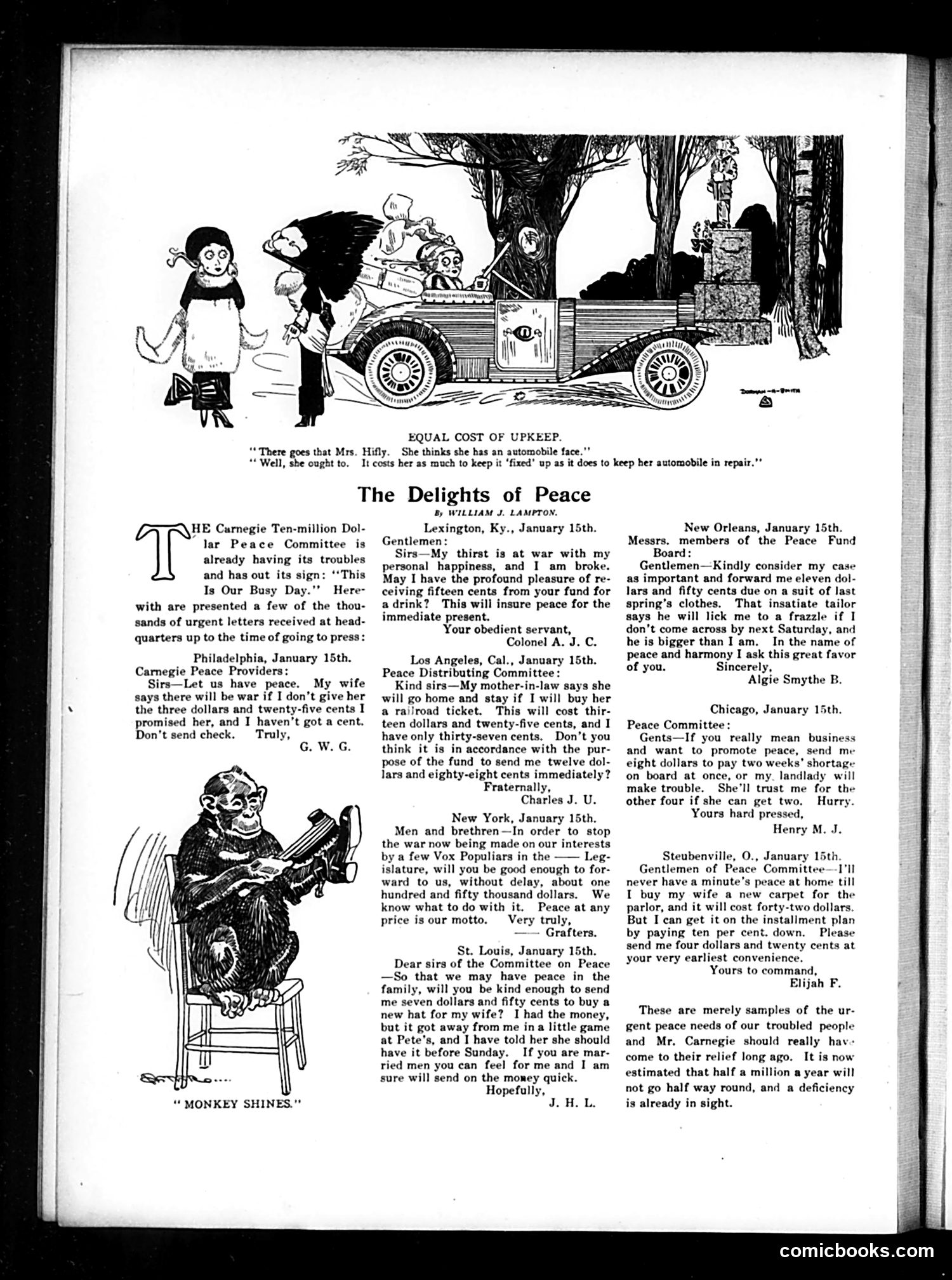
This page satirizes Andrew Carnegie's newly established Peace Committee and its $10 million endowment. The article presents mock letters from ordinary citizens requesting small sums from the peace fund—not for international conflict resolution, but for mundane personal debts: a husband needs money for his wife, a man wants liquor money, someone needs a railroad ticket to send away their mother-in-law, another needs hat money lost gambling. The satire's point: Carnegie's grand peace initiative will be overwhelmed by frivolous requests from broke Americans seeking handouts for personal problems. The joke suggests that "peace" begins at home with financial desperation, making the wealthy philanthropist's lofty goals absurdly impractical. The top cartoon mocks women's vanity, comparing a vain woman's upkeep costs to automobile maintenance—social commentary on female appearance obsession.
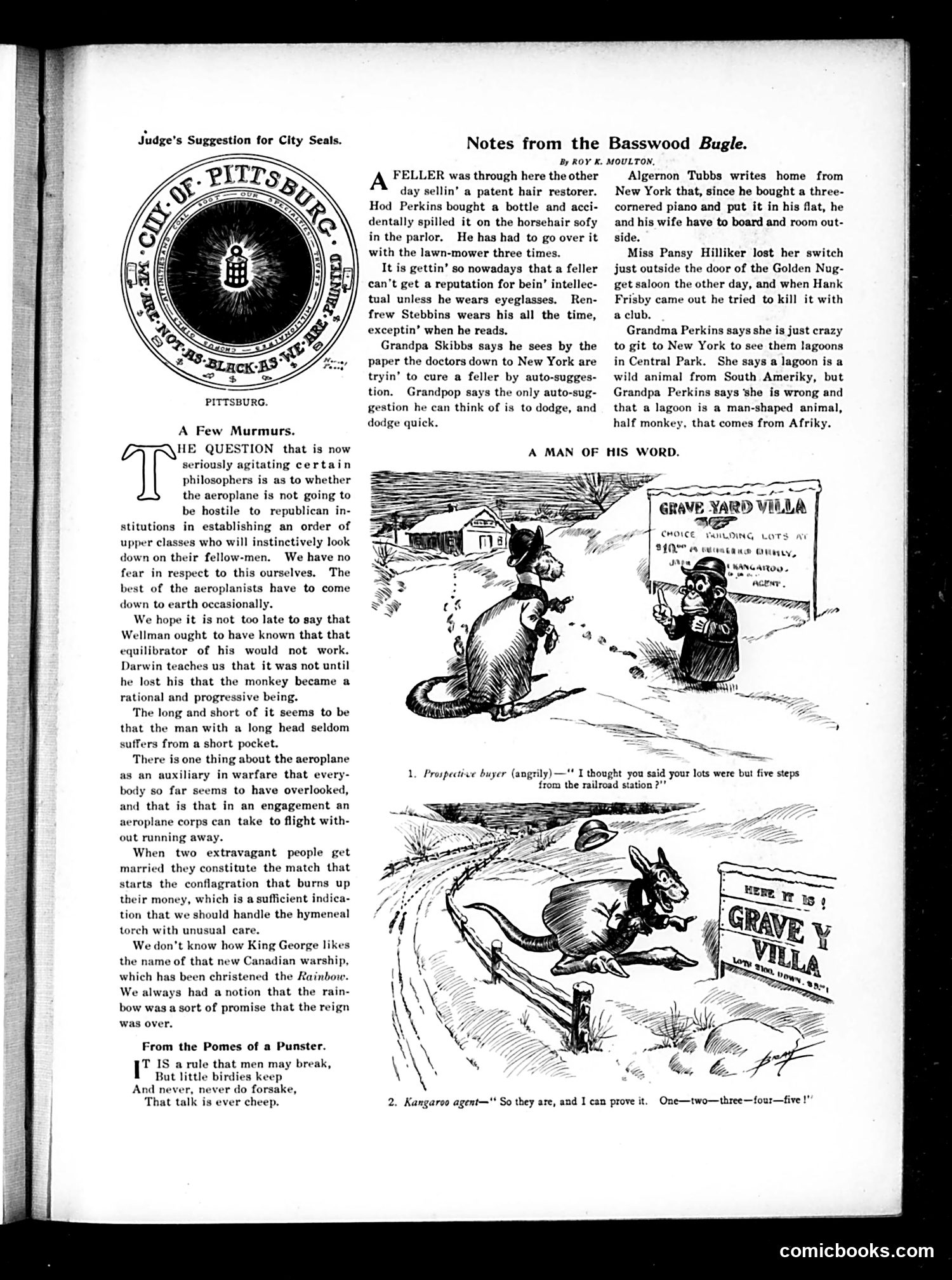
This page contains satirical commentary and humor typical of early 1900s Judge magazine: **Main Cartoons:** 1. **Pittsburgh City Seal**: A satirical suggestion showing a factory smokestack as Pittsburgh's municipal seal—mocking the industrial city's pollution and commercialism. 2. **"Grave Yard Villa" Comics**: Two property-sales gags. The first shows a buyer confronting an agent about distance from the railroad; the second depicts a kangaroo agent literally hopping five times to "prove" lots are five steps from the station—absurdist humor exploiting real estate deception. **"A Few Murmurs"**: Social commentary on aeroplanes as potential class dividers, referencing "Wellman" (likely Walter Wellman's Arctic airship attempt), Darwin's evolution theory used as wordplay, and observations on extravagant couples and Canadian warships named "Rainbow." **"Basswood Bugle"**: Rural humor columns featuring small-town characters discussing patent medicines, eyeglasses as intellectual affectation, and misunderstandings about New York (confusing "lagoon" with a human-animal hybrid). The overall tone: light satire on technology, class anxiety, commercialism, and rural-urban cultural gaps.
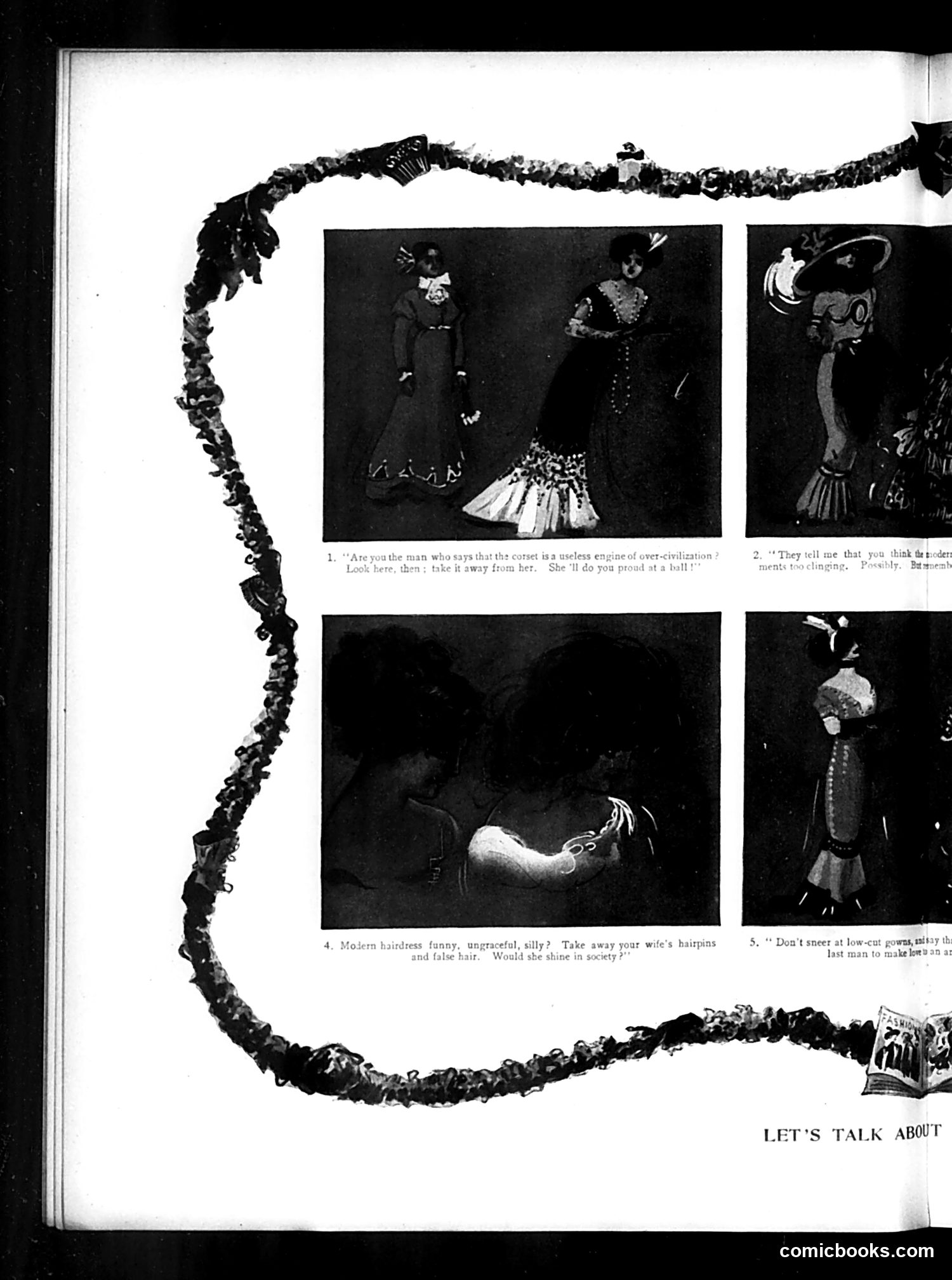
This page from *Judge* magazine contains four numbered cartoon panels with satirical commentary on women's fashion and social behavior, arranged around a decorative holly garland border. The captions ridicule "modern" women for various perceived failings: Panel 1 mocks corsets as unnecessary; Panel 4 criticizes women wearing harpsins and false hair as "funny, ungraceful, silly"; Panel 5 appears to mock women's low-cut gowns. The cartoons employ exaggerated visual caricature typical of early 20th-century satire. The overall theme attacks contemporary women's fashion choices and social conventions, reflecting conservative social anxieties about changing female appearance and autonomy. The page title "Let's Talk About" suggests gossip-column-style commentary. Without a visible date or additional context, the specific era remains unclear, though the style suggests early 1900s.
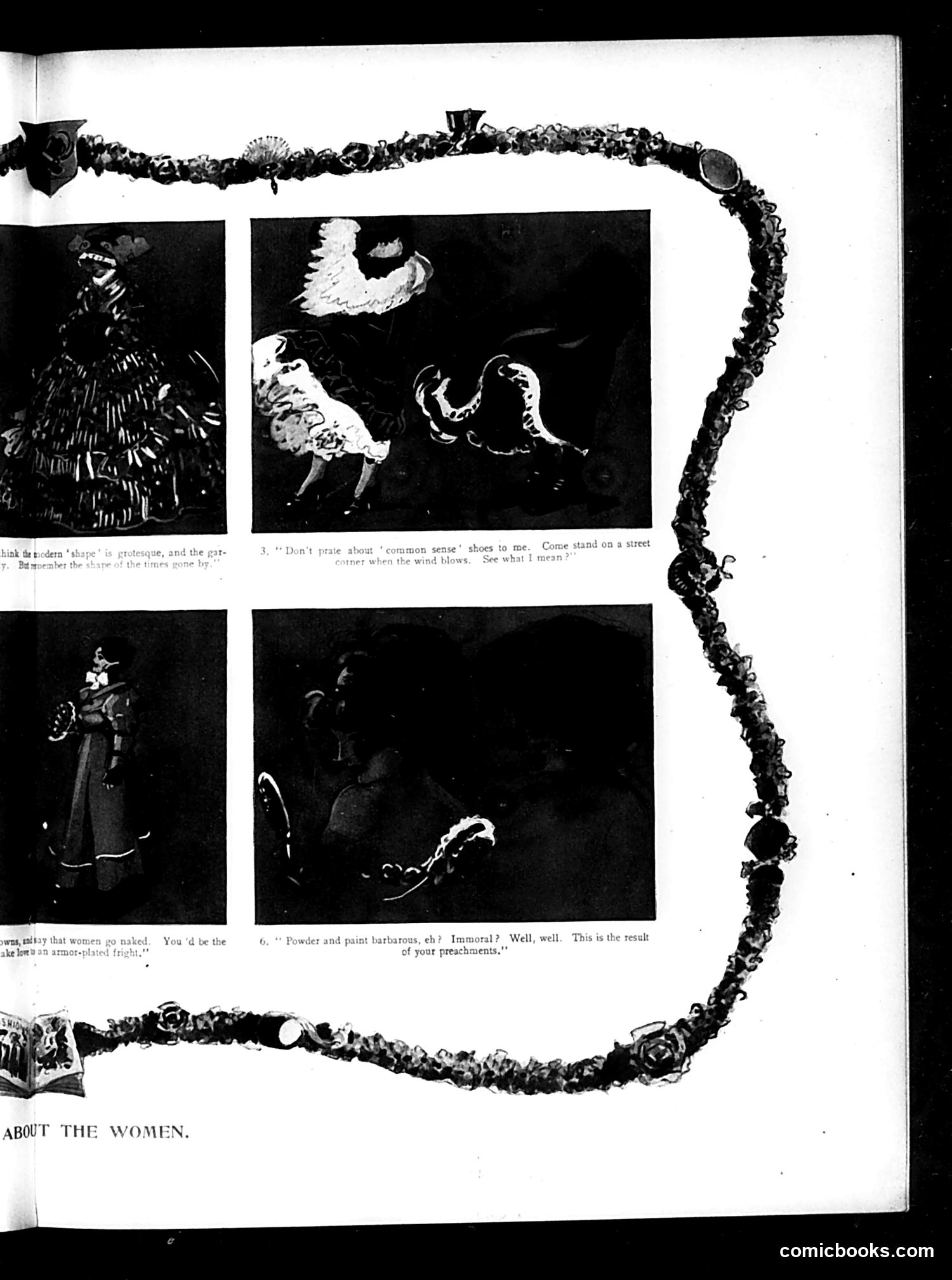
This page from *Judge* appears to be a satirical commentary on women's fashion and social behavior, titled "About the Women." The four illustrated panels use exaggerated caricature to mock contemporary female dress and conduct. The visible captions reference "common sense" shoes, women appearing "naked," and critique of "powder and paint" and "preachments"—suggesting satire of women's changing fashion choices and social attitudes. The ornamental border of decorative objects frames the content. Without clearer caption text, the specific social targets remain somewhat unclear, but the overall intent appears to be ridiculing modern women's departure from traditional dress and behavior through visual exaggeration and sarcastic commentary—typical of *Judge*'s satirical approach to gender and social issues of its era.
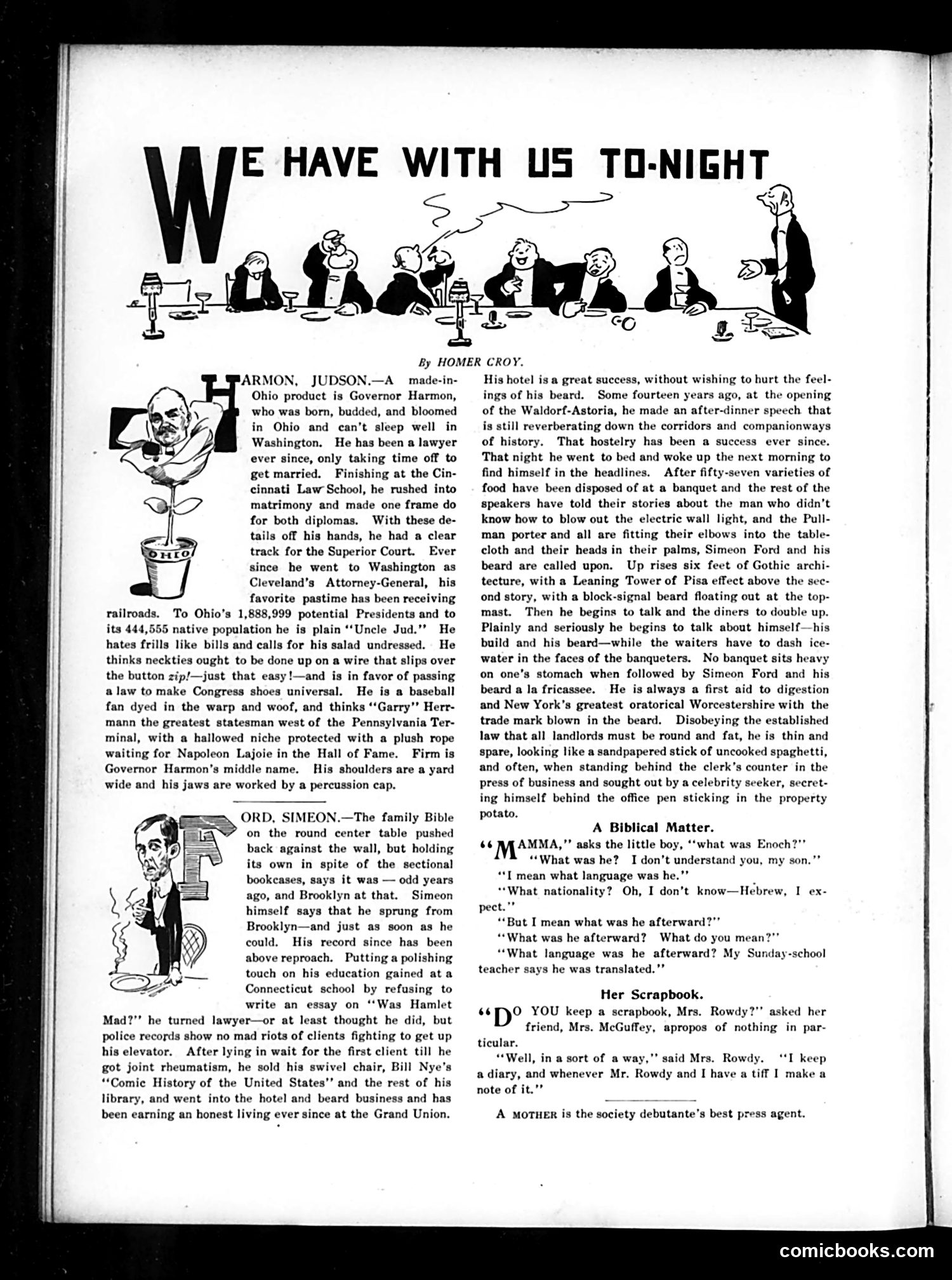
This is a satirical profile page from *Judge* magazine featuring two prominent figures: **Governor Harmon** (top): A caricature of Ohio Governor James Harmon, depicted as an unpretentious politician who dislikes formality (opposes neckties and fancy food). The satire mocks his plainness while crediting his success—he's beloved in Ohio and admired for his legal career and baseball fandom. The caricature is affectionate rather than cutting. **Simeon Ford** (bottom): A New York hotel owner and raconteur famous for his after-dinner speeches. The satire celebrates his wit and distinctive appearance (his remarkable beard). The piece humorously describes how his comic speeches at fancy banquets provide digestive relief to diners. Both profiles use exaggeration and witty wordplay to poke gentle fun at these public figures' quirks and reputations. The humor relies on readers' familiarity with these men—Harmon as a potential presidential candidate, Ford as a noted personality in New York society.
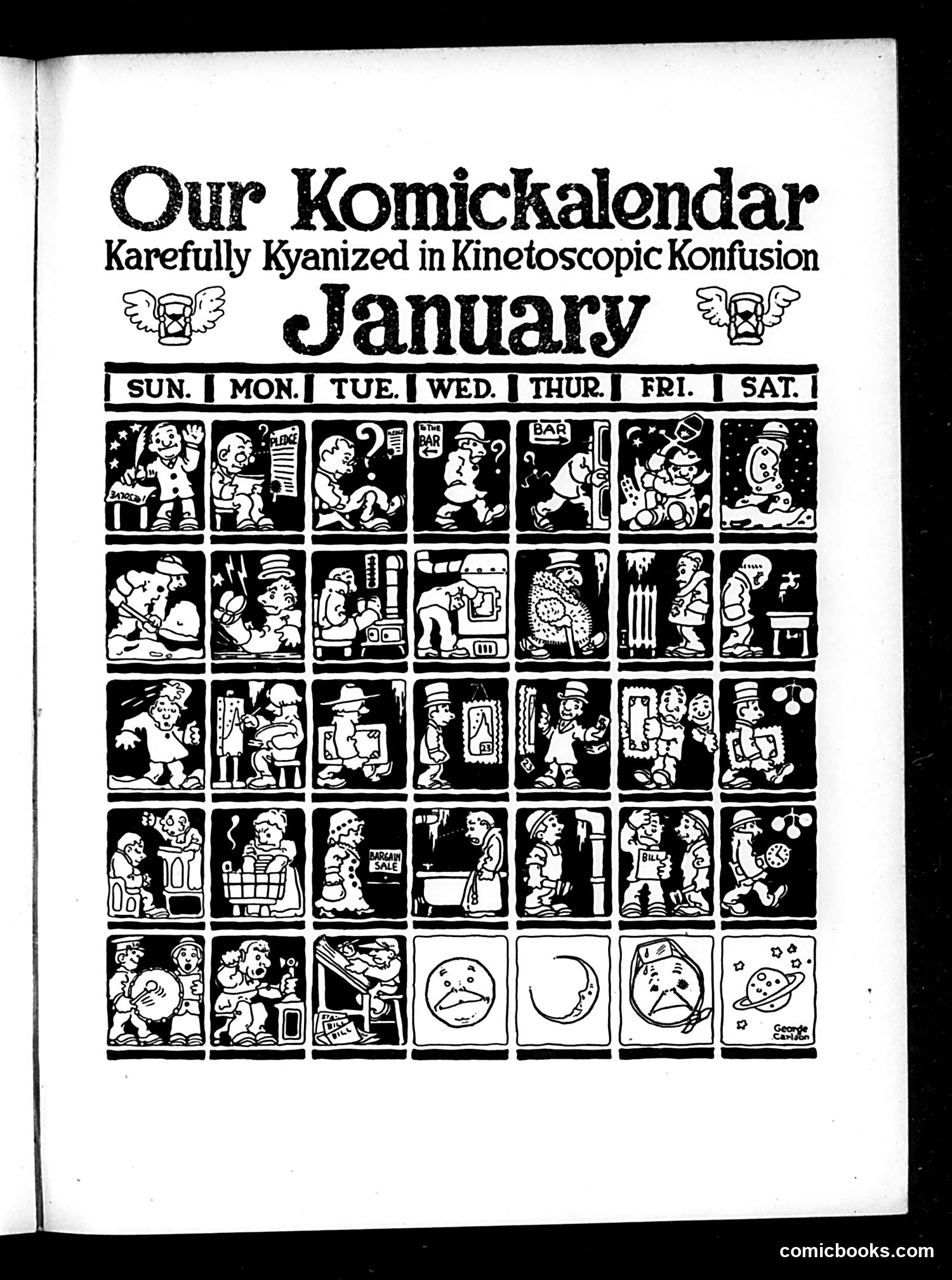
This is a humorous January calendar presented as a grid of daily comic strips. The title's intentional misspellings ("Komickalendar," "Kyanized," "Kinetoscopic Konfusion") parody early 20th-century advertising's exaggerated use of alliteration and creative spelling for comedic effect. Each day features a different cartoon vignette depicting everyday scenes: domestic life, social interactions, workplace situations, and seasonal January activities (snowmen, winter clothing). The final week deteriorates into simple emoticon-like faces (happy, neutral, sad), suggesting the month's emotional arc or a comedic commentary on how January progresses. The strips appear satirical of ordinary middle-class American life rather than targeting specific political figures. This type of calendar was typical Judge magazine content—accessible humor for general audiences.
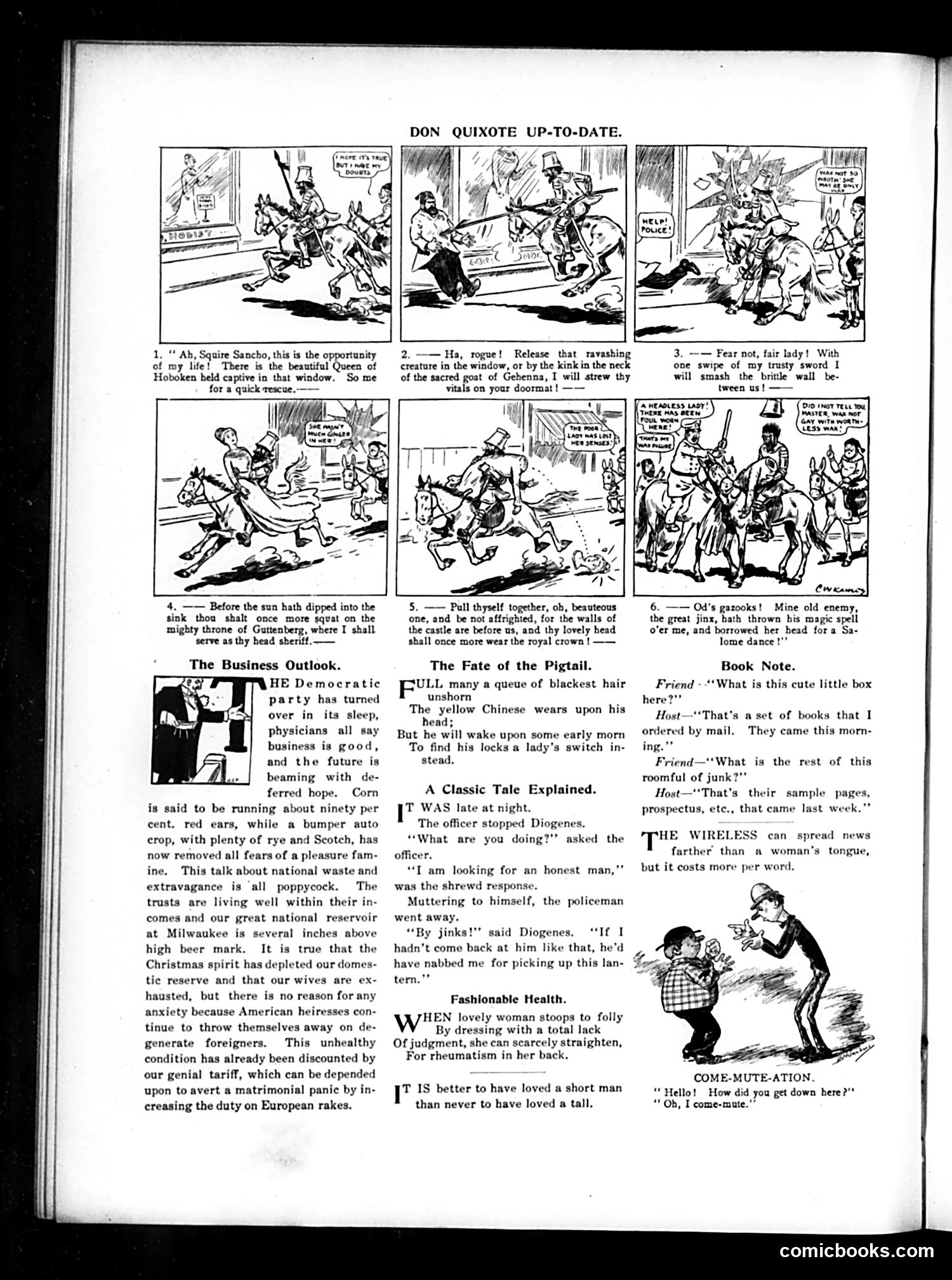
This page parodies Cervantes' classic novel with modernized absurdity. The top comic strip shows Don Quixote attempting a ridiculous "rescue" of a woman from a Hoboken window, treating contemporary urban scenes as medieval adventures—the joke being that Quixote's delusional worldview persists unchanged in modern America. The surrounding pieces mock contemporary concerns: "The Business Outlook" satirizes Democratic Party optimism and economic anxiety through absurdist logic (trusts living well, Milwaukee's beer supply as economic indicator, wealthy American heiresses marrying "degenerate foreigners"). "The Fate of the Pigtail" jokes about Chinese queue-wearing being replaced by women's fashionable hair switches. Other brief pieces ridicule police inefficiency, women's fashion choices causing health problems, and wireless telegraphy's expense. The satire targets political complacency, class anxieties about foreign influence, and modern consumer culture—all wrapped in period humor and puns.
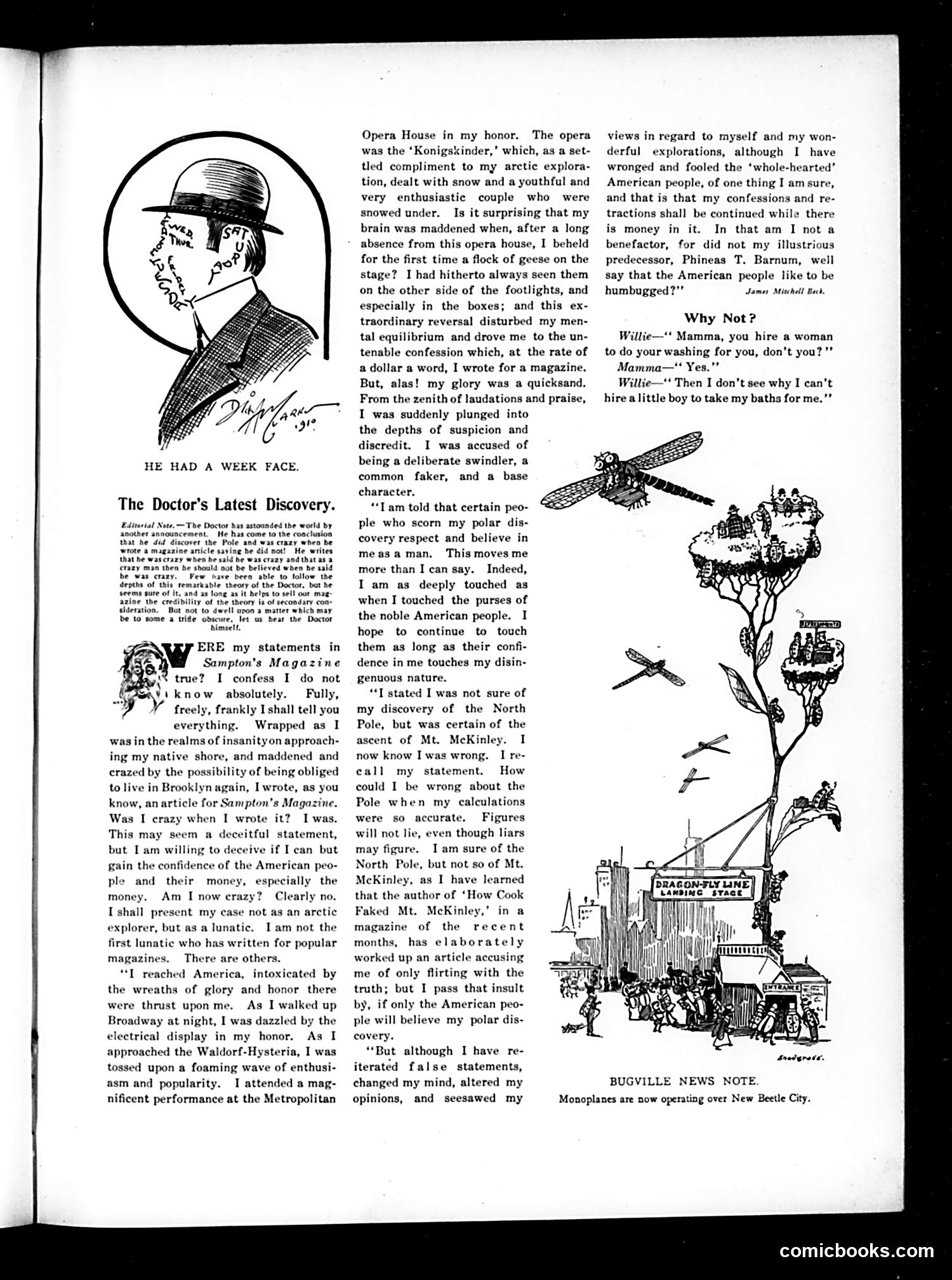
This page mocks an Arctic explorer (likely **Frederick Cook**, who falsely claimed to reach the North Pole in 1909) through a fictionalized "confession." The cartoon's caption "He Had a Week Face" depicts the explorer—drawn with exaggerated features suggesting weakness or duplicity. The satire targets the explorer's shameless opportunism: he admits writing false claims while mentally unstable, confesses to deliberate deception to gain "American people's" money and confidence, then immediately contradicts himself by insisting his polar discovery is true while abandoning his Mt. McKinley claim. The joke is the explorer's transparent hypocrisy—he openly acknowledges lying while simultaneously demanding belief. Judge ridicules both the faker's audacity and the public's gullibility in accepting celebrity explorers' unverified claims. The accompanying "Why Not?" dialogue and "Bugville News" cartoon continue this theme of questioning dubious public figures.
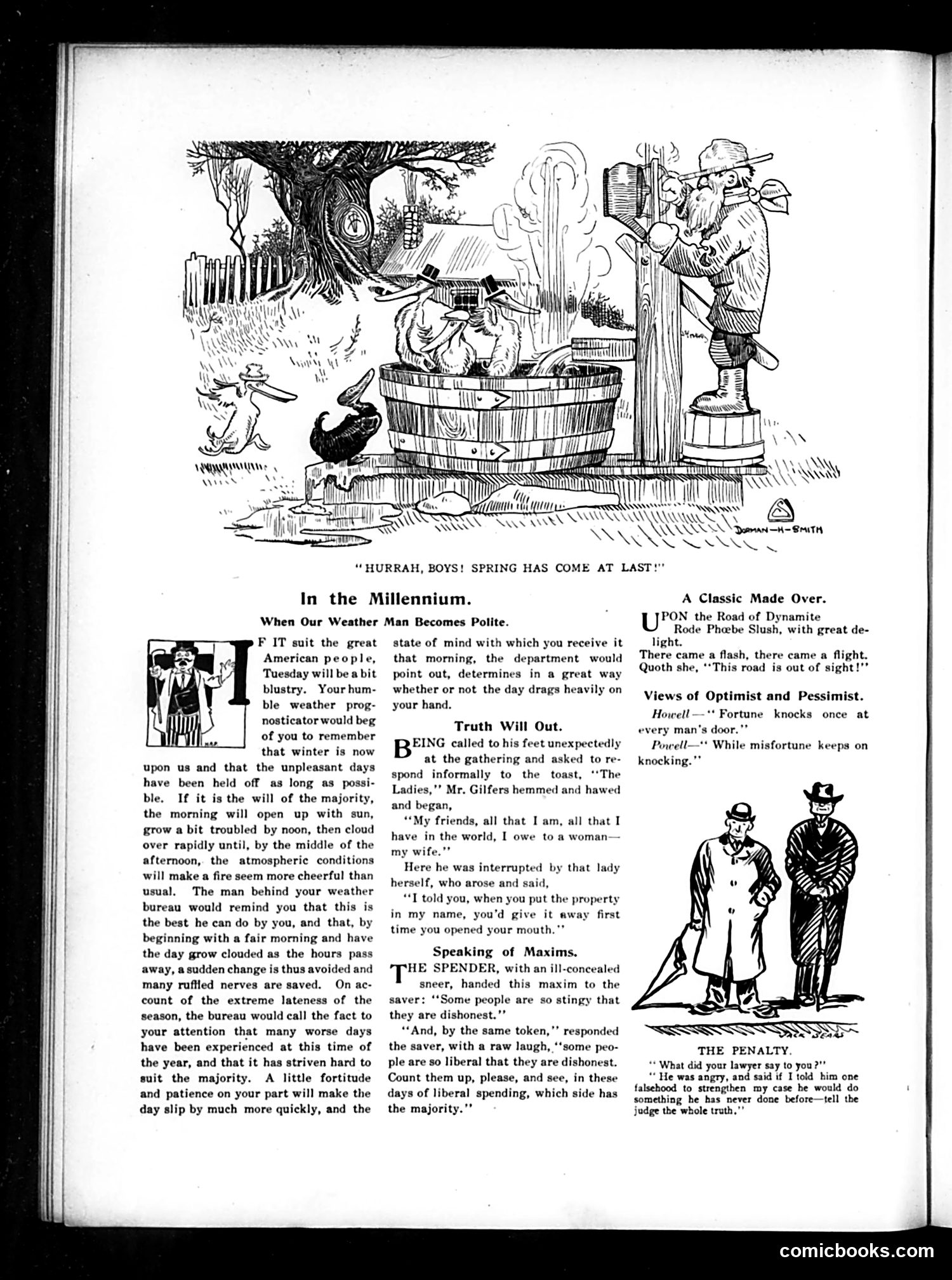
**Top Cartoon:** "Hurrah, Boys! Spring Has Come at Last!" depicts children celebrating spring around a large wooden barrel and cactus in a rural setting. This illustrates the accompanying article's satire about an overly polite, deferential weather forecaster who apologetically describes Tuesday's unpleasant conditions as if requesting permission from "the American people" to deliver bad news. The joke mocks bureaucratic over-politeness and the absurdity of a weather official treating meteorology as a democratic process requiring majority approval. **Text Pieces:** Three brief humorous anecdotes follow: - A man crediting his wife for his success is interrupted by her claiming he gives away her property - A debate between a spender and saver about dishonesty - A poem parodying classic literature, featuring "Phoebe Slush" on "the Road of Dynamite" - A final joke about a lawyer willing to break his principle of honesty only to tell the judge the complete truth The page satirizes American manners, marital dynamics, and legal ethics through light social commentary typical of *Judge* magazine's humor.
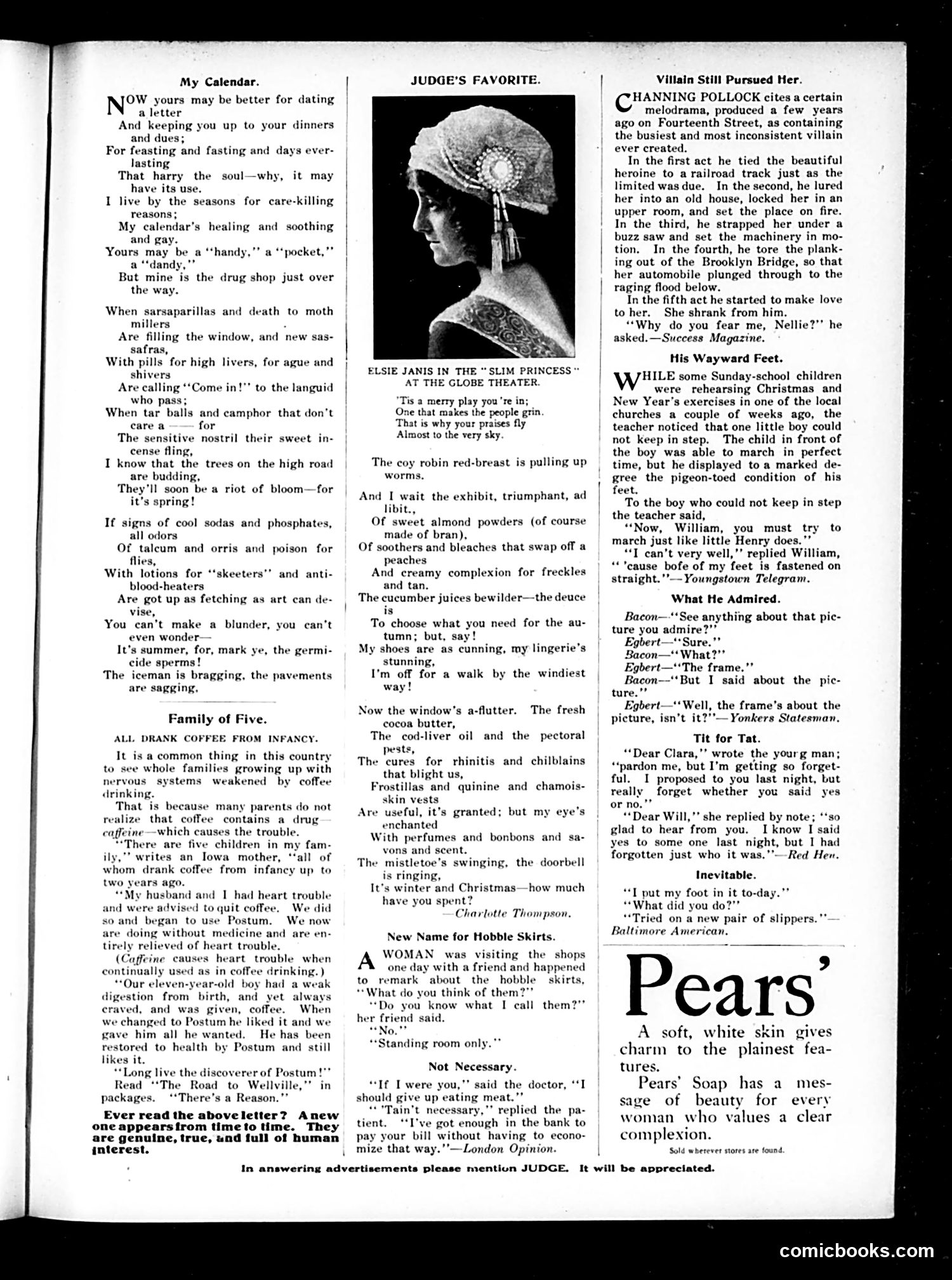
This page contains primarily **humorous verse and advertising** rather than political cartoons. The main content includes: 1. **"My Calendar"** — A poem using drugstore seasonal products (sarsaparillas, sodas, insect lotions) as markers of the seasons instead of traditional calendars. The satire mocks how commercialized American life has become. 2. **"Judge's Favorite"** — A photograph and praise for actress Elsie Janis in the play "The Slim Princess" at the Globe Theater, with accompanying verse. 3. **Social humor pieces** — Short anecdotal jokes about women's fashion (hobble skirts called "standing room only"), children's marching, and doctor-patient exchanges about diet. 4. **Postum advertisement disguised as testimonial** — A lengthy pseudo-letter claiming coffee damaged a family's health but Postum restored them. This was common deceptive advertising of the era. 5. **Pears Soap advertisement** — Standard beauty product marketing. The page reflects early 1900s consumer culture and popular entertainment rather than political satire.
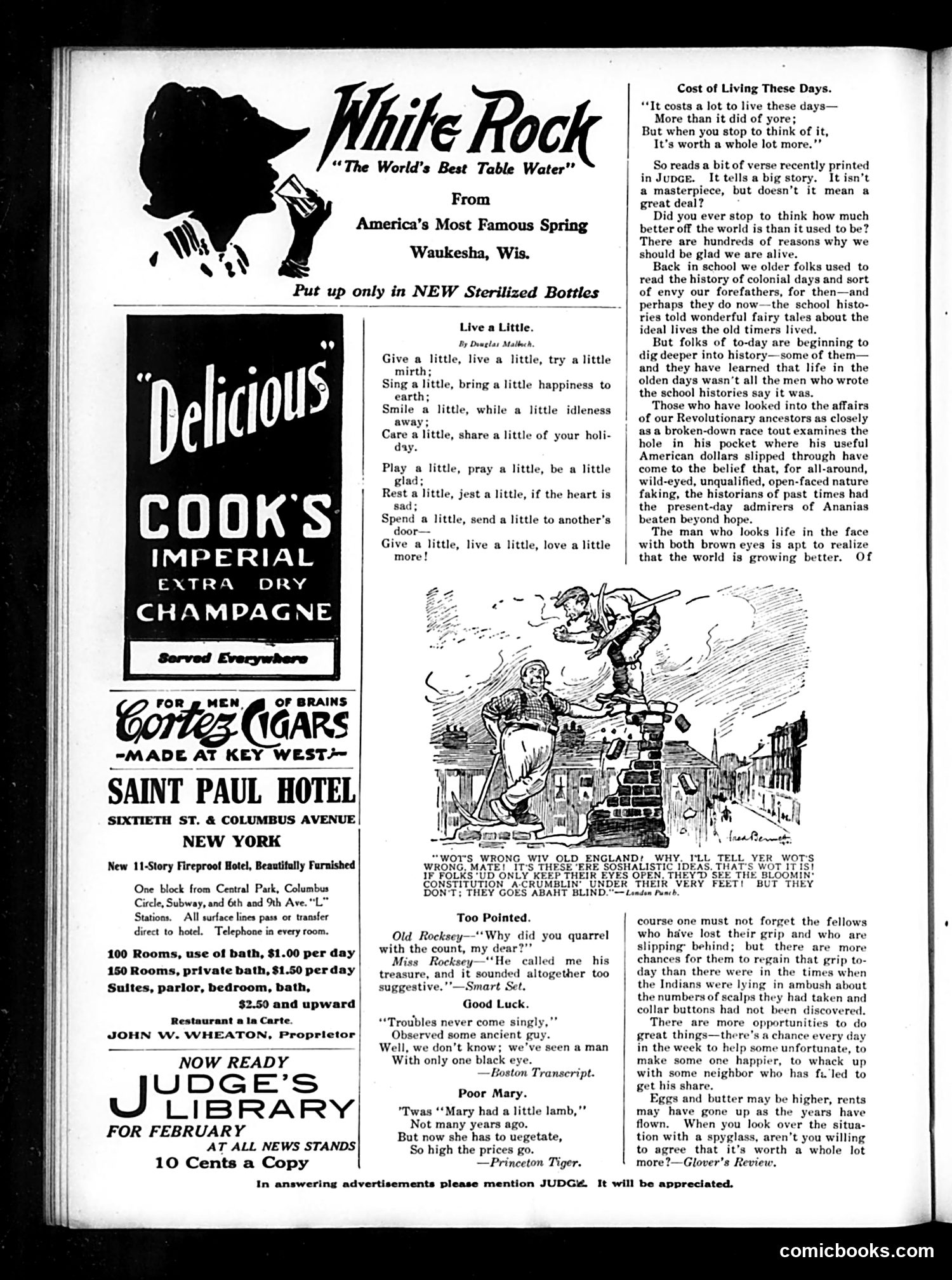
This page is primarily **advertising with light satirical content**, typical of Judge magazine's format. The main cartoon (center) depicts two figures on a rooftop in period dress, captioned with a British character complaining about England's problems. The figure appears to be a working-class Englishman ("mate," "wot's wrong") blaming "soshalistic ideas" for England's troubles—likely a jab at early 20th-century labor movements and socialism gaining traction in Britain. The surrounding content includes brief humorous quips on contemporary life: "Cost of Living These Days" comments on inflation (prices rising, particularly food like lamb); "Too Pointed" jokes about courtship and monetary terminology; and "Poor Mary" satirizes agricultural price increases. The bulk of the page features hotel, champagne, water, and cigar advertisements, reflecting Judge's commercial nature. The verse "Live a Little" is motivational filler content common to period magazines. Overall, this represents Judge's mix of gentle social commentary with period concerns about economics, immigration attitudes, and class anxieties.
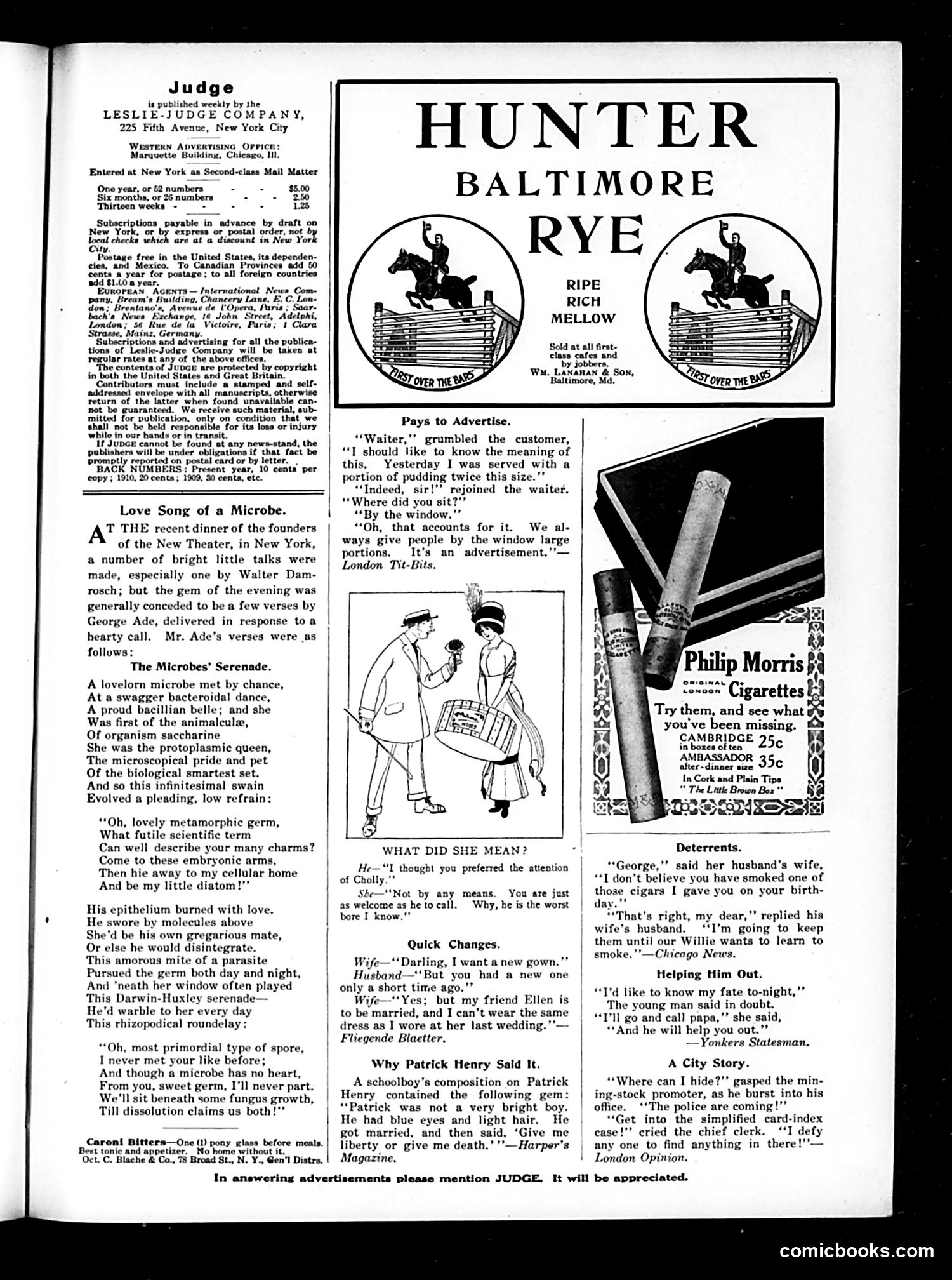
This is primarily an **advertising and humor page** from Judge magazine, a major American satirical weekly. **Main Content:** The featured piece is "Love Song of a Microbe"—a humorous poem by George Ade (credited), delivered at a New Theater founders' dinner. It's a comedic take on romantic courtship, but replacing lovers with microscopic organisms (microbes, bacilli, protoplasm). The joke relies on scientific terminology substituted for traditional love-song language—"epithelium burned with love," "my cellular home," "my little diatom." It's gentle satire playing on both Victorian romantic conventions and the era's fascination with newly-visible microscopic life. **Supporting Content:** A brief anecdote about restaurant service uses the pun "Pays to Advertise"—a waiter explains larger window-seat portions are deliberate marketing. **Advertising:** Prominent ads for Hunter Baltimore Rye whiskey and Philip Morris cigarettes dominate the right side. The page reflects early-20th-century humor: scientific literacy among educated readers, mild romantic satire, and product-focused advertising.
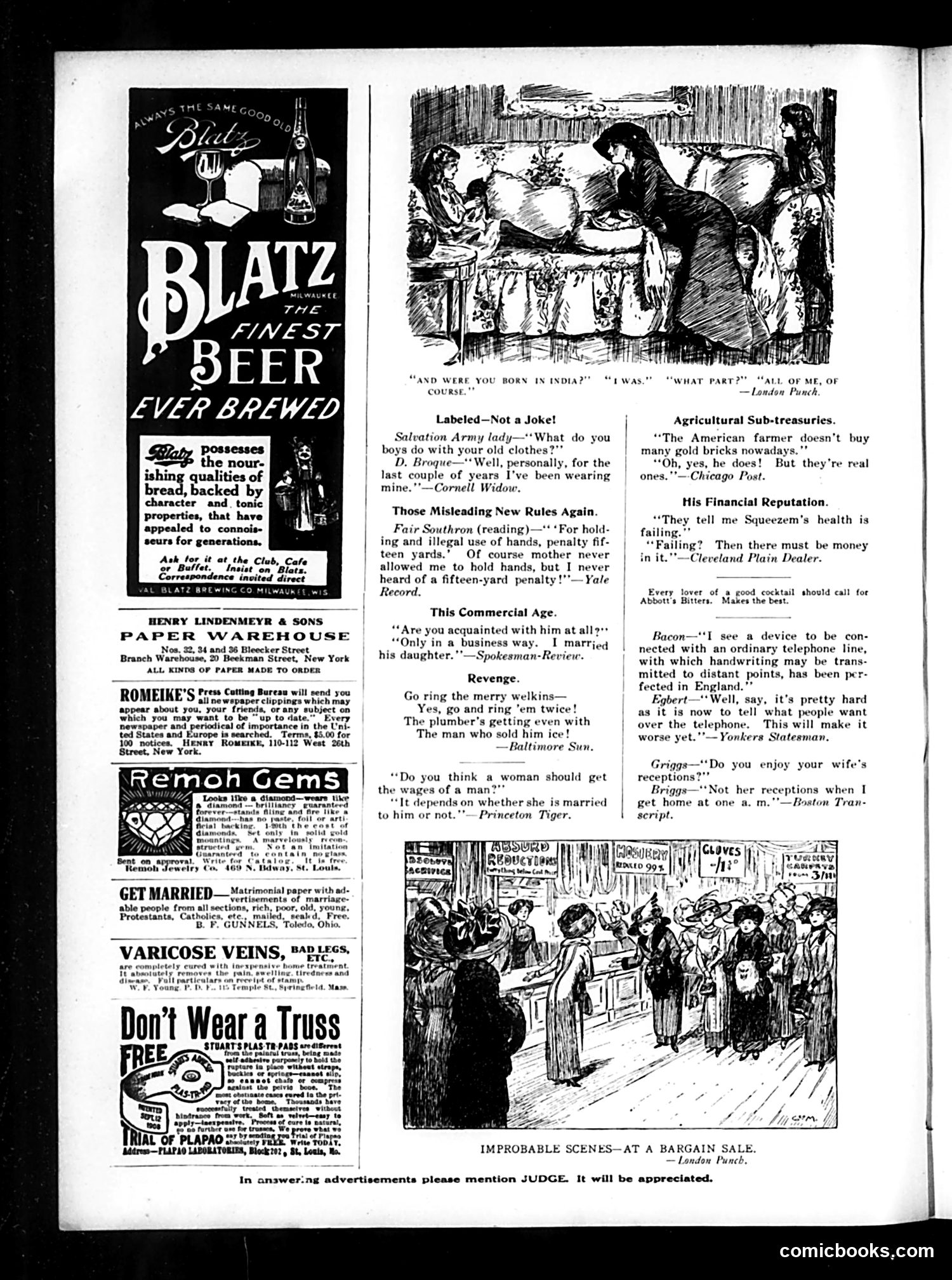
This page is primarily **advertisements and humor snippets** rather than political cartoons. The main visual content is two illustrations: 1. **Top cartoon**: A drawing of women at what appears to be a social gathering, with dialogue about being "born in India"—likely satirizing pretentious social conversation and class affectation among wealthy women. 2. **Bottom cartoon**: Titled "Improbable Scenes—At a Bargain Sale" (credited to London Punch), depicting a crowded, chaotic shopping scene—satirizing the frenzy and undignified behavior of people during retail sales. The surrounding text consists of **short jokes and witticisms** on marriage, gender roles, business conduct, and modern conveniences (like the telephone device mentioned). These reflect early 20th-century American humor about courtship, women's wages, and emerging technology. The page is dominated by **commercial advertisements** for beer, paper warehouses, matrimonial services, and medical treatments—typical of Judge's revenue model.
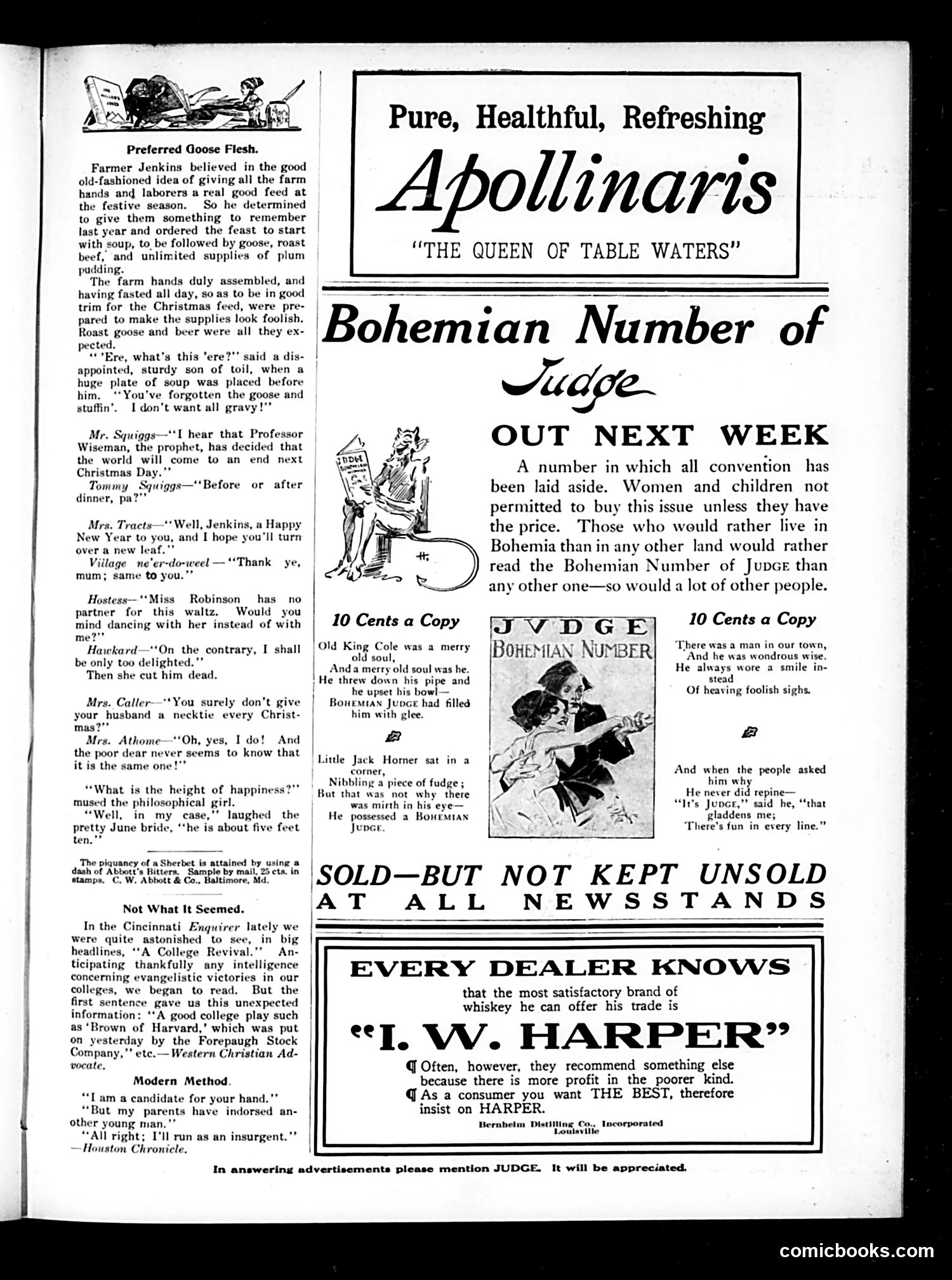
This page is primarily **advertising and filler content** from Judge magazine, with minimal political satire. The main items are: **"Preferred Goose Flesh"**: A humorous anecdote about a farm worker disappointed by soup at a Christmas feast—he expected goose and stuffing, not "all gravy." The joke plays on working-class expectations and impatience. **Small jokes**: Brief, disconnected humor pieces about marriage, dancing, and college revivals—typical light satirical fare of the era with no deeper political meaning. **Advertisements**: The bulk of the page promotes Apollinaris water, Judge magazine's upcoming "Bohemian Number," and I.W. Harper whiskey. These ads use period marketing language emphasizing purity, quality, and exclusivity. The "Bohemian Number" ad appears noteworthy—it suggests Judge was marketing an issue celebrating bohemian lifestyle/artistic freedom, noting women and children needed money to purchase it (implying adult content). Overall, this is a **typical magazine page blending entertainment, serialized humor, and commercial advertising** rather than pointed political commentary.
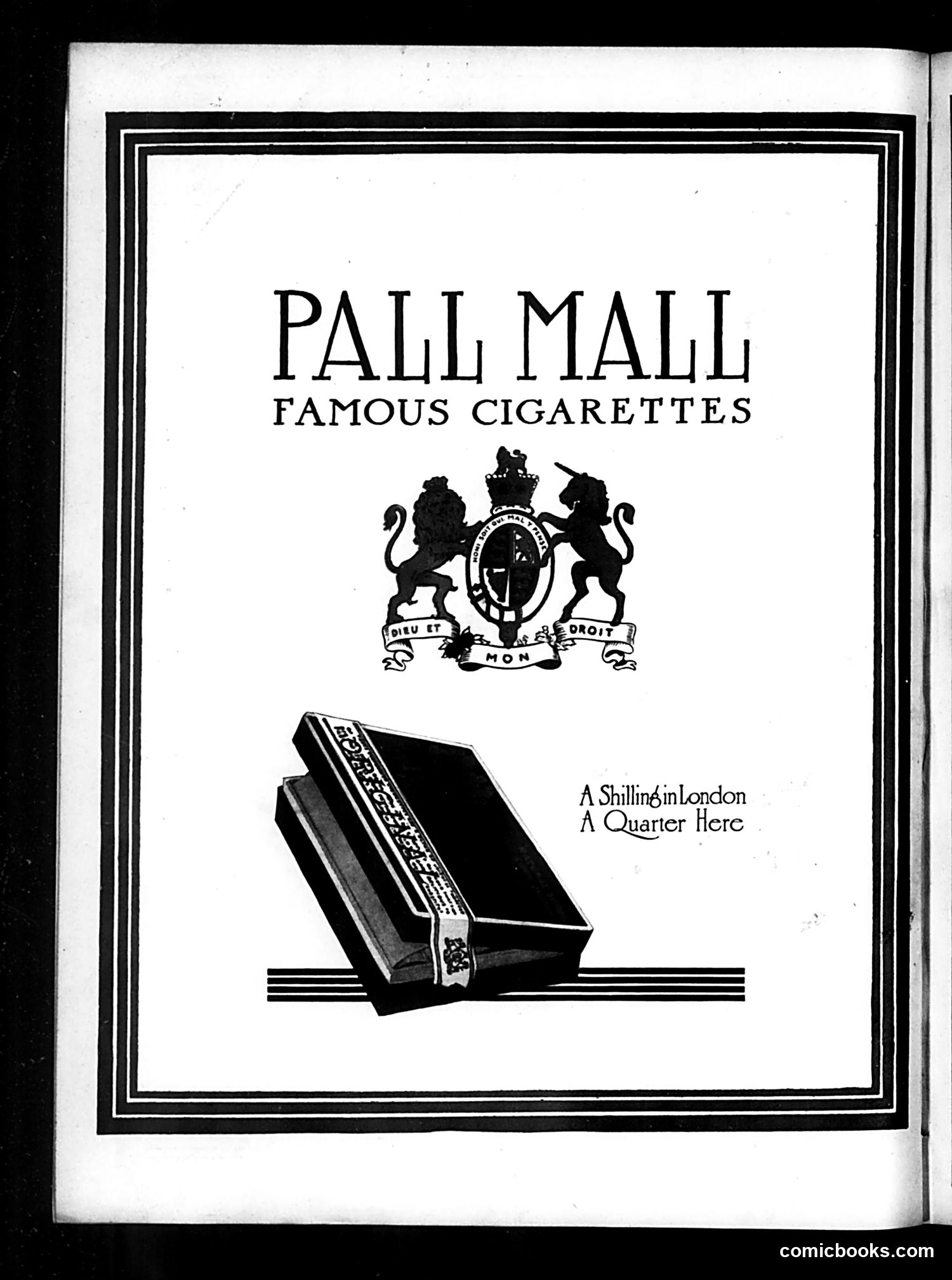
This is primarily a **cigarette advertisement**, not editorial content or satire. It advertises Pall Mall cigarettes, a British brand, using a formal heraldic coat of arms with supporting lions and a crowned shield bearing the motto "DIEU ET MON DROIT" (French royal heraldic language). The ad emphasizes **prestige and luxury** through the royal imagery and British heritage. The pricing comparison—"A Shilling in London / A Quarter Here"—suggests these were imported British cigarettes sold in America, marketed as a premium product. The formal, dignified presentation targets affluent consumers who valued European sophistication. There is no discernible satire or political commentary visible. This reflects early 20th-century advertising practices using aristocratic symbolism to convey quality and exclusivity.