
Judge, 1911-01-21 · page 7 of 24
Judge — January 21, 1911 — page 7: what you’re looking at
What you’re looking at
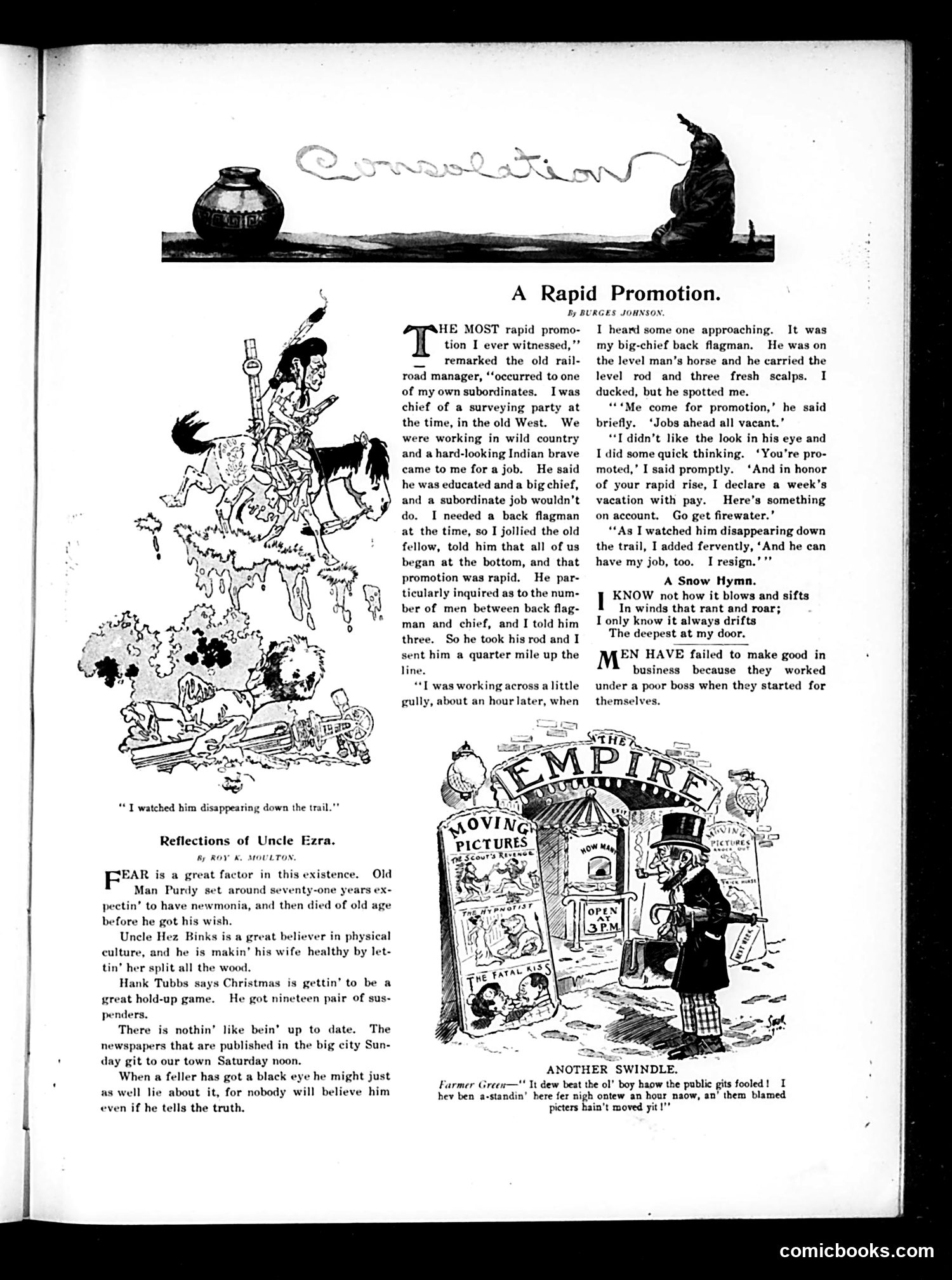
This is a tall tale exploiting racist stereotypes common to early 20th-century American humor. A railroad manager in the Old West hires an educated Native American who demands a high position. The manager tricks him by promoting him rapidly through deception—making him a "back flagman" a quarter mile away, claiming three men separate that rank from chief. The Indian returns with three fresh scalps, demanding further promotion. The terrified manager, now fearing violence, immediately "promotes" him again and sends him away with a week's pay, relieved to be rid of him. The joke depends on depicting Native Americans as savage, easily duped, and violent—reflecting prejudices of the era. The humor derives from the manager's cleverness in exploiting both the employee's ambition and stereotyped assumptions about Indigenous brutality. The page's other content includes rural humor and a sight gag about a farmer fooled by static movie posters.
📄 Transcribed text from this page (OCR, searchable)
Machine-transcribed from the original scan — historical spelling and the odd misread are preserved.
“*T watched him disappearing down the trail."" Reflections of Uncle Ezra. fy ROY K. MOULTON EAR is a great factor in this existence. Old Man Purdy set around seventy-one years ex- pectin’ to have newmonia, and then died of old age before he got his wish. Uncle Hez Binks is a great believer in physical culture, and he is makin’ his wife healthy by let- tin’ her split all the wood. Hank Tubbs 's Christmas is gettin’ to be a great hold-up game. He got nineteen pair of sus- penders. There is nothin’ like bein’ up to date. The newspapers that are published in the big city Sun- day git to our town Saturday noon. When a feller has got a black he might just as well lie about it, for nobody will believe him even if he tells the truth, HE MOST rapid promo- tion I ever witnessed,”” remarked the old rail- road manager, ‘‘occurred to one of my own subordinates. Iwas chief of a surveying party at the time, in the old West. We were working in wild country and a hard-looking Indian brave came to me for a job. He said he was educated and a big chief, and a subordinate job wouldn’t do. I needed a back flagman at the time, so I jollied the old fellow, told him that all of us began at the bottom, and that promotion was rapid. He par- ticularly inquired as to the num- ber of men between back flag- man and chief, and I told him three. So he took his rod and I sent him a quarter mile up the line. “*T was working across a little gully, about an hour later, when PICTURES | caegenors RE A Rapid Promotion. By BURGES JOHNSON ANOTHER SWINDLE. I heard some one approaching. It was my big-chief back flagman, He was on the level man’s horse and he carried the level rod and three fresh scalps. I ducked, but he spotted me. “‘Me come for promotion,’ he said briefly. ‘Jobs ahead all vacant.’ “I didn’t like the look in his eye and I did some quick thinking. ‘You're pro- moted,’ I said promptly. ‘And in honor of your rapid rise, I declare a week’s vacation with pay. Here’s something on account. Go get firewater.’ “As I watched him disappearing down the trail, I added fervently, ‘And he can have my job, too. I resign.’”” A Snow Hymn. KNOW not how it blows and sifts In winds that rant and roar; I only know it always drifts The deepest at my door. MEX HAVE failed to make good in business because they worked under a poor boss when they started for themselves. Farmer Green—" It dew beat the ol’ boy haow the public gits fooled! I hev ben a-standin’ here fer nigh ontew an hour naow, an’ them blamed picters ain't moved yit !'" comicbooks.com