
Judge, 1911-01-21 · page 14 of 24
Judge — January 21, 1911 — page 14: what you’re looking at
What you’re looking at
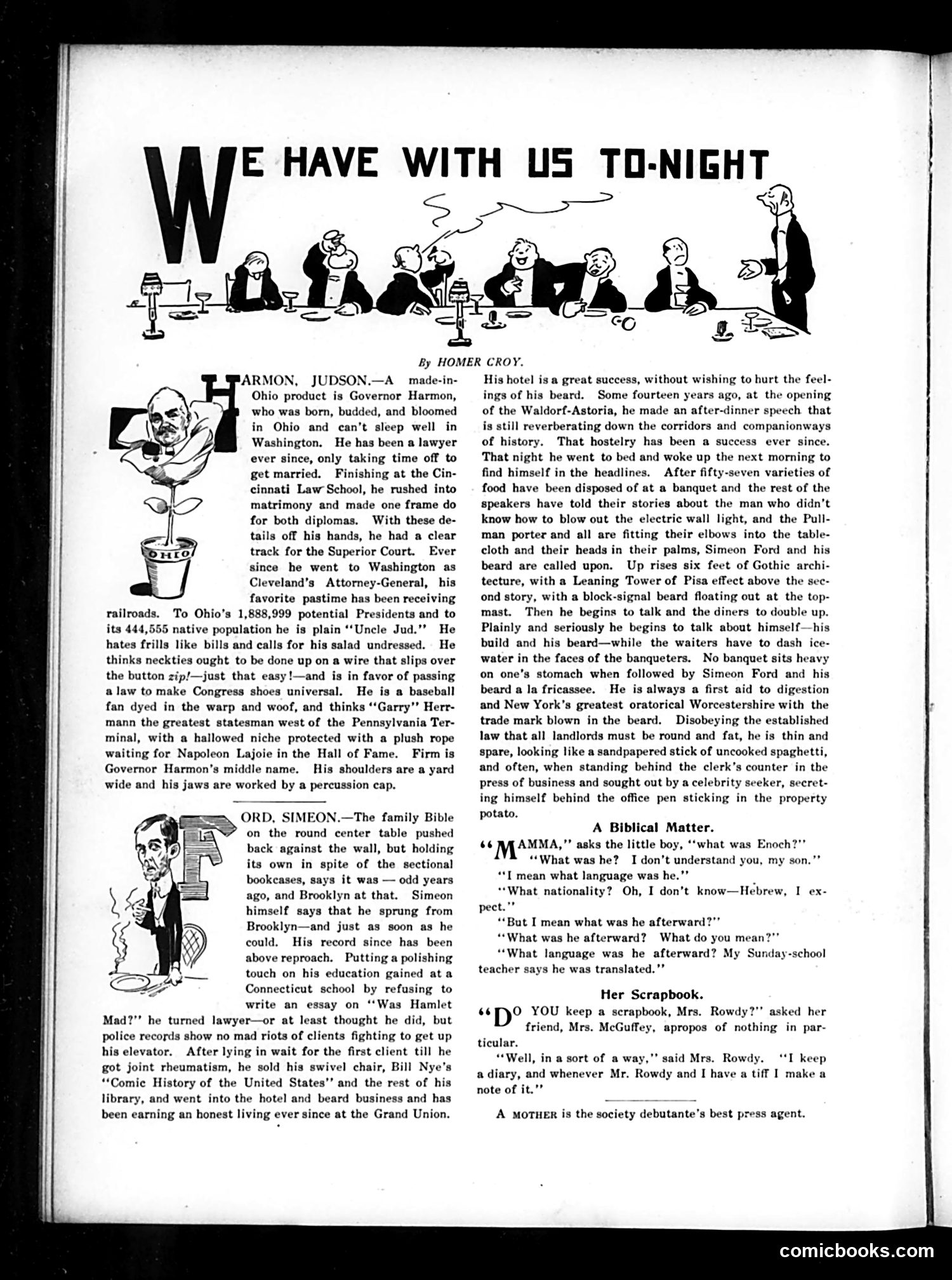
This is a satirical profile page from *Judge* magazine featuring two prominent figures: **Governor Harmon** (top): A caricature of Ohio Governor James Harmon, depicted as an unpretentious politician who dislikes formality (opposes neckties and fancy food). The satire mocks his plainness while crediting his success—he's beloved in Ohio and admired for his legal career and baseball fandom. The caricature is affectionate rather than cutting. **Simeon Ford** (bottom): A New York hotel owner and raconteur famous for his after-dinner speeches. The satire celebrates his wit and distinctive appearance (his remarkable beard). The piece humorously describes how his comic speeches at fancy banquets provide digestive relief to diners. Both profiles use exaggeration and witty wordplay to poke gentle fun at these public figures' quirks and reputations. The humor relies on readers' familiarity with these men—Harmon as a potential presidential candidate, Ford as a noted personality in New York society.
📄 Transcribed text from this page (OCR, searchable)
Machine-transcribed from the original scan — historical spelling and the odd misread are preserved.
By HOMER CROY. IARMON, JUDSON.—A_ made-in- Ohio product is Governor Harmon, who was born, budded, and bloomed in Ohio and can’t sleep well in Washington. He has been a lawyer ever since, only taking time off to get married. Finishing at the Cin- cinnati Law School, he rushed into matrimony and made one frame do for both diplomas. With these de- tails off his hands, he had a clear track for the Superior Court. Ever since he went to Washington as Cleveland’s Attorney-General, his favorite pastime has been receiving railroads. To Ohio’s 1,888,999 potential Presidents and to its 444,555 native population he is plain ‘Uncle Jud.’” He hates frills like bills and calls for his salad undressed. He thinks neckties ought to be done up on a wire that slips over the button zip/—just that easy!—and is in favor of passing a law to make Congress shoes universal. He is a baseball fan dyed in the warp and woof, and thinks ‘“‘Garry’’ Herr- mann the greatest statesman west of the Pennsylvania Ter- minal, with a hallowed niche protected with a plush rope waiting for Napoleon Lajoie in the Hall of Fame. Firm is Governor Harmon's middle name. His shoulders are a yard wide and his jaws are worked by a percussion cap. ORD, SIME on the round center table pushed back against the wall, but holding its own in spite of the sectional bookcases, says it was — odd years IN.—The family Bible ago, and Brooklyn at that. Simeon himself says that he sprung from Brooklyn—and just as soon as he could. His record since has been above reproach. Putting a polishing touch on his education gained ata Connecticut school by refusing to write an essay on ‘‘Was Hamlet Mad?"’ he turned lawyer—or at least thought he did, but police records show no mad riots of clients fighting to get up his elevator. After lying in wait for the first client till he got joint rheumatism, he sold his swivel chair, Bill Nye's “Comic History of the United States’’ and the rest of his library, and went into the hotel and beard business and has been earning an honest living ever since at the Grand Union. His hotel is a great success, without wishing to hurt the feel- ings of his beard. Some fourteen years ago, at the opening of the Waldorf-Astoria, he made an after-dinner speech that is still reverberating down the corridors and companionways of history. That hostelry has been a success ever since. That night he went to bed and woke up the next morning to find himself in the headlines. After fifty-seven varieties of food have been disposed of at a banquet and the rest of the speakers have told their stories about the man who didn’t know how to blow out the electric wall light, and the Pull- man porter and all are fitting their elbows into the table- cloth and their heads in their palms, Simeon Ford and his beard are called upon. Up rises six feet of Gothic archi- tecture, with a Leaning Tower of Pisa effect above the sec- ond story, with a block-signal beard floating out at the top- mast. Then he begins to talk and the diners to double up. Plainly and seriously he begins to talk about himself—his build and his beard—while the waiters have to dash ice- water in the faces of the banqueters. No banquet sits heavy on one’s stomach when followed by Simeon Ford and his beard a la fricassee. He is always a first aid to digestion and New York’s greatest oratorical Worcestershire with the trade mark blown in the beard. Disobeying the established law that all landlords must be round and fat, he is thin and spare, looking like a sandpapered stick of uncooked spaghetti, and often, when standing behind the clerk’s counter in the press of business and sought out by a celebrity seeker, secret- ing himself behind the office pen sticking in the property potato. A Biblical Matter. oe AMMA,” asks the little boy, ‘‘what was Enoch?"’ “‘What was he? I don’t understand you, my son.”’ ““T mean what language was he.”” “What nationality? Oh, I don’t know—Hebrew, I ex- pect."” “‘But I mean what was he afterward?" “‘What was he afterward? What do you mean?"" “What language was he afterward? My Sunday-school teacher says he was translated.”” Her Scrapbook. oe D° YOU keep a scrapbook, Mrs. Rowdy?"’ asked her friend, Mrs. McGuffey, apropos of nothing in par- ticular. “Well, in a sort of a way,'’ said Mrs. Rowdy. ‘‘I keep adiary, and whenever Mr. Rowdy and I have a tiff I make a note of it."” A MOTHER is the society debutante’s best press agent. comicbooks.com