
Judge, 1911-01-21 · page 8 of 24
Judge — January 21, 1911 — page 8: what you’re looking at
What you’re looking at
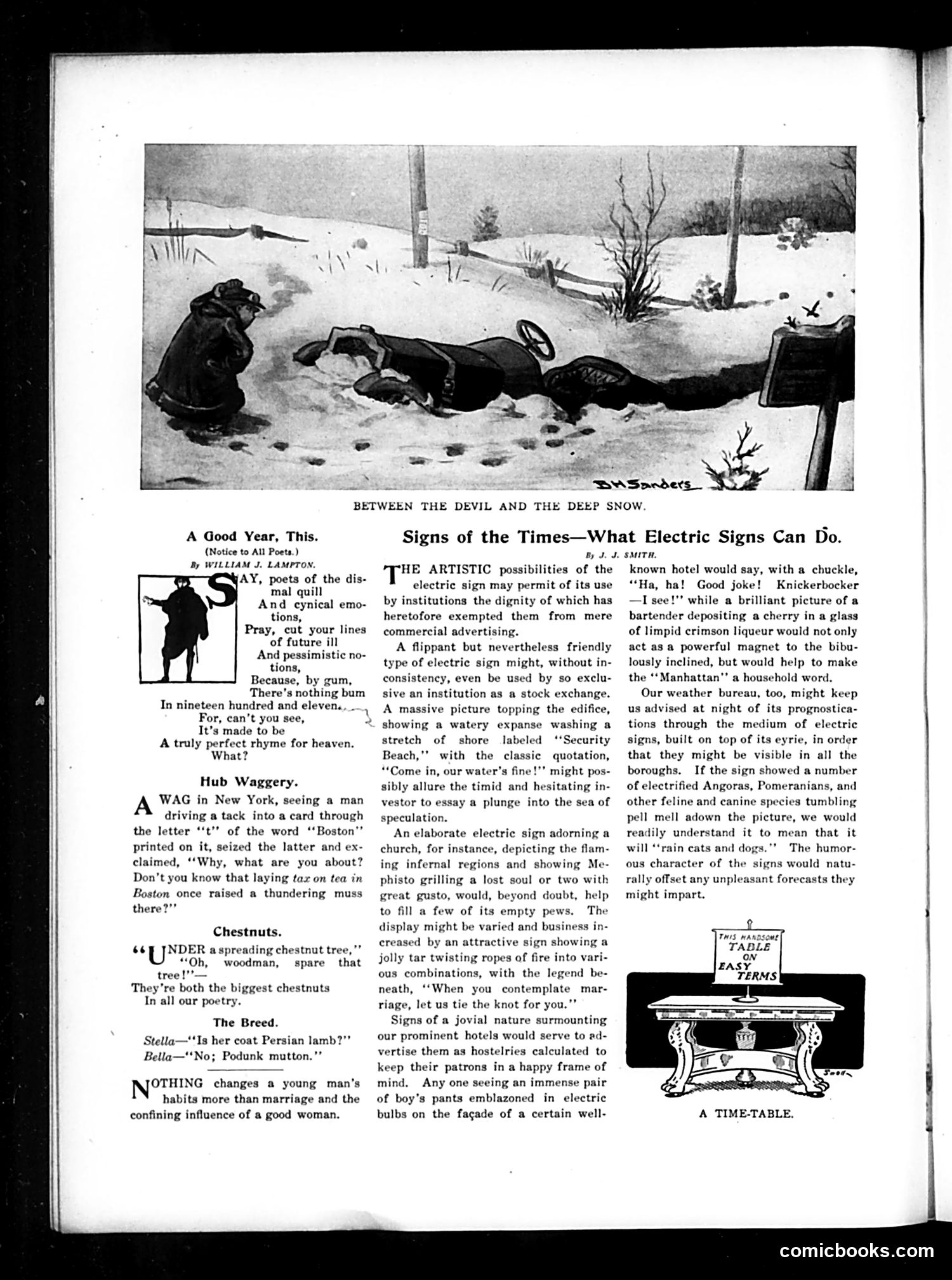
**Top Illustration:** "Between the Devil and the Deep Snow" depicts a car accident in winter—a figure lies in the snow beside an overturned vehicle. The title suggests being trapped between two dire alternatives, likely satirizing the dangers of early automobiles. **Text Content:** The page contains several humor pieces and one substantial article on electric signage. The "Good Year" poem celebrates 1911 optimistically. Brief jokes mock outdated poetry ("Under the Spreading Chestnut Tree"), Boston's colonial tax history, and courtship. **Main Article—"Signs of the Times":** J.J. Smith satirizes how electric signs (newly available technology) could humorously advertise traditionally dignified institutions. He proposes absurd applications: churches advertising with images of hell, stock exchanges with "Security Beach" signs luring investors, hotels advertising with giant electric pants, and weather bureaus displaying "raining cats and dogs" literally. The satire mocks both the commercialization of serious institutions and the literalness of electric advertising. This represents early-20th-century skepticism toward rapid commercialization and new technology.
📄 Transcribed text from this page (OCR, searchable)
Machine-transcribed from the original scan — historical spelling and the odd misread are preserved.
A Good Year, This. (Notice to All Poets.) By WILLIAM J. LAMPTON. AY, poets of the dis- =~ mal quill And cynical emo- tions, Pray, cut your lines of future ill And pessimistic no- tions, Becau: y There’s nothing bum In nineteen hundred and eleven. For, can’t you see, It’s made to be A truly perfect rhyme for heaven. What? Hub Waggery. WAG in New York, seeing a man driving a tack into a card through the letter ‘‘t’’ of the word ‘‘Boston"’ printed on it, seized the latter and ex- claimed, ‘Why, what are you about? Don't you know that laying taz on tea in Boston once raised a thundering muss there?” Chestnuts. “ee UN2EE aspreading chestnut tree,”” “Oh, woodman, spare that tree! They’re both the biggest chestnuts In all our poetry. The Breed. ‘Is her coat Persian lamb?’ No; Podunk mutton." OTHING changes a young man’s habits more than marriage and the confining influence of a good woman. 1 Pe a WOE BETWEEN THE DEVIL AND THE DEEP SNOW. A} Signs of the Times—What Electric Signs Can Do. By J. J. SMITH. HE ARTISTIC possibilities of the electric sign may permit of its use by institutions the dignity of which has heretofore exempted them from mere commercial advertising. A flippant but nevertheless friendly type of electric sign might, without in- consistency, even be used by so exclu- sive an institution as a stock exchange. A massive picture topping the edifice, showing a watery expanse washing a stretch of shore labeled ‘‘Security Beach,’’ with the classic quotation, “Come in, our water’s fine!’? might po: sibly allure the timid and hesitating in- vestor to essay a plunge into the sea of speculation. An elaborate electric sign adorning a church, for instance, depicting the flam- ing infernal regions and showing Me- phisto grilling a lost soul or two with great gusto, would, beyond doubt, help to fill a few of its empty pews. The display might be varied and business in- creased by an attractive sign showing a ing ropes of fire into vari- jolly tar twi ous combinations, with the legend be- neath, ‘‘When you contemplate mar- riage, let us tie the knot for you."’ Signs of a jovial nature surmounting our prominent hotels would serve to ad- vertise them as hostelries calculated to keep their patrons in a happy frame of mind. Any one seeing an immense pair of boy’s pants emblazoned in electric bulbs on the fagade of a certain well- known hotel would say, with a chuck “Ha, ha! Good joke! Knickerbocker —I see!"' while a brilliant picture of a bartender depositing a cherry in a glass of limpid crimson liqueur would not only act as a powerful magnet to the bibu- lously inclined, but would help to make the ‘‘Manhattan"’ a household word. Our weather bureau, too, might keep us advised at night of its prognostica- tions through the medium of electric signs, built on top of its eyrie, in order that they might be visible in all the boroughs. If the sign showed a number of electrified Angoras, Pomeranians, and other feline and canine species tumbling pell mell adown the picture, we would readily understand it to mean that it will ‘train cats and dogs."" | The humor- ous character of the signs would natu- rally offset any unpleasant forecasts they might impart. A TIME-TABLE. comicbooks.com