
A complete issue · 24 pages · 1910
Judge — December 24, 1910
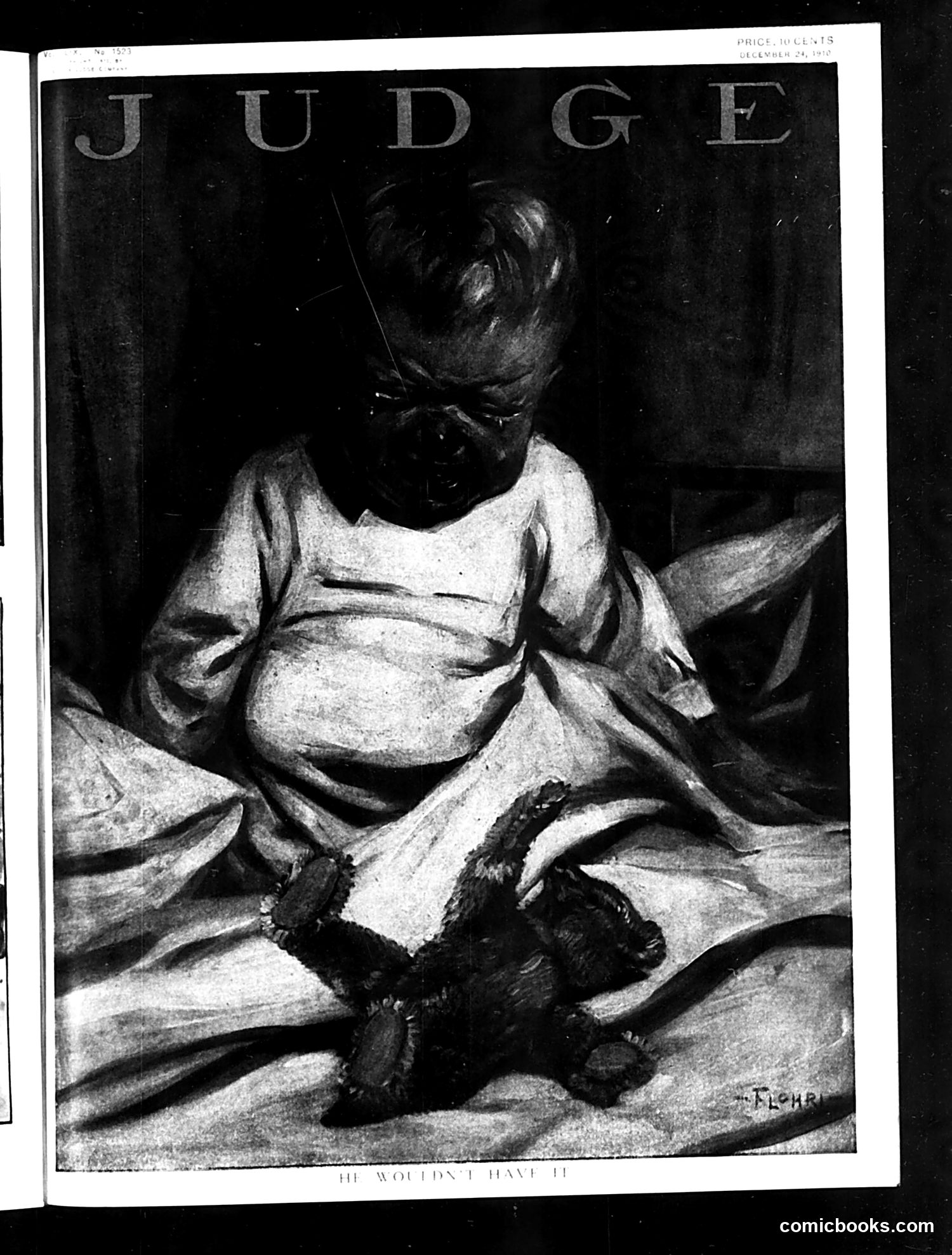
This appears to be a satirical cartoon titled "If I Wouldn't Have It," showing a well-dressed child with a small dark animal (likely a monkey or ape). The image seems to reference racial or ethnic caricature prevalent in early-to-mid 20th century American satire, though the specific political or social commentary is unclear without additional context about the magazine's date and surrounding articles. The child's dismissive pose suggests commentary on American attitudes toward something foreign or "other." The signature appears to read "Flohr," crediting the illustrator. Without the magazine's date or accompanying text beyond the caption, I cannot definitively identify which specific political event or social debate this satirizes, though it clearly reflects the prejudices of its era.
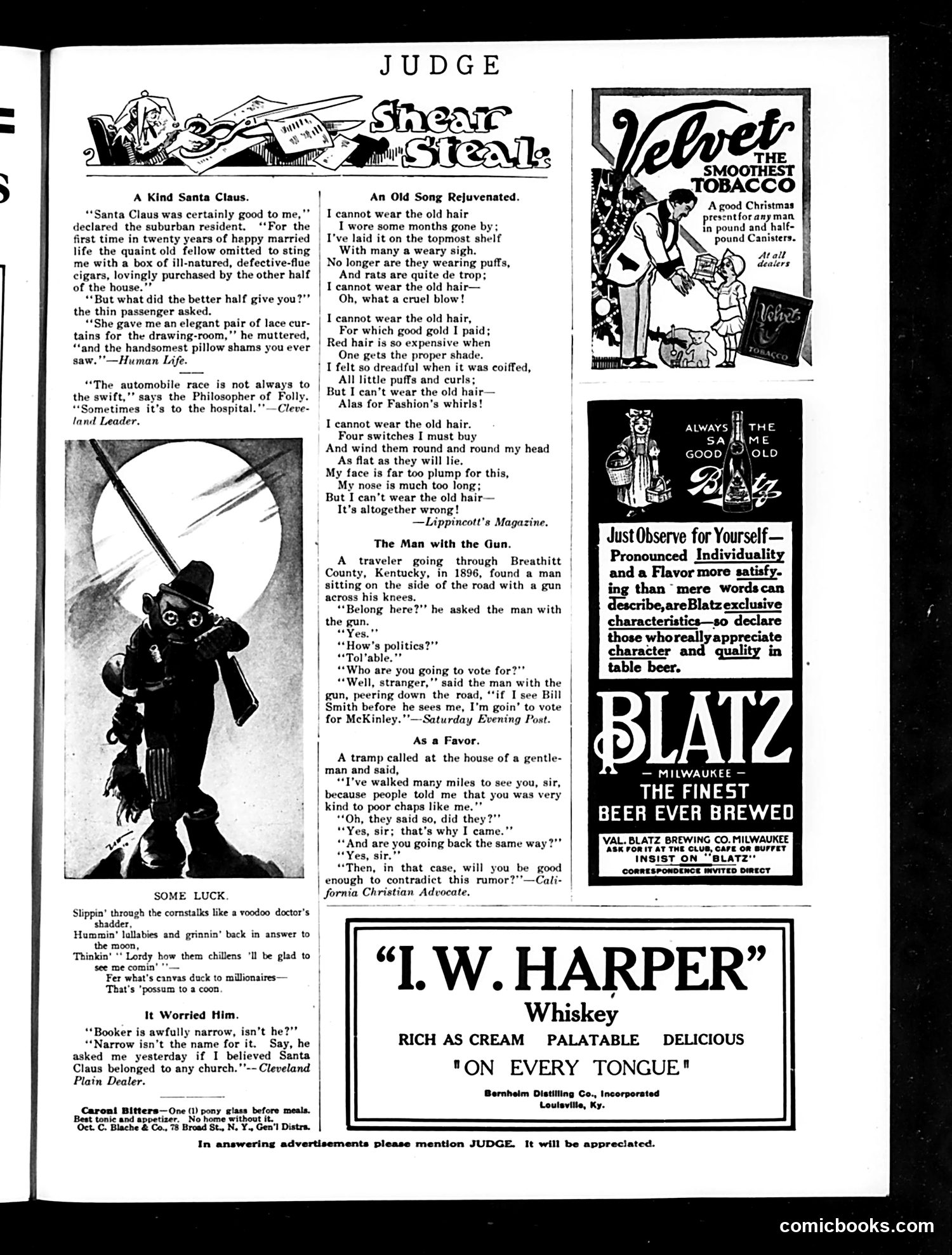
This page is primarily **advertising and humor columns** rather than political cartoons. The main content includes: 1. **"Shear Steal"** — A humor section with anecdotes about domestic life and social observations, including jokes about fashion (women's hair styles) and political behavior. 2. **"Some Luck"** — A cartoon showing a figure with a gun, illustrating a humorous anecdote about a traveler's encounter in 1896 Kentucky involving gun ownership and political voting intentions (voting for McKinley). 3. **Advertisements** for Velvet tobacco, Blatz beer, and I.W. Harper whiskey dominate the right side. The humor reflects early 1900s American domestic comedy and political references (McKinley presidency era), but lacks specific satirical targeting of identifiable public figures. The cartoons are general-interest humor rather than sharp political commentary.
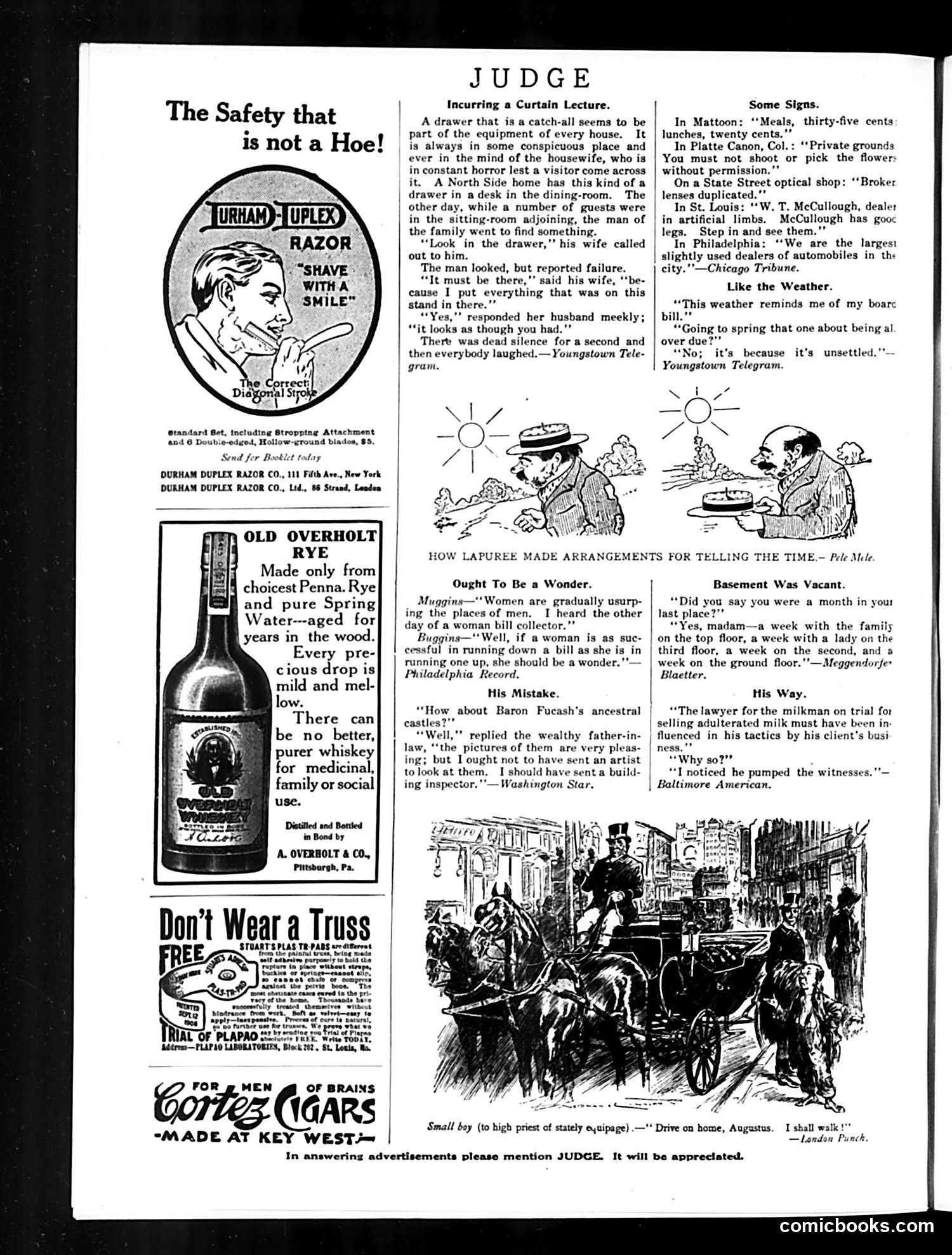
This page is primarily **advertisements and humor columns** rather than political cartoons. The main content includes: **Advertisements:** Durham Duplex Razors, Old Overholt Rye whiskey, a truss device, and Cortez Cigars dominate the layout. **Humor Sections:** The "Judge" column contains brief anecdotes and jokes about domestic life, social observations, and mishaps—typical of early 20th-century American humor magazines. Topics include a catch-all drawer, bill collectors, and ancestral portraits. **Illustration:** A street scene showing a carriage, priest, and boy contains the caption about walking home—likely a mild joke about religious observance or social propriety. The page reflects **everyday middle-class concerns** of the era: household organization, feminine competence, and social etiquette. No specific political figures or events are referenced.
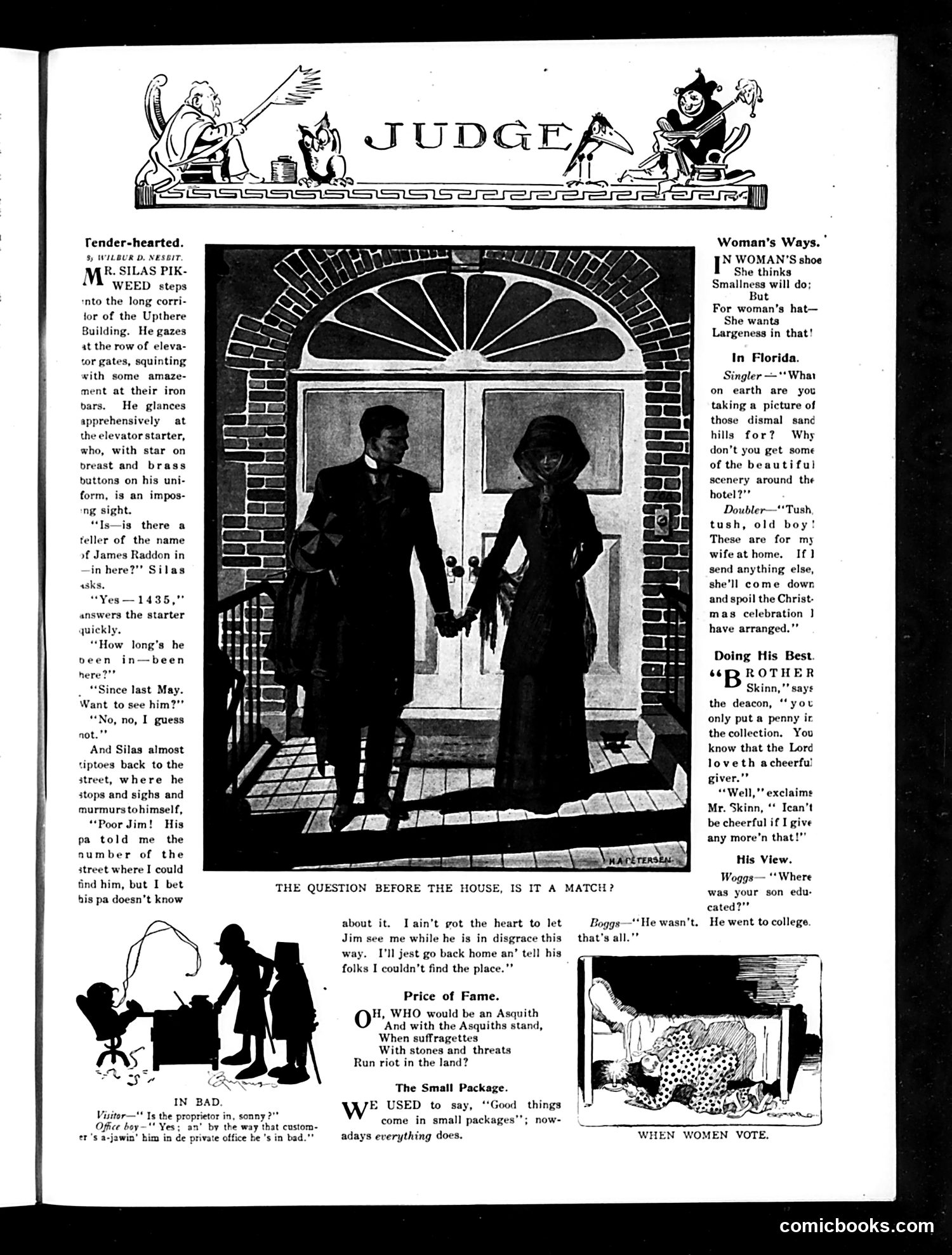
This page satirizes women's suffrage and voting rights through multiple cartoons and commentary. **"The Question Before the House"** (main image): Shows a couple at a doorway, likely debating whether their relationship constitutes a "match" (marriage). The satire suggests that women voting undermines traditional domestic arrangements. **"Woman's Ways"** (right column): Mocking commentary on women's supposed frivolousness—their concern with shoe and hat sizes—implying they're unfit for serious civic participation. **"When Women Vote"** (bottom right): Depicts a woman in bed, suggesting female voters are lazy or incompetent. **"In Bad"** and other snippets mock women's activism around suffrage and women's rights movements of the era (likely early 1900s). The overall message: Judge magazine opposed women's suffrage, using humor to portray female voters as ridiculous, trivial, or dangerous to society.
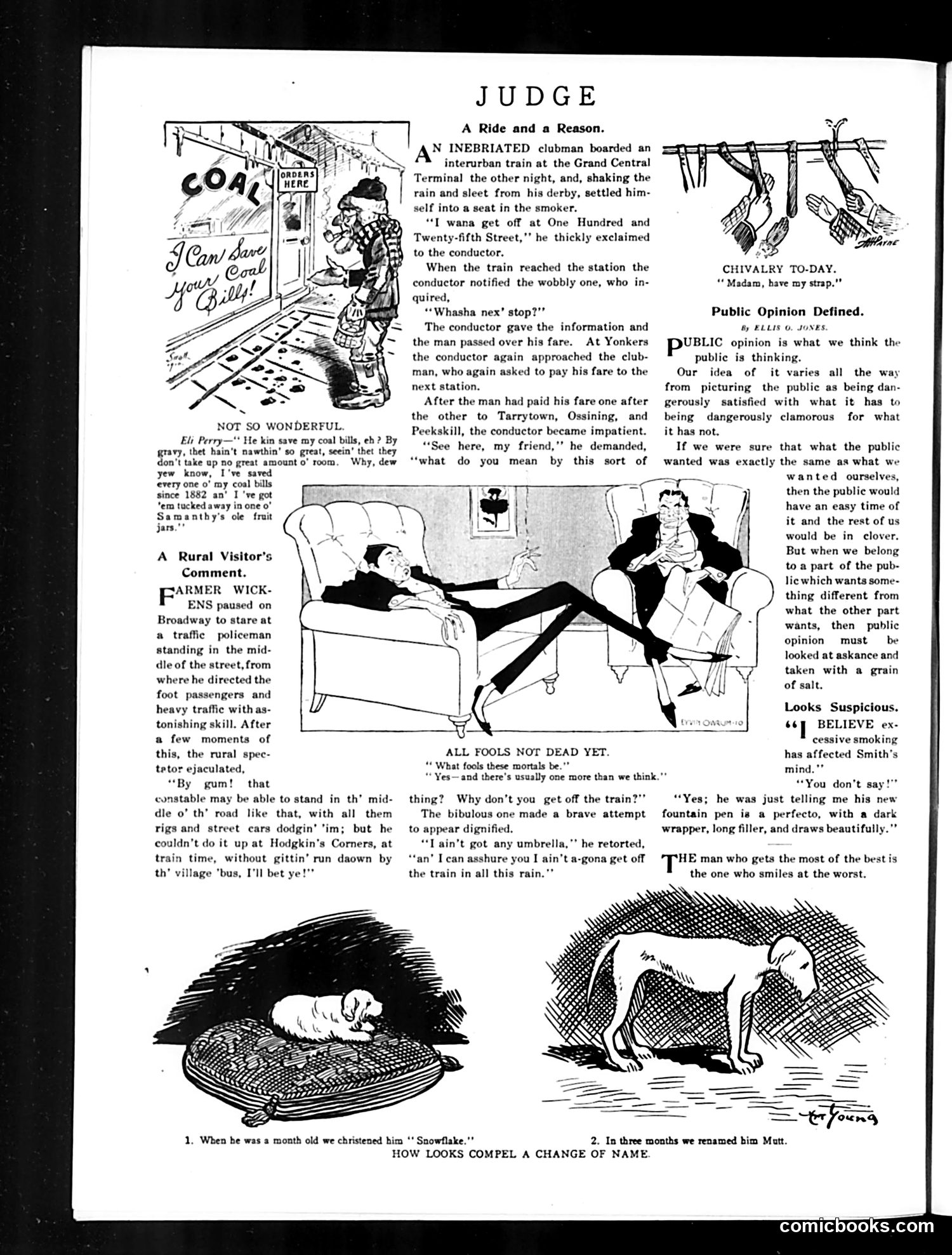
This page contains several satirical pieces typical of early 20th-century American humor: **"A Ride and a Reason"** mocks a drunk clubman repeatedly paying fares on an interurban train, unable to comprehend he's already paid for continuous travel. The conductor's exasperation satirizes the absurdity of willful obtuseness. **"A Rural Visitor's Comment"** presents a farmer amazed by urban traffic control, unable to imagine such coordination possible in rural areas—poking fun at rural naiveté about city sophistication. **"Public Opinion Defined"** offers cynical commentary: public opinion is merely what we *think* the public thinks, often contradicting our own interests. This critiques the gap between perceived and actual public sentiment. **"How Looks Compel a Change of Name"** (bottom) shows a dog christened "Snowflake" (white/fluffy) who transforms into "Matt" (implying darker coloring)—a visual gag about appearance determining identity. The overall tone reflects Judge's characteristic blend of social observation and light mockery of human folly, urban/rural contrasts, and pretension.
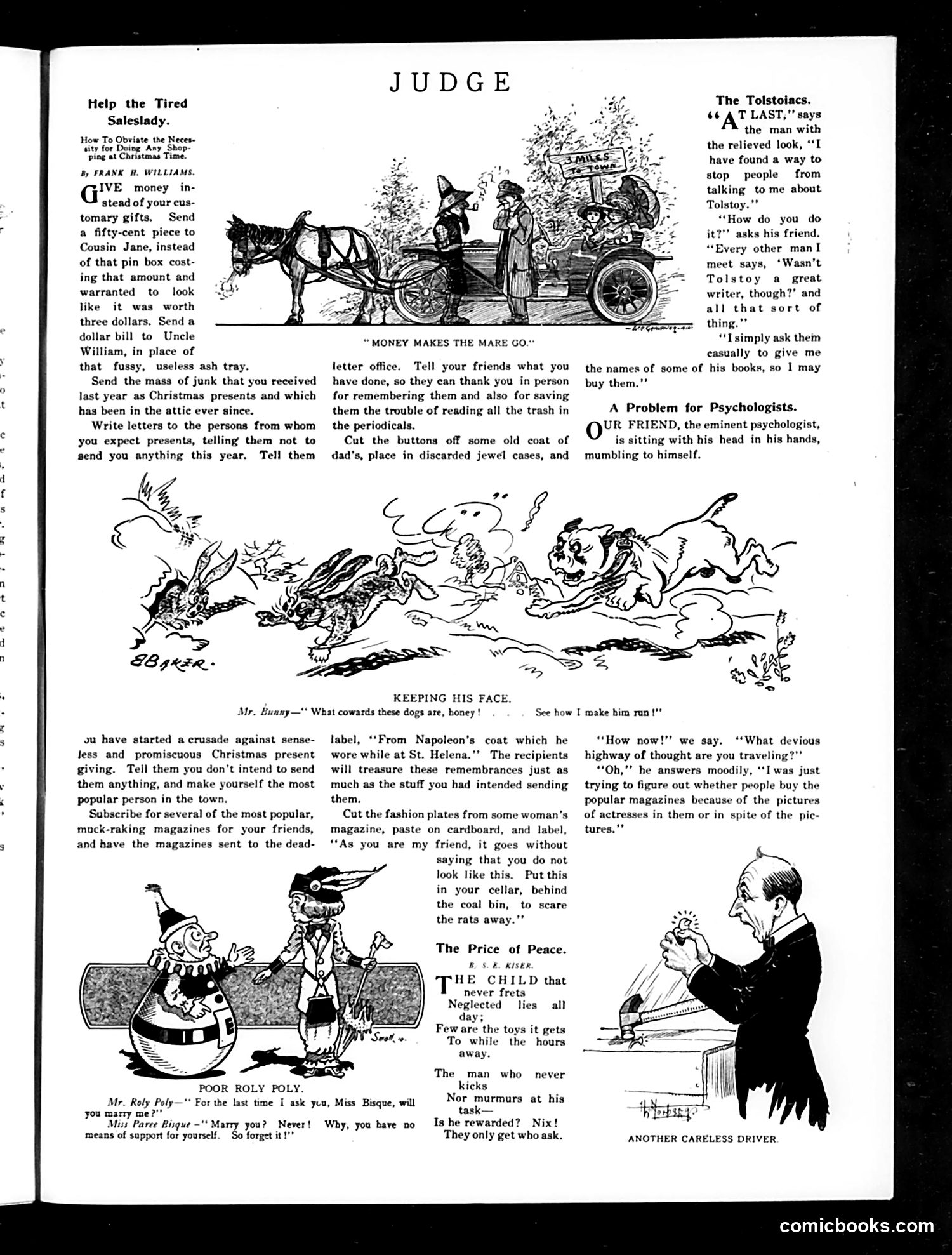
This page contains several satirical pieces typical of Judge's humor: **"Help the Tired Saleslady"** mocks wasteful Christmas gift-giving by suggesting alternatives: send money instead of trinkets, regift old junk from your attic, or give fake "gifts" like fashion plates or buttons labeled as Napoleon's coat. The satire targets both consumer excess and the burden placed on retail workers during holidays. **"The Tolstoiacs"** jokes about the pretentious intellectuals of the era who constantly discuss Leo Tolstoy. The solution: ask them to name his books—they can't, exposing their superficial posturing. **"The Price of Peace"** presents the cynical view that only those who demand rewards receive them; the humble and patient get nothing. **"Another Careless Driver"** shows a distracted motorist, likely referencing early automobile accidents caused by inattention. **"A Problem for Psychologists"** humorously asks whether magazine readers buy them for pictures of actresses or *despite* them—poking fun at both readers' motivations and psychological analysis itself. The cartoons employ Judge's typical approach: satirizing contemporary consumer culture, intellectual pretension, and modern anxieties.
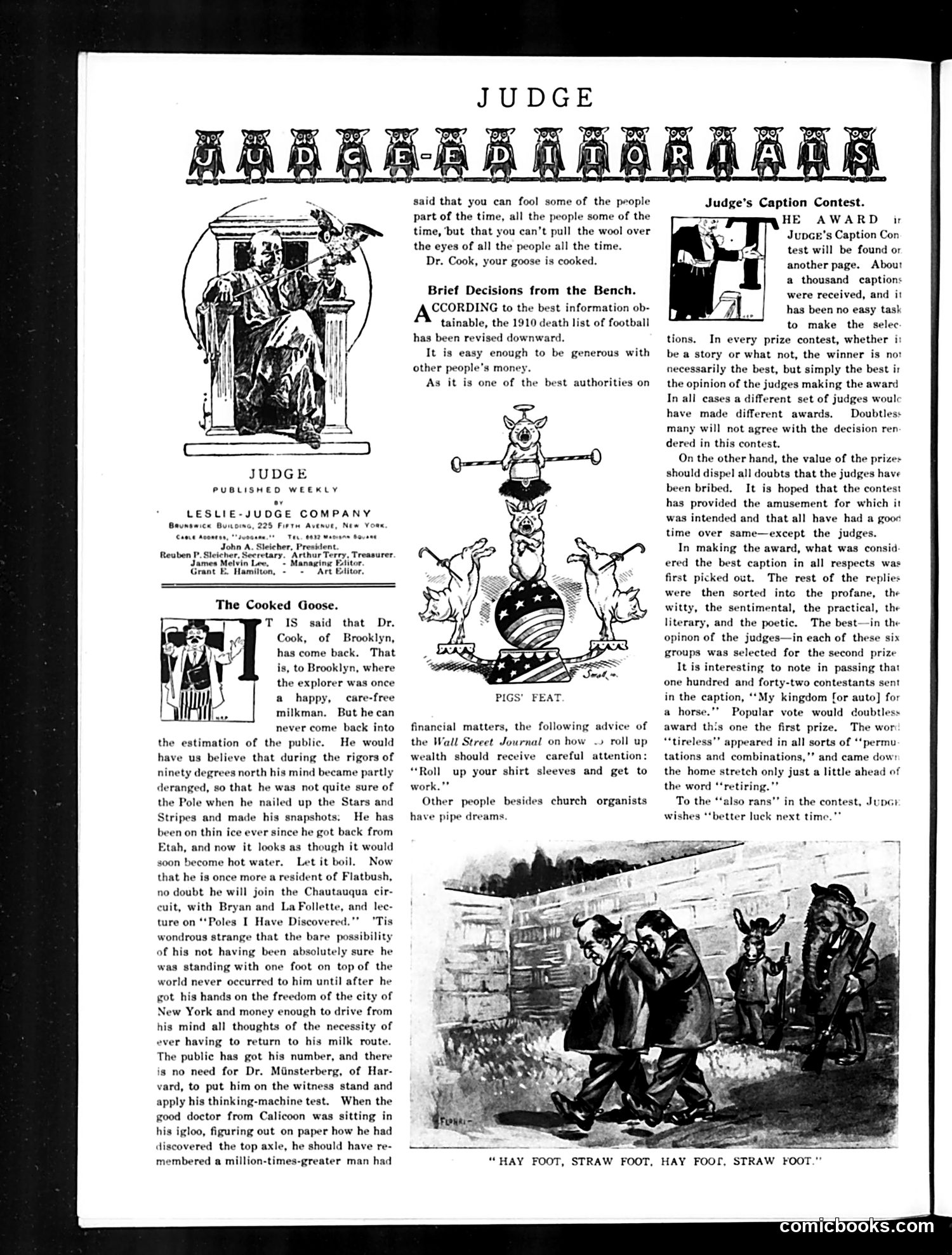
This page contains satirical commentary on **Dr. Frederick Cook**, the Arctic explorer whose 1909 claim to have reached the North Pole was disputed. The main article, "The Cooked Goose," mocks Cook's credibility after he returned to his hometown of Brooklyn, New York. The satire targets Cook's implausible excuse that his mind became "deranged" during the expedition, causing uncertainty about actually reaching the Pole—an explanation the writer finds transparently dishonest. Judge suggests Cook only voiced doubts after profiting from his fame and the city's honors. The piece references Lincoln's quote about fooling people, insinuating Cook underestimated public skepticism. The page also includes brief satirical "decisions," a caption contest announcement, and an illustration captioned "Hay Foot, Straw Foot"—likely referencing Civil War marching cadences, though its specific context here is unclear. This represents Judge's typical role: wealthy-audience political and social satire targeting public figures and contemporary scandals.
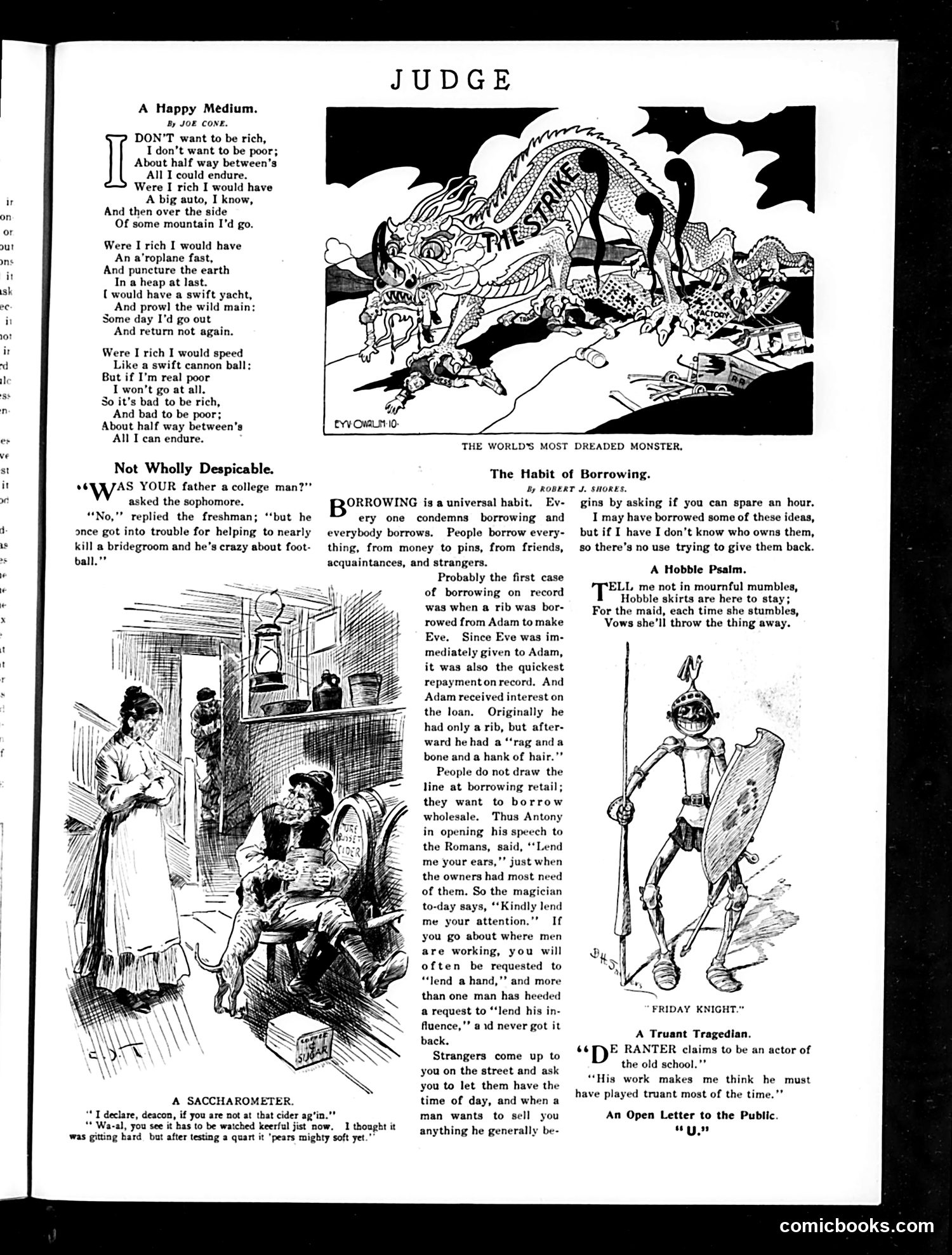
This page from Judge presents early 20th-century American social satire through multiple pieces: **"A Happy Medium"** satirizes the newly wealthy and their dangerous leisure pursuits. The poet argues that riches lead to reckless death—fancy automobiles driving off mountains, airplanes crashing, yachts disappearing. Poverty at least prevents such spectacular demises. It's commentary on how industrial-age wealth enabled dangerous novelties (early automobiles, aviation) that killed the careless rich. **"The Habit of Borrowing"** humorously traces borrowing from Adam's rib through contemporary practice, mocking how people borrow indiscriminately—money, time, attention, influence—rarely returning favors. **"A Hobble Psalm"** jokes about the "hobble skirt," a restrictive 1910s women's fashion so tight at the ankles it severely limited movement. Women supposedly swear they'll discard it each time they stumble. **Minor pieces** include a college humor exchange and theatrical criticism. The overall tone is gentle social observation rather than harsh political attack.
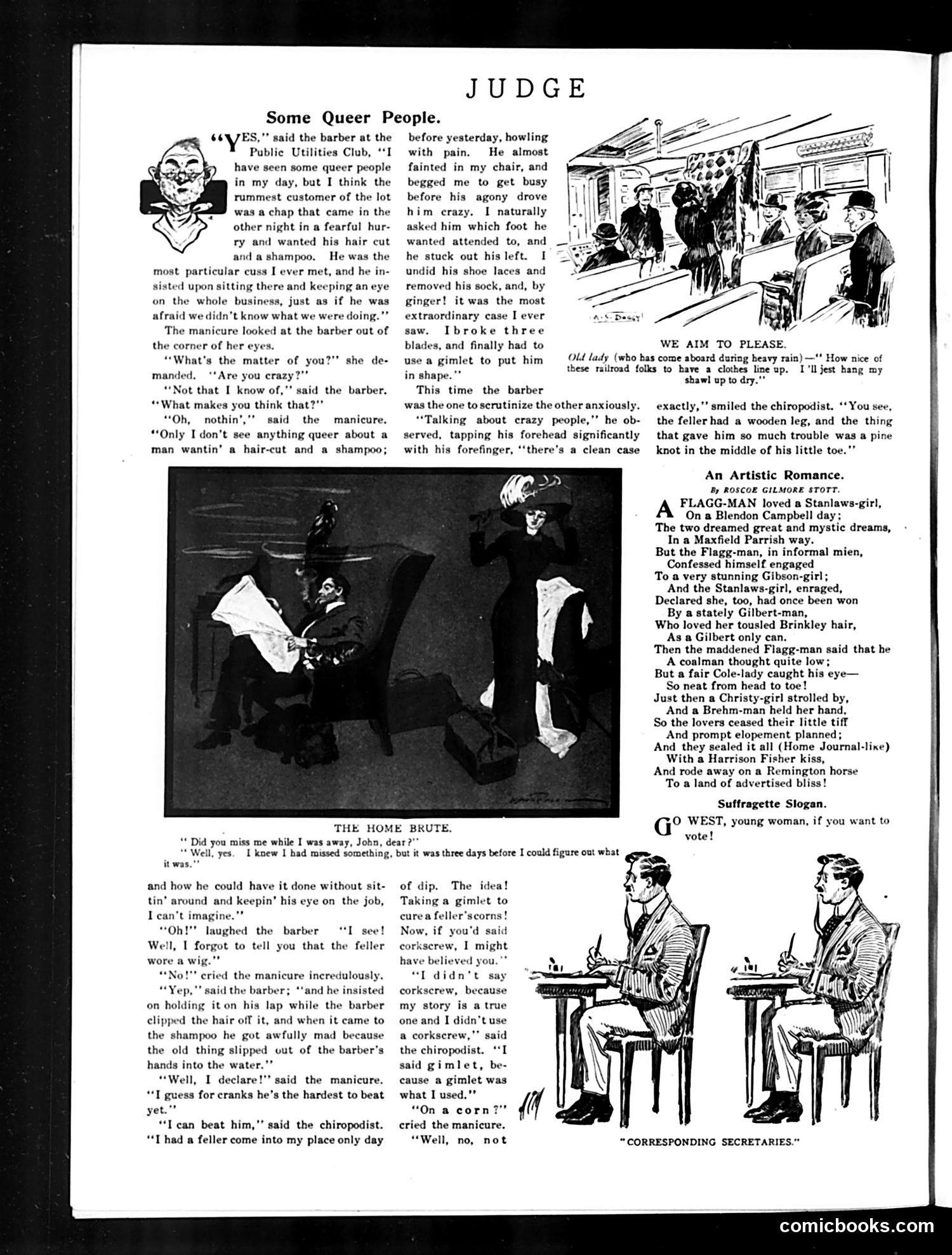
This Judge page presents three unrelated humorous pieces typical of early 20th-century American satire. **"Some Queer People"** features barber-shop workers exchanging anecdotes about eccentric customers—a man obsessively supervising his haircut and a chiropodist's patient with a wooden leg containing a troublesome pine knot. The humor relies on absurdist detail and deadpan delivery. **"The Home Brute"** is a brief domestic comedy about a husband's indifference to his wife's absence, suggesting marital discord. **"An Artistic Romance"** is a poem mocking pretentious aesthetic movements by name-dropping famous illustrators (Gibson, Maxfield Parrish, Christy) as character types. The joke: lovers constantly switch romantic interests based on whatever artistic "type" they encounter, treating people as aesthetic objects rather than individuals. The "Suffragette Slogan" and "Corresponding Secretaries" cartoons appear to mock women's suffrage activism and women's organizations, reflecting Judge's conservative editorial stance of the era.
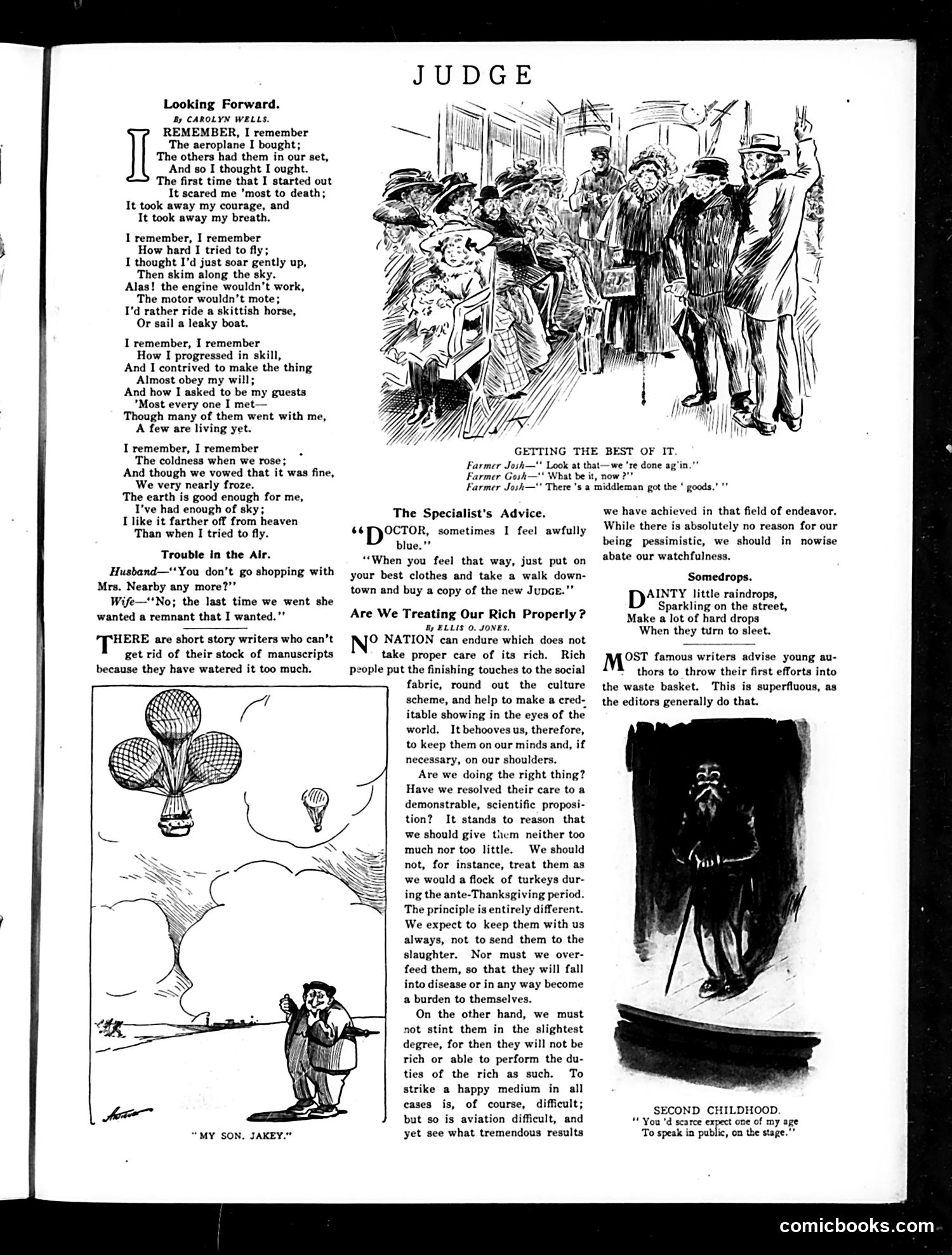
This page from Judge magazine contains multiple satirical pieces mocking early 20th-century American trends and attitudes. **"Looking Forward"** by Carolyn Wells mocks the aviation craze among the wealthy. The poem describes someone who bought an airplane because "others had them in our set"—satirizing status-conscious consumption. The humor lies in the narrator's terrifying experience: the engine fails, it's freezing, and guests invited for rides either died or rarely returned. This reflects real public anxiety about dangerous, experimental aircraft. **"Are We Treating Our Rich Properly?"** offers deadpan satirical advice, arguing the wealthy require careful scientific management—not too much indulgence (like turkeys before Thanksgiving slaughter) nor too little (or they'd lose their "rich" status). This is political satire mocking class inequality and obsequiousness toward the wealthy. **Other pieces** include jokes about domestic disputes, failed writers, and general observations. The cartoons appear to illustrate these themes with early 20th-century domestic and social scenarios, typical of Judge's satirical commentary on contemporary American life and values.
I can see this is a black and white illustration from *Judge* magazine showing what appears to be a dramatic scene with figures in period clothing. However, the OCR text provided is blank or illegible, and the image quality makes it difficult to identify specific individuals or read any captions that might clarify the cartoon's meaning. Without visible text identifying the figures or explaining the satirical context, I cannot reliably determine which political or social issue this cartoon addresses. The style suggests late 19th or early 20th century, and the dramatic staging implies social or political commentary, but I cannot specify what without additional readable information. To properly analyze this cartoon's meaning for a modern reader, I would need either clearer OCR text or visible captions from the original page.
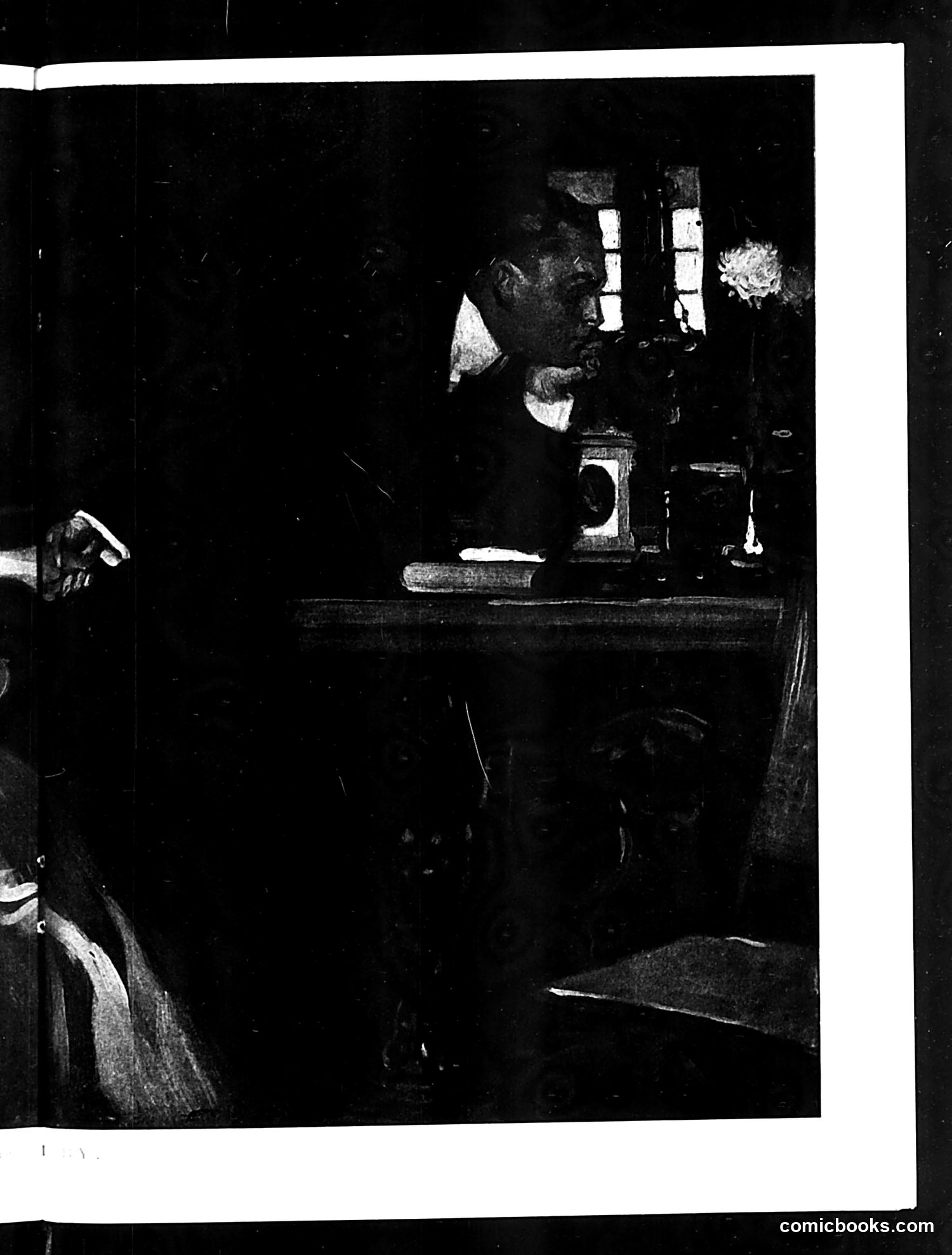
This appears to be a black and white photograph or illustration from *Judge* magazine rather than a traditional cartoon. It shows a man in formal attire (white collar visible) seated at what appears to be a desk or table with some kind of mechanical device or equipment in front of him. Windows are visible in the background, and the lighting creates dramatic shadows typical of early photographic documentation. However, without clearer visibility of identifying details, specific captions, or surrounding text that would explain the political or social commentary, I cannot confidently identify the specific figures, the referenced event, or the satirical point being made. The OCR text only shows "comicbooks.com," providing no contextual information about the page's content or meaning.
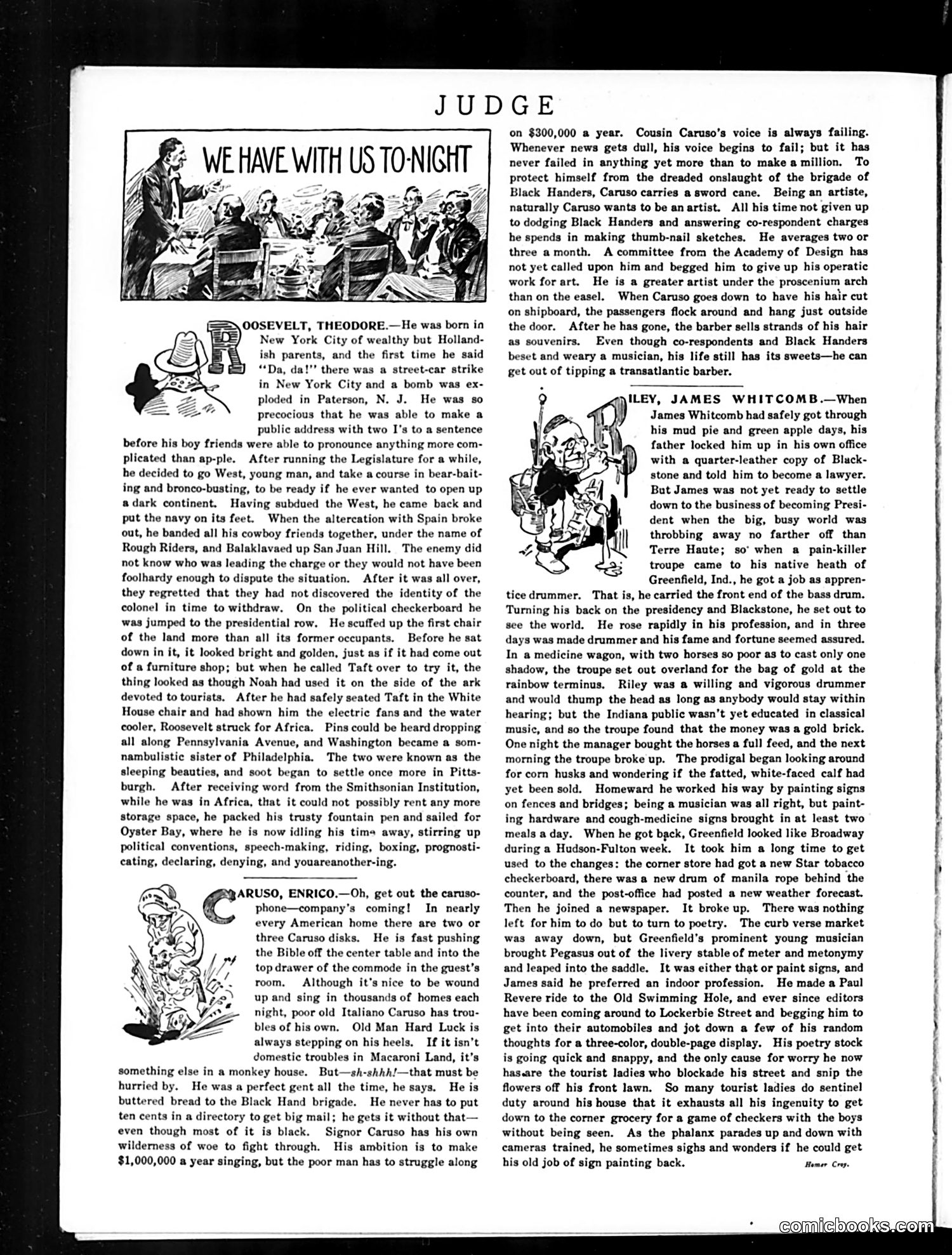
This page contains biographical satirical sketches of prominent figures. The main cartoon "WE HAVE WITH US TO-NIGHT" (top left) depicts a gathering of notable people. **Theodore Roosevelt** receives extended mockery: the text humorously traces his life from precocious child through Western adventures, his Rough Rider leadership in the Spanish-American War, his presidency (where he supposedly roughed up the White House), and his post-presidency African safari. The satire suggests Roosevelt's restless energy and tendency to dominate every situation—even his successor Taft's use of the presidential chair is "worn" by comparison. **Enrico Caruso** (the famous opera singer) is satirized for earning $300,000 yearly while complaining his voice is failing, yet never failing to make money. The text mocks his entanglement with the Black Hand (organized crime), his desire to become a painter, and various personal troubles despite his wealth and success. Both sketches employ Judge's characteristic caustic humor targeting public figures' vanity, contradictions, and outsized ambitions.
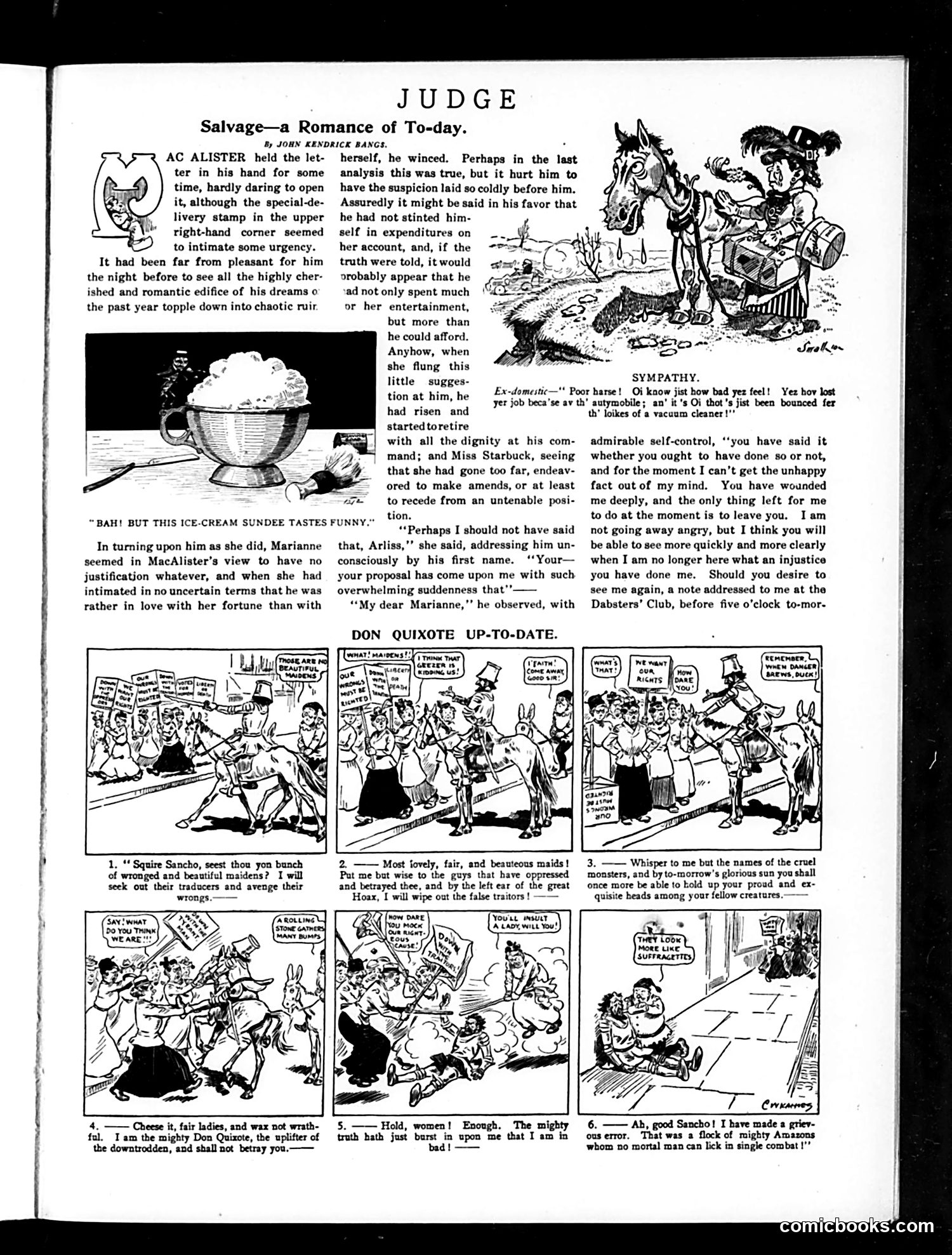
This page contains two distinct pieces: **"Salvage—a Romance of To-day"** is a serialized short story by John Kendrick Bangs about a romantic entanglement. MacAlister proposes to Marianne, who cruelly suggests he loves her money, not her. He leaves in wounded dignity. The ice cream sundae illustration is a humorous aside on the story's romantic pretensions. **"Don Quixote Up-to-Date"** is a comic strip that modernizes Cervantes' classic novel. Sancho directs Don Quixote toward wronged women, framing them as victims of oppressive "guys." When Quixote charges to rescue them, he discovers they're actually "a flock of mighty Amazons"—modern, independent women who don't need rescue. The satire mocks both romantic chivalry and contemporary feminism, suggesting modern women have become too formidable for traditional male heroics. The page's broader theme appears to be satirizing outdated romantic ideals in contemporary America.
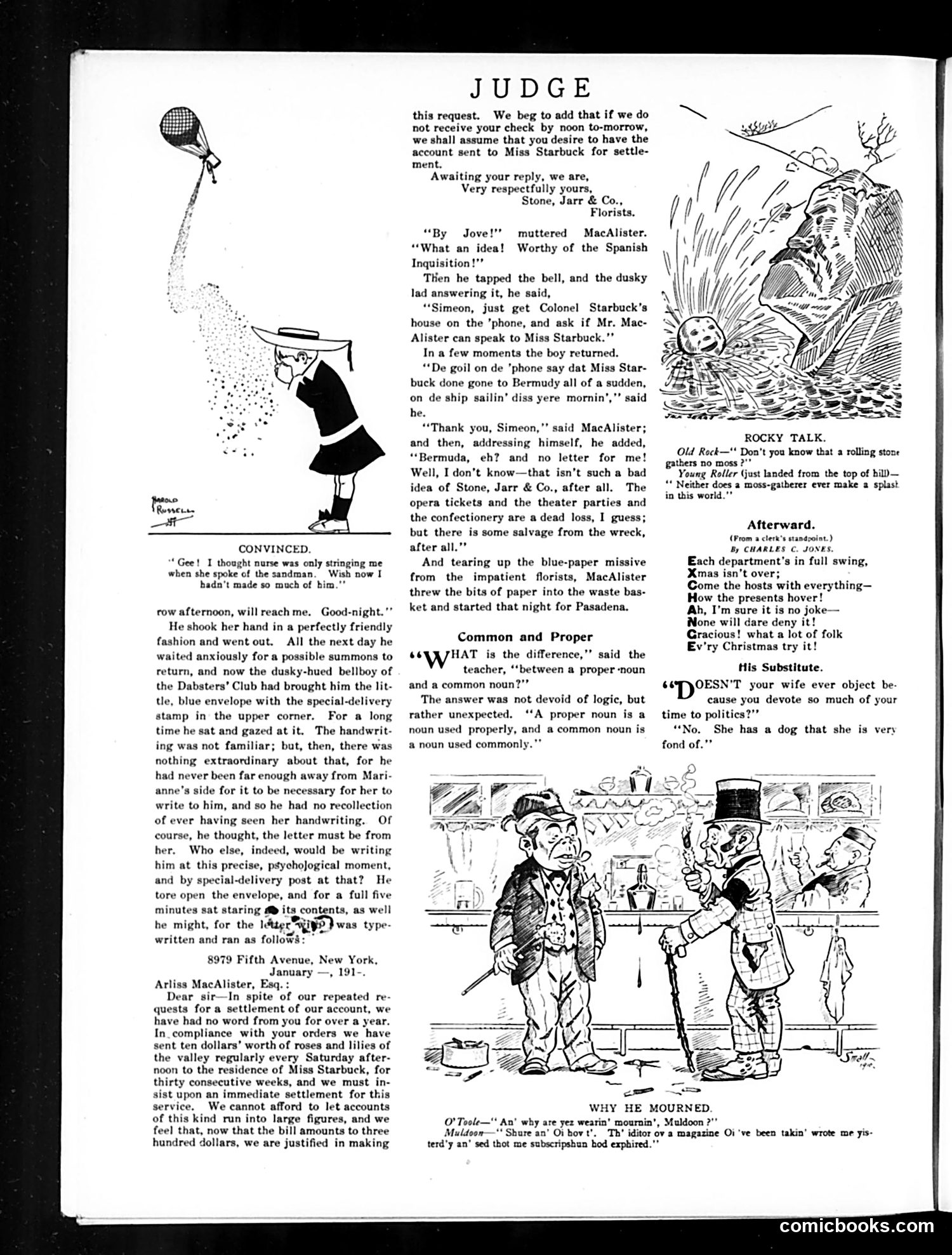
This page contains three separate satirical pieces typical of early 1910s Judge magazine: **"Convinced"**: A romantic comedy about a man who sends expensive flowers to Miss Starbuck for thirty weeks, only to receive a $300 florist bill demanding payment. The joke: Miss Starbuck has fled to Bermuda without leaving him a letter. The man decides to follow her to Pasadena (unclear why the destination changes), suggesting he'll pursue the relationship rather than pay the florists. The satire mocks romantic male persistence and the expensive courting customs of wealthy society. **"Common and Proper"**: A brief school humor piece where a student defines "proper noun" as "a noun used properly" versus "common noun" as "a noun used commonly"—a circular, nonsensical answer that's technically clever but misses the linguistic point. Light educational satire. **"Rocky Talk" and "Why He Mourned"**: Brief joke captions pairing illustrations with working-class humor and domestic comedy. The page reflects upper-class romantic courtship rituals and period conventions of gender, wealth, and social aspiration.
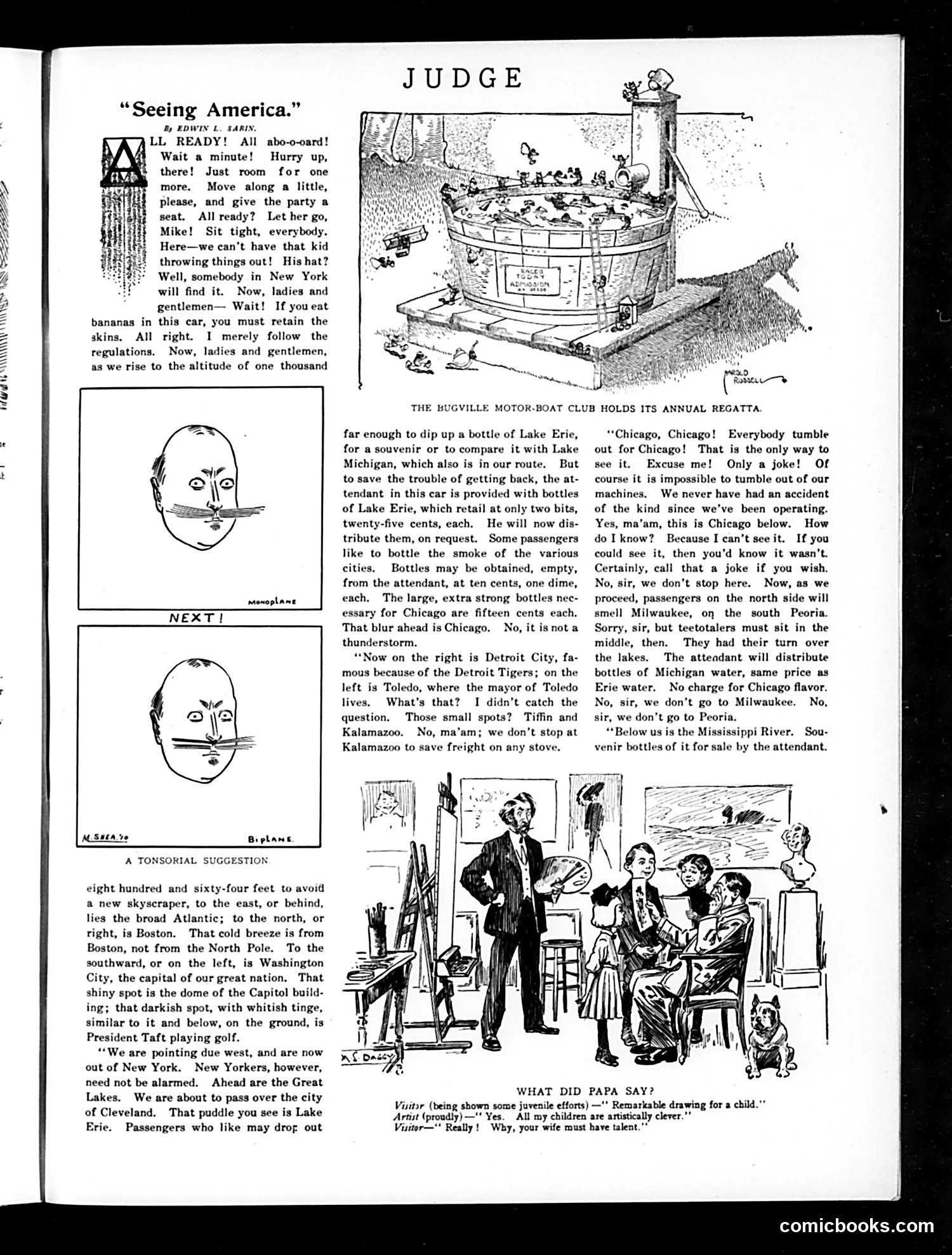
This Judge magazine page satirizes early 1910s airplane tourism and tour-guide culture. The main piece, "Seeing America," mocks the breathless hype around sightseeing flights—a new luxury experience. A tour guide delivers absurdly overwrought commentary about mundane sights (Lake Erie, Detroit, Chicago) while passengers can buy bottled city "flavors" as souvenirs, a joke about commercializing experience. The satire targets both the pretentiousness of the tour industry and tourists themselves. The guide's claim that Chicago is invisible because "you can't see it" is comedic nonsense masquerading as sophistication. A smaller cartoon shows a caricature with an exaggerated protruding lower lip (labeled "A Tonsorial Suggestion"—mocking a hairstyle). The bottom cartoon, "What Did Papa Say?," jokes that a child's artistic talent must come from the mother, not the father—a gendered insult implying the father lacks any creative ability. All content lampoons contemporary American attitudes about technology, tourism, and gender roles.
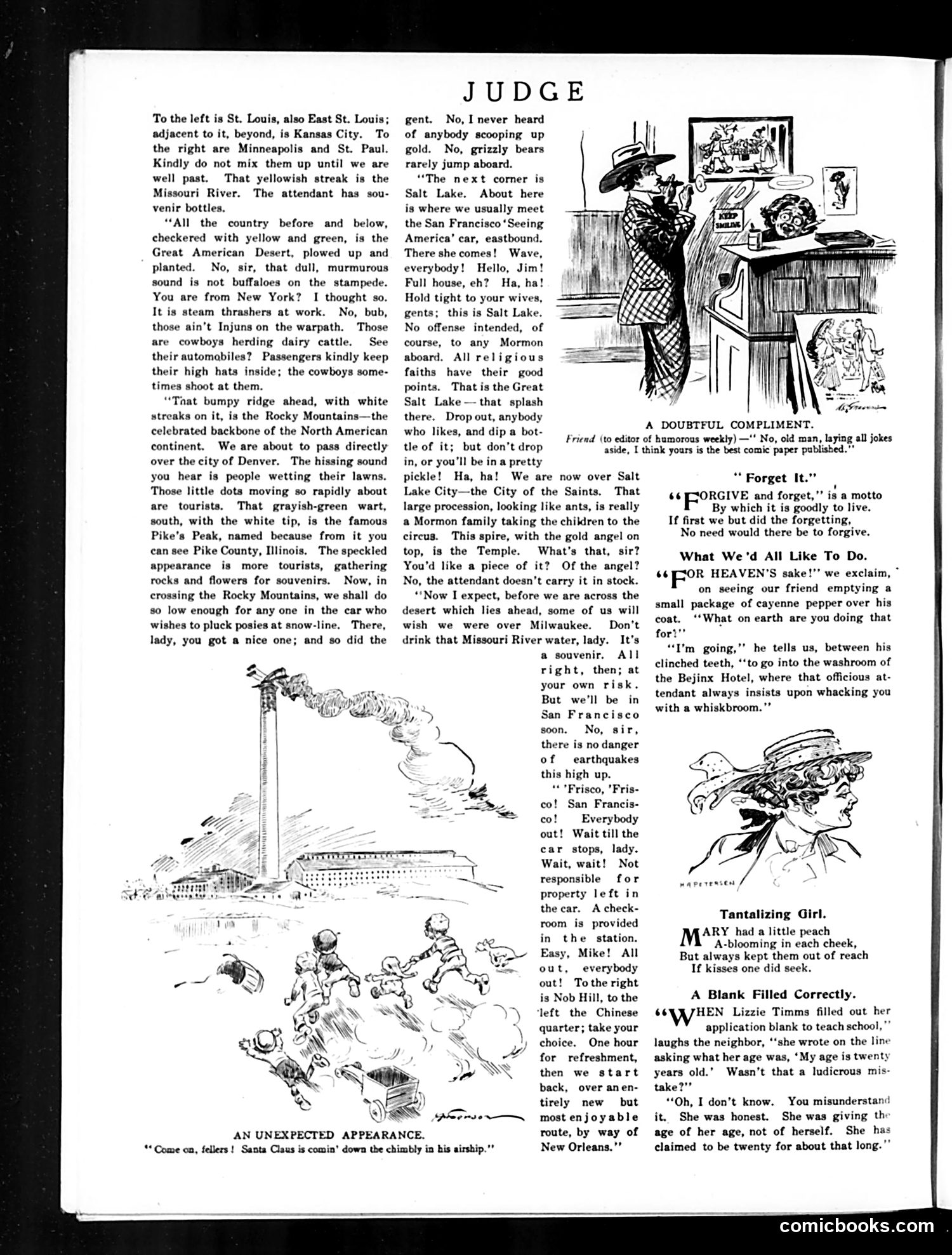
This Judge magazine page satirizes the tourist experience of early 20th-century America, specifically airship travel across the continent. **The Main Cartoon:** An airship guide delivers patronizing commentary to Eastern passengers, mocking their ignorance about the West. He dismisses romantic myths—no buffalo stampedes, no gold-scooping, no attacking bears—revealing the region's actual transformation into industrial farmland and Mormon settlements. The guide's condescension peaks at Salt Lake City, where he makes an off-color joke about Mormon polygamy ("hold tight to your wives"). **The Satire:** The humor targets both tourists' naive expectations and Western stereotypes. The crowded guide treats passengers like children, repeatedly correcting their misconceptions while remaining intentionally crude about Mormons and Chinese immigrants. **Supporting Content:** Smaller items mock age-lying women and praise the magazine itself—typical period filler humor. The overall tone reflects 1910s attitudes: civilization has conquered the "Wild West," but regional stereotypes persist.
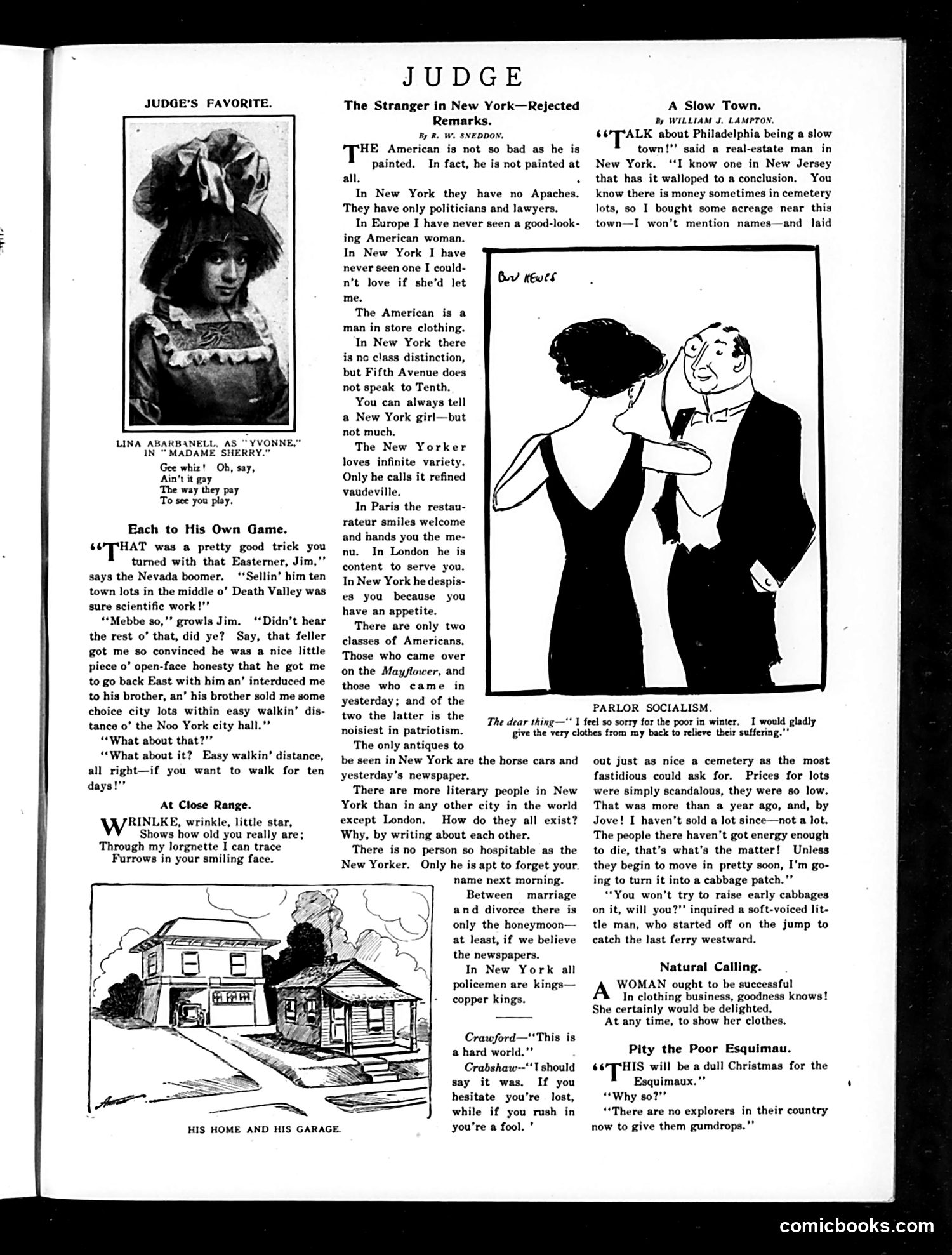
This page from the satirical magazine *Judge* contains several distinct pieces mocking American society circa the early 1900s. **"Judge's Favorite"** is simply promotional material for actress Lina Abarbanell in the Broadway musical *Madame Sherry*. **"Each to His Own Game"** satirizes con artists: a Nevada con man who sold worthless Death Valley lots gets tricked into buying equally worthless New York real estate near City Hall—the humor lies in the ironic reversal. **"The Stranger in New York"** collects pointed observations comparing American character unfavorably to Europeans. The satire targets American pretension, rudeness, and hypocrisy—New Yorkers claim classlessness yet Fifth Avenue ignores Tenth Street; they're hospitable but forget your name; they despise diners for having appetites. **"A Slow Town"** jokes about a New Jersey cemetery so unpopular the developer can't even sell burial plots—mocking both small-town lethargy and real-estate speculation schemes. **"Parlor Socialism"** depicts wealthy philanthropy as performative: a woman boasts of charitable impulses while apparently doing nothing substantive.
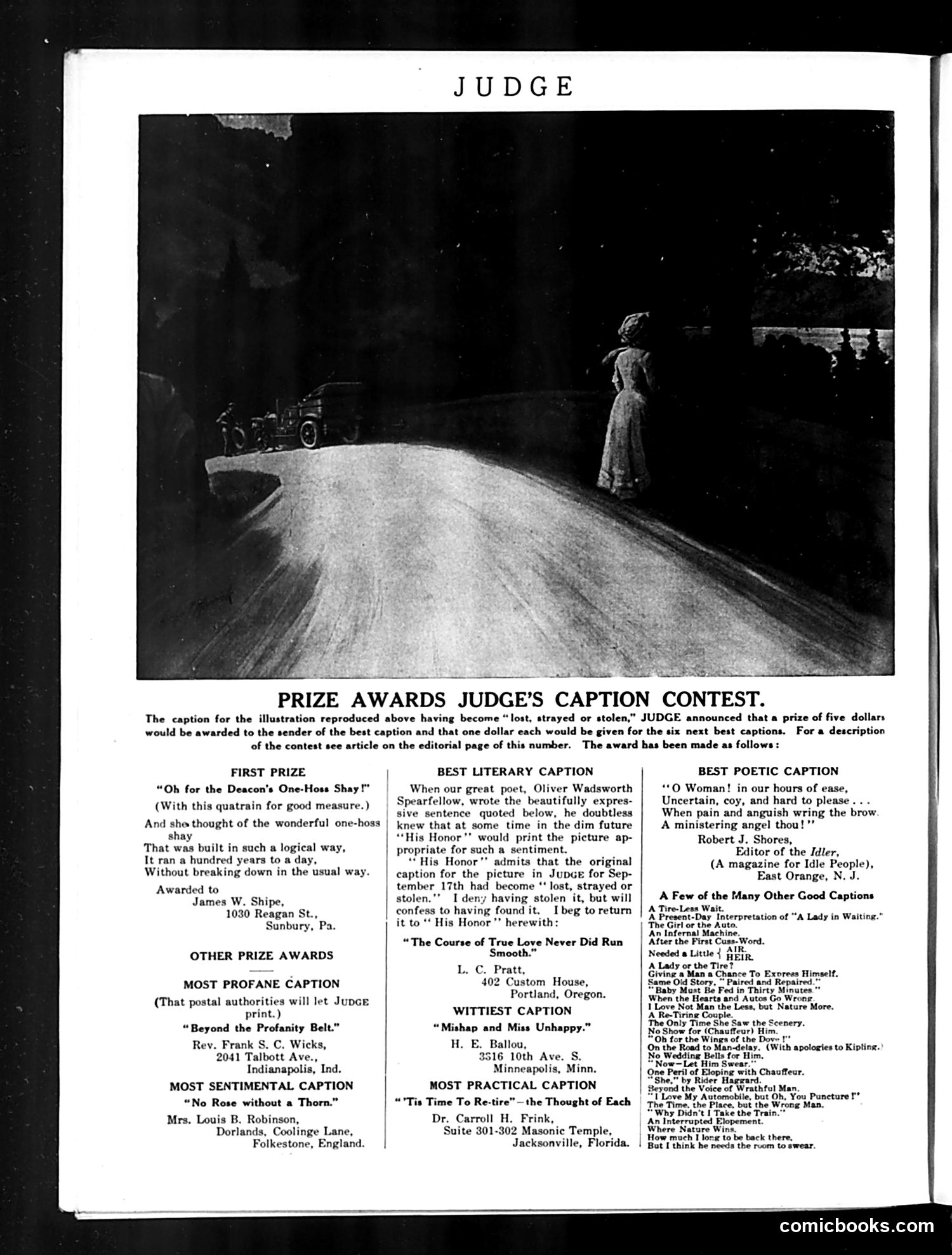
This page reproduces a **caption contest** from Judge magazine. The accompanying illustration (visible at top) shows a woman standing beside a broken-down automobile on a darkened road, with the vehicle's occupant visible. The magazine announced the original caption had been "lost, strayed or stolen" and solicited replacements, awarding prizes for the best submissions across various categories: most literary, wittiest, most practical, most poetic, etc. The winning captions are clever wordplay centered on automobiles and romantic/domestic themes. The first prize references Oliver Wendell Holmes's poem about the "One-Hoss Shay." Other entries pun on "tire," "re-tire," and automotive breakdowns as metaphors for relationships. This reflects early 20th-century anxieties about automobiles as new technology disrupting courtship and family life—a common Judge satire subject. The contest itself was a popular magazine feature of the era, inviting reader participation.
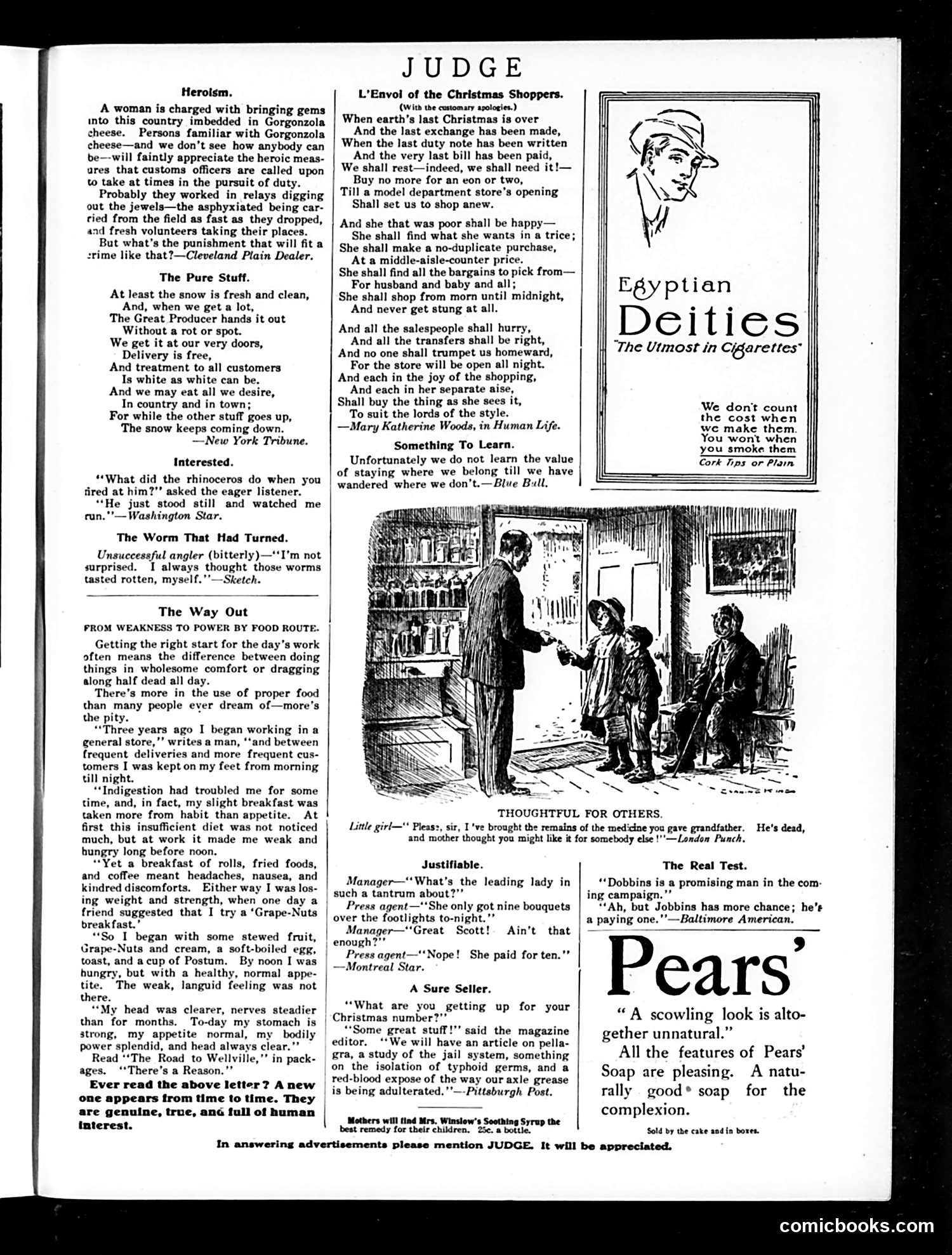
This page from Judge magazine contains satirical short pieces and advertisements rather than political cartoons. The main content includes witty commentary on contemporary issues: **"Heroism"** mocks customs officers forced to inspect Gorgonzola cheese smuggling gems—the joke being the cheese's notoriously pungent odor makes this an absurdly unpleasant duty. **"L'Envoi of the Christmas Shoppers"** parodies women's exhaustion from holiday shopping, imagining a utopian future where stores never close, merchandise is always in stock, and salespeople are always helpful—an obvious satire of actual shopping frustrations. **"The Way Out"** is a Grape-Nuts cereal advertisement disguised as reader testimony about curing indigestion through proper breakfast nutrition—typical early-1900s advertising disguised as advice. The cartoon illustration labeled "Thoughtful for Others" depicts what appears to be a domestic scene with gift-related awkwardness. The page primarily satirizes consumer culture, holiday commercialism, and gender-specific shopping frustrations while mixing in product advertisements typical of Judge's business model.
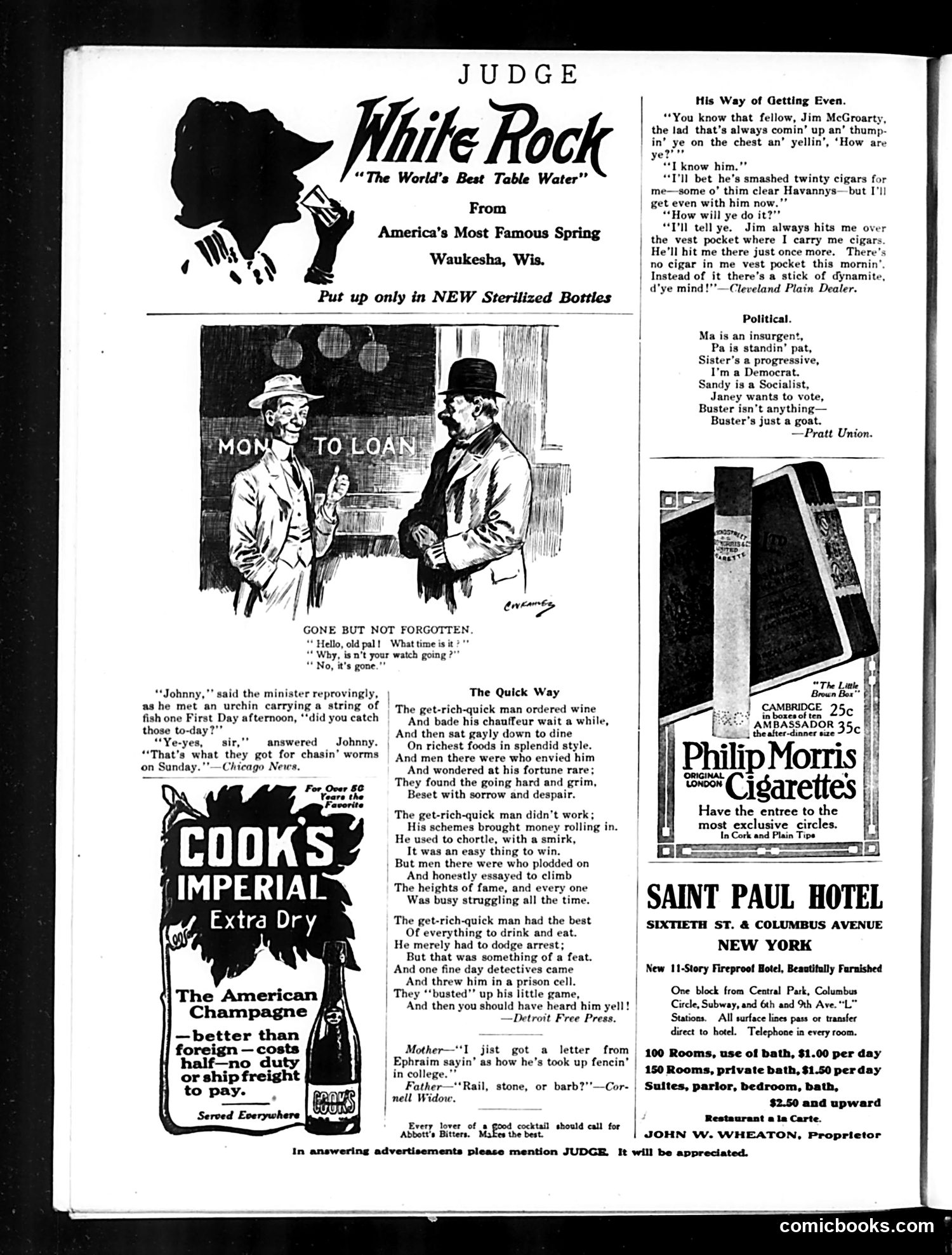
This page is primarily **advertising with interspersed humor content**, typical of Judge's format. The main cartoon ("Gone But Not Forgotten") shows a minister catching a boy fishing on Sunday—a religious observance violation. The joke: the boy admits catching fish on the Sabbath, and the minister warns him God punishes such transgressions. The boy responds that fish got punished for "chasin' worms on Sunday," mocking the minister's piety. Other brief jokes satirize common early-20th-century social types: the "get-rich-quick" scheme promoter who eventually faces arrest; a college student's father misunderstanding "fencing" (swordplay vs. stealing livestock); and family political divisions ("Ma is insurgent, Pa is standin' pat..."). The "Political" verse mocks the era's fractured political landscape—Progressive, Democrat, Socialist movements competing while some citizens remain apathetic ("Buster's just a goat"). The page's bulk comprises product advertisements: White Rock water, Cook's champagne, Philip Morris cigarettes, and the Saint Paul Hotel—representing consumer goods marketed to Judge's upper-middle-class readership.
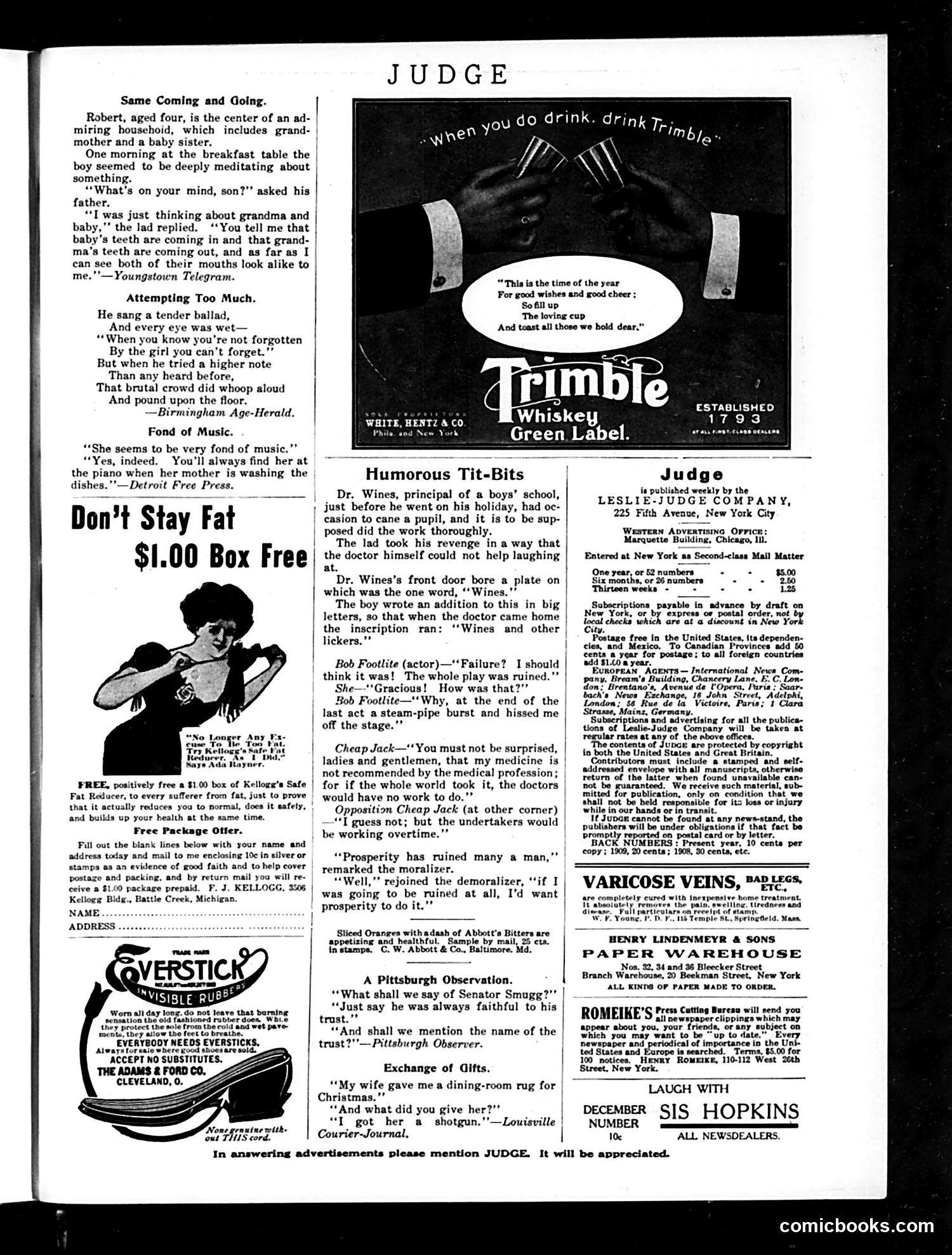
This page from Judge magazine (a satirical publication) contains several brief humorous anecdotes typical of early 20th-century American humor: **"Same Coming and Going"**: A four-year-old observes that his grandmother's teeth are falling out while his baby sister's are coming in—they look the same to him. The joke plays on innocent childhood logic. **"Attempting Too Much"**: A singer moves an audience with a tender ballad, but when attempting a higher note, the crowd's emotional reaction shifts to mockery and floor-pounding. It satirizes fickle audiences or overreach. **"Fond of Music"**: A woman plays piano constantly—but only when her mother is washing dishes, suggesting she avoids housework rather than genuinely loving music. **Dr. Wines anecdotes**: A schoolmaster canes a student; the boy retaliates by adding "and other lickers" to the doctor's nameplate on his door. Separate jokes mock patent medicines and politicians' vague trustworthiness. **"Exchange of Gifts"**: A husband gives his wife a shotgun for Christmas—likely implying marital discord (a common Judge theme). The page is primarily advertising otherwise, with notices for fat-reducing pills and other products.
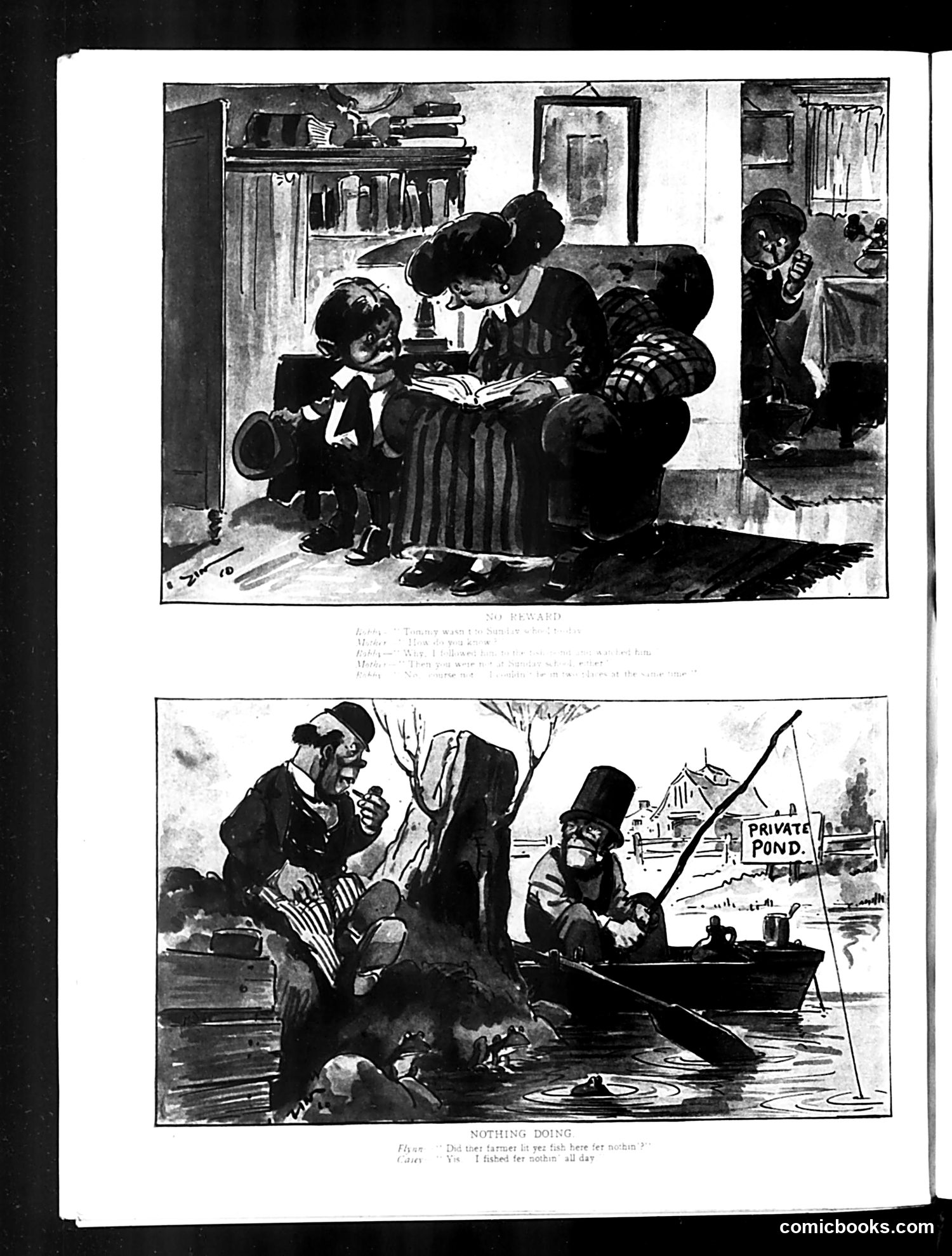
This page contains two satirical cartoons with captions, though the OCR text is too degraded to read clearly. The **top cartoon** ("SO REGARDS") depicts what appears to be a woman reading to children in a domestic interior, likely satirizing education or parenting methods of the era. The **bottom cartoon** ("NOTHING DOING") shows two men in a rowboat at a "PRIVATE POND," apparently fishing unsuccessfully. The satire likely mocks either trespassing on private property, the futility of fishing, or class tensions regarding access to recreational spaces. Both cartoons employ Judge magazine's characteristic style of social commentary through domestic and leisure scenarios. Without clearer text, the specific political or social targets remain unclear, though the imagery suggests critiques of middle-class behavior and pretension typical of Gilded Age satire.