
Judge, 1910-12-24 · page 14 of 24
Judge — December 24, 1910 — page 14: what you’re looking at
What you’re looking at
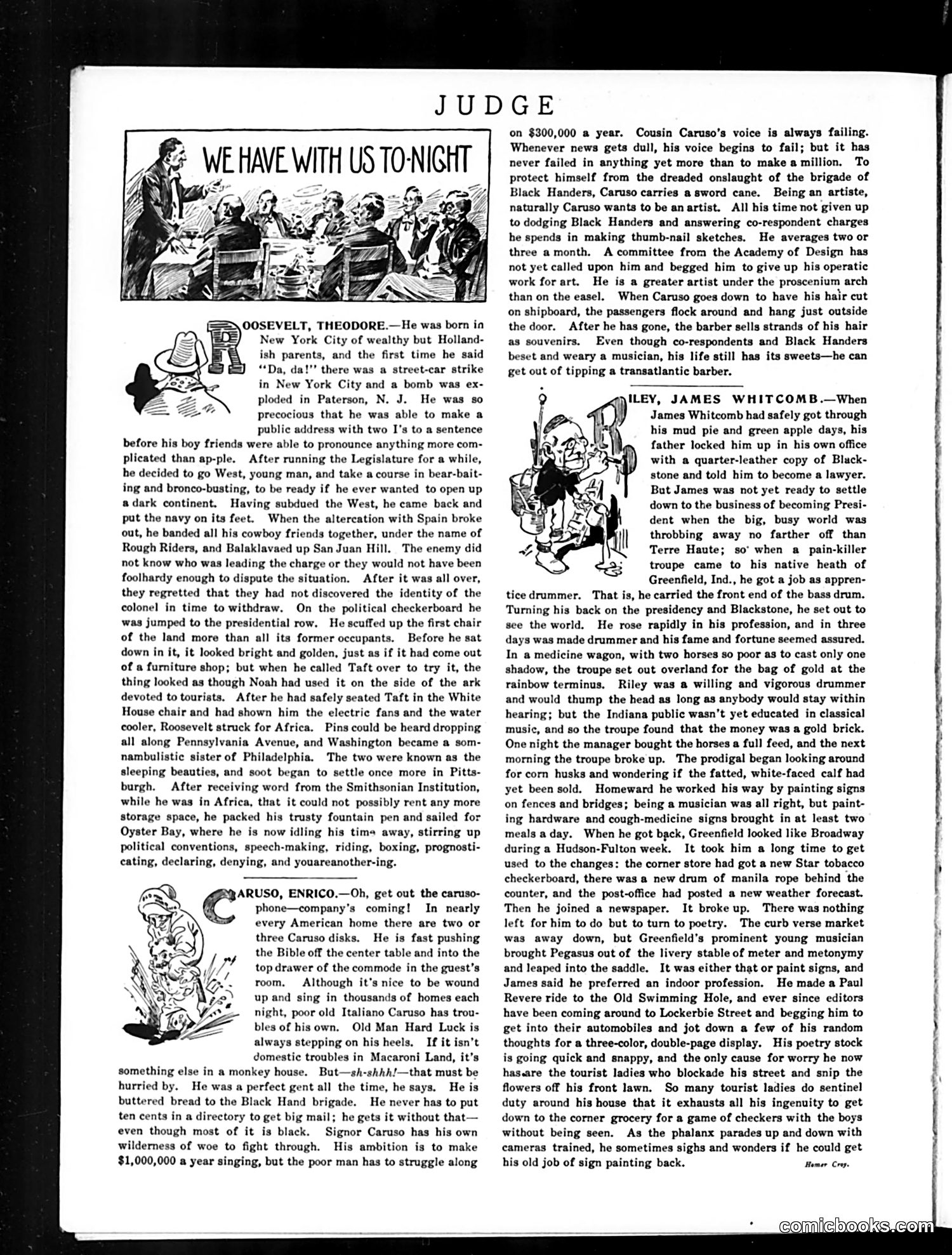
This page contains biographical satirical sketches of prominent figures. The main cartoon "WE HAVE WITH US TO-NIGHT" (top left) depicts a gathering of notable people. **Theodore Roosevelt** receives extended mockery: the text humorously traces his life from precocious child through Western adventures, his Rough Rider leadership in the Spanish-American War, his presidency (where he supposedly roughed up the White House), and his post-presidency African safari. The satire suggests Roosevelt's restless energy and tendency to dominate every situation—even his successor Taft's use of the presidential chair is "worn" by comparison. **Enrico Caruso** (the famous opera singer) is satirized for earning $300,000 yearly while complaining his voice is failing, yet never failing to make money. The text mocks his entanglement with the Black Hand (organized crime), his desire to become a painter, and various personal troubles despite his wealth and success. Both sketches employ Judge's characteristic caustic humor targeting public figures' vanity, contradictions, and outsized ambitions.
📄 Transcribed text from this page (OCR, searchable)
Machine-transcribed from the original scan — historical spelling and the odd misread are preserved.
JUDGE AVE WITH US TONIG OOSEVELT, THEODORE.—He was born in New York City of wealthy but Holland- ish parents, and the first time he said there was a street-car strike in New York City and a bomb was ex- ploded in Paterson, N. J. He was so precocious that he was able to make a public address with two I's to a sentence before his boy friends were able to pronounce anything more com- plicated than ap-ple. After running the Legislature for a while, he decided to go West, young man, and take a course in bear-bait- ing and bronco-busting, to be ready if he ever wanted to open up adark continent. Having subdued the West, he came back and put the navy on its feet. When the altercation with Spain broke out, he banded all his cowboy friends together, under the name of Rough Riders, and Balaklavaed up San Juan Hill. The enemy did not know who was leading the charge or they would not have been foolhardy enough to dispute the situation. After it was all over, they regretted that they had not discovered the identity of the colonel in time to withdraw. On the political checkerboard he was jumped to the presidential row. He scuffed up the first chair of the land more than all its former occupants. Before he sat down in it, it looked bright and golden, just as if it had come out of a furniture shop; but when he called Taft over to try it, the thing looked as though Noah had used it on the side of the ark devoted to tourists. After he had safely seated Taft in the White House chair and had shown him the electric fans and the water cooler, Roosevelt struck for Africa. Pins could be heard dropping all along Pennsylvania Avenue, and Washington became a som- nambulistic sister of Philadelphia. The two were known as the sleeping beauties, and soot began to settle once more in Pitts- burgh. After receiving word from the Smithsonian Institution, while he was in Africa, that it could not possibly rent any more storage space, he packed his trusty fountain pen and sailed for Oyster Bay, where he is now idling his time away, stirring up political conventions, speech-making, riding, boxing, prognosti- cating, declaring, denying, and youareanother-ing. phone—company's coming! In nearly every American home there are two or three Caruso disks. He is fast pushing the Bible off the center table and into the top drawer of the commode in the guest's room. Although it's nice to be wound up and sing in thousands of homes each night, poor old Italiano Caruso has trou- bles of his own. Old Man Hard Luck is always stepping on his heels, If it isn’t domestic troubles in Macaroni Land, it’s something else in a monkey house. But—sh-shhh!—that must be hurried by. He was a perfect gent all the time, he says. He is buttered bread to the Black Hand brigade. He never has to put ten cents in a directory to get big mail; he gets it without that— even though most of it is black. jor Caruso has his own wilderness of woe to fight through. His ambition is to make $1,000,000 a year singing, but the poor man has to struggle along a ENRICO.—Oh, get out the caruso- on $300,000 a year. Cousin Caruso’s voice is always failing. Whenever news gets dull, his voice begins to fail; but it has never failed in anything yet more than to make a million. To protect himself from the dreaded onslaught of the brigade of Black Handers, Caruso carries a sword cane. Being an artiste, naturally Caruso wants to be anartist. All his time not given up to dodging Black Handers and answering co-respondent charges he spends in making thumb-: sketches, He averages two or three a month, A committee from the Academy of Design has not yet called upon him and begged him to give up his operatic work for art. He is a greater artist under the proscenium arch than on the easel. When Caruso goes down to have his hair cut on shipboard, the passengers flock around and hang just outside the door. After he has gone, the barber sells strands of his hair as souvenirs. Even though co-respondents and Black Handers beset and weary a musician, his life still has its sweets—he can get out of tipping a transatlantic barber. ( ILEY, JAMES WHITCOMB.—When ) James Whitcomb had safely got through his mud pie and green apple days, his father locked him up in his own office with a quarter-leather copy of Black- stone and told him to become a lawyer. But James was not yet ready to settle down to the business of becoming Presi- dent when the big, busy world was throbbing away no farther off than Terre Haute; so’ when a pain-killer troupe came to his native heath of Greenfield, Ind., he got a job as appren- tice drummer. That is, he carried the front end of the bass drum. Turning his back on the presidency and Blackstone, he set out to see the world. He rose rapidly in his profession, and in three days was made drummer and his fame and fortune seemed assured. In a medicine wagon, with two horses so poor as to cast only one shadow, the troupe set out overland for the bag of gold at the rainbow terminus. Riley was a willing and vigorous drummer and would thump the head as long as anybody would stay within hearing; but the Indiana public wasn’t yet educated in classical music, and so the troupe found that the money was a gold brick. One night the manager bought the horses a full feed, and the next morning the troupe broke up. The prodigal began looking around for corn husks and wondering if the fatted, white-faced calf had yet been sold. Homeward he worked his way by painting signs on fences and bridges; being a musician was all right, but paint- ing hardware and cough-medicine signs brought in at least two meals a day. When he got back, Greenfield looked like Broadway during a Hudson-Fulton week. It took him a long time to get used to the changes: the corner store had got a new Star tobacco checkerboard, there was a new drum of manila rope behind the counter, and the post-office had posted a new weather forecast. Then he joined a newspaper. It broke up. There was nothing left for him to do but to turn to poetry. The curb verse market was away down, but Greenfield's prominent young musician brought Pegasus out of the livery stable of meter and metonymy and leaped into the saddle. It was either that or paint signs, and James said he preferred an indoor profession. He made a Paul Revere ride to the Old Swimming Hole, and ever since editors have been coming around to Lockerbie Street and begging him to get into their automobiles and jot down a few of his random thoughts for a three-color, double-page display. His poetry stock is going quick and snappy, and the only cause for worry he now has.are the tourist ladies who blockade his street and snip the flowers off his front lawn. So many tourist ladies do sentinel duty around his house that it exhausts all his ingenuity to get down to the corner grocery for a game of checkers with the boys without being seen. As the phalanx parades up and down with cameras trained, he sometimes sighs and wonders if he could get his old job of sign painting back.