
Judge, 1910-12-24 · page 9 of 24
Judge — December 24, 1910 — page 9: what you’re looking at
What you’re looking at
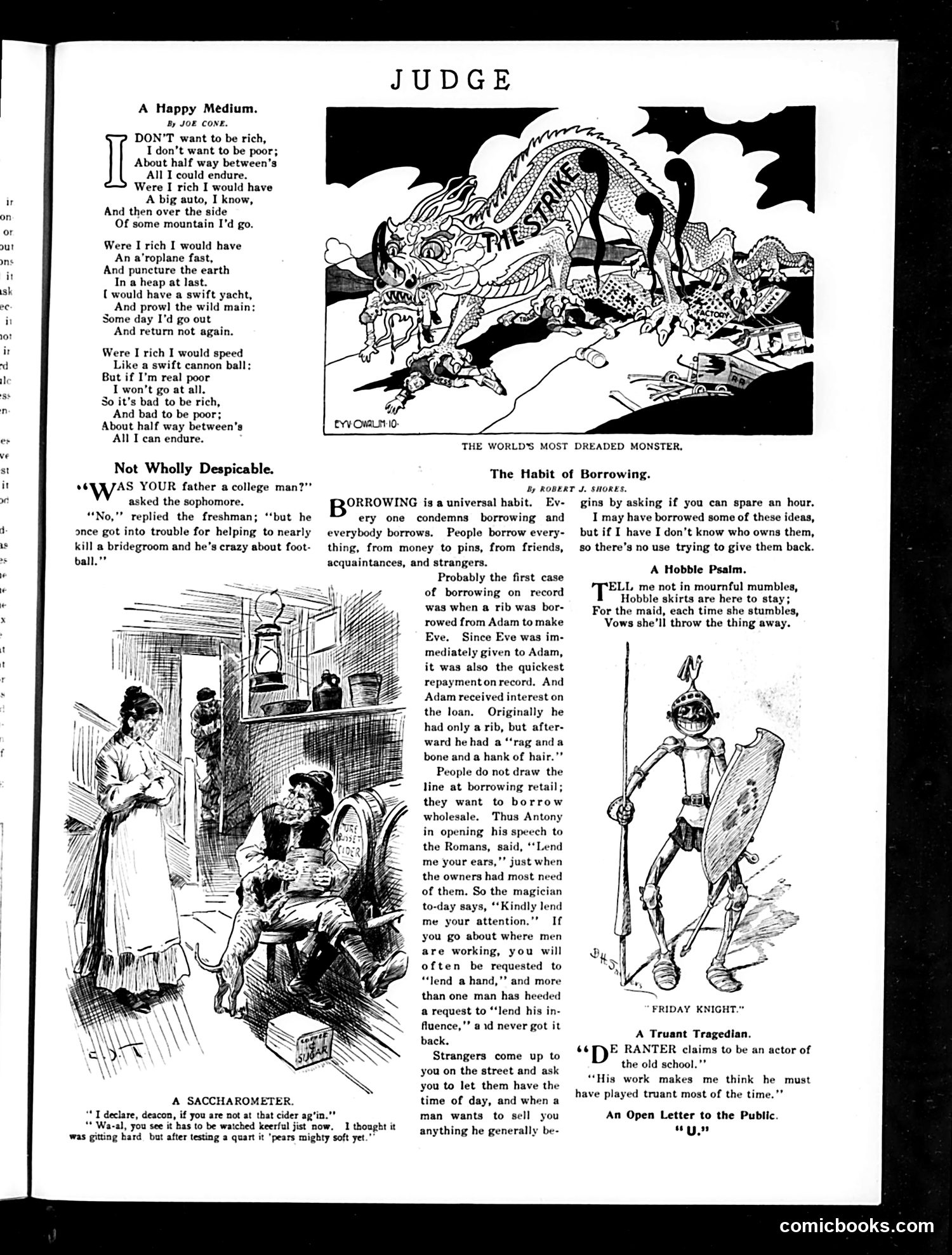
This page from Judge presents early 20th-century American social satire through multiple pieces: **"A Happy Medium"** satirizes the newly wealthy and their dangerous leisure pursuits. The poet argues that riches lead to reckless death—fancy automobiles driving off mountains, airplanes crashing, yachts disappearing. Poverty at least prevents such spectacular demises. It's commentary on how industrial-age wealth enabled dangerous novelties (early automobiles, aviation) that killed the careless rich. **"The Habit of Borrowing"** humorously traces borrowing from Adam's rib through contemporary practice, mocking how people borrow indiscriminately—money, time, attention, influence—rarely returning favors. **"A Hobble Psalm"** jokes about the "hobble skirt," a restrictive 1910s women's fashion so tight at the ankles it severely limited movement. Women supposedly swear they'll discard it each time they stumble. **Minor pieces** include a college humor exchange and theatrical criticism. The overall tone is gentle social observation rather than harsh political attack.
📄 Transcribed text from this page (OCR, searchable)
Machine-transcribed from the original scan — historical spelling and the odd misread are preserved.
A Happy Medium. By JOE CONE. DON’T want to be rich, I don’t want to be poor; About half way between’s All I could endure. Were I rich I would have A big auto, I know, And then over the side Of some mountain I'd go. Were I rich I would have An a’roplane fast, And puncture the earth In a heap at last. (would have a swift yacht, And prow] the wild main: Some day I'd go out And return not again. Were I rich I would speed Like a swift cannon ball; But if I'm real poor I won’t go at all. 3o it’s bad to be rich, And bad to be poor; About half way between’s All I can endure. 7 = THE WORLDS MOST DREADED MONSTER, Not Wholly Despicable. The Habit of Borrowing. soyyas YOUR father a college man?” By ROBERT J. SHORES. asked the sophomore. ORROWING is a universal habit. Ev- gins by asking if you can spare an hour. “No,"” replied the freshman; “but he ery one condemns borrowing and I may have borrowed some of these ideas, once got into trouble for helping to nearly everybody borrows. People borrow every- but if I have I don’t know who owns them, kill a bridegroom and he’s crazy about foot- thing, from money to pins, from friends, so there’s no use trying to give them back. ball.”” acquaintances, and strangers. AC HORBIS Peat? Probably the first case j of borrowing on record ELL me not in mournful mumb! F Hobble skirts are here to stay; was when a rib was bor- For the maid, each time she stumbles, rowed from Adam to make Vows she'll throw the thing away. Eve. Since Eve was im- mediately given to Adam, it was also the quickest repaymenton record. And Adam received interest on the loan. Originally he had only a rib, but after- ward he had a “rag anda bone and a hank of hair.’" People do not draw the line at borrowing retail; they want to borrow wholesale. Thus Antony in opening his speech to the Romans, said, ‘*Lend me your ears,”’ just when the owners had most need of them. So the magician to-day says, ‘Kindly lend me your attention.” If you go about where men are working, you will often be requested to “lend a hand,’’ and more than one man has heeded a request to “‘lend his in- fluence,"’ a id never got it back. Strangers come up to you on the street and ask you to let them have the A SACCHAROMETER. time of day, and when a “* I declare, deacon, if you are not at that cider ag'in."* man wants to sell you An Open Letter to the Public. ** Wa-al, you see it has to be watched keerful jist now. 1 thought it Fo kmoe shes pe was gitting hard but after testing a quart it ‘pears mighty soft yet.”” anything he generally be: U. FRIDAY KNIGHT.” A Truant Tragedian. ee E RANTER claims to be an actor of the old school."’ “His work makes me think he must have played truant most of the time.”” comicbooks.com