
Judge, 1910-12-24 · page 11 of 24
Judge — December 24, 1910 — page 11: what you’re looking at
What you’re looking at
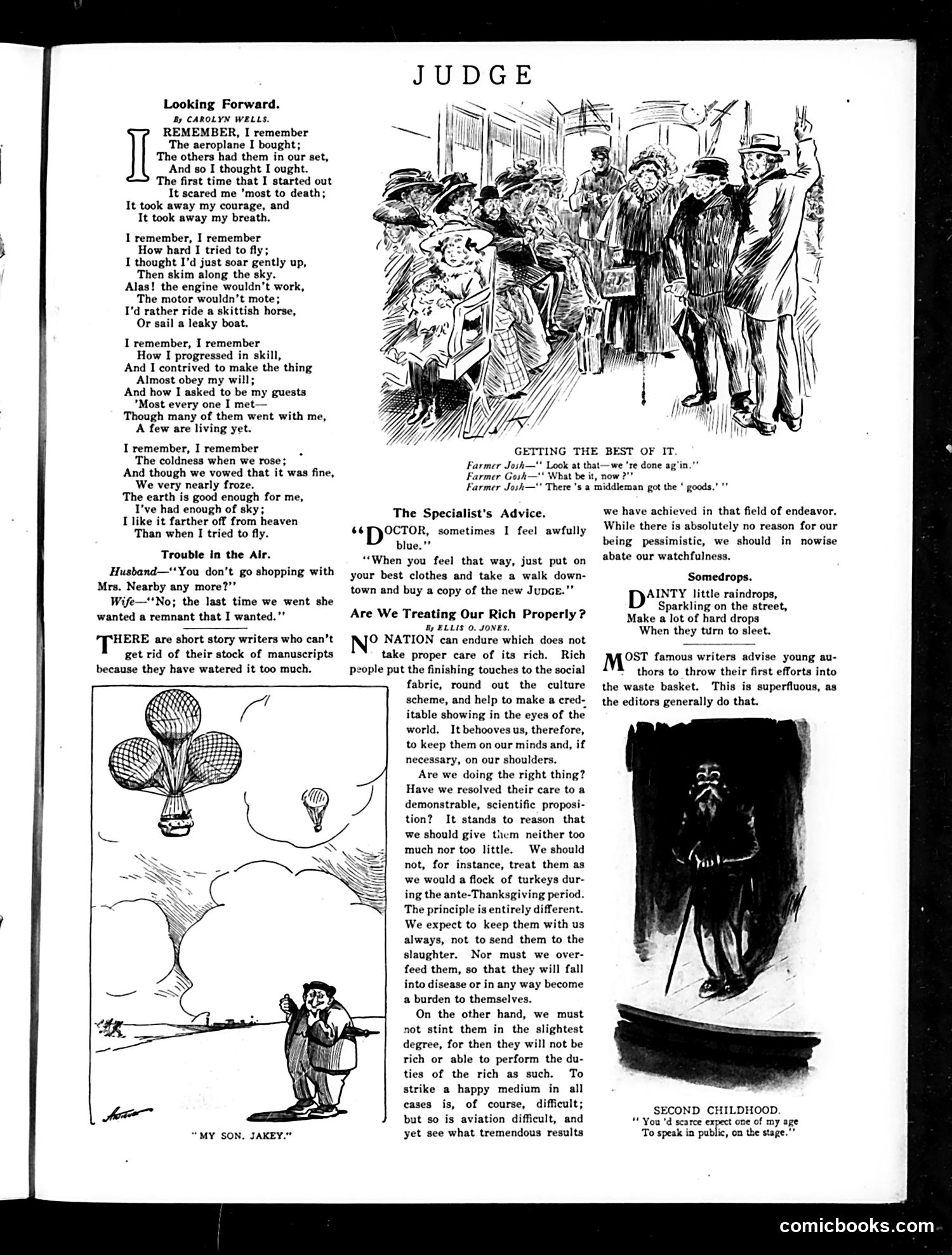
This page from Judge magazine contains multiple satirical pieces mocking early 20th-century American trends and attitudes. **"Looking Forward"** by Carolyn Wells mocks the aviation craze among the wealthy. The poem describes someone who bought an airplane because "others had them in our set"—satirizing status-conscious consumption. The humor lies in the narrator's terrifying experience: the engine fails, it's freezing, and guests invited for rides either died or rarely returned. This reflects real public anxiety about dangerous, experimental aircraft. **"Are We Treating Our Rich Properly?"** offers deadpan satirical advice, arguing the wealthy require careful scientific management—not too much indulgence (like turkeys before Thanksgiving slaughter) nor too little (or they'd lose their "rich" status). This is political satire mocking class inequality and obsequiousness toward the wealthy. **Other pieces** include jokes about domestic disputes, failed writers, and general observations. The cartoons appear to illustrate these themes with early 20th-century domestic and social scenarios, typical of Judge's satirical commentary on contemporary American life and values.
📄 Transcribed text from this page (OCR, searchable)
Machine-transcribed from the original scan — historical spelling and the odd misread are preserved.
Looking Forward. ‘By CAROLYN WELLS. REMEMBER, I remember The aeroplane I bought; The others had them in our set, And so I thought I ought. The first time that I started out It scared me ‘most to death; It took away my courage, and It took away my breath. I remember, I remember How hard I tried to fly; I thought I’d just soar gently up, ‘Then skim along the sky. Alas! the engine wouldn’t work, The motor wouldn’t mote; I'd rather ride a skittish horse, Or sail a leaky boat. I remember, I remember How I progressed in skill, And I contrived to make the thing Almost obey my will; And how I asked to be my guests "Most every one I met— Though many of them went with me, A few are living yet. I remember, I remember The coldness when we rose; And though we vowed that it was fine, We very nearly froze. The earth is good enough for me, I've had enough of sky; I like it farther off from heaven Than when I tried to fly. Trouble in the Air. Husband—‘‘You don’t go shopping with Mrs. Nearby any more?’ Wife—No; the last time we went she wanted a remnant that I wanted."” "THERE are short story writers who can’t get rid of their stock of manuscripts because they have watered it too much. GETTING THE BEST OF IT. Farmer Josh—* Look at that—we 're done ag’in."” Farmer Gosh * What be it, now 2"? Farmer Josh—" There's a middleman got the ‘ goods.’ "” The Specialist’s Advice. 66P)OCTOR, sometimes I feel awfully blue.’” ‘*When you feel that way, just put on your best clothes and take a walk down- town and buy a copy of the new JupGE."” Are We Treating Our Rich Properly ? By ELLIS 0. JONES. N° NATION can endure which does not take proper care of its rich. Rich people put the finishing touches to the social fabric, round out the culture “MY SON. JAKEY.” scheme, and help to make a cred- itable showing in the eyes of the world. It behooves us, therefore, to keep them on our minds and, if necessary, on our shoulders. Are we doing the right thing? Have we resolved their care to a demonstrable, scientific proposi- tion? It stands to reason that we should give them neither too much nor too little. We should not, for instance, treat them as we would a flock of turkeys dur- ing the ante-Thanksgiving period. The principle is entirely different. We expect to keep them with us always, not to send them to the slaughter. Nor must we over- feed them, so that they will fall into disease or in any way become a burden to themselves. On the other hand, we must not stint them in the slightest degree, for then they will not be rich or able to perform the du- ties of the rich as such. To strike a happy medium in all cases is, of course, difficult; but so is aviation difficult, and yet see what tremendous results we have achieved in that field of endeavor. While there is absolutely no reason for our being pessimistic, we should in nowise abate our watchfulness. Somedrops. pAaTY little raindrops, Sparkling on the street, Make a lot of hard drops When they turn to sleet. M(t famous writers advise young au- thors to throw their first efforts into the waste basket. This is superfluous, as the editors generally do that. SECOND CHILDHOOD. “" You 'd scarce expect one of my age ‘To speak in publ, on the stage.” comicbooks.com