
Judge, 1910-12-24 · page 19 of 24
Judge — December 24, 1910 — page 19: what you’re looking at
What you’re looking at
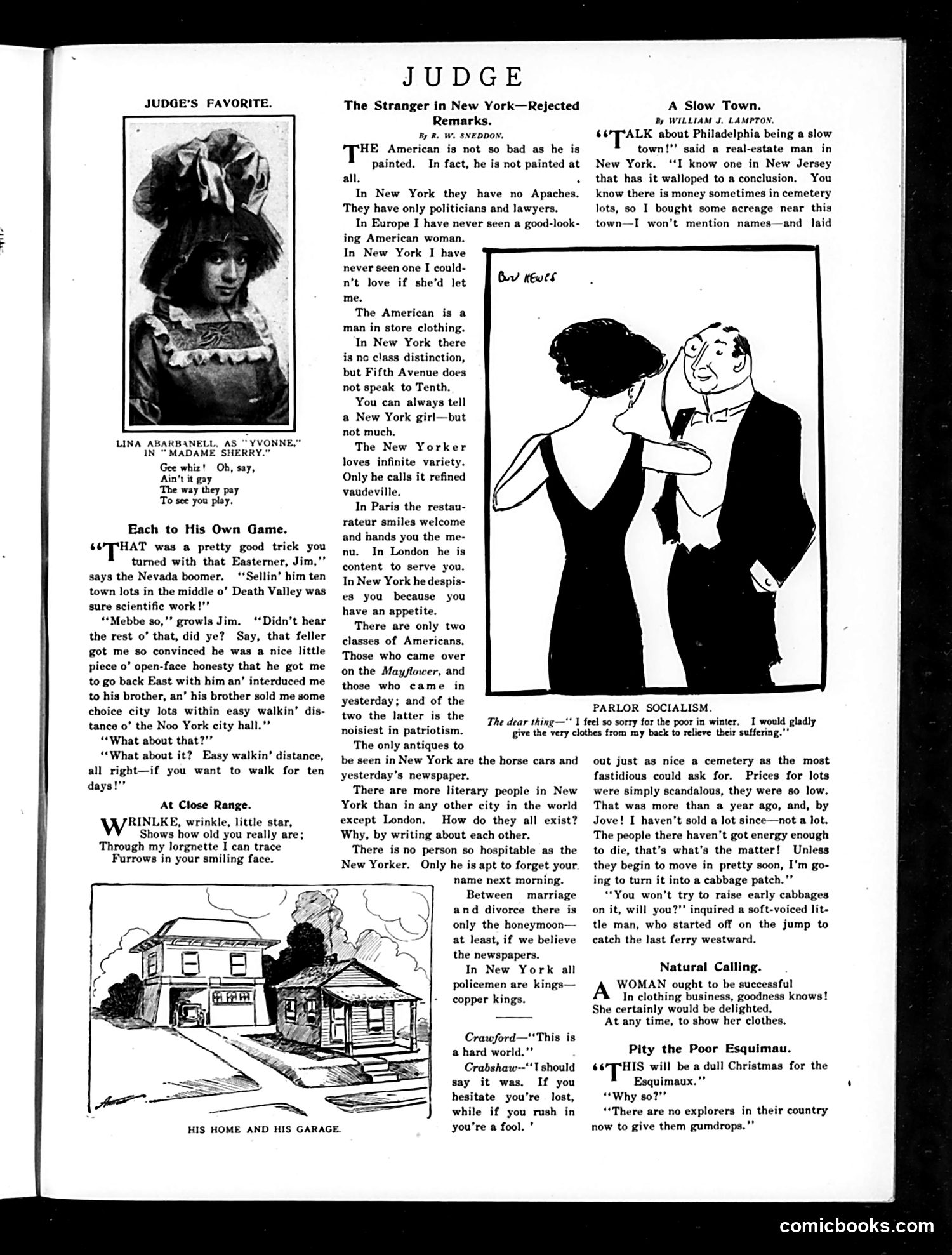
This page from the satirical magazine *Judge* contains several distinct pieces mocking American society circa the early 1900s. **"Judge's Favorite"** is simply promotional material for actress Lina Abarbanell in the Broadway musical *Madame Sherry*. **"Each to His Own Game"** satirizes con artists: a Nevada con man who sold worthless Death Valley lots gets tricked into buying equally worthless New York real estate near City Hall—the humor lies in the ironic reversal. **"The Stranger in New York"** collects pointed observations comparing American character unfavorably to Europeans. The satire targets American pretension, rudeness, and hypocrisy—New Yorkers claim classlessness yet Fifth Avenue ignores Tenth Street; they're hospitable but forget your name; they despise diners for having appetites. **"A Slow Town"** jokes about a New Jersey cemetery so unpopular the developer can't even sell burial plots—mocking both small-town lethargy and real-estate speculation schemes. **"Parlor Socialism"** depicts wealthy philanthropy as performative: a woman boasts of charitable impulses while apparently doing nothing substantive.
📄 Transcribed text from this page (OCR, searchable)
Machine-transcribed from the original scan — historical spelling and the odd misread are preserved.
JUDGE'S FAVORITE. LINA ABARBANELL, AS “YVONNE,” IN “MADAME SHERRY.” Gee whiz! Oh, say, Ain’t it gay The way they pay To see you play. Each to His Own Game. sopuaT was a pretty good trick you turned with that Easterner, Jim,” says the Nevada boomer. ‘‘Sellin’ him ten town lots in the middle o’ Death Valley was sure scientific work!"" “‘Mebbe so,’’ growls Jim. ‘*Didn’t hear the rest o' that, did ye? Say, that feller got me so convinced he was a nice little piece o’ open-face honesty that he got me to go back East with him an’ interduced me to his brother, an’ his brother sold me some choice city lots within easy walkin’ dis- tance o’ the Noo York city hall.’”’ ‘What about that?” “What about it? Easy walkin’ distance, all right—if you want to walk for ten days!"’ At Close Range. RINLKE, wrinkle, little star, Shows how old you really are; Through my lorgnette I can trace Furrows in your smiling face. JUDGE The Stranger in New York—Rejected Remarks. By R. W. SNEDDON. HE American is not so bad as he is painted. In fact, he is not painted at all. . In New York they have no Apaches. They have only politicians and lawyers. In Europe I have never seen a good-look- ing American woman. In New York I have never seen one I could- n’t love if she’d let me. The American is a man in store clothing. In New York there is no class distinction, but Fifth Avenue does not speak to Tenth. You can always tell a New York girl—but not much. The New Yorker loves infinite variety. Only he calls it refined vaudeville. In Paris the restau- rateur smiles welcome and hands you the me- nu. In London he is content to serve you. In New York he despis- es you because you have an appetite. There are only two classes of Americans. Those who came over on the Mayflower, and those who came in yesterday; and of the two the latter is the noisiest in patriotism. The only antiques to be seen in New York are the horse cars and yesterday’s newspaper. There are more literary people in New York than in any other city in the world except London. How do they all exist? Why, by writing about each other. There is no person so hospitable as the New Yorker. Only he is apt to forget your. name next morning. HIS HOME AND HIS GARAGE. Between marriage and divorce there is only the honeymoon— at least, if we believe the newspapers. In New York all policemen are kings— copper kings. Crawford—"This is a hard world.”” Crabshaw--"T should say it was. If you hesitate you're lost, while if you rush in you're a fool. * The dear thing—"" 1 feel so sorry for the poor in winter. give the very clothes from my back to relieve their suffering.” A Slow Town. By WILLIAM J. LAMPTON. Ta about Philadelphia being a slow town!’’ said a real-estate man in New York. ‘I know one in New Jersey that has it walloped to a conclusion, You know there is money sometimes in cemetery lots, so I bought some acreage near this town—I won't mention names—and laid PARLOR SOCIALISM. I would gladly out just as nice a cemetery as the most fastidious could ask for. Prices for lots were simply scandalous, they were 80 low. That was more than a year ago, and, by Jove! I haven't sold a lot since—not a lot. The people there haven't got energy enough to die, that’s what's the matter! Unless they begin to move in pretty soon, I'm go- ing to turn it into a cabbage patch.”” “You won’t try to raise early cabbages on it, will you?” inquired a soft-voiced lit- tle man, who started off on the jump to catch the last ferry westward. Natural Calling. A WOMAN ought to be successful In clothing business, goodness knows! She certainly would be delighted, At any time, to show her clothes. Pity the Poor Esquimau. 667°HIS will be a dull Christmas for the Esquimaux."’ “Why so?"” “There are no explorers in their country now to give them gumdrops."" comicbooks.com