
Judge, 1910-12-24 · page 6 of 24
Judge — December 24, 1910 — page 6: what you’re looking at
What you’re looking at
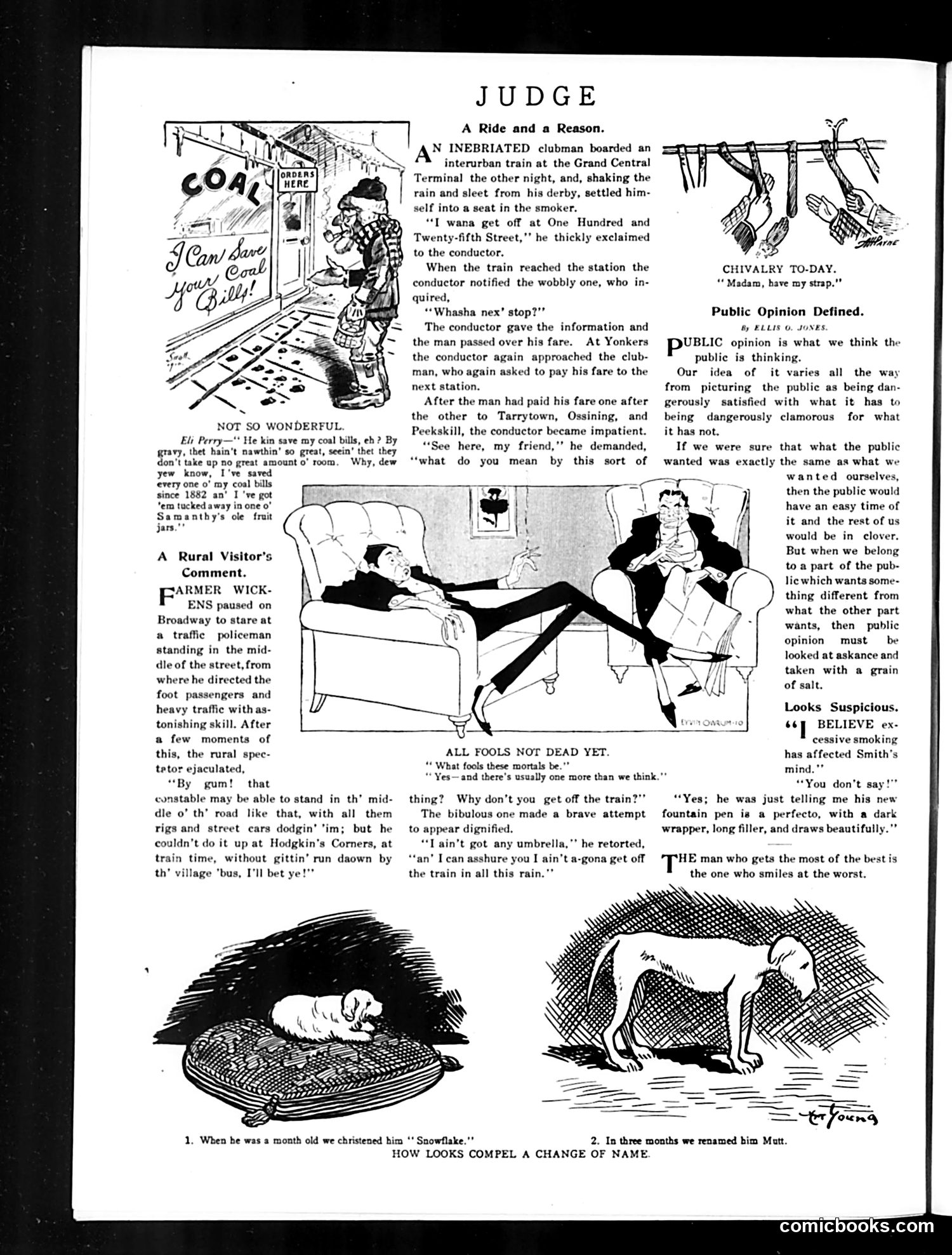
This page contains several satirical pieces typical of early 20th-century American humor: **"A Ride and a Reason"** mocks a drunk clubman repeatedly paying fares on an interurban train, unable to comprehend he's already paid for continuous travel. The conductor's exasperation satirizes the absurdity of willful obtuseness. **"A Rural Visitor's Comment"** presents a farmer amazed by urban traffic control, unable to imagine such coordination possible in rural areas—poking fun at rural naiveté about city sophistication. **"Public Opinion Defined"** offers cynical commentary: public opinion is merely what we *think* the public thinks, often contradicting our own interests. This critiques the gap between perceived and actual public sentiment. **"How Looks Compel a Change of Name"** (bottom) shows a dog christened "Snowflake" (white/fluffy) who transforms into "Matt" (implying darker coloring)—a visual gag about appearance determining identity. The overall tone reflects Judge's characteristic blend of social observation and light mockery of human folly, urban/rural contrasts, and pretension.
📄 Transcribed text from this page (OCR, searchable)
Machine-transcribed from the original scan — historical spelling and the odd misread are preserved.
NOT SO WONDERFUL. Eli Perry—"" He kin save my coal bills, eh ? By gravy, thet hain’t nawthin’ so great, seein’ thet they don't take up no great amount 0’ room. Why, dew yew know, I've saved JUDGE A Ride and a Reason. N INEBRIATED clubman boarded an interurban train at the Grand Central Terminal the other night, and, shaking the rain and sleet from his derby, settled him- self into a seat in the smoker. “I wana get off at One Hundred and Twenty-fifth Street," he thickly exclaimed to the conductor, When the train reached the station the conductor notified the wobbly one, who in- quired, “*Whasha nex’ stop?"” The conductor gave the information and the man passed over his fare. At Yonkers the conductor again approached the club- man, who again asked to pay his fare to the next station. After the man had paid his fare one after the other to Tarrytown, Ossining, and Peekskill, the conductor became impatient. “See here, my friend,’’ he demanded, “‘what do you mean by this sort of every one o' my coal bills since 1882 an’ I ‘ve got ‘em tucked away in one o° Samanthy's ole frait jars.” A Rural Visitor's Comment. FARMER WICK- ENS paused on Broadway to stare at a traffic policeman standing in the mid- dle of the street, from where he directed the foot passengers and heavy traffic with as- tonishing skill. After = —~ cal] CHIVALRY TO-DAY. “ Madam, have my strap." Public Opinion Defined. fy ELLIS 0. JONES puBtic opinion is what we think the public is thinking. Our idea of it varies all the way from picturing the public as being dan- gerously satisfied with what it has to being dangerously clamorous for what it has not, If we were sure that what the public wanted was exactly the same as what we wanted ourselves, then the public would have an easy time of it and the rest of us would be in clover. But when we belong to a part of the pub- lic which wants some- thing different from what the other part wants, then public opinion must be looked at askance and taken with a grain of salt. Looks Suspicious. 66 BELIEVE ex: a few moments of the rural spec- tetor ejaculated, “By gum! that constable may be able to stand in th’ mid- dle o’ th’ road like that, with all them rigs and street cars dodgin’’im; but he couldn't do it up at Hodgkin's Corners, at train time, without gittin’ run daown by th’ village "bus, I'll bet ye!"’ 1, When he was a month old we christened hi ALL FOOLS NOT DEAD YET. “* What fools these mortals be."” * Yes—and there's usually one more than we think."* thing? Why don’t you get off the train?”’ The bibulous one made a brave attempt to appear dignified. “Tain’t got any umbrella,’’ he retorted, ‘tan’ Ican asshure you I ain't a-gona get off the train in all this rain."* cessive smoking affected Smith's mind. “You don’t say!” “Yes; he was just telling me his new fountain pen is a perfecto, with a dark wrapper, long filler, and draws beautifully.” THE man who gets the most of the best is the one who smiles at the worst. im ** Snowflake."* HOW LOOKS COMPEL A CHANGE OF NAME. 2. In three months we renamed him Matt. comicbooks.com