
A complete issue · 16 pages · 1910
Judge — July 30, 1910
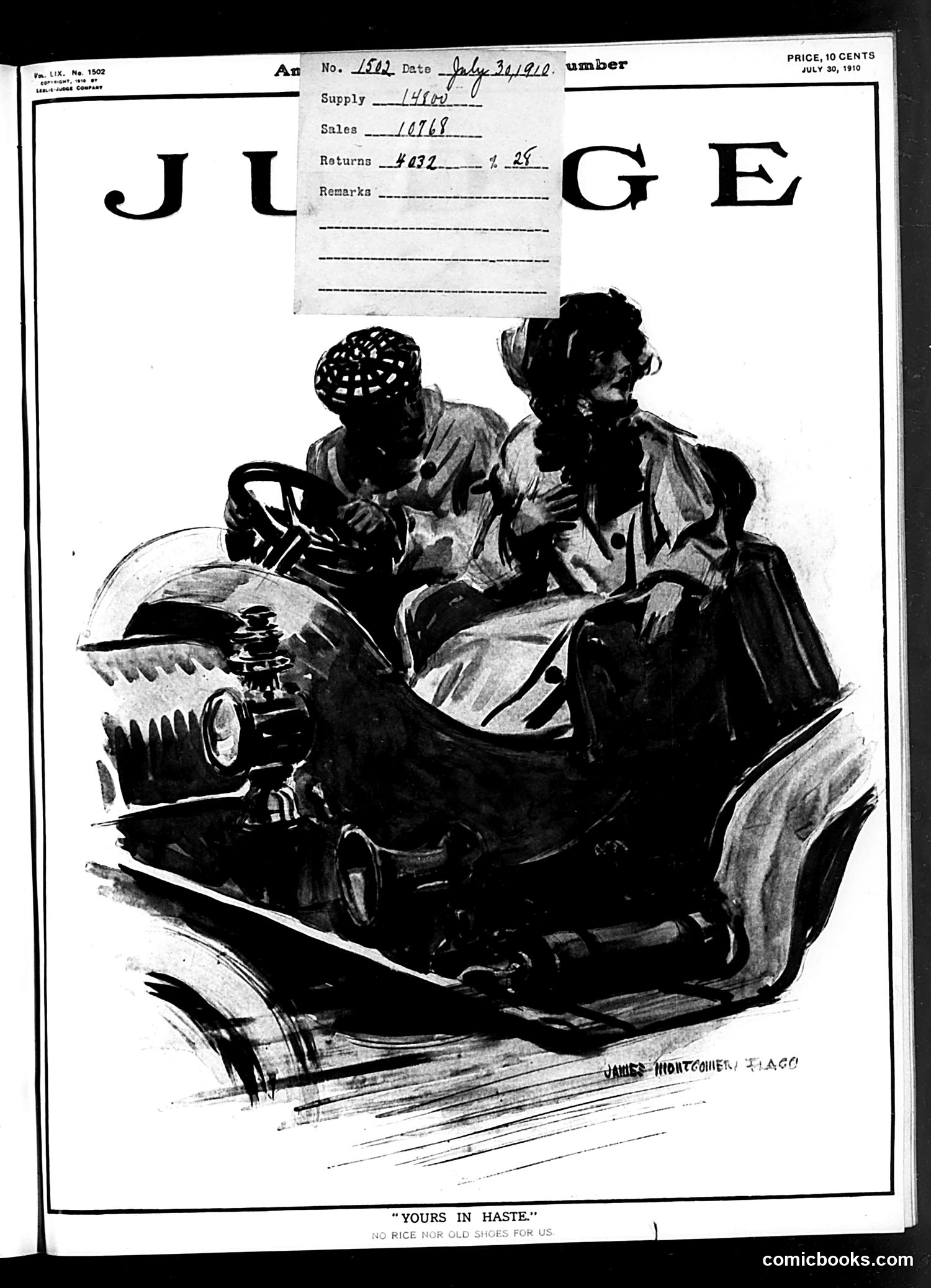
This is a Judge magazine cover from July 30, 1910, priced at 10 cents. The illustration, credited to James Montgomery Flagg, depicts two women in a motorcar with the caption "YOURS IN HASTE" and the subtitle "NO RICE FOR OLD SHOES FOR US." The satire appears to target changing social customs around courtship and marriage. The "no rice" reference alludes to the traditional rice-throwing at weddings. The women's rushed departure in a motorcar suggests they're rejecting old matrimonial conventions—choosing modern independence and speed over traditional domestic arrangements. The cartoon likely mocks women's increasing autonomy in the early 1900s, portraying them as reckless or frivolous for abandoning established social rituals in favor of modern pursuits like automobile driving.
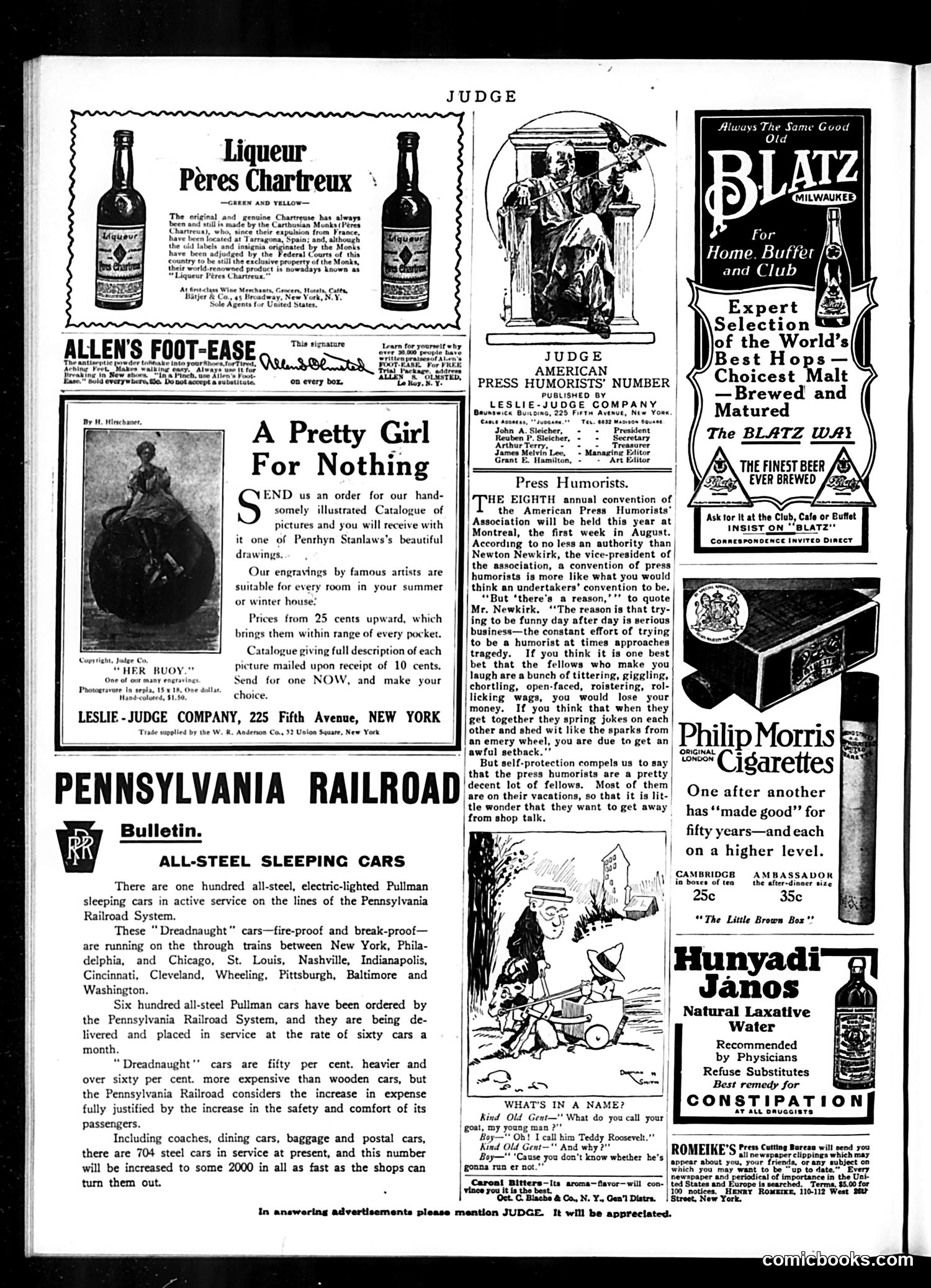
This page is primarily **advertisements and filler content** rather than political satire. The main elements include: 1. **"A Pretty Girl For Nothing"** — an advertisement from Leslie-Judge Company promoting an illustrated catalog of Penthyn Stanlaw's drawings, priced from 25 cents. 2. **Pennsylvania Railroad bulletin** describing their all-steel Pullman sleeping cars ("Dreadnaught" cars) for luxury train travel between major cities. 3. **"Judge: American Humorist's Number"** — editorial content announcing the eighth convention of the American Press Humorists' Association in Montreal, with commentary on press humor as serious business. 4. **Various product advertisements** including Allen's Foot-Ease, Blatz Milwaukee beer, Philip Morris cigarettes, and Hunyadi János laxative. The page contains **no significant political cartoons or satire** — it's standard magazine filler from the era mixing advertisements with light editorial content.
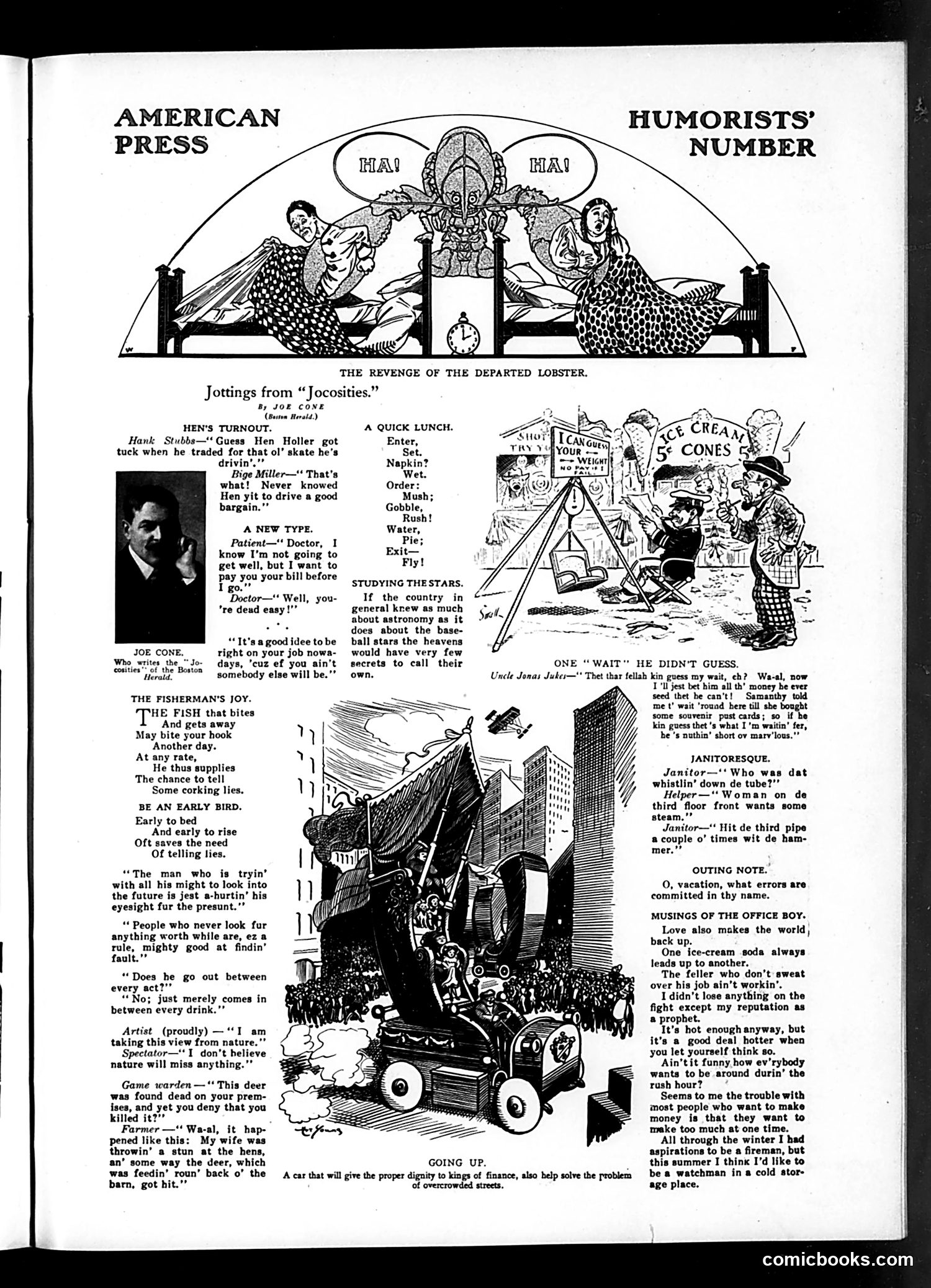
The main illustration "The Revenge of the Departed Lobster" depicts two figures in bed flanking a grotesque lobster-headed creature saying "HA! HA!" This appears to be surreal humor about indigestion or food revenge—a common turn-of-the-century joke format where eaten foods metaphorically haunt consumers. The page contains various humor shorts typical of Judge magazine: puns ("Hen's Turnout," "Joe Cone"), brief comedic dialogues, and observational humor about everyday situations. References include domestic life, workplace dynamics, romance ("Love also makes the world, back up"), and urban characters like janitors and office boys. The tone reflects early 20th-century American satire focused on wordplay, social awkwardness, and gentle mockery of modern life rather than sharp political commentary.
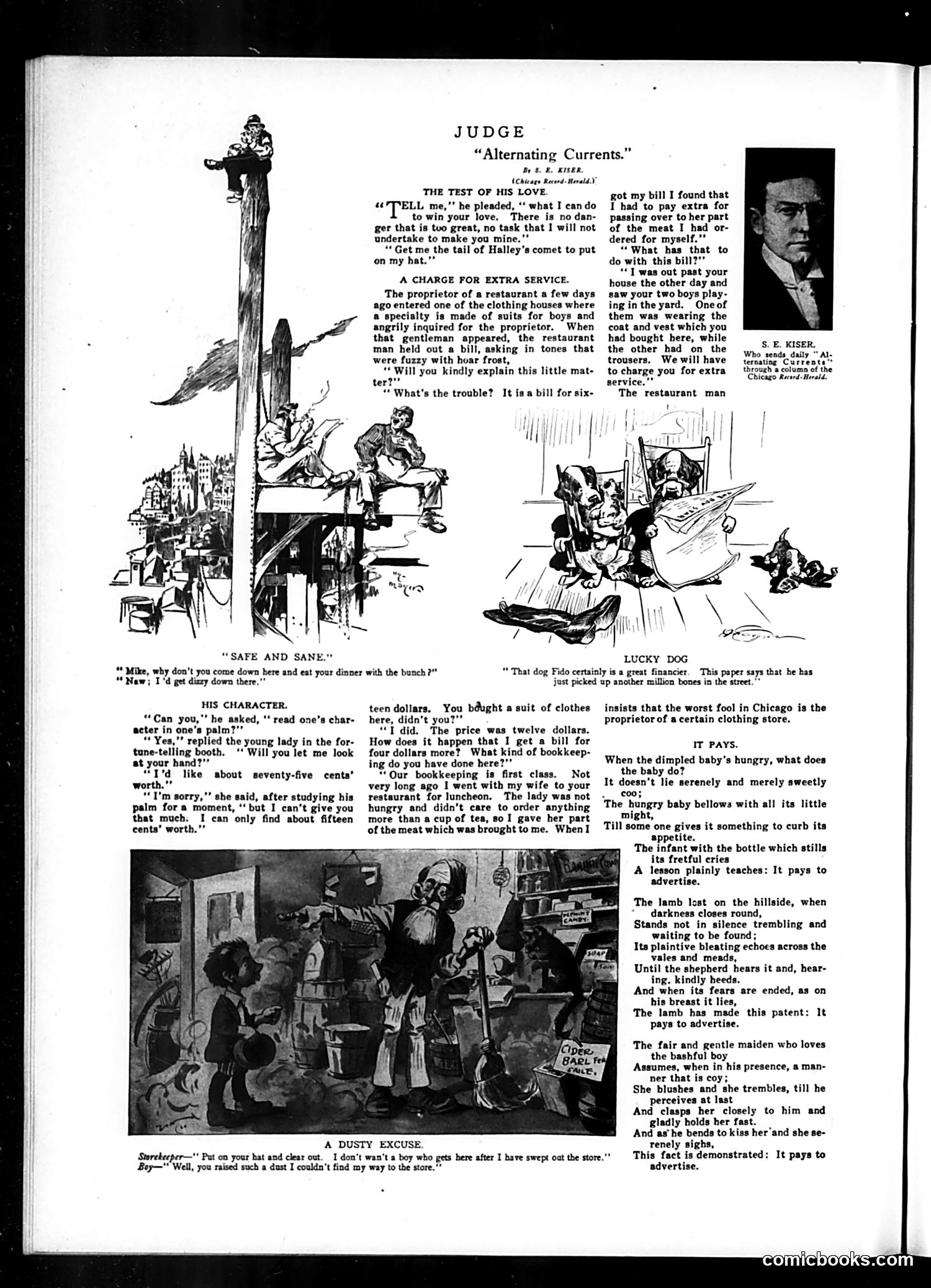
This Judge page contains several short satirical pieces and cartoons mocking everyday consumer situations. "A Charge for Extra Service" ridicules restaurant owners who exploit customers—a proprietor bills a man for an unexplained "extra service" charge, which the customer discovers relates to wearing a coat purchased elsewhere. The satire targets arbitrary fees and merchant dishonesty. Other pieces ("Safe and Sane," "His Character," "Lucky Dog," "A Dusty Excuse") employ similar humor about domestic life, parenting, and social awkwardness. "It Pays" includes verse about advertising's power. The cartoons use simple line drawings and dialogue to expose petty consumer fraud and social hypocrisy—typical Judge fare mocking middle-class life and business practices of the early 20th century.
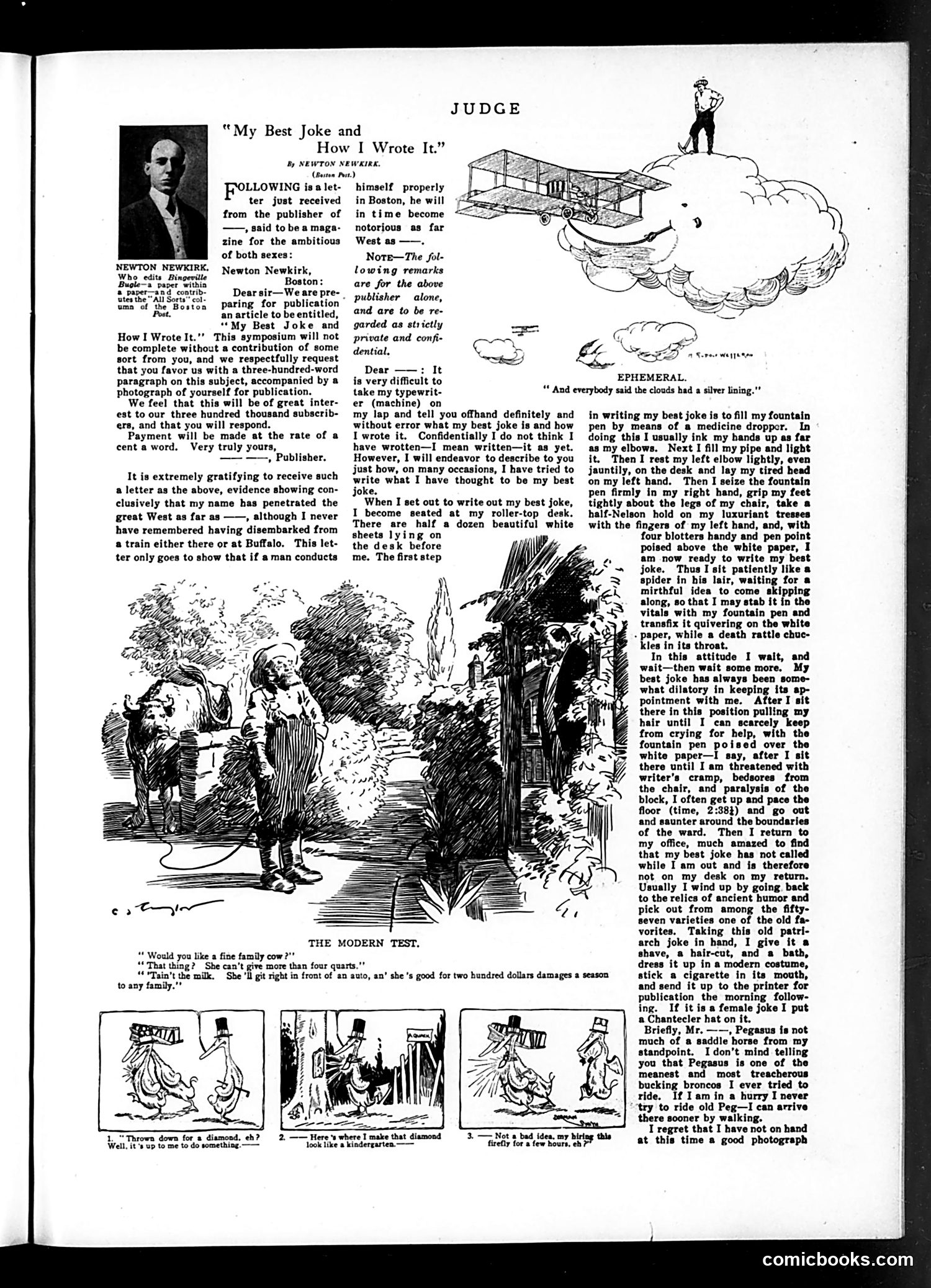
This page features humorist **Newton Newkirk** describing how he wrote his "best joke." The article is largely autobiographical rather than political satire—Newkirk explains his creative process for composing humor while seated at his desk. **The cartoons illustrate** his description: the main sketch shows a figure in a study with writing implements, depicting the mental effort of joke composition. Below, "The Modern Test" presents a domestic scene where someone discusses a fine saddle horse, with sequential panels showing the punchline's delivery. The content reflects **Judge magazine's** focus on genteel American humor and literary wit rather than hard political commentary. It's essentially a meta-joke about joke-writing itself—appealing to the magazine's educated readership.
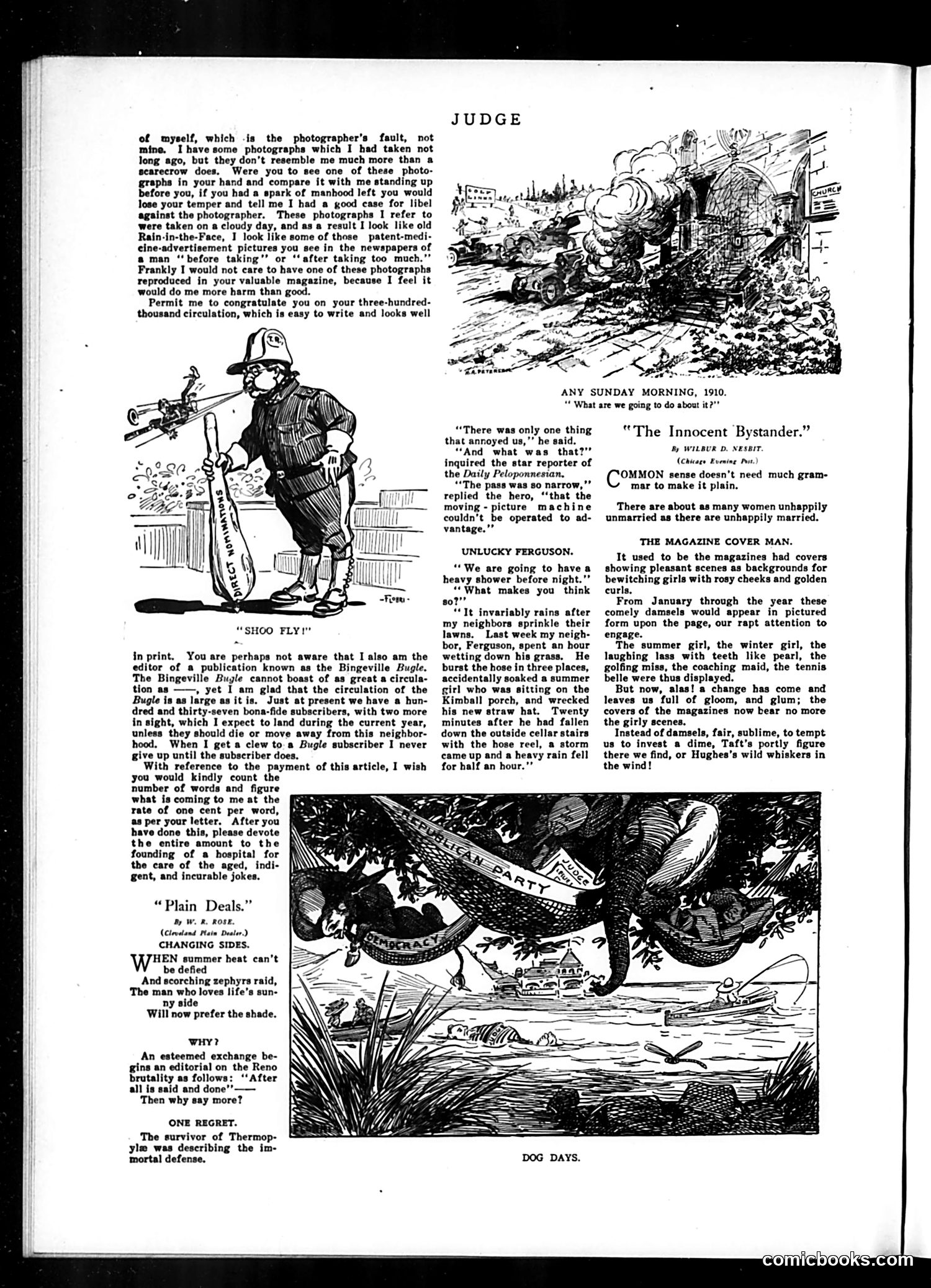
This page features several satirical pieces typical of Judge's humor: **"Shoo Fly!"** - A cartoon mocking an unnamed photographer's poor work, showing a disheveled man with a camera. The accompanying letter humorously complains that photographs make the writer look worse than a scarecrow, comparing unflattering results to "before/after" patent medicine ads. **"Any Sunday Morning, 1910"** - A joke about the Thermopylae battle survivors complaining that the narrow mountain pass prevented filming their heroic stand with a moving-picture camera—satirizing early cinema's intrusion into historical narratives. **"Unlucky Ferguson"** - A humorous anecdote about a man whose lawn-watering always triggers rainstorms, with escalating comical disasters. **"The Magazine Cover Man"** - Commentary on how magazine covers once featured attractive girls with pleasant backgrounds, but the format has become repetitive and formulaic. The page satirizes early 20th-century concerns: photography's limitations, cinema's growing cultural presence, and magazine publishing conventions.
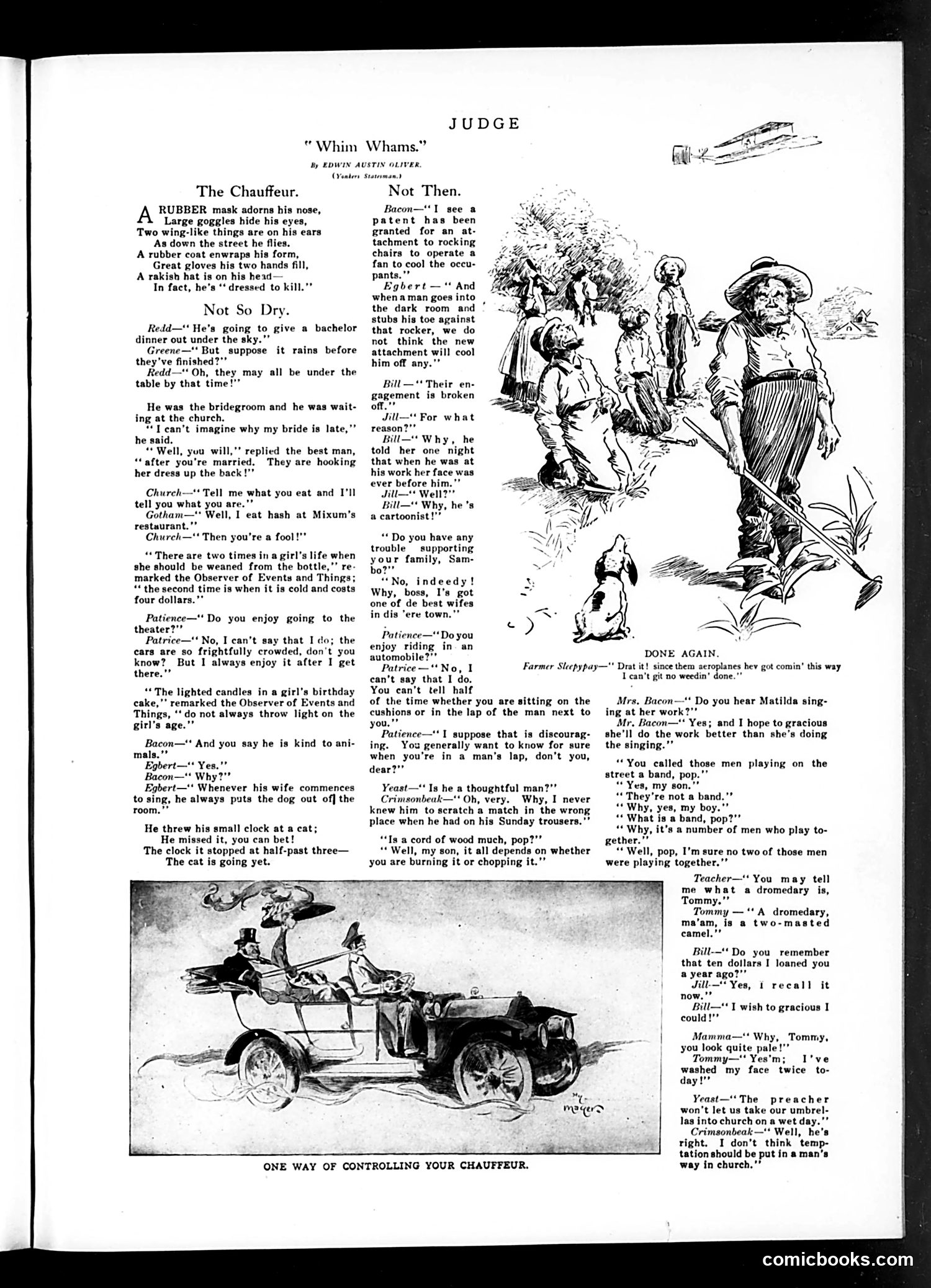
This page from **Judge** magazine contains satirical humor pieces ("Whim Whams") rather than political cartoons. The content mocks early 1900s social conventions and emerging technology: **"The Chauffeur"** ridicules the automobile chauffeur's exaggerated protective gear—rubber mask, goggles, coat, gloves—portraying early motorists as absurdly overdressed for a still-dangerous new technology. **"One Way of Controlling Your Chauffeur"** (illustrated bottom) shows a farmer controlling a speeding car by launching airplanes above it—satirizing both chauffeurs' recklessness and the novelty of aviation. The remaining humor pieces are typical period jokes about marriage ("bride is late"), courtship, restaurants, and social etiquette. "Done Again" mocks aeroplanes as disruptive nuisances to rural life. The cartoon style and subject matter suggest this is **early 1900s** content, when automobiles and aviation were new, dangerous, and culturally disruptive innovations.
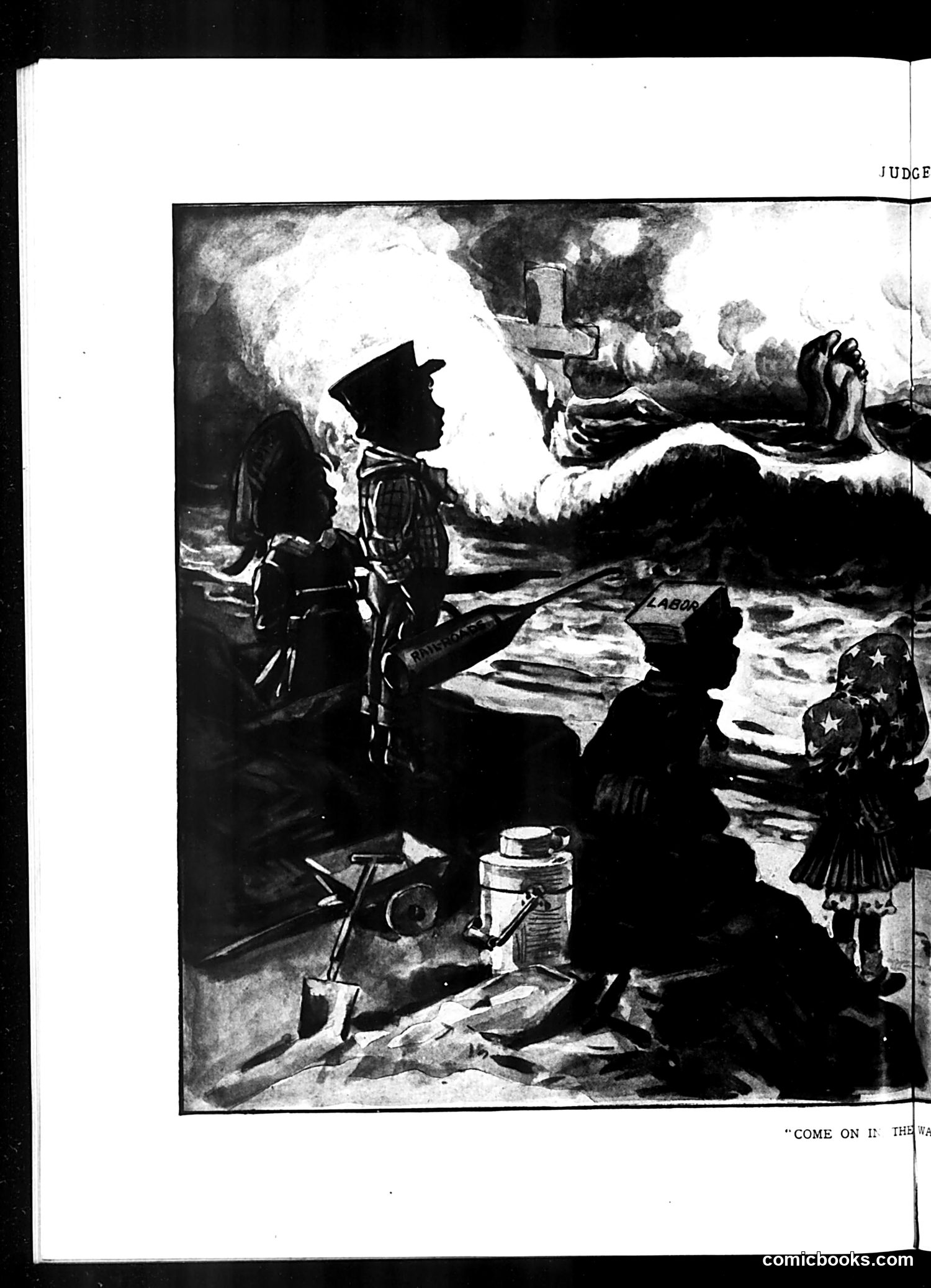
This political cartoon depicts a nighttime scene with silhouetted figures gathered around what appears to be a campfire or gathering place. Visible text references include "LABOR" and what seems to be patriotic imagery (stars visible on clothing). The phrase at bottom reads "COME ON IF THE WA..." (text cut off). The composition suggests a commentary on labor issues or workers' movements, likely from the early-to-mid 20th century based on Judge magazine's publication period. The silhouetted style and dramatic lighting create a somewhat ominous or cautionary tone, suggesting the cartoon critiques or satirizes labor organizing, strikes, or related social movements of the era. Without the complete caption and given the OCR errors, the precise political message remains partially unclear.
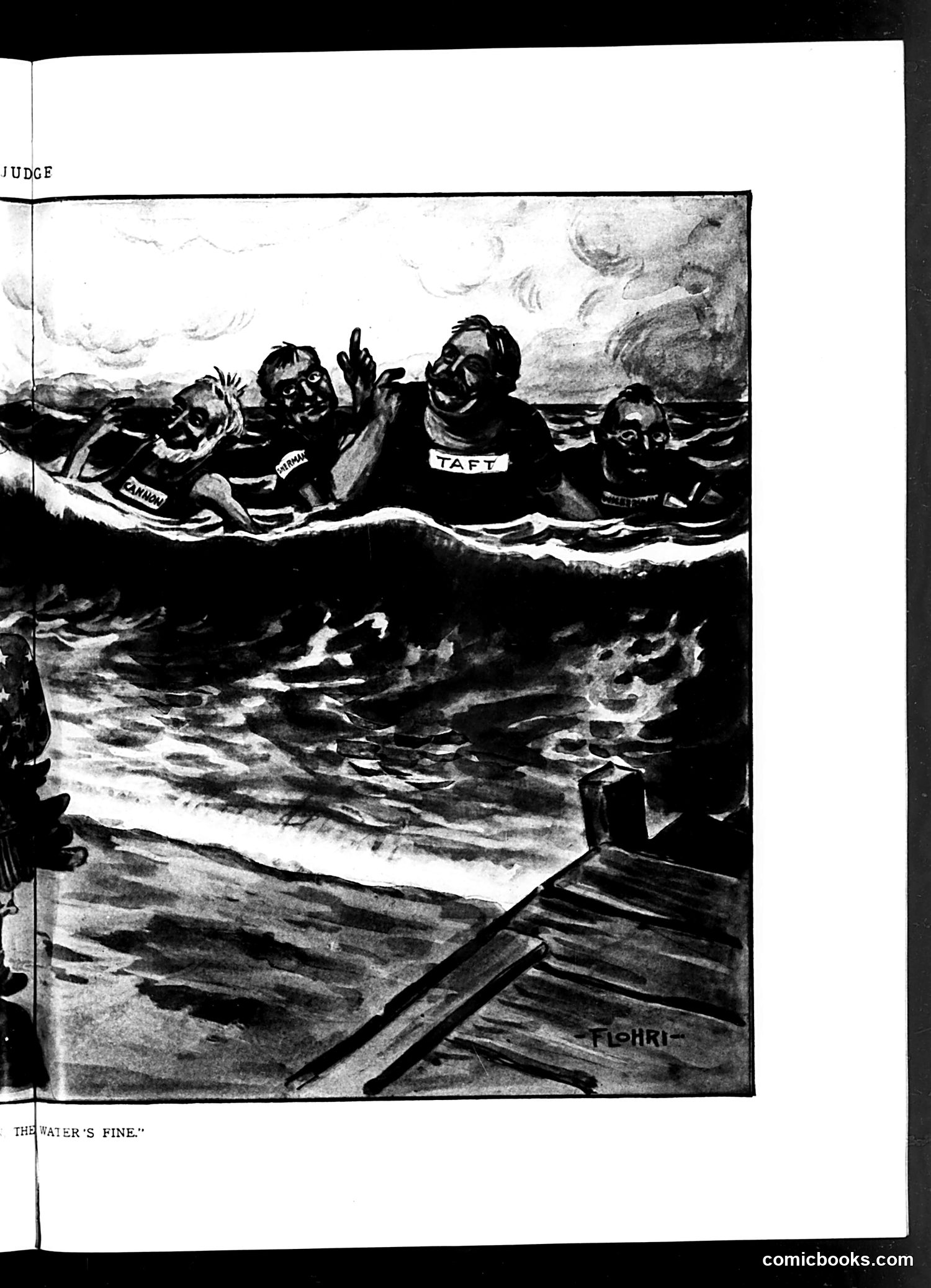
This Judge magazine cartoon depicts what appears to be political figures in water, with one central figure wearing a "TAFT" label. The satire suggests someone (likely President William Howard Taft) is inviting others into troubled waters—a common metaphor for dangerous political situations. The cartoon's title, "The Water's Fine," is ironic: the figure assures onlookers that conditions are safe while the roiling waters and turbulent environment suggest otherwise. This likely critiques Taft's political assurances during a period of controversy or instability, possibly referencing his administration's policies or political challenges. The other figures appear skeptical or wary, reflecting public doubt about Taft's claims. The artwork style and subject matter are consistent with early 20th-century American political satire.
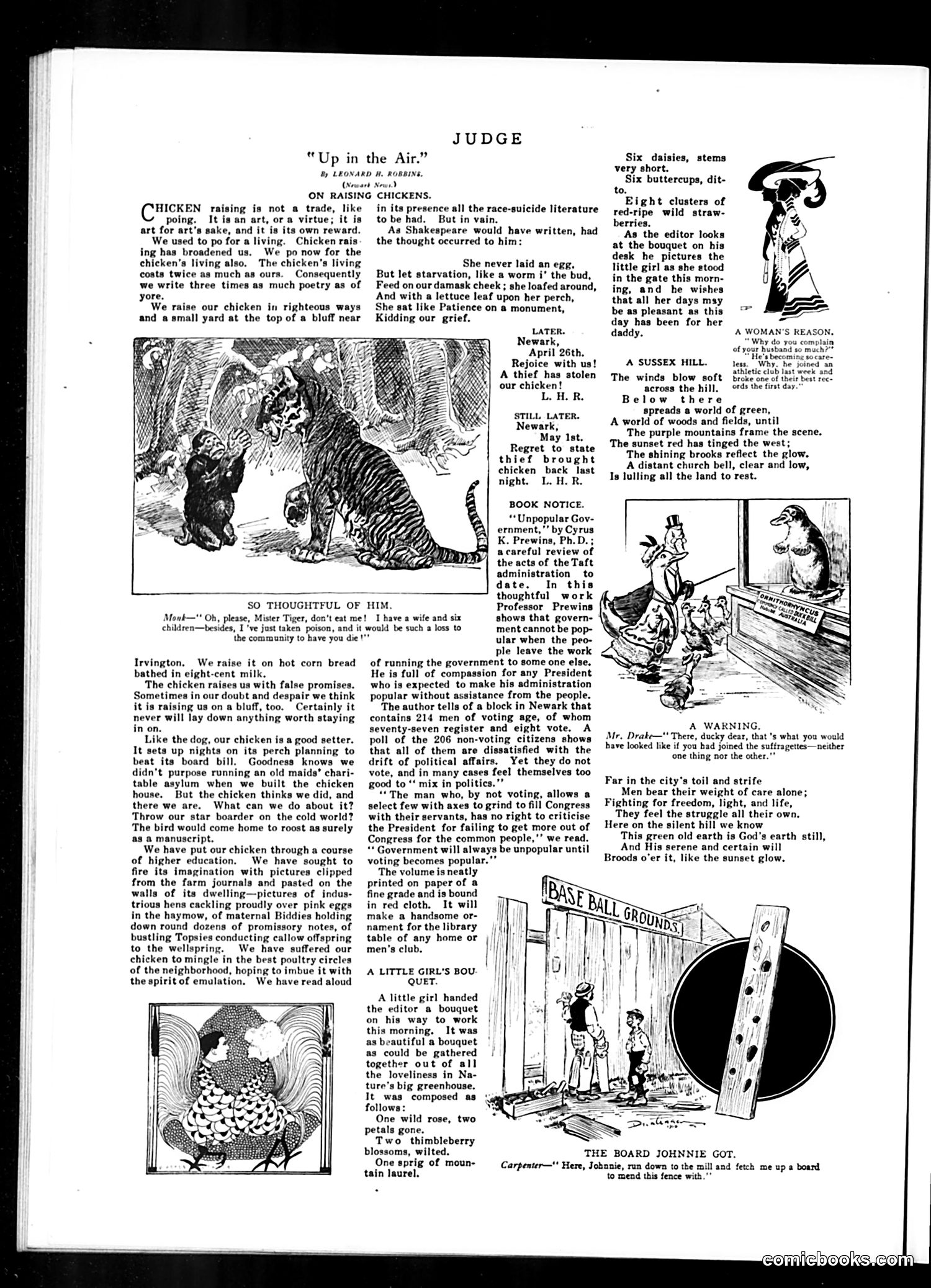
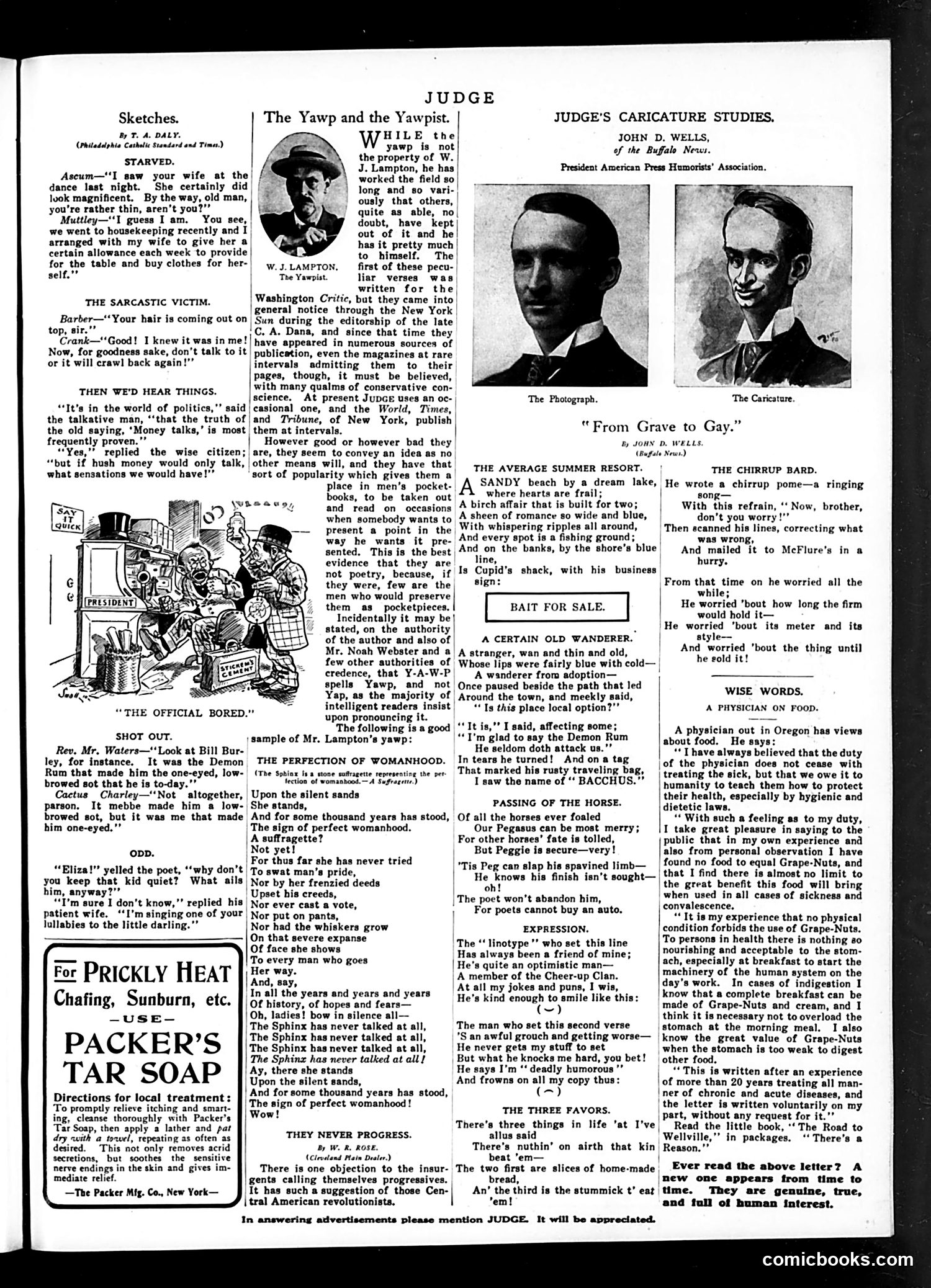
This Judge magazine page satirizes American apathy toward civic participation through two main pieces: **"On Raising Chickens"** (left): A humorous essay by Leonard H. Robbins uses chicken farming as an extended metaphor for futile, unrewarding labor. The impoverished narrator obsesses over an unproductive chicken that never lays eggs, costs more to feed than he earns, and represents wasted effort—likely critiquing either agricultural hardship or pointless government work. **"Unpopular Government" (book notice)**: A review of Cyrus K. Prewins's critique of the Taft administration (circa 1909-1913) that explicitly argues government cannot be popular when citizens shirk civic duties. It highlights a Newark block where 214 men of voting age exist, but only eight actually vote—the central point: democratic failure stems from public disengagement, not leadership. The page connects these pieces thematically: both mock apathy and wasted resources. The chicken represents the ungrateful public; the non-voting men represent citizens abandoning their democratic responsibility. Together, they critique American complacency.
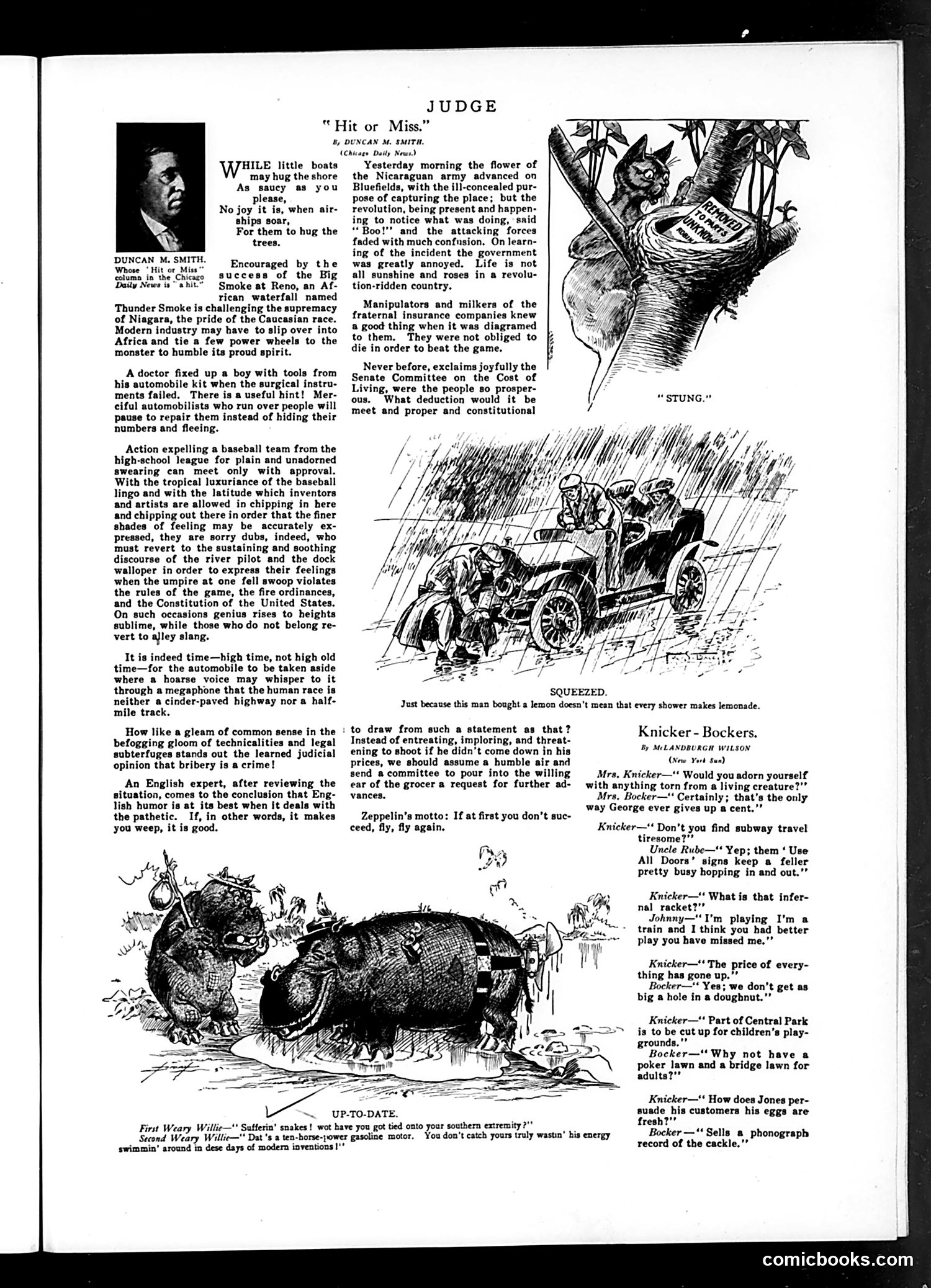
This page contains several satirical pieces typical of Judge's style: **Main Editorial Cartoon ("Hit or Miss")**: Critiques various social issues including: - Automobiles as public menaces (comparing them to dangerous terrain) - A doctor using auto tools for surgery (praising practical improvisation) - Baseball players' profanity (defending their right to colorful language as artistic expression) - Automobiles again as threats to pedestrians **Political References**: - Nicaragua's revolution: mocks the government's annoyance at a failed military advance on Bluefields, satirizing instability in "revolution-ridden country" - "Thunder Smoke" waterfall challenging Niagara: racist commentary suggesting Africa's natural features need industrial enhancement to match "Caucasian" achievements **"Up-to-Date" Cartoon**: Two hobos discuss one wearing a "ten-horse-power gasoline motor"—satirizing the era's obsession with motorization as a solution to everything, even vagrant life. **"Knicker-Bockers" Column**: Humorous dialogue about rising prices and modern complaints. The page reflects early 1900s anxieties: automobiles, technology, labor unrest, and imperial attitudes toward non-Western nations.
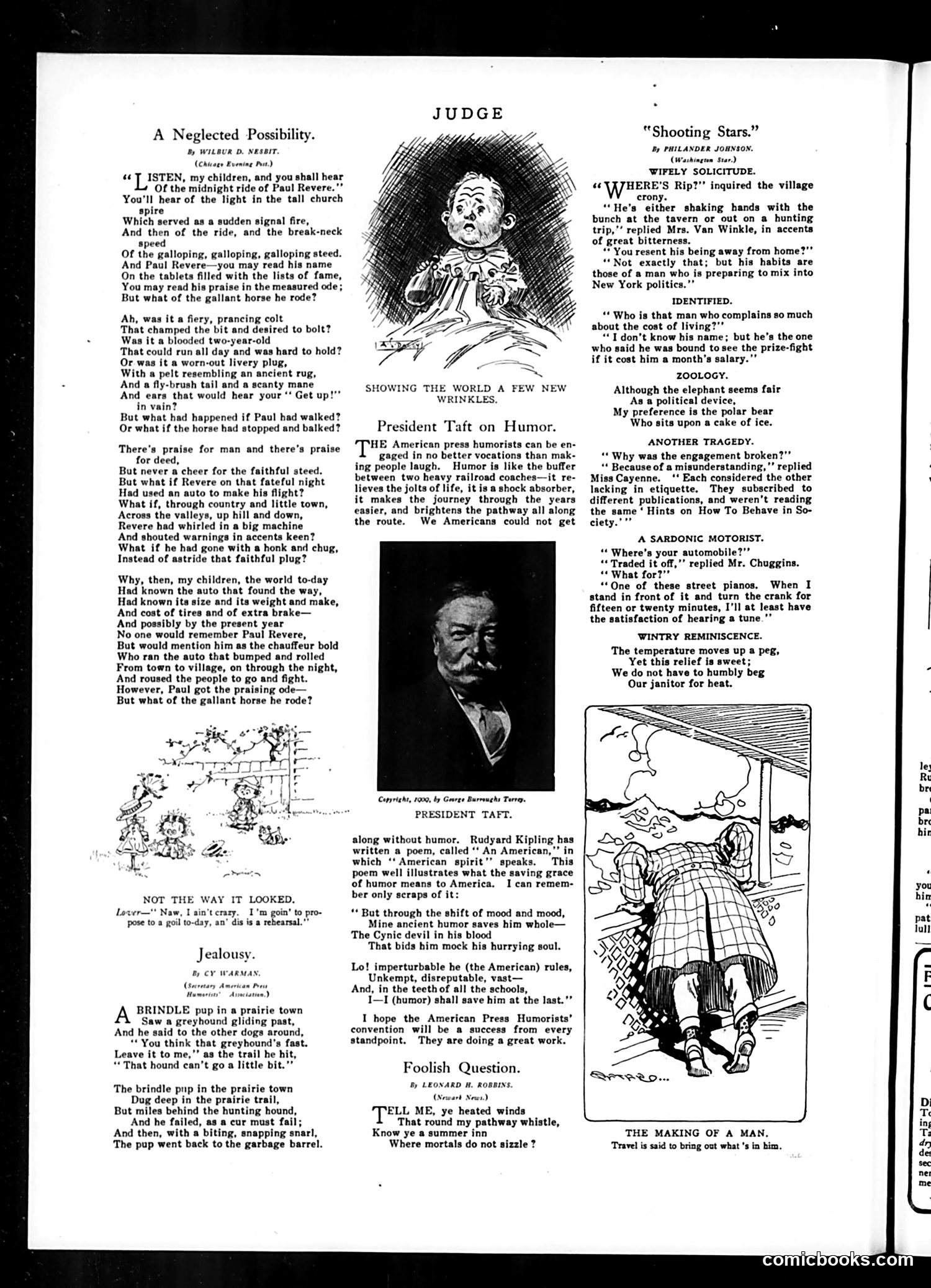
This page from Judge magazine (early 1900s) contains several satirical pieces: **"A Neglected Possibility"** by Wilbur D. Nesbit presents a humorous thought experiment: what if Paul Revere had ridden his famous midnight ride in an automobile instead of on horseback? The satire mocks America's obsession with new technology and credit-claiming. The poem suggests that had Revere used a car, history would remember the *vehicle* rather than the heroic rider—a jab at contemporary fixation on modern inventions over human achievement. **The President Taft section** quotes the president praising American humor as a social "shock absorber" that eases life's difficulties, using Kipling's poem to argue humor saves the American character. The page also includes lighter pieces like "Jealousy" (a prairie dog's envy of a greyhound) and various comic vignettes satirizing social pretensions and human nature—typical Judge fare blending political commentary with everyday absurdities.
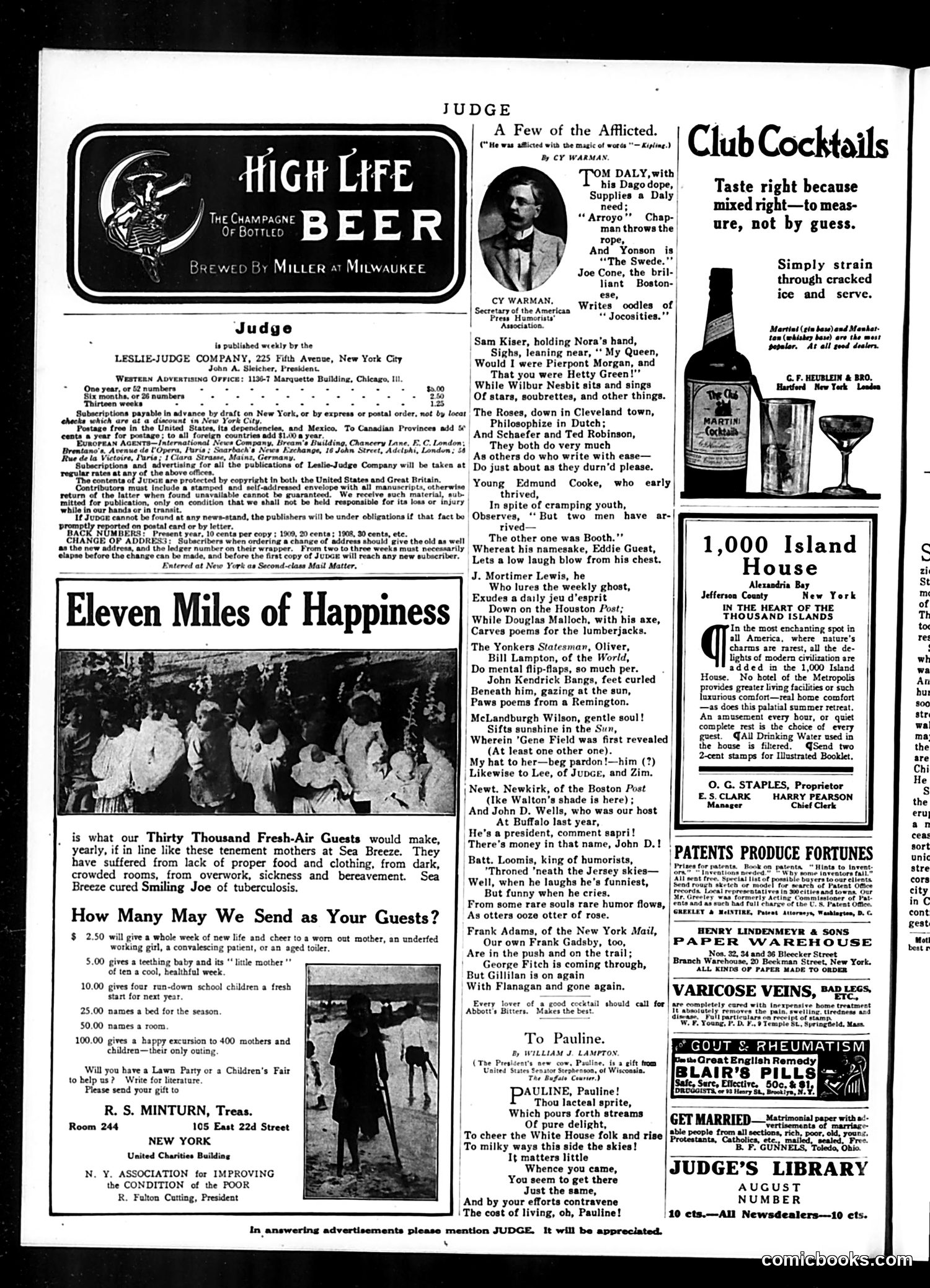
This page from Judge magazine (a date-unclear satirical weekly) primarily features **advertising and charitable appeals** rather than political cartoons. The main content is "A Few of the Afflicted" — a lighthearted satirical poem by Cy Warman mocking contemporary American humorists and writers. It names figures like **Tom Daly, Joe Cone, and Wilbur Nesbit**, poking fun at their literary styles and mannerisms (ethnic stereotypes included — "Dago," "Yonson"). The satire targets their pretentious or overwrought writing. The dominant visual feature is "Eleven Miles of Happiness," promoting **Sea Breeze**, a charitable fresh-air resort for poor mothers and children. The accompanying donation scale ($2.50-$100) shows Judge readers could sponsor working-class families' vacations. Additional ads include **High Life Beer** (Milwaukee), cocktail recipes, and real-estate promotion. The page reflects Gilded Age concerns: mocking literary affectation while celebrating charitable paternalism toward the urban poor.
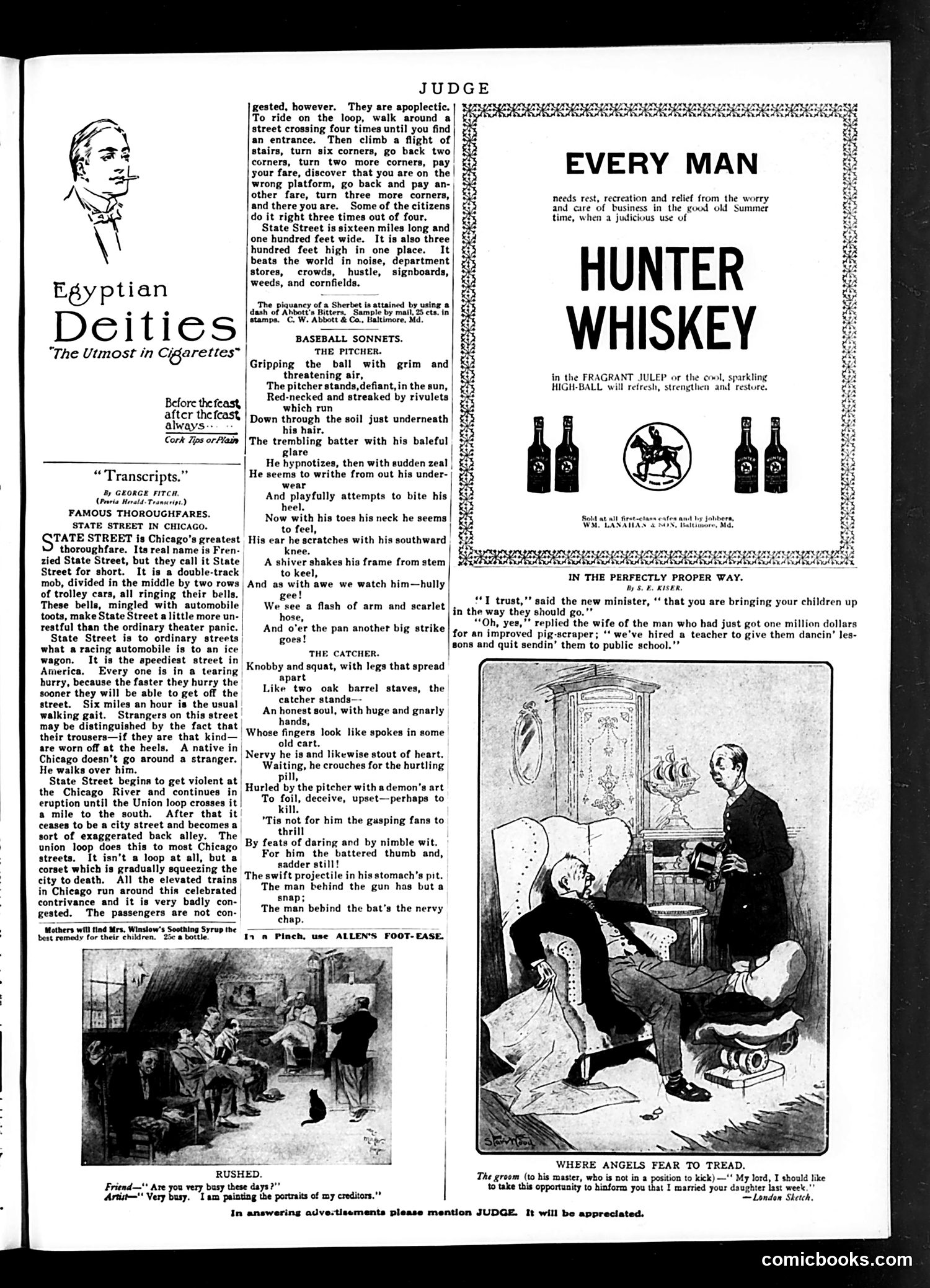
This page from *Judge* magazine contains several distinct elements: **Left side:** A humorous essay by George Fitch describing Chicago's State Street as chaotically crowded and frenzied—a satirical commentary on urban congestion and the hectic pace of city life. The piece uses exaggeration to mock both the street itself and the hurried behavior of its inhabitants. **Center:** Two comic sonnets about baseball players (the pitcher and catcher), written in mock-serious poetic language that humorously describes their awkward physical contortions and mannerisms during play. **Right side:** A Hunter Whiskey advertisement with an illustration labeled "Where Angels Fear to Tread," depicting a domestic scene where a woman appears to have injured a man with household items—a darkly comedic advertisement playing on marital discord for product appeal. **Top left:** An advertisement for Egyptian Deities cigarettes. The page is primarily humorous editorial content with period advertising, typical of *Judge's* satirical approach to American urban life and consumer culture.
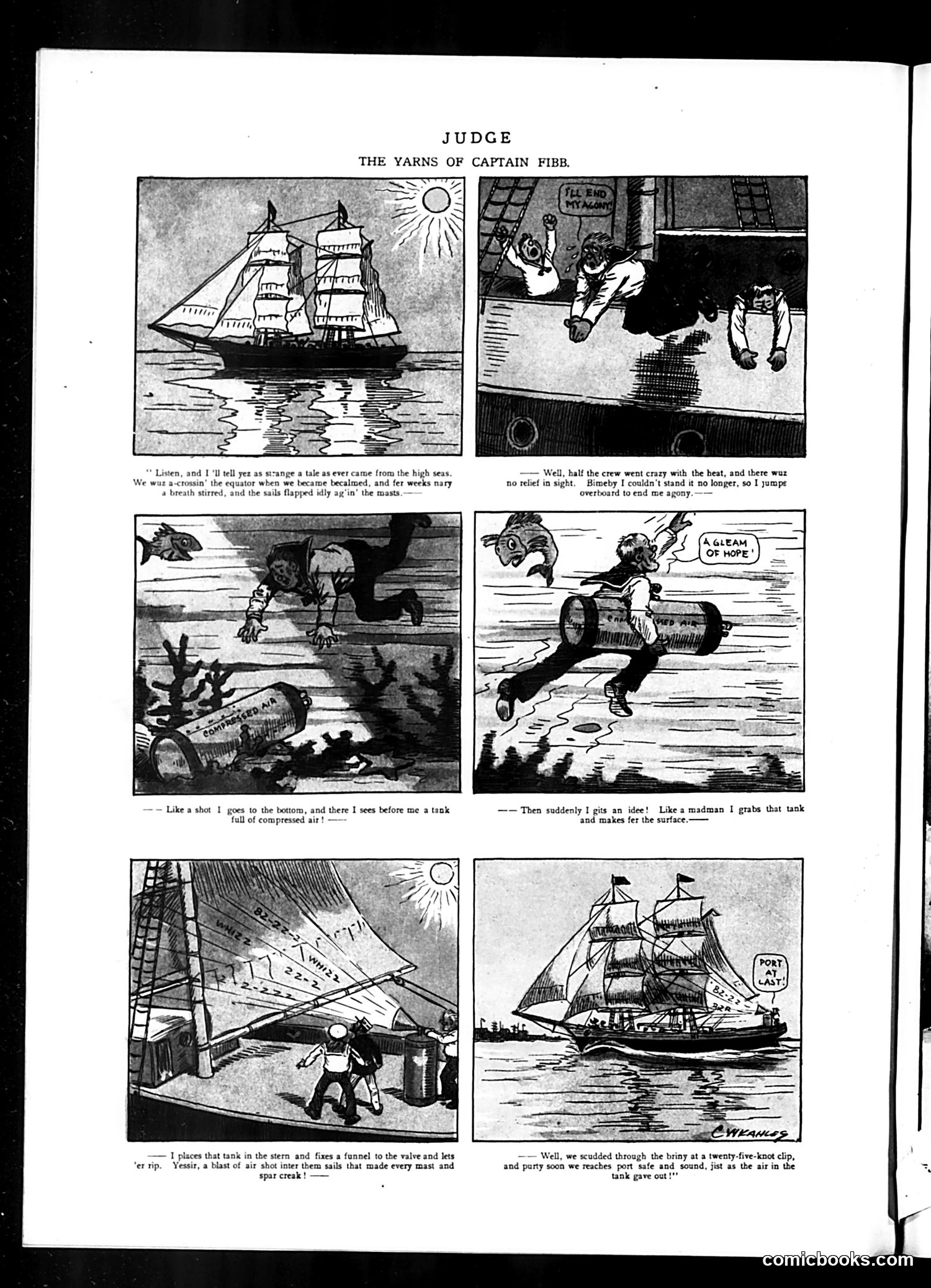
This is a tall-tale comic strip featuring an exaggerated seafaring yarn. Captain Fibb narrates an implausible adventure: his becalmed ship crosses the equator, the crew goes mad from heat, and he jumps overboard seeking relief. Underwater, he discovers a compressed-air tank, grabs it, and uses the air blast to propel the ship at "twenty-five-knot" speed back to port. The humor relies on the absurdity of the premise—the ridiculous logic that a tank of compressed air could both save him from drowning and power an entire ship. This type of exaggerated sailor's tall tale was popular comic fodder in early-20th-century humor magazines. The cartoonist (signed "C. Weaver") depicts each stage of the increasingly implausible story through sequential panels, emphasizing the comedic escalation and the narrator's earnest delivery of obvious nonsense.