
Judge, 1910-07-30 · page 4 of 16
Judge — July 30, 1910 — page 4: what you’re looking at
What you’re looking at
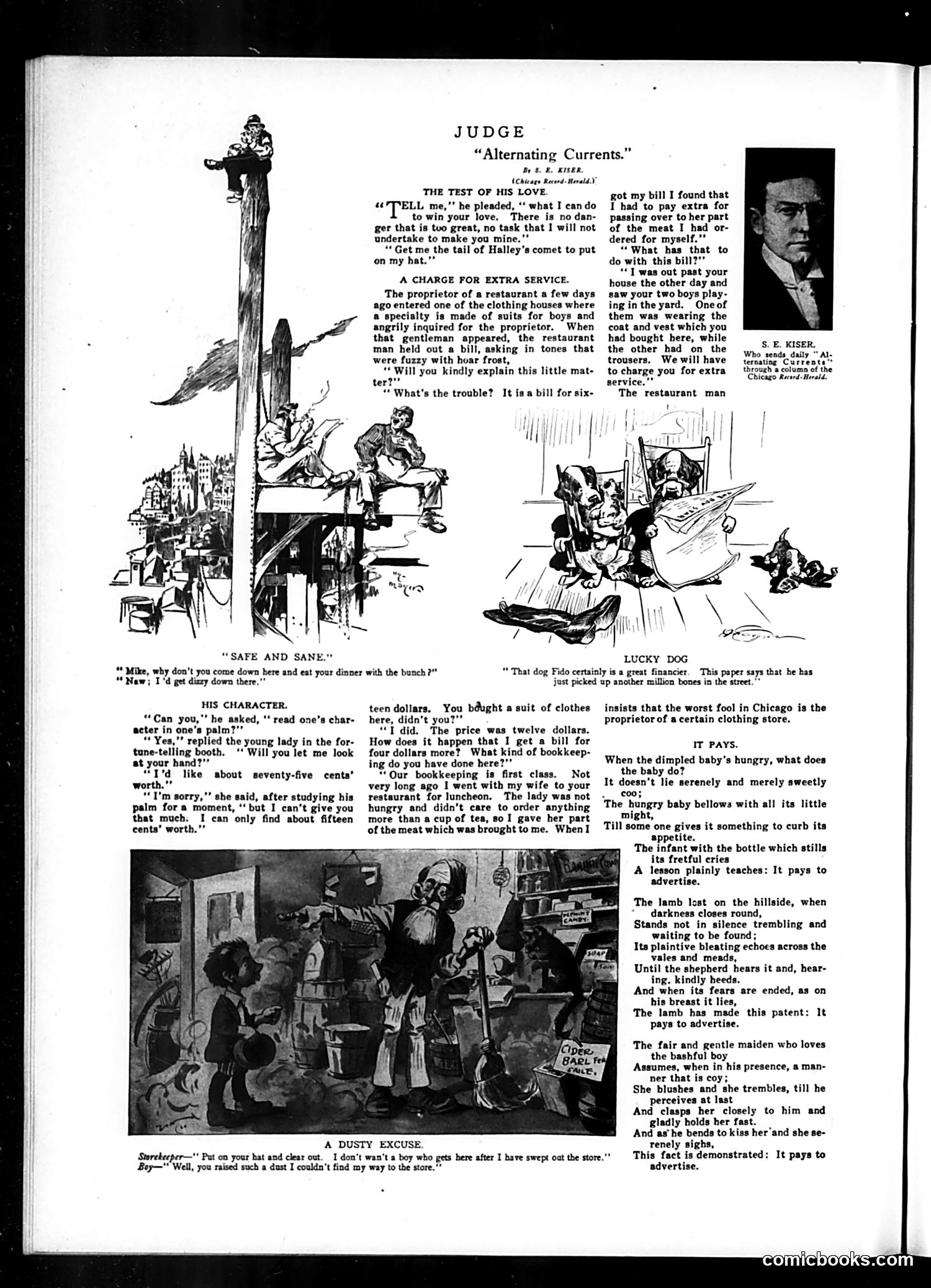
This Judge page contains several short satirical pieces and cartoons mocking everyday consumer situations. "A Charge for Extra Service" ridicules restaurant owners who exploit customers—a proprietor bills a man for an unexplained "extra service" charge, which the customer discovers relates to wearing a coat purchased elsewhere. The satire targets arbitrary fees and merchant dishonesty. Other pieces ("Safe and Sane," "His Character," "Lucky Dog," "A Dusty Excuse") employ similar humor about domestic life, parenting, and social awkwardness. "It Pays" includes verse about advertising's power. The cartoons use simple line drawings and dialogue to expose petty consumer fraud and social hypocrisy—typical Judge fare mocking middle-class life and business practices of the early 20th century.
📄 Transcribed text from this page (OCR, searchable)
Machine-transcribed from the original scan — historical spelling and the odd misread are preserved.
“SAFE AND SANE." JUDGE “Alternating Currents.” By 8. . RISER. (Chicate Record Herald.) THE TEST OF HIS LOVE. (TELL me,” he pleaded, * what I can do to win your love. There is no dan- ger that is tuo great, no task that I will not undertake to make you mine.”* “* Get me the tail of Halley’s comet to put on my hat.’* A CHARGE FOR EXTRA SERVICE. The proprietor of a restaurant a few days o entered one of the clothing houses where pecialty is made of suits for boys and angrily inquired for the proprietor. When that gentleman appeared, the restaurant man held out a bill, asking in tones that were fuzzy with hoar frost, “Will you kindly explain this little mat- ter?” “What's the trouble? It is a bill for six- got my bill I found that T had to pay extra for passing over to her part of the meat I had or- dered for myself.”” “What has that to do with this bill?” “«T was out past your house the other day and saw your two boys play- coat and vest which you had bought here, while the other had on the trousers. We will have to charge you for extra service." The restaurant man S. E. KISER. Who sends daily “ Al ternating Currents through a columa of the Chicago Recerd- Herald. Pia LUCKY DOG “That dog Fido certainly is a great financier. This paper says that he has “ Mike, why don't you come down here and eat your dinner with the bunch ?”” just picked up another million bones in the street “ Naw} I'd get dizzy down there." HIS CHARACTER. “Can you," he asked, ‘ read one’s char- Pi plied the young lady in the for- tune-telling booth. at your hand?” like “Will you let me look about seventy-five cents’ ‘I'm sorry,” she said, after studying his palm for a moment, “‘ but I can’t give you that much. I can only find about fifteen cents’ worth.”” teen dollars, You béught a suit of clothes here, didn’t you?” “I did. The price was twelve dollars. How does it happen that I get a bill for four dollars more? What kind of bookkeep- ing do you have done here?’” “Our bookkeeping is first class. Not very long ago I went with my wife to your restaurant for luncheon. The lady was not hungry and didn’t care to order anything more than a cup of tea, 801 gave her part of the meat which was brought tome. WhenI A DUSTY EXCUSE. Sterekeeper—"' Put on your hat and clear out, I don’t wan't a boy who gets here after I have swept oat the store."” Boy—"" Well, you raised such a dast I couldn't find my way to the store."* insists that the worst fool in Chicago is the proprietor of a certain clothing store. IT Pays. When the dimpled baby’s hungry, what does the baby do? It doesn’t lie serenely and merely sweetly . €003 ‘The hungry baby bellows with all its little might, Till some one gives it something to curb its appetite. The infant with the bottle which stills its fretful cries A lesson plainly teaches: It pays to advertise. The lamb lost on the hillside, when darkness closes round, Stands not in silence trembling and waiting to be found; Its plaintive bleating echoes across the vales and meads, Until the shepherd hears it and, hear- ing. kindly heeds. And when its fea his breast it lies, The lamb has made this patent: It pays to advertise. are ended, as on The fair and gentle maiden who loves the bashful boy Assumes, when in his presence, a man- ner that is coy; id she trembles, till he perceives at last And clasps her closely to him and gladly holds her fast. And ashe bends to kiss her’and she se- renely sighs, This fact is demonstrated: It pays to advertise.